International Journal on Cybernetics & Informatics (IJCI) Vol. 5, No. 2, April 2016
DOI: 10.5121/ijci.2016.5221 193
INFORMATION SATURATION IN MULTISPECTRAL
PIXEL LEVEL IMAGE FUSION
Preema Mole 1
and M Mathurakani2
1
Student in M.Tech, ECE Department, Toc H Institute of Science and Technology,
Ernakulam, India
2
Professor, ECE Department, Toc H Institute of Science and Technology
Formerly Scientist, DRDO, NPOL, Kochi, Ernakulam, India
ABSTRACT
The availability of imaging sensors operating in multiple spectral bands has led to the requirement of
image fusion algorithms that would combine the image from these sensors in an efficient way to give an
image that is more informative as well as perceptible to human eye. Multispectral image fusion is the
process of combining images from different spectral bands that are optically acquired. In this paper, we
used a pixel-level image fusion based on principal component analysis that combines satellite images of the
same scene from seven different spectral bands. The purpose of using principal component analysis
technique is that it is best method for Grayscale image fusion and gives better results. The main aim of
PCA technique is to reduce a large set of variables into a small set which still contains most of the
information that was present in the large set. The paper compares different parameters namely, entropy,
standard deviation, correlation coefficient etc. for different number of images fused from two to seven.
Finally, the paper shows that the information content in an image gets saturated after fusing four images.
KEYWORDS
Multispectral image fusion, pixel-level image fusion, principal component analysis, Grayscale image.
1. INTRODUCTION
The deployment of multiple number of sensors operating in different spectral bands has led to the
availability of multiple data. To educe information from these data there is a need to combine all
data from different sensors. This can be accomplished by image fusion algorithms. Image fusion
is generally defined as the process of combining images of a scene from different spectral bands
into a single composite image which is more informative. This fused image will be suitable for
human vision and computer processing. Image fusion aims at improving the geometric precision,
spatial resolution, classification accuracy and enhance capability of spatial display. The main
objective of image fusion is to Extract all the useful information from different input source
images,Reduce redundancy and improve quality,Eliminate artifacts or any inconsistencies that
distract human observers.
The fusion of multispectral images used in remote sensing and other applications yields better
recognition results since the narrowband images highlights salient features which is sometimes
neglected in captured images. Based on the level of processing where fusion is performed, the
image fusion techniques are classified into three main levels: pixel level, feature level, and
International Journal on Cybernetics & Informatics (IJCI) Vol. 5, No. 2, April 2016
194
decision level. Fusion at pixel level means processing at lowest level based on information
extracted from set of pixels present in the input source images. These information are the
originally measured quantities that are directly involved in the fusion process. The advantage of
using pixel level image fusion is that it is easy to implement, simple and efficient with respect to
time. In feature level, the main idea is to extract the feature sets from each input source images,
and then perform an appropriate fusion rule to generate the fused image. The feature includes
pixel intensities, edges, textures etc. Finally, in decision level fusion involves processing at
highest level. Each classifier applies a threshold on the match score of input source images and
transmits the ensuing decision. Both feature and decision have got a disadvantage that they
generates inaccurate and incomplete transfer of the fused information. But, on the other hand
pixel level improves the content of the final fused image. In recent years, many pixel level image
fusion methods have been proposed. Some of the well known image fusion methods includes
high pass filtering technique, Laplacian pyramid method, weighted average method , IHS
transform-based image fusion, Discrete wavelet transform(DWT), Gradient pyramid, PCA based
fusion, Stationary wavelet transform(SWT), Dual tree complex wavelet transform (DTCWT), etc.
The basic strategy is to perform certain multiscale decomposition on each input source images
and then to combine all this decompositions to achieve one merged representation based on the
fusion rule. Then to this combined representation, the inverse transformation is applied to
construct the final fused image.
1.1. ENTROPY
The entropy feature yields a measure of randomness in the intensity values of an image. This
measure of randomness can be used to characterize the texture of input image. Also entropy
defines the measure of an image’s smoothness in terms of Gray level values. The higher the value
of entropy, higher will be the number of Gray levels and lower the energy.
Entropy is given as: -Ʃ(p*log p) (1)
Where p is the probability associated with the Gray level. For an image, this p is obtained by
dividing number of pixels with Gray level by total number of pixels in an image.
1.2. STANDARD DEVIATION
It is a measure that provides an understanding of the spread intensities across the image.
Standard deviation also indicates the contrast in an image. The contrast of each image is
defined as an unbiased estimate of the standard deviation
It is given as:
SD = ∑ )2
(2)
N -1
Where N is the total number of pixels and µ is the mean. In image processing, standard
deviation can also be taken as an estimate of underlying brightness probability istribution
of an image.
International Journal on Cybernetics & Informatics (IJCI) Vol. 5, No. 2, April 2016
195
1.2. CORRELATION COEFFICIENT
Correlation is an approach that comes from analyzing the displacement between two consecutive
images. To find a characteristic feature from two images, the first image is compared with the
second within a certain search range. Within this range the position of optimum similarity
between two images is found.
Correlation coefficient is defined as the degree of correlation between two images. The value of
this coefficient remains between -1 and +1.
The correlation coefficient between two random variables X and Y with expected values µx and
µy and standard deviation SD, is defined as
r = Cov(X, Y) (3)
SD(X).SD(Y)
2. SURVEY OF RELATED RESEARCH
We examine some of the salient features of related research that has been reported. These works
in image fusion can be traced back to mid eighties. Burt[1] was one of the first to report the use of
Laplacian pyramid techniques. In this method, several copies of images was constructed at
increasing scale, then each copy was convolved with original image. The advantages of this
method was in terms of both computational cost and complexity. In 1985, P.J.Burt et.al and
E.H.Adelson in[2] analysed that the essential problem in image merging is pattern conservation
that must be preserved in composite image. In this paper, authors proposed an approach called
Merging images through pattern decomposition. At about 1988, Alexander Toet et. Al proposed
composite visible/thermal-infrared imaging apparatus[3]. R.D. Lillquist et. al in [4] presented a ,
Composite visible/thermal-infrared imaging apparatus Alexander Toet et al(1989),introduced
ROLP(Ratio Of Low Pass) pyramid method that fits models of the human visual system. In this
approach, judgments on the relative importance of pattern segments were based in their local
luminance contrast values[5]. Alexander Toet et. al in [6], introduced a new approach to image
fusion based on hierarchical image decomposition. This approach produced images that appeared
to be more crispy than the images produced by other linear fusion scheme. H. Li et.al in [7]
presented an image fusion scheme based on wavelet transforms. In this paper, the fusion took
place in different resolution levels and more dominant features at each scale were preserved in the
new multiresolution representation. I. Koren et.al in 1995,proposed a method of image fusion
using steerable dyadic wavelet transform[8], which executed low level fusion on registered
images by the use of steerable dyadic wavelet transform. Shutao Li et.al in [9], proposed pixel
level image fusion algorithm for merging Landsat thematic mapper (TM) images and SPOT
panchromatic images. V.S. Petrovoic et.al in [10] introduced a novel approach to multi resolution
signal level image fusion for accurately transferring visual information from any number of input
image signals, into a single fused image without the loss of information or the introduction of
distortion. This new Gradient fusion reduced the amount of distortion, artifacts and the loss of
contrast information. V.Tsagaris et.al in 2005 came up with the method based on partitioning the
hyperspectral data into subgroups of bands[11]. V. Tsagaris and V. Anastassopoulos proposed
International Journal on Cybernetics & Informatics (IJCI) Vol. 5, No. 2, April 2016
196
Multispectral image fusion for improved RGB representation based on perceptual attributes in
[12]. Q. Du, N. Raksuntorn, S. Cai, and R. J. Moorhead, et al in 2008, investigated RGB colour
composition schemes for hyperspectral imagery. In their paper, they proposed to display the
useful information as distinctively as possible for high-class seperability. The work also
demonstrated that the use of data processing step can significantly improve the quality of colour
display, whereas data classification generally outperforms data transformation, although the
implementation is more complicated [13].
3. IMAGE FUSION ALGORITHM
There are various methods that have been developed to perform image fusion. The method
focussed in this paper is principal component analysis. In this section, the necessary background
for vector representation of multidimensional remotely sensed data is provided. Also, the
introduction to Principal Component Analysis (PCA) and the basic principles of pixel level fusion
method are also provided.
3.1. PRINCIPAL COMPONENT ANALYSIS
Principal Component Analysis has been called as one of the most valuable results from applied
Linear algebra. It is a mathematical procedure that transforms a number of correlated variables
into a number of uncorrelated variables called principal components. These components captures
as much of variance in data as possible. PCA provides an efficient way to reduce the
dimensionality (for e.g. 10 dimensional data to 2 dimensional data). The principal component is
taken to be along the direction with the maximum variance. The second principal component will
be orthogonal to the first. The third principal component is taken in the maximum variance
direction in the subspace perpendicular to the first two and so on. The PCA is also known as
Karhunen-Loeve transform or the Hotelling transform.
3.2. MULTIDIMENSIONAL SPACE VECTOR REPRESENTATION AND DIMENSIONALITY
REDUCTION
The properties of multispectral data set with K different channels and MxN number of pixels per
channel can be examined if each pixel is described by a vector whose components are individual
spectral responses to each multispectral channel.
X = [X1,X2,X3,……….X k]T
(4)
The mean for this vector is given by,
= E[X] =1/M.N ∑ i (5)
This mean vector defines the average position of the pixel in vector space, while the covariance
matrix describes their scatter.
Cx = 1/ M.N ∑ iXi
T
- T
(6)
International Journal on Cybernetics & Informatics (IJCI) Vol. 5, No. 2, April 2016
197
The covariance matrix is used to measure the correlation between multispectral band images. In
case if there is high degree f correlation between multispectral band images, the corresponding
off-diagonal elements in the covariance matrix will be large. The correlation between different
multispectral images can also be described by means of correlation coefficient. The correlation
coefficient r is related to covariance matrix as covariance matrix divided by the standard
deviation of corresponding multispectral components. ie r=Cij/ SD(i).SD(j) . According to the
property of covariance matrix, Cx will be symmetric and all diagonal elements will be 1.
Among several linear transformations, Karhunen-Loeve also known as Principal Component
Analysis is an important one. For this transform the covariance matrix is real and symmetric
thereby making it possible to find a set of orthonormal eigen values and corresponding eigen
vectors. Let ei and λi for i =1, 2,……K (where K is the number of multispectral band images) be
the eigen vectors and corresponding eigen values of Cx arranged in descending order. Next an
another matrix A is formed in such a way that the rows of A are formed by the eigen vectors of
Cx corresponding to largest eigen value and last row of A with the eigen vectors corresponding to
the smallest eigen value. Thus this matrix is known as the transformation matrix that maps vector
X into Y
Y= AT
(X - X) (7)
From this transformation, the mean of Y will result in zero and covariance matrix for Y is given
as,
Cy= ACxAT
(8)
The resulting covariance matrix Cy will be the diagonal matrix and the elements along the main
diagonal will be the eigen values of Cx . The value zero in the off-diagonal elements of the matrix
denotes that the vector population Y are uncorrelated. This transformation will establish a new
coordinate system whose origin is at the centroid of the population and the axes are in the
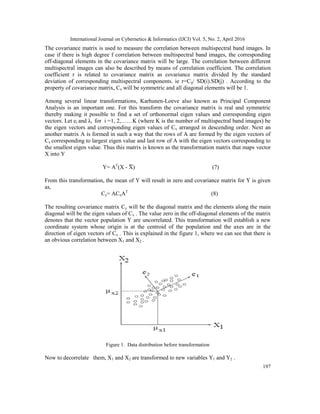
direction of eigen vectors of Cx . This is explained in the figure 1, where we can see that there is
an obvious correlation between X1 and X2 .
Figure 1. Data distribution before transformation
Now to decorrelate them, X1 and X2 are transformed to new variables Y1 and Y2 .
International Journal on Cybernetics & Informatics (IJCI) Vol. 5, No. 2, April 2016
198
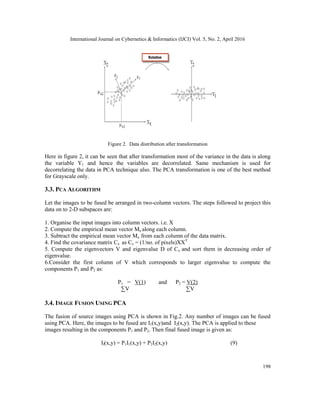
Figure 2. Data distribution after transformation
Here in figure 2, it can be seen that after transformation most of the variance in the data is along
the variable Y1 and hence the variables are decorrelated. Same mechanism is used for
decorrelating the data in PCA technique also. The PCA transformation is one of the best method
for Grayscale only.
3.3. PCA ALGORITHM
Let the images to be fused be arranged in two-column vectors. The steps followed to project this
data on to 2-D subspaces are:
1. Organise the input images into column vectors. i.e. X
2. Compute the empirical mean vector Me along each column.
3. Subtract the empirical mean vector Me from each column of the data matrix.
4. Find the covariance matrix Cx as Cx = (1/no. of pixels)XXT
5. Compute the eigenvectors V and eigenvalue D of Cx and sort them in decreasing order of
eigenvalue.
6.Consider the first column of V which corresponds to larger eigenvalue to compute the
components P1 and P2 as:
P1 = V(1) and P2 = V(2)
∑V ∑V
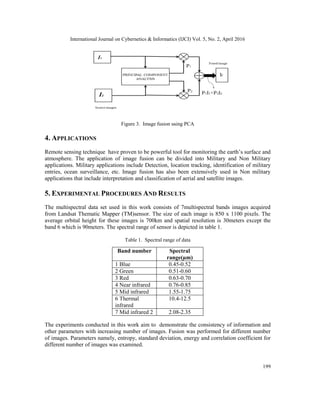
3.4. IMAGE FUSION USING PCA
The fusion of source images using PCA is shown in Fig.2. Any number of images can be fused
using PCA. Here, the images to be fused are I1(x,y)and I2(x,y). The PCA is applied to these
images resulting in the components P1 and P2. Then final fused image is given as:
If(x,y) = P1I1(x,y) + P2I2(x,y) (9)
International Journal on Cybernetics & Informatics (IJCI) Vol. 5, No. 2, April 2016
199
Figure 3. Image fusion using PCA
4. APPLICATIONS
Remote sensing technique have proven to be powerful tool for monitoring the earth’s surface and
atmosphere. The application of image fusion can be divided into Military and Non Military
applications. Military applications include Detection, location tracking, identification of military
entries, ocean surveillance, etc. Image fusion has also been extensively used in Non military
applications that include interpretation and classification of aerial and satellite images.
5. EXPERIMENTAL PROCEDURES AND RESULTS
The multispectral data set used in this work consists of 7multispectral bands images acquired
from Landsat Thematic Mapper (TM)sensor. The size of each image is 850 x 1100 pixels. The
average orbital height for these images is 700km and spatial resolution is 30meters except the
band 6 which is 90meters. The spectral range of sensor is depicted in table 1.
Table 1. Spectral range of data
The experiments conducted in this work aim to demonstrate the consistency of information and
other parameters with increasing number of images. Fusion was performed for different number
of images. Parameters namely, entropy, standard deviation, energy and correlation coefficient for
different number of images was examined.
Band number Spectral
range(µm)
1 Blue 0.45-0.52
2 Green 0.51-0.60
3 Red 0.63-0.70
4 Near infrared 0.76-0.85
5 Mid infrared 1.55-1.75
6 Thermal
infrared
10.4-12.5
7 Mid infrared 2 2.08-2.35
International Journal on Cybernetics & Informatics (IJCI) Vol. 5, No. 2, April 2016
200
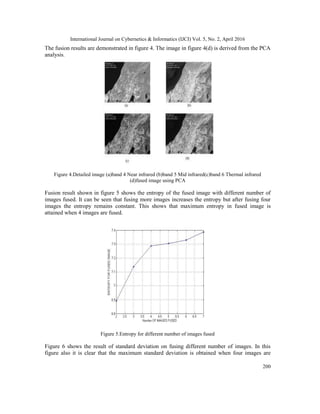
The fusion results are demonstrated in figure 4. The image in figure 4(d) is derived from the PCA
analysis.
Figure 4.Detailed image (a)band 4 Near infrared (b)band 5 Mid infrared(c)band 6 Thermal infrared
(d)fused image using PCA
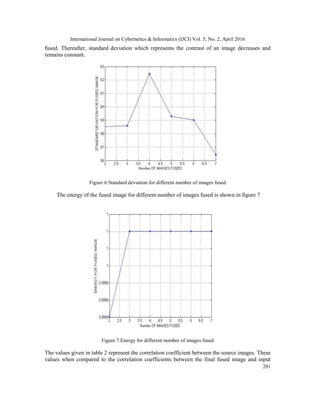
Fusion result shown in figure 5 shows the entropy of the fused image with different number of
images fused. It can be seen that fusing more images increases the entropy but after fusing four
images the entropy remains constant. This shows that maximum entropy in fused image is
attained when 4 images are fused.
Figure 5.Entropy for different number of images fused
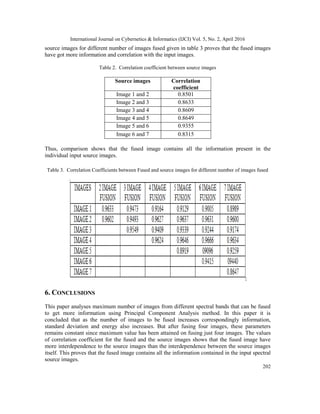
Figure 6 shows the result of standard deviation on fusing different number of images. In this
figure also it is clear that the maximum standard deviation is obtained when four images are
International Journal on Cybernetics & Informatics (IJCI) Vol. 5, No. 2, April 2016
201
fused. Thereafter, standard deviation which represents the contrast of an image decreases and
remains constant.
Figure 6.Standard deviation for different number of images fused
The energy of the fused image for different number of images fused is shown in figure 7
Figure 7.Energy for different number of images fused
The values given in table 2 represent the correlation coefficient between the source images. These
values when compared to the correlation coefficients between the final fused image and input
International Journal on Cybernetics & Informatics (IJCI) Vol. 5, No. 2, April 2016
202
source images for different number of images fused given in table 3 proves that the fused images
have got more information and correlation with the input images.
Table 2. Correlation coefficient between source images
Source images Correlation
coefficient
Image 1 and 2 0.8501
Image 2 and 3 0.8633
Image 3 and 4 0.8609
Image 4 and 5 0.8649
Image 5 and 6 0.9355
Image 6 and 7 0.8315
Thus, comparison shows that the fused image contains all the information present in the
individual input source images.
Table 3. Correlation Coefficients between Fused and source images for different number of images fused
6. CONCLUSIONS
This paper analyses maximum number of images from different spectral bands that can be fused
to get more information using Principal Component Analysis method. In this paper it is
concluded that as the number of images to be fused increases correspondingly information,
standard deviation and energy also increases. But after fusing four images, these parameters
remains constant since maximum value has been attained on fusing just four images. The values
of correlation coefficient for the fused and the source images shows that the fused image have
more interdependence to the source images than the interdependence between the source images
itself. This proves that the fused image contains all the information contained in the input spectral
source images.
International Journal on Cybernetics & Informatics (IJCI) Vol. 5, No. 2, April 2016
203
REFERENCES
[1] P.J. Burt, The pyramid as a structure for efficient computation, in: A.Rosenfeld (Ed.), Multiresolution
Image Processing and Analysis,Springer-Verlag, Berlin, 1984, pp. 635.
[2] P.J. Burt, E.H. Adelson, Merging images through pattern decomposition,Proc. SPIE 575 (1985)
173181.
[3] E.H. Adelson, Depth-of-Focus Imaging Process Method, United States Patent 4,661,986 (1987).
[4] R.D. Lillquist, Composite visible/thermal-infrared imaging apparatus,United States Patent 4,751,571
(1988).
[5] A.Toet, Image fusion by a ratio of low-pass pyramid, Pattern Recognition Letters 9 (4) (1989)
245253.
[6] A.Toet, Hierarchical image fusion, Machine Vision and Applications 3 (1990) 111.
[7] H. Li, S. Manjunath, S. Mitra, Multisensor image fusion using the wavelet transform, Graphical
Models and Image Processing 57 (3) (1995) 235245.
[8] I. Koren, A. Laine, F. Taylor, Image fusion using steerable dyadic wavelet transform, in: Proceedings
of the International Conference on Image Processing, Washington, DC, USA, 1995, pp. 232235.
[9] S. Li, J.T. Kwok, Y. Wang, Using the discrete wavelet frame transform to merge Landsat TM and
SPOT panchromatic images, Information Fusion 3 (2002) 1723.
[10] V.S. Petrovic, C.S. Xydeas, Gradient-based multiresolution image fusion, IEEE Transactions on
Image Processing 13 (2) (2004) 228237
[11] V. Tsagaris, V. Anastassopoulos, and G. Lampropoulos, Fusion of hyperspectral data using
segmented PCT for enhanced color representation, IEEE Trans. Geosci. Remote Sens., vol. 43, no.
10, pp. 23652375,Oct.2005.
[12] V. Tsagaris and V. Anastassopoulos, Multispectral image fusion for improved RGB representation
based on perceptual attributes, Int. J.Remote Sens., vol. 26, no. 15, pp. 32413254, Aug. 2005.
[13] Q. Du, N. Raksuntorn, S. Cai, and R. J. Moorhead, Color display for hyperspectral imagery, IEEE
Trans. Geosci. Remote Sens., vol. 46, no. 6,pp. 18581866, Jun. 2008.
AUTHORS
Preema Mole has graduated from Sree Narayana Gurukulam College of Engineering of
Mahatma Gandhi University in Electronics & Communication Engineering in 2013. She is
currently pursuing her M.Tech Degree in Wireless Technology from Toc H Institute of
Science & Technology, Arakunnam. Her research interest includes Signal Processing and
Image Processing.
M. Mathurakani has graduated from Alagappa Chettiar College of Engineering and
Technology of Madurai University and completed his masters from PSG college of
Technology of Madras University. He has worked as a Scientist in Defence Research and
development organization (DRDO) in the area of signal processing and embedded system
design and implementation. He was honoured with the DRDO Scientist of the year award in
2003.Currently he is a professor in Toc H Institute of Science and Technology, Arakunnam.
His area of research interest includes signal processing algorithms, embedded system modeling and
synthesis, reusable software architectures and MIMO and OFDM based communication systems.

INFORMATION SATURATION IN MULTISPECTRAL PIXEL LEVEL IMAGE FUSION

  • 1.
    International Journal onCybernetics & Informatics (IJCI) Vol. 5, No. 2, April 2016 DOI: 10.5121/ijci.2016.5221 193 INFORMATION SATURATION IN MULTISPECTRAL PIXEL LEVEL IMAGE FUSION Preema Mole 1 and M Mathurakani2 1 Student in M.Tech, ECE Department, Toc H Institute of Science and Technology, Ernakulam, India 2 Professor, ECE Department, Toc H Institute of Science and Technology Formerly Scientist, DRDO, NPOL, Kochi, Ernakulam, India ABSTRACT The availability of imaging sensors operating in multiple spectral bands has led to the requirement of image fusion algorithms that would combine the image from these sensors in an efficient way to give an image that is more informative as well as perceptible to human eye. Multispectral image fusion is the process of combining images from different spectral bands that are optically acquired. In this paper, we used a pixel-level image fusion based on principal component analysis that combines satellite images of the same scene from seven different spectral bands. The purpose of using principal component analysis technique is that it is best method for Grayscale image fusion and gives better results. The main aim of PCA technique is to reduce a large set of variables into a small set which still contains most of the information that was present in the large set. The paper compares different parameters namely, entropy, standard deviation, correlation coefficient etc. for different number of images fused from two to seven. Finally, the paper shows that the information content in an image gets saturated after fusing four images. KEYWORDS Multispectral image fusion, pixel-level image fusion, principal component analysis, Grayscale image. 1. INTRODUCTION The deployment of multiple number of sensors operating in different spectral bands has led to the availability of multiple data. To educe information from these data there is a need to combine all data from different sensors. This can be accomplished by image fusion algorithms. Image fusion is generally defined as the process of combining images of a scene from different spectral bands into a single composite image which is more informative. This fused image will be suitable for human vision and computer processing. Image fusion aims at improving the geometric precision, spatial resolution, classification accuracy and enhance capability of spatial display. The main objective of image fusion is to Extract all the useful information from different input source images,Reduce redundancy and improve quality,Eliminate artifacts or any inconsistencies that distract human observers. The fusion of multispectral images used in remote sensing and other applications yields better recognition results since the narrowband images highlights salient features which is sometimes neglected in captured images. Based on the level of processing where fusion is performed, the image fusion techniques are classified into three main levels: pixel level, feature level, and
  • 2.
    International Journal onCybernetics & Informatics (IJCI) Vol. 5, No. 2, April 2016 194 decision level. Fusion at pixel level means processing at lowest level based on information extracted from set of pixels present in the input source images. These information are the originally measured quantities that are directly involved in the fusion process. The advantage of using pixel level image fusion is that it is easy to implement, simple and efficient with respect to time. In feature level, the main idea is to extract the feature sets from each input source images, and then perform an appropriate fusion rule to generate the fused image. The feature includes pixel intensities, edges, textures etc. Finally, in decision level fusion involves processing at highest level. Each classifier applies a threshold on the match score of input source images and transmits the ensuing decision. Both feature and decision have got a disadvantage that they generates inaccurate and incomplete transfer of the fused information. But, on the other hand pixel level improves the content of the final fused image. In recent years, many pixel level image fusion methods have been proposed. Some of the well known image fusion methods includes high pass filtering technique, Laplacian pyramid method, weighted average method , IHS transform-based image fusion, Discrete wavelet transform(DWT), Gradient pyramid, PCA based fusion, Stationary wavelet transform(SWT), Dual tree complex wavelet transform (DTCWT), etc. The basic strategy is to perform certain multiscale decomposition on each input source images and then to combine all this decompositions to achieve one merged representation based on the fusion rule. Then to this combined representation, the inverse transformation is applied to construct the final fused image. 1.1. ENTROPY The entropy feature yields a measure of randomness in the intensity values of an image. This measure of randomness can be used to characterize the texture of input image. Also entropy defines the measure of an image’s smoothness in terms of Gray level values. The higher the value of entropy, higher will be the number of Gray levels and lower the energy. Entropy is given as: -Ʃ(p*log p) (1) Where p is the probability associated with the Gray level. For an image, this p is obtained by dividing number of pixels with Gray level by total number of pixels in an image. 1.2. STANDARD DEVIATION It is a measure that provides an understanding of the spread intensities across the image. Standard deviation also indicates the contrast in an image. The contrast of each image is defined as an unbiased estimate of the standard deviation It is given as: SD = ∑ )2 (2) N -1 Where N is the total number of pixels and µ is the mean. In image processing, standard deviation can also be taken as an estimate of underlying brightness probability istribution of an image.
  • 3.
    International Journal onCybernetics & Informatics (IJCI) Vol. 5, No. 2, April 2016 195 1.2. CORRELATION COEFFICIENT Correlation is an approach that comes from analyzing the displacement between two consecutive images. To find a characteristic feature from two images, the first image is compared with the second within a certain search range. Within this range the position of optimum similarity between two images is found. Correlation coefficient is defined as the degree of correlation between two images. The value of this coefficient remains between -1 and +1. The correlation coefficient between two random variables X and Y with expected values µx and µy and standard deviation SD, is defined as r = Cov(X, Y) (3) SD(X).SD(Y) 2. SURVEY OF RELATED RESEARCH We examine some of the salient features of related research that has been reported. These works in image fusion can be traced back to mid eighties. Burt[1] was one of the first to report the use of Laplacian pyramid techniques. In this method, several copies of images was constructed at increasing scale, then each copy was convolved with original image. The advantages of this method was in terms of both computational cost and complexity. In 1985, P.J.Burt et.al and E.H.Adelson in[2] analysed that the essential problem in image merging is pattern conservation that must be preserved in composite image. In this paper, authors proposed an approach called Merging images through pattern decomposition. At about 1988, Alexander Toet et. Al proposed composite visible/thermal-infrared imaging apparatus[3]. R.D. Lillquist et. al in [4] presented a , Composite visible/thermal-infrared imaging apparatus Alexander Toet et al(1989),introduced ROLP(Ratio Of Low Pass) pyramid method that fits models of the human visual system. In this approach, judgments on the relative importance of pattern segments were based in their local luminance contrast values[5]. Alexander Toet et. al in [6], introduced a new approach to image fusion based on hierarchical image decomposition. This approach produced images that appeared to be more crispy than the images produced by other linear fusion scheme. H. Li et.al in [7] presented an image fusion scheme based on wavelet transforms. In this paper, the fusion took place in different resolution levels and more dominant features at each scale were preserved in the new multiresolution representation. I. Koren et.al in 1995,proposed a method of image fusion using steerable dyadic wavelet transform[8], which executed low level fusion on registered images by the use of steerable dyadic wavelet transform. Shutao Li et.al in [9], proposed pixel level image fusion algorithm for merging Landsat thematic mapper (TM) images and SPOT panchromatic images. V.S. Petrovoic et.al in [10] introduced a novel approach to multi resolution signal level image fusion for accurately transferring visual information from any number of input image signals, into a single fused image without the loss of information or the introduction of distortion. This new Gradient fusion reduced the amount of distortion, artifacts and the loss of contrast information. V.Tsagaris et.al in 2005 came up with the method based on partitioning the hyperspectral data into subgroups of bands[11]. V. Tsagaris and V. Anastassopoulos proposed
  • 4.
    International Journal onCybernetics & Informatics (IJCI) Vol. 5, No. 2, April 2016 196 Multispectral image fusion for improved RGB representation based on perceptual attributes in [12]. Q. Du, N. Raksuntorn, S. Cai, and R. J. Moorhead, et al in 2008, investigated RGB colour composition schemes for hyperspectral imagery. In their paper, they proposed to display the useful information as distinctively as possible for high-class seperability. The work also demonstrated that the use of data processing step can significantly improve the quality of colour display, whereas data classification generally outperforms data transformation, although the implementation is more complicated [13]. 3. IMAGE FUSION ALGORITHM There are various methods that have been developed to perform image fusion. The method focussed in this paper is principal component analysis. In this section, the necessary background for vector representation of multidimensional remotely sensed data is provided. Also, the introduction to Principal Component Analysis (PCA) and the basic principles of pixel level fusion method are also provided. 3.1. PRINCIPAL COMPONENT ANALYSIS Principal Component Analysis has been called as one of the most valuable results from applied Linear algebra. It is a mathematical procedure that transforms a number of correlated variables into a number of uncorrelated variables called principal components. These components captures as much of variance in data as possible. PCA provides an efficient way to reduce the dimensionality (for e.g. 10 dimensional data to 2 dimensional data). The principal component is taken to be along the direction with the maximum variance. The second principal component will be orthogonal to the first. The third principal component is taken in the maximum variance direction in the subspace perpendicular to the first two and so on. The PCA is also known as Karhunen-Loeve transform or the Hotelling transform. 3.2. MULTIDIMENSIONAL SPACE VECTOR REPRESENTATION AND DIMENSIONALITY REDUCTION The properties of multispectral data set with K different channels and MxN number of pixels per channel can be examined if each pixel is described by a vector whose components are individual spectral responses to each multispectral channel. X = [X1,X2,X3,……….X k]T (4) The mean for this vector is given by, = E[X] =1/M.N ∑ i (5) This mean vector defines the average position of the pixel in vector space, while the covariance matrix describes their scatter. Cx = 1/ M.N ∑ iXi T - T (6)
  • 5.
    International Journal onCybernetics & Informatics (IJCI) Vol. 5, No. 2, April 2016 197 The covariance matrix is used to measure the correlation between multispectral band images. In case if there is high degree f correlation between multispectral band images, the corresponding off-diagonal elements in the covariance matrix will be large. The correlation between different multispectral images can also be described by means of correlation coefficient. The correlation coefficient r is related to covariance matrix as covariance matrix divided by the standard deviation of corresponding multispectral components. ie r=Cij/ SD(i).SD(j) . According to the property of covariance matrix, Cx will be symmetric and all diagonal elements will be 1. Among several linear transformations, Karhunen-Loeve also known as Principal Component Analysis is an important one. For this transform the covariance matrix is real and symmetric thereby making it possible to find a set of orthonormal eigen values and corresponding eigen vectors. Let ei and λi for i =1, 2,……K (where K is the number of multispectral band images) be the eigen vectors and corresponding eigen values of Cx arranged in descending order. Next an another matrix A is formed in such a way that the rows of A are formed by the eigen vectors of Cx corresponding to largest eigen value and last row of A with the eigen vectors corresponding to the smallest eigen value. Thus this matrix is known as the transformation matrix that maps vector X into Y Y= AT (X - X) (7) From this transformation, the mean of Y will result in zero and covariance matrix for Y is given as, Cy= ACxAT (8) The resulting covariance matrix Cy will be the diagonal matrix and the elements along the main diagonal will be the eigen values of Cx . The value zero in the off-diagonal elements of the matrix denotes that the vector population Y are uncorrelated. This transformation will establish a new coordinate system whose origin is at the centroid of the population and the axes are in the direction of eigen vectors of Cx . This is explained in the figure 1, where we can see that there is an obvious correlation between X1 and X2 . Figure 1. Data distribution before transformation Now to decorrelate them, X1 and X2 are transformed to new variables Y1 and Y2 .
  • 6.
    International Journal onCybernetics & Informatics (IJCI) Vol. 5, No. 2, April 2016 198 Figure 2. Data distribution after transformation Here in figure 2, it can be seen that after transformation most of the variance in the data is along the variable Y1 and hence the variables are decorrelated. Same mechanism is used for decorrelating the data in PCA technique also. The PCA transformation is one of the best method for Grayscale only. 3.3. PCA ALGORITHM Let the images to be fused be arranged in two-column vectors. The steps followed to project this data on to 2-D subspaces are: 1. Organise the input images into column vectors. i.e. X 2. Compute the empirical mean vector Me along each column. 3. Subtract the empirical mean vector Me from each column of the data matrix. 4. Find the covariance matrix Cx as Cx = (1/no. of pixels)XXT 5. Compute the eigenvectors V and eigenvalue D of Cx and sort them in decreasing order of eigenvalue. 6.Consider the first column of V which corresponds to larger eigenvalue to compute the components P1 and P2 as: P1 = V(1) and P2 = V(2) ∑V ∑V 3.4. IMAGE FUSION USING PCA The fusion of source images using PCA is shown in Fig.2. Any number of images can be fused using PCA. Here, the images to be fused are I1(x,y)and I2(x,y). The PCA is applied to these images resulting in the components P1 and P2. Then final fused image is given as: If(x,y) = P1I1(x,y) + P2I2(x,y) (9)
  • 7.
    International Journal onCybernetics & Informatics (IJCI) Vol. 5, No. 2, April 2016 199 Figure 3. Image fusion using PCA 4. APPLICATIONS Remote sensing technique have proven to be powerful tool for monitoring the earth’s surface and atmosphere. The application of image fusion can be divided into Military and Non Military applications. Military applications include Detection, location tracking, identification of military entries, ocean surveillance, etc. Image fusion has also been extensively used in Non military applications that include interpretation and classification of aerial and satellite images. 5. EXPERIMENTAL PROCEDURES AND RESULTS The multispectral data set used in this work consists of 7multispectral bands images acquired from Landsat Thematic Mapper (TM)sensor. The size of each image is 850 x 1100 pixels. The average orbital height for these images is 700km and spatial resolution is 30meters except the band 6 which is 90meters. The spectral range of sensor is depicted in table 1. Table 1. Spectral range of data The experiments conducted in this work aim to demonstrate the consistency of information and other parameters with increasing number of images. Fusion was performed for different number of images. Parameters namely, entropy, standard deviation, energy and correlation coefficient for different number of images was examined. Band number Spectral range(µm) 1 Blue 0.45-0.52 2 Green 0.51-0.60 3 Red 0.63-0.70 4 Near infrared 0.76-0.85 5 Mid infrared 1.55-1.75 6 Thermal infrared 10.4-12.5 7 Mid infrared 2 2.08-2.35
  • 8.
    International Journal onCybernetics & Informatics (IJCI) Vol. 5, No. 2, April 2016 200 The fusion results are demonstrated in figure 4. The image in figure 4(d) is derived from the PCA analysis. Figure 4.Detailed image (a)band 4 Near infrared (b)band 5 Mid infrared(c)band 6 Thermal infrared (d)fused image using PCA Fusion result shown in figure 5 shows the entropy of the fused image with different number of images fused. It can be seen that fusing more images increases the entropy but after fusing four images the entropy remains constant. This shows that maximum entropy in fused image is attained when 4 images are fused. Figure 5.Entropy for different number of images fused Figure 6 shows the result of standard deviation on fusing different number of images. In this figure also it is clear that the maximum standard deviation is obtained when four images are
  • 9.
    International Journal onCybernetics & Informatics (IJCI) Vol. 5, No. 2, April 2016 201 fused. Thereafter, standard deviation which represents the contrast of an image decreases and remains constant. Figure 6.Standard deviation for different number of images fused The energy of the fused image for different number of images fused is shown in figure 7 Figure 7.Energy for different number of images fused The values given in table 2 represent the correlation coefficient between the source images. These values when compared to the correlation coefficients between the final fused image and input
  • 10.
    International Journal onCybernetics & Informatics (IJCI) Vol. 5, No. 2, April 2016 202 source images for different number of images fused given in table 3 proves that the fused images have got more information and correlation with the input images. Table 2. Correlation coefficient between source images Source images Correlation coefficient Image 1 and 2 0.8501 Image 2 and 3 0.8633 Image 3 and 4 0.8609 Image 4 and 5 0.8649 Image 5 and 6 0.9355 Image 6 and 7 0.8315 Thus, comparison shows that the fused image contains all the information present in the individual input source images. Table 3. Correlation Coefficients between Fused and source images for different number of images fused 6. CONCLUSIONS This paper analyses maximum number of images from different spectral bands that can be fused to get more information using Principal Component Analysis method. In this paper it is concluded that as the number of images to be fused increases correspondingly information, standard deviation and energy also increases. But after fusing four images, these parameters remains constant since maximum value has been attained on fusing just four images. The values of correlation coefficient for the fused and the source images shows that the fused image have more interdependence to the source images than the interdependence between the source images itself. This proves that the fused image contains all the information contained in the input spectral source images.
  • 11.
    International Journal onCybernetics & Informatics (IJCI) Vol. 5, No. 2, April 2016 203 REFERENCES [1] P.J. Burt, The pyramid as a structure for efficient computation, in: A.Rosenfeld (Ed.), Multiresolution Image Processing and Analysis,Springer-Verlag, Berlin, 1984, pp. 635. [2] P.J. Burt, E.H. Adelson, Merging images through pattern decomposition,Proc. SPIE 575 (1985) 173181. [3] E.H. Adelson, Depth-of-Focus Imaging Process Method, United States Patent 4,661,986 (1987). [4] R.D. Lillquist, Composite visible/thermal-infrared imaging apparatus,United States Patent 4,751,571 (1988). [5] A.Toet, Image fusion by a ratio of low-pass pyramid, Pattern Recognition Letters 9 (4) (1989) 245253. [6] A.Toet, Hierarchical image fusion, Machine Vision and Applications 3 (1990) 111. [7] H. Li, S. Manjunath, S. Mitra, Multisensor image fusion using the wavelet transform, Graphical Models and Image Processing 57 (3) (1995) 235245. [8] I. Koren, A. Laine, F. Taylor, Image fusion using steerable dyadic wavelet transform, in: Proceedings of the International Conference on Image Processing, Washington, DC, USA, 1995, pp. 232235. [9] S. Li, J.T. Kwok, Y. Wang, Using the discrete wavelet frame transform to merge Landsat TM and SPOT panchromatic images, Information Fusion 3 (2002) 1723. [10] V.S. Petrovic, C.S. Xydeas, Gradient-based multiresolution image fusion, IEEE Transactions on Image Processing 13 (2) (2004) 228237 [11] V. Tsagaris, V. Anastassopoulos, and G. Lampropoulos, Fusion of hyperspectral data using segmented PCT for enhanced color representation, IEEE Trans. Geosci. Remote Sens., vol. 43, no. 10, pp. 23652375,Oct.2005. [12] V. Tsagaris and V. Anastassopoulos, Multispectral image fusion for improved RGB representation based on perceptual attributes, Int. J.Remote Sens., vol. 26, no. 15, pp. 32413254, Aug. 2005. [13] Q. Du, N. Raksuntorn, S. Cai, and R. J. Moorhead, Color display for hyperspectral imagery, IEEE Trans. Geosci. Remote Sens., vol. 46, no. 6,pp. 18581866, Jun. 2008. AUTHORS Preema Mole has graduated from Sree Narayana Gurukulam College of Engineering of Mahatma Gandhi University in Electronics & Communication Engineering in 2013. She is currently pursuing her M.Tech Degree in Wireless Technology from Toc H Institute of Science & Technology, Arakunnam. Her research interest includes Signal Processing and Image Processing. M. Mathurakani has graduated from Alagappa Chettiar College of Engineering and Technology of Madurai University and completed his masters from PSG college of Technology of Madras University. He has worked as a Scientist in Defence Research and development organization (DRDO) in the area of signal processing and embedded system design and implementation. He was honoured with the DRDO Scientist of the year award in 2003.Currently he is a professor in Toc H Institute of Science and Technology, Arakunnam. His area of research interest includes signal processing algorithms, embedded system modeling and synthesis, reusable software architectures and MIMO and OFDM based communication systems.