CHAPTER6
IMAGE ENHANCEMENT
Dr. Varun Kumar Ojha
and
Prof. (Dr.) Paramartha Dutta
Visva Bharati University
Santiniketan, West Bengal, India
Image Enhancement
 Necessity of Image Enhancement
 Spatial Domain Operation
 Frequency Domain Operation
Back to Course Content Page
Click Here
Image Enhancement
 Image Enhancement: It is processing of
enhancement of certain feature of image
 Removal of noise
 Increasing contrast for a dark image etc.
 Choice of image enhancement technique are vary
from problem to problem
 i.e. Best technique fro enhancement of X-Ray
image may not be suitable for enhancement of
microscopic images.
Image Enhancement
 There are two image enhancement technique
 Spatial Domain Technique
 Work on image plane itself
 Discrete manipulation of pixels in an image
 Frequency Domain Technique
 Modify Fourier Transform coefficient of image and
taking inverse Fourier Transform of modified image to
obtain modified image
Back to the chapter content
Click Here
Spatial Domain Operation
 Let we image f(x,y) then
g(x,y) = T[f(x,y)]
 Where T [ . ] is the transfer function which
transform the input image f(x,y) (which need to
be enhanced) to enhanced image g(x,y)
 The operator T operates at point (x,y)
considering certain neighborhood of the point
(x,y) of the image
 Similarly for a single pixel x we can write
g(x) = T[f(x)]
Spatial Domain Operation
p
y
x
Input Image f(x,y)
3 x 3 neighborhood at
point (x,y)
For different technique neighborhood
size may be different depending
upon the type of image and type of
operation
Spatial Domain Operation
 Spatial domain operation includes
 Point Processing Techniques
 Histogram Based Technique
 Mask Processing Technique
Point Processing Technique
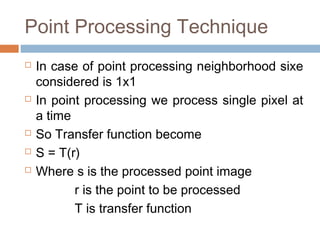
 In case of point processing neighborhood sixe
considered is 1x1
 In point processing we process single pixel at
a time
 So Transfer function become
 S = T(r)
 Where s is the processed point image
r is the point to be processed
T is transfer function
Point Processing Technique
s
lightDark
light
r
T(r)
Dark
s
lightDark
light
r
T(r)
Dark
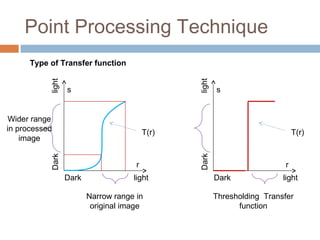
Type of Transfer function
Narrow range in
original image
Wider range
in processed
image
Thresholding Transfer
function
Point Processing Technique
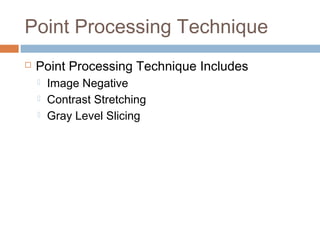
 Point Processing Technique Includes
 Image Negative
 Contrast Stretching
 Gray Level Slicing
Image Negative
 Light image converted to darker image
 Darker image converted to lighter image
s
L -1
s = T(r) = L-1-r
r
L -1
This kind of Transfer function is very useful in medical science
0
Concept:
max intensity → min intensity
min intensity → max intensity
Image Negative Result
Cancer region detection
Contrast Stretching
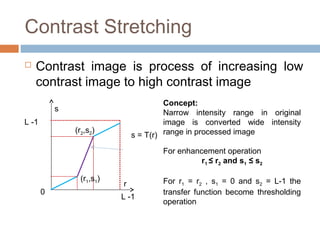
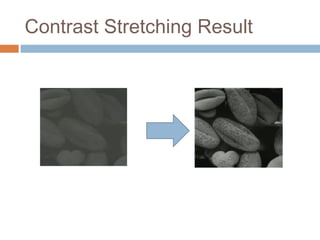
 Contrast image is process of increasing low
contrast image to high contrast image
s
L -1
s = T(r)
r
L -1
0
Concept:
Narrow intensity range in original
image is converted wide intensity
range in processed image
For enhancement operation
r1 ≤ r2 and s1 ≤ s2
For r1 = r2 , s1 = 0 and s2 = L-1 the
transfer function become thresholding
operation
(r1,s1)
(r2,s2)
Contrast Stretching Result
Gray Level Slicing
s
L -1
r
L -1
0
A B
s
L -1
r
L -1
0
A B
Concept:
Here it shows that only in the
range A – B the image is
enhanced and for all other pixel
value are suppressed
Concept:
Here it shows that only in the
range A – B the image is
enhanced and all other pixel
value are retained
Gray Level Slicing Results
Histogram Based Technique
 Histogram Definition
 A image having (0 , L-1) discrete intensity
level
 Then Histogram:
h(rk) = nk
 Where rk: Intensity level
 nk: No. of pixel having intensity level rk
 The plot of distinct intensity level against all
possible intensity level is known at Histogram
Histogram Based Technique
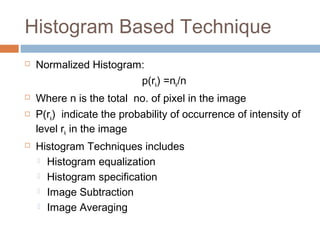
 Normalized Histogram:
p(rk) =nk/n
 Where n is the total no. of pixel in the image
 P(rk) indicate the probability of occurrence of intensity of
level rk in the image
 Histogram Techniques includes
 Histogram equalization
 Histogram specification
 Image Subtraction
 Image Averaging
Histogram Based Technique
Histogram Equalization
 Let r represents gray level in an image
 Assume [0,1] is the normalized pixel in the image where 0 →
back pixel and 1 → white pixel
s = T(r)
 where r is the intensity in original image and s is the intensity
in the processed image
 We assume the transfer function satisfy the following
condition
1. T(r) must be a single valued & monotonically increasing
in the range 0 ≤ r ≤ 1 i.e. Darker pixel remains darker in
the processed image
2. 0 ≤ T(r) ≤ 1 for 0 ≤ r ≤ 1 i.e. any pixel intensity vale may
not be larger than the maxim intensity level.
Histogram Equalization
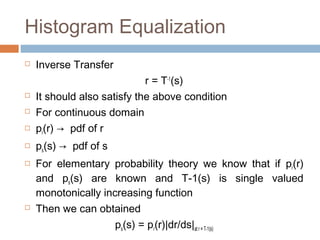
 Inverse Transfer
r = T-1
(s)
 It should also satisfy the above condition
 For continuous domain
 pr(r) → pdf of r
 ps(s) → pdf of s
 For elementary probability theory we know that if pr(r)
and ps(s) are known and T-1(s) is single valued
monotonically increasing function
 Then we can obtained
ps(s) = pr(r)|dr/ds|at r = T-1(s)
Histogram Equalization
 Now we take transfer function
 s = T(r) = ∫0→ r pr(w) dw
 From this we can compute
ds/dr = pr(r)
 ps(s) = pr(r) |dr/ds|
 = pr(r). 1/pr(r) = 1
 Discrete Formulation
 pr(rk) = nk/n
 Histogram equalization become
sk = T(rk) = ∑i= 0 – k pr(ri)
= ∑i= 0 – k ni/n
Histogram Equalization
Histogram
Specification/Matching
 Target Histogram
 Let r → given image and z → target area in the image
 Hence pz(z) → target histogram
 s = T(r) = ∫0→ r pr(w) dw
 Similarly we have function G(z) instead T(r) for target
histogram
 G(z) = ∫0→ z pz(t) dt
 Discrete formulation
sk = T(rk) =∑i= 0 – k ni/n
Let pz(z) is the specified target histogram
Vk = G(zk) = ∑i= 0 – k pz(zi) = sk
Zk =G-1
[T(rk)]
Histogram
Specification/Matching
Graphical interpretation
of mapping from rk to sk
via T(r).
Mapping of zq to its
corresponding value
vq via G(z).
Inverse mapping from sk
to its corresponding
value of zk
Example Histogram
 Preparing..
Image Differencing
g(x,y) = f(x,y) – h(x,y)
 where h(x,y) is the image subtracted from image f(x,y)
 Application of Image Subtraction
 Mask mode radiography: ( It is a image differencing
preprocess for showing oriental diseases.)
 In this case h(x, y), the m ask, is an X-ray im ag e o f a re g io n o f a
patie nt’s bo dy capture d by an intensified TV camera (instead of
traditional X-ray film) located opposite an X-ray source. The
procedure consists of injecting a contrast medium into the patient’s
bloodstream, taking a series of images of the same anatomical
region as h(x, y), and subtracting this mask from the series of
incoming images after injection of the contrast medium. The net
effect of subtracting the mask from each sample in the incoming
stream of TV images is that the areas that are different between f(x,
y) and h(x, y) appear in the output image as enhanced detail.
Application Image Differencing
Mask image.
An image (taken after
injection of a contrast
medium into the
bloodstream) with mask
subtracted out
Image Averaging
g(x,y) = f(x,y) + η(x,y)
g’(x,y) = 1/k ∑i = 1 to K gi(x,y)
E [g’(x,y) ] = f(x,y)
 Application in Astronomical Field
 Noise reduction by image averaging
average of k frames
Error (noise must be zero mean)
Image Averaging Result
a b c
fed
(a) Image of Galaxy Pair NGC 3314. (b) Image corrupted by additive Gaussian
noise with zero mean and a standard deviation of 64 gray levels. (c)–(f) Results
of averaging K=8, 16, 64, and 128 noisy images.
Mask Processing Techniques
 Preparing..
Back to the chapter content
Click Here
Frequency Domain Operation
 Preparing…
Back to the chapter content
Click Here

Chapter 6 Image Processing: Image Enhancement

  • 1.
    CHAPTER6 IMAGE ENHANCEMENT Dr. VarunKumar Ojha and Prof. (Dr.) Paramartha Dutta Visva Bharati University Santiniketan, West Bengal, India
  • 2.
    Image Enhancement  Necessityof Image Enhancement  Spatial Domain Operation  Frequency Domain Operation Back to Course Content Page Click Here
  • 3.
    Image Enhancement  ImageEnhancement: It is processing of enhancement of certain feature of image  Removal of noise  Increasing contrast for a dark image etc.  Choice of image enhancement technique are vary from problem to problem  i.e. Best technique fro enhancement of X-Ray image may not be suitable for enhancement of microscopic images.
  • 4.
    Image Enhancement  Thereare two image enhancement technique  Spatial Domain Technique  Work on image plane itself  Discrete manipulation of pixels in an image  Frequency Domain Technique  Modify Fourier Transform coefficient of image and taking inverse Fourier Transform of modified image to obtain modified image
  • 5.
    Back to thechapter content Click Here
  • 6.
    Spatial Domain Operation Let we image f(x,y) then g(x,y) = T[f(x,y)]  Where T [ . ] is the transfer function which transform the input image f(x,y) (which need to be enhanced) to enhanced image g(x,y)  The operator T operates at point (x,y) considering certain neighborhood of the point (x,y) of the image  Similarly for a single pixel x we can write g(x) = T[f(x)]
  • 7.
    Spatial Domain Operation p y x InputImage f(x,y) 3 x 3 neighborhood at point (x,y) For different technique neighborhood size may be different depending upon the type of image and type of operation
  • 8.
    Spatial Domain Operation Spatial domain operation includes  Point Processing Techniques  Histogram Based Technique  Mask Processing Technique
  • 9.
    Point Processing Technique In case of point processing neighborhood sixe considered is 1x1  In point processing we process single pixel at a time  So Transfer function become  S = T(r)  Where s is the processed point image r is the point to be processed T is transfer function
  • 10.
    Point Processing Technique s lightDark light r T(r) Dark s lightDark light r T(r) Dark Typeof Transfer function Narrow range in original image Wider range in processed image Thresholding Transfer function
  • 11.
    Point Processing Technique Point Processing Technique Includes  Image Negative  Contrast Stretching  Gray Level Slicing
  • 12.
    Image Negative  Lightimage converted to darker image  Darker image converted to lighter image s L -1 s = T(r) = L-1-r r L -1 This kind of Transfer function is very useful in medical science 0 Concept: max intensity → min intensity min intensity → max intensity
  • 13.
  • 14.
    Contrast Stretching  Contrastimage is process of increasing low contrast image to high contrast image s L -1 s = T(r) r L -1 0 Concept: Narrow intensity range in original image is converted wide intensity range in processed image For enhancement operation r1 ≤ r2 and s1 ≤ s2 For r1 = r2 , s1 = 0 and s2 = L-1 the transfer function become thresholding operation (r1,s1) (r2,s2)
  • 15.
  • 16.
    Gray Level Slicing s L-1 r L -1 0 A B s L -1 r L -1 0 A B Concept: Here it shows that only in the range A – B the image is enhanced and for all other pixel value are suppressed Concept: Here it shows that only in the range A – B the image is enhanced and all other pixel value are retained
  • 17.
  • 18.
    Histogram Based Technique Histogram Definition  A image having (0 , L-1) discrete intensity level  Then Histogram: h(rk) = nk  Where rk: Intensity level  nk: No. of pixel having intensity level rk  The plot of distinct intensity level against all possible intensity level is known at Histogram
  • 19.
    Histogram Based Technique Normalized Histogram: p(rk) =nk/n  Where n is the total no. of pixel in the image  P(rk) indicate the probability of occurrence of intensity of level rk in the image  Histogram Techniques includes  Histogram equalization  Histogram specification  Image Subtraction  Image Averaging
  • 20.
  • 21.
  • 22.
    Histogram Equalization  Letr represents gray level in an image  Assume [0,1] is the normalized pixel in the image where 0 → back pixel and 1 → white pixel s = T(r)  where r is the intensity in original image and s is the intensity in the processed image  We assume the transfer function satisfy the following condition 1. T(r) must be a single valued & monotonically increasing in the range 0 ≤ r ≤ 1 i.e. Darker pixel remains darker in the processed image 2. 0 ≤ T(r) ≤ 1 for 0 ≤ r ≤ 1 i.e. any pixel intensity vale may not be larger than the maxim intensity level.
  • 23.
    Histogram Equalization  InverseTransfer r = T-1 (s)  It should also satisfy the above condition  For continuous domain  pr(r) → pdf of r  ps(s) → pdf of s  For elementary probability theory we know that if pr(r) and ps(s) are known and T-1(s) is single valued monotonically increasing function  Then we can obtained ps(s) = pr(r)|dr/ds|at r = T-1(s)
  • 24.
    Histogram Equalization  Nowwe take transfer function  s = T(r) = ∫0→ r pr(w) dw  From this we can compute ds/dr = pr(r)  ps(s) = pr(r) |dr/ds|  = pr(r). 1/pr(r) = 1  Discrete Formulation  pr(rk) = nk/n  Histogram equalization become sk = T(rk) = ∑i= 0 – k pr(ri) = ∑i= 0 – k ni/n
  • 25.
  • 26.
    Histogram Specification/Matching  Target Histogram Let r → given image and z → target area in the image  Hence pz(z) → target histogram  s = T(r) = ∫0→ r pr(w) dw  Similarly we have function G(z) instead T(r) for target histogram  G(z) = ∫0→ z pz(t) dt  Discrete formulation sk = T(rk) =∑i= 0 – k ni/n Let pz(z) is the specified target histogram Vk = G(zk) = ∑i= 0 – k pz(zi) = sk Zk =G-1 [T(rk)]
  • 27.
    Histogram Specification/Matching Graphical interpretation of mappingfrom rk to sk via T(r). Mapping of zq to its corresponding value vq via G(z). Inverse mapping from sk to its corresponding value of zk
  • 28.
  • 29.
    Image Differencing g(x,y) =f(x,y) – h(x,y)  where h(x,y) is the image subtracted from image f(x,y)  Application of Image Subtraction  Mask mode radiography: ( It is a image differencing preprocess for showing oriental diseases.)  In this case h(x, y), the m ask, is an X-ray im ag e o f a re g io n o f a patie nt’s bo dy capture d by an intensified TV camera (instead of traditional X-ray film) located opposite an X-ray source. The procedure consists of injecting a contrast medium into the patient’s bloodstream, taking a series of images of the same anatomical region as h(x, y), and subtracting this mask from the series of incoming images after injection of the contrast medium. The net effect of subtracting the mask from each sample in the incoming stream of TV images is that the areas that are different between f(x, y) and h(x, y) appear in the output image as enhanced detail.
  • 30.
    Application Image Differencing Maskimage. An image (taken after injection of a contrast medium into the bloodstream) with mask subtracted out
  • 31.
    Image Averaging g(x,y) =f(x,y) + η(x,y) g’(x,y) = 1/k ∑i = 1 to K gi(x,y) E [g’(x,y) ] = f(x,y)  Application in Astronomical Field  Noise reduction by image averaging average of k frames Error (noise must be zero mean)
  • 32.
    Image Averaging Result ab c fed (a) Image of Galaxy Pair NGC 3314. (b) Image corrupted by additive Gaussian noise with zero mean and a standard deviation of 64 gray levels. (c)–(f) Results of averaging K=8, 16, 64, and 128 noisy images.
  • 33.
  • 34.
    Back to thechapter content Click Here
  • 35.
  • 36.
    Back to thechapter content Click Here