EAR
 1st part ……………external ear
 2nd part….................middle ear
 3rd part……………..inner ear
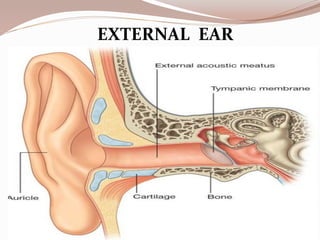
EXTERNAL EAR
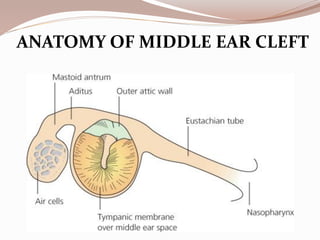
ANATOMY OF MIDDLE EAR CLEFT
THE MIDDLE EAR CLEFT
 The middle ear cleft consists of the
 tympanic cavity,
 Eustachian tube and
 mastoid air cell system.
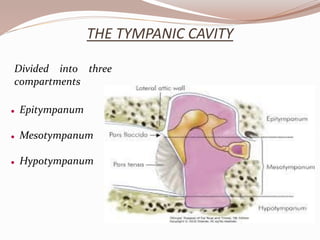
THE TYMPANIC CAVITY
Divided into three
compartments
 Epitympanum
 Mesotympanum
 Hypotympanum
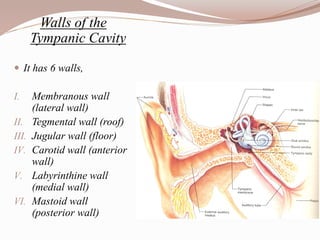
Walls of the
Tympanic Cavity
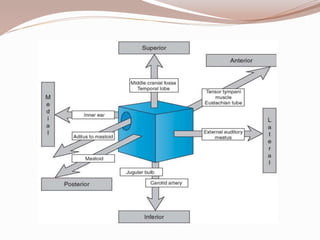
 It has 6 walls,
I. Membranous wall
(lateral wall)
II. Tegmental wall (roof)
III. Jugular wall (floor)
IV. Carotid wall (anterior
wall)
V. Labyrinthine wall
(medial wall)
VI. Mastoid wall
(posterior wall)
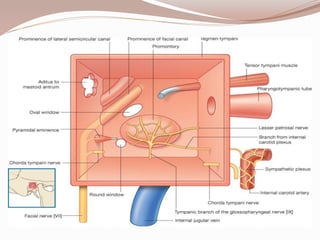
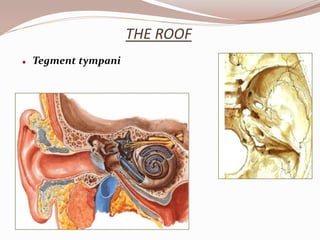
THE ROOF
 Tegment tympani
 It is formed by both the petrous and squamous portions of
the temporal bone
 The petrosquamous suture line, which does not close
until adult life, can provide a route of access for infection
into the extradural space in children
 Veins from the tympanic cavity running to the superior
petrosal sinus pass through this suture line
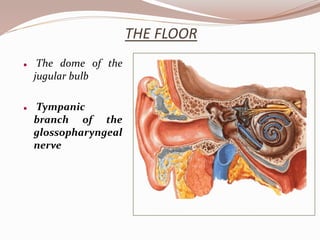
THE FLOOR
 The dome of the
jugular bulb
 Tympanic
branch of the
glossopharyngeal
nerve
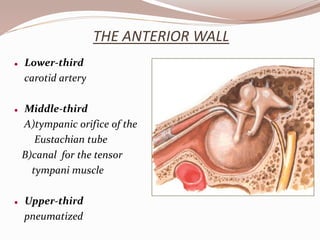
THE ANTERIOR WALL
 Lower-third
carotid artery
 Middle-third
A)tympanic orifice of the
Eustachian tube
B)canal for the tensor
tympani muscle
 Upper-third
pneumatized
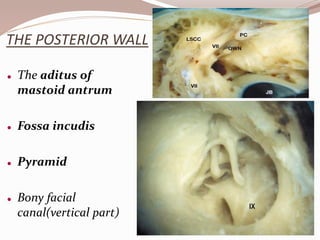
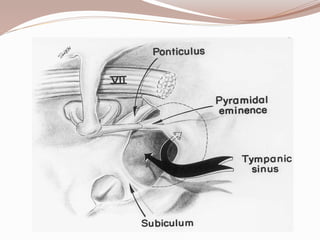
THE POSTERIOR WALL
 The aditus of
mastoid antrum
 Fossa incudis
 Pyramid
 Bony facial
canal(vertical part)
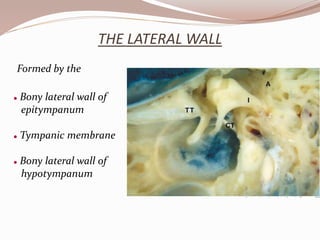
THE LATERAL WALL
Formed by the
 Bony lateral wall of
epitympanum
 Tympanic membrane
 Bony lateral wall of
hypotympanum
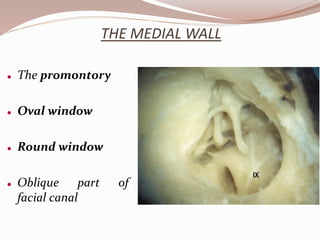
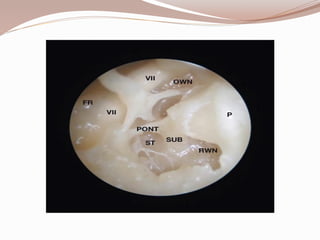
THE MEDIAL WALL
 The promontory
 Oval window
 Round window
 Oblique part of
facial canal
THE CONTENTS OF THE TYMPANIC CAVITY
The tympanic cavity contains the
 Ear ossicles – malleus, incus and stapes
 Muscles – Stapedius, Tensor tympani
 The chorda tympani and
 The tympanic plexus
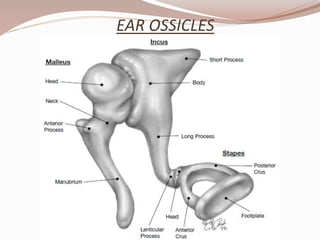
EAR OSSICLES
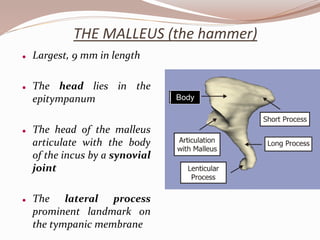
THE MALLEUS (the hammer)
 Largest, 9 mm in length
 The head lies in the
epitympanum
 The head of the malleus
articulate with the body
of the incus by a synovial
joint
 The lateral process
prominent landmark on
the tympanic membrane
Body
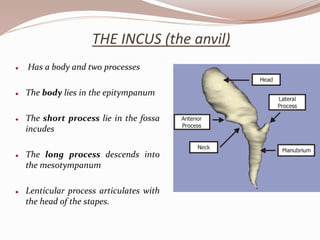
THE INCUS (the anvil)
 Has a body and two processes
 The body lies in the epitympanum
 The short process lie in the fossa
incudes
 The long process descends into
the mesotympanum
 Lenticular process articulates with
the head of the stapes.
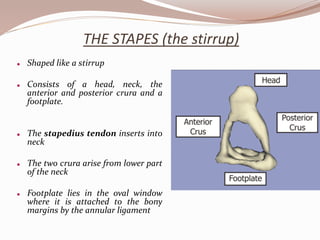
THE STAPES (the stirrup)
 Shaped like a stirrup
 Consists of a head, neck, the
anterior and posterior crura and a
footplate.
 The stapedius tendon inserts into
neck
 The two crura arise from lower part
of the neck
 Footplate lies in the oval window
where it is attached to the bony
margins by the annular ligament
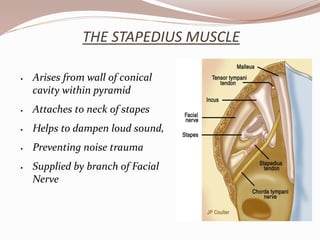
THE STAPEDIUS MUSCLE
 Arises from wall of conical
cavity within pyramid
 Attaches to neck of stapes
 Helps to dampen loud sound,
 Preventing noise trauma
 Supplied by branch of Facial
Nerve
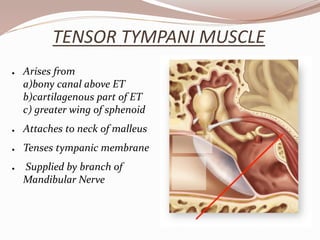
TENSOR TYMPANI MUSCLE
● Arises from
a)bony canal above ET
b)cartilagenous part of ET
c) greater wing of sphenoid
● Attaches to neck of malleus
● Tenses tympanic membrane
● Supplied by branch of
Mandibular Nerve
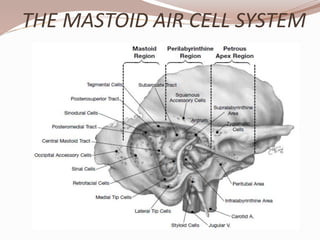
THE MASTOID AIR CELL SYSTEM
 The mastoid antrum air-filled sinus in the petrous part of
temporal bone.
 It communicates with the middle ear by the aditus.
 Antrum is well developed at birth.
 Volume = 2 ml (adult).
 The medial wall relates to the posterior semicircular canal.
 More deeply and inferiorly is the dura of the posterior cranial
fossa and the endolymphatic sac.
 The roof of the mastoid antrum and mastoid air cell space
form the floor of the middle cranial fossa.
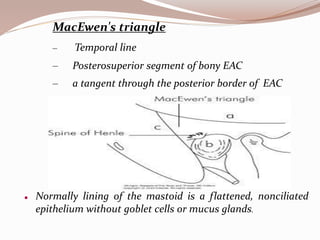
MacEwen's triangle
– Temporal line
– Posterosuperior segment of bony EAC
– a tangent through the posterior border of EAC
 Normally lining of the mastoid is a flattened, nonciliated
epithelium without goblet cells or mucus glands.
THE BLOOD SUPPLY OF THE TYMPANIC CAVITY
 Arise from both the internal and external carotid system.
 The overlap is extensive and great variability is present.
 Anterior tympanic
 Stylomastoid
 Maxillary
 Posterior auricular
 Middle meningeal
 Ascending pharyngeal
 Artery of pterygoid canal and internal carotid arteries.
 The anterior tympanic and stylomastoid arteries are
the biggest.
Venous drainage
 Pterygoid plexus
 Superior petrosal sinus
Lymphatic
 Retropharyngeal
 Parotid lymph node
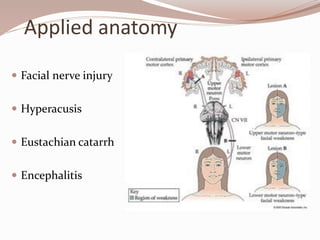
Applied anatomy
 Facial nerve injury
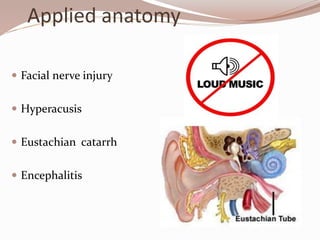
 Hyperacusis
 Eustachian catarrh
 Encephalitis
 Facial nerve injury
 Hyperacusis
 Eustachian catarrh
 Encephalitis
Applied anatomy
Otitis Media
 Otitis media is an infection
or inflammation of the
middle ear
 This inflammation often
begins when infections that
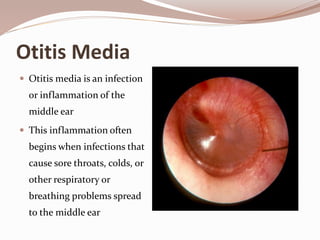
cause sore throats, colds, or
other respiratory or
breathing problems spread
to the middle ear
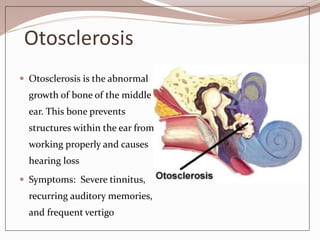
Otosclerosis
 Otosclerosis is the abnormal
growth of bone of the middle
ear. This bone prevents
structures within the ear from
working properly and causes
hearing loss
 Symptoms: Severe tinnitus,
recurring auditory memories,
and frequent vertigo
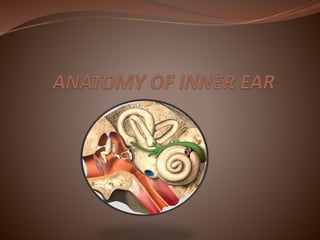
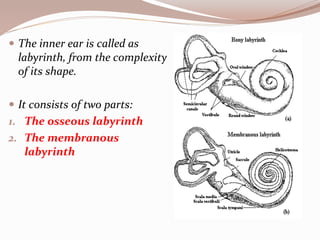
 The inner ear is called as
labyrinth, from the complexity
of its shape.
 It consists of two parts:
1. The osseous labyrinth
2. The membranous
labyrinth
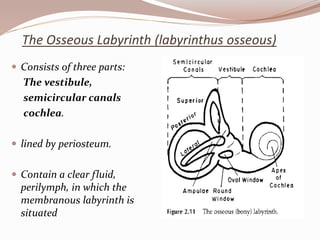
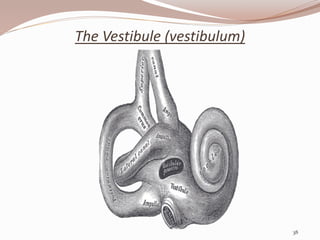
The Osseous Labyrinth (labyrinthus osseous)
 Consists of three parts:
The vestibule,
semicircular canals
cochlea.
 lined by periosteum.
 Contain a clear fluid,
perilymph, in which the
membranous labyrinth is
situated
The Vestibule (vestibulum)
38
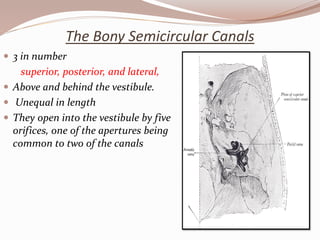
The Bony Semicircular Canals
 3 in number
superior, posterior, and lateral,
 Above and behind the vestibule.
 Unequal in length
 They open into the vestibule by five
orifices, one of the apertures being
common to two of the canals
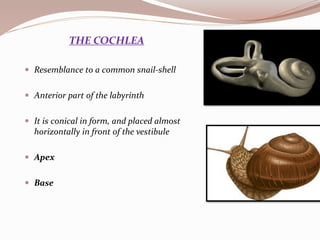
THE COCHLEA
 Resemblance to a common snail-shell
 Anterior part of the labyrinth
 It is conical in form, and placed almost
horizontally in front of the vestibule
 Apex
 Base
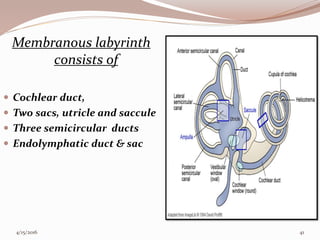
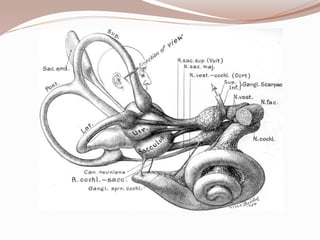
Membranous labyrinth
consists of
 Cochlear duct,
 Two sacs, utricle and saccule
 Three semicircular ducts
 Endolymphatic duct & sac
4/15/2016 41
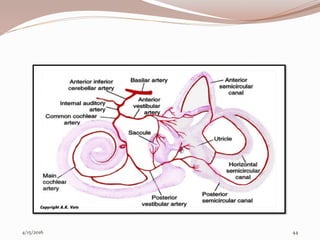
Blood supply of labyrinth
 Mainly by internal auditory a. (branch of AICA - branch of
basilar a.)
 Internal auditory artery divides into
1. Anterior vestibular artery
 Supplies utricle ,superior & lateral SCC
2. Common cochlear artery
 Main cochlear artery(80%)-supplies cochlea
 Vestibulocochlear artery
1. Post vestibular A.-supplies saccule & post SCC
2. Cochlear branch –supplies to cochlea4/15/2016 43
4/15/2016 44
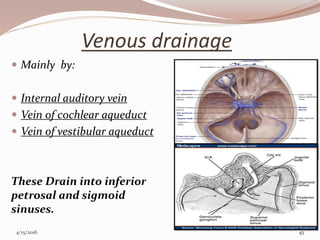
Venous drainage
 Mainly by:
 Internal auditory vein
 Vein of cochlear aqueduct
 Vein of vestibular aqueduct
These Drain into inferior
petrosal and sigmoid
sinuses.
4/15/2016 45
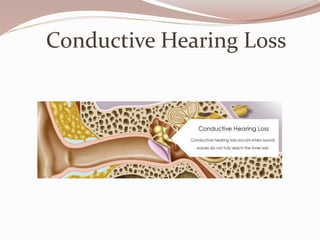
Conductive Hearing Loss
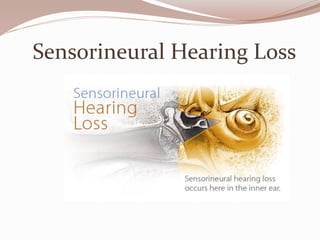
Sensorineural Hearing Loss
Labyrinthitis
Inflammation of the semi-circular canals give you a
sense of motion when you’re not moving = VERTIGO
(dizziness) or LABYRINTHITIS
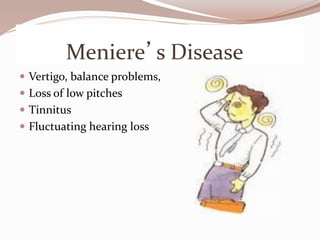
Meniere’s Disease
 Vertigo, balance problems,
 Loss of low pitches
 Tinnitus
 Fluctuating hearing loss
THANK YOU

Middle and inner ear 15416

  • 2.
    EAR  1st part……………external ear  2nd part….................middle ear  3rd part……………..inner ear
  • 3.
  • 4.
  • 5.
    THE MIDDLE EARCLEFT  The middle ear cleft consists of the  tympanic cavity,  Eustachian tube and  mastoid air cell system.
  • 6.
    THE TYMPANIC CAVITY Dividedinto three compartments  Epitympanum  Mesotympanum  Hypotympanum
  • 7.
    Walls of the TympanicCavity  It has 6 walls, I. Membranous wall (lateral wall) II. Tegmental wall (roof) III. Jugular wall (floor) IV. Carotid wall (anterior wall) V. Labyrinthine wall (medial wall) VI. Mastoid wall (posterior wall)
  • 9.
  • 10.
     It isformed by both the petrous and squamous portions of the temporal bone  The petrosquamous suture line, which does not close until adult life, can provide a route of access for infection into the extradural space in children  Veins from the tympanic cavity running to the superior petrosal sinus pass through this suture line
  • 11.
    THE FLOOR  Thedome of the jugular bulb  Tympanic branch of the glossopharyngeal nerve
  • 12.
    THE ANTERIOR WALL Lower-third carotid artery  Middle-third A)tympanic orifice of the Eustachian tube B)canal for the tensor tympani muscle  Upper-third pneumatized
  • 13.
    THE POSTERIOR WALL The aditus of mastoid antrum  Fossa incudis  Pyramid  Bony facial canal(vertical part)
  • 14.
    THE LATERAL WALL Formedby the  Bony lateral wall of epitympanum  Tympanic membrane  Bony lateral wall of hypotympanum
  • 15.
    THE MEDIAL WALL The promontory  Oval window  Round window  Oblique part of facial canal
  • 19.
    THE CONTENTS OFTHE TYMPANIC CAVITY The tympanic cavity contains the  Ear ossicles – malleus, incus and stapes  Muscles – Stapedius, Tensor tympani  The chorda tympani and  The tympanic plexus
  • 20.
  • 21.
    THE MALLEUS (thehammer)  Largest, 9 mm in length  The head lies in the epitympanum  The head of the malleus articulate with the body of the incus by a synovial joint  The lateral process prominent landmark on the tympanic membrane Body
  • 22.
    THE INCUS (theanvil)  Has a body and two processes  The body lies in the epitympanum  The short process lie in the fossa incudes  The long process descends into the mesotympanum  Lenticular process articulates with the head of the stapes.
  • 23.
    THE STAPES (thestirrup)  Shaped like a stirrup  Consists of a head, neck, the anterior and posterior crura and a footplate.  The stapedius tendon inserts into neck  The two crura arise from lower part of the neck  Footplate lies in the oval window where it is attached to the bony margins by the annular ligament
  • 24.
    THE STAPEDIUS MUSCLE Arises from wall of conical cavity within pyramid  Attaches to neck of stapes  Helps to dampen loud sound,  Preventing noise trauma  Supplied by branch of Facial Nerve
  • 25.
    TENSOR TYMPANI MUSCLE ●Arises from a)bony canal above ET b)cartilagenous part of ET c) greater wing of sphenoid ● Attaches to neck of malleus ● Tenses tympanic membrane ● Supplied by branch of Mandibular Nerve
  • 26.
    THE MASTOID AIRCELL SYSTEM
  • 27.
     The mastoidantrum air-filled sinus in the petrous part of temporal bone.  It communicates with the middle ear by the aditus.  Antrum is well developed at birth.  Volume = 2 ml (adult).  The medial wall relates to the posterior semicircular canal.  More deeply and inferiorly is the dura of the posterior cranial fossa and the endolymphatic sac.  The roof of the mastoid antrum and mastoid air cell space form the floor of the middle cranial fossa.
  • 28.
    MacEwen's triangle – Temporalline – Posterosuperior segment of bony EAC – a tangent through the posterior border of EAC  Normally lining of the mastoid is a flattened, nonciliated epithelium without goblet cells or mucus glands.
  • 29.
    THE BLOOD SUPPLYOF THE TYMPANIC CAVITY  Arise from both the internal and external carotid system.  The overlap is extensive and great variability is present.  Anterior tympanic  Stylomastoid  Maxillary  Posterior auricular  Middle meningeal  Ascending pharyngeal  Artery of pterygoid canal and internal carotid arteries.  The anterior tympanic and stylomastoid arteries are the biggest.
  • 30.
    Venous drainage  Pterygoidplexus  Superior petrosal sinus Lymphatic  Retropharyngeal  Parotid lymph node
  • 31.
    Applied anatomy  Facialnerve injury  Hyperacusis  Eustachian catarrh  Encephalitis
  • 32.
     Facial nerveinjury  Hyperacusis  Eustachian catarrh  Encephalitis Applied anatomy
  • 33.
    Otitis Media  Otitismedia is an infection or inflammation of the middle ear  This inflammation often begins when infections that cause sore throats, colds, or other respiratory or breathing problems spread to the middle ear
  • 34.
    Otosclerosis  Otosclerosis isthe abnormal growth of bone of the middle ear. This bone prevents structures within the ear from working properly and causes hearing loss  Symptoms: Severe tinnitus, recurring auditory memories, and frequent vertigo
  • 36.
     The innerear is called as labyrinth, from the complexity of its shape.  It consists of two parts: 1. The osseous labyrinth 2. The membranous labyrinth
  • 37.
    The Osseous Labyrinth(labyrinthus osseous)  Consists of three parts: The vestibule, semicircular canals cochlea.  lined by periosteum.  Contain a clear fluid, perilymph, in which the membranous labyrinth is situated
  • 38.
  • 39.
    The Bony SemicircularCanals  3 in number superior, posterior, and lateral,  Above and behind the vestibule.  Unequal in length  They open into the vestibule by five orifices, one of the apertures being common to two of the canals
  • 40.
    THE COCHLEA  Resemblanceto a common snail-shell  Anterior part of the labyrinth  It is conical in form, and placed almost horizontally in front of the vestibule  Apex  Base
  • 41.
    Membranous labyrinth consists of Cochlear duct,  Two sacs, utricle and saccule  Three semicircular ducts  Endolymphatic duct & sac 4/15/2016 41
  • 43.
    Blood supply oflabyrinth  Mainly by internal auditory a. (branch of AICA - branch of basilar a.)  Internal auditory artery divides into 1. Anterior vestibular artery  Supplies utricle ,superior & lateral SCC 2. Common cochlear artery  Main cochlear artery(80%)-supplies cochlea  Vestibulocochlear artery 1. Post vestibular A.-supplies saccule & post SCC 2. Cochlear branch –supplies to cochlea4/15/2016 43
  • 44.
  • 45.
    Venous drainage  Mainlyby:  Internal auditory vein  Vein of cochlear aqueduct  Vein of vestibular aqueduct These Drain into inferior petrosal and sigmoid sinuses. 4/15/2016 45
  • 46.
  • 47.
  • 48.
    Labyrinthitis Inflammation of thesemi-circular canals give you a sense of motion when you’re not moving = VERTIGO (dizziness) or LABYRINTHITIS
  • 49.
    Meniere’s Disease  Vertigo,balance problems,  Loss of low pitches  Tinnitus  Fluctuating hearing loss
  • 50.