Lecture By
Dr.N.Mugunthan.MBBS.,MS.,DNB.,MNAMS.,PhD
Associate Professor
MGMC&RI
 Boundaries of pharynx
 Subdivision of pharynx & it’s features
 Structure of pharyngeal wall
 Muscles of pharynx
 Blood supply
 Nerve supply
 Lymphatic drainage
 Applied anatomy
©Dr.N.Mugunthan
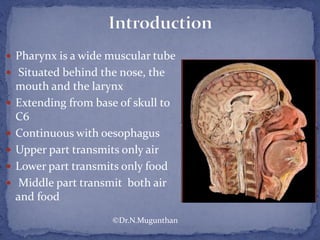
 Pharynx is a wide muscular tube
 Situated behind the nose, the
mouth and the larynx
 Extending from base of skull to
C6
 Continuous with oesophagus
 Upper part transmits only air
 Lower part transmits only food
 Middle part transmit both air
and food
©Dr.N.Mugunthan
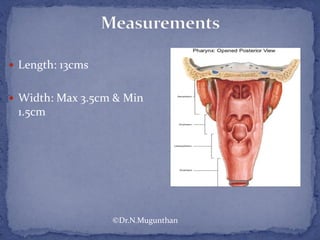
 Length: 13cms
 Width: Max 3.5cm & Min
1.5cm
©Dr.N.Mugunthan
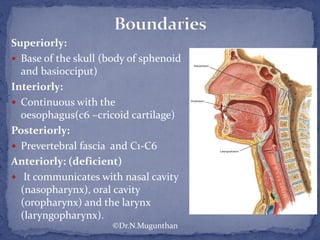
Superiorly:
 Base of the skull (body of sphenoid
and basiocciput)
Interiorly:
 Continuous with the
oesophagus(c6 –cricoid cartilage)
Posteriorly:
 Prevertebral fascia and C1-C6
Anteriorly: (deficient)
 It communicates with nasal cavity
(nasopharynx), oral cavity
(oropharynx) and the larynx
(laryngopharynx).
©Dr.N.Mugunthan
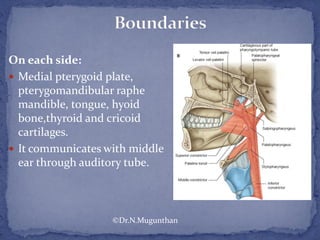
On each side:
 Medial pterygoid plate,
pterygomandibular raphe
mandible, tongue, hyoid
bone,thyroid and cricoid
cartilages.
 It communicates with middle
ear through auditory tube.
©Dr.N.Mugunthan
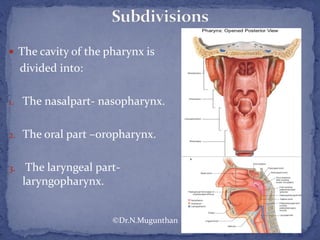
 The cavity of the pharynx is
divided into:
1. The nasalpart- nasopharynx.
2. The oral part –oropharynx.
3. The laryngeal part-
laryngopharynx.
©Dr.N.Mugunthan
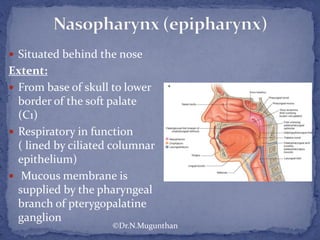
 Situated behind the nose
Extent:
 From base of skull to lower
border of the soft palate
(C1)
 Respiratory in function
( lined by ciliated columnar
epithelium)
 Mucous membrane is
supplied by the pharyngeal
branch of pterygopalatine
ganglion
©Dr.N.Mugunthan
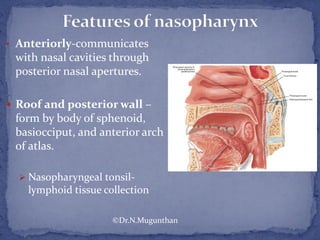
• Anteriorly-communicates
with nasal cavities through
posterior nasal apertures.
 Roof and posterior wall –
form by body of sphenoid,
basiocciput, and anterior arch
of atlas.
 Nasopharyngeal tonsil-
lymphoid tissue collection
©Dr.N.Mugunthan
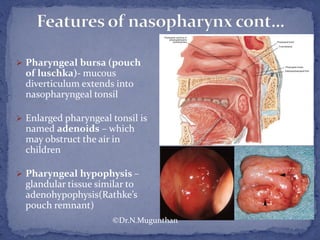
 Pharyngeal bursa (pouch
of luschka)- mucous
diverticulum extends into
nasopharyngeal tonsil
 Enlarged pharyngeal tonsil is
named adenoids – which
may obstruct the air in
children
 Pharyngeal hypophysis –
glandular tissue similar to
adenohypophysis(Rathke’s
pouch remnant)
©Dr.N.Mugunthan
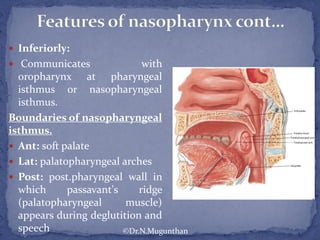
 Inferiorly:
 Communicates with
oropharynx at pharyngeal
isthmus or nasopharyngeal
isthmus.
Boundaries of nasopharyngeal
isthmus.
 Ant: soft palate
 Lat: palatopharyngeal arches
 Post: post.pharyngeal wall in
which passavant's ridge
(palatopharyngeal muscle)
appears during deglutition and
speech ©Dr.N.Mugunthan
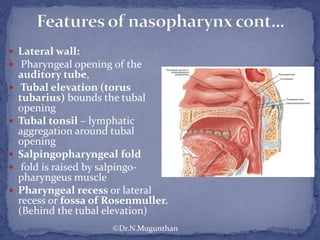
 Lateral wall:
 Pharyngeal opening of the
auditory tube,
 Tubal elevation (torus
tubarius) bounds the tubal
opening
 Tubal tonsil – lymphatic
aggregation around tubal
opening
 Salpingopharyngeal fold
 fold is raised by salpingo-
pharyngeus muscle
 Pharyngeal recess or lateral
recess or fossa of Rosenmuller.
(Behind the tubal elevation)
©Dr.N.Mugunthan
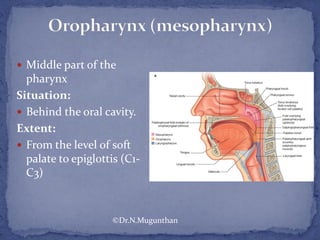
 Middle part of the
pharynx
Situation:
 Behind the oral cavity.
Extent:
 From the level of soft
palate to epiglottis (C1-
C3)
©Dr.N.Mugunthan
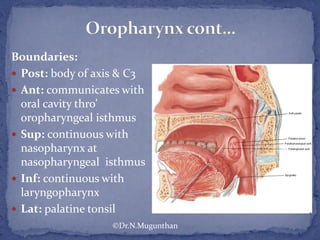
Boundaries:
 Post: body of axis & C3
 Ant: communicates with
oral cavity thro’
oropharyngeal isthmus
 Sup: continuous with
nasopharynx at
nasopharyngeal isthmus
 Inf: continuous with
laryngopharynx
 Lat: palatine tonsil
©Dr.N.Mugunthan
Oropharyngeal isthmus:
Boundaries:
 Above: soft palate
 Below: dorsal surface of
post 1/3 of tongue
 Each side: palatoglossal
arch
Closed during deglutition
to prevent regurgitation of
food from the pharynx to
mouth. ©Dr.N.Mugunthan
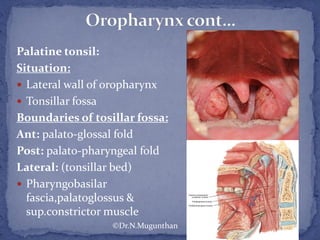
Palatine tonsil:
Situation:
 Lateral wall of oropharynx
 Tonsillar fossa
Boundaries of tosillar fossa:
Ant: palato-glossal fold
Post: palato-pharyngeal fold
Lateral: (tonsillar bed)
 Pharyngobasilar
fascia,palatoglossus &
sup.constrictor muscle
©Dr.N.Mugunthan
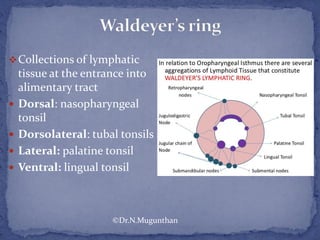
Collections of lymphatic
tissue at the entrance into
alimentary tract
 Dorsal: nasopharyngeal
tonsil
 Dorsolateral: tubal tonsils
 Lateral: palatine tonsil
 Ventral: lingual tonsil
©Dr.N.Mugunthan
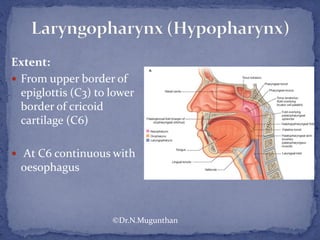
Extent:
 From upper border of
epiglottis (C3) to lower
border of cricoid
cartilage (C6)
 At C6 continuous with
oesophagus
©Dr.N.Mugunthan
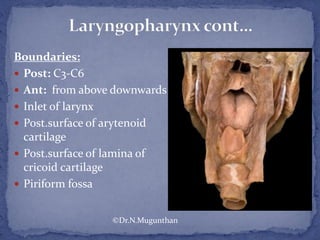
Boundaries:
 Post: C3-C6
 Ant: from above downwards
 Inlet of larynx
 Post.surface of arytenoid
cartilage
 Post.surface of lamina of
cricoid cartilage
 Piriform fossa
©Dr.N.Mugunthan
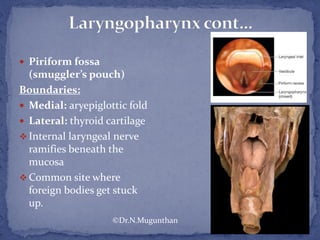
 Piriform fossa
(smuggler’s pouch)
Boundaries:
 Medial: aryepiglottic fold
 Lateral: thyroid cartilage
 Internal laryngeal nerve
ramifies beneath the
mucosa
 Common site where
foreign bodies get stuck
up.
©Dr.N.Mugunthan
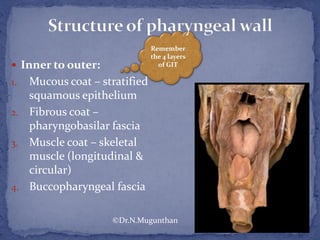
 Inner to outer:
1. Mucous coat – stratified
squamous epithelium
2. Fibrous coat –
pharyngobasilar fascia
3. Muscle coat – skeletal
muscle (longitudinal &
circular)
4. Buccopharyngeal fascia
©Dr.N.Mugunthan
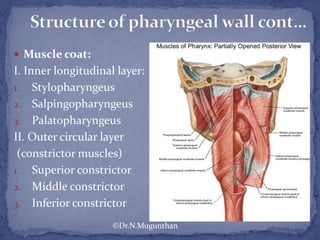
 Muscle coat:
I. Inner longitudinal layer:
1. Stylopharyngeus
2. Salpingopharyngeus
3. Palatopharyngeus
II. Outer circular layer
(constrictor muscles)
1. Superior constrictor
2. Middle constrictor
3. Inferior constrictor
©Dr.N.Mugunthan
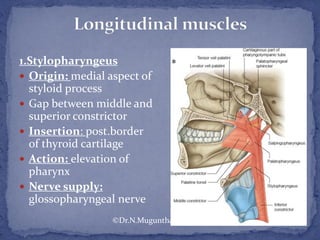
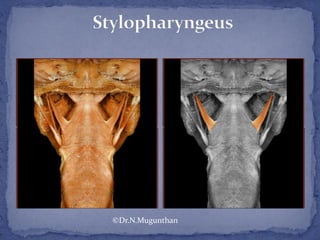
1.Stylopharyngeus
 Origin: medial aspect of
styloid process
 Gap between middle and
superior constrictor
 Insertion: post.border
of thyroid cartilage
 Action: elevation of
pharynx
 Nerve supply:
glossopharyngeal nerve
©Dr.N.Mugunthan
©Dr.N.Mugunthan
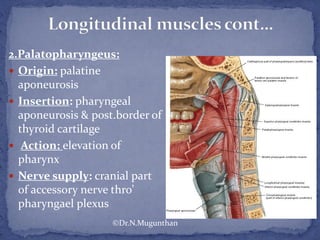
2.Palatopharyngeus:
 Origin: palatine
aponeurosis
 Insertion: pharyngeal
aponeurosis & post.border of
thyroid cartilage
 Action: elevation of
pharynx
 Nerve supply: cranial part
of accessory nerve thro’
pharyngael plexus
©Dr.N.Mugunthan
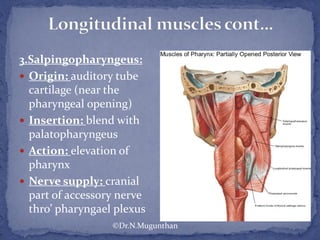
3.Salpingopharyngeus:
 Origin: auditory tube
cartilage (near the
pharyngeal opening)
 Insertion: blend with
palatopharyngeus
 Action: elevation of
pharynx
 Nerve supply: cranial
part of accessory nerve
thro’ pharyngael plexus
©Dr.N.Mugunthan
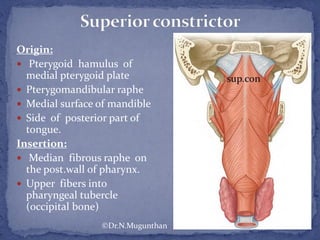
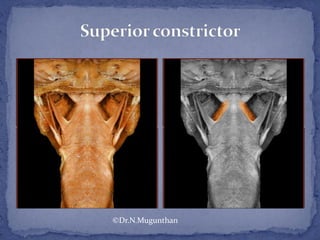
Origin:
 Pterygoid hamulus of
medial pterygoid plate
 Pterygomandibular raphe
 Medial surface of mandible
 Side of posterior part of
tongue.
Insertion:
 Median fibrous raphe on
the post.wall of pharynx.
 Upper fibers into
pharyngeal tubercle
(occipital bone)
©Dr.N.Mugunthan
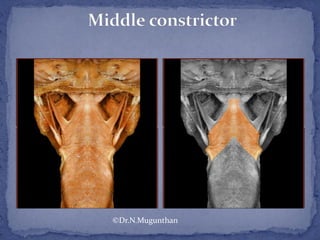
©Dr.N.Mugunthan
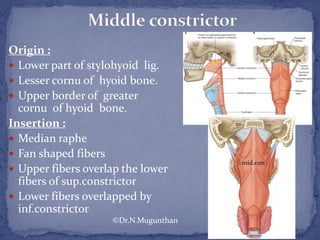
Origin :
 Lower part of stylohyoid lig.
 Lesser cornu of hyoid bone.
 Upper border of greater
cornu of hyoid bone.
Insertion :
 Median raphe
 Fan shaped fibers
 Upper fibers overlap the lower
fibers of sup.constrictor
 Lower fibers overlapped by
inf.constrictor
©Dr.N.Mugunthan
©Dr.N.Mugunthan
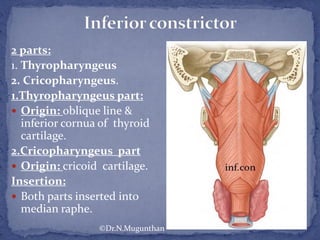
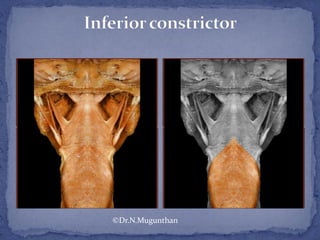
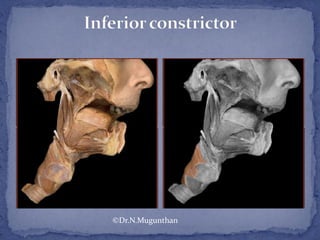
2 parts:
1. Thyropharyngeus
2. Cricopharyngeus.
1.Thyropharyngeus part:
 Origin: oblique line &
inferior cornua of thyroid
cartilage.
2.Cricopharyngeus part
 Origin: cricoid cartilage.
Insertion:
 Both parts inserted into
median raphe.
©Dr.N.Mugunthan
©Dr.N.Mugunthan
©Dr.N.Mugunthan
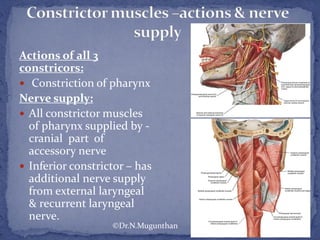
Actions of all 3
constricors:
 Constriction of pharynx
Nerve supply:
 All constrictor muscles
of pharynx supplied by -
cranial part of
accessory nerve
 Inferior constrictor – has
additional nerve supply
from external laryngeal
& recurrent laryngeal
nerve.
©Dr.N.Mugunthan
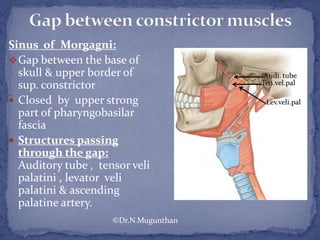
Sinus of Morgagni:
Gap between the base of
skull & upper border of
sup. constrictor
 Closed by upper strong
part of pharyngobasilar
fascia
 Structures passing
through the gap:
Auditory tube , tensor veli
palatini , levator veli
palatini & ascending
palatine artery.
©Dr.N.Mugunthan
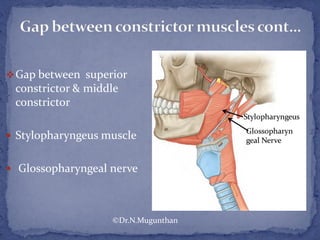
Gap between superior
constrictor & middle
constrictor
 Stylopharyngeus muscle
 Glossopharyngeal nerve
©Dr.N.Mugunthan
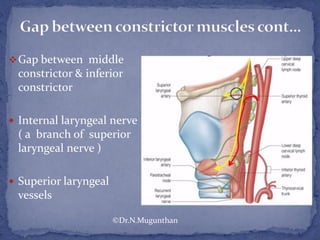
Gap between middle
constrictor & inferior
constrictor
 Internal laryngeal nerve
( a branch of superior
laryngeal nerve )
 Superior laryngeal
vessels
©Dr.N.Mugunthan
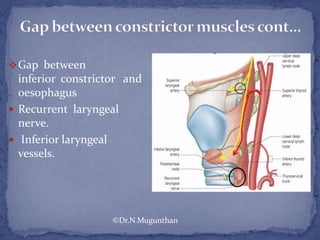
Gap between
inferior constrictor and
oesophagus
 Recurrent laryngeal
nerve.
 Inferior laryngeal
vessels.
©Dr.N.Mugunthan
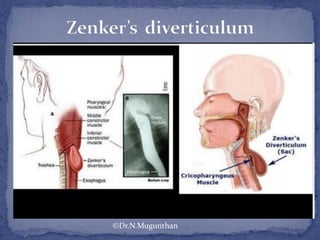
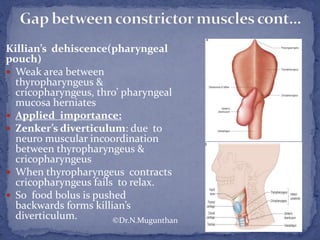
Killian’s dehiscence(pharyngeal
pouch)
 Weak area between
thyropharyngeus &
cricopharyngeus, thro’ pharyngeal
mucosa herniates
 Applied importance:
 Zenker’s diverticulum: due to
neuro muscular incoordination
between thyropharyngeus &
cricopharyngeus
 When thyropharyngeus contracts
cricopharyngeus fails to relax.
 So food bolus is pushed
backwards forms killian’s
diverticulum. ©Dr.N.Mugunthan
©Dr.N.Mugunthan
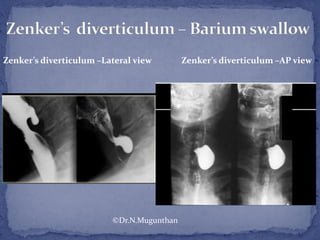
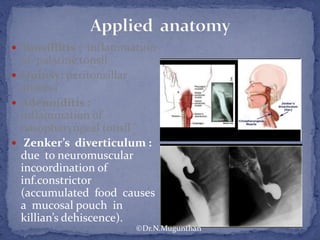
Zenker’s diverticulum –Lateral view Zenker’s diverticulum –AP view
©Dr.N.Mugunthan
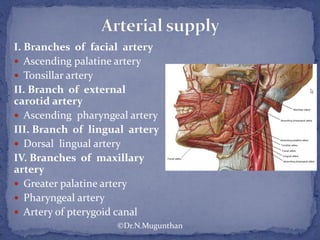
I. Branches of facial artery
 Ascending palatine artery
 Tonsillar artery
II. Branch of external
carotid artery
 Ascending pharyngeal artery
III. Branch of lingual artery
 Dorsal lingual artery
IV. Branches of maxillary
artery
 Greater palatine artery
 Pharyngeal artery
 Artery of pterygoid canal
©Dr.N.Mugunthan
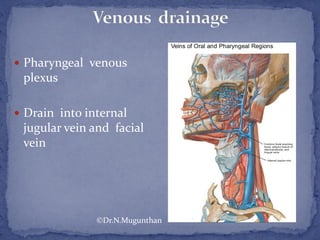
 Pharyngeal venous
plexus
 Drain into internal
jugular vein and facial
vein
©Dr.N.Mugunthan
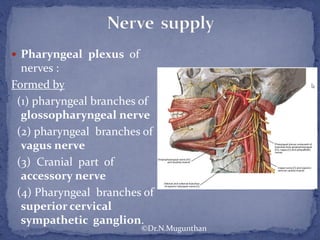
 Pharyngeal plexus of
nerves :
Formed by
(1) pharyngeal branches of
glossopharyngeal nerve
(2) pharyngeal branches of
vagus nerve
(3) Cranial part of
accessory nerve
(4) Pharyngeal branches of
superior cervical
sympathetic ganglion.
©Dr.N.Mugunthan
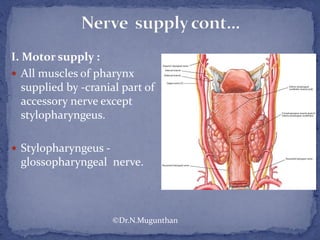
I. Motor supply :
 All muscles of pharynx
supplied by -cranial part of
accessory nerve except
stylopharyngeus.
 Stylopharyngeus -
glossopharyngeal nerve.
©Dr.N.Mugunthan
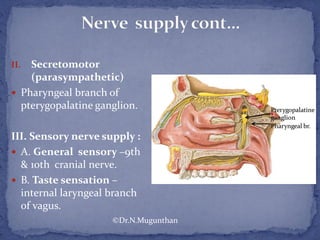
II. Secretomotor
(parasympathetic)
 Pharyngeal branch of
pterygopalatine ganglion.
III. Sensory nerve supply :
 A. General sensory –9th
& 10th cranial nerve.
 B. Taste sensation –
internal laryngeal branch
of vagus.
©Dr.N.Mugunthan
a) Retropharyngeal
lymph nodes
b) Parapharyngeal
nodes
 Deep cervical lymph
nodes
©Dr.N.Mugunthan
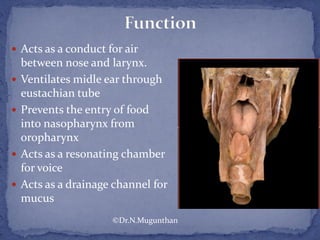
 Acts as a conduct for air
between nose and larynx.
 Ventilates midle ear through
eustachian tube
 Prevents the entry of food
into nasopharynx from
oropharynx
 Acts as a resonating chamber
for voice
 Acts as a drainage channel for
mucus
©Dr.N.Mugunthan
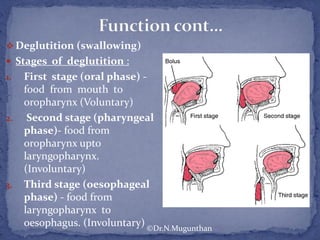
 Deglutition (swallowing)
 Stages of deglutition :
1. First stage (oral phase) -
food from mouth to
oropharynx (Voluntary)
2. Second stage (pharyngeal
phase)- food from
oropharynx upto
laryngopharynx.
(Involuntary)
3. Third stage (oesophageal
phase) - food from
laryngopharynx to
oesophagus. (Involuntary) ©Dr.N.Mugunthan
©Dr.N.Mugunthan
©Dr.N.Mugunthan
©Dr.N.Mugunthan
©Dr.N.Mugunthan
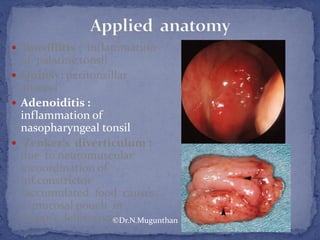
 Tonsillitis : inflammation
of palatine tonsil
 Quinsy: peritonsillar
abscess
 Adenoiditis :
inflammation of
nasopharyngeal tonsil
 Zenker’s diverticulum :
due to neuromuscular
incoordination of
inf.constrictor
(accumulated food causes
a mucosal pouch in
killian’s dehiscence).©Dr.N.Mugunthan
 Tonsillitis : inflammation
of palatine tonsil
 Quinsy: peritonsillar
abscess
 Adenoiditis :
inflammation of
nasopharyngeal tonsil
 Zenker’s diverticulum :
due to neuromuscular
incoordination of
inf.constrictor
(accumulated food causes
a mucosal pouch in
killian’s dehiscence).©Dr.N.Mugunthan
 Tonsillitis : inflammation
of palatine tonsil
 Quinsy: peritonsillar
abscess
 Adenoiditis :
inflammation of
nasopharyngeal tonsil
 Zenker’s diverticulum :
due to neuromuscular
incoordination of
inf.constrictor
(accumulated food causes
a mucosal pouch in
killian’s dehiscence).©Dr.N.Mugunthan
 Tonsillitis : inflammation
of palatine tonsil
 Quinsy: peritonsillar
abscess
 Adenoiditis :
inflammation of
nasopharyngeal tonsil
 Zenker’s diverticulum :
due to neuromuscular
incoordination of
inf.constrictor
(accumulated food causes
a mucosal pouch in
killian’s dehiscence).
©Dr.N.Mugunthan
 Pharyngitis- inflammation
of pharyngeal mucosa -
 Nasopharynx -common site
of carcinoma [Fossa of
Rosen muller ].
 Infection from
nasopharynx can easily
spread into middle ear
through auditory tube.
 Retropharyngeal abscess.
 Smuggler's pouch (
common site of foreign
body stuck up)
©Dr.N.Mugunthan
 Pharyngitis- inflammation
of pharyngeal mucosa .
 Nasopharynx -common site
of carcinoma [Fossa of
Rosen muller ].
 Infection from
nasopharynx can easily
spread into middle ear
through auditory tube.
 Retropharyngeal abscess.
 Smuggler's pouch (
common site of foreign
body stuck up)
©Dr.N.Mugunthan
 Pharyngitis- inflammation
of pharyngeal mucosa .
 Nasopharynx -common site
of carcinoma [Fossa of
Rosen muller ].
 Infection from
nasopharynx can easily
spread into middle ear
through auditory tube.
 Retropharyngeal abscess.
 Smuggler's pouch (
common site of foreign
body stuck up)
©Dr.N.Mugunthan
 Pharyngitis- inflammation
of pharyngeal mucosa .
 Nasopharynx -common site
of carcinoma [Fossa of
Rosen muller ].
 Infection from
nasopharynx can easily
spread into middle ear
through auditory tube.
 Retropharyngeal abscess.
 Smuggler's pouch (
common site of foreign
body stuck up)
©Dr.N.Mugunthan
 Pharyngitis- inflammation
of pharyngeal mucosa .
 Nasopharynx -common site
of carcinoma [Fossa of
Rosen muller ].
 Infection from
nasopharynx can easily
spread into middle ear
through auditory tube.
 Retropharyngeal abscess.
 Smuggler's pouch (
common site of foreign
body stuck up)
©Dr.N.Mugunthan
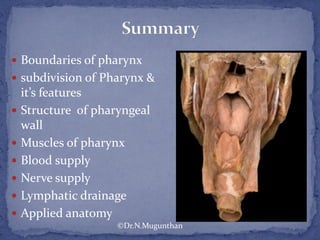
 Boundaries of pharynx
 subdivision of Pharynx &
it’s features
 Structure of pharyngeal
wall
 Muscles of pharynx
 Blood supply
 Nerve supply
 Lymphatic drainage
 Applied anatomy
©Dr.N.Mugunthan
If any queries click @
dr.mugunth111@gmail.com

Pharynx Dr.N.Mugunthan.M.S.,

  • 1.
  • 2.
     Boundaries ofpharynx  Subdivision of pharynx & it’s features  Structure of pharyngeal wall  Muscles of pharynx  Blood supply  Nerve supply  Lymphatic drainage  Applied anatomy ©Dr.N.Mugunthan
  • 3.
     Pharynx isa wide muscular tube  Situated behind the nose, the mouth and the larynx  Extending from base of skull to C6  Continuous with oesophagus  Upper part transmits only air  Lower part transmits only food  Middle part transmit both air and food ©Dr.N.Mugunthan
  • 4.
     Length: 13cms Width: Max 3.5cm & Min 1.5cm ©Dr.N.Mugunthan
  • 5.
    Superiorly:  Base ofthe skull (body of sphenoid and basiocciput) Interiorly:  Continuous with the oesophagus(c6 –cricoid cartilage) Posteriorly:  Prevertebral fascia and C1-C6 Anteriorly: (deficient)  It communicates with nasal cavity (nasopharynx), oral cavity (oropharynx) and the larynx (laryngopharynx). ©Dr.N.Mugunthan
  • 6.
    On each side: Medial pterygoid plate, pterygomandibular raphe mandible, tongue, hyoid bone,thyroid and cricoid cartilages.  It communicates with middle ear through auditory tube. ©Dr.N.Mugunthan
  • 7.
     The cavityof the pharynx is divided into: 1. The nasalpart- nasopharynx. 2. The oral part –oropharynx. 3. The laryngeal part- laryngopharynx. ©Dr.N.Mugunthan
  • 8.
     Situated behindthe nose Extent:  From base of skull to lower border of the soft palate (C1)  Respiratory in function ( lined by ciliated columnar epithelium)  Mucous membrane is supplied by the pharyngeal branch of pterygopalatine ganglion ©Dr.N.Mugunthan
  • 9.
    • Anteriorly-communicates with nasalcavities through posterior nasal apertures.  Roof and posterior wall – form by body of sphenoid, basiocciput, and anterior arch of atlas.  Nasopharyngeal tonsil- lymphoid tissue collection ©Dr.N.Mugunthan
  • 10.
     Pharyngeal bursa(pouch of luschka)- mucous diverticulum extends into nasopharyngeal tonsil  Enlarged pharyngeal tonsil is named adenoids – which may obstruct the air in children  Pharyngeal hypophysis – glandular tissue similar to adenohypophysis(Rathke’s pouch remnant) ©Dr.N.Mugunthan
  • 11.
     Inferiorly:  Communicateswith oropharynx at pharyngeal isthmus or nasopharyngeal isthmus. Boundaries of nasopharyngeal isthmus.  Ant: soft palate  Lat: palatopharyngeal arches  Post: post.pharyngeal wall in which passavant's ridge (palatopharyngeal muscle) appears during deglutition and speech ©Dr.N.Mugunthan
  • 12.
     Lateral wall: Pharyngeal opening of the auditory tube,  Tubal elevation (torus tubarius) bounds the tubal opening  Tubal tonsil – lymphatic aggregation around tubal opening  Salpingopharyngeal fold  fold is raised by salpingo- pharyngeus muscle  Pharyngeal recess or lateral recess or fossa of Rosenmuller. (Behind the tubal elevation) ©Dr.N.Mugunthan
  • 13.
     Middle partof the pharynx Situation:  Behind the oral cavity. Extent:  From the level of soft palate to epiglottis (C1- C3) ©Dr.N.Mugunthan
  • 14.
    Boundaries:  Post: bodyof axis & C3  Ant: communicates with oral cavity thro’ oropharyngeal isthmus  Sup: continuous with nasopharynx at nasopharyngeal isthmus  Inf: continuous with laryngopharynx  Lat: palatine tonsil ©Dr.N.Mugunthan
  • 15.
    Oropharyngeal isthmus: Boundaries:  Above:soft palate  Below: dorsal surface of post 1/3 of tongue  Each side: palatoglossal arch Closed during deglutition to prevent regurgitation of food from the pharynx to mouth. ©Dr.N.Mugunthan
  • 16.
    Palatine tonsil: Situation:  Lateralwall of oropharynx  Tonsillar fossa Boundaries of tosillar fossa: Ant: palato-glossal fold Post: palato-pharyngeal fold Lateral: (tonsillar bed)  Pharyngobasilar fascia,palatoglossus & sup.constrictor muscle ©Dr.N.Mugunthan
  • 17.
    Collections of lymphatic tissueat the entrance into alimentary tract  Dorsal: nasopharyngeal tonsil  Dorsolateral: tubal tonsils  Lateral: palatine tonsil  Ventral: lingual tonsil ©Dr.N.Mugunthan
  • 18.
    Extent:  From upperborder of epiglottis (C3) to lower border of cricoid cartilage (C6)  At C6 continuous with oesophagus ©Dr.N.Mugunthan
  • 19.
    Boundaries:  Post: C3-C6 Ant: from above downwards  Inlet of larynx  Post.surface of arytenoid cartilage  Post.surface of lamina of cricoid cartilage  Piriform fossa ©Dr.N.Mugunthan
  • 20.
     Piriform fossa (smuggler’spouch) Boundaries:  Medial: aryepiglottic fold  Lateral: thyroid cartilage  Internal laryngeal nerve ramifies beneath the mucosa  Common site where foreign bodies get stuck up. ©Dr.N.Mugunthan
  • 21.
     Inner toouter: 1. Mucous coat – stratified squamous epithelium 2. Fibrous coat – pharyngobasilar fascia 3. Muscle coat – skeletal muscle (longitudinal & circular) 4. Buccopharyngeal fascia ©Dr.N.Mugunthan
  • 22.
     Muscle coat: I.Inner longitudinal layer: 1. Stylopharyngeus 2. Salpingopharyngeus 3. Palatopharyngeus II. Outer circular layer (constrictor muscles) 1. Superior constrictor 2. Middle constrictor 3. Inferior constrictor ©Dr.N.Mugunthan
  • 23.
    1.Stylopharyngeus  Origin: medialaspect of styloid process  Gap between middle and superior constrictor  Insertion: post.border of thyroid cartilage  Action: elevation of pharynx  Nerve supply: glossopharyngeal nerve ©Dr.N.Mugunthan
  • 24.
  • 25.
    2.Palatopharyngeus:  Origin: palatine aponeurosis Insertion: pharyngeal aponeurosis & post.border of thyroid cartilage  Action: elevation of pharynx  Nerve supply: cranial part of accessory nerve thro’ pharyngael plexus ©Dr.N.Mugunthan
  • 26.
    3.Salpingopharyngeus:  Origin: auditorytube cartilage (near the pharyngeal opening)  Insertion: blend with palatopharyngeus  Action: elevation of pharynx  Nerve supply: cranial part of accessory nerve thro’ pharyngael plexus ©Dr.N.Mugunthan
  • 27.
    Origin:  Pterygoid hamulusof medial pterygoid plate  Pterygomandibular raphe  Medial surface of mandible  Side of posterior part of tongue. Insertion:  Median fibrous raphe on the post.wall of pharynx.  Upper fibers into pharyngeal tubercle (occipital bone) ©Dr.N.Mugunthan
  • 28.
  • 29.
    Origin :  Lowerpart of stylohyoid lig.  Lesser cornu of hyoid bone.  Upper border of greater cornu of hyoid bone. Insertion :  Median raphe  Fan shaped fibers  Upper fibers overlap the lower fibers of sup.constrictor  Lower fibers overlapped by inf.constrictor ©Dr.N.Mugunthan
  • 30.
  • 31.
    2 parts: 1. Thyropharyngeus 2.Cricopharyngeus. 1.Thyropharyngeus part:  Origin: oblique line & inferior cornua of thyroid cartilage. 2.Cricopharyngeus part  Origin: cricoid cartilage. Insertion:  Both parts inserted into median raphe. ©Dr.N.Mugunthan
  • 32.
  • 33.
  • 34.
    Actions of all3 constricors:  Constriction of pharynx Nerve supply:  All constrictor muscles of pharynx supplied by - cranial part of accessory nerve  Inferior constrictor – has additional nerve supply from external laryngeal & recurrent laryngeal nerve. ©Dr.N.Mugunthan
  • 35.
    Sinus of Morgagni: Gapbetween the base of skull & upper border of sup. constrictor  Closed by upper strong part of pharyngobasilar fascia  Structures passing through the gap: Auditory tube , tensor veli palatini , levator veli palatini & ascending palatine artery. ©Dr.N.Mugunthan
  • 36.
    Gap between superior constrictor& middle constrictor  Stylopharyngeus muscle  Glossopharyngeal nerve ©Dr.N.Mugunthan
  • 37.
    Gap between middle constrictor& inferior constrictor  Internal laryngeal nerve ( a branch of superior laryngeal nerve )  Superior laryngeal vessels ©Dr.N.Mugunthan
  • 38.
    Gap between inferior constrictorand oesophagus  Recurrent laryngeal nerve.  Inferior laryngeal vessels. ©Dr.N.Mugunthan
  • 39.
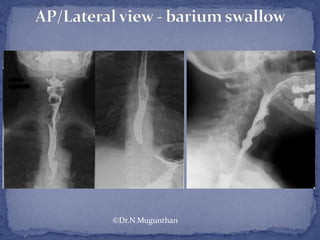
    Killian’s dehiscence(pharyngeal pouch)  Weakarea between thyropharyngeus & cricopharyngeus, thro’ pharyngeal mucosa herniates  Applied importance:  Zenker’s diverticulum: due to neuro muscular incoordination between thyropharyngeus & cricopharyngeus  When thyropharyngeus contracts cricopharyngeus fails to relax.  So food bolus is pushed backwards forms killian’s diverticulum. ©Dr.N.Mugunthan
  • 40.
  • 41.
    Zenker’s diverticulum –Lateralview Zenker’s diverticulum –AP view ©Dr.N.Mugunthan
  • 42.
    I. Branches offacial artery  Ascending palatine artery  Tonsillar artery II. Branch of external carotid artery  Ascending pharyngeal artery III. Branch of lingual artery  Dorsal lingual artery IV. Branches of maxillary artery  Greater palatine artery  Pharyngeal artery  Artery of pterygoid canal ©Dr.N.Mugunthan
  • 43.
     Pharyngeal venous plexus Drain into internal jugular vein and facial vein ©Dr.N.Mugunthan
  • 44.
     Pharyngeal plexusof nerves : Formed by (1) pharyngeal branches of glossopharyngeal nerve (2) pharyngeal branches of vagus nerve (3) Cranial part of accessory nerve (4) Pharyngeal branches of superior cervical sympathetic ganglion. ©Dr.N.Mugunthan
  • 45.
    I. Motor supply:  All muscles of pharynx supplied by -cranial part of accessory nerve except stylopharyngeus.  Stylopharyngeus - glossopharyngeal nerve. ©Dr.N.Mugunthan
  • 46.
    II. Secretomotor (parasympathetic)  Pharyngealbranch of pterygopalatine ganglion. III. Sensory nerve supply :  A. General sensory –9th & 10th cranial nerve.  B. Taste sensation – internal laryngeal branch of vagus. ©Dr.N.Mugunthan
  • 47.
    a) Retropharyngeal lymph nodes b)Parapharyngeal nodes  Deep cervical lymph nodes ©Dr.N.Mugunthan
  • 48.
     Acts asa conduct for air between nose and larynx.  Ventilates midle ear through eustachian tube  Prevents the entry of food into nasopharynx from oropharynx  Acts as a resonating chamber for voice  Acts as a drainage channel for mucus ©Dr.N.Mugunthan
  • 49.
     Deglutition (swallowing) Stages of deglutition : 1. First stage (oral phase) - food from mouth to oropharynx (Voluntary) 2. Second stage (pharyngeal phase)- food from oropharynx upto laryngopharynx. (Involuntary) 3. Third stage (oesophageal phase) - food from laryngopharynx to oesophagus. (Involuntary) ©Dr.N.Mugunthan
  • 50.
  • 51.
  • 52.
  • 53.
  • 54.
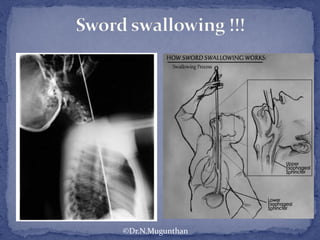
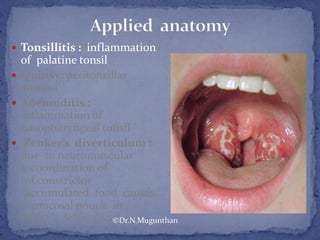
     Tonsillitis :inflammation of palatine tonsil  Quinsy: peritonsillar abscess  Adenoiditis : inflammation of nasopharyngeal tonsil  Zenker’s diverticulum : due to neuromuscular incoordination of inf.constrictor (accumulated food causes a mucosal pouch in killian’s dehiscence).©Dr.N.Mugunthan
  • 55.
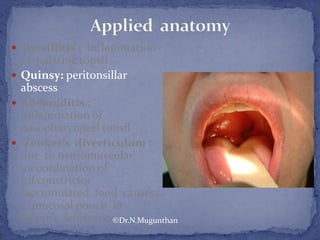
     Tonsillitis :inflammation of palatine tonsil  Quinsy: peritonsillar abscess  Adenoiditis : inflammation of nasopharyngeal tonsil  Zenker’s diverticulum : due to neuromuscular incoordination of inf.constrictor (accumulated food causes a mucosal pouch in killian’s dehiscence).©Dr.N.Mugunthan
  • 56.
     Tonsillitis :inflammation of palatine tonsil  Quinsy: peritonsillar abscess  Adenoiditis : inflammation of nasopharyngeal tonsil  Zenker’s diverticulum : due to neuromuscular incoordination of inf.constrictor (accumulated food causes a mucosal pouch in killian’s dehiscence).©Dr.N.Mugunthan
  • 57.
     Tonsillitis :inflammation of palatine tonsil  Quinsy: peritonsillar abscess  Adenoiditis : inflammation of nasopharyngeal tonsil  Zenker’s diverticulum : due to neuromuscular incoordination of inf.constrictor (accumulated food causes a mucosal pouch in killian’s dehiscence). ©Dr.N.Mugunthan
  • 58.
     Pharyngitis- inflammation ofpharyngeal mucosa -  Nasopharynx -common site of carcinoma [Fossa of Rosen muller ].  Infection from nasopharynx can easily spread into middle ear through auditory tube.  Retropharyngeal abscess.  Smuggler's pouch ( common site of foreign body stuck up) ©Dr.N.Mugunthan
  • 59.
     Pharyngitis- inflammation ofpharyngeal mucosa .  Nasopharynx -common site of carcinoma [Fossa of Rosen muller ].  Infection from nasopharynx can easily spread into middle ear through auditory tube.  Retropharyngeal abscess.  Smuggler's pouch ( common site of foreign body stuck up) ©Dr.N.Mugunthan
  • 60.
     Pharyngitis- inflammation ofpharyngeal mucosa .  Nasopharynx -common site of carcinoma [Fossa of Rosen muller ].  Infection from nasopharynx can easily spread into middle ear through auditory tube.  Retropharyngeal abscess.  Smuggler's pouch ( common site of foreign body stuck up) ©Dr.N.Mugunthan
  • 61.
     Pharyngitis- inflammation ofpharyngeal mucosa .  Nasopharynx -common site of carcinoma [Fossa of Rosen muller ].  Infection from nasopharynx can easily spread into middle ear through auditory tube.  Retropharyngeal abscess.  Smuggler's pouch ( common site of foreign body stuck up) ©Dr.N.Mugunthan
  • 62.
     Pharyngitis- inflammation ofpharyngeal mucosa .  Nasopharynx -common site of carcinoma [Fossa of Rosen muller ].  Infection from nasopharynx can easily spread into middle ear through auditory tube.  Retropharyngeal abscess.  Smuggler's pouch ( common site of foreign body stuck up) ©Dr.N.Mugunthan
  • 63.
     Boundaries ofpharynx  subdivision of Pharynx & it’s features  Structure of pharyngeal wall  Muscles of pharynx  Blood supply  Nerve supply  Lymphatic drainage  Applied anatomy ©Dr.N.Mugunthan
  • 64.
    If any queriesclick @ dr.mugunth111@gmail.com