First Week- Fertilization to
beginning of Implantation
Dr Jyoti Chopra
Professor
KGMU, Lucknow
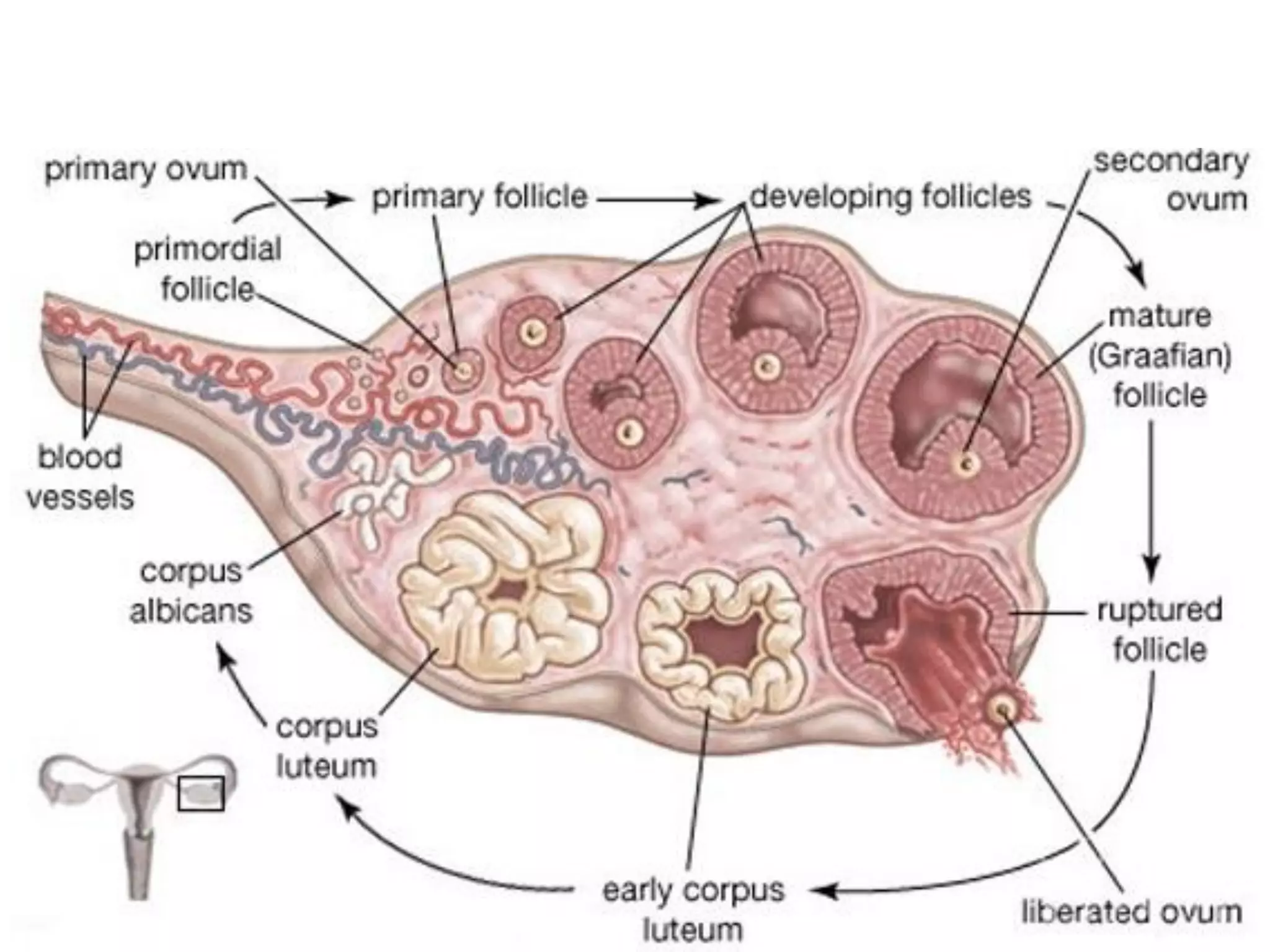
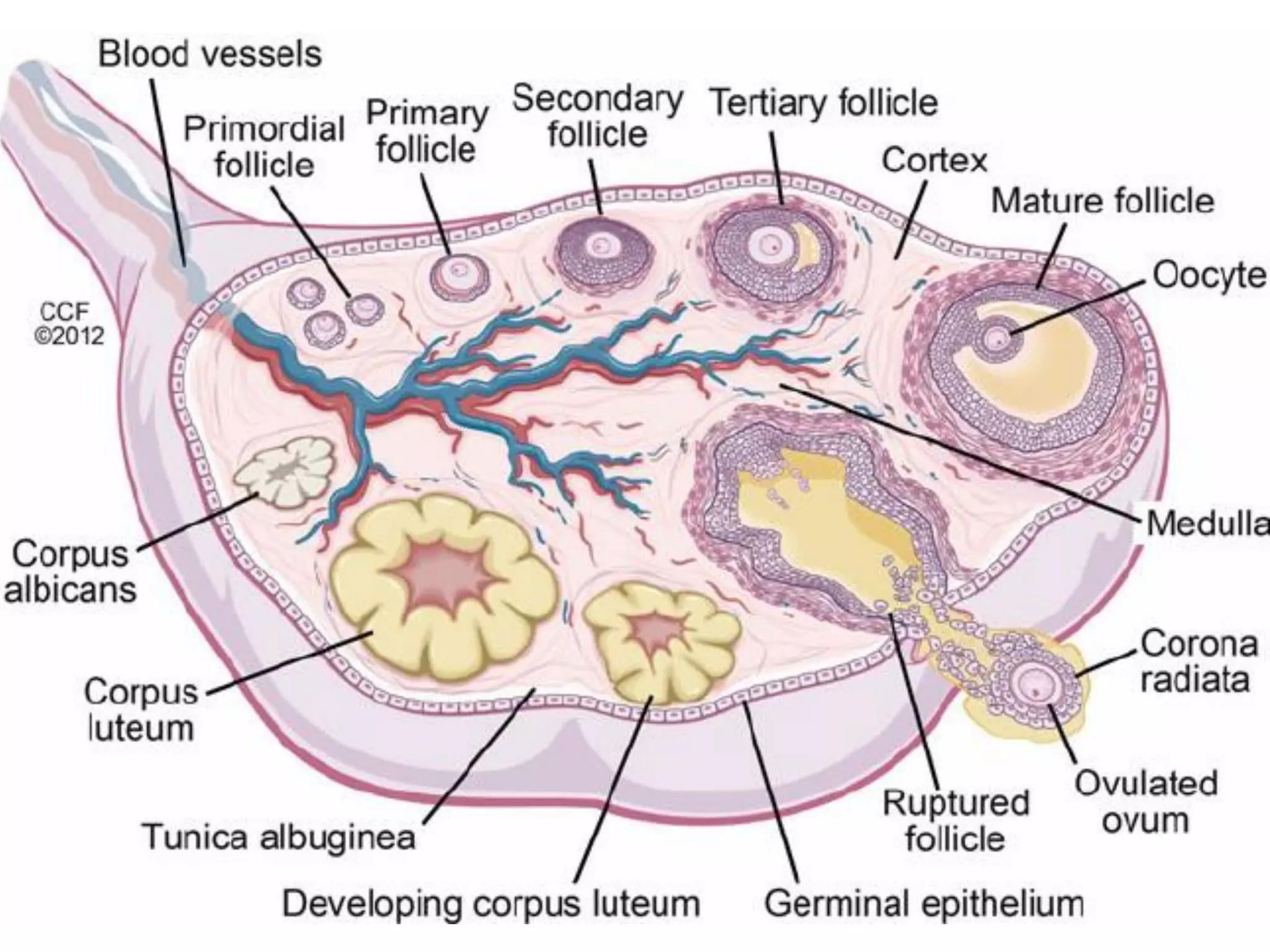
Antral follicle grows rapidly
LH and FSH
Graffian follicle
LH surge
Primary oocyte completes meiosis I
Meiosis II initiated
Arrested in metaphase (3 hrs before ovulation)
Surface bulges, avascular spot- stigma appears
Follicle ruptures, Sec oocyte with surrounding
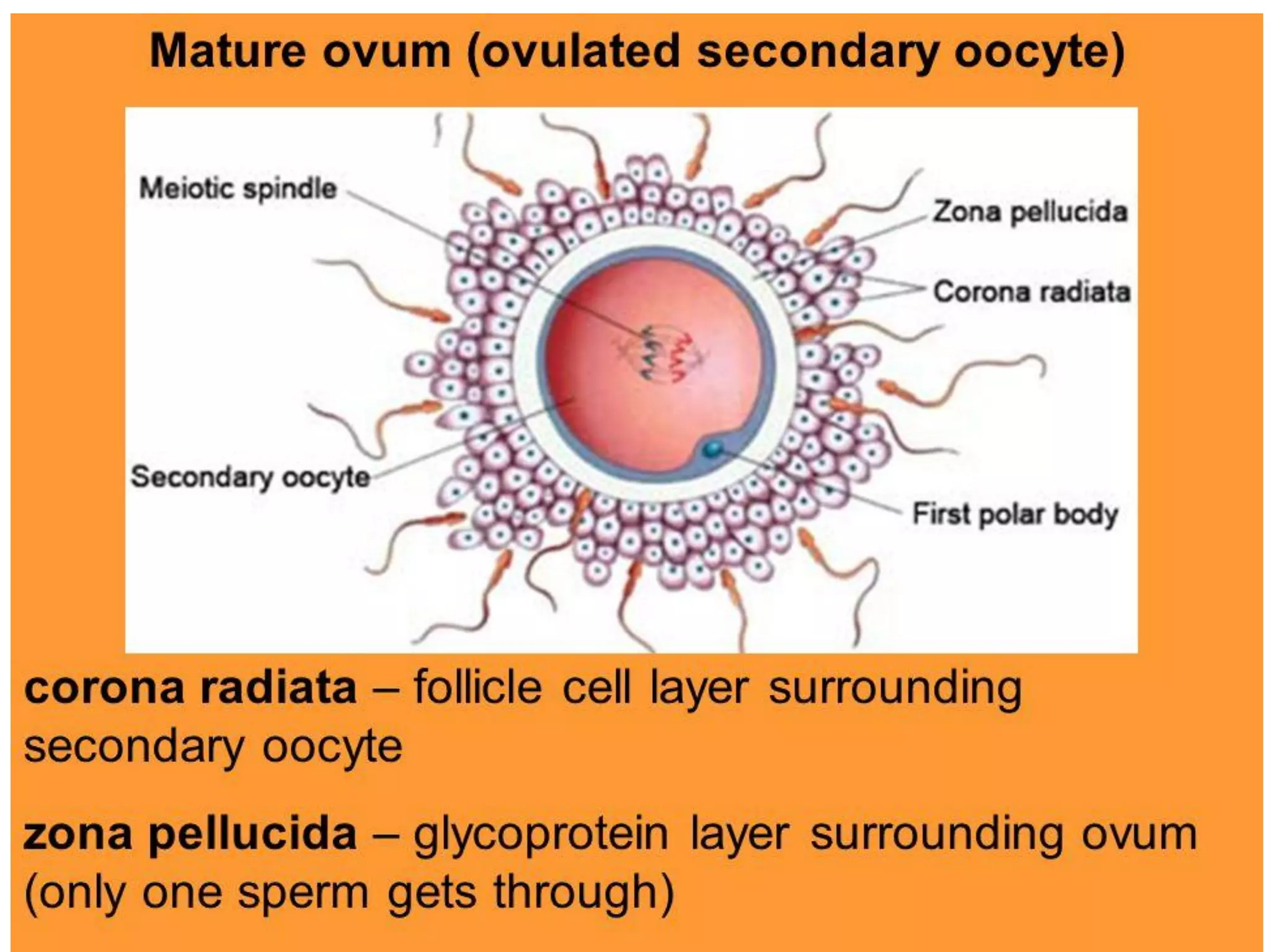
granulosa cells (corona radiata) released
Remaining granulosa cells and theca interna cells- vascularized
Develop yellowish pigment- Lutein cells
Secrets oestrogen and progesterone
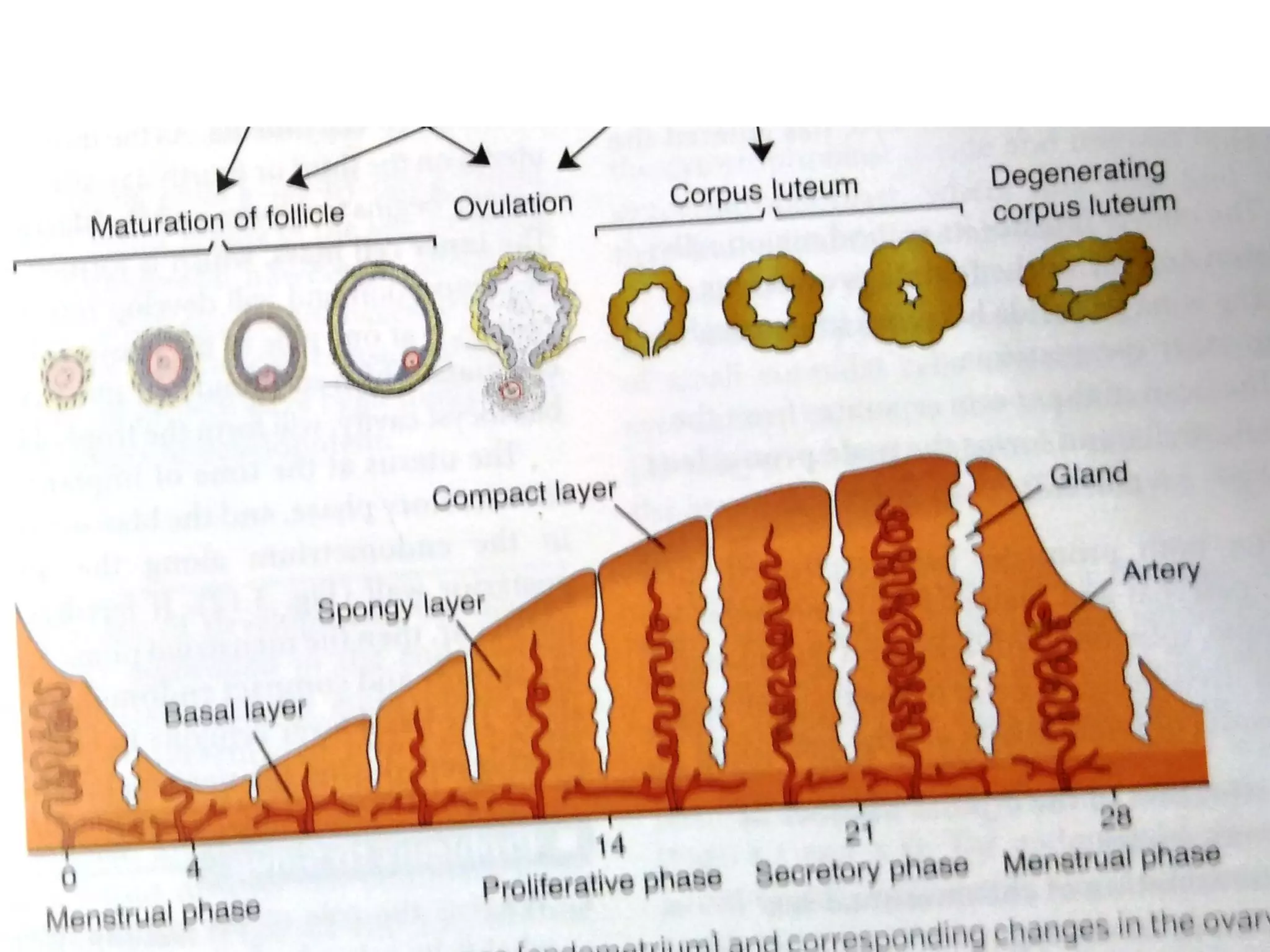
Uterine mucosa enters secretory phase- prepares for implantation
Corpus luteum- maximum development- 9 days after ovulation
No fertilization- degeneration of lutein cells- mass of fibrotic scar-
Corpus albicans- progesterone ↓- menstrual bleeding
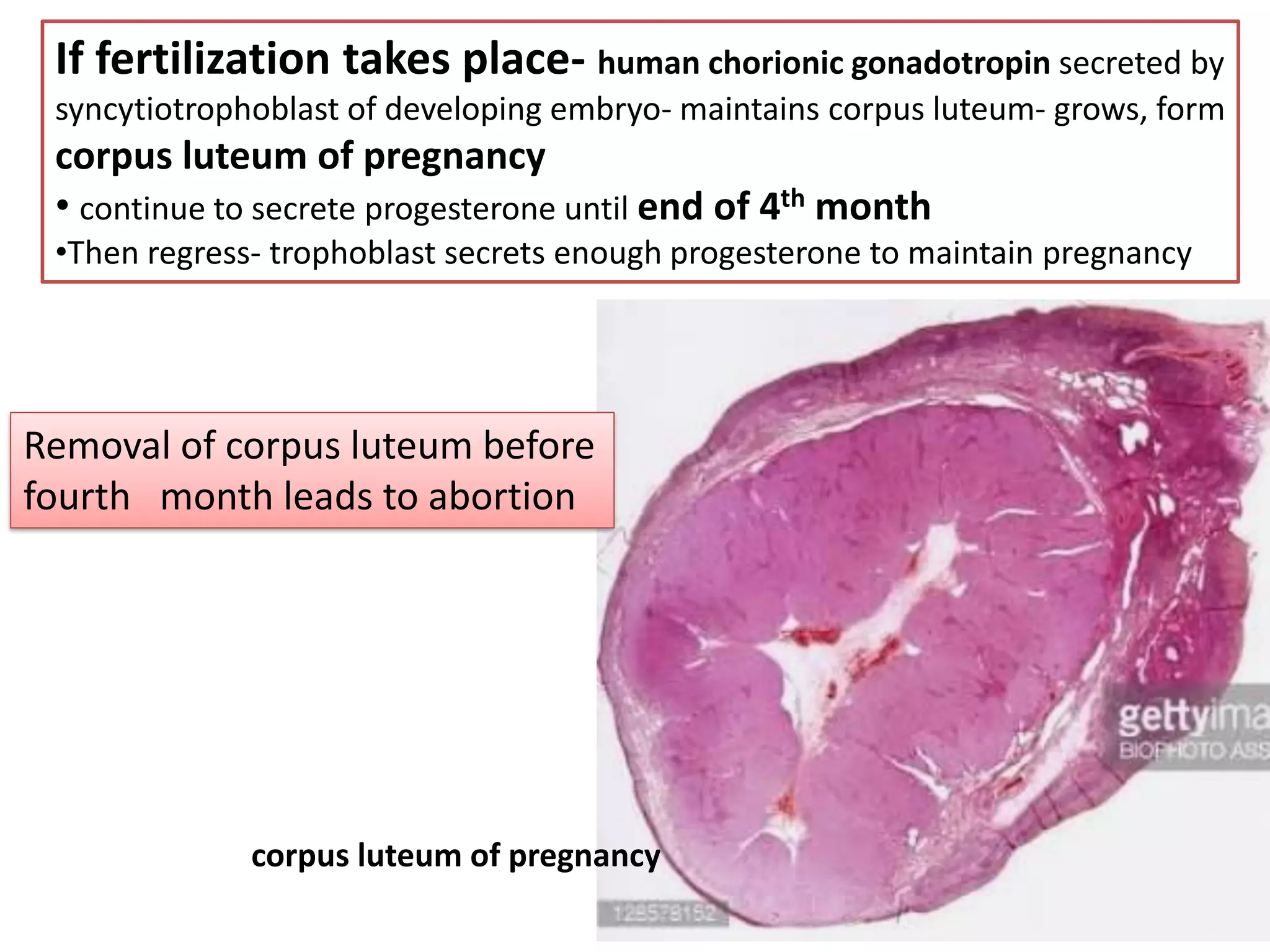
If fertilization takes place- human chorionic gonadotropin secreted by
syncytiotrophoblast of developing embryo- maintains corpus luteum- grows, form
corpus luteum of pregnancy
• continue to secrete progesterone until end of 4th month
•Then regress- trophoblast secrets enough progesterone to maintain pregnancy
Removal of corpus luteum before
fourth month leads to abortion
corpus luteum of pregnancy
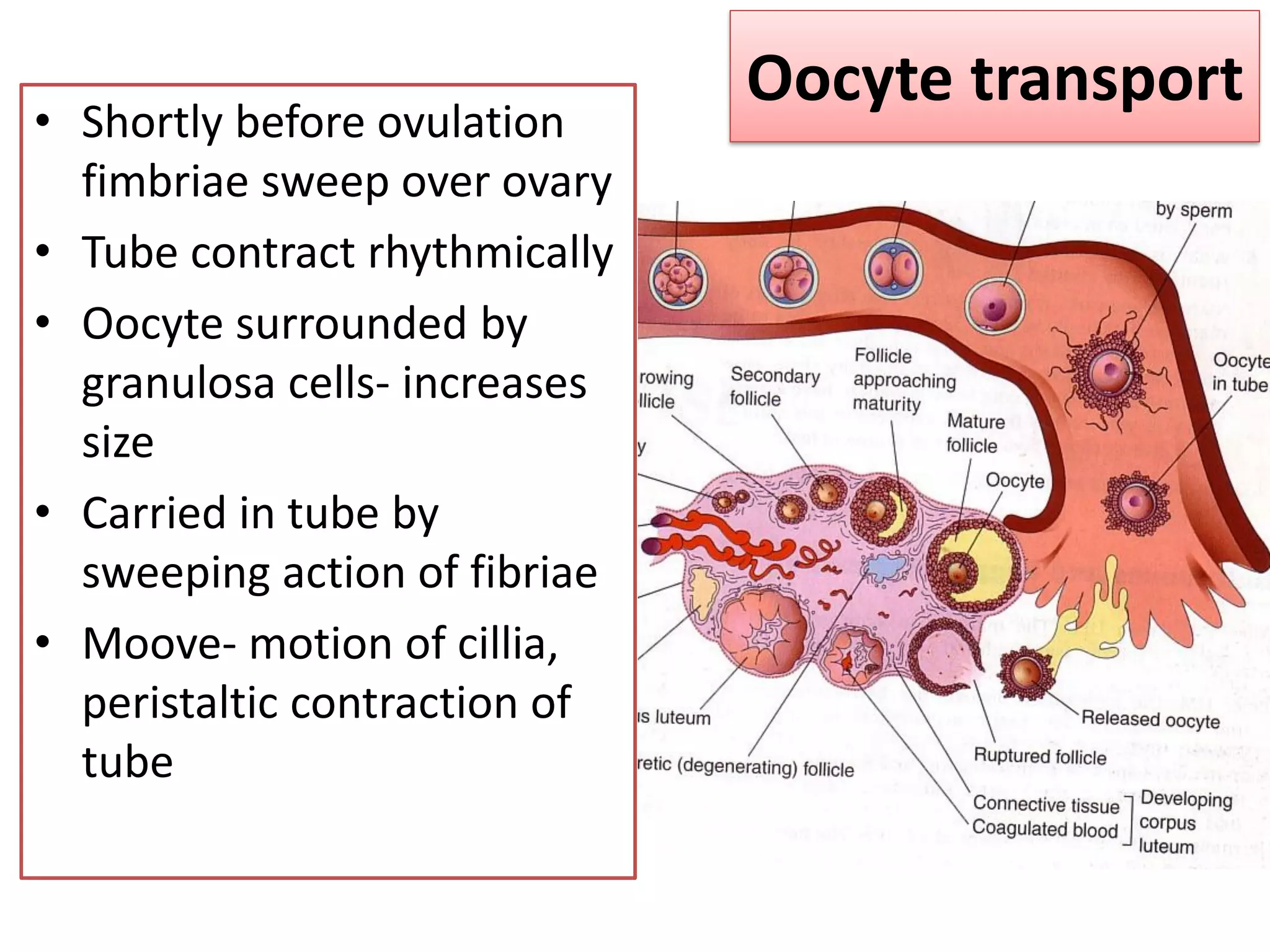
Oocyte transport
• Shortly before ovulation
fimbriae sweep over ovary
• Tube contract rhythmically
• Oocyte surrounded by
granulosa cells- increases
size
• Carried in tube by
sweeping action of fibriae
• Moove- motion of cillia,
peristaltic contraction of
tube
Transport of Sperm
• Only 1% of sperm deposited in vagina reach
cervix
• Movement from cervix to uterine tube- mainly
by muscular contraction- may take 30min to 6
days
• At ovulation sperm again become motile-
chemo-attractants produced by cumulus cells
Sperm Capacitation
• Freshly ejaculated sperms - unable to fertilize oocyte
• Capacitation- period of conditioning in female
reproductive tract
• Takes about 7 hours
• Conditioning occurs mainly in uterine tube
• Glycoprotien coat and seminal plasma protien
removed from plasma membrane of acrosome
• Only capacitated sperm can pass through corona
cells
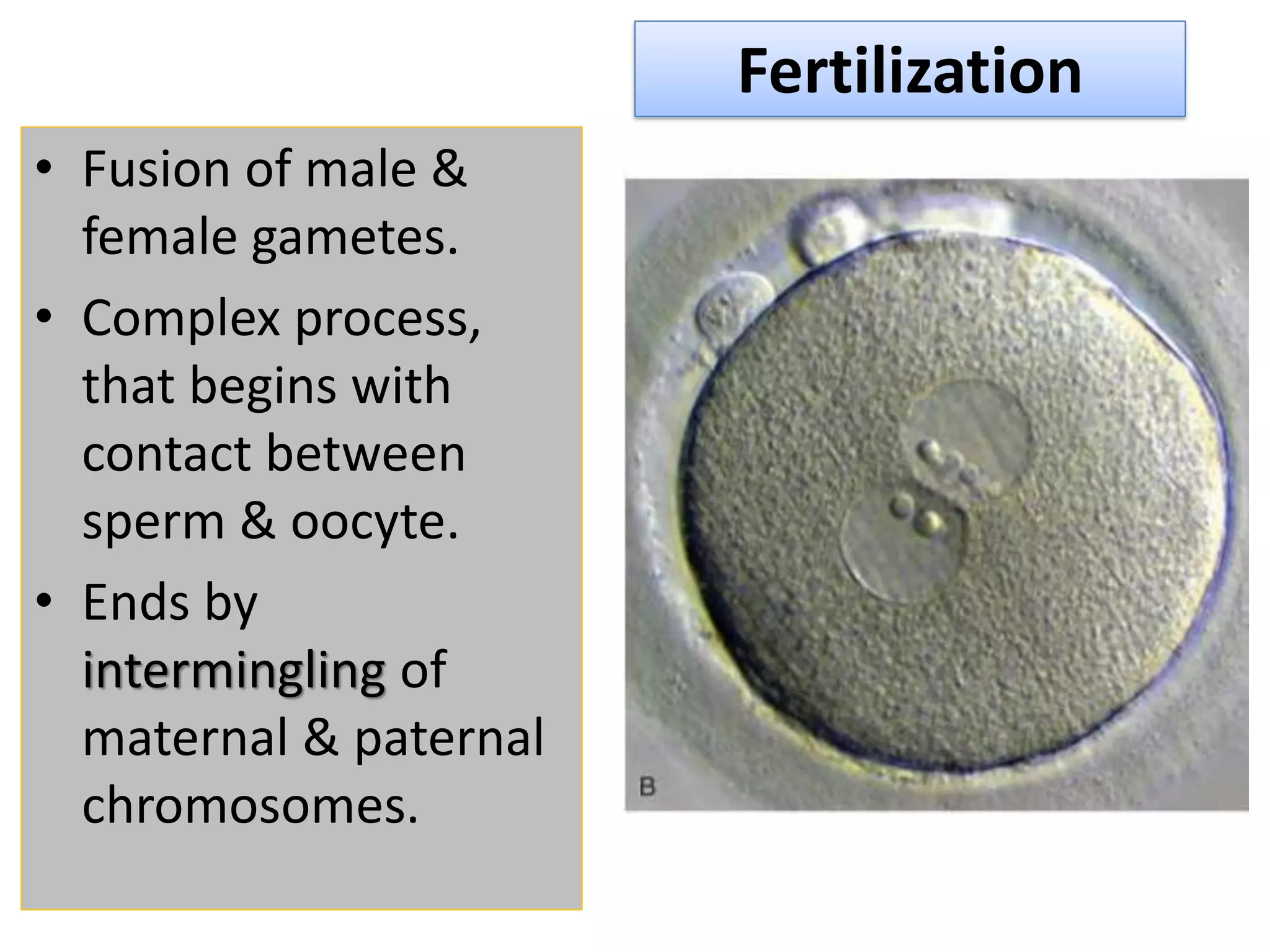
Fertilization
• Fusion of male &
female gametes.
• Complex process,
that begins with
contact between
sperm & oocyte.
• Ends by
intermingling of
maternal & paternal
chromosomes.
Phases of Fertilization
Stage 1: Passage of sperm through Corona Radiata
It results from:
• Action of an
enzyme called
hyaluronidase
released from the
acrosome of the
sperm which helps
in dispersal of
corona radiata
cells.
• Constant
propulsive force of
the sperm's tail.
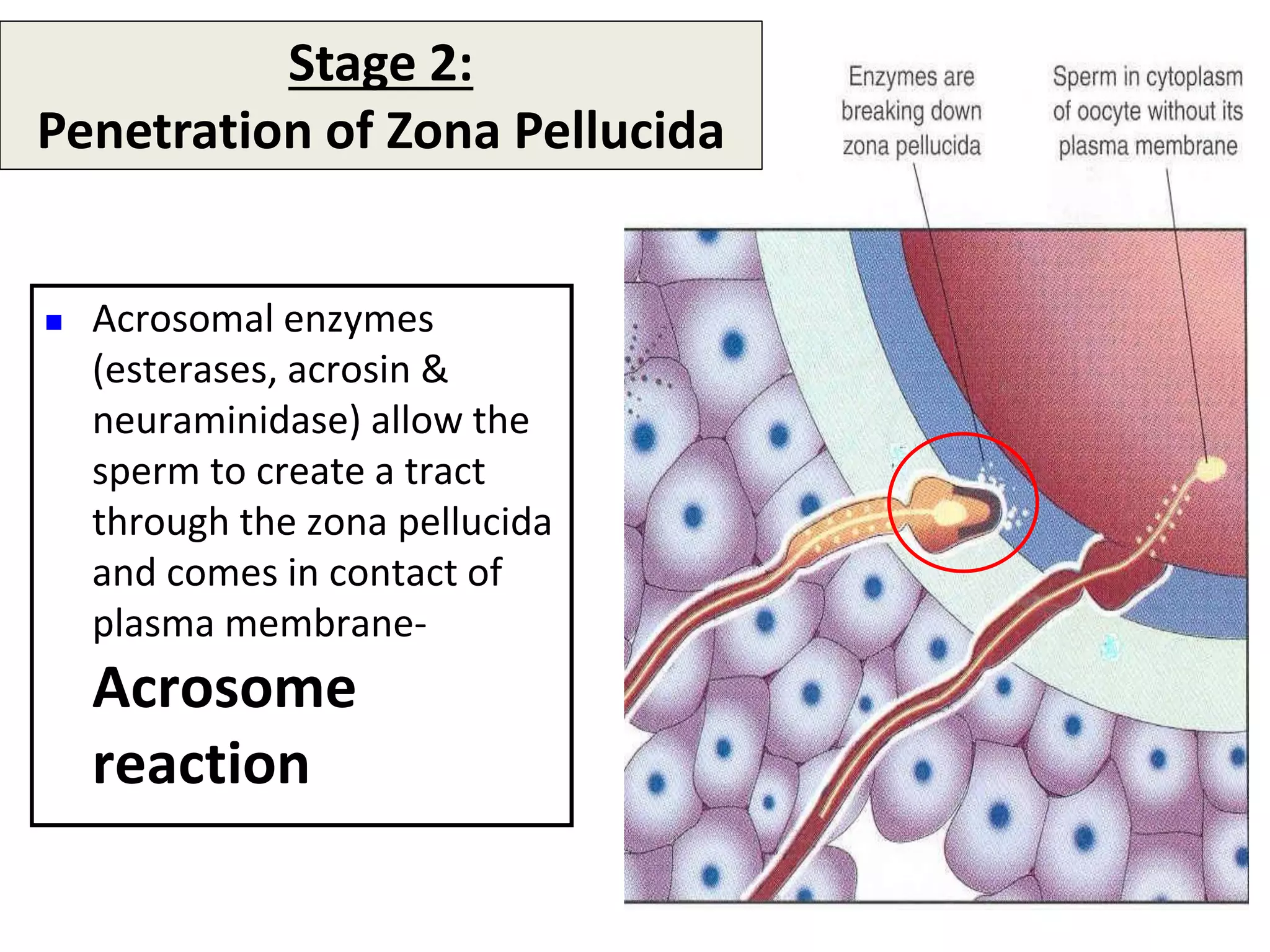
Stage 2:
Penetration of Zona Pellucida
 Acrosomal enzymes
(esterases, acrosin &
neuraminidase) allow the
sperm to create a tract
through the zona pellucida
and comes in contact of
plasma membrane-
Acrosome
reaction
•Head of sperm comes in contact with oocyte surface
•Cortical granules lining plasma membrane of oocyte release lysosomal
enzymes
•Alters property of zona and prevents other sperm from penetrating
egg-thus polyspermy
•Inactivates species specific receptor sites for sperms
Zona Reaction
Stage 3:
Fusion of plasma membranes of oocyte & sperm
Entry of sperm contents into the oocyte, plasma membrane left
behind
Stage 4:
Completion of second
meiotic division of the 2ry
oocyte and formation of
female pronucleus.
Stage 5:
Formation of male pronucleus
Tail detaches and degenerates
Stage 6. Fusion of pronuclei & formation of the zygote
and preparation of first mitotic division
During growth each pronucleus replicates its DNA
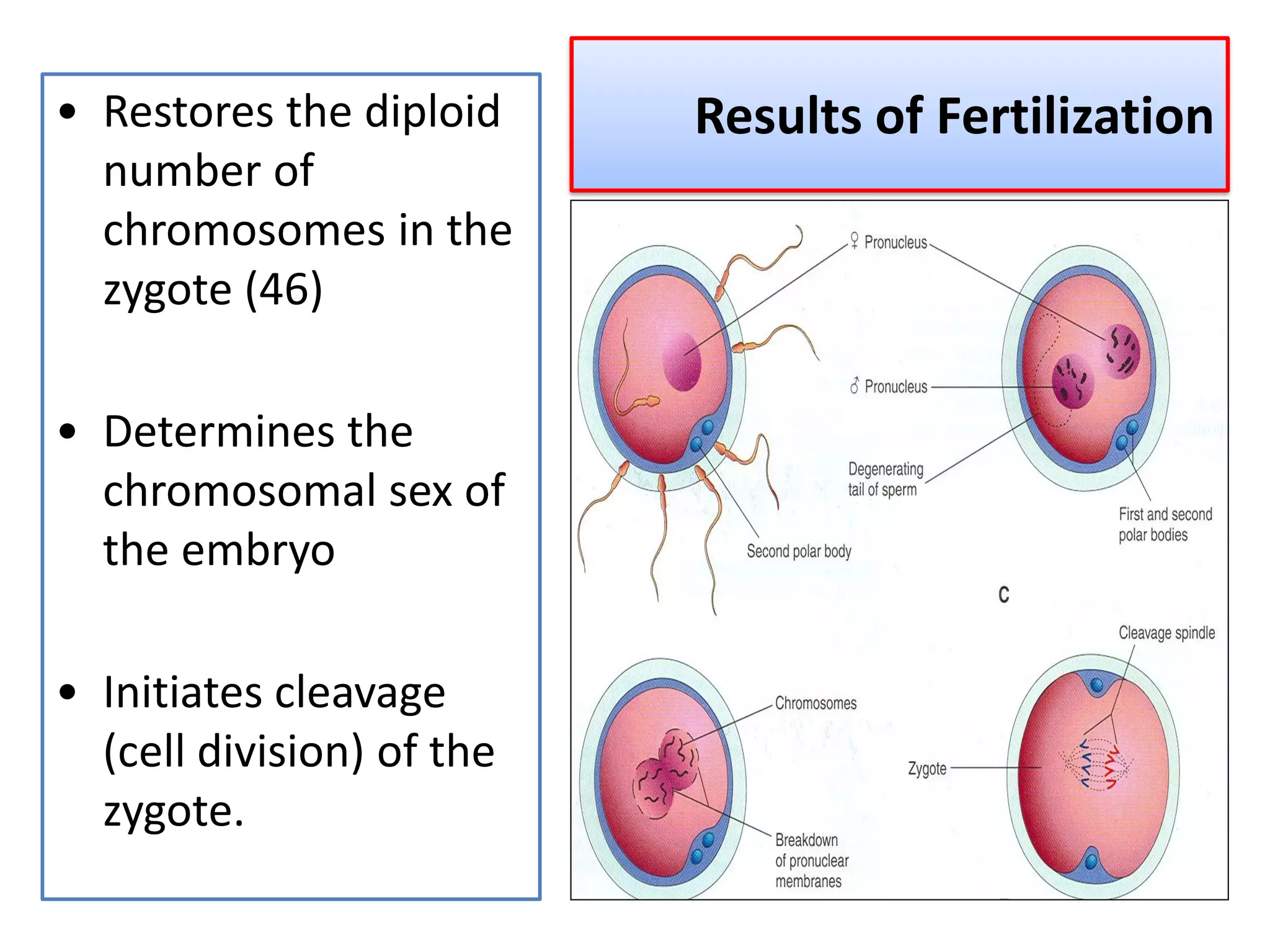
Results of Fertilization• Restores the diploid
number of
chromosomes in the
zygote (46)
• Determines the
chromosomal sex of
the embryo
• Initiates cleavage
(cell division) of the
zygote.
Sex of the Embryo
• Embryo's chromosomal sex is determined
at the time of fertilization.
• Sex is determined by the type of sperm (X
or Y) that fertilizes the oocyte.
• So, it is the father whose gamete decides
the sex of the embryo.
Viability of Gametes
• Oocytes should be
fertilized within
12-24 hours after
ovulation.
• After 24 hours it
starts degenerating
• Human sperms
survive for approx 5
days in female
genital tract
• Safe period- except
5days before and 2
days after ovulation
Site of Fertilization
• Normal site-
ampulla of
uterine tube
• It may occur in
other parts of
the tube but
never in the
uterus.
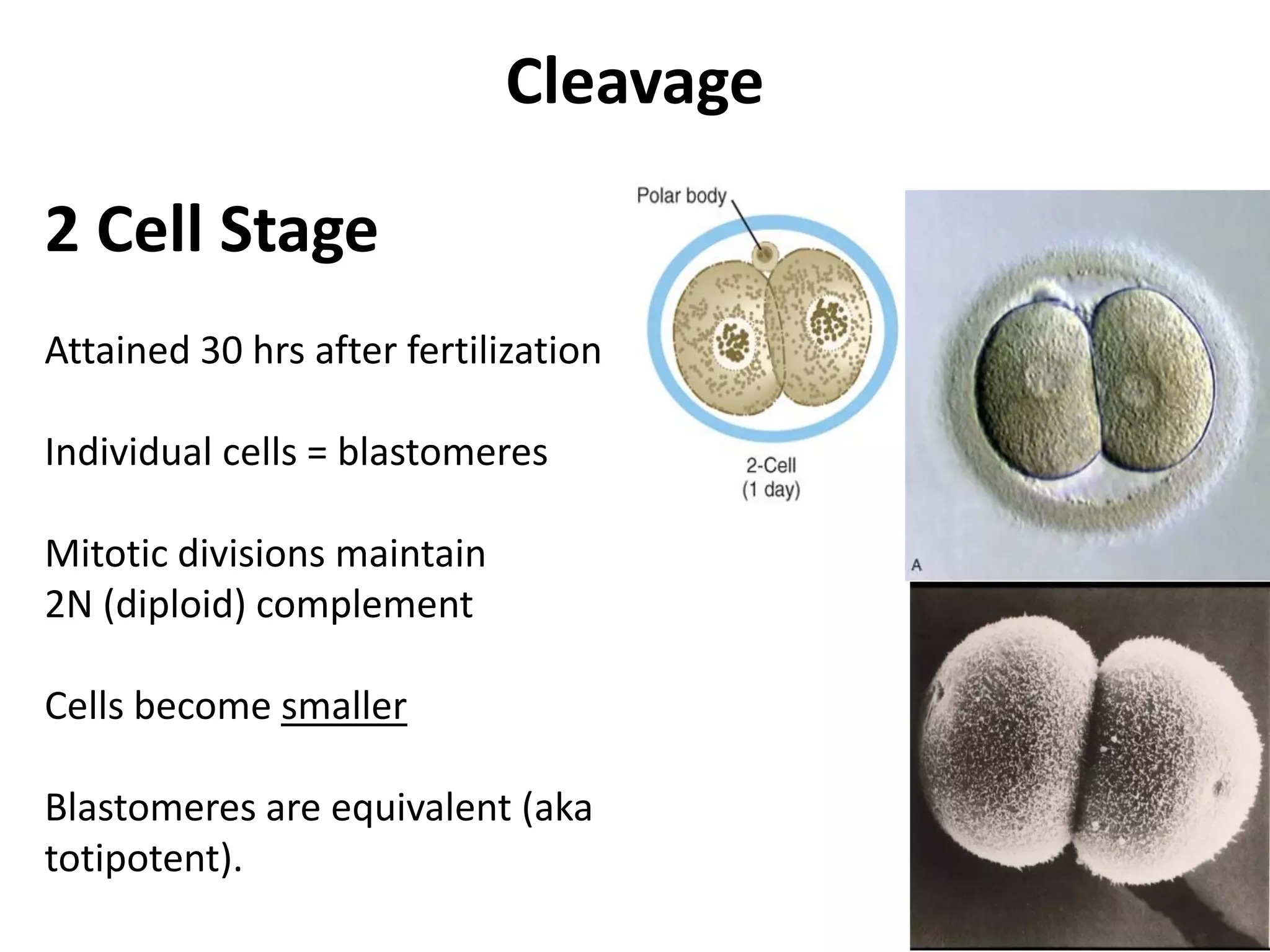
2 Cell Stage
Attained 30 hrs after fertilization
Individual cells = blastomeres
Mitotic divisions maintain
2N (diploid) complement
Cells become smaller
Blastomeres are equivalent (aka
totipotent).
Cleavage
4 cell; second cleavage
4 equivalent blastomeres
Still in zona pellucida
40 hrs after fertilization
8 Cell;
third
cleavage
Blastomeres still
equivalent
Embryo undergoes compaction after 8-cell stage
Caused by increased cell-cell adhesion
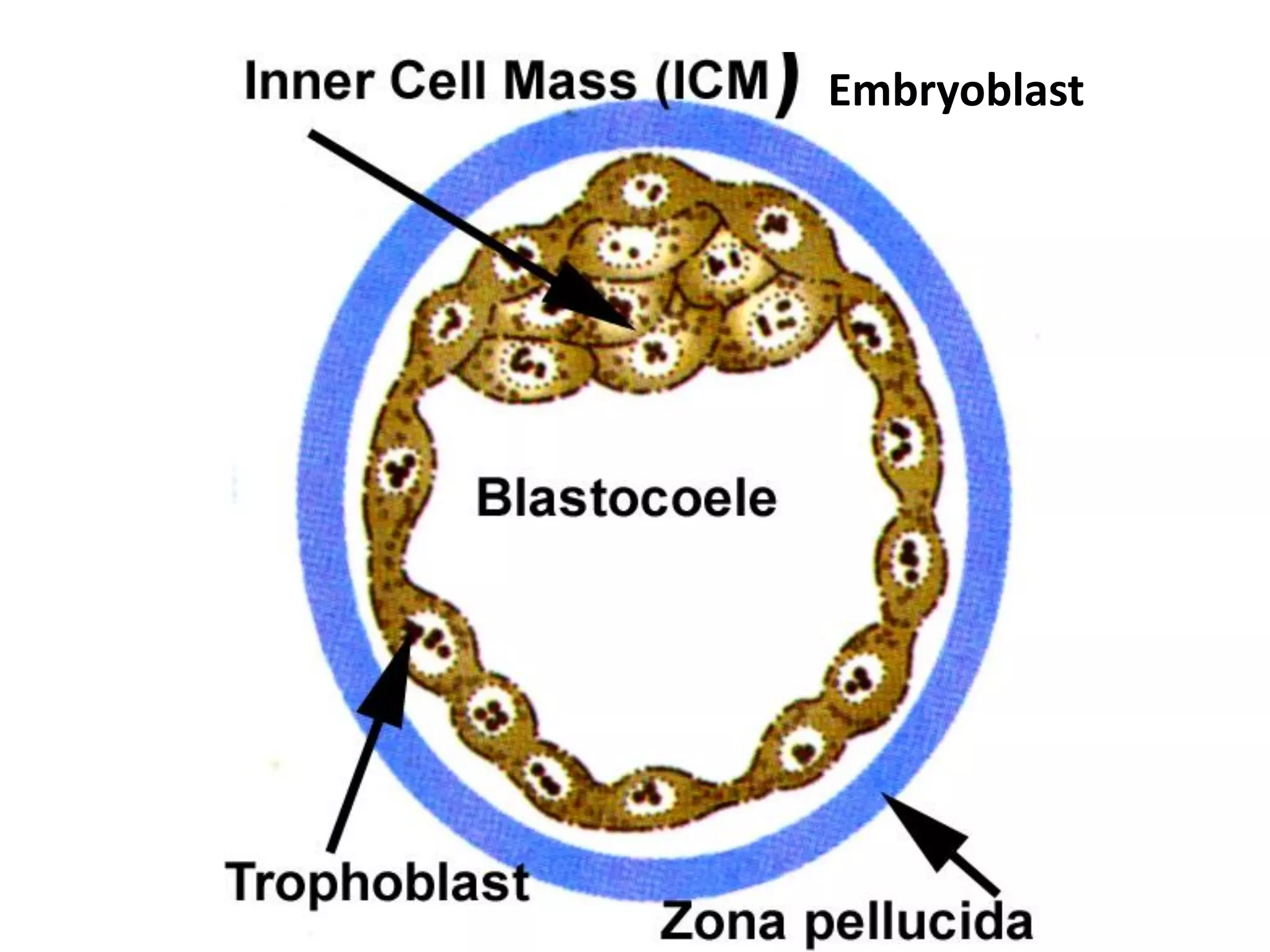
Cells that are forced to the outside of the morula are destined
to become trophoblast--cells that will form placenta
The inner cells will form the embryo proper and are called the
inner cell mass (ICM).
3days after fertilization 16-cell morula forms
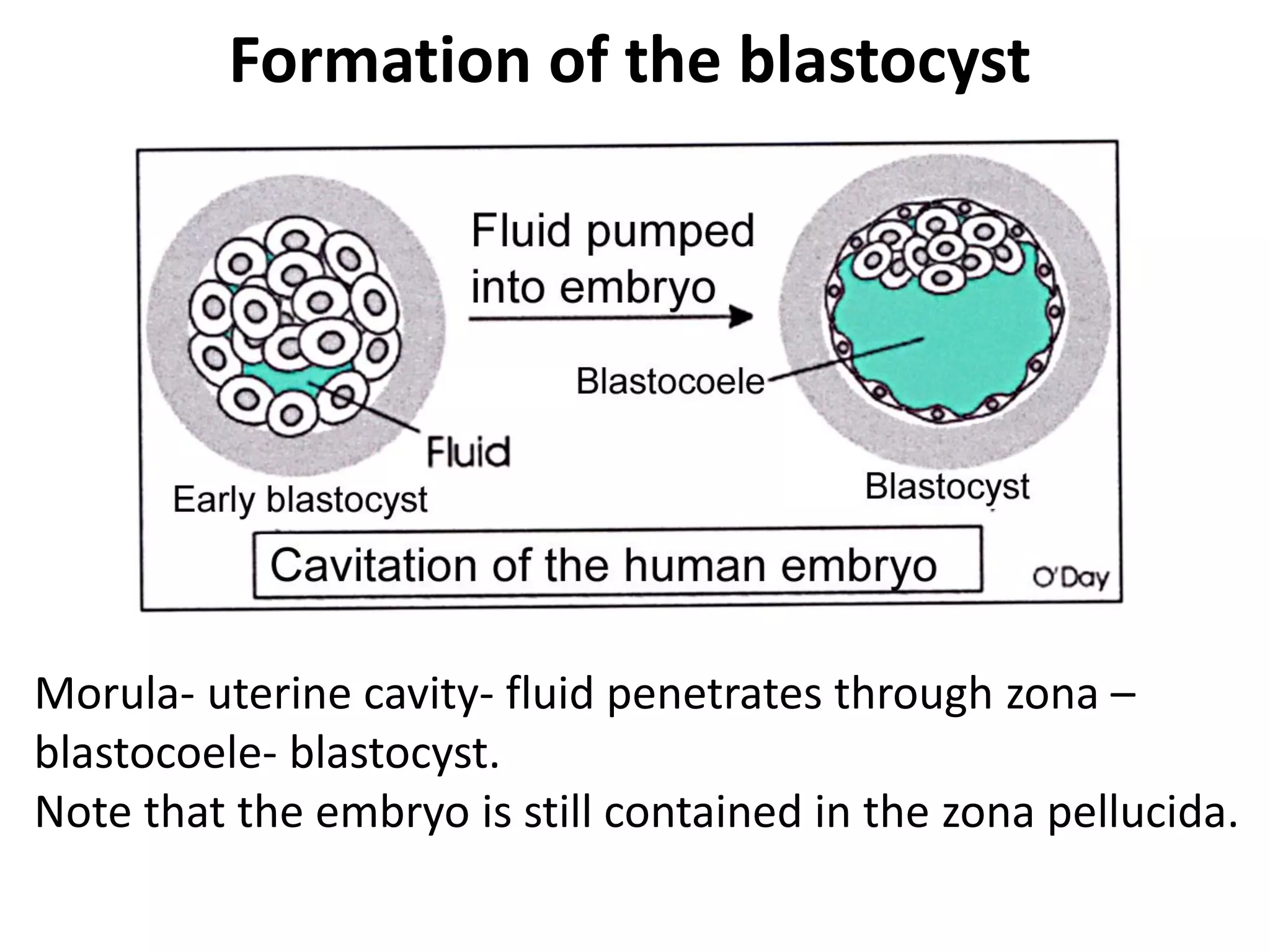
Formation of the blastocyst
Morula- uterine cavity- fluid penetrates through zona –
blastocoele- blastocyst.
Note that the embryo is still contained in the zona pellucida.
Embryoblast
Early blastocyst
Day 3
Later blastocyst
Day 5
blastocoele
inner cell mass
“Hatching” of the blastocyst:
preparation for implantation
Hatching of the embryo from the zona pellucida- 5th day after
fertilization
inability to hatch results in infertility, and premature hatching can
result in abnormal implantation in the uterine tube.
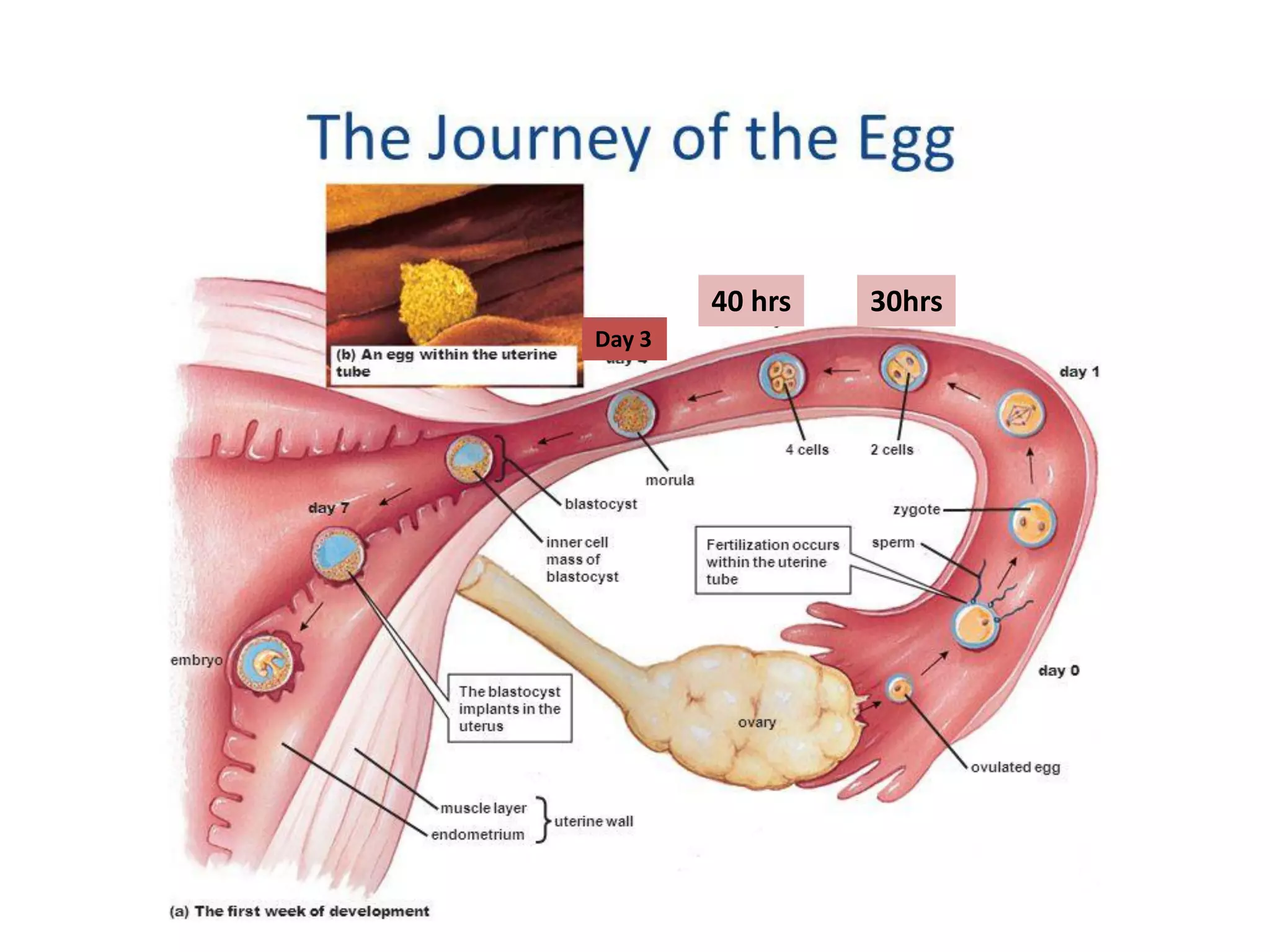
The Journey of Egg
Uterus at the time of Implantation
Hormonal methods of contraception
Contraceptive pills- Oestrogen & Progesterone
• Pack of 28 pills- 21 contain hormone, last 7 plain
• Start on day 5
• Progesterone in preovulatory phase inhibits
ovulation by preventing release of LH & FSH
• Changing lining of uterus, thickening cervical
mucus
Male Pill- contains synthetic androgen thus prevents
LH & FSH secretion- stops sperm production to 70-
90% or reduces to level of infertility
IUD (Intra Uterine Device)
• Small T shaped unit- hormonal/ copper
• Releases progestin- cervical mucus thick
• Makes sperm less active & germ cells less viable
• Copper prevents fertilization, prevents sperm
from entering uterine tube, inhibits implantation
Emergency contraceptive pills
• Prevent pregnancy if taken 120 hrs after sexual
contact
• Act as anti hormonal agent and abortifacient
IVF (In Vitro Fertilization)
• Follicle growth in ovary is stimulated by
gonadotropins
• Oocyte recovered from follicle just before ouvulation
• Oocyte placed in culture medium and sperm added
• Fertilized egg monitored till 8 cell stage and then
placed in uterus
• Low success rate (30% for women younger than 35
yrs)
• To increase success rate multiple oocyte collected
fertilized and placed in uterus- chances of multiple
birth
Male infertility
Oligozoospermia- 2-5 ml semen ejaculated, 100
million live sperm/ml. If less than 20 million/ml
difficulty in fertilization
Azoospermia- no live sperms
ICSI (Intra cytoplasmic sperm injection)- single
sperm injected in cytoplasm of egg- associated
with higher incidence of birth defects
Implantation
• Process by which blastocyst penetrates
superficial (Compact) layer of endometrium of
uterus.
Site:
• Anterior or Posterior wall of uterus near
fundus
Time:
• Begins about 6th day after fertilization
• Completed by 11th or 12th day
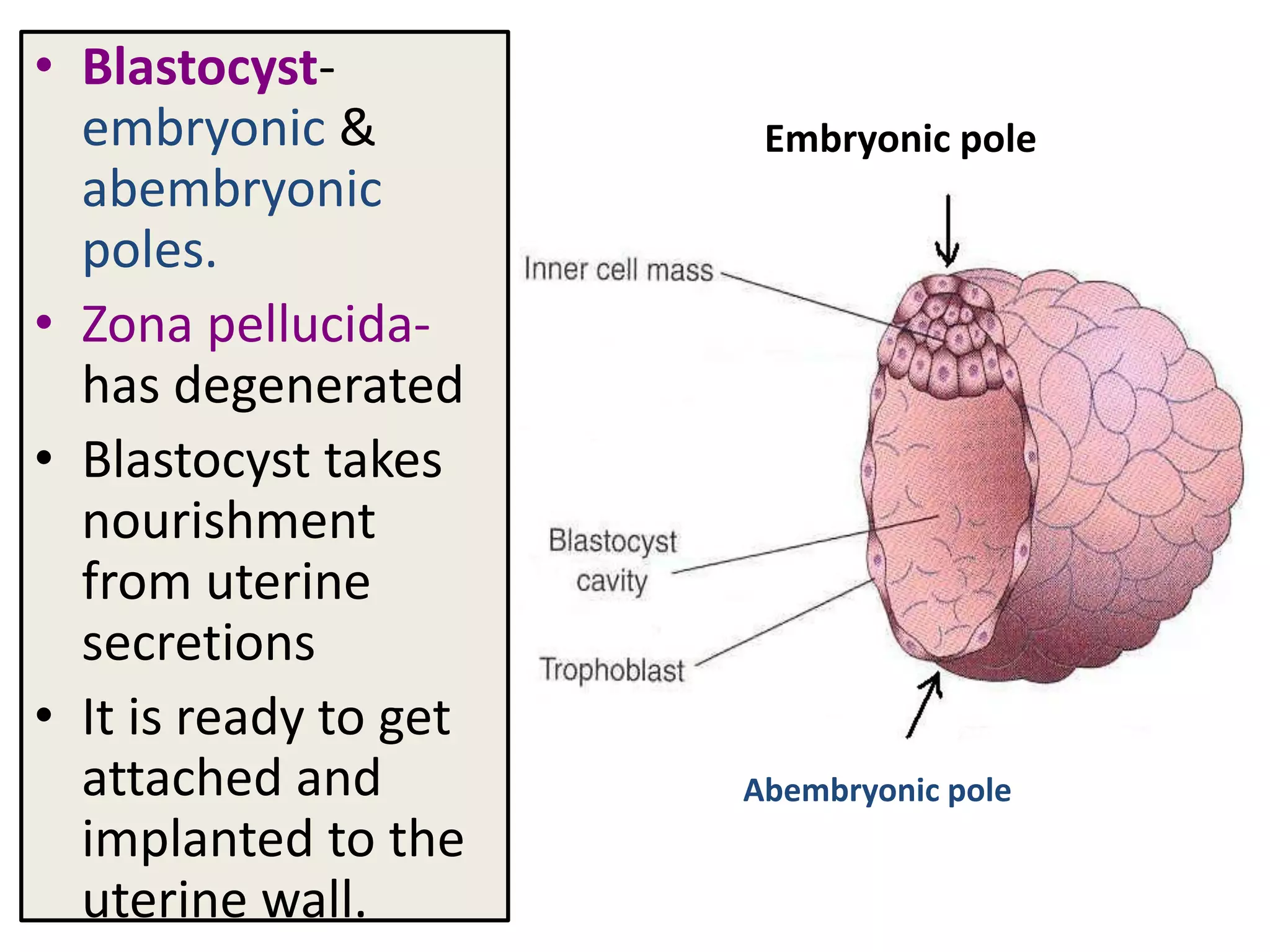
• Blastocyst-
embryonic &
abembryonic
poles.
• Zona pellucida-
has degenerated
• Blastocyst takes
nourishment
from uterine
secretions
• It is ready to get
attached and
implanted to the
uterine wall.
Embryonic pole
Abembryonic pole
Implantation
• 6 days after
fertilization:
Blastocyst
attaches to
the
endometrial
epithelium, at
its embryonic
pole.
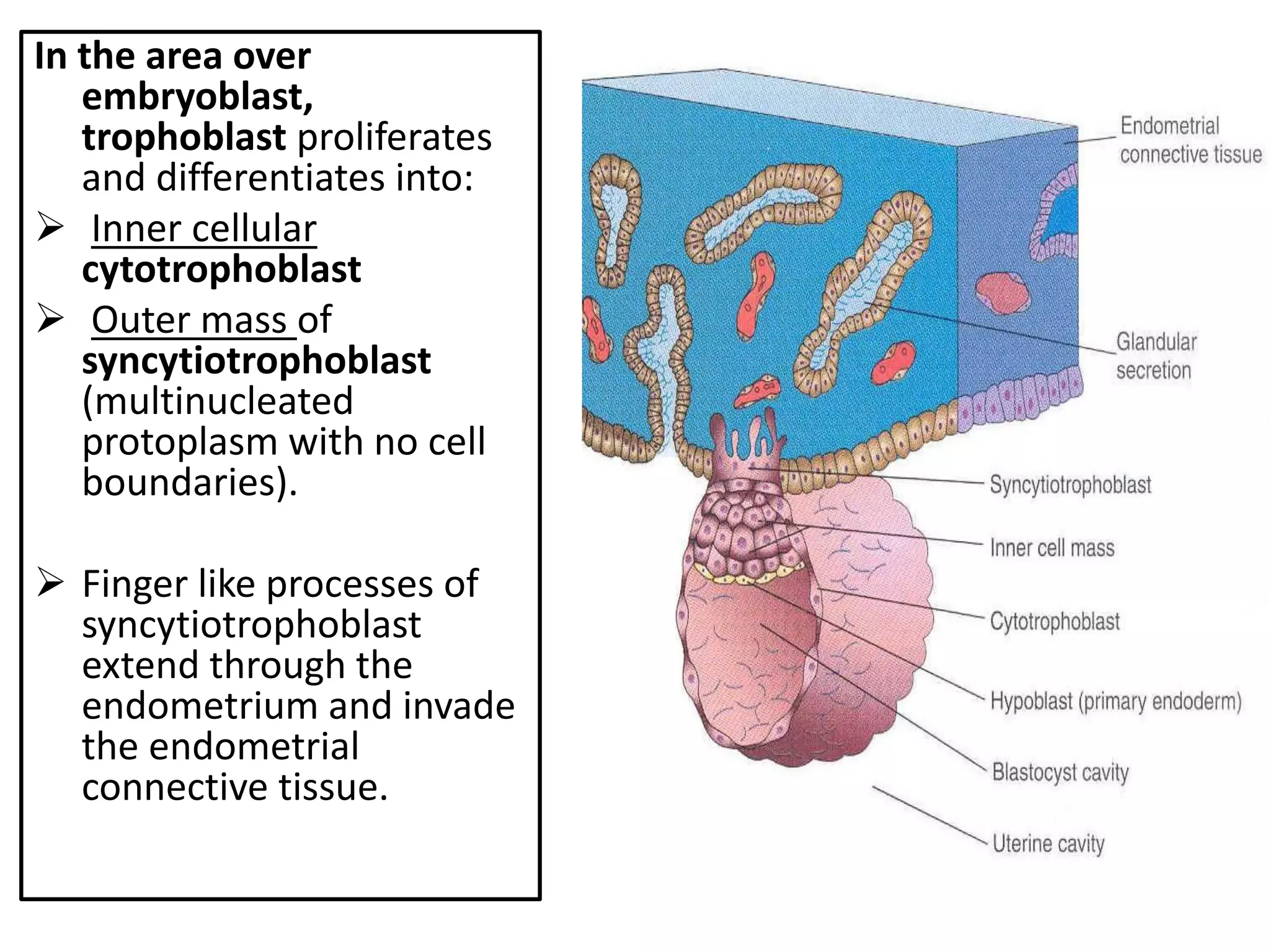
In the area over
embryoblast,
trophoblast proliferates
and differentiates into:
 Inner cellular
cytotrophoblast
 Outer mass of
syncytiotrophoblast
(multinucleated
protoplasm with no cell
boundaries).
 Finger like processes of
syncytiotrophoblast
extend through the
endometrium and invade
the endometrial
connective tissue.
• By 8th day,
blastocyst gets
partially
embedded in the
superficial
compact layer of
the endometrium
and derives its
nourishment from
the eroded
endometrium
• Blastocyst gradually
embed deeper
• Defect in
endometrial
epithelium filled by
fibrin coagulum
(closing plug) (day
9)
• Vacuoles appear in
syncytiotrophoblast
- fuse to form
lacunae
• The defect disappear-
endometrial
epithelium repaired
(day 12 & 13)
• Lacunar spaces form
network mainly at
embryonic pole
• Syncytiotrophoblast
erode maternal
capillaries
• Lacunae filled with
maternal blood
• Primitive
uteroplacental
circulation
established
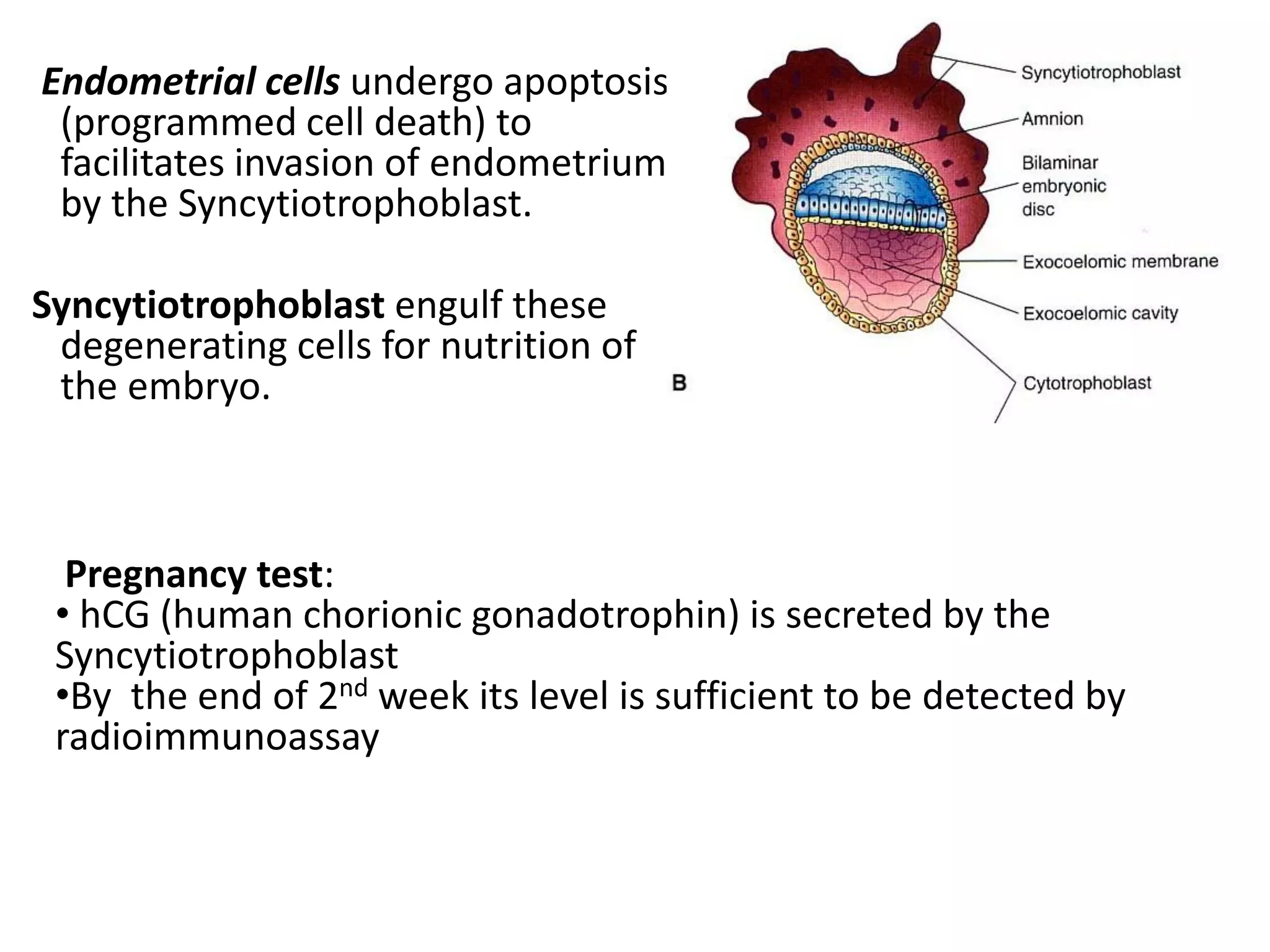
Endometrial cells undergo apoptosis
(programmed cell death) to
facilitates invasion of endometrium
by the Syncytiotrophoblast.
Syncytiotrophoblast engulf these
degenerating cells for nutrition of
the embryo.
Pregnancy test:
• hCG (human chorionic gonadotrophin) is secreted by the
Syncytiotrophoblast
•By the end of 2nd week its level is sufficient to be detected by
radioimmunoassay
• Uterine:
 Usually occurs in the
posterior wall of the body
of uterus near the fundus.
 Implantation in the lower
segment leads to placenta
Praevia
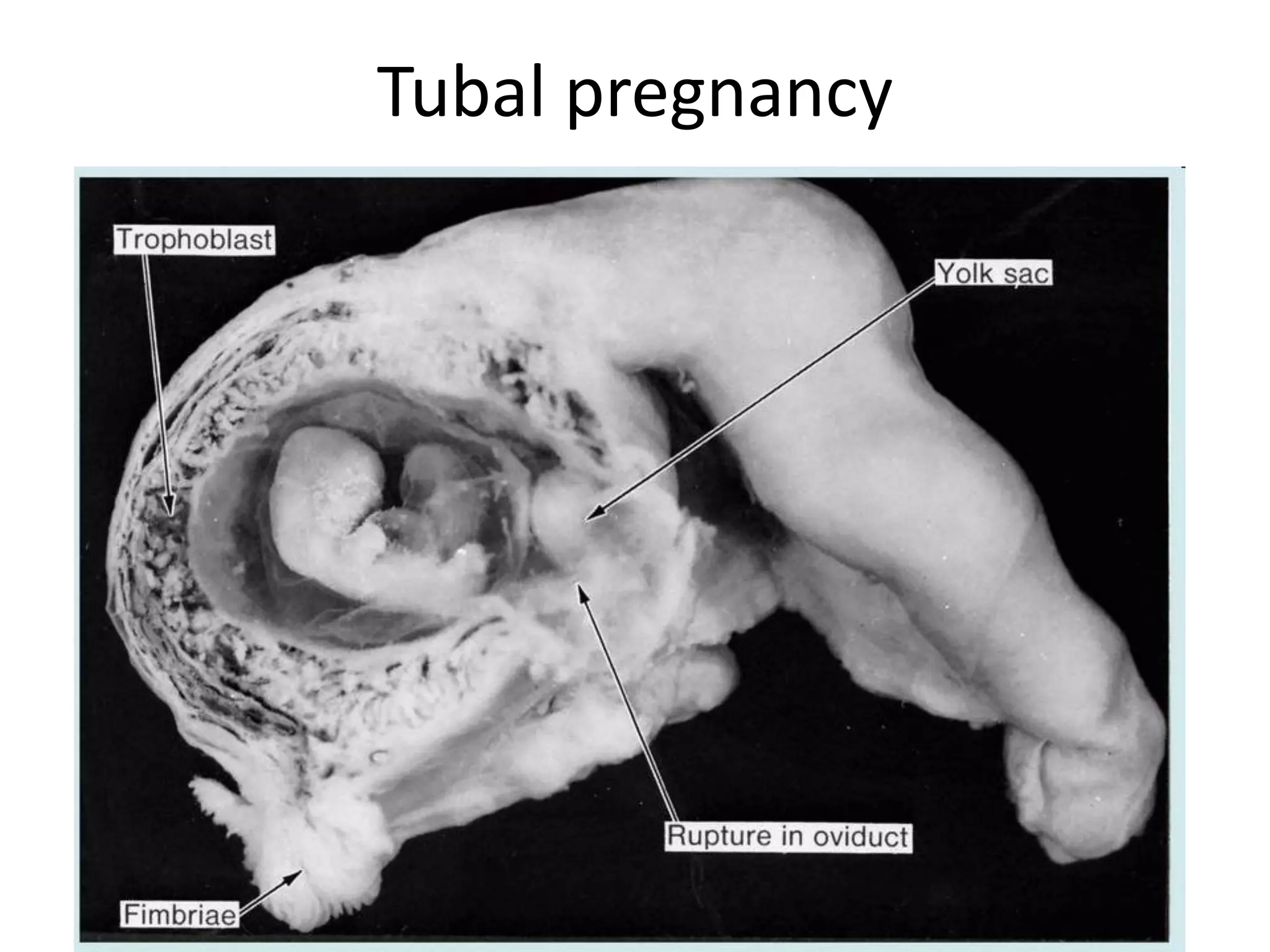
• Extrauterine: leading to
ectopic pregnancies:
 Fallopian tube
 Ovary
 Abdomen
 Cervical
 “Rupture” can lead to life-
threatening hemorrhage
Tubal pregnancy
30hrs40 hrs
Day 3

Ovulation to implantation

  • 1.
    First Week- Fertilizationto beginning of Implantation Dr Jyoti Chopra Professor KGMU, Lucknow
  • 2.
    Antral follicle growsrapidly LH and FSH Graffian follicle LH surge Primary oocyte completes meiosis I Meiosis II initiated Arrested in metaphase (3 hrs before ovulation) Surface bulges, avascular spot- stigma appears Follicle ruptures, Sec oocyte with surrounding granulosa cells (corona radiata) released
  • 6.
    Remaining granulosa cellsand theca interna cells- vascularized Develop yellowish pigment- Lutein cells Secrets oestrogen and progesterone Uterine mucosa enters secretory phase- prepares for implantation Corpus luteum- maximum development- 9 days after ovulation No fertilization- degeneration of lutein cells- mass of fibrotic scar- Corpus albicans- progesterone ↓- menstrual bleeding
  • 7.
    If fertilization takesplace- human chorionic gonadotropin secreted by syncytiotrophoblast of developing embryo- maintains corpus luteum- grows, form corpus luteum of pregnancy • continue to secrete progesterone until end of 4th month •Then regress- trophoblast secrets enough progesterone to maintain pregnancy Removal of corpus luteum before fourth month leads to abortion corpus luteum of pregnancy
  • 8.
    Oocyte transport • Shortlybefore ovulation fimbriae sweep over ovary • Tube contract rhythmically • Oocyte surrounded by granulosa cells- increases size • Carried in tube by sweeping action of fibriae • Moove- motion of cillia, peristaltic contraction of tube
  • 9.
    Transport of Sperm •Only 1% of sperm deposited in vagina reach cervix • Movement from cervix to uterine tube- mainly by muscular contraction- may take 30min to 6 days • At ovulation sperm again become motile- chemo-attractants produced by cumulus cells
  • 10.
    Sperm Capacitation • Freshlyejaculated sperms - unable to fertilize oocyte • Capacitation- period of conditioning in female reproductive tract • Takes about 7 hours • Conditioning occurs mainly in uterine tube • Glycoprotien coat and seminal plasma protien removed from plasma membrane of acrosome • Only capacitated sperm can pass through corona cells
  • 11.
    Fertilization • Fusion ofmale & female gametes. • Complex process, that begins with contact between sperm & oocyte. • Ends by intermingling of maternal & paternal chromosomes.
  • 12.
    Phases of Fertilization Stage1: Passage of sperm through Corona Radiata It results from: • Action of an enzyme called hyaluronidase released from the acrosome of the sperm which helps in dispersal of corona radiata cells. • Constant propulsive force of the sperm's tail.
  • 13.
    Stage 2: Penetration ofZona Pellucida  Acrosomal enzymes (esterases, acrosin & neuraminidase) allow the sperm to create a tract through the zona pellucida and comes in contact of plasma membrane- Acrosome reaction
  • 14.
    •Head of spermcomes in contact with oocyte surface •Cortical granules lining plasma membrane of oocyte release lysosomal enzymes •Alters property of zona and prevents other sperm from penetrating egg-thus polyspermy •Inactivates species specific receptor sites for sperms Zona Reaction
  • 15.
    Stage 3: Fusion ofplasma membranes of oocyte & sperm Entry of sperm contents into the oocyte, plasma membrane left behind
  • 16.
    Stage 4: Completion ofsecond meiotic division of the 2ry oocyte and formation of female pronucleus. Stage 5: Formation of male pronucleus Tail detaches and degenerates
  • 17.
    Stage 6. Fusionof pronuclei & formation of the zygote and preparation of first mitotic division During growth each pronucleus replicates its DNA
  • 18.
    Results of Fertilization•Restores the diploid number of chromosomes in the zygote (46) • Determines the chromosomal sex of the embryo • Initiates cleavage (cell division) of the zygote.
  • 19.
    Sex of theEmbryo • Embryo's chromosomal sex is determined at the time of fertilization. • Sex is determined by the type of sperm (X or Y) that fertilizes the oocyte. • So, it is the father whose gamete decides the sex of the embryo.
  • 20.
    Viability of Gametes •Oocytes should be fertilized within 12-24 hours after ovulation. • After 24 hours it starts degenerating • Human sperms survive for approx 5 days in female genital tract • Safe period- except 5days before and 2 days after ovulation
  • 21.
    Site of Fertilization •Normal site- ampulla of uterine tube • It may occur in other parts of the tube but never in the uterus.
  • 22.
    2 Cell Stage Attained30 hrs after fertilization Individual cells = blastomeres Mitotic divisions maintain 2N (diploid) complement Cells become smaller Blastomeres are equivalent (aka totipotent). Cleavage
  • 23.
    4 cell; secondcleavage 4 equivalent blastomeres Still in zona pellucida 40 hrs after fertilization
  • 24.
  • 25.
    Embryo undergoes compactionafter 8-cell stage Caused by increased cell-cell adhesion Cells that are forced to the outside of the morula are destined to become trophoblast--cells that will form placenta The inner cells will form the embryo proper and are called the inner cell mass (ICM). 3days after fertilization 16-cell morula forms
  • 26.
    Formation of theblastocyst Morula- uterine cavity- fluid penetrates through zona – blastocoele- blastocyst. Note that the embryo is still contained in the zona pellucida.
  • 27.
  • 28.
    Early blastocyst Day 3 Laterblastocyst Day 5 blastocoele inner cell mass
  • 31.
    “Hatching” of theblastocyst: preparation for implantation Hatching of the embryo from the zona pellucida- 5th day after fertilization inability to hatch results in infertility, and premature hatching can result in abnormal implantation in the uterine tube.
  • 32.
  • 33.
    Uterus at thetime of Implantation
  • 35.
    Hormonal methods ofcontraception Contraceptive pills- Oestrogen & Progesterone • Pack of 28 pills- 21 contain hormone, last 7 plain • Start on day 5 • Progesterone in preovulatory phase inhibits ovulation by preventing release of LH & FSH • Changing lining of uterus, thickening cervical mucus Male Pill- contains synthetic androgen thus prevents LH & FSH secretion- stops sperm production to 70- 90% or reduces to level of infertility
  • 36.
    IUD (Intra UterineDevice) • Small T shaped unit- hormonal/ copper • Releases progestin- cervical mucus thick • Makes sperm less active & germ cells less viable • Copper prevents fertilization, prevents sperm from entering uterine tube, inhibits implantation Emergency contraceptive pills • Prevent pregnancy if taken 120 hrs after sexual contact • Act as anti hormonal agent and abortifacient
  • 37.
    IVF (In VitroFertilization) • Follicle growth in ovary is stimulated by gonadotropins • Oocyte recovered from follicle just before ouvulation • Oocyte placed in culture medium and sperm added • Fertilized egg monitored till 8 cell stage and then placed in uterus • Low success rate (30% for women younger than 35 yrs) • To increase success rate multiple oocyte collected fertilized and placed in uterus- chances of multiple birth
  • 38.
    Male infertility Oligozoospermia- 2-5ml semen ejaculated, 100 million live sperm/ml. If less than 20 million/ml difficulty in fertilization Azoospermia- no live sperms ICSI (Intra cytoplasmic sperm injection)- single sperm injected in cytoplasm of egg- associated with higher incidence of birth defects
  • 39.
    Implantation • Process bywhich blastocyst penetrates superficial (Compact) layer of endometrium of uterus. Site: • Anterior or Posterior wall of uterus near fundus Time: • Begins about 6th day after fertilization • Completed by 11th or 12th day
  • 40.
    • Blastocyst- embryonic & abembryonic poles. •Zona pellucida- has degenerated • Blastocyst takes nourishment from uterine secretions • It is ready to get attached and implanted to the uterine wall. Embryonic pole Abembryonic pole
  • 41.
    Implantation • 6 daysafter fertilization: Blastocyst attaches to the endometrial epithelium, at its embryonic pole.
  • 42.
    In the areaover embryoblast, trophoblast proliferates and differentiates into:  Inner cellular cytotrophoblast  Outer mass of syncytiotrophoblast (multinucleated protoplasm with no cell boundaries).  Finger like processes of syncytiotrophoblast extend through the endometrium and invade the endometrial connective tissue.
  • 43.
    • By 8thday, blastocyst gets partially embedded in the superficial compact layer of the endometrium and derives its nourishment from the eroded endometrium
  • 44.
    • Blastocyst gradually embeddeeper • Defect in endometrial epithelium filled by fibrin coagulum (closing plug) (day 9) • Vacuoles appear in syncytiotrophoblast - fuse to form lacunae
  • 45.
    • The defectdisappear- endometrial epithelium repaired (day 12 & 13) • Lacunar spaces form network mainly at embryonic pole • Syncytiotrophoblast erode maternal capillaries • Lacunae filled with maternal blood • Primitive uteroplacental circulation established
  • 46.
    Endometrial cells undergoapoptosis (programmed cell death) to facilitates invasion of endometrium by the Syncytiotrophoblast. Syncytiotrophoblast engulf these degenerating cells for nutrition of the embryo. Pregnancy test: • hCG (human chorionic gonadotrophin) is secreted by the Syncytiotrophoblast •By the end of 2nd week its level is sufficient to be detected by radioimmunoassay
  • 47.
    • Uterine:  Usuallyoccurs in the posterior wall of the body of uterus near the fundus.  Implantation in the lower segment leads to placenta Praevia • Extrauterine: leading to ectopic pregnancies:  Fallopian tube  Ovary  Abdomen  Cervical  “Rupture” can lead to life- threatening hemorrhage
  • 48.
  • 49.