THIRD WEEK OF
DEVELOPMENT :
Trilaminar germ disc
BY :- DR. VIBHASH KUMAR VAIDYA
DEPARTMENT OF ANATOMY
Gastrulation:-
 The most characteristic event occurring during the third week of gestation is gastrulation, the
process that establishes all three germ layers (ectoderm, mesoderm, and endoderm) in the
embryo.
 Gastrulation begins with formation of the primitive streak on the surface of the epiblast.---
Initially, the streak is vaguely defined, but in a 15- to 16-day embryo, it is clearly visible as a
narrow groove with slightly bulging regions on either side.
Vibhash
Vibhash
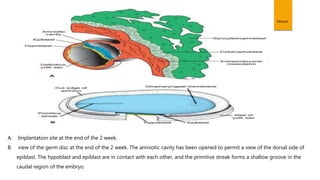
A. Implantation site at the end of the 2 week.
B. view of the germ disc at the end of the 2 week. The amniotic cavity has been opened to permit a view of the dorsal side of
epiblast. The hypoblast and epiblast are in contact with each other, and the primitive streak forms a shallow groove in the
caudal region of the embryo.
Formation of Primitive node and pit :-
 The cephalic end of the streak, the primitive node, consists of a slightly elevated area surrounding
the small primitive pit.
 Cells of the epiblast migrate toward the primitive streak.
 Upon arrival in the region of the streak, they become flask-shaped, detach from the epiblast, and
slip beneath it. This inward movement is known as invagination.
Vibhash
Formation of Prochordal plate:-
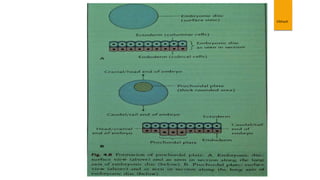
 As more and more cells move between the epiblast and hypoblast layers, they begin to spread laterally
and cranially. Gradually, they migrate beyond the margin of the disc and establish contact with the
extraembryonic mesoderm covering the yolk sac and amnion.
 In the cephalic direction, they pass on each side of the prechordal plate.
 The prechordal plate itself forms between the tip of the notochord and the oropharyngeal membrane
and is derived from some of the first cells that migrate through the node in the midline and move in a
cephalic direction. Later, the prechordal plate will be important for induction of the forebrain.
 The oropharyngeal membrane at the cranial end of the disc consists of a small region of tightly adherent
ectoderm and endoderm cells that represents the future opening of the oral cavity.
Vibhash
Vibhash
Formation of Endoderm, Mesoderm and
Ectoderm :-
 Once the cells have invaginated, some displace.
 The hypoblast, creating the embryonic endoderm,
 And others come to lie between the epiblast and newly created endoderm to form
mesoderm.
 Cells remaining in the epiblast then form ectoderm.
Vibhash
Vibhash
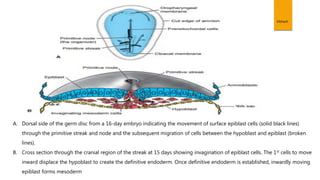
A. Dorsal side of the germ disc from a 16-day embryo indicating the movement of surface epiblast cells (solid black lines)
through the primitive streak and node and the subsequent migration of cells between the hypoblast and epiblast (broken
lines).
B. Cross section through the cranial region of the streak at 15 days showing invagination of epiblast cells. The 1st cells to move
inward displace the hypoblast to create the definitive endoderm. Once definitive endoderm is established, inwardly moving
epiblast forms mesoderm
Formation of Notochord :-
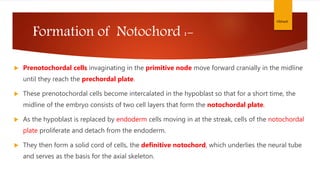
 Prenotochordal cells invaginating in the primitive node move forward cranially in the midline
until they reach the prechordal plate.
 These prenotochordal cells become intercalated in the hypoblast so that for a short time, the
midline of the embryo consists of two cell layers that form the notochordal plate.
 As the hypoblast is replaced by endoderm cells moving in at the streak, cells of the notochordal
plate proliferate and detach from the endoderm.
 They then form a solid cord of cells, the definitive notochord, which underlies the neural tube
and serves as the basis for the axial skeleton.
Vibhash
Vibhash
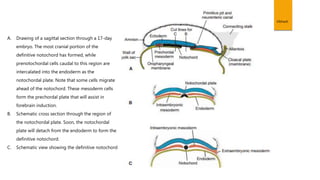
A. Drawing of a sagittal section through a 17-day
embryo. The most cranial portion of the
definitive notochord has formed, while
prenotochordal cells caudal to this region are
intercalated into the endoderm as the
notochordal plate. Note that some cells migrate
ahead of the notochord. These mesoderm cells
form the prechordal plate that will assist in
forebrain induction.
B. Schematic cross section through the region of
the notochordal plate. Soon, the notochordal
plate will detach from the endoderm to form the
definitive notochord.
C. Schematic view showing the definitive notochord
Derivatives of the Germ layers :-
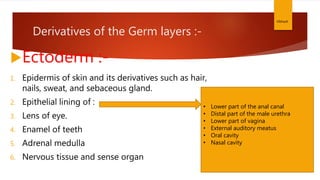
Ectoderm :-
1. Epidermis of skin and its derivatives such as hair,
nails, sweat, and sebaceous gland.
2. Epithelial lining of :
3. Lens of eye.
4. Enamel of teeth
5. Adrenal medulla
6. Nervous tissue and sense organ
Vibhash
• Lower part of the anal canal
• Distal part of the male urethra
• Lower part of vagina
• External auditory meatus
• Oral cavity
• Nasal cavity
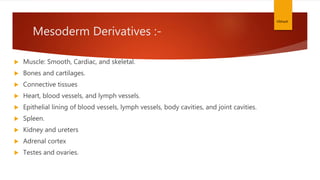
Mesoderm Derivatives :-
 Muscle: Smooth, Cardiac, and skeletal.
 Bones and cartilages.
 Connective tissues
 Heart, blood vessels, and lymph vessels.
 Epithelial lining of blood vessels, lymph vessels, body cavities, and joint cavities.
 Spleen.
 Kidney and ureters
 Adrenal cortex
 Testes and ovaries.
Vibhash
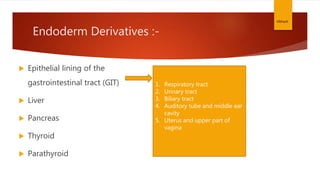
Endoderm Derivatives :-
 Epithelial lining of the
gastrointestinal tract (GIT)
 Liver
 Pancreas
 Thyroid
 Parathyroid
Vibhash
1. Respiratory tract
2. Urinary tract
3. Biliary tract
4. Auditory tube and middle ear
cavity
5. Uterus and upper part of
vagina
Vibhash
Thank You…!

Third week of development

  • 1.
    THIRD WEEK OF DEVELOPMENT: Trilaminar germ disc BY :- DR. VIBHASH KUMAR VAIDYA DEPARTMENT OF ANATOMY
  • 2.
    Gastrulation:-  The mostcharacteristic event occurring during the third week of gestation is gastrulation, the process that establishes all three germ layers (ectoderm, mesoderm, and endoderm) in the embryo.  Gastrulation begins with formation of the primitive streak on the surface of the epiblast.--- Initially, the streak is vaguely defined, but in a 15- to 16-day embryo, it is clearly visible as a narrow groove with slightly bulging regions on either side. Vibhash
  • 3.
    Vibhash A. Implantation siteat the end of the 2 week. B. view of the germ disc at the end of the 2 week. The amniotic cavity has been opened to permit a view of the dorsal side of epiblast. The hypoblast and epiblast are in contact with each other, and the primitive streak forms a shallow groove in the caudal region of the embryo.
  • 4.
    Formation of Primitivenode and pit :-  The cephalic end of the streak, the primitive node, consists of a slightly elevated area surrounding the small primitive pit.  Cells of the epiblast migrate toward the primitive streak.  Upon arrival in the region of the streak, they become flask-shaped, detach from the epiblast, and slip beneath it. This inward movement is known as invagination. Vibhash
  • 5.
    Formation of Prochordalplate:-  As more and more cells move between the epiblast and hypoblast layers, they begin to spread laterally and cranially. Gradually, they migrate beyond the margin of the disc and establish contact with the extraembryonic mesoderm covering the yolk sac and amnion.  In the cephalic direction, they pass on each side of the prechordal plate.  The prechordal plate itself forms between the tip of the notochord and the oropharyngeal membrane and is derived from some of the first cells that migrate through the node in the midline and move in a cephalic direction. Later, the prechordal plate will be important for induction of the forebrain.  The oropharyngeal membrane at the cranial end of the disc consists of a small region of tightly adherent ectoderm and endoderm cells that represents the future opening of the oral cavity. Vibhash
  • 6.
  • 7.
    Formation of Endoderm,Mesoderm and Ectoderm :-  Once the cells have invaginated, some displace.  The hypoblast, creating the embryonic endoderm,  And others come to lie between the epiblast and newly created endoderm to form mesoderm.  Cells remaining in the epiblast then form ectoderm. Vibhash
  • 8.
    Vibhash A. Dorsal sideof the germ disc from a 16-day embryo indicating the movement of surface epiblast cells (solid black lines) through the primitive streak and node and the subsequent migration of cells between the hypoblast and epiblast (broken lines). B. Cross section through the cranial region of the streak at 15 days showing invagination of epiblast cells. The 1st cells to move inward displace the hypoblast to create the definitive endoderm. Once definitive endoderm is established, inwardly moving epiblast forms mesoderm
  • 9.
    Formation of Notochord:-  Prenotochordal cells invaginating in the primitive node move forward cranially in the midline until they reach the prechordal plate.  These prenotochordal cells become intercalated in the hypoblast so that for a short time, the midline of the embryo consists of two cell layers that form the notochordal plate.  As the hypoblast is replaced by endoderm cells moving in at the streak, cells of the notochordal plate proliferate and detach from the endoderm.  They then form a solid cord of cells, the definitive notochord, which underlies the neural tube and serves as the basis for the axial skeleton. Vibhash
  • 10.
    Vibhash A. Drawing ofa sagittal section through a 17-day embryo. The most cranial portion of the definitive notochord has formed, while prenotochordal cells caudal to this region are intercalated into the endoderm as the notochordal plate. Note that some cells migrate ahead of the notochord. These mesoderm cells form the prechordal plate that will assist in forebrain induction. B. Schematic cross section through the region of the notochordal plate. Soon, the notochordal plate will detach from the endoderm to form the definitive notochord. C. Schematic view showing the definitive notochord
  • 11.
    Derivatives of theGerm layers :- Ectoderm :- 1. Epidermis of skin and its derivatives such as hair, nails, sweat, and sebaceous gland. 2. Epithelial lining of : 3. Lens of eye. 4. Enamel of teeth 5. Adrenal medulla 6. Nervous tissue and sense organ Vibhash • Lower part of the anal canal • Distal part of the male urethra • Lower part of vagina • External auditory meatus • Oral cavity • Nasal cavity
  • 12.
    Mesoderm Derivatives :- Muscle: Smooth, Cardiac, and skeletal.  Bones and cartilages.  Connective tissues  Heart, blood vessels, and lymph vessels.  Epithelial lining of blood vessels, lymph vessels, body cavities, and joint cavities.  Spleen.  Kidney and ureters  Adrenal cortex  Testes and ovaries. Vibhash
  • 13.
    Endoderm Derivatives :- Epithelial lining of the gastrointestinal tract (GIT)  Liver  Pancreas  Thyroid  Parathyroid Vibhash 1. Respiratory tract 2. Urinary tract 3. Biliary tract 4. Auditory tube and middle ear cavity 5. Uterus and upper part of vagina
  • 14.