Copyright © 2017 Pearson Education, Ltd. Chapter 9, Slide 1
Chapter 9
Hypothesis Tests
for One Population
Mean
Copyright © 2017 Pearson Education, Ltd. Chapter 9, Slide 1
Copyright © 2017 Pearson Education, Ltd. Chapter 9, Slide 2
Section 9.1
The Nature of Hypothesis
Testing
Copyright © 2017 Pearson Education, Ltd. Chapter 9, Slide 3
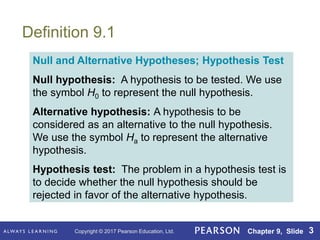
Definition 9.1
Null and Alternative Hypotheses; Hypothesis Test
Null hypothesis: A hypothesis to be tested. We use
the symbol H0 to represent the null hypothesis.
Alternative hypothesis: A hypothesis to be
considered as an alternative to the null hypothesis.
We use the symbol Ha to represent the alternative
hypothesis.
Hypothesis test: The problem in a hypothesis test is
to decide whether the null hypothesis should be
rejected in favor of the alternative hypothesis.
Copyright © 2017 Pearson Education, Ltd. Chapter 9, Slide 4
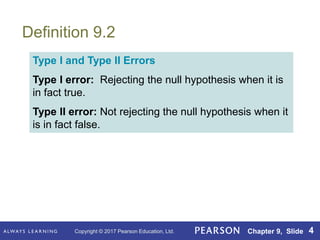
Definition 9.2
Type I and Type II Errors
Type I error: Rejecting the null hypothesis when it is
in fact true.
Type II error: Not rejecting the null hypothesis when it
is in fact false.
Copyright © 2017 Pearson Education, Ltd. Chapter 9, Slide 5
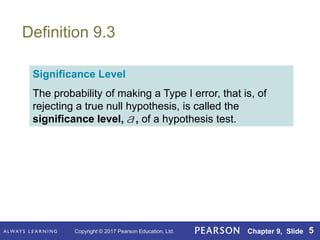
Definition 9.3
Significance Level
The probability of making a Type I error, that is, of
rejecting a true null hypothesis, is called the
significance level, , of a hypothesis test.
a
Copyright © 2017 Pearson Education, Ltd. Chapter 9, Slide 6
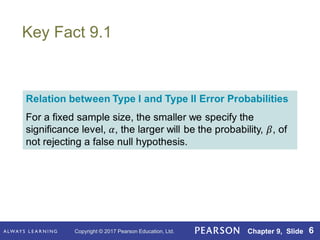
Key Fact 9.1
Copyright © 2017 Pearson Education, Ltd. Chapter 9, Slide 7
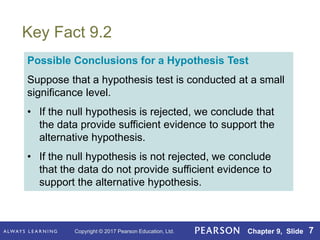
Key Fact 9.2
Possible Conclusions for a Hypothesis Test
Suppose that a hypothesis test is conducted at a small
significance level.
• If the null hypothesis is rejected, we conclude that
the data provide sufficient evidence to support the
alternative hypothesis.
• If the null hypothesis is not rejected, we conclude
that the data do not provide sufficient evidence to
support the alternative hypothesis.
Copyright © 2017 Pearson Education, Ltd. Chapter 9, Slide 8
Section 9.2
Critical-Value Approach to
Hypothesis Testing
Copyright © 2017 Pearson Education, Ltd. Chapter 9, Slide 9
Figure 9.2
Criterion for deciding whether to reject the null hypothesis
Copyright © 2017 Pearson Education, Ltd. Chapter 9, Slide 10
Figure 9.3
Rejection region, nonrejection region, and critical value for
the golf-driving-distances hypothesis test
Copyright © 2017 Pearson Education, Ltd. Chapter 9, Slide 11
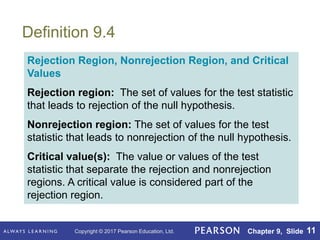
Definition 9.4
Rejection Region, Nonrejection Region, and Critical
Values
Rejection region: The set of values for the test statistic
that leads to rejection of the null hypothesis.
Nonrejection region: The set of values for the test
statistic that leads to nonrejection of the null hypothesis.
Critical value(s): The value or values of the test
statistic that separate the rejection and nonrejection
regions. A critical value is considered part of the
rejection region.
Copyright © 2017 Pearson Education, Ltd. Chapter 9, Slide 12
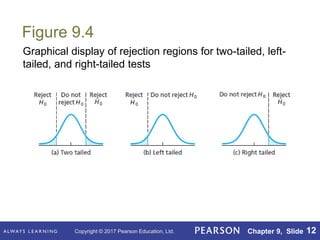
Figure 9.4
Graphical display of rejection regions for two-tailed, left-
tailed, and right-tailed tests
Copyright © 2017 Pearson Education, Ltd. Chapter 9, Slide 13
Definition 9.3
Copyright © 2017 Pearson Education, Ltd. Chapter 9, Slide 14
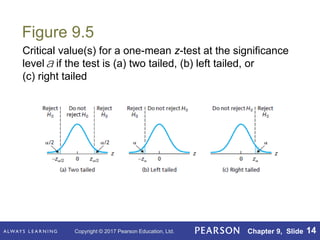
Figure 9.5
Critical value(s) for a one-mean z-test at the significance
level if the test is (a) two tailed, (b) left tailed, or
(c) right tailed
a
Copyright © 2017 Pearson Education, Ltd. Chapter 9, Slide 15
Section 9.3
P-Value Approach to
Hypothesis Testing
Copyright © 2017 Pearson Education, Ltd. Chapter 9, Slide 16
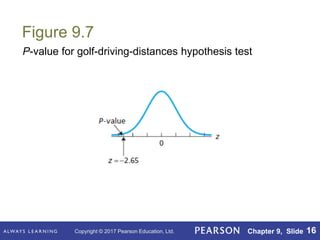
Figure 9.7
P-value for golf-driving-distances hypothesis test
Copyright © 2017 Pearson Education, Ltd. Chapter 9, Slide 17
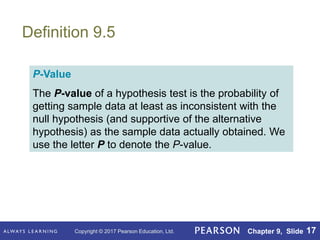
Definition 9.5
P-Value
The P-value of a hypothesis test is the probability of
getting sample data at least as inconsistent with the
null hypothesis (and supportive of the alternative
hypothesis) as the sample data actually obtained. We
use the letter P to denote the P-value.
Copyright © 2017 Pearson Education, Ltd. Chapter 9, Slide 18
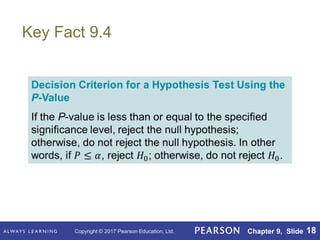
Key Fact 9.4
Copyright © 2017 Pearson Education, Ltd. Chapter 9, Slide 19
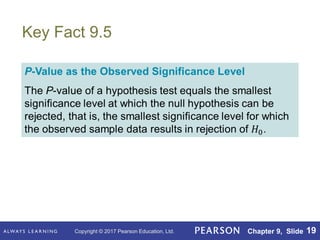
Key Fact 9.5
Copyright © 2017 Pearson Education, Ltd. Chapter 9, Slide 20
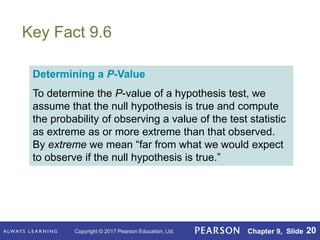
Key Fact 9.6
Determining a P-Value
To determine the P-value of a hypothesis test, we
assume that the null hypothesis is true and compute
the probability of observing a value of the test statistic
as extreme as or more extreme than that observed.
By extreme we mean “far from what we would expect
to observe if the null hypothesis is true.”
Copyright © 2017 Pearson Education, Ltd. Chapter 9, Slide 21
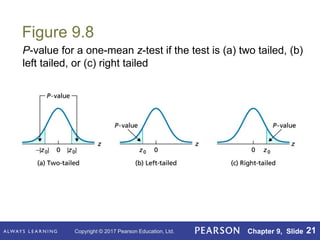
Figure 9.8
P-value for a one-mean z-test if the test is (a) two tailed, (b)
left tailed, or (c) right tailed
Copyright © 2017 Pearson Education, Ltd. Chapter 9, Slide 22
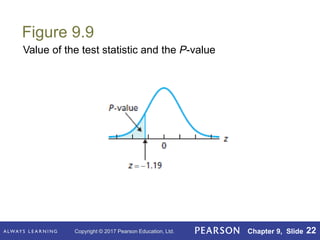
Figure 9.9
Value of the test statistic and the P-value
Copyright © 2017 Pearson Education, Ltd. Chapter 9, Slide 23
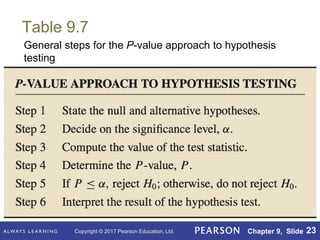
Table 9.7
General steps for the P-value approach to hypothesis
testing
Copyright © 2017 Pearson Education, Ltd. Chapter 9, Slide 24
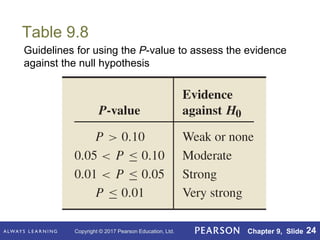
Table 9.8
Guidelines for using the P-value to assess the evidence
against the null hypothesis
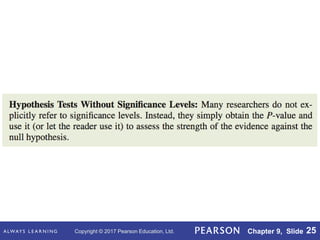
Copyright © 2017 Pearson Education, Ltd. Chapter 9, Slide 25
Copyright © 2017 Pearson Education, Ltd. Chapter 9, Slide 26
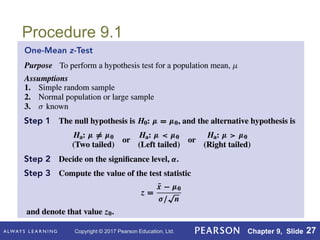
Copyright © 2017 Pearson Education, Ltd. Chapter 9, Slide 27
Procedure 9.1
Copyright © 2017 Pearson Education, Ltd. Chapter 9, Slide 28
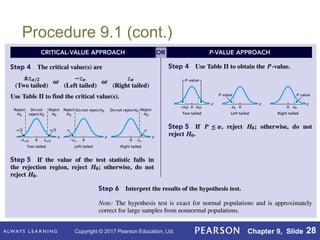
Procedure 9.1 (cont.)
Copyright © 2017 Pearson Education, Ltd. Chapter 9, Slide 29
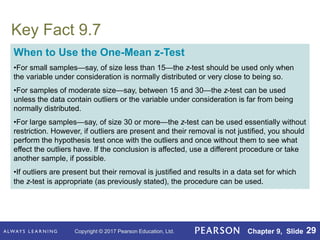
Key Fact 9.7
When to Use the One-Mean z-Test
•For small samples—say, of size less than 15—the z-test should be used only when
the variable under consideration is normally distributed or very close to being so.
•For samples of moderate size—say, between 15 and 30—the z-test can be used
unless the data contain outliers or the variable under consideration is far from being
normally distributed.
•For large samples—say, of size 30 or more—the z-test can be used essentially without
restriction. However, if outliers are present and their removal is not justified, you should
perform the hypothesis test once with the outliers and once without them to see what
effect the outliers have. If the conclusion is affected, use a different procedure or take
another sample, if possible.
•If outliers are present but their removal is justified and results in a data set for which
the z-test is appropriate (as previously stated), the procedure can be used.
Copyright © 2017 Pearson Education, Ltd. Chapter 9, Slide 30
Copyright © 2017 Pearson Education, Ltd. Chapter 9, Slide 31
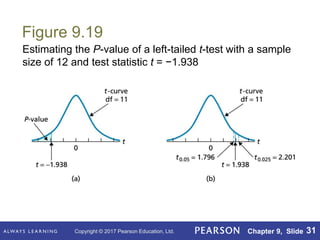
Figure 9.19
Estimating the P-value of a left-tailed t-test with a sample
size of 12 and test statistic t = −1.938
Copyright © 2017 Pearson Education, Ltd. Chapter 9, Slide 32
Figure 9.20
Estimating the P-value of a two-tailed t-test with a sample
size of 25 and test statistic t =−0.895
Copyright © 2017 Pearson Education, Ltd. Chapter 9, Slide 33
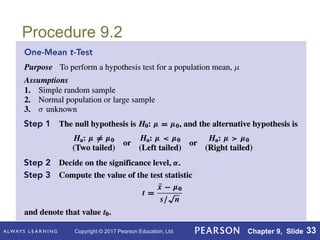
Procedure 9.2
Copyright © 2017 Pearson Education, Ltd. Chapter 9, Slide 34
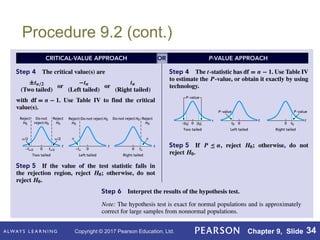
Procedure 9.2 (cont.)
Copyright © 2017 Pearson Education, Ltd. Chapter 9, Slide 35
Section 9.6
The Wilcoxon Signed-Rank Test
Copyright © 2017 Pearson Education, Ltd. Chapter 9, Slide 36
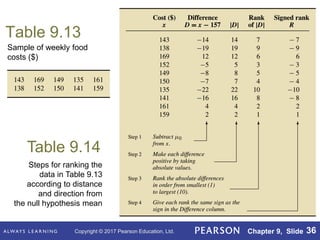
Table 9.13
Steps for ranking the
data in Table 9.13
according to distance
and direction from
the null hypothesis mean
Table 9.14
Sample of weekly food
costs ($)
Copyright © 2017 Pearson Education, Ltd. Chapter 9, Slide 37
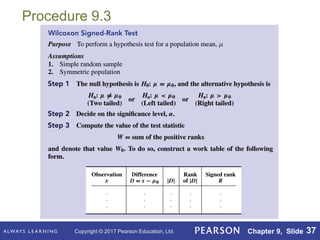
Procedure 9.3
Copyright © 2017 Pearson Education, Ltd. Chapter 9, Slide 38
Procedure 9.3 (cont.)
Copyright © 2017 Pearson Education, Ltd. Chapter 9, Slide 39
Key Fact 9.8
Wilcoxon Signed-Rank Test Versus the t-Test
Suppose that you want to perform a hypothesis test for a population
mean. When deciding between the t-test and the Wilcoxon signed-rank
test, follow these guidelines:
• If you are reasonably sure that the variable under consideration is
normally distributed, use the t-test.
• If you are not reasonably sure that the variable under consideration
is normally distributed but are reasonably sure that it has a
symmetric distribution, use the Wilcoxon signed-rank test.
Copyright © 2017 Pearson Education, Ltd. Chapter 9, Slide 40
Section 9.7
Type II Error Probabilities;
Power
Copyright © 2017 Pearson Education, Ltd. Chapter 9, Slide 41
Figure 9.30
Decision criterion for the gas mileage illustration
(α = 0.05, n = 30)
Copyright © 2017 Pearson Education, Ltd. Chapter 9, Slide 42
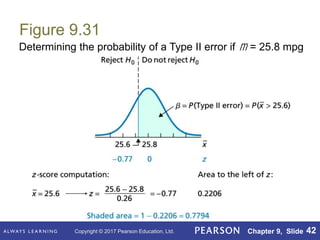
Figure 9.31
Determining the probability of a Type II error if = 25.8 mpg
m
Copyright © 2017 Pearson Education, Ltd. Chapter 9, Slide 43
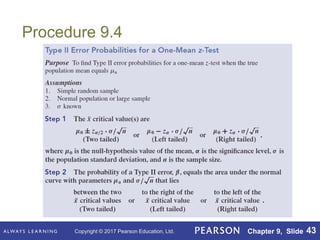
Procedure 9.4
Copyright © 2017 Pearson Education, Ltd. Chapter 9, Slide 44
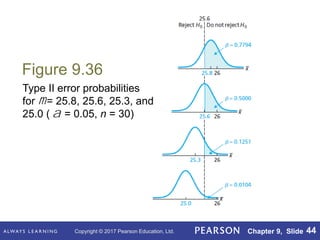
Figure 9.36
Type II error probabilities
for = 25.8, 25.6, 25.3, and
25.0 ( = 0.05, n = 30)
m
a
Copyright © 2017 Pearson Education, Ltd. Chapter 9, Slide 45
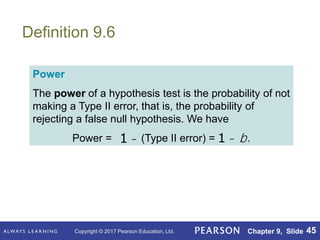
Definition 9.6
Power
The power of a hypothesis test is the probability of not
making a Type II error, that is, the probability of
rejecting a false null hypothesis. We have
Power = (Type II error) = .
1 - 1 - b
Copyright © 2017 Pearson Education, Ltd. Chapter 9, Slide 46
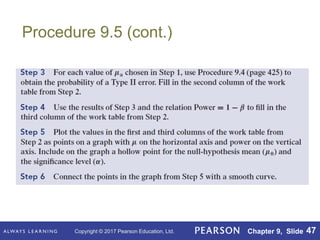
Procedure 9.5
Copyright © 2017 Pearson Education, Ltd. Chapter 9, Slide 47
Procedure 9.5 (cont.)
Copyright © 2017 Pearson Education, Ltd. Chapter 9, Slide 48
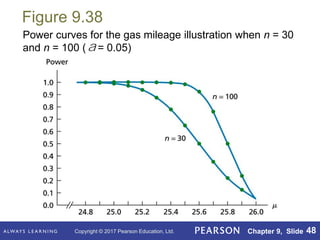
Figure 9.38
Power curves for the gas mileage illustration when n = 30
and n = 100 ( = 0.05)
a
Copyright © 2017 Pearson Education, Ltd. Chapter 9, Slide 49
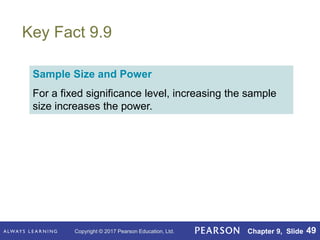
Key Fact 9.9
Sample Size and Power
For a fixed significance level, increasing the sample
size increases the power.
Copyright © 2017 Pearson Education, Ltd. Chapter 9, Slide 50
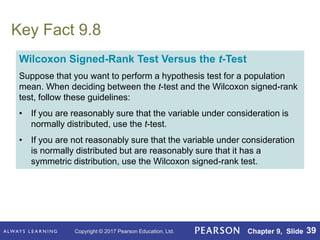
Section 9.8
Which Procedure Should Be Used?
Copyright © 2017 Pearson Education, Ltd. Chapter 9, Slide 51
Flowchart for choosing
the correct hypothesis
testing procedure for a
population mean
Figure 9.39

Hypothesis tests for one population mean.pdf

  • 1.
    Copyright © 2017Pearson Education, Ltd. Chapter 9, Slide 1 Chapter 9 Hypothesis Tests for One Population Mean Copyright © 2017 Pearson Education, Ltd. Chapter 9, Slide 1
  • 2.
    Copyright © 2017Pearson Education, Ltd. Chapter 9, Slide 2 Section 9.1 The Nature of Hypothesis Testing
  • 3.
    Copyright © 2017Pearson Education, Ltd. Chapter 9, Slide 3 Definition 9.1 Null and Alternative Hypotheses; Hypothesis Test Null hypothesis: A hypothesis to be tested. We use the symbol H0 to represent the null hypothesis. Alternative hypothesis: A hypothesis to be considered as an alternative to the null hypothesis. We use the symbol Ha to represent the alternative hypothesis. Hypothesis test: The problem in a hypothesis test is to decide whether the null hypothesis should be rejected in favor of the alternative hypothesis.
  • 4.
    Copyright © 2017Pearson Education, Ltd. Chapter 9, Slide 4 Definition 9.2 Type I and Type II Errors Type I error: Rejecting the null hypothesis when it is in fact true. Type II error: Not rejecting the null hypothesis when it is in fact false.
  • 5.
    Copyright © 2017Pearson Education, Ltd. Chapter 9, Slide 5 Definition 9.3 Significance Level The probability of making a Type I error, that is, of rejecting a true null hypothesis, is called the significance level, , of a hypothesis test. a
  • 6.
    Copyright © 2017Pearson Education, Ltd. Chapter 9, Slide 6 Key Fact 9.1
  • 7.
    Copyright © 2017Pearson Education, Ltd. Chapter 9, Slide 7 Key Fact 9.2 Possible Conclusions for a Hypothesis Test Suppose that a hypothesis test is conducted at a small significance level. • If the null hypothesis is rejected, we conclude that the data provide sufficient evidence to support the alternative hypothesis. • If the null hypothesis is not rejected, we conclude that the data do not provide sufficient evidence to support the alternative hypothesis.
  • 8.
    Copyright © 2017Pearson Education, Ltd. Chapter 9, Slide 8 Section 9.2 Critical-Value Approach to Hypothesis Testing
  • 9.
    Copyright © 2017Pearson Education, Ltd. Chapter 9, Slide 9 Figure 9.2 Criterion for deciding whether to reject the null hypothesis
  • 10.
    Copyright © 2017Pearson Education, Ltd. Chapter 9, Slide 10 Figure 9.3 Rejection region, nonrejection region, and critical value for the golf-driving-distances hypothesis test
  • 11.
    Copyright © 2017Pearson Education, Ltd. Chapter 9, Slide 11 Definition 9.4 Rejection Region, Nonrejection Region, and Critical Values Rejection region: The set of values for the test statistic that leads to rejection of the null hypothesis. Nonrejection region: The set of values for the test statistic that leads to nonrejection of the null hypothesis. Critical value(s): The value or values of the test statistic that separate the rejection and nonrejection regions. A critical value is considered part of the rejection region.
  • 12.
    Copyright © 2017Pearson Education, Ltd. Chapter 9, Slide 12 Figure 9.4 Graphical display of rejection regions for two-tailed, left- tailed, and right-tailed tests
  • 13.
    Copyright © 2017Pearson Education, Ltd. Chapter 9, Slide 13 Definition 9.3
  • 14.
    Copyright © 2017Pearson Education, Ltd. Chapter 9, Slide 14 Figure 9.5 Critical value(s) for a one-mean z-test at the significance level if the test is (a) two tailed, (b) left tailed, or (c) right tailed a
  • 15.
    Copyright © 2017Pearson Education, Ltd. Chapter 9, Slide 15 Section 9.3 P-Value Approach to Hypothesis Testing
  • 16.
    Copyright © 2017Pearson Education, Ltd. Chapter 9, Slide 16 Figure 9.7 P-value for golf-driving-distances hypothesis test
  • 17.
    Copyright © 2017Pearson Education, Ltd. Chapter 9, Slide 17 Definition 9.5 P-Value The P-value of a hypothesis test is the probability of getting sample data at least as inconsistent with the null hypothesis (and supportive of the alternative hypothesis) as the sample data actually obtained. We use the letter P to denote the P-value.
  • 18.
    Copyright © 2017Pearson Education, Ltd. Chapter 9, Slide 18 Key Fact 9.4
  • 19.
    Copyright © 2017Pearson Education, Ltd. Chapter 9, Slide 19 Key Fact 9.5
  • 20.
    Copyright © 2017Pearson Education, Ltd. Chapter 9, Slide 20 Key Fact 9.6 Determining a P-Value To determine the P-value of a hypothesis test, we assume that the null hypothesis is true and compute the probability of observing a value of the test statistic as extreme as or more extreme than that observed. By extreme we mean “far from what we would expect to observe if the null hypothesis is true.”
  • 21.
    Copyright © 2017Pearson Education, Ltd. Chapter 9, Slide 21 Figure 9.8 P-value for a one-mean z-test if the test is (a) two tailed, (b) left tailed, or (c) right tailed
  • 22.
    Copyright © 2017Pearson Education, Ltd. Chapter 9, Slide 22 Figure 9.9 Value of the test statistic and the P-value
  • 23.
    Copyright © 2017Pearson Education, Ltd. Chapter 9, Slide 23 Table 9.7 General steps for the P-value approach to hypothesis testing
  • 24.
    Copyright © 2017Pearson Education, Ltd. Chapter 9, Slide 24 Table 9.8 Guidelines for using the P-value to assess the evidence against the null hypothesis
  • 25.
    Copyright © 2017Pearson Education, Ltd. Chapter 9, Slide 25
  • 26.
    Copyright © 2017Pearson Education, Ltd. Chapter 9, Slide 26
  • 27.
    Copyright © 2017Pearson Education, Ltd. Chapter 9, Slide 27 Procedure 9.1
  • 28.
    Copyright © 2017Pearson Education, Ltd. Chapter 9, Slide 28 Procedure 9.1 (cont.)
  • 29.
    Copyright © 2017Pearson Education, Ltd. Chapter 9, Slide 29 Key Fact 9.7 When to Use the One-Mean z-Test •For small samples—say, of size less than 15—the z-test should be used only when the variable under consideration is normally distributed or very close to being so. •For samples of moderate size—say, between 15 and 30—the z-test can be used unless the data contain outliers or the variable under consideration is far from being normally distributed. •For large samples—say, of size 30 or more—the z-test can be used essentially without restriction. However, if outliers are present and their removal is not justified, you should perform the hypothesis test once with the outliers and once without them to see what effect the outliers have. If the conclusion is affected, use a different procedure or take another sample, if possible. •If outliers are present but their removal is justified and results in a data set for which the z-test is appropriate (as previously stated), the procedure can be used.
  • 30.
    Copyright © 2017Pearson Education, Ltd. Chapter 9, Slide 30
  • 31.
    Copyright © 2017Pearson Education, Ltd. Chapter 9, Slide 31 Figure 9.19 Estimating the P-value of a left-tailed t-test with a sample size of 12 and test statistic t = −1.938
  • 32.
    Copyright © 2017Pearson Education, Ltd. Chapter 9, Slide 32 Figure 9.20 Estimating the P-value of a two-tailed t-test with a sample size of 25 and test statistic t =−0.895
  • 33.
    Copyright © 2017Pearson Education, Ltd. Chapter 9, Slide 33 Procedure 9.2
  • 34.
    Copyright © 2017Pearson Education, Ltd. Chapter 9, Slide 34 Procedure 9.2 (cont.)
  • 35.
    Copyright © 2017Pearson Education, Ltd. Chapter 9, Slide 35 Section 9.6 The Wilcoxon Signed-Rank Test
  • 36.
    Copyright © 2017Pearson Education, Ltd. Chapter 9, Slide 36 Table 9.13 Steps for ranking the data in Table 9.13 according to distance and direction from the null hypothesis mean Table 9.14 Sample of weekly food costs ($)
  • 37.
    Copyright © 2017Pearson Education, Ltd. Chapter 9, Slide 37 Procedure 9.3
  • 38.
    Copyright © 2017Pearson Education, Ltd. Chapter 9, Slide 38 Procedure 9.3 (cont.)
  • 39.
    Copyright © 2017Pearson Education, Ltd. Chapter 9, Slide 39 Key Fact 9.8 Wilcoxon Signed-Rank Test Versus the t-Test Suppose that you want to perform a hypothesis test for a population mean. When deciding between the t-test and the Wilcoxon signed-rank test, follow these guidelines: • If you are reasonably sure that the variable under consideration is normally distributed, use the t-test. • If you are not reasonably sure that the variable under consideration is normally distributed but are reasonably sure that it has a symmetric distribution, use the Wilcoxon signed-rank test.
  • 40.
    Copyright © 2017Pearson Education, Ltd. Chapter 9, Slide 40 Section 9.7 Type II Error Probabilities; Power
  • 41.
    Copyright © 2017Pearson Education, Ltd. Chapter 9, Slide 41 Figure 9.30 Decision criterion for the gas mileage illustration (α = 0.05, n = 30)
  • 42.
    Copyright © 2017Pearson Education, Ltd. Chapter 9, Slide 42 Figure 9.31 Determining the probability of a Type II error if = 25.8 mpg m
  • 43.
    Copyright © 2017Pearson Education, Ltd. Chapter 9, Slide 43 Procedure 9.4
  • 44.
    Copyright © 2017Pearson Education, Ltd. Chapter 9, Slide 44 Figure 9.36 Type II error probabilities for = 25.8, 25.6, 25.3, and 25.0 ( = 0.05, n = 30) m a
  • 45.
    Copyright © 2017Pearson Education, Ltd. Chapter 9, Slide 45 Definition 9.6 Power The power of a hypothesis test is the probability of not making a Type II error, that is, the probability of rejecting a false null hypothesis. We have Power = (Type II error) = . 1 - 1 - b
  • 46.
    Copyright © 2017Pearson Education, Ltd. Chapter 9, Slide 46 Procedure 9.5
  • 47.
    Copyright © 2017Pearson Education, Ltd. Chapter 9, Slide 47 Procedure 9.5 (cont.)
  • 48.
    Copyright © 2017Pearson Education, Ltd. Chapter 9, Slide 48 Figure 9.38 Power curves for the gas mileage illustration when n = 30 and n = 100 ( = 0.05) a
  • 49.
    Copyright © 2017Pearson Education, Ltd. Chapter 9, Slide 49 Key Fact 9.9 Sample Size and Power For a fixed significance level, increasing the sample size increases the power.
  • 50.
    Copyright © 2017Pearson Education, Ltd. Chapter 9, Slide 50 Section 9.8 Which Procedure Should Be Used?
  • 51.
    Copyright © 2017Pearson Education, Ltd. Chapter 9, Slide 51 Flowchart for choosing the correct hypothesis testing procedure for a population mean Figure 9.39