Copyright © 2017 Pearson Education, Ltd. Chapter 3, Slide 1
Chapter 3
Descriptive
Measures
Copyright © 2017 Pearson Education, Ltd. Chapter 3, Slide 1
Copyright © 2017 Pearson Education, Ltd. Chapter 3, Slide 2
Chapter 3
Descriptive Measures
Copyright © 2017 Pearson Education, Ltd. Chapter 3, Slide 3
Section 3.1
Measures of Center
Copyright © 2017 Pearson Education, Ltd. Chapter 3, Slide 4
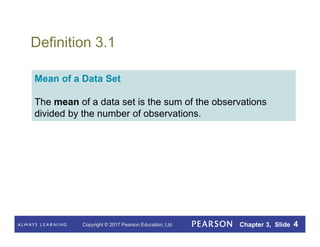
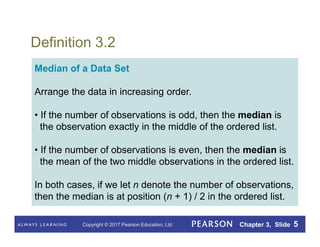
Definition 3.1
Mean of a Data Set
The mean of a data set is the sum of the observations
divided by the number of observations.
Copyright © 2017 Pearson Education, Ltd. Chapter 3, Slide 5
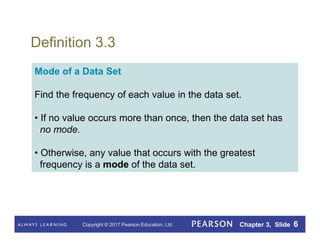
Definition 3.2
Median of a Data Set
Arrange the data in increasing order.
• If the number of observations is odd, then the median is
the observation exactly in the middle of the ordered list.
• If the number of observations is even, then the median is
the mean of the two middle observations in the ordered list.
In both cases, if we let n denote the number of observations,
then the median is at position (n + 1) / 2 in the ordered list.
Copyright © 2017 Pearson Education, Ltd. Chapter 3, Slide 6
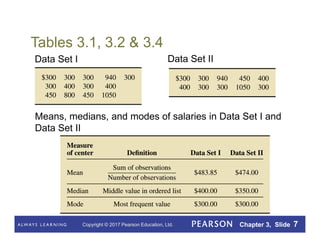
Definition 3.3
Mode of a Data Set
Find the frequency of each value in the data set.
• If no value occurs more than once, then the data set has
no mode.
• Otherwise, any value that occurs with the greatest
frequency is a mode of the data set.
Copyright © 2017 Pearson Education, Ltd. Chapter 3, Slide 7
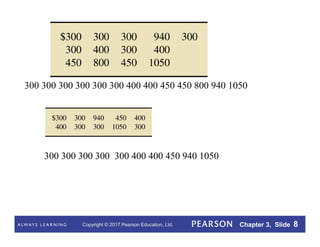
Tables 3.1, 3.2 & 3.4
Data Set I Data Set II
Means, medians, and modes of salaries in Data Set I and
Data Set II
Copyright © 2017 Pearson Education, Ltd. Chapter 3, Slide 8
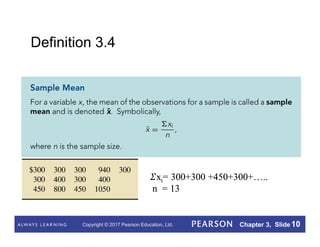
300 300 300 300 300 300 400 400 450 450 800 940 1050
300 300 300 300 300 400 400 450 940 1050
Copyright © 2017 Pearson Education, Ltd. Chapter 3, Slide 9
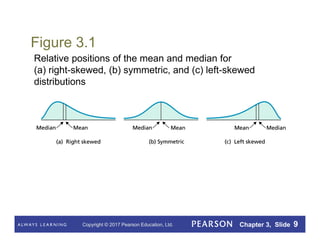
Figure 3.1
Relative positions of the mean and median for
(a) right-skewed, (b) symmetric, and (c) left-skewed
distributions
Copyright © 2017 Pearson Education, Ltd. Chapter 3, Slide 10
Definition 3.4
Copyright © 2017 Pearson Education, Ltd. Chapter 3, Slide 11
Section 3.2
Measures of Variation
Copyright © 2017 Pearson Education, Ltd. Chapter 3, Slide 12
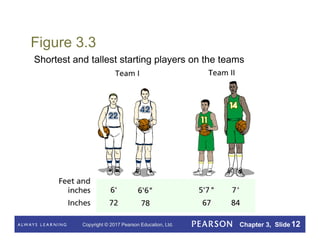
Figure 3.3
Shortest and tallest starting players on the teams
Copyright © 2017 Pearson Education, Ltd. Chapter 3, Slide 13
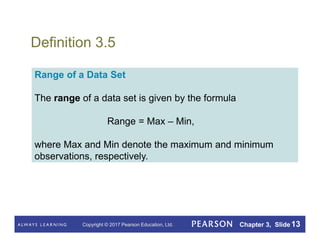
Definition 3.5
Range of a Data Set
The range of a data set is given by the formula
Range = Max – Min,
where Max and Min denote the maximum and minimum
observations, respectively.
Copyright © 2017 Pearson Education, Ltd. Chapter 3, Slide 14
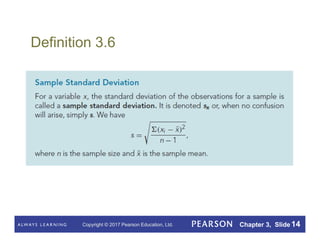
Definition 3.6
Copyright © 2017 Pearson Education, Ltd. Chapter 3, Slide 15
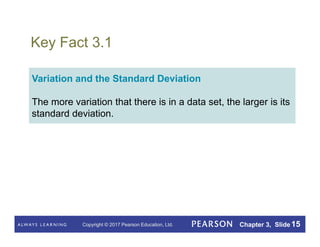
Key Fact 3.1
Variation and the Standard Deviation
The more variation that there is in a data set, the larger is its
standard deviation.
Copyright © 2017 Pearson Education, Ltd. Chapter 3, Slide 16
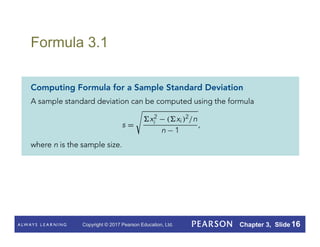
Formula 3.1
Copyright © 2017 Pearson Education, Ltd. Chapter 3, Slide 17
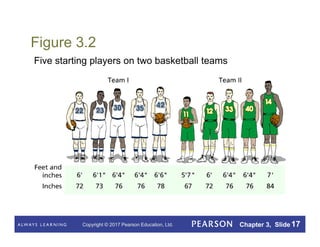
Figure 3.2
Five starting players on two basketball teams
Copyright © 2017 Pearson Education, Ltd. Chapter 3, Slide 18
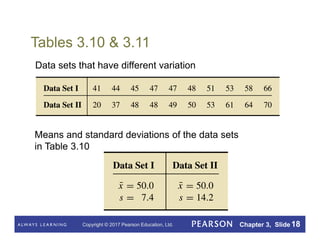
Tables 3.10 & 3.11
Data sets that have different variation
Means and standard deviations of the data sets
in Table 3.10
Copyright © 2017 Pearson Education, Ltd. Chapter 3, Slide 19
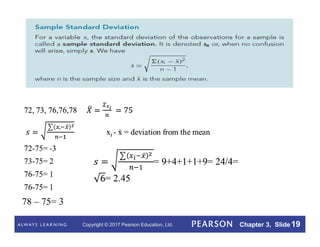
78 – 75= 3
Copyright © 2017 Pearson Education, Ltd. Chapter 3, Slide 20
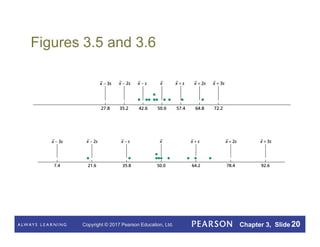
Figures 3.5 and 3.6
Copyright © 2017 Pearson Education, Ltd. Chapter 3, Slide 21
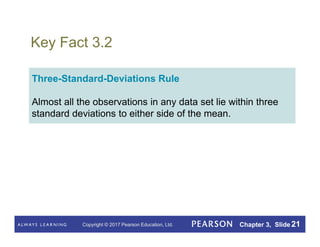
Key Fact 3.2
Three-Standard-Deviations Rule
Almost all the observations in any data set lie within three
standard deviations to either side of the mean.
Copyright © 2017 Pearson Education, Ltd. Chapter 3, Slide 22
Section 3.3
Empirical Rule
Copyright © 2017 Pearson Education, Ltd. Chapter 3, Slide 23
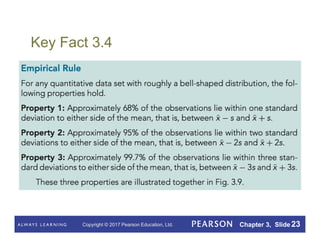
Key Fact 3.4
Copyright © 2017 Pearson Education, Ltd. Chapter 3, Slide 24
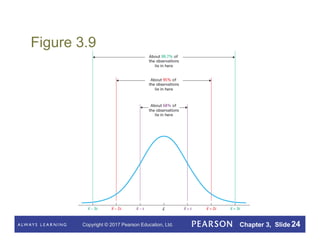
Figure 3.9
Copyright © 2017 Pearson Education, Ltd. Chapter 3, Slide 25
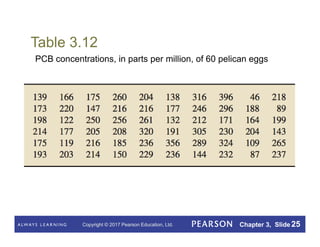
Table 3.12
PCB concentrations, in parts per million, of 60 pelican eggs
Copyright © 2017 Pearson Education, Ltd. Chapter 3, Slide 26
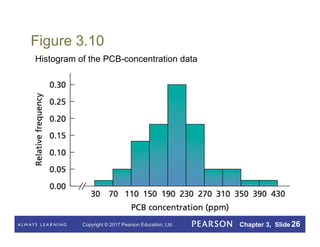
Figure 3.10
Histogram of the PCB-concentration data
Copyright © 2017 Pearson Education, Ltd. Chapter 3, Slide 27
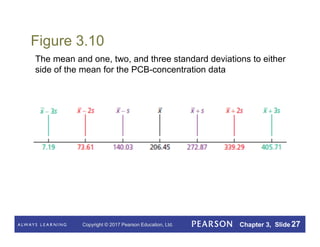
Figure 3.10
The mean and one, two, and three standard deviations to either
side of the mean for the PCB-concentration data
Copyright © 2017 Pearson Education, Ltd. Chapter 3, Slide 28
Section 3.4
The Five-Number Summary; Boxplots
Copyright © 2017 Pearson Education, Ltd. Chapter 3, Slide 29
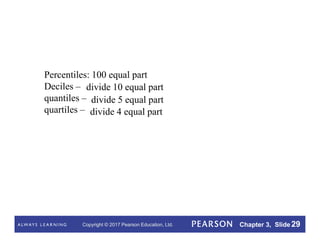
Percentiles: 100 equal part
Deciles –
quantiles –
quartiles –
divide 10 equal part
divide 5 equal part
divide 4 equal part
Copyright © 2017 Pearson Education, Ltd. Chapter 3, Slide 30
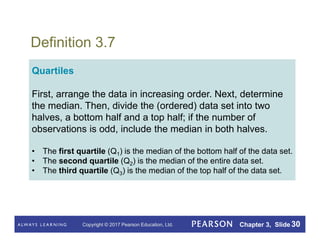
Definition 3.7
Quartiles
First, arrange the data in increasing order. Next, determine
the median. Then, divide the (ordered) data set into two
halves, a bottom half and a top half; if the number of
observations is odd, include the median in both halves.
• The first quartile (Q1) is the median of the bottom half of the data set.
• The second quartile (Q2) is the median of the entire data set.
• The third quartile (Q3) is the median of the top half of the data set.
Copyright © 2017 Pearson Education, Ltd. Chapter 3, Slide 31
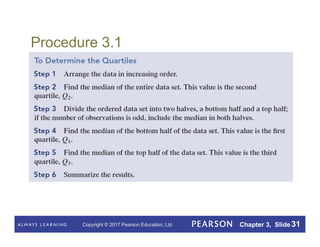
Procedure 3.1
Copyright © 2017 Pearson Education, Ltd. Chapter 3, Slide 32
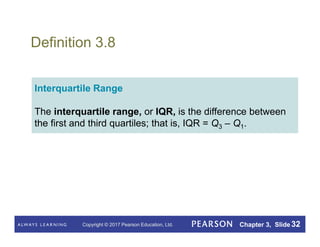
Definition 3.8
Interquartile Range
The interquartile range, or IQR, is the difference between
the first and third quartiles; that is, IQR = Q3 – Q1.
Copyright © 2017 Pearson Education, Ltd. Chapter 3, Slide 33
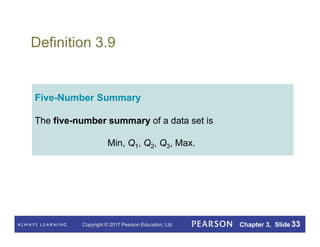
Definition 3.9
Five-Number Summary
The five-number summary of a data set is
Min, Q1, Q2, Q3, Max.
Copyright © 2017 Pearson Education, Ltd. Chapter 3, Slide 34
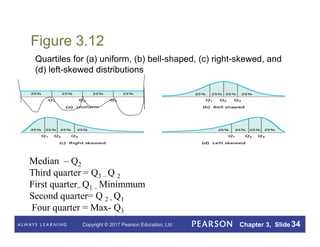
Figure 3.12
Quartiles for (a) uniform, (b) bell-shaped, (c) right-skewed, and
(d) left-skewed distributions
Median – Q2
Third quarter = Q3 – Q 2
First quarter= Q1 – Minimmum
Second quarter= Q 2 - Q1
Four quarter = Max- Q3
Copyright © 2017 Pearson Education, Ltd. Chapter 3, Slide 35
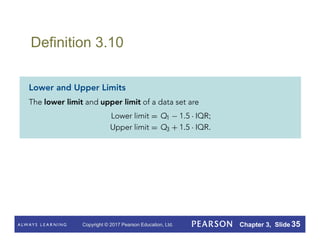
Definition 3.10
Copyright © 2017 Pearson Education, Ltd. Chapter 3, Slide 36
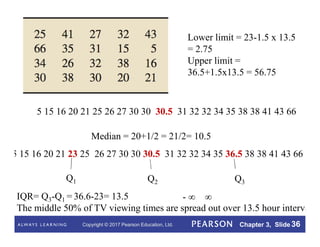
5 15 16 20 21 23 25 26 27 30 30 30.5 31 32 32 34 35 36.5 38 38 41 43 66
Q2
Q1 Q3
IQR= Q3-Q1 = 36.6-23= 13.5
The middle 50% of TV viewing times are spread out over 13.5 hour intervals.
5 15 16 20 21 25 26 27 30 30 30.5 31 32 32 34 35 38 38 41 43 66
Median = 20+1/2 = 21/2= 10.5
- ∞ ∞
Lower limit = 23-1.5 x 13.5
= 2.75
Upper limit =
36.5+1.5x13.5 = 56.75
Copyright © 2017 Pearson Education, Ltd. Chapter 3, Slide 37
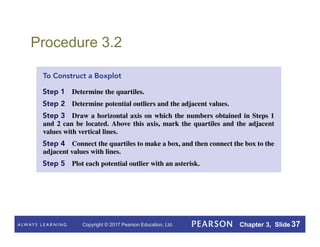
Procedure 3.2
Copyright © 2017 Pearson Education, Ltd. Chapter 3, Slide 38
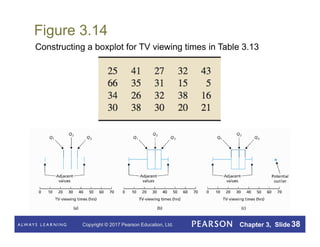
Figure 3.14
Constructing a boxplot for TV viewing times in Table 3.13
Copyright © 2017 Pearson Education, Ltd. Chapter 3, Slide 39
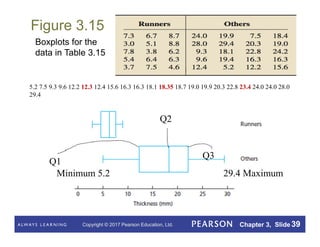
Figure 3.15
Boxplots for the
data in Table 3.15
Q3
Q1
Q2
29.4 Maximum
Minimum 5.2
5.2 7.5 9.3 9.6 12.2 12.3 12.4 15.6 16.3 16.3 18.1 18.35 18.7 19.0 19.9 20.3 22.8 23.4 24.0 24.0 28.0
29.4
Copyright © 2017 Pearson Education, Ltd. Chapter 3, Slide 40
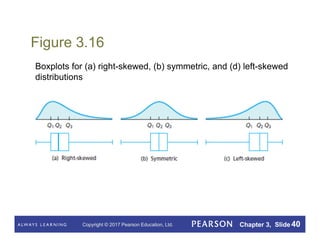
Figure 3.16
Boxplots for (a) right-skewed, (b) symmetric, and (d) left-skewed
distributions
Copyright © 2017 Pearson Education, Ltd. Chapter 3, Slide 41
Section 3.5
Descriptive Measures for Populations;
Use of Samples
Copyright © 2017 Pearson Education, Ltd. Chapter 3, Slide 42
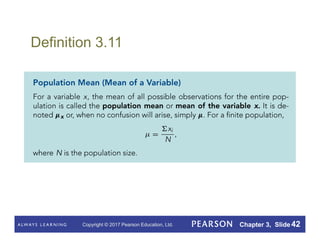
Definition 3.11
Copyright © 2017 Pearson Education, Ltd. Chapter 3, Slide 43
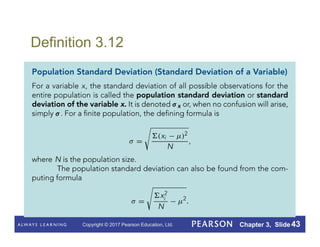
Definition 3.12
Copyright © 2017 Pearson Education, Ltd. Chapter 3, Slide 44
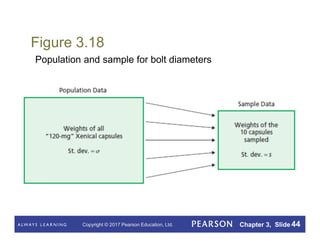
Figure 3.18
Population and sample for bolt diameters
Copyright © 2017 Pearson Education, Ltd. Chapter 3, Slide 45
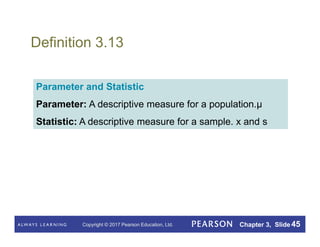
Definition 3.13
Parameter and Statistic
Parameter: A descriptive measure for a population.µ
Statistic: A descriptive measure for a sample. x and s
Copyright © 2017 Pearson Education, Ltd. Chapter 3, Slide 46
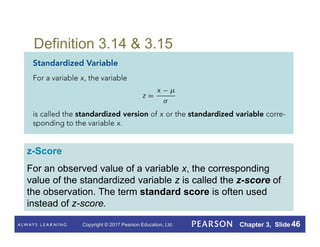
Definition 3.14 & 3.15
z-Score
For an observed value of a variable x, the corresponding
value of the standardized variable z is called the z-score of
the observation. The term standard score is often used
instead of z-score.

Descriptive measures.pdf

  • 1.
    Copyright © 2017Pearson Education, Ltd. Chapter 3, Slide 1 Chapter 3 Descriptive Measures Copyright © 2017 Pearson Education, Ltd. Chapter 3, Slide 1
  • 2.
    Copyright © 2017Pearson Education, Ltd. Chapter 3, Slide 2 Chapter 3 Descriptive Measures
  • 3.
    Copyright © 2017Pearson Education, Ltd. Chapter 3, Slide 3 Section 3.1 Measures of Center
  • 4.
    Copyright © 2017Pearson Education, Ltd. Chapter 3, Slide 4 Definition 3.1 Mean of a Data Set The mean of a data set is the sum of the observations divided by the number of observations.
  • 5.
    Copyright © 2017Pearson Education, Ltd. Chapter 3, Slide 5 Definition 3.2 Median of a Data Set Arrange the data in increasing order. • If the number of observations is odd, then the median is the observation exactly in the middle of the ordered list. • If the number of observations is even, then the median is the mean of the two middle observations in the ordered list. In both cases, if we let n denote the number of observations, then the median is at position (n + 1) / 2 in the ordered list.
  • 6.
    Copyright © 2017Pearson Education, Ltd. Chapter 3, Slide 6 Definition 3.3 Mode of a Data Set Find the frequency of each value in the data set. • If no value occurs more than once, then the data set has no mode. • Otherwise, any value that occurs with the greatest frequency is a mode of the data set.
  • 7.
    Copyright © 2017Pearson Education, Ltd. Chapter 3, Slide 7 Tables 3.1, 3.2 & 3.4 Data Set I Data Set II Means, medians, and modes of salaries in Data Set I and Data Set II
  • 8.
    Copyright © 2017Pearson Education, Ltd. Chapter 3, Slide 8 300 300 300 300 300 300 400 400 450 450 800 940 1050 300 300 300 300 300 400 400 450 940 1050
  • 9.
    Copyright © 2017Pearson Education, Ltd. Chapter 3, Slide 9 Figure 3.1 Relative positions of the mean and median for (a) right-skewed, (b) symmetric, and (c) left-skewed distributions
  • 10.
    Copyright © 2017Pearson Education, Ltd. Chapter 3, Slide 10 Definition 3.4
  • 11.
    Copyright © 2017Pearson Education, Ltd. Chapter 3, Slide 11 Section 3.2 Measures of Variation
  • 12.
    Copyright © 2017Pearson Education, Ltd. Chapter 3, Slide 12 Figure 3.3 Shortest and tallest starting players on the teams
  • 13.
    Copyright © 2017Pearson Education, Ltd. Chapter 3, Slide 13 Definition 3.5 Range of a Data Set The range of a data set is given by the formula Range = Max – Min, where Max and Min denote the maximum and minimum observations, respectively.
  • 14.
    Copyright © 2017Pearson Education, Ltd. Chapter 3, Slide 14 Definition 3.6
  • 15.
    Copyright © 2017Pearson Education, Ltd. Chapter 3, Slide 15 Key Fact 3.1 Variation and the Standard Deviation The more variation that there is in a data set, the larger is its standard deviation.
  • 16.
    Copyright © 2017Pearson Education, Ltd. Chapter 3, Slide 16 Formula 3.1
  • 17.
    Copyright © 2017Pearson Education, Ltd. Chapter 3, Slide 17 Figure 3.2 Five starting players on two basketball teams
  • 18.
    Copyright © 2017Pearson Education, Ltd. Chapter 3, Slide 18 Tables 3.10 & 3.11 Data sets that have different variation Means and standard deviations of the data sets in Table 3.10
  • 19.
    Copyright © 2017Pearson Education, Ltd. Chapter 3, Slide 19 78 – 75= 3
  • 20.
    Copyright © 2017Pearson Education, Ltd. Chapter 3, Slide 20 Figures 3.5 and 3.6
  • 21.
    Copyright © 2017Pearson Education, Ltd. Chapter 3, Slide 21 Key Fact 3.2 Three-Standard-Deviations Rule Almost all the observations in any data set lie within three standard deviations to either side of the mean.
  • 22.
    Copyright © 2017Pearson Education, Ltd. Chapter 3, Slide 22 Section 3.3 Empirical Rule
  • 23.
    Copyright © 2017Pearson Education, Ltd. Chapter 3, Slide 23 Key Fact 3.4
  • 24.
    Copyright © 2017Pearson Education, Ltd. Chapter 3, Slide 24 Figure 3.9
  • 25.
    Copyright © 2017Pearson Education, Ltd. Chapter 3, Slide 25 Table 3.12 PCB concentrations, in parts per million, of 60 pelican eggs
  • 26.
    Copyright © 2017Pearson Education, Ltd. Chapter 3, Slide 26 Figure 3.10 Histogram of the PCB-concentration data
  • 27.
    Copyright © 2017Pearson Education, Ltd. Chapter 3, Slide 27 Figure 3.10 The mean and one, two, and three standard deviations to either side of the mean for the PCB-concentration data
  • 28.
    Copyright © 2017Pearson Education, Ltd. Chapter 3, Slide 28 Section 3.4 The Five-Number Summary; Boxplots
  • 29.
    Copyright © 2017Pearson Education, Ltd. Chapter 3, Slide 29 Percentiles: 100 equal part Deciles – quantiles – quartiles – divide 10 equal part divide 5 equal part divide 4 equal part
  • 30.
    Copyright © 2017Pearson Education, Ltd. Chapter 3, Slide 30 Definition 3.7 Quartiles First, arrange the data in increasing order. Next, determine the median. Then, divide the (ordered) data set into two halves, a bottom half and a top half; if the number of observations is odd, include the median in both halves. • The first quartile (Q1) is the median of the bottom half of the data set. • The second quartile (Q2) is the median of the entire data set. • The third quartile (Q3) is the median of the top half of the data set.
  • 31.
    Copyright © 2017Pearson Education, Ltd. Chapter 3, Slide 31 Procedure 3.1
  • 32.
    Copyright © 2017Pearson Education, Ltd. Chapter 3, Slide 32 Definition 3.8 Interquartile Range The interquartile range, or IQR, is the difference between the first and third quartiles; that is, IQR = Q3 – Q1.
  • 33.
    Copyright © 2017Pearson Education, Ltd. Chapter 3, Slide 33 Definition 3.9 Five-Number Summary The five-number summary of a data set is Min, Q1, Q2, Q3, Max.
  • 34.
    Copyright © 2017Pearson Education, Ltd. Chapter 3, Slide 34 Figure 3.12 Quartiles for (a) uniform, (b) bell-shaped, (c) right-skewed, and (d) left-skewed distributions Median – Q2 Third quarter = Q3 – Q 2 First quarter= Q1 – Minimmum Second quarter= Q 2 - Q1 Four quarter = Max- Q3
  • 35.
    Copyright © 2017Pearson Education, Ltd. Chapter 3, Slide 35 Definition 3.10
  • 36.
    Copyright © 2017Pearson Education, Ltd. Chapter 3, Slide 36 5 15 16 20 21 23 25 26 27 30 30 30.5 31 32 32 34 35 36.5 38 38 41 43 66 Q2 Q1 Q3 IQR= Q3-Q1 = 36.6-23= 13.5 The middle 50% of TV viewing times are spread out over 13.5 hour intervals. 5 15 16 20 21 25 26 27 30 30 30.5 31 32 32 34 35 38 38 41 43 66 Median = 20+1/2 = 21/2= 10.5 - ∞ ∞ Lower limit = 23-1.5 x 13.5 = 2.75 Upper limit = 36.5+1.5x13.5 = 56.75
  • 37.
    Copyright © 2017Pearson Education, Ltd. Chapter 3, Slide 37 Procedure 3.2
  • 38.
    Copyright © 2017Pearson Education, Ltd. Chapter 3, Slide 38 Figure 3.14 Constructing a boxplot for TV viewing times in Table 3.13
  • 39.
    Copyright © 2017Pearson Education, Ltd. Chapter 3, Slide 39 Figure 3.15 Boxplots for the data in Table 3.15 Q3 Q1 Q2 29.4 Maximum Minimum 5.2 5.2 7.5 9.3 9.6 12.2 12.3 12.4 15.6 16.3 16.3 18.1 18.35 18.7 19.0 19.9 20.3 22.8 23.4 24.0 24.0 28.0 29.4
  • 40.
    Copyright © 2017Pearson Education, Ltd. Chapter 3, Slide 40 Figure 3.16 Boxplots for (a) right-skewed, (b) symmetric, and (d) left-skewed distributions
  • 41.
    Copyright © 2017Pearson Education, Ltd. Chapter 3, Slide 41 Section 3.5 Descriptive Measures for Populations; Use of Samples
  • 42.
    Copyright © 2017Pearson Education, Ltd. Chapter 3, Slide 42 Definition 3.11
  • 43.
    Copyright © 2017Pearson Education, Ltd. Chapter 3, Slide 43 Definition 3.12
  • 44.
    Copyright © 2017Pearson Education, Ltd. Chapter 3, Slide 44 Figure 3.18 Population and sample for bolt diameters
  • 45.
    Copyright © 2017Pearson Education, Ltd. Chapter 3, Slide 45 Definition 3.13 Parameter and Statistic Parameter: A descriptive measure for a population.µ Statistic: A descriptive measure for a sample. x and s
  • 46.
    Copyright © 2017Pearson Education, Ltd. Chapter 3, Slide 46 Definition 3.14 & 3.15 z-Score For an observed value of a variable x, the corresponding value of the standardized variable z is called the z-score of the observation. The term standard score is often used instead of z-score.