Sampling and Sampling Distributions 1
Sampling and Sampling
Distributions
Sampling and Sampling Distributions 2
Learning Objectives
Upon completionof this chapter, you will be able to:
➢ Understand the importance of sampling
➢ Differentiate between random and non-random sampling
➢ Understand the concept of sampling and non-sampling errors
➢ Understand the concept of sampling distribution and the
application of central limit theorem
➢ Understand sampling distribution of sample proportion
Sampling and Sampling Distributions 3
Sampling
A researcher generally takes a small portion of the population for
study, which is referred to as sample. The process of selecting a
sample from the population is called sampling.
Sampling and Sampling Distributions 4
Importance of Sampling
➢ Sampling saves time.
➢ Sampling saves money.
➢ When the research process is destructive in nature, sampling
minimizes the destruction.
➢ Sampling broadens the scope of the study in light of the scarcity
of resources.
Sampling and Sampling Distributions 5
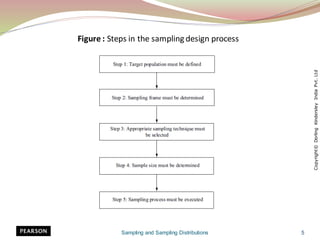
Figure : Steps in the sampling design process
Sampling and Sampling Distributions 6
The Sampling Design Process
Step 1: Target population must be defined
➢ Target population is the collection of the objects which possess the
information required by the researcher and about which an
inference is to be made.
Step 2: Sampling frame mustbe determined
➢ This list possesses the information about the subjects and is called
the sampling frame.
➢ Sampling is carried out from the sampling frame and not from the
target population.
Sampling and Sampling Distributions 7
The Sampling Design Process (Contd.)
Step 3: Appropriate sampling technique must be selected
➢ Non probabilitysampling
➢ Probabilitysampling
Step 4: Sample size must be determined
➢ Sample size refers to the number of elements to be included in the
study.
Step 5: Sampling process must be executed
Sampling and Sampling Distributions 8
Random Versus Non-random Sampling
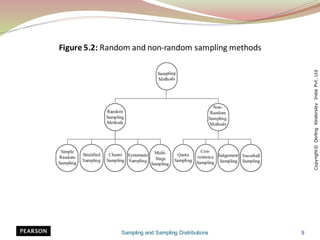
➢ In random sampling, each unit of the population has the same
probability (chance) of being selected as part of the sample.
➢ In non-random sampling, members of the sample are not
selected by chance. Some other factors like judgment or
convenience, etc. are the basis of selection.
Sampling and Sampling Distributions 9
Figure 5.2: Random and non-random sampling methods
Sampling and Sampling Distributions 10
Random Sampling Methods
➢ Simple Random Sampling
▪ In simple random sampling, each member of the population has an
equal chance of being includedin the sample.
▪ Ex. Lottery Method
➢ StratifiedRandom Sampling
▪ In stratified random sampling, elements in the population are
dividedinto homogeneous groups called strata.
▪ Then, researchers use the simple random sampling method to select
a sample from each of the strata. Each group is called stratum.
Sampling and Sampling Distributions 11
Random Sampling Methods (Contd.)
➢ Cluster (or Area) Sampling
▪ In stratified sampling, strata happen to be homogenous but in cluster
sampling, clusters are internally heterogeneous.
Figure 5.6: Diagram for cluster sampling
Sampling and Sampling Distributions 12
Systematic (or Quasi-random) Sampling
➢ In systematic sampling, sample elements are selected from the
population at uniform intervals in terms of time, order, or space.
Sampling and Sampling Distributions 13
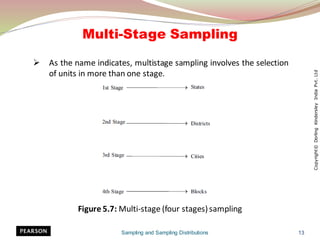
Multi-Stage Sampling
➢ As the name indicates, multistage sampling involves the selection
of units in more than one stage.
Figure 5.7: Multi-stage (four stages)sampling
Sampling and Sampling Distributions 14
Non-Random Sampling
Sampling techniques where selection of the sampling units is not
based on a random selection process are called nonrandom sampling
techniques.
➢ Quota Sampling
▪ In quota sampling, quota are fixed according to the requirement of
research. a researcher uses non-random sampling methods to gather
data from one stratum until the required quota fixed by the researcher is
fulfilled.
➢ Convenience Sampling
▪ In convenience sampling, sample elements are selected based on the
convenience of a researcher.
Sampling and Sampling Distributions 15
➢ Judgement Sampling
▪ In judgement sampling, selection of the sampling units is based on
the judgement of a researcher.
➢ Snowball Sampling
▪ In snowball sampling, survey respondents are selected on the basis
of referrals from other survey respondents.
Sampling and Sampling Distributions 16
Sampling and Non-Sampling Errors
Sampling Error
Sampling error occurs when the sample is not a true representative
of the population. In complete enumeration, sampling errors are not
present.
Sampling errorscan occur due to some specificreasons:
➢ Faulty selection of the sample.
➢ Sometimes due to the difficulty in selection a particular
sampling unit, researchers try to substitute that sampling unit
with another sampling unit which is easy to be surveyed.
Sampling and Sampling Distributions 17
Non-Sampling Errors
All errors other than sampling can be included in the category of non-
sampling errors.
The following are some commonnon-sampling errors:
➢ Faulty designing and planning of survey
➢ Response errors
➢ Errors in coverage
Sampling and Sampling Distributions 18
Key things to keep in mind
• Parameters- characteristic of population( what
we actually want to know)
• Statistic- Characteristic of sample – (what we
have with our data)
• Sampling distribution-the means by which we
will go from our sample to the population
Sampling and Sampling Distributions 19
sampling distribution(cont….)
• A sampling distribution is the probability
distribution for all possible values of the
sample statistic.
• Each sample contains different elements so
the value of the sample statistic differs for
each sample selected. These statistics
provide different estimates of the parameter.
The sampling distribution describes how these
different values are distributed.
Sampling and Sampling Distributions 20
Sampling distribution(Cont…)
• Sampling distribution is a theoretical
distribution that describes all possible values
of means, medians, etc.
• Some important sampling distributionsare
• 1-sampling distribution of mean
• 2-sampling distribution of proportion
• 3- t distribution
• 4- f distribution
Sampling and Sampling Distributions 21
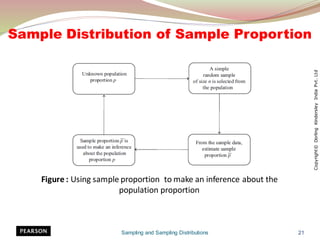
Sample Distribution of Sample Proportion
Figure : Using sample proportion to make an inference about the
population proportion

Sampling and sampling distribution tttt

  • 1.
    Sampling and SamplingDistributions 1 Sampling and Sampling Distributions
  • 2.
    Sampling and SamplingDistributions 2 Learning Objectives Upon completionof this chapter, you will be able to: ➢ Understand the importance of sampling ➢ Differentiate between random and non-random sampling ➢ Understand the concept of sampling and non-sampling errors ➢ Understand the concept of sampling distribution and the application of central limit theorem ➢ Understand sampling distribution of sample proportion
  • 3.
    Sampling and SamplingDistributions 3 Sampling A researcher generally takes a small portion of the population for study, which is referred to as sample. The process of selecting a sample from the population is called sampling.
  • 4.
    Sampling and SamplingDistributions 4 Importance of Sampling ➢ Sampling saves time. ➢ Sampling saves money. ➢ When the research process is destructive in nature, sampling minimizes the destruction. ➢ Sampling broadens the scope of the study in light of the scarcity of resources.
  • 5.
    Sampling and SamplingDistributions 5 Figure : Steps in the sampling design process
  • 6.
    Sampling and SamplingDistributions 6 The Sampling Design Process Step 1: Target population must be defined ➢ Target population is the collection of the objects which possess the information required by the researcher and about which an inference is to be made. Step 2: Sampling frame mustbe determined ➢ This list possesses the information about the subjects and is called the sampling frame. ➢ Sampling is carried out from the sampling frame and not from the target population.
  • 7.
    Sampling and SamplingDistributions 7 The Sampling Design Process (Contd.) Step 3: Appropriate sampling technique must be selected ➢ Non probabilitysampling ➢ Probabilitysampling Step 4: Sample size must be determined ➢ Sample size refers to the number of elements to be included in the study. Step 5: Sampling process must be executed
  • 8.
    Sampling and SamplingDistributions 8 Random Versus Non-random Sampling ➢ In random sampling, each unit of the population has the same probability (chance) of being selected as part of the sample. ➢ In non-random sampling, members of the sample are not selected by chance. Some other factors like judgment or convenience, etc. are the basis of selection.
  • 9.
    Sampling and SamplingDistributions 9 Figure 5.2: Random and non-random sampling methods
  • 10.
    Sampling and SamplingDistributions 10 Random Sampling Methods ➢ Simple Random Sampling ▪ In simple random sampling, each member of the population has an equal chance of being includedin the sample. ▪ Ex. Lottery Method ➢ StratifiedRandom Sampling ▪ In stratified random sampling, elements in the population are dividedinto homogeneous groups called strata. ▪ Then, researchers use the simple random sampling method to select a sample from each of the strata. Each group is called stratum.
  • 11.
    Sampling and SamplingDistributions 11 Random Sampling Methods (Contd.) ➢ Cluster (or Area) Sampling ▪ In stratified sampling, strata happen to be homogenous but in cluster sampling, clusters are internally heterogeneous. Figure 5.6: Diagram for cluster sampling
  • 12.
    Sampling and SamplingDistributions 12 Systematic (or Quasi-random) Sampling ➢ In systematic sampling, sample elements are selected from the population at uniform intervals in terms of time, order, or space.
  • 13.
    Sampling and SamplingDistributions 13 Multi-Stage Sampling ➢ As the name indicates, multistage sampling involves the selection of units in more than one stage. Figure 5.7: Multi-stage (four stages)sampling
  • 14.
    Sampling and SamplingDistributions 14 Non-Random Sampling Sampling techniques where selection of the sampling units is not based on a random selection process are called nonrandom sampling techniques. ➢ Quota Sampling ▪ In quota sampling, quota are fixed according to the requirement of research. a researcher uses non-random sampling methods to gather data from one stratum until the required quota fixed by the researcher is fulfilled. ➢ Convenience Sampling ▪ In convenience sampling, sample elements are selected based on the convenience of a researcher.
  • 15.
    Sampling and SamplingDistributions 15 ➢ Judgement Sampling ▪ In judgement sampling, selection of the sampling units is based on the judgement of a researcher. ➢ Snowball Sampling ▪ In snowball sampling, survey respondents are selected on the basis of referrals from other survey respondents.
  • 16.
    Sampling and SamplingDistributions 16 Sampling and Non-Sampling Errors Sampling Error Sampling error occurs when the sample is not a true representative of the population. In complete enumeration, sampling errors are not present. Sampling errorscan occur due to some specificreasons: ➢ Faulty selection of the sample. ➢ Sometimes due to the difficulty in selection a particular sampling unit, researchers try to substitute that sampling unit with another sampling unit which is easy to be surveyed.
  • 17.
    Sampling and SamplingDistributions 17 Non-Sampling Errors All errors other than sampling can be included in the category of non- sampling errors. The following are some commonnon-sampling errors: ➢ Faulty designing and planning of survey ➢ Response errors ➢ Errors in coverage
  • 18.
    Sampling and SamplingDistributions 18 Key things to keep in mind • Parameters- characteristic of population( what we actually want to know) • Statistic- Characteristic of sample – (what we have with our data) • Sampling distribution-the means by which we will go from our sample to the population
  • 19.
    Sampling and SamplingDistributions 19 sampling distribution(cont….) • A sampling distribution is the probability distribution for all possible values of the sample statistic. • Each sample contains different elements so the value of the sample statistic differs for each sample selected. These statistics provide different estimates of the parameter. The sampling distribution describes how these different values are distributed.
  • 20.
    Sampling and SamplingDistributions 20 Sampling distribution(Cont…) • Sampling distribution is a theoretical distribution that describes all possible values of means, medians, etc. • Some important sampling distributionsare • 1-sampling distribution of mean • 2-sampling distribution of proportion • 3- t distribution • 4- f distribution
  • 21.
    Sampling and SamplingDistributions 21 Sample Distribution of Sample Proportion Figure : Using sample proportion to make an inference about the population proportion