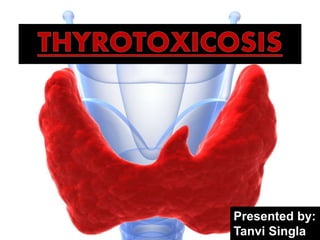
Presented by:
Tanvi Singla
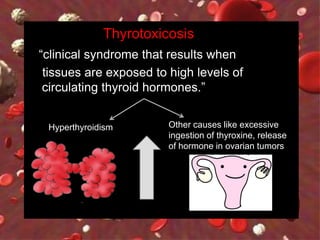
Thyrotoxicosis
ā€œclinical syndrome that results when
tissues are exposed to high levels of
circulating thyroid hormones.ā€
Hyperthyroidism Other causes like excessive
ingestion of thyroxine, release
of hormone in ovarian tumors
CLINICAL TYPES
ļ‚ž Primary thyrotoxicosis
(Grave’s disease)
ļ‚ž Secondary thyrotoxicosis
(Toxic nodular goitre)
ļ‚ž Solitary toxic nodule
ļ‚ž Hyperthyroidism due to rarer
causes
DIFFUSE TOXIC
GOITRE
ļ‚ž Grave’s disease (S/S & diffuse vascular
goitre appears simultaneously)
ļ‚ž Primary thyrotoxicosis
ļ‚ž 8 times more common in females
ļ‚ž Hyperthyroidism more severe than secondary
ļ‚ž Cardiac failure rare
FEATURES: FEMALE
ļ‚ž Female with strong family predisposition
(50%)
ļ‚ž Extra thyroidal manifestation
ļ‚ž Middle or young age (30-50 yr)
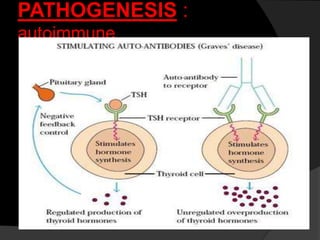
ļ‚ž Autoimmune disorder (evidence
:demonstration of TSH R auto – antibodies in
the circulation)
ļ‚ž human Leukocyte antigen(HLA) and T-
lymphocyte may contribute
ļ‚ž Enlargement of gland is diffuse.
•Pretibial myxoedema
• Proximal myopathy
• Acropachy
• Ophthalmoplegia
PATHOGENESIS :
autoimmune
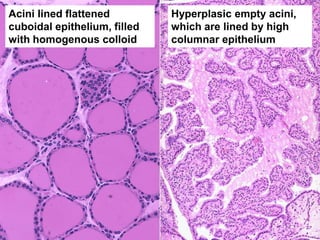
Acini lined flattened
cuboidal epithelium, filled
with homogenous colloid
Hyperplasic empty acini,
which are lined by high
columnar epithelium
C/F:
ļ‚ž Most significant being:
weight loss despite good appetite
tiredness
heat intolerance
ļ‚ž Others being:
emotional instability
palpitations
diarrhoea
EXAMINATION
ļ‚ž GPE: underweight
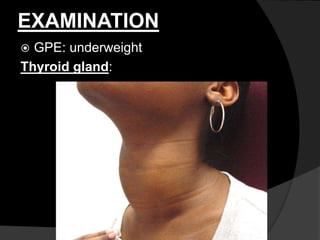
Thyroid gland:
Site : Swelling in the lower part of the front of the neck.
Size : slight to moderate enlargement.
Shape : symmetrical.
Surface: smooth.
Skin overlying: is warm.
Special character : moves up & down with
deglutition.
Consistency : soft or firm
Edge: well defined.
Pulsations & thrills : are detected usually
at the upper poles
CNS signs
ļ‚ž Insomnia
ļ‚ž Tremors of tongue and outstretched
hands
ļ‚ž Agitation
ļ‚ž Exaggerated reflexes
Cutaneous Changes
ļ‚ž Moist warm extremities
ļ‚ž Profuse sweating & flushed face
ļ‚ž Falling of hairs
ļ‚ž Clubbing of fingers & toes
ļ‚ž Soft and brittle nails
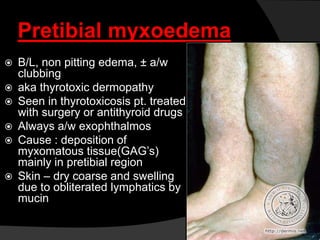
Pretibial myxoedema
ļ‚ž B/L, non pitting edema, ± a/w
clubbing
ļ‚ž aka thyrotoxic dermopathy
ļ‚ž Seen in thyrotoxicosis pt. treated
with surgery or antithyroid drugs
ļ‚ž Always a/w exophthalmos
ļ‚ž Cause : deposition of
myxomatous tissue(GAG’s)
mainly in pretibial region
ļ‚ž Skin – dry coarse and swelling
due to obliterated lymphatics by
mucin
CVS
ļ‚ž More in elderly
ļ‚ž PULSE
Rate : Sleeping pulse up to 100 – 120/ min
Character : water - hammer character
Rhythm: cardiac arrythmias are
superimposed on sinus tachycardia as
disease progresses.
Stages of development of
cardiac arrythmias in
thyrotoxicosis
ļ‚ž Multiple extrasystoles
ļ‚ž Paroxymal atrial tachycardia
ļ‚ž Paroxysmal atrial fibrillation
ļ‚ž Persistent atrial fibrillation
(non responsive to digoxin)
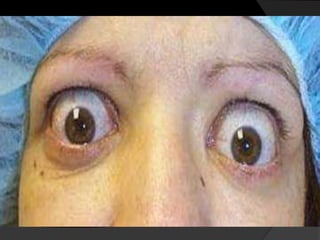
(V) Eye manifestations :
A. Exophthatmos ( > 50 % of cases ) :
TYPES :
a)Apparent ( mild = false) exophthalmos :
widening of the palpebral fissure due to spasm of
Muller's muscle.
b)True exophthalmos :
actual protrusion of the eyeballs.
It is an autoimmune disease
Infiltration of retro bulbar tissue with
inflammatory cells & fluids with
varying degree of spasm of upper
eyelid as LPS is partly innervated by
symapthetic fibres
Probably due to cross- reaction of thyroid antigen & eye (Schwartz )
C.T showing infiltration of
Retro bulbar spaces
True exophthalmos
With widdened palpebral
apperture and
clearly seen sclera
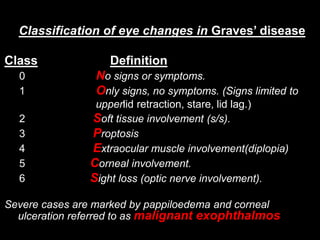
Classification of eye changes in Graves’ disease
Class Definition
0 No signs or symptoms.
1 Only signs, no symptoms. (Signs limited to
upperlid retraction, stare, lid lag.)
2 Soft tissue involvement (s/s).
3 Proptosis
4 Extraocular muscle involvement(diplopia)
5 Corneal involvement.
6 Sight loss (optic nerve involvement).
Severe cases are marked by pappiloedema and corneal
ulceration referred to as malignant exophthalmos
ļ‚ž Spasm and retraction usually disappears
when hyperthyroidism is controlled – B
adrenergic drugs
ļ‚ž Sleeping propped up and lateral
tarsorrhaphy help protect the eye
ļ‚ž Prednisolone – improvement has been
reported….intraorbital not preferred.
ļ‚ž When the eye is in danger…orbital
decompression reqd
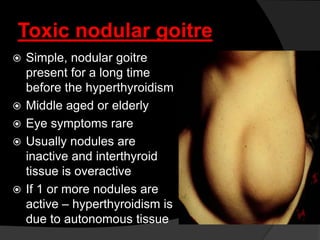
Toxic nodular goitre
ļ‚ž Simple, nodular goitre
present for a long time
before the hyperthyroidism
ļ‚ž Middle aged or elderly
ļ‚ž Eye symptoms rare
ļ‚ž Usually nodules are
inactive and interthyroid
tissue is overactive
ļ‚ž If 1 or more nodules are
active – hyperthyroidism is
due to autonomous tissue
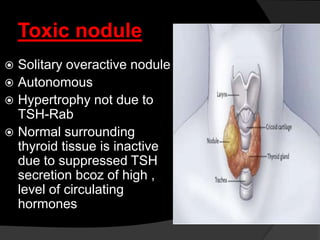
Toxic nodule
ļ‚ž Solitary overactive nodule
ļ‚ž Autonomous
ļ‚ž Hypertrophy not due to
TSH-Rab
ļ‚ž Normal surrounding
thyroid tissue is inactive
due to suppressed TSH
secretion bcoz of high ,
level of circulating
hormones
TREATMENT
NON SPECIFIC – Rest and Sedation.
SPECIFIC – Medical intervention
Surgical intervention
Radioiodine
ANTI – THYROID DRUGS
ļ‚ž Carbimazole, Propyluracil, Methimazole
ļ‚ž B – adrenergic blockers – proranolol,
nadolol
ļ‚ž Iodides – dec vascularity of the gland
only used as immediate preoperative
measure
ļ‚ž Drugs help maintain euthyroid state for a
long time in hope of spontaneous
remission
Block
Cvs
effects
Regime
ļ‚ž Start with 10mg carbimazole- 3 or 4 times a
day …. Latent interval – 2 weeks
When pt. becomes euthyroid, decrease the
dose to 5mg- 2 to 3 times a day for 6 to 24
months
ļ‚ž Alternative regime- BLOCK AND
REPLACEMENT THERAPY
Inhibit all T3 T4 production with high dose and
then give maintainence dose of 0.1 – 0.15mg
of thyroxine daily
decreased risk of iatrogenic thyroid
insufficiency and less follow up required
ļ‚ž Adv : no surgery and no use of
radioactive
ļ‚ž Disadv: prolonged t/t and failure rate
about 50%.
aplastic anemia and agranulocytosis
ļ‚ž Poor prognosis: large gland size,
severity of disease nad TSH-Rab levels
RADIO-IODINE
ļ‚ž Destroys thyroid cells
ļ‚ž Reduces mass of thyroid tissue below a
critical level
ļ‚ž Slow response.. substantial
improvement expected in 8 – 12 wks.. If
not repeat dose
ļ‚ž Higher dose – thyroid failure in 6mnths
ļ‚ž Lower dose result in insufficiency
ļ‚ž Due to sublethal damage to cells not
damaged by t/t
SURGERY
ļ‚ž Indicated in- severe diffuse toxic goitre
- toxic nodular goitre with overactive
internodular tissue
-toxic nodule
ļ‚ž Cures by reducing overactive mass
ļ‚ž Subtotal thyroidectomy- long term followup
ļ‚ž Total or near total thyroidectomy- immediate
thyroid failure with life long thyroxine
replacement… SIMPLIFIES FOLLOW UP
ļ‚ž Adv: Goitre is removed, cure is rapid and
cure rate is high if surgery has been
adequate
ļ‚ž Disadv: recurrence in 5% cases
risk of permanent hypothyroidism
nerve injury
young women – cosmetic issues
Structure
Each lobe
Pear shaped
2 *1*1 inches
Its apex lies at
Level of oblique line
Of thyroid cartilage
& base reach 5th.
Or 6th. Tracheal
ring
Isthmus lies on
2nd. ,3rd. ,4th ,
Tracheal rings
Pyramidal lobe
It is connected to hyoid bone
By fibrous band ( levator glandulae )
thyroid
2 capsules :
*true C.T. capsule around gland
*false outer capsule from
pretracheal fascia
Pretracheal fascia
1- arterial :
Blood supply
• superior thyroid artery
• Branch from E.C.A..
– Inferior thyroid artery
– Branch from thyrocervical trunk
– Which is branch of 1st. Part of subclavian
Others
Thyroid artery from aorta ( may be absent )
Accessory tracheal & esophageal braches
2- venous :
Superior thyroid vein
drain to I.J.V.
middle thyroid vein
drain to I.J.V.
inferior thyroid veins
drain to left innominate vein
The middle thyroid vein
Is the shortest soit is the
1st To be ligated
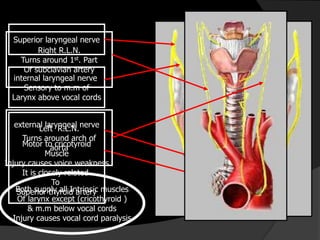
Superior laryngeal nerve
internal laryngeal nerve
Sensory to m.m of
Larynx above vocal cords
external laryngeal nerve
Motor to cricotyroid
Muscle
Injury causes voice weakness
It is closely related
To
Superior thyroid artery
Right R.L.N.
Turns around 1st. Part
Of subclavian artery
Left R.L.N.
Turns around arch of
aorta
Both supply all Intrinsic muscles
Of larynx except (cricothyroid )
& m.m below vocal cords
Injury causes vocal cord paralysis
Surgical anatomy
ļ‚ž From superficial to deep:
ļ‚— Skin
ļ‚— Platysma (a muscle in superficial fascia
of neck)
ļ‚— Investing layer of deep cervical fascia
ļ‚— Pre-tracheal layer of deep cervical
fascia
ļ‚— Strap muscles of neck (thin flat muscles)
Preoperative preparation
ļ‚ž Make patient euthyroid
CARBIMAZOLE regime (8-12wks)
Alternate: B adrenergic blocking drugs
abolish clinical manifest. of toxic state
propranolol(40mgTDS) or nadolol(160mg OD)
rapid response.. Operation can be arranged
within few days
continue therapy for 7 days postoperatively
Investigations
ļ‚ž Full blood count (CBC)
ļ‚ž Serum Urea, Electrolytes, Creatinine
ļ‚ž Thyroid Function tests
ļ‚ž Laryngoscopy
ļ‚ž Thyroid antibodies
ļ‚ž Serum calcium estimation
ļ‚ž Radio-iodine (99mTc / 131I) scan of thyroid
INFORMED CONSENT
FOR THE SURGERY IS
ESSENTIAL
Technique
ļ‚ž GA with endotracheal intubation
ļ‚ž Pt. is supine with table tilted at 15° at the
head end to reduce venous
engorgement (reverse trendelenburg)
ļ‚ž Sand bag placed transversely under the
shoulder
ļ‚ž Neck extended
ļ‚ž Apply tension to skin, platysma and
strap msls for easy dissection.
ļ‚ž Curved skin incision made midway
between notch of thyroid cartilage and
suprasternal notch
ļ‚ž Flaps of skin, s/c, platysma raised
upwards to superior thyroid notch and
downwards to suprasternal notch
Exposing the gland
ļ‚ž Investing fascia divided in the midline
ļ‚ž Strap msls divided only if large area to be
exposed
ļ‚ž Sternohyoid msl is mobilised off the thyroid
lobe taking care to stay close to msl and
outside capsule
ļ‚ž Pretracheal fascia opened
ļ‚ž Gland is exposed
Dealing with vessels
ļ‚ž Arteries before veins (to prevent venous
engorgement)
ļ‚ž Vessels clamped, divided and ligated
ļ‚ž Superior thyroid artery ligated close to the
upper pole of the gland.
ļ‚ž This is to prevent damage to external
laryngeal nerve.
ļ‚ž Inferior thyroid artery is similarly dealt with
faraway from the lower pole of the gland
ļ‚ž This is to safeguard recurrent laryngeal
nerve.
ļ‚ž They are not routinely ligated to preserve
parathyroid function
ļ‚ž Then superior, middle and inferior thyroid
veins are dealt with in a similar manner.
i
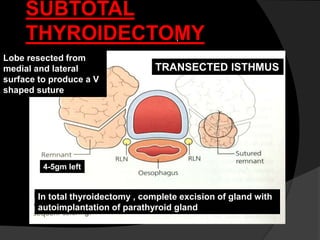
SUBTOTAL
THYROIDECTOMY
TRANSECTED ISTHMUS
Lobe resected from
medial and lateral
surface to produce a V
shaped suture
4-5gm left
In total thyroidectomy , complete excision of gland with
autoimplantation of parathyroid gland
Parathyroid glands
ļ‚ž Identified by careful inspection
ļ‚ž If inadvertently or unavoidbly excised or
devasularised
ļ‚ž Should be fragmented and auto-
transplanted immediately within
sternoclenomastoid muscle
ļ‚ž Absolute hemostasis secured by ligation
of individual vessels and by suture of
thyroid remnants to tracheal fascia
ļ‚ž Pretracheal msls and cervical fascia are
sutured and wound closed
Complications
ļ‚ž Hemorrhage
ļ‚ž Respiratory obstruction
ļ‚ž Recurrent laryngeal nerve paralysis-Hoarseness
of voice
ļ‚ž Hypocalcemic tetany (due to accidental removal
of parathyroid glands during total thyroidectomy)
ļ‚ž Wound infection: This may manifest after 48
hours of surgery
ļ‚ž Thyroid insufficiency
ļ‚ž Thyrotoxic crisis
ļ‚ž Hypertrophic / Keloid scar
ļ‚ž Stitch granuloma
Post operative care
ļ‚ž Transient hypocalcemia – oral Ca+2
maybe necessary….if severe then 10ml
IV Ca+2 gluconate 10% given
ļ‚ž Screen parathyroid insufficiency –
serum Ca+2 measured 4-6wks after
operation
ļ‚ž Recurrent thyrotoxicosis common –
lifelong follow up

Thyrotoxicosis

  • 1.
  • 2.
    Thyrotoxicosis ā€œclinical syndrome thatresults when tissues are exposed to high levels of circulating thyroid hormones.ā€ Hyperthyroidism Other causes like excessive ingestion of thyroxine, release of hormone in ovarian tumors
  • 4.
    CLINICAL TYPES ļ‚ž Primarythyrotoxicosis (Grave’s disease) ļ‚ž Secondary thyrotoxicosis (Toxic nodular goitre) ļ‚ž Solitary toxic nodule ļ‚ž Hyperthyroidism due to rarer causes
  • 5.
    DIFFUSE TOXIC GOITRE ļ‚ž Grave’sdisease (S/S & diffuse vascular goitre appears simultaneously) ļ‚ž Primary thyrotoxicosis ļ‚ž 8 times more common in females ļ‚ž Hyperthyroidism more severe than secondary ļ‚ž Cardiac failure rare
  • 6.
    FEATURES: FEMALE ļ‚ž Femalewith strong family predisposition (50%) ļ‚ž Extra thyroidal manifestation ļ‚ž Middle or young age (30-50 yr) ļ‚ž Autoimmune disorder (evidence :demonstration of TSH R auto – antibodies in the circulation) ļ‚ž human Leukocyte antigen(HLA) and T- lymphocyte may contribute ļ‚ž Enlargement of gland is diffuse. •Pretibial myxoedema • Proximal myopathy • Acropachy • Ophthalmoplegia
  • 7.
  • 8.
    Acini lined flattened cuboidalepithelium, filled with homogenous colloid Hyperplasic empty acini, which are lined by high columnar epithelium
  • 9.
    C/F: ļ‚ž Most significantbeing: weight loss despite good appetite tiredness heat intolerance ļ‚ž Others being: emotional instability palpitations diarrhoea
  • 10.
  • 11.
    Site : Swellingin the lower part of the front of the neck. Size : slight to moderate enlargement. Shape : symmetrical. Surface: smooth. Skin overlying: is warm. Special character : moves up & down with deglutition. Consistency : soft or firm Edge: well defined. Pulsations & thrills : are detected usually at the upper poles
  • 12.
    CNS signs ļ‚ž Insomnia ļ‚žTremors of tongue and outstretched hands ļ‚ž Agitation ļ‚ž Exaggerated reflexes
  • 13.
    Cutaneous Changes ļ‚ž Moistwarm extremities ļ‚ž Profuse sweating & flushed face ļ‚ž Falling of hairs ļ‚ž Clubbing of fingers & toes ļ‚ž Soft and brittle nails
  • 14.
    Pretibial myxoedema ļ‚ž B/L,non pitting edema, ± a/w clubbing ļ‚ž aka thyrotoxic dermopathy ļ‚ž Seen in thyrotoxicosis pt. treated with surgery or antithyroid drugs ļ‚ž Always a/w exophthalmos ļ‚ž Cause : deposition of myxomatous tissue(GAG’s) mainly in pretibial region ļ‚ž Skin – dry coarse and swelling due to obliterated lymphatics by mucin
  • 15.
    CVS ļ‚ž More inelderly ļ‚ž PULSE Rate : Sleeping pulse up to 100 – 120/ min Character : water - hammer character Rhythm: cardiac arrythmias are superimposed on sinus tachycardia as disease progresses.
  • 16.
    Stages of developmentof cardiac arrythmias in thyrotoxicosis ļ‚ž Multiple extrasystoles ļ‚ž Paroxymal atrial tachycardia ļ‚ž Paroxysmal atrial fibrillation ļ‚ž Persistent atrial fibrillation (non responsive to digoxin)
  • 17.
    (V) Eye manifestations: A. Exophthatmos ( > 50 % of cases ) : TYPES : a)Apparent ( mild = false) exophthalmos : widening of the palpebral fissure due to spasm of Muller's muscle.
  • 18.
    b)True exophthalmos : actualprotrusion of the eyeballs. It is an autoimmune disease Infiltration of retro bulbar tissue with inflammatory cells & fluids with varying degree of spasm of upper eyelid as LPS is partly innervated by symapthetic fibres Probably due to cross- reaction of thyroid antigen & eye (Schwartz ) C.T showing infiltration of Retro bulbar spaces True exophthalmos With widdened palpebral apperture and clearly seen sclera
  • 20.
    Classification of eyechanges in Graves’ disease Class Definition 0 No signs or symptoms. 1 Only signs, no symptoms. (Signs limited to upperlid retraction, stare, lid lag.) 2 Soft tissue involvement (s/s). 3 Proptosis 4 Extraocular muscle involvement(diplopia) 5 Corneal involvement. 6 Sight loss (optic nerve involvement). Severe cases are marked by pappiloedema and corneal ulceration referred to as malignant exophthalmos
  • 21.
    ļ‚ž Spasm andretraction usually disappears when hyperthyroidism is controlled – B adrenergic drugs ļ‚ž Sleeping propped up and lateral tarsorrhaphy help protect the eye ļ‚ž Prednisolone – improvement has been reported….intraorbital not preferred. ļ‚ž When the eye is in danger…orbital decompression reqd
  • 22.
    Toxic nodular goitre ļ‚žSimple, nodular goitre present for a long time before the hyperthyroidism ļ‚ž Middle aged or elderly ļ‚ž Eye symptoms rare ļ‚ž Usually nodules are inactive and interthyroid tissue is overactive ļ‚ž If 1 or more nodules are active – hyperthyroidism is due to autonomous tissue
  • 23.
    Toxic nodule ļ‚ž Solitaryoveractive nodule ļ‚ž Autonomous ļ‚ž Hypertrophy not due to TSH-Rab ļ‚ž Normal surrounding thyroid tissue is inactive due to suppressed TSH secretion bcoz of high , level of circulating hormones
  • 25.
    TREATMENT NON SPECIFIC –Rest and Sedation. SPECIFIC – Medical intervention Surgical intervention Radioiodine
  • 26.
    ANTI – THYROIDDRUGS ļ‚ž Carbimazole, Propyluracil, Methimazole ļ‚ž B – adrenergic blockers – proranolol, nadolol ļ‚ž Iodides – dec vascularity of the gland only used as immediate preoperative measure ļ‚ž Drugs help maintain euthyroid state for a long time in hope of spontaneous remission Block Cvs effects
  • 27.
    Regime ļ‚ž Start with10mg carbimazole- 3 or 4 times a day …. Latent interval – 2 weeks When pt. becomes euthyroid, decrease the dose to 5mg- 2 to 3 times a day for 6 to 24 months ļ‚ž Alternative regime- BLOCK AND REPLACEMENT THERAPY Inhibit all T3 T4 production with high dose and then give maintainence dose of 0.1 – 0.15mg of thyroxine daily decreased risk of iatrogenic thyroid insufficiency and less follow up required
  • 28.
    ļ‚ž Adv :no surgery and no use of radioactive ļ‚ž Disadv: prolonged t/t and failure rate about 50%. aplastic anemia and agranulocytosis ļ‚ž Poor prognosis: large gland size, severity of disease nad TSH-Rab levels
  • 29.
    RADIO-IODINE ļ‚ž Destroys thyroidcells ļ‚ž Reduces mass of thyroid tissue below a critical level ļ‚ž Slow response.. substantial improvement expected in 8 – 12 wks.. If not repeat dose ļ‚ž Higher dose – thyroid failure in 6mnths ļ‚ž Lower dose result in insufficiency ļ‚ž Due to sublethal damage to cells not damaged by t/t
  • 30.
    SURGERY ļ‚ž Indicated in-severe diffuse toxic goitre - toxic nodular goitre with overactive internodular tissue -toxic nodule ļ‚ž Cures by reducing overactive mass ļ‚ž Subtotal thyroidectomy- long term followup ļ‚ž Total or near total thyroidectomy- immediate thyroid failure with life long thyroxine replacement… SIMPLIFIES FOLLOW UP
  • 31.
    ļ‚ž Adv: Goitreis removed, cure is rapid and cure rate is high if surgery has been adequate ļ‚ž Disadv: recurrence in 5% cases risk of permanent hypothyroidism nerve injury young women – cosmetic issues
  • 32.
    Structure Each lobe Pear shaped 2*1*1 inches Its apex lies at Level of oblique line Of thyroid cartilage & base reach 5th. Or 6th. Tracheal ring Isthmus lies on 2nd. ,3rd. ,4th , Tracheal rings Pyramidal lobe It is connected to hyoid bone By fibrous band ( levator glandulae ) thyroid 2 capsules : *true C.T. capsule around gland *false outer capsule from pretracheal fascia Pretracheal fascia
  • 33.
    1- arterial : Bloodsupply • superior thyroid artery • Branch from E.C.A.. – Inferior thyroid artery – Branch from thyrocervical trunk – Which is branch of 1st. Part of subclavian Others Thyroid artery from aorta ( may be absent ) Accessory tracheal & esophageal braches
  • 34.
    2- venous : Superiorthyroid vein drain to I.J.V. middle thyroid vein drain to I.J.V. inferior thyroid veins drain to left innominate vein The middle thyroid vein Is the shortest soit is the 1st To be ligated
  • 35.
    Superior laryngeal nerve internallaryngeal nerve Sensory to m.m of Larynx above vocal cords external laryngeal nerve Motor to cricotyroid Muscle Injury causes voice weakness It is closely related To Superior thyroid artery Right R.L.N. Turns around 1st. Part Of subclavian artery Left R.L.N. Turns around arch of aorta Both supply all Intrinsic muscles Of larynx except (cricothyroid ) & m.m below vocal cords Injury causes vocal cord paralysis
  • 36.
    Surgical anatomy ļ‚ž Fromsuperficial to deep: ļ‚— Skin ļ‚— Platysma (a muscle in superficial fascia of neck) ļ‚— Investing layer of deep cervical fascia ļ‚— Pre-tracheal layer of deep cervical fascia ļ‚— Strap muscles of neck (thin flat muscles)
  • 37.
    Preoperative preparation ļ‚ž Makepatient euthyroid CARBIMAZOLE regime (8-12wks) Alternate: B adrenergic blocking drugs abolish clinical manifest. of toxic state propranolol(40mgTDS) or nadolol(160mg OD) rapid response.. Operation can be arranged within few days continue therapy for 7 days postoperatively
  • 38.
    Investigations ļ‚ž Full bloodcount (CBC) ļ‚ž Serum Urea, Electrolytes, Creatinine ļ‚ž Thyroid Function tests ļ‚ž Laryngoscopy ļ‚ž Thyroid antibodies ļ‚ž Serum calcium estimation ļ‚ž Radio-iodine (99mTc / 131I) scan of thyroid
  • 39.
    INFORMED CONSENT FOR THESURGERY IS ESSENTIAL
  • 40.
    Technique ļ‚ž GA withendotracheal intubation ļ‚ž Pt. is supine with table tilted at 15° at the head end to reduce venous engorgement (reverse trendelenburg) ļ‚ž Sand bag placed transversely under the shoulder ļ‚ž Neck extended ļ‚ž Apply tension to skin, platysma and strap msls for easy dissection.
  • 41.
    ļ‚ž Curved skinincision made midway between notch of thyroid cartilage and suprasternal notch ļ‚ž Flaps of skin, s/c, platysma raised upwards to superior thyroid notch and downwards to suprasternal notch
  • 42.
    Exposing the gland ļ‚žInvesting fascia divided in the midline ļ‚ž Strap msls divided only if large area to be exposed ļ‚ž Sternohyoid msl is mobilised off the thyroid lobe taking care to stay close to msl and outside capsule ļ‚ž Pretracheal fascia opened ļ‚ž Gland is exposed
  • 43.
    Dealing with vessels ļ‚žArteries before veins (to prevent venous engorgement) ļ‚ž Vessels clamped, divided and ligated ļ‚ž Superior thyroid artery ligated close to the upper pole of the gland. ļ‚ž This is to prevent damage to external laryngeal nerve.
  • 44.
    ļ‚ž Inferior thyroidartery is similarly dealt with faraway from the lower pole of the gland ļ‚ž This is to safeguard recurrent laryngeal nerve. ļ‚ž They are not routinely ligated to preserve parathyroid function ļ‚ž Then superior, middle and inferior thyroid veins are dealt with in a similar manner.
  • 45.
    i SUBTOTAL THYROIDECTOMY TRANSECTED ISTHMUS Lobe resectedfrom medial and lateral surface to produce a V shaped suture 4-5gm left In total thyroidectomy , complete excision of gland with autoimplantation of parathyroid gland
  • 46.
    Parathyroid glands ļ‚ž Identifiedby careful inspection ļ‚ž If inadvertently or unavoidbly excised or devasularised ļ‚ž Should be fragmented and auto- transplanted immediately within sternoclenomastoid muscle
  • 47.
    ļ‚ž Absolute hemostasissecured by ligation of individual vessels and by suture of thyroid remnants to tracheal fascia ļ‚ž Pretracheal msls and cervical fascia are sutured and wound closed
  • 48.
    Complications ļ‚ž Hemorrhage ļ‚ž Respiratoryobstruction ļ‚ž Recurrent laryngeal nerve paralysis-Hoarseness of voice ļ‚ž Hypocalcemic tetany (due to accidental removal of parathyroid glands during total thyroidectomy) ļ‚ž Wound infection: This may manifest after 48 hours of surgery ļ‚ž Thyroid insufficiency ļ‚ž Thyrotoxic crisis ļ‚ž Hypertrophic / Keloid scar ļ‚ž Stitch granuloma
  • 49.
    Post operative care ļ‚žTransient hypocalcemia – oral Ca+2 maybe necessary….if severe then 10ml IV Ca+2 gluconate 10% given ļ‚ž Screen parathyroid insufficiency – serum Ca+2 measured 4-6wks after operation ļ‚ž Recurrent thyrotoxicosis common – lifelong follow up