HYPERTHYROIDISM
DR
VARESH NAGRATH
,9838071306
Reference: Harrison's
THYROTOXICOSIS
•Thyrotoxicosis :Excess
•Hyperthyroidism: Excess due to over production
THYROTOXICOSIS
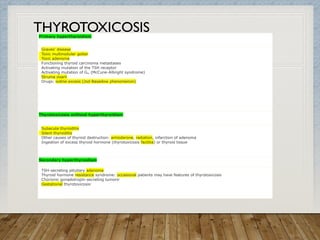
Table 335-6 Causes of Thyrotoxicosis
Primary hyperthyroidism
Graves' disease
Toxic multinodular goiter
Toxic adenoma
Functioning thyroid carcinoma metastases
Activating mutation of the TSH receptor
Activating mutation of Gsa (McCune-Albright syndrome)
Struma ovarii
Drugs: iodine excess (Jod-Basedow phenomenon)
Thyrotoxicosis without hyperthyroidism
Subacute thyroiditis
Silent thyroiditis
Other causes of thyroid destruction: amiodarone, radiation, infarction of adenoma
Ingestion of excess thyroid hormone (thyrotoxicosis factitia) or thyroid tissue
Secondary hyperthyroidism
TSH-secreting pituitary adenoma
Thyroid hormone resistance syndrome: occasional patients may have features of thyrotoxicosis
Chorionic gonadotropin-secreting tumorsa
Gestational thyrotoxicosisa
PREDISPOSING FACTORS OF GRAVES'
Predisposing factors
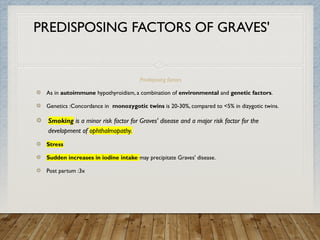
As in autoimmune hypothyroidism, a combination of environmental and genetic factors.
Genetics :Concordance in monozygotic twins is 20-30%, compared to <5% in dizygotic twins.
Smoking is a minor risk factor for Graves' disease and a major risk factor for the
development of ophthalmopathy.
Stress
Sudden increases in iodine intake may precipitate Graves' disease.
Post partum :3x
PATHOGENESIS
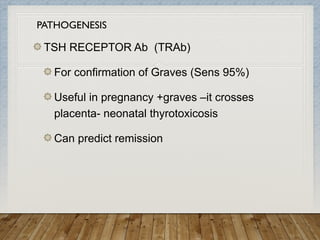
TSH RECEPTOR Ab (TRAb)
For confirmation of Graves (Sens 95%)
Useful in pregnancy +graves –it crosses
placenta- neonatal thyrotoxicosis
Can predict remission
PATHOLOGY OF OPTHALMOPATHY
EOM SWELLING :
Infiltrated by activatedT cells,release cytokines:IFN-Gama,TNF, and IL-1
Fibroblast activation > glycosaminoglycans produced >trap water
EOM Fibrosis
Later , irreversible
Increased fat is an additional cause of retrobulbar tissue expansion.
The increase in intraorbital pressure can lead to proptosis, diplopia, and optic neuropathy
INCIDENCE
Graves' disease accounts for 60-80% of thyrotoxicosis.
The prevalence varies among populations, depending mainly on iodine
intake (high iodine intake is associated with an increased prevalence of
Graves' disease)
Graves' disease occurs in up to 2% of women but is one-tenth as
frequent in men.
The disorder rarely begins before adolescence and typically occurs between
20 and 50 years of age, but it also occurs in the elderly.
C/F :
Excludes the signs of ophthalmopathy and dermopathy specific for Graves' disease.
Table 335-7 Signs and Symptoms of Thyrotoxicosis (Descending Order of
Frequency)
Signs and Symptoms of Thyrotoxicosis (Descending Order of Frequency)
Symptoms Signs
Hyperactivity, irritability, dysphoria
Heat intolerance and sweating
Palpitations
Fatigue and weakness
Weight loss with increased appetite (5% Wt gain)
Diarrhea
Polyuria
Oligomenorrhea, Amenorrhoea loss of libido
Tachycardia; atrial fibrillation in the elderly
Tremor
Goiter
Warm, moist skin
Muscle weakness, proximal myopathy,hyperreflexia,wasting
Lid retraction or lag
Gynecomastia
Chorea Rare
C/F:CVS
Pulse
Rate :High
Rhythm :AF in > 50 yr .Tr ofThyrotoxicosis converts to SR in 50%)
Volume :Bounding ,boad PP
Auscultation :Aortic systolic murmur
Worsening of angina or heart failure (IN elderly or preexisting heart disease
C/F CONTD
Palmar erythema, onycholysis, and, less commonly, pruritus, urticaria, and diffuse hyperpigmentation may
be evident.
Hair texture may become fine,
Diffuse alopecia:40% , takes months to improve
Osteopenia , #
Mild hypercalcemia :In 20%
Hypercalciuria
O/E
Gland :Diffuse enlargement 2-3X
Thrill or bruit m/b+
O/E :GRAVES OPTHALMOPATHY
Lid retraction,staring appearance (Any thyrotoxicosis,due to sympathetic
overactivity)
Graves' ophthalmopathy.
Syn:Thyroid-associated ophthalmopathy,
Causes :10% inAutoimmune hypothyroidism or thyroid antibodies.
Time line
Starts 1 year +/- of onset of Graves disease
Sometime several year +/- , m/b euthyroid ophthalmopathy.
GRAVES’ OPTHALMOPATHY
Symptoms :
m/b Unilateral in 10%
Grittiness, eye discomfort, and excess tearing
Diplopia in 5-10% if muscle swelling is severe . On Up&lateral gaze
Sign :
Lid lag
Proptosis –on Exopthalmometer Corneal exposure
Periorbital edema ,scleral injection ,Cheimosis
Investigation :
CT/USG orbit :Enlarged extraocular muscles in all pts
Complication : Compression of the optic nerve at the apex of the orbit- papilledema, peripheral
field defects, and, if left untreated, permanent loss of vision.
GRAVES’ OPTHALMOPATHY
Orbital changes in Graves' disease
"NO SPECS” scheme
0 = No signs or symptoms
1 = Only signs (lid retraction or lag), no symptoms
2 = Soft tissue involvement (periorbital edema)
3 = Proptosis (>22 mm)
4 = Extraocular muscle involvement (diplopia)
5 = Corneal involvement
6 = Sight loss
patients do not necessarily progress from one class to another
referral to an ophthalmologist is indicated
GRAVES’ OPTHALMOPATHY
• Lid retraction
• Periorbital edema
• Conjunctival injection
• Proptosis
GRAVES’ DERMOPATHY
Thyroid dermopathy : In <5% , almost asso with Mod-severe
opthalmopatthy
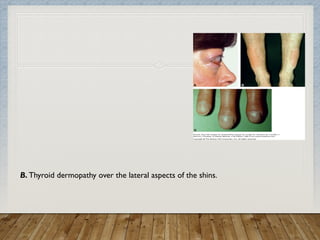
Site :Pretibial ,anterior and lateral leg
Myxoedema :Thickening of skin
Noninflamed, indurated plaque
Deep pink or purple color and an "orange-skin" appearance.
Nodular involvement can occur,
Rarely whole leg and foot involvement D/D Elephantiasis.
B. Thyroid dermopathy over the lateral aspects of the shins.
GRAVES' DISEASE
Thyroid acropachy:Thickening of acral parts, <1%
Triad of :
Digital clubbing
Soft tissue swelling of the hands and feet
Periosteal new bone formation.
Asso :Thyroid dermopathy
C. Thyroid acropachy.
GRAVES IN ELDERLY
Only fatigue /wt loss :Apathetic graves (D/D
Depression)
AF
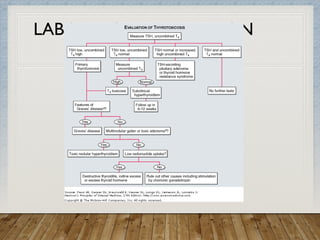
LABORATORY EVALUATION
INVESTIGATION IN GRAVES' DISEASE
Low TSH/High FT4/High FT3
Low TSH, Normal FT4, FT3 elevated :In 2-5% ,T3 toxicosis
Low TSH , Elevated totalT4,Elevated FT4 ,NormalT3 k/a T4 toxicosis
Seen in areas with excess iodine, providing surplus substrate for thyroid hormone
synthesis.
Measurement of TPO antibodies is useful in differential diagnosis.
Measurement of TBII orTSI will confirm the diagnosis but is not needed routinely.
Asso :
Bilirubin, liver enzymes, and ferritin.
Microcytic anemia and thrombocytopenia may occur.
GRAVES' DISEASE D/D
Diagnosis of Graves' disease is straightforward in a patient with:
1.Biochemically confirmed thyrotoxicosis,
2.Diffuse goiter on palpation,
3.Ophthalmopathy,
4.PositiveTPO orTSH-R antibodies,
5.Often a personal or family history of autoimmune
disorders.
GRAVES' DISEASE
• In doubtful patients do a radionuclide scan
• Graves :Diffuse, high uptake
• MNG
• Toxic adenoma
• Thyroiditis
• Ectopic thyroid tissue
• Factitious thyrotoxicosis.
THYROTOXICOSIS WITH DECREASED
RAI UPTAKE
Thyroiditis (Thyroglobulin is elevated)
Thyrotoxicosis factita (Thyroglobulin is decreased)
Iodine excess
Ectopic thyroid tissue, particularly teratomas of the
ovary (struma ovarii) (Rare)
Functional metastatic follicular carcinoma (Rare)
GRAVES' DISEASE D/D
Non supressedTSH + High freeT4
TSH-secreting pituitary tumor:
Diffuse goiter.
CT/MRI pituitary fossa
Panic attacks
Mania
Pheochromocytoma
Weight loss associated with malignancy.
GRAVES' DISEASE COURSE
Some pts spontaneous relapses and remissions.
Rarely, fluctuation between hypo- and hyperthyroidism due to changes in
the functional activity of TSH-R antibodies.
15% of patients who enter remission after treatment with antithyroid drugs
develop hypothyroidism 10-15 years later as a result of the destructive
autoimmune process.
COURSE …
Ophthalmopathy
Worsens over the initial 3-6 months, followed by
Plateau for next 12-18 months,
Apontaneous improvement, particularly in the soft tissue changes.
Fulminant course in 5% :Optic nerve compression or corneal ulceration.
Diplopia :Late due to fibrosis of the extraocular muscles.
Rai treatment worsens eye disease in a small proportion of patients (especially smokers).
Antithyroid drugs or surgery have no adverse effects on the clinical course of ophthalmopathy.
Thyroid dermopathy, when it occurs, usually appears 1-2 years after the development of Graves'
hyperthyroidism; it may improve spontaneously.
GRAVES' DISEASE
GRAVES' DISEASE:TREATMENT
reducing thyroid hormone synthesis:
1. Antithyroid drugs
2. Radioiodine (131
I) treatment
3. Thyroidectomy
TR –ANTITHYROID DRUGS
Thionamides, such as propylthiouracil, carbimazole, and the active metabolite of
the latter, methimazole.
All inhibit the function of Thyroid peroxidase (which helps in oxidation and
organification of iodide.)
Propylthiouracil inhibits deiodination ofT4 toT3
These drugs also reduce thyroid antibody levels
Half life
PTU : 90 minute
Carbimazole : Slightly less than 6 hr
Methimazole 6 hr .
TR …
Start with carbimazole or methimazole :
Carbimazole/Methimazole : 10-20 mg every 8 or 12 h
PTU : 100-200 mg 6-8 hour
Maintain after euthyroidism achieved :OD
Block-replace regimen: High doses +Levothyroxine to avoid
drug-induced hypothyroidism.
PTU INDICATIONS
First trimester of pregnancy, the
Thyroid storm
Carbimazole/ Metimazole :S/E
OD Dose is not possible even after euthyroidism achievement
S/E
Hepatotoxicity
Watch LFT
TR..
REVIEW :3-4 week
Dose titrated on basis of :FT4
TSH :Remains suppressed for Several mo.
Maintenance dose :Usually 5-10 mg of carbimazole or methimazole and 50-100 mg of PTU
Remission achieved :By 18-24 month in 40% pts
In Block & replace regimen :Remission achieved in 6 mo
After remission is achieved closely follow for 1 yr & then annually
S/E OF DRUGS :
Rash, urticaria, fever, and arthralgia (1-5% of patients).
Either resolve spontaneously or
May need substituting an alternative antithyroid drug.
Tr :Antihistaminc
Rare but Major (Never restart )
Hepatitis :PTU (Avoid in children)
Vasculitis
Agranulocytosis (<1%): Sore throat,Fever , Oral ulcer
Idiosyncratic & abrupt-serial testing for detection not useful
GRAVES' DISEASE TR …
Propranolol (or Atenolol)
20-40 mg every 6 h
Helpful in initial stages of treatment
Thyrotoxic periodic paralysis
AF :Anticoagulation
In thyrotoxic state :Lesser dose of Coumarin& higher of Digoxin
TR RADIOIODINE
Indications : Drug Naïve or in relapse
C/E :
Pregnancy & Lactation. Can conceive after 6 mo
Opthalmopathy :Worsens ,esp in smokers
Preparation :Stop iodine containing drugs
Carbimazole/Methimazole Stop 2-3 days prior ,o/w I uptake dec
PTU :Stop several weeks before or higher dose of RaI
Dose :Let specialist decide. Strategy c/b Ablate & replace –advantage-single dose
S/E :
Radiation thyroiditis : 1-2 week after treatment
Thyrotoxic crisis :
Prevention : Pre tr with antithyroid x1 mo prevents ,by depleting thyroid hormone
Elderly
Cardiac pt
Relapse : Second dose after 6 mo
Hypothyroidism : 10-20% in first year ,then 5%/year ,Most pts 5-10 yr later
After RAI :Restart oral after 3-7 days, Give for 2-3 mo +Propranolol
RADIOIODINE TR
S/E :
Radiation thyroiditis : 1-2 week after treatment
Thyrotoxic crisis :
Prevention : Pre tr with antithyroid x1 mo prevents ,by depleting thyroid
hormone
Elderly
Cardiac pt
Relapse : Second dose after 6 mo
Hypothyroidism : 10-20% in first year ,then 5%/year ,Most pts 5-10 yr later
Risk of cancer : minimal
After RAI :Restart oral after 3-7 days, Give for 2-3 mo +Propranolo.Avoid contact
with pregnant & children for 7 days
TR SUBTOTAL OR NEAR TOTAL
THYROIDECTOMY
Indications : Patient preference in relapse pts ; large goiter
Prerequisite :
Control toxicosis by oral drugs
Potassium Iodide 1-2 drops tds for 10 days to prevent thyroid storm
Complications :
Recurrent laryngeal nerve damage
Hypoparathyroidism
Laryngeal edema
Recurrence :<2%
Hypothyroidism later
GRAVES' DISEASE IN PREGNANCY
14-16 week :PTU-Doesn’t cross placenta - watch LFT-
Thereafter :Carbimazole/Methimazole.( (Third trimester m/b drug free)
Carbimazole dose :1/10th
of PTU
Target :FT4/TotalT4 at or just above the preg ref range
S/E to fetus :
Hypothyroidism& Goiter : More if higher dose of Carb/Meth to mother .Therefore use
lower dose /titration regimen (Not blocking doses)
Carbi/Methi : Esp if first trimester , aplasia cutis,choanal atresia and TE fistula
Fetal thyrotoxicosis/Neonatal too : If Thyroid stimulating immunoglobulins are 3x after 26 week
Suspect :IUGR,fetal HR > 160 ,fetal goiter ,advance bone age
Tr :Antithyroid Rx to mother . Neonate may need drugs for 1-3 mo
PREGNANCY CONTD
Stop oral drugs at presentation if
THYROID STORM / THYROTOXIC CRISIS
 Rare
 PPT causes :
 Ac illness :Stroke, infection, trauma, diabetic ketoacidosis
 Surgery (especially on the thyroid)
 Radioiodine treatment of partially treated or untreated hyperthyroidism.
 C/F
 High Fever +Altered sensorium - delirium, seizures, coma
 Vomiting, diarrhea, and jaundice.
 High output heart failure ,AF
 Prognosis :Mortality 30%, even with treatment.
THYROID STORM / THYROTOXIC CRISIS
In ICU
Treat the ppt cause
PTU : 600 mg loading dose and 200-300 mg every 6 h. Orally/RT/Per rectum
One hour after PTU :Iodine to block thyroid hormone synthesis via the Wolff-Chaikoff effect .
Saturated Potassium Iodine :5 drops SSKI every 6 h
Ipodate or iopanoic acid (0.5 mg every 12 h), may be given orally.
PTU pre-tr prevents incorporation of iodine for new hormone synthesis
Propranolol :40-60 mg orally every 4 h (High doses decrease T4 to T3 conversion)
Dexamethasone, 2 mg every 6 h or Hydrocortisone 300 mg stat,then 100 mg tds
Antibiotics if infection is present,
Cooling, oxygen, and intravenous fluids.
Cholestyramine to sequester thyroid hormones
OPTHALMOPATHY TR
Mild-Mod :No tr ,spontaneous improvement ,stop smoking
Discomfort :Artificial tears (e.g., 1% methylcellulose), paraffin based eye ointment, and the use of
dark glasses with side frames.
Periorbital edema may respond to a more upright sleeping position or a diuretic.
Corneal exposure during sleep can be avoided by using patches or taping the eyelids shut.
Minor degrees of diplopia improve with prisms fitted to spectacles.
Some authorities also advocate selenium 100 μg bid.
Severe ophthalmopathy, with optic nerve involvement or chemosis resulting in corneal
damage, is an emergency.
Short-term benefit can be gained in about two-thirds of patients by the use of high-dose
glucocorticoids (e.g., prednisone, 40-80 mg daily), sometimes combined with cyclosporine.
GRAVES' DISEASE
Pulse therapy with IV methylprednisolone:
500 mg /week for 6 week then
250 mg once weekly for 6 weeks
When glucocorticoids are ineffective, orbital decompression
Proptosis recedes an average of 5 mm, but there may be residual or even worsened diplopia.
External beam radiotherapy m/b used .Steroids are better
Teprotumumab: FDA gave breakthrough designation . Rapidly improves proptosis,diplopia, clinical activity score,
and quality of life.
Thyroid dermopathy does not usually require treatment but can cause cosmetic problems or
interfere with the fit of shoes. Surgical removal is not indicated.
If necessary, treatment consists of topical, high-potency glucocorticoid ointment under an
occlusive dressing. Octreotide may be beneficial in some cases.
OTHER CAUSES OF
THYROTOXICOSIS
Destructive thyroiditis typically presents with a short thyrotoxic phase due to
the release of preformed thyroid hormones and catabolism of Tg.True
hyperthyroidism is absent, as demonstrated by a low radionuclide uptake.
Circulating Tg levels are usually increased.
Other causes of thyrotoxicosis with low or absent thyroid radionuclide
uptake include thyrotoxicosis factitia; iodine excess and, rarely, ectopic
thyroid tissue, particularly teratomas of the ovary (struma ovarii); and
functional metastatic follicular carcinoma.
Whole-body radionuclide studies can demonstrate ectopic thyroid tissue.
Thyrotoxicosis factitia can be distinguished from destructive thyroiditis by the
clinical features and low levels ofTg.
OTHER CAUSES OF
THYROTOXICOSIS
TSH-secreting pituitary adenoma is a rare cause of
thyrotoxicosis.
It can be identified by the presence of an inappropriately normal or
increased TSH level in a patient with hyperthyroidism, diffuse
goiter, and elevatedT4 and T3 levels.
levated levels of the alpha subunit ofTSH, released by theTSH-
secreting adenoma, support this diagnosis, which can be confirmed
by demonstrating the pituitary tumor on MRI or CT scan.

Hyperthyroidism mainly from Harrison.pptx

  • 1.
  • 2.
  • 3.
    THYROTOXICOSIS Table 335-6 Causesof Thyrotoxicosis Primary hyperthyroidism Graves' disease Toxic multinodular goiter Toxic adenoma Functioning thyroid carcinoma metastases Activating mutation of the TSH receptor Activating mutation of Gsa (McCune-Albright syndrome) Struma ovarii Drugs: iodine excess (Jod-Basedow phenomenon) Thyrotoxicosis without hyperthyroidism Subacute thyroiditis Silent thyroiditis Other causes of thyroid destruction: amiodarone, radiation, infarction of adenoma Ingestion of excess thyroid hormone (thyrotoxicosis factitia) or thyroid tissue Secondary hyperthyroidism TSH-secreting pituitary adenoma Thyroid hormone resistance syndrome: occasional patients may have features of thyrotoxicosis Chorionic gonadotropin-secreting tumorsa Gestational thyrotoxicosisa
  • 4.
    PREDISPOSING FACTORS OFGRAVES' Predisposing factors As in autoimmune hypothyroidism, a combination of environmental and genetic factors. Genetics :Concordance in monozygotic twins is 20-30%, compared to <5% in dizygotic twins. Smoking is a minor risk factor for Graves' disease and a major risk factor for the development of ophthalmopathy. Stress Sudden increases in iodine intake may precipitate Graves' disease. Post partum :3x
  • 5.
    PATHOGENESIS TSH RECEPTOR Ab(TRAb) For confirmation of Graves (Sens 95%) Useful in pregnancy +graves –it crosses placenta- neonatal thyrotoxicosis Can predict remission
  • 6.
    PATHOLOGY OF OPTHALMOPATHY EOMSWELLING : Infiltrated by activatedT cells,release cytokines:IFN-Gama,TNF, and IL-1 Fibroblast activation > glycosaminoglycans produced >trap water EOM Fibrosis Later , irreversible Increased fat is an additional cause of retrobulbar tissue expansion. The increase in intraorbital pressure can lead to proptosis, diplopia, and optic neuropathy
  • 7.
    INCIDENCE Graves' disease accountsfor 60-80% of thyrotoxicosis. The prevalence varies among populations, depending mainly on iodine intake (high iodine intake is associated with an increased prevalence of Graves' disease) Graves' disease occurs in up to 2% of women but is one-tenth as frequent in men. The disorder rarely begins before adolescence and typically occurs between 20 and 50 years of age, but it also occurs in the elderly.
  • 8.
    C/F : Excludes thesigns of ophthalmopathy and dermopathy specific for Graves' disease. Table 335-7 Signs and Symptoms of Thyrotoxicosis (Descending Order of Frequency) Signs and Symptoms of Thyrotoxicosis (Descending Order of Frequency) Symptoms Signs Hyperactivity, irritability, dysphoria Heat intolerance and sweating Palpitations Fatigue and weakness Weight loss with increased appetite (5% Wt gain) Diarrhea Polyuria Oligomenorrhea, Amenorrhoea loss of libido Tachycardia; atrial fibrillation in the elderly Tremor Goiter Warm, moist skin Muscle weakness, proximal myopathy,hyperreflexia,wasting Lid retraction or lag Gynecomastia Chorea Rare
  • 9.
    C/F:CVS Pulse Rate :High Rhythm :AFin > 50 yr .Tr ofThyrotoxicosis converts to SR in 50%) Volume :Bounding ,boad PP Auscultation :Aortic systolic murmur Worsening of angina or heart failure (IN elderly or preexisting heart disease
  • 10.
    C/F CONTD Palmar erythema,onycholysis, and, less commonly, pruritus, urticaria, and diffuse hyperpigmentation may be evident. Hair texture may become fine, Diffuse alopecia:40% , takes months to improve Osteopenia , # Mild hypercalcemia :In 20% Hypercalciuria
  • 11.
    O/E Gland :Diffuse enlargement2-3X Thrill or bruit m/b+
  • 12.
    O/E :GRAVES OPTHALMOPATHY Lidretraction,staring appearance (Any thyrotoxicosis,due to sympathetic overactivity) Graves' ophthalmopathy. Syn:Thyroid-associated ophthalmopathy, Causes :10% inAutoimmune hypothyroidism or thyroid antibodies. Time line Starts 1 year +/- of onset of Graves disease Sometime several year +/- , m/b euthyroid ophthalmopathy.
  • 13.
    GRAVES’ OPTHALMOPATHY Symptoms : m/bUnilateral in 10% Grittiness, eye discomfort, and excess tearing Diplopia in 5-10% if muscle swelling is severe . On Up&lateral gaze Sign : Lid lag Proptosis –on Exopthalmometer Corneal exposure Periorbital edema ,scleral injection ,Cheimosis Investigation : CT/USG orbit :Enlarged extraocular muscles in all pts Complication : Compression of the optic nerve at the apex of the orbit- papilledema, peripheral field defects, and, if left untreated, permanent loss of vision.
  • 14.
    GRAVES’ OPTHALMOPATHY Orbital changesin Graves' disease "NO SPECS” scheme 0 = No signs or symptoms 1 = Only signs (lid retraction or lag), no symptoms 2 = Soft tissue involvement (periorbital edema) 3 = Proptosis (>22 mm) 4 = Extraocular muscle involvement (diplopia) 5 = Corneal involvement 6 = Sight loss patients do not necessarily progress from one class to another referral to an ophthalmologist is indicated
  • 15.
    GRAVES’ OPTHALMOPATHY • Lidretraction • Periorbital edema • Conjunctival injection • Proptosis
  • 16.
    GRAVES’ DERMOPATHY Thyroid dermopathy: In <5% , almost asso with Mod-severe opthalmopatthy Site :Pretibial ,anterior and lateral leg Myxoedema :Thickening of skin Noninflamed, indurated plaque Deep pink or purple color and an "orange-skin" appearance. Nodular involvement can occur, Rarely whole leg and foot involvement D/D Elephantiasis.
  • 17.
    B. Thyroid dermopathyover the lateral aspects of the shins.
  • 18.
    GRAVES' DISEASE Thyroid acropachy:Thickeningof acral parts, <1% Triad of : Digital clubbing Soft tissue swelling of the hands and feet Periosteal new bone formation. Asso :Thyroid dermopathy
  • 19.
  • 20.
    GRAVES IN ELDERLY Onlyfatigue /wt loss :Apathetic graves (D/D Depression) AF
  • 21.
  • 22.
    INVESTIGATION IN GRAVES'DISEASE Low TSH/High FT4/High FT3 Low TSH, Normal FT4, FT3 elevated :In 2-5% ,T3 toxicosis Low TSH , Elevated totalT4,Elevated FT4 ,NormalT3 k/a T4 toxicosis Seen in areas with excess iodine, providing surplus substrate for thyroid hormone synthesis. Measurement of TPO antibodies is useful in differential diagnosis. Measurement of TBII orTSI will confirm the diagnosis but is not needed routinely. Asso : Bilirubin, liver enzymes, and ferritin. Microcytic anemia and thrombocytopenia may occur.
  • 23.
    GRAVES' DISEASE D/D Diagnosisof Graves' disease is straightforward in a patient with: 1.Biochemically confirmed thyrotoxicosis, 2.Diffuse goiter on palpation, 3.Ophthalmopathy, 4.PositiveTPO orTSH-R antibodies, 5.Often a personal or family history of autoimmune disorders.
  • 24.
    GRAVES' DISEASE • Indoubtful patients do a radionuclide scan • Graves :Diffuse, high uptake • MNG • Toxic adenoma • Thyroiditis • Ectopic thyroid tissue • Factitious thyrotoxicosis.
  • 25.
    THYROTOXICOSIS WITH DECREASED RAIUPTAKE Thyroiditis (Thyroglobulin is elevated) Thyrotoxicosis factita (Thyroglobulin is decreased) Iodine excess Ectopic thyroid tissue, particularly teratomas of the ovary (struma ovarii) (Rare) Functional metastatic follicular carcinoma (Rare)
  • 26.
    GRAVES' DISEASE D/D NonsupressedTSH + High freeT4 TSH-secreting pituitary tumor: Diffuse goiter. CT/MRI pituitary fossa Panic attacks Mania Pheochromocytoma Weight loss associated with malignancy.
  • 27.
    GRAVES' DISEASE COURSE Somepts spontaneous relapses and remissions. Rarely, fluctuation between hypo- and hyperthyroidism due to changes in the functional activity of TSH-R antibodies. 15% of patients who enter remission after treatment with antithyroid drugs develop hypothyroidism 10-15 years later as a result of the destructive autoimmune process.
  • 28.
    COURSE … Ophthalmopathy Worsens overthe initial 3-6 months, followed by Plateau for next 12-18 months, Apontaneous improvement, particularly in the soft tissue changes. Fulminant course in 5% :Optic nerve compression or corneal ulceration. Diplopia :Late due to fibrosis of the extraocular muscles. Rai treatment worsens eye disease in a small proportion of patients (especially smokers). Antithyroid drugs or surgery have no adverse effects on the clinical course of ophthalmopathy. Thyroid dermopathy, when it occurs, usually appears 1-2 years after the development of Graves' hyperthyroidism; it may improve spontaneously.
  • 29.
    GRAVES' DISEASE GRAVES' DISEASE:TREATMENT reducingthyroid hormone synthesis: 1. Antithyroid drugs 2. Radioiodine (131 I) treatment 3. Thyroidectomy
  • 30.
    TR –ANTITHYROID DRUGS Thionamides,such as propylthiouracil, carbimazole, and the active metabolite of the latter, methimazole. All inhibit the function of Thyroid peroxidase (which helps in oxidation and organification of iodide.) Propylthiouracil inhibits deiodination ofT4 toT3 These drugs also reduce thyroid antibody levels Half life PTU : 90 minute Carbimazole : Slightly less than 6 hr Methimazole 6 hr .
  • 31.
    TR … Start withcarbimazole or methimazole : Carbimazole/Methimazole : 10-20 mg every 8 or 12 h PTU : 100-200 mg 6-8 hour Maintain after euthyroidism achieved :OD Block-replace regimen: High doses +Levothyroxine to avoid drug-induced hypothyroidism.
  • 32.
    PTU INDICATIONS First trimesterof pregnancy, the Thyroid storm Carbimazole/ Metimazole :S/E OD Dose is not possible even after euthyroidism achievement S/E Hepatotoxicity Watch LFT
  • 33.
    TR.. REVIEW :3-4 week Dosetitrated on basis of :FT4 TSH :Remains suppressed for Several mo. Maintenance dose :Usually 5-10 mg of carbimazole or methimazole and 50-100 mg of PTU Remission achieved :By 18-24 month in 40% pts In Block & replace regimen :Remission achieved in 6 mo After remission is achieved closely follow for 1 yr & then annually
  • 34.
    S/E OF DRUGS: Rash, urticaria, fever, and arthralgia (1-5% of patients). Either resolve spontaneously or May need substituting an alternative antithyroid drug. Tr :Antihistaminc Rare but Major (Never restart ) Hepatitis :PTU (Avoid in children) Vasculitis Agranulocytosis (<1%): Sore throat,Fever , Oral ulcer Idiosyncratic & abrupt-serial testing for detection not useful
  • 35.
    GRAVES' DISEASE TR… Propranolol (or Atenolol) 20-40 mg every 6 h Helpful in initial stages of treatment Thyrotoxic periodic paralysis AF :Anticoagulation In thyrotoxic state :Lesser dose of Coumarin& higher of Digoxin
  • 36.
    TR RADIOIODINE Indications :Drug Naïve or in relapse C/E : Pregnancy & Lactation. Can conceive after 6 mo Opthalmopathy :Worsens ,esp in smokers Preparation :Stop iodine containing drugs Carbimazole/Methimazole Stop 2-3 days prior ,o/w I uptake dec PTU :Stop several weeks before or higher dose of RaI Dose :Let specialist decide. Strategy c/b Ablate & replace –advantage-single dose S/E : Radiation thyroiditis : 1-2 week after treatment Thyrotoxic crisis : Prevention : Pre tr with antithyroid x1 mo prevents ,by depleting thyroid hormone Elderly Cardiac pt Relapse : Second dose after 6 mo Hypothyroidism : 10-20% in first year ,then 5%/year ,Most pts 5-10 yr later After RAI :Restart oral after 3-7 days, Give for 2-3 mo +Propranolol
  • 37.
    RADIOIODINE TR S/E : Radiationthyroiditis : 1-2 week after treatment Thyrotoxic crisis : Prevention : Pre tr with antithyroid x1 mo prevents ,by depleting thyroid hormone Elderly Cardiac pt Relapse : Second dose after 6 mo Hypothyroidism : 10-20% in first year ,then 5%/year ,Most pts 5-10 yr later Risk of cancer : minimal After RAI :Restart oral after 3-7 days, Give for 2-3 mo +Propranolo.Avoid contact with pregnant & children for 7 days
  • 38.
    TR SUBTOTAL ORNEAR TOTAL THYROIDECTOMY Indications : Patient preference in relapse pts ; large goiter Prerequisite : Control toxicosis by oral drugs Potassium Iodide 1-2 drops tds for 10 days to prevent thyroid storm Complications : Recurrent laryngeal nerve damage Hypoparathyroidism Laryngeal edema Recurrence :<2% Hypothyroidism later
  • 39.
    GRAVES' DISEASE INPREGNANCY 14-16 week :PTU-Doesn’t cross placenta - watch LFT- Thereafter :Carbimazole/Methimazole.( (Third trimester m/b drug free) Carbimazole dose :1/10th of PTU Target :FT4/TotalT4 at or just above the preg ref range S/E to fetus : Hypothyroidism& Goiter : More if higher dose of Carb/Meth to mother .Therefore use lower dose /titration regimen (Not blocking doses) Carbi/Methi : Esp if first trimester , aplasia cutis,choanal atresia and TE fistula Fetal thyrotoxicosis/Neonatal too : If Thyroid stimulating immunoglobulins are 3x after 26 week Suspect :IUGR,fetal HR > 160 ,fetal goiter ,advance bone age Tr :Antithyroid Rx to mother . Neonate may need drugs for 1-3 mo
  • 40.
    PREGNANCY CONTD Stop oraldrugs at presentation if
  • 41.
    THYROID STORM /THYROTOXIC CRISIS  Rare  PPT causes :  Ac illness :Stroke, infection, trauma, diabetic ketoacidosis  Surgery (especially on the thyroid)  Radioiodine treatment of partially treated or untreated hyperthyroidism.  C/F  High Fever +Altered sensorium - delirium, seizures, coma  Vomiting, diarrhea, and jaundice.  High output heart failure ,AF  Prognosis :Mortality 30%, even with treatment.
  • 42.
    THYROID STORM /THYROTOXIC CRISIS In ICU Treat the ppt cause PTU : 600 mg loading dose and 200-300 mg every 6 h. Orally/RT/Per rectum One hour after PTU :Iodine to block thyroid hormone synthesis via the Wolff-Chaikoff effect . Saturated Potassium Iodine :5 drops SSKI every 6 h Ipodate or iopanoic acid (0.5 mg every 12 h), may be given orally. PTU pre-tr prevents incorporation of iodine for new hormone synthesis Propranolol :40-60 mg orally every 4 h (High doses decrease T4 to T3 conversion) Dexamethasone, 2 mg every 6 h or Hydrocortisone 300 mg stat,then 100 mg tds Antibiotics if infection is present, Cooling, oxygen, and intravenous fluids. Cholestyramine to sequester thyroid hormones
  • 43.
    OPTHALMOPATHY TR Mild-Mod :Notr ,spontaneous improvement ,stop smoking Discomfort :Artificial tears (e.g., 1% methylcellulose), paraffin based eye ointment, and the use of dark glasses with side frames. Periorbital edema may respond to a more upright sleeping position or a diuretic. Corneal exposure during sleep can be avoided by using patches or taping the eyelids shut. Minor degrees of diplopia improve with prisms fitted to spectacles. Some authorities also advocate selenium 100 μg bid. Severe ophthalmopathy, with optic nerve involvement or chemosis resulting in corneal damage, is an emergency. Short-term benefit can be gained in about two-thirds of patients by the use of high-dose glucocorticoids (e.g., prednisone, 40-80 mg daily), sometimes combined with cyclosporine.
  • 44.
    GRAVES' DISEASE Pulse therapywith IV methylprednisolone: 500 mg /week for 6 week then 250 mg once weekly for 6 weeks When glucocorticoids are ineffective, orbital decompression Proptosis recedes an average of 5 mm, but there may be residual or even worsened diplopia. External beam radiotherapy m/b used .Steroids are better Teprotumumab: FDA gave breakthrough designation . Rapidly improves proptosis,diplopia, clinical activity score, and quality of life. Thyroid dermopathy does not usually require treatment but can cause cosmetic problems or interfere with the fit of shoes. Surgical removal is not indicated. If necessary, treatment consists of topical, high-potency glucocorticoid ointment under an occlusive dressing. Octreotide may be beneficial in some cases.
  • 45.
    OTHER CAUSES OF THYROTOXICOSIS Destructivethyroiditis typically presents with a short thyrotoxic phase due to the release of preformed thyroid hormones and catabolism of Tg.True hyperthyroidism is absent, as demonstrated by a low radionuclide uptake. Circulating Tg levels are usually increased. Other causes of thyrotoxicosis with low or absent thyroid radionuclide uptake include thyrotoxicosis factitia; iodine excess and, rarely, ectopic thyroid tissue, particularly teratomas of the ovary (struma ovarii); and functional metastatic follicular carcinoma. Whole-body radionuclide studies can demonstrate ectopic thyroid tissue. Thyrotoxicosis factitia can be distinguished from destructive thyroiditis by the clinical features and low levels ofTg.
  • 46.
    OTHER CAUSES OF THYROTOXICOSIS TSH-secretingpituitary adenoma is a rare cause of thyrotoxicosis. It can be identified by the presence of an inappropriately normal or increased TSH level in a patient with hyperthyroidism, diffuse goiter, and elevatedT4 and T3 levels. levated levels of the alpha subunit ofTSH, released by theTSH- secreting adenoma, support this diagnosis, which can be confirmed by demonstrating the pituitary tumor on MRI or CT scan.