THYROIDITIS
Dr TAHIRA AGHANI
INTRODUCTION
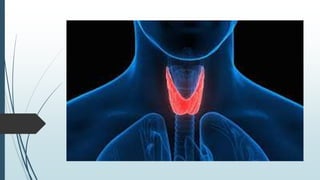
 The thyroid gland is a butterfly-shaped gland found in the
neck. It produces hormones that are released into the
bloodstream to control the body's growth and metabolism.
 They affect processes such as heart rate and body
temperature, and help convert food into energy to keep the
body going.
DEFINITION
Thyroiditis is a general term that refers to
“inflammation of the thyroid gland”.
TYPES
1. Hashimoto's thyroiditis
2. De Quervain's or subacute thyroiditis
3. Post-partum thyroiditis
4. Silent or painless thyroiditis
5. Drug-induced thyroiditis
6. Radiation-induced thyroiditis
7. Acute or infectious thyroiditis
8. Riedel thyroiditis
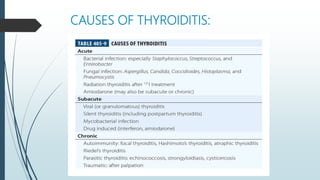
CAUSES OF THYROIDITIS:
HASHIMOTO'S THYROIDITIS
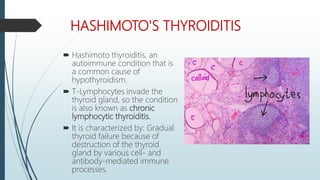
 Hashimoto thyroiditis, an
autoimmune condition that is
a common cause of
hypothyroidism.
 T-Lymphocytes invade the
thyroid gland, so the condition
is also known as chronic
lymphocytic thyroiditis.
 It is characterized by: Gradual
thyroid failure because of
destruction of the thyroid
gland by various cell- and
antibody-mediated immune
processes.
INCIDENCE
 The incidence of Hashimoto thyroiditis varies by kindred, race,
and sex.
 Hashimoto thyroiditis is six times more common in women than
in men.
 The mean age at diagnosis is 60 years, and the prevalence of
overt hypothyroidism increases with age.
 Can occur in children “nonendemic goiter”
 The concordance rate in monozygotic twins is 30% to 60%.
 Several chromosomal abnormalities have been associated with
thyroid autoimmunity.
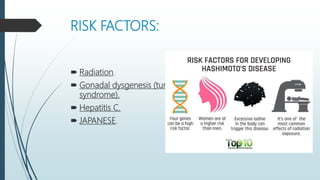
RISK FACTORS:
 Radiation.
 Gonadal dysgenesis (turner
syndrome).
 Hepatitis C.
 JAPANESE.
PATHOGENESIS
 In Hashimoto’s thyroiditis, there is a marked lymphocytic
infiltration of the thyroid with germinal center formation,
atrophy of the thyroid follicles, absence of colloid, and mild
to moderate fibrosis.
 A variety of different thyroid antigen autoantibodies are also
involved.
 ANTITHYROPEROXIDASE ANTIBODIES (TPO-Abs)…… >90%
 ANTITHYROGLOBULIN ANTIBODIES (anti-Tg Abs)…… 40%
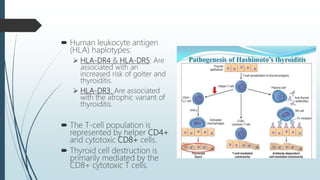
 Human leukocyte antigen
(HLA) haplotypes:
 HLA-DR4 & HLA-DR5: Are
associated with an
increased risk of goiter and
thyroiditis.
 HLA-DR3: Are associated
with the atrophic variant of
thyroiditis.
 The T-cell population is
represented by helper CD4+
and cytotoxic CD8+ cells.
 Thyroid cell destruction is
primarily mediated by the
CD8+ cytotoxic T cells.
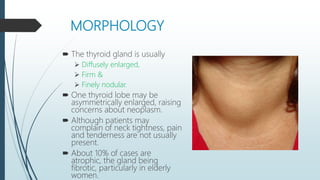
MORPHOLOGY
 The thyroid gland is usually
 Diffusely enlarged,
 Firm &
 Finely nodular.
 One thyroid lobe may be
asymmetrically enlarged, raising
concerns about neoplasm.
 Although patients may
complain of neck tightness, pain
and tenderness are not usually
present.
 About 10% of cases are
atrophic, the gland being
fibrotic, particularly in elderly
women.
SIGNS & SYMPTOMS
 Symptoms and signs of Hashimoto's thyroiditis resemble
those of hypothyroidism generally and are often subtle.
 Early nonspecific symptoms may include the following:
 Fatigue
 Constipation
 Dry skin
 Weight gain
Many of the symptoms associated with thyroid hormone deficiency.
Fatigue
Drowsiness
Difficulty with learning
Dry, brittle hair and nails
Dry, itchy skin
Puffy face
Constipation.
Weight gain
Heavy menstrual flow
Increased frequency of miscarriages
Increased sensitivity to many medications
ASSOCIATIONS
 ADDISON'S DISEASE,
 TYPE 1 DIABETES MELLITUS,
 PERNICIOUS ANEMIA,
 VITILIGO,
 ALOPECIA AREATA,
 CELIAC DISEASE,
 DERMATITIS HERPETIFORMIS,
 MULTIPLE SCLEROSIS,
 RHEUMATOID ARTHRITIS,
 SYSTEMIC LUPUS ERYTHEMATOSUS,
 SYSTEMIC SCLEROSIS
 MYASTHENIA GRAVIS
 SJOGREN’S SYNDROME.
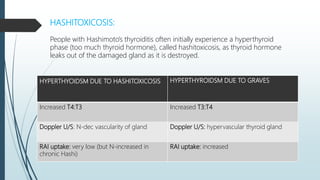
HYPERTHYROIDSM DUE TO GRAVES
Increased T4:T3 Increased T3:T4
Doppler U/S: N-dec vascularity of gland Doppler U/S: hypervascular thyroid gland
RAI uptake: very low (but N-increased in
chronic Hashi)
RAI uptake: increased
HASHITOXICOSIS:
People with Hashimoto's thyroiditis often initially experience a hyperthyroid
phase (too much thyroid hormone), called hashitoxicosis, as thyroid hormone
leaks out of the damaged gland as it is destroyed.
HYPERTHYOIDSM DUE TO HASHITOXICOSIS
DIAGNOSIS:
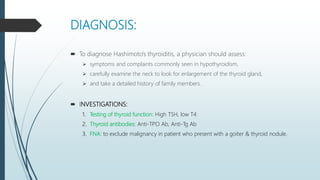
 To diagnose Hashimoto's thyroiditis, a physician should assess:
 symptoms and complaints commonly seen in hypothyroidism,
 carefully examine the neck to look for enlargement of the thyroid gland,
 and take a detailed history of family members.
 INVESTIGATIONS:
1. Testing of thyroid function: High TSH, low T4
2. Thyroid antibodies: Anti-TPO Ab, Anti-Tg Ab
3. FNA: to exclude malignancy in patient who present with a goiter & thyroid nodule.
TREATMENT
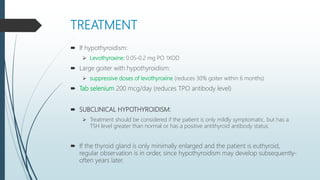
 If hypothyroidism:
 Levothyroxine: 0.05-0.2 mg PO 1XOD
 Large goiter with hypothyroidism:
 suppressive doses of levothyroxine (reduces 30% goiter within 6 months)
 Tab selenium 200 mcg/day (reduces TPO antibody level)
 SUBCLINICAL HYPOTHYROIDISM:
 Treatment should be considered if the patient is only mildly symptomatic, but has a
TSH level greater than normal or has a positive antithyroid antibody status.
 If the thyroid gland is only minimally enlarged and the patient is euthyroid,
regular observation is in order, since hypothyroidism may develop subsequently-
often years later.
DE QUERVAIN'S (SUBACUTE)
THYROIDITIS
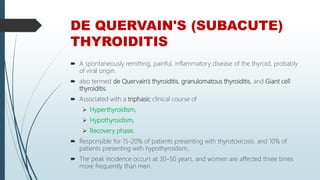
 A spontaneously remitting, painful, inflammatory disease of the thyroid, probably
of viral origin.
 also termed de Quervain’s thyroiditis, granulomatous thyroiditis, and Giant cell
thyroiditis.
 Associated with a triphasic clinical course of
 Hyperthyroidism,
 Hypothyroidism,
 Recovery phase.
 Responsible for 15-20% of patients presenting with thyrotoxicosis. and 10% of
patients presenting with hypothyroidism.
 The peak incidence occurs at 30–50 years, and women are affected three times
more frequently than men.
ETIOLOGY
 There are some evidence:
 Often preceded by an upper respiratory tract viral infection
 Prodromal viral symptoms
 Seasonal distribution (summer and fall)
 Many viruses have been implicated, including
 Mumps
 Measles
 Coxsackie
 Influenza
 Adenoviruses
 Echoviruses
PATHOPHYSIOLOGY
 The thyroid shows a characteristic
 patchy inflammatory infiltrate
 with disruption of the thyroid follicles
 multinucleated giant cells within some follicles.
 The follicular changes progress to granulomas accompanied by fibrosis.
SIGNS & SYMPTOMS
 Painful and enlarged thyroid, sometimes accompanied by fever.
 There is usually a viral prodrome with:
 Myalgias
 Low-grade fever
 Sore-throat
 Dysphagia
 Pain is often referred to the jaw, ear or occiput.
 Normal thyroid function typically returns within 12 months.
 Persistent hypothyroidism develops in 5% of patients.
 Recurrences of the subacute thyroiditis are reported in about one-fifth of the
patients.
LABORATORY FINDINGS:
 Markedly Elevated ESR
 Normal or slightly elevated leukocyte counts
 RAIU: Very low
 Thyroid antibodies are transiently detectable at low titers in a minority of patients.
TREATMENT
FOR THYROTOXIC PHASE:
 Tab propranolol 10-40 mg 6H
 Ipodate sodium/ iopanoic acid 500 mg PO 1xOD
 dramatic improvement in thyrotoxic symptoms
PAIN AND INFLAMMATION
 Aspirin (DOC)
FOR HYPOTHYROID PHASE:
 T4: 0.05-0.1 mg PO daily
POST-PARTUM THYROIDITIS
 It is a variant of chronic autoimmune thyroiditis.
 The maternal immune response, which is modified during pregnancy to allow
survival of the fetus, is enhanced after delivery and may unmask previously
unrecognized subclinical autoimmune thyroid disease.
 Transient biochemical disturbances of thyroid function occur in 5–10% of women
within 6 months of delivery.
 PPT has 3 phases:
 Hyperthyroid phase, when thyroid hormones are being released because of thyroid
destruction
 Hypothyroid phase
 Resolution, or euthyroid, phase
 Post-partum thyroiditis have 70% chance of recurrence after subsequent
pregnancies, and eventually patients progress over a period of years to permanent
hypothyroidism.
RISK FACTORS:
 High levels TPO Antibodies in the first trimester of pregnancy or immediately
after delivery.
 Type 1 diabetes mellitus.
 A history of chronic autoimmune thyroiditis or graves’ disease, or a previous
episode of PPT during a preceding pregnancy.
HISTOLOGY:
 Destructive lymphocytic thyroiditis.
 The clinical course and treatment are similar to those of painless subacute
thyroiditis.
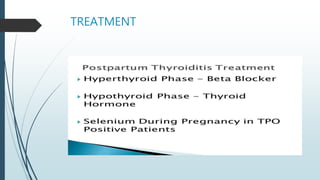
TREATMENT
SILENT (PAINLESS) THYROIDITIS
 SILENT (PAINLESS) THYROIDITIS is characterized by transient thyrotoxicosis with
low RAIU, and a small, painless, nondender goiter.
 Thyrotoxicosis results from damage of follicular Cells by the inflammatory
process, with leakage of performed thyroid hormones in the bloodstream.
 The female/male ratio is ~ 2:1
 THERE ARE 3 PHASES:
 Thyrotoxicosis,
 Hypothyroidism,
 Recovery.
CLINICAL PICTURE
 Silent thyroiditis presents with a relatively abrupt onset of symptoms of mild
thyrotoxicosis:
 Tachycardia
 Heat intolerance
 Sweating
 Nervousness
 Weight loss.
 High serum thyroid peroxidase antibody concentrations are found in only 50%.
 Persistent hypothyroidism may also develop in about 5%.
 Differentiation from Graves’ hyperthyroidism is important.
 In silent thyroiditis
 Abrupt onset
 Thyrotoxicosis less severe
 Duration of thyrotoxicosis < 3 months.
 Thyroid bruit, ophthalmopathy and dermopathy absent,
 T3/T4 ratio < 20/1,
 RAIU low,
 TSH-R antibodies usually negative,
 thyrotoxicosis transient.
ACUTE OR INFECTIOUS THYROIDITIS
 Acute thyroiditis is rare and due to suppurative infection of the thyroid.
 In children and young adults, the most common cause is the presence of a
piriform sinus, a remnant of the fourth brachial pouch that connects the
oropharynx with the thyroid.
 A long-standing goiter and degeneration in a thyroid malignancy are risk factors
in the elderly.
ETIOLOGY
 Streptococcus pyogenes
 Streptococcus pneumoniae
 Escherichia coli
 Pseudomonas aeruginosa
 Salmonella typhi
 anaerobes of the oropharyngeal cavity.
 The thyroid is rarely the seat of tuberculosis, syphilis, fungal infections (Aspergillus
species), or parasites.
 Pneumocystis carinii infection of the thyroid has been reported in patients with
AIDS.
SIGNS & SYMPTOMS
 Thyroidal pain……… referred to the throat or ears.
 Systemic illness.
 Dysphagia & Erythema
 Small, tender goiter
 Hypothyroidism.
 The symptoms usually resolve once the infection resolves.
 In the few instances where it still occurs, antibiotics and surgery to drain the pus
can result in complete cure.
LABORATORY FINDINGS
 Raised ESR
 Raised white cell count
 Thyroid function is normal.
 Normal RAIU.
 Thyroid antibodies are absent
 FNA biopsy shows infiltration by polymorphonuclear leukocytes.
DRUG-INDUCED THYROIDITIS
 CAUSES
 Amiodarone
 Lithium
 Interferon alfa
 Interleukin 2
 CLINICAL FEATURES: Either thyrotoxicosis or hypothyroidism.
 DURATION AND RESOLUTION: Often continues as long as the drug is taken
RIEDEL’S THYROIDITIS
 Riedel thyroiditis, also called invasive fibrous thyroiditis, Riedel struma, woody
thyroiditis, ligneous thyroiditis, and invasive thyroiditis.
 It is the rarest form of thyroiditis.
 It is found most frequently in middle-aged or elderly women and is usually part
of a multifocal systemic fibrosis syndrome. It may occur as a thyroid manifestation
of lgG4-related systemic disease.
 There is extensive infiltration of the thyroid and surrounding structures with
fibrous tissue.
CLINICAL PICTURE
 Presentation is with a slow-growing goitre that is irregular, stony-hard & adherent
to the neck structures.
 There is usually tracheal and esophageal compression necessitating partial
thyroidectomy.
 PRESSURE SYMPTOMS: dysphagia, cough, hoarseness, stridor, attacks of
suffocation may appear.
 Most patients are euthyroid.
 Thyroid antibodies are present in up to 45% of patients.
 Serum calcium may be low due to parathyroid invasion.
 Differentiation from thyroid carcinoma or lymphoma of the thyroid requires open
biopsy, since FNAB may be difficult to interpret.
ASSOCIATED CONDITIONS
 Retroperitoneal fibrosis
 Fibrosing mediastinitis
 Sclerosing cervicitis
 Subretinal fibrosis
 Sclerosing cholangitis.
COMPLICATIONS:
 recurrent laryngeal nerve palsy
 hypoparathyroidism
 eventually hypothyroidism.
TREATMENT:
 The treatment of choice is
 TAMOXIFEN, 20 mg orally twice daily: which must be continued for years.
 Tamoxifen can induce partial to complete remissions in most patients within 3-6
months.
 SHORT-TERM CORTICOSTEROID: for partial alleviation of pain and compression
symptoms.
 Surgical decompression usually fails due to dense fibrous adhesions, making
surgical complications more likely.
 RITUXIMAB: for refractory cases.
Thyroiditis

Thyroiditis

  • 1.
  • 3.
    INTRODUCTION  The thyroidgland is a butterfly-shaped gland found in the neck. It produces hormones that are released into the bloodstream to control the body's growth and metabolism.  They affect processes such as heart rate and body temperature, and help convert food into energy to keep the body going.
  • 4.
    DEFINITION Thyroiditis is ageneral term that refers to “inflammation of the thyroid gland”.
  • 5.
    TYPES 1. Hashimoto's thyroiditis 2.De Quervain's or subacute thyroiditis 3. Post-partum thyroiditis 4. Silent or painless thyroiditis 5. Drug-induced thyroiditis 6. Radiation-induced thyroiditis 7. Acute or infectious thyroiditis 8. Riedel thyroiditis
  • 6.
  • 7.
    HASHIMOTO'S THYROIDITIS  Hashimotothyroiditis, an autoimmune condition that is a common cause of hypothyroidism.  T-Lymphocytes invade the thyroid gland, so the condition is also known as chronic lymphocytic thyroiditis.  It is characterized by: Gradual thyroid failure because of destruction of the thyroid gland by various cell- and antibody-mediated immune processes.
  • 8.
    INCIDENCE  The incidenceof Hashimoto thyroiditis varies by kindred, race, and sex.  Hashimoto thyroiditis is six times more common in women than in men.  The mean age at diagnosis is 60 years, and the prevalence of overt hypothyroidism increases with age.  Can occur in children “nonendemic goiter”  The concordance rate in monozygotic twins is 30% to 60%.  Several chromosomal abnormalities have been associated with thyroid autoimmunity.
  • 9.
    RISK FACTORS:  Radiation. Gonadal dysgenesis (turner syndrome).  Hepatitis C.  JAPANESE.
  • 10.
    PATHOGENESIS  In Hashimoto’sthyroiditis, there is a marked lymphocytic infiltration of the thyroid with germinal center formation, atrophy of the thyroid follicles, absence of colloid, and mild to moderate fibrosis.  A variety of different thyroid antigen autoantibodies are also involved.  ANTITHYROPEROXIDASE ANTIBODIES (TPO-Abs)…… >90%  ANTITHYROGLOBULIN ANTIBODIES (anti-Tg Abs)…… 40%
  • 11.
     Human leukocyteantigen (HLA) haplotypes:  HLA-DR4 & HLA-DR5: Are associated with an increased risk of goiter and thyroiditis.  HLA-DR3: Are associated with the atrophic variant of thyroiditis.  The T-cell population is represented by helper CD4+ and cytotoxic CD8+ cells.  Thyroid cell destruction is primarily mediated by the CD8+ cytotoxic T cells.
  • 12.
    MORPHOLOGY  The thyroidgland is usually  Diffusely enlarged,  Firm &  Finely nodular.  One thyroid lobe may be asymmetrically enlarged, raising concerns about neoplasm.  Although patients may complain of neck tightness, pain and tenderness are not usually present.  About 10% of cases are atrophic, the gland being fibrotic, particularly in elderly women.
  • 13.
    SIGNS & SYMPTOMS Symptoms and signs of Hashimoto's thyroiditis resemble those of hypothyroidism generally and are often subtle.  Early nonspecific symptoms may include the following:  Fatigue  Constipation  Dry skin  Weight gain
  • 14.
    Many of thesymptoms associated with thyroid hormone deficiency. Fatigue Drowsiness Difficulty with learning Dry, brittle hair and nails Dry, itchy skin Puffy face Constipation. Weight gain Heavy menstrual flow Increased frequency of miscarriages Increased sensitivity to many medications
  • 15.
    ASSOCIATIONS  ADDISON'S DISEASE, TYPE 1 DIABETES MELLITUS,  PERNICIOUS ANEMIA,  VITILIGO,  ALOPECIA AREATA,  CELIAC DISEASE,  DERMATITIS HERPETIFORMIS,  MULTIPLE SCLEROSIS,  RHEUMATOID ARTHRITIS,  SYSTEMIC LUPUS ERYTHEMATOSUS,  SYSTEMIC SCLEROSIS  MYASTHENIA GRAVIS  SJOGREN’S SYNDROME.
  • 16.
    HYPERTHYROIDSM DUE TOGRAVES Increased T4:T3 Increased T3:T4 Doppler U/S: N-dec vascularity of gland Doppler U/S: hypervascular thyroid gland RAI uptake: very low (but N-increased in chronic Hashi) RAI uptake: increased HASHITOXICOSIS: People with Hashimoto's thyroiditis often initially experience a hyperthyroid phase (too much thyroid hormone), called hashitoxicosis, as thyroid hormone leaks out of the damaged gland as it is destroyed. HYPERTHYOIDSM DUE TO HASHITOXICOSIS
  • 17.
    DIAGNOSIS:  To diagnoseHashimoto's thyroiditis, a physician should assess:  symptoms and complaints commonly seen in hypothyroidism,  carefully examine the neck to look for enlargement of the thyroid gland,  and take a detailed history of family members.  INVESTIGATIONS: 1. Testing of thyroid function: High TSH, low T4 2. Thyroid antibodies: Anti-TPO Ab, Anti-Tg Ab 3. FNA: to exclude malignancy in patient who present with a goiter & thyroid nodule.
  • 18.
    TREATMENT  If hypothyroidism: Levothyroxine: 0.05-0.2 mg PO 1XOD  Large goiter with hypothyroidism:  suppressive doses of levothyroxine (reduces 30% goiter within 6 months)  Tab selenium 200 mcg/day (reduces TPO antibody level)  SUBCLINICAL HYPOTHYROIDISM:  Treatment should be considered if the patient is only mildly symptomatic, but has a TSH level greater than normal or has a positive antithyroid antibody status.  If the thyroid gland is only minimally enlarged and the patient is euthyroid, regular observation is in order, since hypothyroidism may develop subsequently- often years later.
  • 19.
    DE QUERVAIN'S (SUBACUTE) THYROIDITIS A spontaneously remitting, painful, inflammatory disease of the thyroid, probably of viral origin.  also termed de Quervain’s thyroiditis, granulomatous thyroiditis, and Giant cell thyroiditis.  Associated with a triphasic clinical course of  Hyperthyroidism,  Hypothyroidism,  Recovery phase.  Responsible for 15-20% of patients presenting with thyrotoxicosis. and 10% of patients presenting with hypothyroidism.  The peak incidence occurs at 30–50 years, and women are affected three times more frequently than men.
  • 20.
    ETIOLOGY  There aresome evidence:  Often preceded by an upper respiratory tract viral infection  Prodromal viral symptoms  Seasonal distribution (summer and fall)  Many viruses have been implicated, including  Mumps  Measles  Coxsackie  Influenza  Adenoviruses  Echoviruses
  • 21.
    PATHOPHYSIOLOGY  The thyroidshows a characteristic  patchy inflammatory infiltrate  with disruption of the thyroid follicles  multinucleated giant cells within some follicles.  The follicular changes progress to granulomas accompanied by fibrosis.
  • 22.
    SIGNS & SYMPTOMS Painful and enlarged thyroid, sometimes accompanied by fever.  There is usually a viral prodrome with:  Myalgias  Low-grade fever  Sore-throat  Dysphagia  Pain is often referred to the jaw, ear or occiput.
  • 23.
     Normal thyroidfunction typically returns within 12 months.  Persistent hypothyroidism develops in 5% of patients.  Recurrences of the subacute thyroiditis are reported in about one-fifth of the patients. LABORATORY FINDINGS:  Markedly Elevated ESR  Normal or slightly elevated leukocyte counts  RAIU: Very low  Thyroid antibodies are transiently detectable at low titers in a minority of patients.
  • 24.
    TREATMENT FOR THYROTOXIC PHASE: Tab propranolol 10-40 mg 6H  Ipodate sodium/ iopanoic acid 500 mg PO 1xOD  dramatic improvement in thyrotoxic symptoms PAIN AND INFLAMMATION  Aspirin (DOC) FOR HYPOTHYROID PHASE:  T4: 0.05-0.1 mg PO daily
  • 25.
    POST-PARTUM THYROIDITIS  Itis a variant of chronic autoimmune thyroiditis.  The maternal immune response, which is modified during pregnancy to allow survival of the fetus, is enhanced after delivery and may unmask previously unrecognized subclinical autoimmune thyroid disease.  Transient biochemical disturbances of thyroid function occur in 5–10% of women within 6 months of delivery.  PPT has 3 phases:  Hyperthyroid phase, when thyroid hormones are being released because of thyroid destruction  Hypothyroid phase  Resolution, or euthyroid, phase  Post-partum thyroiditis have 70% chance of recurrence after subsequent pregnancies, and eventually patients progress over a period of years to permanent hypothyroidism.
  • 26.
    RISK FACTORS:  Highlevels TPO Antibodies in the first trimester of pregnancy or immediately after delivery.  Type 1 diabetes mellitus.  A history of chronic autoimmune thyroiditis or graves’ disease, or a previous episode of PPT during a preceding pregnancy. HISTOLOGY:  Destructive lymphocytic thyroiditis.  The clinical course and treatment are similar to those of painless subacute thyroiditis.
  • 27.
  • 28.
    SILENT (PAINLESS) THYROIDITIS SILENT (PAINLESS) THYROIDITIS is characterized by transient thyrotoxicosis with low RAIU, and a small, painless, nondender goiter.  Thyrotoxicosis results from damage of follicular Cells by the inflammatory process, with leakage of performed thyroid hormones in the bloodstream.  The female/male ratio is ~ 2:1  THERE ARE 3 PHASES:  Thyrotoxicosis,  Hypothyroidism,  Recovery.
  • 29.
    CLINICAL PICTURE  Silentthyroiditis presents with a relatively abrupt onset of symptoms of mild thyrotoxicosis:  Tachycardia  Heat intolerance  Sweating  Nervousness  Weight loss.  High serum thyroid peroxidase antibody concentrations are found in only 50%.  Persistent hypothyroidism may also develop in about 5%.
  • 30.
     Differentiation fromGraves’ hyperthyroidism is important.  In silent thyroiditis  Abrupt onset  Thyrotoxicosis less severe  Duration of thyrotoxicosis < 3 months.  Thyroid bruit, ophthalmopathy and dermopathy absent,  T3/T4 ratio < 20/1,  RAIU low,  TSH-R antibodies usually negative,  thyrotoxicosis transient.
  • 31.
    ACUTE OR INFECTIOUSTHYROIDITIS  Acute thyroiditis is rare and due to suppurative infection of the thyroid.  In children and young adults, the most common cause is the presence of a piriform sinus, a remnant of the fourth brachial pouch that connects the oropharynx with the thyroid.  A long-standing goiter and degeneration in a thyroid malignancy are risk factors in the elderly.
  • 32.
    ETIOLOGY  Streptococcus pyogenes Streptococcus pneumoniae  Escherichia coli  Pseudomonas aeruginosa  Salmonella typhi  anaerobes of the oropharyngeal cavity.  The thyroid is rarely the seat of tuberculosis, syphilis, fungal infections (Aspergillus species), or parasites.  Pneumocystis carinii infection of the thyroid has been reported in patients with AIDS.
  • 33.
    SIGNS & SYMPTOMS Thyroidal pain……… referred to the throat or ears.  Systemic illness.  Dysphagia & Erythema  Small, tender goiter  Hypothyroidism.  The symptoms usually resolve once the infection resolves.  In the few instances where it still occurs, antibiotics and surgery to drain the pus can result in complete cure.
  • 34.
    LABORATORY FINDINGS  RaisedESR  Raised white cell count  Thyroid function is normal.  Normal RAIU.  Thyroid antibodies are absent  FNA biopsy shows infiltration by polymorphonuclear leukocytes.
  • 35.
    DRUG-INDUCED THYROIDITIS  CAUSES Amiodarone  Lithium  Interferon alfa  Interleukin 2  CLINICAL FEATURES: Either thyrotoxicosis or hypothyroidism.  DURATION AND RESOLUTION: Often continues as long as the drug is taken
  • 36.
    RIEDEL’S THYROIDITIS  Riedelthyroiditis, also called invasive fibrous thyroiditis, Riedel struma, woody thyroiditis, ligneous thyroiditis, and invasive thyroiditis.  It is the rarest form of thyroiditis.  It is found most frequently in middle-aged or elderly women and is usually part of a multifocal systemic fibrosis syndrome. It may occur as a thyroid manifestation of lgG4-related systemic disease.  There is extensive infiltration of the thyroid and surrounding structures with fibrous tissue.
  • 37.
    CLINICAL PICTURE  Presentationis with a slow-growing goitre that is irregular, stony-hard & adherent to the neck structures.  There is usually tracheal and esophageal compression necessitating partial thyroidectomy.  PRESSURE SYMPTOMS: dysphagia, cough, hoarseness, stridor, attacks of suffocation may appear.  Most patients are euthyroid.  Thyroid antibodies are present in up to 45% of patients.  Serum calcium may be low due to parathyroid invasion.  Differentiation from thyroid carcinoma or lymphoma of the thyroid requires open biopsy, since FNAB may be difficult to interpret.
  • 38.
    ASSOCIATED CONDITIONS  Retroperitonealfibrosis  Fibrosing mediastinitis  Sclerosing cervicitis  Subretinal fibrosis  Sclerosing cholangitis. COMPLICATIONS:  recurrent laryngeal nerve palsy  hypoparathyroidism  eventually hypothyroidism.
  • 39.
    TREATMENT:  The treatmentof choice is  TAMOXIFEN, 20 mg orally twice daily: which must be continued for years.  Tamoxifen can induce partial to complete remissions in most patients within 3-6 months.  SHORT-TERM CORTICOSTEROID: for partial alleviation of pain and compression symptoms.  Surgical decompression usually fails due to dense fibrous adhesions, making surgical complications more likely.  RITUXIMAB: for refractory cases.

Editor's Notes