ENTROPI
ON
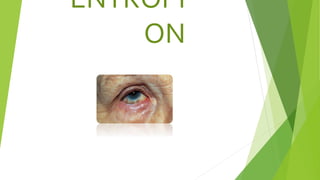
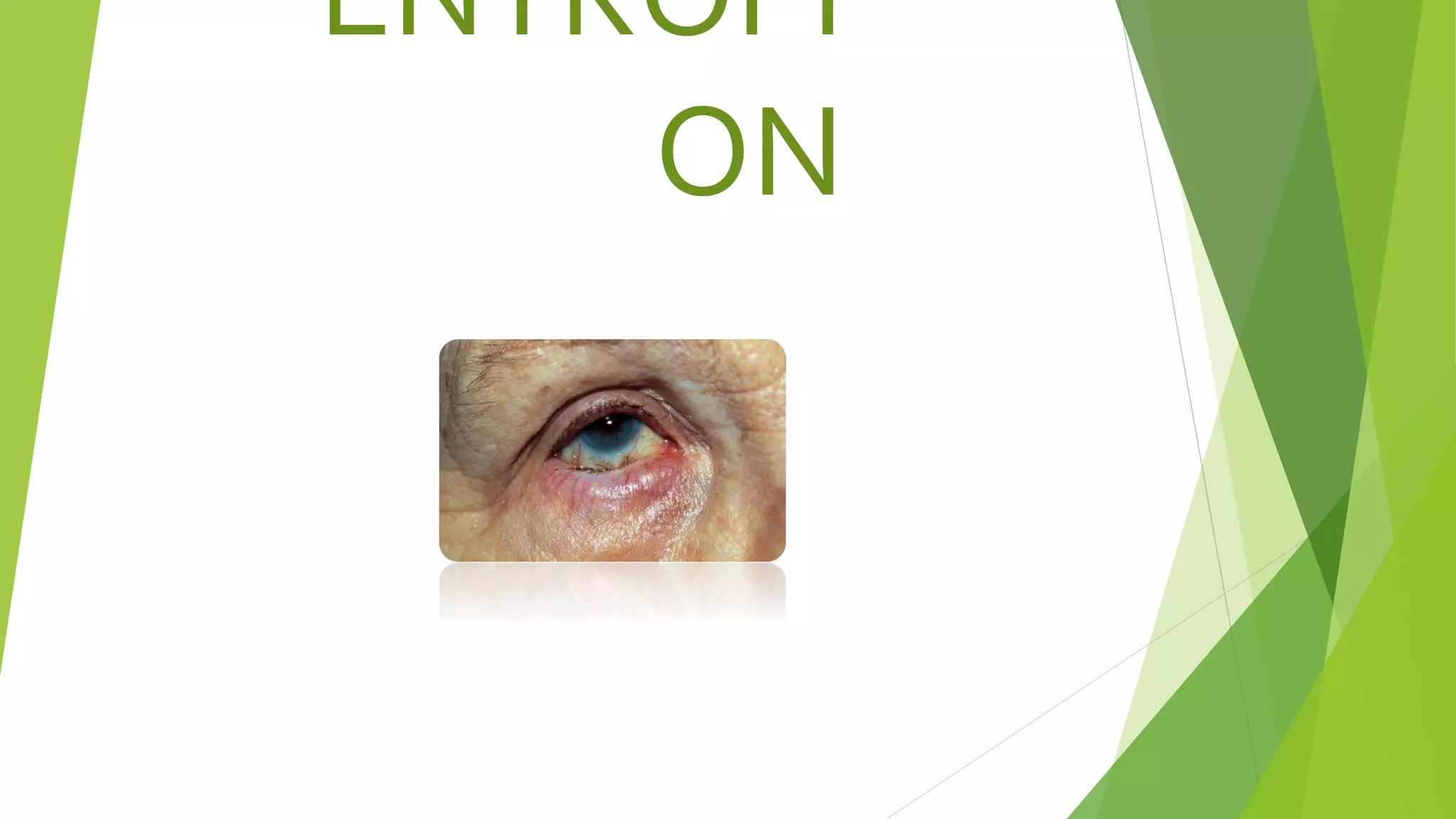
ENTROPION
It refers to inturning of lid margin.
ETIOLOGICAL TYPES
 CONGENITAL ENTROPION
 Pretarsal orbicularis is hypertrophied.
 CICATRICIAL ENTROPION
 Common condition involving the upper lid.
 Cicatricial contraction of palpebral conjunctiva, like trachoma, membranous
conjunctivitis, chemical burns.
 SENILE ENTROPION
 Commonly seen in elderly people.
 Affect only lower lid.
 Horizontal laxity of the lid- weakening of orbicularis muscle.
 Vertical lid instability- weakening of capsulopalpebral fascia(lower lid
retractor).
 Over riding of pretarsal orbicularis.
 MECHANICAL ENTROPION
 Lack of support provided by the globe to the lids.
 Occurs in patients with phthisis bulbi, after enucleation or evisceration.
SIGNS
 Foreign body sensation, Irritation, Lacrimation, Photophobia.
SYMPTOMS
 Inturning of lid margins.
 Scaring of palpebral conjunctiva.
 Horizontal lid laxity.
COMPLICATIONS
 Corneal abrasions.
 Corneal opacities.
 Corneal vascularisation.
 Corneal ulceration.
TREATMENT
 CONGENITAL ENTROPION
 Resolve with time.
 CICATRICIAL ENTROPION
ANTERIOR LAMELLAR RESECTION.
 Elliptical strip of skin, orbicularis resected 3mm away from lid margin.
TARSAL WEDGE RESECTION.
 In addition to elliptical strip of skin & orbicularis a wedge of tarsal bone is removed.
TRANSPOSITION OF TARSOCONJUNCTIVAL WEDGE
 A horizontal incision is made along the whole length of sulcus subtarsalis involving
conjunctiva and tarsal plate.
 The lower piece of tarsal plate is undermined up to lid margin.
 Mattress sutures are then passed from the upper cut end of tarsal plate to emerge on skin
1mm above lid margin.
POSTERIOR LAMELLAR GRAFT.
 Indications : severe entropion with upper eyelid retraction.
 Deficient / keratinized conjunctiva & contracted tarsus are replaced by a
composite posterior lamellar graft.
 Tarsus replaced by preserved sclera/ear cartilage/hard palate.
SENILE ENTROPION
TRANSVERSE EVERTING SUTURE
 Temporary cure so Indicated in very old patients.
 Transverse sutures are applied through full thickness of lid to prevent overriding of
preseptal muscle.
WEIS OPERATION
 Long term cure
 Incision involving skin, orbicularis & tarsal plate is given 3mm below the lid margin,
along the whole length of eyelid.
 Mattress sutures are then passed the lower cut end of tarsus to emerge on skin, 1mm
below the lid margin.
 PLICATION OF LOWER LID RETRACTOR
 Horizontal skin incision at lower border of tarsal plate, lower lid retractor
exposed .
 Shortened and sutures used and prevent overriding of preseptal muscles.
 QUICKERT PROCEDURE
 Indication: marked horizontal lid laxity.
 Two vertical incisions for lid shortening.
 Horizontal slit incision and passage of lid everting suture.
 It is a combination of horizontal lid shortening with Weis procedure.
THANK
YOU

Entropion

  • 1.
  • 2.
    ENTROPION It refers tointurning of lid margin. ETIOLOGICAL TYPES  CONGENITAL ENTROPION  Pretarsal orbicularis is hypertrophied.  CICATRICIAL ENTROPION  Common condition involving the upper lid.  Cicatricial contraction of palpebral conjunctiva, like trachoma, membranous conjunctivitis, chemical burns.
  • 3.
     SENILE ENTROPION Commonly seen in elderly people.  Affect only lower lid.  Horizontal laxity of the lid- weakening of orbicularis muscle.  Vertical lid instability- weakening of capsulopalpebral fascia(lower lid retractor).  Over riding of pretarsal orbicularis.  MECHANICAL ENTROPION  Lack of support provided by the globe to the lids.  Occurs in patients with phthisis bulbi, after enucleation or evisceration.
  • 4.
    SIGNS  Foreign bodysensation, Irritation, Lacrimation, Photophobia. SYMPTOMS  Inturning of lid margins.  Scaring of palpebral conjunctiva.  Horizontal lid laxity. COMPLICATIONS  Corneal abrasions.  Corneal opacities.  Corneal vascularisation.  Corneal ulceration.
  • 5.
    TREATMENT  CONGENITAL ENTROPION Resolve with time.  CICATRICIAL ENTROPION ANTERIOR LAMELLAR RESECTION.  Elliptical strip of skin, orbicularis resected 3mm away from lid margin. TARSAL WEDGE RESECTION.  In addition to elliptical strip of skin & orbicularis a wedge of tarsal bone is removed. TRANSPOSITION OF TARSOCONJUNCTIVAL WEDGE  A horizontal incision is made along the whole length of sulcus subtarsalis involving conjunctiva and tarsal plate.  The lower piece of tarsal plate is undermined up to lid margin.  Mattress sutures are then passed from the upper cut end of tarsal plate to emerge on skin 1mm above lid margin.
  • 6.
    POSTERIOR LAMELLAR GRAFT. Indications : severe entropion with upper eyelid retraction.  Deficient / keratinized conjunctiva & contracted tarsus are replaced by a composite posterior lamellar graft.  Tarsus replaced by preserved sclera/ear cartilage/hard palate.
  • 7.
    SENILE ENTROPION TRANSVERSE EVERTINGSUTURE  Temporary cure so Indicated in very old patients.  Transverse sutures are applied through full thickness of lid to prevent overriding of preseptal muscle. WEIS OPERATION  Long term cure  Incision involving skin, orbicularis & tarsal plate is given 3mm below the lid margin, along the whole length of eyelid.  Mattress sutures are then passed the lower cut end of tarsus to emerge on skin, 1mm below the lid margin.
  • 8.
     PLICATION OFLOWER LID RETRACTOR  Horizontal skin incision at lower border of tarsal plate, lower lid retractor exposed .  Shortened and sutures used and prevent overriding of preseptal muscles.  QUICKERT PROCEDURE  Indication: marked horizontal lid laxity.  Two vertical incisions for lid shortening.  Horizontal slit incision and passage of lid everting suture.  It is a combination of horizontal lid shortening with Weis procedure.
  • 9.