Dr. Arijit Mondal
Junior Resident,
Dept. of Psychiatry,
R. G. Kar Medical College ,
Kolkata.
• Sleep is a state of decreased awareness of
environmental stimuli that is distinguished from states
such as coma or hibernation by its relatively rapid
reversibility.
• Sleep is an universal behavior.
• Sleep is also an essential component for good health and
optimal cognitive function.
• For peak performance, human
need 8 hrs sleep a day.
8 hr sleep/day
1. Restoration and recovery
2. Energy conservation
3. Memory consolidation
4. Discharge of emotion
5. Thermoregulation
6. Homeostasis
7. Maintenance of immune system
• Sleep is generally defined by combining BEHAVIORAL
OBSERVATION with ELECTROPHYSIOLOGICAL
RECORDING.
• WHAT ARE THE TOOLS OF SLEEP MEDICINE ?
Clinical interview
Polysomnography
Multiple sleep latency test (MSLT)
Actigraphy
• Study to asses pattern of sleep disturbances
• Parameters Monitored
1. Electroencephalography (EEG) : EEG channel used to monitor
sleep stage. most laboratories use 2 central channels and 2
occipital channels, with ear references as an adjunct to help
identify sleep latency and arousals.
2. Electrooculography (EOG): Two channels are used to monitor both
horizontal and vertical eye movements. Electrodes are placed at
the right and left outer canthi. Evaluation of the eye movements is
necessary for 2 reasons.
 documentation of the onset of REM sleep
 to note the onset of sleep(the presence of slow-rolling eye
movements )
3. Electromyography (EMG): One(usually chin or mentalis and/or
submentalis) used to record atonia during REM sleep or lack of atonia
in patients with REM-related parasomnias.
1. Monitoring airflow. Two channels are used.
2. Nasal pressure transducer channel: more sensitive measure of
airflow restriction. Recommended channel for hypopneas. Also
used for airflow resistance in upper airway resistance syndrome.
3. Electrocardiography
4. Pulse oximetry
5. Respiratory effort (thoracic and abdominal)
6. End tidal or transcutaneous CO2
7. Sound recordings to measure snoring
8. Surface EMG monitoring of limb muscles (to detect limb
movements, periodic or other)
9. Continuous video monitoring
10. Core body temperature
11. Incident light intensity
12. Penile tumescence
1. Sleep latency: Period of time from turning out the lights until
the appearance of stage II sleep
2. Early morning awakening: Time of being continuously awake
from the last stage of the sleep until the end of the sleep
record (usually at 7 AM)
3. Sleep efficiency: Total sleep time / total time of the sleep
record × 100%
4. Apnea index: Number of apneas longer than 10 seconds per
hour of sleep
5. Nocturnal myoclonus index: Number of periodic leg
movements per hour
6. Rapid eye movement (REM) latency: Period of time from the
onset of sleep until the first REM period of the night
7. Sleep-onset REM period: REM sleep within the first 10
minutes of sleep.
• Rapid eye movement (REM) sleep
Frequent bursts of eye movement activity
Paradoxical sleep
In infant  Active sleep
• Non-rapid eye movement (NREM) sleep
Orthodox sleep
In infant  Quiet sleep
• NREM sleep, which usually precedes REM sleep, is
subdivided into three (N1 to N3) stages.
• N1 (formerly stage 1 sleep), characterized by :
1. Loss of alpha activity
2. Appearance of a low-voltage, mixed-frequency EEG
pattern with prominent theta activity (4 to 7 Hz)
3. Occasional vertex sharp waves (V waves) over the
central regions may also appear
4. Eye movements become slow and rolling
5. Skeletal muscle tone relaxes.
• Stage N2 (formerly stage 2) is heralded by the
appearance of sleep spindles and K complex (high
amplitude negative sharp wave followed by positive slow
waves) in the EEG.
• N3 (formerly stage 3 and 4) is also defined as slow wave
sleep (SWS), delta sleep, or deep sleep, because the
arousal threshold increases incrementally from stage N1
to N3.
• REM sleep or Stage R is characterised by Saw Tooth
Wave, rapid eye movement and atonia with phasic
twitches.
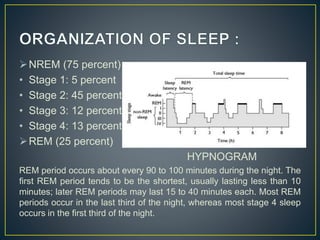
NREM (75 percent)
• Stage 1: 5 percent
• Stage 2: 45 percent
• Stage 3: 12 percent
• Stage 4: 13 percent
REM (25 percent)
HYPNOGRAM
REM period occurs about every 90 to 100 minutes during the night. The
first REM period tends to be the shortest, usually lasting less than 10
minutes; later REM periods may last 15 to 40 minutes each. Most REM
periods occur in the last third of the night, whereas most stage 4 sleep
occurs in the first third of the night.
• Total sleep time decreases with age. Average daily values are
as follows: newborns, 16 to 18h; young children, 10h;
adolescents, 8h; adults, 7.5h and possibly less than this in
elderly people.
• NREM sleep shows an overall decrease across the lifespan.
• NREM–REM sleep cycles occur at intervals of 50 to 60 min in
infants who often enter REM at the start of their sleep period.
This interval between sleep cycles remains until adolescence
when the periodicity changes to 90 to 100 min, which persists
into adult life.
• Continuity of sleep is greatest in early childhood and least at
the extremes of age.
• Circadian sleep–wake rhythms : Full-term neonates show 3-
to 4-h sleep–wake cycles. Sleep periods have largely shifted
• Autonomic Nervous System : The autonomic nervous
system reaches its most stable state during SWS in
comparison to wakefulness; e.g., blood pressure, heart rate,
and respiratory rate are at their lowest mean values and least
variable during SWS.
• Cardiovascular System : Blood pressure, heart rate, and
cardiac output decrease during NREM sleep.
• Pulmonary System : Respiratory rate and minute ventilation
decrease during sleep, and upper airway resistance increases
as a result of muscle relaxation, most significantly during REM
sleep.
• Thermoregulation : Brain and body temperature are down
regulated during NREM sleep, particularly SWS, as a result of
both a decreased hypothalamic temperature set point as well
as active heat loss.
• Sexual Function : Characteristic of REM, In men  penile
erection
In women  increased vaginal blood flow & clitorial erection.
• NEUROENDOCRINE SYSTEM -
GH : Released primarily in night , enhanced during SWS.
GH again enhances SWS by feedback.
Prolactin : peaks after GH. It enhances REM sleep.
TSH : Peaks just before sleep. Sleep reduces TSH
secretion.
ACTH & Cortisol : HPA axis is most inactive during onset
of
sleep and rises shortly before
1. Histamine
2. Dopamine
3. Norepinephrine
4. Serotonin
5. Acetylcholine
These neurotransmitter circuits as a group are called
Ascending Reticular Activating System , because they are
known to work together to regulate arousal.
1. DSM-V
2. ICSD-2
3. ICD-10
The subjects of sleep disorder covers only NON-ORGANIC
type in ICD-10. Sleep disorders of organic origin, non-
psychogenic disrders such as narcolepsy, cataplexy, sleep
apnoea and episodic movement disorders are discussed
under other categories (G).
 Dyssomnias (quantitative)
 Primary insomnia
 Primary hypersomnia
 Narcolepsy
 Breathing related sleep disorder
 Circadian rhythm sleep disorder
 Dyssomnia NOS
 Parasomnias(qualitative)
 Nightmare disorder
 Sleep terror disorder
 Sleep walking disorder
 Parasomnia NOS
 Others
 Bruxism
 Restless legs syndrome and periodic limb movement disorder
DSM-V defines insomnia disorder as dissatisfaction with
sleep quantity or quality associated with one or more of the
following symptoms :
1. Difficulty in initiation of sleep
2. Difficulty in maintaining sleep with frequent awakenings
3. Early morning awakening with inability to return to sleep
ADJUSTMENT INSOMNIA : Associated with anxiety,
anticipation of anxiety provoking event (exam). Transient
in nature.
SLEEP STATE MISPERCEPTION or PSEUDOSOMNIA :
patient complaining of difficulty in sleep but no objective
evidence of sleep disruption is found.
PSYCHOPHYSIOLOGICAL INSOMNIA : problem in
going to sleep, stress, object related to sleep becomes
conditioned to insomnia.
IDIOPATHIC INSOMNIA : Starts in early life.
Neurochemical imbalance of brainstem reticular
formation, impaired regulation of raphe nucleus, locus
ceruleus or basal forebrain dysfunction.
• MAJOR DEPRESSIVE DISORDER :
Insomnia is an independent risk for suicide in MDD
 sleep latency, nocturnal awakening, early
awakening
 SWS in first NREM-REM cycle
Shortened REM latency
More REM sleep earlier in night
Increased REM density
• Bipolar ,mania: severe insomnia may precede relapse
• Schizophrenia : stage N3 as negative symptoms
increased
• PTSD: nightmares , stage N3, hyperarousal
• Treatment of insomnia should be directed at identifiable
causes, or those factors that perpetuate the disorders
such as temperament and life style, ineffective coping
and defense mechanism, inappropriate use of alcohol or
other substances maladaptive sleep wake schedules,
and excessive worry about poor sleep.
1. NONPHARMACOLOGICAL
2. PHARMACOLOGICAL
• Maintain regular hours of bedtime and arising
• Avoid heavy meals near bedtime
• Avoid daytime napping
• Exercise daily, but not later in the evening
• Minimize caffeine intake and smoking within 8 hr of bedtime
• Do not look at clock in night
• Make bedroom comfortable, preferably slightly cool
• Do not use alcohol while going to sleep
• Go to bed only when sleepy
• Minimize light, noise and excessive temperature during sleep
• Avoid evening stimulation: substituted radio or relaxed reading
for television. Practice evening relaxation routines
• Insomnia patients tend to have high levels of cognitive,
physiologic, and/or emotional arousal both day and night.
• Imagery training, meditation are used to lower presleep
cognitive arousal.
• Yoga may be an effective method for relaxation when
done properly (e.g. Shavasana).
• Goal is to decrease the amount of time in bed to increase
the percentage of time spent in bed asleep.
• Patients should stay in bed only as long as their average
sleep time: but no less than 5 hr.
• Get up at the same time each day.
• Do not nap during the day.
• When sleep efficiency is 85% (i.e., sleeping for 85% of
the time in bed), go to bed 15 min earlier.
• Repeat this process until you are sleeping for 8 hours or
the desired amount of time.
• Based upon the theory that insomnia is conditioned
response to temporal (bedtime) and environmental
(bedroom/bed) cues that are associated with sleep.
• Bed and bedroom should be associated with rapid onset
of sleep
• Go to bed only when sleepy
• Use bed only for sleep
• Get out of bed and go to another room when unable to
fall asleep and return only when sleepy
• Keep regular morning arising regardless of duration of
sleep the night before
Principles:
• Start with the lowest effective dose
• Use intermittent dosing
• Prescribe medications for short-term use
• Discontinue the medications gradually
• Be alert for rebound insomnia
• Most commonly prescribed agents for treatment of
insomnia
• May be used as adjunctive therapy with behavioral
therapy
• Have been proven effective for short-term insomnia
treatment
• Use usually limited to a maximum 4 weeks duration
• Long term use increase chances of habituation and
withdrawal symptoms
• Tolerance to hypnotic effects develops on repeated
administration
• Rebound Insomnia occurs
• Alter sleep patterns least
• Are safer than other drugs in overdose
• Ultra long half life: flurazepam,quazepam
• Moderate half life: estazolam, tamazepam
• Ultra short half life: triazolam
• Similar hypnotic effects to benzodiazepines but side
effects tend to be less
• Does not alter normal sleep patterns and is not
associated with tolerance or rebound insomnia
• Patients fail to respond to one should not offered another
• More expensive than BDZ
• Only to be used if adverse effects to BDZ
• DIPHENHYDRAMINE
• Most widely available OTC preparation for insomnia
• Inhibition of H1 receptor
• Research does not support efficacy
• Anticholinergic side effects
• Sedation and hangover for long half life
• Prescribed for insomnia symptoms, typically at low doses
1. Trazodone
2. Mirtazapine
3. Amitriptyline
4. Doxepin
• RAMELTEON is indicated for the treatment of insomnia
characterized by difficulty with sleep onset
• Dose: 8 mg
• High-affinity binding to melatonin MT1 and MT2 receptors
• No evidence of abuse potential or rebound insomnia
• AGOMELATINE : not only hypnotic but also action on
GAD & MDD
• Hypersomnolence is a serious, debilitating, potentially life threatening
noncommunicable condition.
1. Insufficient sleep
2. Neurologic dysfunction in brain regulating sleep
3. Disrupted sleep
• What does excessive sleepiness cause :
 Traffic accident
 Errors/accident at work
 Decreased work productivity
 Deficit in cognitive function, learning & memory
 Alcohol interaction
 Stimulant seeking
 Insulin resistance
 Increased sympathetic activity
 Obesity
• This is a rare syndrome characterized by -
1) Hypersomnia (always present)
2) Hyperphagia (usually present)
3) Hypersexuality (associated at times)
• Predominantly afflicts male in adolescence
• Recurrent episodes of sleepiness, episode lasting for few
days to several weeks
• Most widely used and successful t/t : Stimulant
• First choice : Modafinil
• Amphetamines (if Modafinil fails)
• Patients intolerant or insensitive to stimulant, stimulant
antidepressant, MAOI or SSRI may be used.
• METHYSERGIDE may be effective in resistant cases.
• Excessive day time sleepiness, often disturbed night
time sleep and disturbance of REM sleep.
• Recurrent intrusion of REM sleep into transition between
sleep and wakefulness
• Hallmark of Narcolepsy- Decreased REM latency
(about <10 mins)
• Age of onset- 15-25 yrs, with a stable course
throughout life.
• Classical Tetrad of symptom-
1) Sleep Attacks
2) Cataplexy
3) Hypnogogic Hallucination
4) Sleep Paralysis
• Decreased CSF 'Orexin' protein level / hypocretin -1
immunoreactivity value.
• Non-pharmacological
1. Patients Education
2. Scheduled Naps
3. Other Management Approaches
a. Avoid sleep deprivation
b. Regular sleep/awake cycle
c. Avoidance of shift work
• Pharmacotherapy
• Effective agents for daytime sleepiness – Amphetamine,
Dextromphetamine , Methamphetamine, Methylphenidate,
Modafinil , Pemoline
• Agents for Cataplexy, Sleep Paralysis & Hypnagogic
Hallucination –
• Tricyclic Antidepressants (TCAs):
Clomipramine, Imipramine
• Selective serotonin Reuptake Inhibitor
Fluoxetine
• There are three types of sleep apnea
1. Obstructive
2. Central
3. Mixed
• Of these, obstructive sleep apnea (OSA) is the most common.
• RISK FACTORS :
1. Excessive weight gain
2. Anatomic abnormalities, such as a receding chin.
3. enlarged tonsils and adenoids, main cause in children.
4. Family history of OSA
5. Alcohol and sedative drugs
6. Hypothyroidism, acromegaly
• Clinically speaking, an obstructive apnea is defined as a
complete cessation of airflow for more than 10 seconds
with persistent respiratory effort.
• An obstructive hypopnea is defined as a partial reduction
in air flow of approximately 30 percent to 50 percent with
persistent respiratory effort and a reduction in oxygen
saturation by at least 3 percent to 4 percent and/or an
arousal from sleep.
• Weight reduction
• Positional therapy
• Positive pressure therapy (BIPAP , CPAP) : T/T of choice
• Surgical options
Persistent sleep disturbance due to DESYNCHRONY
BETWEEN AN INDIVIDUAL’S INTERNAL CIRCADIAN
BIOLOGICAL CLOCK & CONVENTIONAL SLEEP WAKE
CYCLE.
Types:
1. Delayed sleep phase type: late onset sleep and late
awakening
2. Jet lag type: travel across more than 1 time zone
3. Shift work type: frequent change of shift work, night shift
4. Advanced sleep phase syndrome
5. Disorganized sleep-wake pattern
Treatment: melatonin and light exposure
• Disorders of “partial arousal”.
NREM Sleep Arousal Disorder
1. Sleepwalking
2. Sleep terror
REM Sleep Arousal Disorder
1. REM Behavior Disorder (RBD)
2. Sleep Paralysis
3. Nightmare disorder
• Repeated episodes of rising from bed during sleep and
walking about. While sleeping the individual has a blank
staring face, is relatively unresponsive and can be
awakened with great difficulty.
• Individual can engage in a complex behavior of semi
purposeful actions.
• Sleepwalker may interact with the environment
inappropriately, resulting in injury.
• Disorders of arousal, particularly from deepest stage of
sleep (N3).
• Amnesia of the episode is present.
• Very common in children, peak prevalence between 4 to
8 yrs.
• Rare in adults  familial pattern.
• D/D : Psychomotor epileptic seizure
Dissociative fugue
• “Specialized forms” : Sleep related eating
Sexsomnia
• T/T : often unnecessary
psychoeducation & assurance
safety issue
medication : benzodiazepines
• Recurrent episodes of abrupt terror arousals from sleep,
beginning with a panicky scream. There is intense fear
and signs of autonomic hyperactivity – mydriasis,
tachycardia, rapid breathing and sweating.
• Relative unresponsiveness to efforts of others to comfort
the individual during the episode.
• Recall of event, if any, is minimal.
• Risk of injury during episode.
• Occurs during first third of nocturnal sleep, deep sleep
(N3).
• Sleep terror and sleep walking – part of same nosologic
continuum.
• Patients with rapid eye movement behavior disorder
(RBD) act out dramatic and/or violent dreams during
rapid eye movement (REM) stage sleep.
• Another feature of RBD is shouting and grunting. RBD
seems similar to other sleep disorders that involve motor
activity, like Sleep Walking or Periodic limb movement
disorder.
• RBD movements occur during REM sleep.
• Patients with RBD usually respond to treatment with
clonazepam when taken nightly.
• Nightmares are dream experiences loaded with anxiety
or fear, of which the individual has very detailed recall.
• The dream experiences are extremely vivid and usually
include themes involving threats to survival, security or
self esteem.
• Often, there is recurrence of similar nightmare theme.
• During a typical episode there is a degree of autonomic
discharge but no appreciable vocalization or body
motility.
• Medications known to provoke nightmares : l-DOPA,
reserpine, thioridazine, TCA, B-blocker, benzodiazepine
and alcohol abuse
• “Fear of sleeping” type insomnia.
• Uncomfortable subjective sensation(creepy crawly) in
legs
• Worse at night
• Relieved by walking or moving legs
• Sleep initiation insomnia
• Linked to deficiency of DA, iron, B12, and pregnancy and
renal disease
• T/T : DA agonist (ropinirole, pramipexole), iron
replacement, levodopa, anti-epileptic (gabapentin).
• Previously known as nocturnal myoclonus .
• Brief, stereotypic, repetitive, non-epileptiform contraction
of muscle during sleep.
• Patient is unaware of the incident
• PLMs are 0.5-5 s in duration and occur every 20-40 s
during NREM
• Often accompanied by K complex or brief arousal signal
• Associated with folate deficiency, renal disease, anemia,
use of antidepressant.
• T/T : Benzodiazepine (clonazepam), Opiates.
• Bruxism, often referred to as “gnashing,” is the act of
involuntary teeth grinding, either while awake or asleep,
which results primarily in tooth damage and jaw pain and
which seems to be caused by psychological effects of
everyday stress.
• The sound of teeth grinding can be quite loud and
disruptive to bed partners or roommates.
• These include stress, facial or oral trauma, nervous
system malfunction, poor diet, and allergies.
• Children with bruxism usually stop grinding their teeth
before adulthood.
• In adults, alcohol and drug use is suspected to increase
the occurrence of bruxism.
 SLEEP IS AN IMPORTANT ENTITY FOR GOOD
HEALTH AND OPTIMUM COGNITIVE FUNCTION
SLEEP DISORDER IS A COMMON ENTITY IN
POPULATION
IT MAY CAUSE ACCIDENTS, INCREASED DISEASE
BURDEN
FOR TREATMENT, SEDATIVES ARE TO BE USED
CAUTIOUSLY TO AVOID DEPENDENCE AND
TOLERANCE
PSYCHOTHERAPY HAS IMPORTANT ROLE IN THE
Sleep wake disorders

Sleep wake disorders

  • 1.
    Dr. Arijit Mondal JuniorResident, Dept. of Psychiatry, R. G. Kar Medical College , Kolkata.
  • 2.
    • Sleep isa state of decreased awareness of environmental stimuli that is distinguished from states such as coma or hibernation by its relatively rapid reversibility. • Sleep is an universal behavior. • Sleep is also an essential component for good health and optimal cognitive function. • For peak performance, human need 8 hrs sleep a day. 8 hr sleep/day
  • 3.
    1. Restoration andrecovery 2. Energy conservation 3. Memory consolidation 4. Discharge of emotion 5. Thermoregulation 6. Homeostasis 7. Maintenance of immune system
  • 4.
    • Sleep isgenerally defined by combining BEHAVIORAL OBSERVATION with ELECTROPHYSIOLOGICAL RECORDING. • WHAT ARE THE TOOLS OF SLEEP MEDICINE ? Clinical interview Polysomnography Multiple sleep latency test (MSLT) Actigraphy
  • 5.
    • Study toasses pattern of sleep disturbances • Parameters Monitored 1. Electroencephalography (EEG) : EEG channel used to monitor sleep stage. most laboratories use 2 central channels and 2 occipital channels, with ear references as an adjunct to help identify sleep latency and arousals. 2. Electrooculography (EOG): Two channels are used to monitor both horizontal and vertical eye movements. Electrodes are placed at the right and left outer canthi. Evaluation of the eye movements is necessary for 2 reasons.  documentation of the onset of REM sleep  to note the onset of sleep(the presence of slow-rolling eye movements ) 3. Electromyography (EMG): One(usually chin or mentalis and/or submentalis) used to record atonia during REM sleep or lack of atonia in patients with REM-related parasomnias.
  • 6.
    1. Monitoring airflow.Two channels are used. 2. Nasal pressure transducer channel: more sensitive measure of airflow restriction. Recommended channel for hypopneas. Also used for airflow resistance in upper airway resistance syndrome. 3. Electrocardiography 4. Pulse oximetry 5. Respiratory effort (thoracic and abdominal) 6. End tidal or transcutaneous CO2 7. Sound recordings to measure snoring 8. Surface EMG monitoring of limb muscles (to detect limb movements, periodic or other) 9. Continuous video monitoring 10. Core body temperature 11. Incident light intensity 12. Penile tumescence
  • 7.
    1. Sleep latency:Period of time from turning out the lights until the appearance of stage II sleep 2. Early morning awakening: Time of being continuously awake from the last stage of the sleep until the end of the sleep record (usually at 7 AM) 3. Sleep efficiency: Total sleep time / total time of the sleep record × 100% 4. Apnea index: Number of apneas longer than 10 seconds per hour of sleep 5. Nocturnal myoclonus index: Number of periodic leg movements per hour 6. Rapid eye movement (REM) latency: Period of time from the onset of sleep until the first REM period of the night 7. Sleep-onset REM period: REM sleep within the first 10 minutes of sleep.
  • 8.
    • Rapid eyemovement (REM) sleep Frequent bursts of eye movement activity Paradoxical sleep In infant  Active sleep • Non-rapid eye movement (NREM) sleep Orthodox sleep In infant  Quiet sleep
  • 9.
    • NREM sleep,which usually precedes REM sleep, is subdivided into three (N1 to N3) stages. • N1 (formerly stage 1 sleep), characterized by : 1. Loss of alpha activity 2. Appearance of a low-voltage, mixed-frequency EEG pattern with prominent theta activity (4 to 7 Hz) 3. Occasional vertex sharp waves (V waves) over the central regions may also appear 4. Eye movements become slow and rolling 5. Skeletal muscle tone relaxes.
  • 10.
    • Stage N2(formerly stage 2) is heralded by the appearance of sleep spindles and K complex (high amplitude negative sharp wave followed by positive slow waves) in the EEG. • N3 (formerly stage 3 and 4) is also defined as slow wave sleep (SWS), delta sleep, or deep sleep, because the arousal threshold increases incrementally from stage N1 to N3. • REM sleep or Stage R is characterised by Saw Tooth Wave, rapid eye movement and atonia with phasic twitches.
  • 11.
    NREM (75 percent) •Stage 1: 5 percent • Stage 2: 45 percent • Stage 3: 12 percent • Stage 4: 13 percent REM (25 percent) HYPNOGRAM REM period occurs about every 90 to 100 minutes during the night. The first REM period tends to be the shortest, usually lasting less than 10 minutes; later REM periods may last 15 to 40 minutes each. Most REM periods occur in the last third of the night, whereas most stage 4 sleep occurs in the first third of the night.
  • 12.
    • Total sleeptime decreases with age. Average daily values are as follows: newborns, 16 to 18h; young children, 10h; adolescents, 8h; adults, 7.5h and possibly less than this in elderly people. • NREM sleep shows an overall decrease across the lifespan. • NREM–REM sleep cycles occur at intervals of 50 to 60 min in infants who often enter REM at the start of their sleep period. This interval between sleep cycles remains until adolescence when the periodicity changes to 90 to 100 min, which persists into adult life. • Continuity of sleep is greatest in early childhood and least at the extremes of age. • Circadian sleep–wake rhythms : Full-term neonates show 3- to 4-h sleep–wake cycles. Sleep periods have largely shifted
  • 13.
    • Autonomic NervousSystem : The autonomic nervous system reaches its most stable state during SWS in comparison to wakefulness; e.g., blood pressure, heart rate, and respiratory rate are at their lowest mean values and least variable during SWS. • Cardiovascular System : Blood pressure, heart rate, and cardiac output decrease during NREM sleep. • Pulmonary System : Respiratory rate and minute ventilation decrease during sleep, and upper airway resistance increases as a result of muscle relaxation, most significantly during REM sleep. • Thermoregulation : Brain and body temperature are down regulated during NREM sleep, particularly SWS, as a result of both a decreased hypothalamic temperature set point as well as active heat loss. • Sexual Function : Characteristic of REM, In men  penile erection In women  increased vaginal blood flow & clitorial erection.
  • 14.
    • NEUROENDOCRINE SYSTEM- GH : Released primarily in night , enhanced during SWS. GH again enhances SWS by feedback. Prolactin : peaks after GH. It enhances REM sleep. TSH : Peaks just before sleep. Sleep reduces TSH secretion. ACTH & Cortisol : HPA axis is most inactive during onset of sleep and rises shortly before
  • 15.
    1. Histamine 2. Dopamine 3.Norepinephrine 4. Serotonin 5. Acetylcholine These neurotransmitter circuits as a group are called Ascending Reticular Activating System , because they are known to work together to regulate arousal.
  • 19.
    1. DSM-V 2. ICSD-2 3.ICD-10 The subjects of sleep disorder covers only NON-ORGANIC type in ICD-10. Sleep disorders of organic origin, non- psychogenic disrders such as narcolepsy, cataplexy, sleep apnoea and episodic movement disorders are discussed under other categories (G).
  • 20.
     Dyssomnias (quantitative) Primary insomnia  Primary hypersomnia  Narcolepsy  Breathing related sleep disorder  Circadian rhythm sleep disorder  Dyssomnia NOS  Parasomnias(qualitative)  Nightmare disorder  Sleep terror disorder  Sleep walking disorder  Parasomnia NOS  Others  Bruxism  Restless legs syndrome and periodic limb movement disorder
  • 21.
    DSM-V defines insomniadisorder as dissatisfaction with sleep quantity or quality associated with one or more of the following symptoms : 1. Difficulty in initiation of sleep 2. Difficulty in maintaining sleep with frequent awakenings 3. Early morning awakening with inability to return to sleep
  • 22.
    ADJUSTMENT INSOMNIA :Associated with anxiety, anticipation of anxiety provoking event (exam). Transient in nature. SLEEP STATE MISPERCEPTION or PSEUDOSOMNIA : patient complaining of difficulty in sleep but no objective evidence of sleep disruption is found. PSYCHOPHYSIOLOGICAL INSOMNIA : problem in going to sleep, stress, object related to sleep becomes conditioned to insomnia. IDIOPATHIC INSOMNIA : Starts in early life. Neurochemical imbalance of brainstem reticular formation, impaired regulation of raphe nucleus, locus ceruleus or basal forebrain dysfunction.
  • 23.
    • MAJOR DEPRESSIVEDISORDER : Insomnia is an independent risk for suicide in MDD  sleep latency, nocturnal awakening, early awakening  SWS in first NREM-REM cycle Shortened REM latency More REM sleep earlier in night Increased REM density • Bipolar ,mania: severe insomnia may precede relapse • Schizophrenia : stage N3 as negative symptoms increased • PTSD: nightmares , stage N3, hyperarousal
  • 24.
    • Treatment ofinsomnia should be directed at identifiable causes, or those factors that perpetuate the disorders such as temperament and life style, ineffective coping and defense mechanism, inappropriate use of alcohol or other substances maladaptive sleep wake schedules, and excessive worry about poor sleep. 1. NONPHARMACOLOGICAL 2. PHARMACOLOGICAL
  • 25.
    • Maintain regularhours of bedtime and arising • Avoid heavy meals near bedtime • Avoid daytime napping • Exercise daily, but not later in the evening • Minimize caffeine intake and smoking within 8 hr of bedtime • Do not look at clock in night • Make bedroom comfortable, preferably slightly cool • Do not use alcohol while going to sleep • Go to bed only when sleepy • Minimize light, noise and excessive temperature during sleep • Avoid evening stimulation: substituted radio or relaxed reading for television. Practice evening relaxation routines
  • 26.
    • Insomnia patientstend to have high levels of cognitive, physiologic, and/or emotional arousal both day and night. • Imagery training, meditation are used to lower presleep cognitive arousal. • Yoga may be an effective method for relaxation when done properly (e.g. Shavasana).
  • 27.
    • Goal isto decrease the amount of time in bed to increase the percentage of time spent in bed asleep. • Patients should stay in bed only as long as their average sleep time: but no less than 5 hr. • Get up at the same time each day. • Do not nap during the day. • When sleep efficiency is 85% (i.e., sleeping for 85% of the time in bed), go to bed 15 min earlier. • Repeat this process until you are sleeping for 8 hours or the desired amount of time.
  • 28.
    • Based uponthe theory that insomnia is conditioned response to temporal (bedtime) and environmental (bedroom/bed) cues that are associated with sleep. • Bed and bedroom should be associated with rapid onset of sleep • Go to bed only when sleepy • Use bed only for sleep • Get out of bed and go to another room when unable to fall asleep and return only when sleepy • Keep regular morning arising regardless of duration of sleep the night before
  • 29.
    Principles: • Start withthe lowest effective dose • Use intermittent dosing • Prescribe medications for short-term use • Discontinue the medications gradually • Be alert for rebound insomnia
  • 30.
    • Most commonlyprescribed agents for treatment of insomnia • May be used as adjunctive therapy with behavioral therapy • Have been proven effective for short-term insomnia treatment • Use usually limited to a maximum 4 weeks duration • Long term use increase chances of habituation and withdrawal symptoms • Tolerance to hypnotic effects develops on repeated administration • Rebound Insomnia occurs • Alter sleep patterns least • Are safer than other drugs in overdose
  • 31.
    • Ultra longhalf life: flurazepam,quazepam • Moderate half life: estazolam, tamazepam • Ultra short half life: triazolam
  • 32.
    • Similar hypnoticeffects to benzodiazepines but side effects tend to be less • Does not alter normal sleep patterns and is not associated with tolerance or rebound insomnia • Patients fail to respond to one should not offered another • More expensive than BDZ • Only to be used if adverse effects to BDZ
  • 33.
    • DIPHENHYDRAMINE • Mostwidely available OTC preparation for insomnia • Inhibition of H1 receptor • Research does not support efficacy • Anticholinergic side effects • Sedation and hangover for long half life
  • 34.
    • Prescribed forinsomnia symptoms, typically at low doses 1. Trazodone 2. Mirtazapine 3. Amitriptyline 4. Doxepin
  • 35.
    • RAMELTEON isindicated for the treatment of insomnia characterized by difficulty with sleep onset • Dose: 8 mg • High-affinity binding to melatonin MT1 and MT2 receptors • No evidence of abuse potential or rebound insomnia • AGOMELATINE : not only hypnotic but also action on GAD & MDD
  • 38.
    • Hypersomnolence isa serious, debilitating, potentially life threatening noncommunicable condition. 1. Insufficient sleep 2. Neurologic dysfunction in brain regulating sleep 3. Disrupted sleep • What does excessive sleepiness cause :  Traffic accident  Errors/accident at work  Decreased work productivity  Deficit in cognitive function, learning & memory  Alcohol interaction  Stimulant seeking  Insulin resistance  Increased sympathetic activity  Obesity
  • 39.
    • This isa rare syndrome characterized by - 1) Hypersomnia (always present) 2) Hyperphagia (usually present) 3) Hypersexuality (associated at times) • Predominantly afflicts male in adolescence • Recurrent episodes of sleepiness, episode lasting for few days to several weeks
  • 40.
    • Most widelyused and successful t/t : Stimulant • First choice : Modafinil • Amphetamines (if Modafinil fails) • Patients intolerant or insensitive to stimulant, stimulant antidepressant, MAOI or SSRI may be used. • METHYSERGIDE may be effective in resistant cases.
  • 41.
    • Excessive daytime sleepiness, often disturbed night time sleep and disturbance of REM sleep. • Recurrent intrusion of REM sleep into transition between sleep and wakefulness • Hallmark of Narcolepsy- Decreased REM latency (about <10 mins) • Age of onset- 15-25 yrs, with a stable course throughout life.
  • 42.
    • Classical Tetradof symptom- 1) Sleep Attacks 2) Cataplexy 3) Hypnogogic Hallucination 4) Sleep Paralysis • Decreased CSF 'Orexin' protein level / hypocretin -1 immunoreactivity value.
  • 43.
    • Non-pharmacological 1. PatientsEducation 2. Scheduled Naps 3. Other Management Approaches a. Avoid sleep deprivation b. Regular sleep/awake cycle c. Avoidance of shift work
  • 44.
    • Pharmacotherapy • Effectiveagents for daytime sleepiness – Amphetamine, Dextromphetamine , Methamphetamine, Methylphenidate, Modafinil , Pemoline • Agents for Cataplexy, Sleep Paralysis & Hypnagogic Hallucination – • Tricyclic Antidepressants (TCAs): Clomipramine, Imipramine • Selective serotonin Reuptake Inhibitor Fluoxetine
  • 45.
    • There arethree types of sleep apnea 1. Obstructive 2. Central 3. Mixed • Of these, obstructive sleep apnea (OSA) is the most common. • RISK FACTORS : 1. Excessive weight gain 2. Anatomic abnormalities, such as a receding chin. 3. enlarged tonsils and adenoids, main cause in children. 4. Family history of OSA 5. Alcohol and sedative drugs 6. Hypothyroidism, acromegaly
  • 46.
    • Clinically speaking,an obstructive apnea is defined as a complete cessation of airflow for more than 10 seconds with persistent respiratory effort. • An obstructive hypopnea is defined as a partial reduction in air flow of approximately 30 percent to 50 percent with persistent respiratory effort and a reduction in oxygen saturation by at least 3 percent to 4 percent and/or an arousal from sleep.
  • 47.
    • Weight reduction •Positional therapy • Positive pressure therapy (BIPAP , CPAP) : T/T of choice • Surgical options
  • 48.
    Persistent sleep disturbancedue to DESYNCHRONY BETWEEN AN INDIVIDUAL’S INTERNAL CIRCADIAN BIOLOGICAL CLOCK & CONVENTIONAL SLEEP WAKE CYCLE. Types: 1. Delayed sleep phase type: late onset sleep and late awakening 2. Jet lag type: travel across more than 1 time zone 3. Shift work type: frequent change of shift work, night shift 4. Advanced sleep phase syndrome 5. Disorganized sleep-wake pattern Treatment: melatonin and light exposure
  • 49.
    • Disorders of“partial arousal”. NREM Sleep Arousal Disorder 1. Sleepwalking 2. Sleep terror REM Sleep Arousal Disorder 1. REM Behavior Disorder (RBD) 2. Sleep Paralysis 3. Nightmare disorder
  • 50.
    • Repeated episodesof rising from bed during sleep and walking about. While sleeping the individual has a blank staring face, is relatively unresponsive and can be awakened with great difficulty. • Individual can engage in a complex behavior of semi purposeful actions. • Sleepwalker may interact with the environment inappropriately, resulting in injury. • Disorders of arousal, particularly from deepest stage of sleep (N3). • Amnesia of the episode is present.
  • 51.
    • Very commonin children, peak prevalence between 4 to 8 yrs. • Rare in adults  familial pattern. • D/D : Psychomotor epileptic seizure Dissociative fugue • “Specialized forms” : Sleep related eating Sexsomnia • T/T : often unnecessary psychoeducation & assurance safety issue medication : benzodiazepines
  • 52.
    • Recurrent episodesof abrupt terror arousals from sleep, beginning with a panicky scream. There is intense fear and signs of autonomic hyperactivity – mydriasis, tachycardia, rapid breathing and sweating. • Relative unresponsiveness to efforts of others to comfort the individual during the episode. • Recall of event, if any, is minimal. • Risk of injury during episode. • Occurs during first third of nocturnal sleep, deep sleep (N3). • Sleep terror and sleep walking – part of same nosologic continuum.
  • 53.
    • Patients withrapid eye movement behavior disorder (RBD) act out dramatic and/or violent dreams during rapid eye movement (REM) stage sleep. • Another feature of RBD is shouting and grunting. RBD seems similar to other sleep disorders that involve motor activity, like Sleep Walking or Periodic limb movement disorder. • RBD movements occur during REM sleep. • Patients with RBD usually respond to treatment with clonazepam when taken nightly.
  • 54.
    • Nightmares aredream experiences loaded with anxiety or fear, of which the individual has very detailed recall. • The dream experiences are extremely vivid and usually include themes involving threats to survival, security or self esteem. • Often, there is recurrence of similar nightmare theme. • During a typical episode there is a degree of autonomic discharge but no appreciable vocalization or body motility. • Medications known to provoke nightmares : l-DOPA, reserpine, thioridazine, TCA, B-blocker, benzodiazepine and alcohol abuse • “Fear of sleeping” type insomnia.
  • 55.
    • Uncomfortable subjectivesensation(creepy crawly) in legs • Worse at night • Relieved by walking or moving legs • Sleep initiation insomnia • Linked to deficiency of DA, iron, B12, and pregnancy and renal disease • T/T : DA agonist (ropinirole, pramipexole), iron replacement, levodopa, anti-epileptic (gabapentin).
  • 56.
    • Previously knownas nocturnal myoclonus . • Brief, stereotypic, repetitive, non-epileptiform contraction of muscle during sleep. • Patient is unaware of the incident • PLMs are 0.5-5 s in duration and occur every 20-40 s during NREM • Often accompanied by K complex or brief arousal signal • Associated with folate deficiency, renal disease, anemia, use of antidepressant. • T/T : Benzodiazepine (clonazepam), Opiates.
  • 57.
    • Bruxism, oftenreferred to as “gnashing,” is the act of involuntary teeth grinding, either while awake or asleep, which results primarily in tooth damage and jaw pain and which seems to be caused by psychological effects of everyday stress. • The sound of teeth grinding can be quite loud and disruptive to bed partners or roommates. • These include stress, facial or oral trauma, nervous system malfunction, poor diet, and allergies. • Children with bruxism usually stop grinding their teeth before adulthood. • In adults, alcohol and drug use is suspected to increase the occurrence of bruxism.
  • 58.
     SLEEP ISAN IMPORTANT ENTITY FOR GOOD HEALTH AND OPTIMUM COGNITIVE FUNCTION SLEEP DISORDER IS A COMMON ENTITY IN POPULATION IT MAY CAUSE ACCIDENTS, INCREASED DISEASE BURDEN FOR TREATMENT, SEDATIVES ARE TO BE USED CAUTIOUSLY TO AVOID DEPENDENCE AND TOLERANCE PSYCHOTHERAPY HAS IMPORTANT ROLE IN THE