Hypertension and ocular changes
Dr. Md. Anisur Rahman (Anjum)
Professor & Head, Department of Ophthalmology
Dhaka Medical College, Dhaka
Hypertension and ocular changes
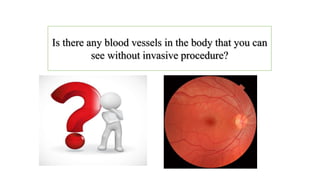
Is there any blood vessels in the body that you can
see without invasive procedure?
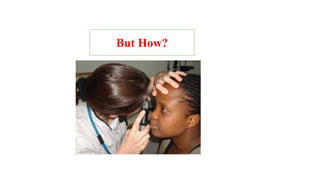
But How?
So, eye is called ā€œgateway of medicineā€
So, clinicians have to know how to
perform ophthalmoscopy
To know ophthalmoscopy is nothing, but practice,
practice and practice
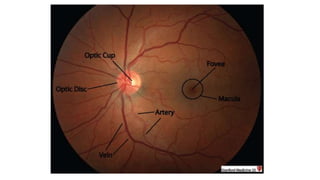
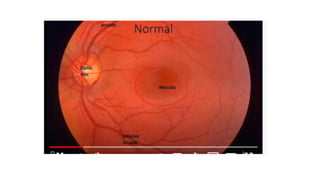
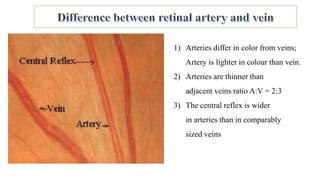
1) Arteries differ in color from veins;
Artery is lighter in colour than vein.
2) Arteries are thinner than
adjacent veins ratio A:V = 2:3
3) The central reflex is wider
in arteries than in comparably
sized veins
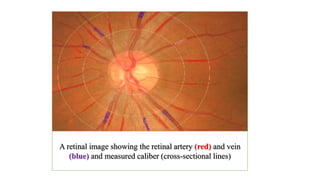
A retinal image showing the retinal artery (red) and vein
(blue) and measured caliber (cross-sectional lines)
Ocular changes in hypertension
The vascular changes associated with systemic elevated blood pressure
are visible in the retina as hypertensive retinopathy
What are the changes?
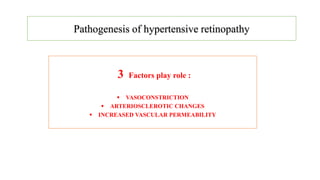
Pathogenesis of hypertensive retinopathy
3 Factors play role :
ļ‚§ VASOCONSTRICTION
ļ‚§ ARTERIOSCLEROTIC CHANGES
ļ‚§ INCREASED VASCULAR PERMEABILITY
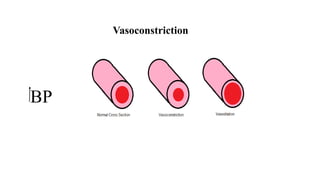
Vasoconstriction
BP
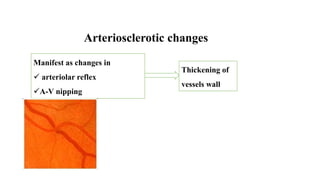
Arteriosclerotic changes
Manifest as changes in
 arteriolar reflex
A-V nipping
Thickening of
vessels wall
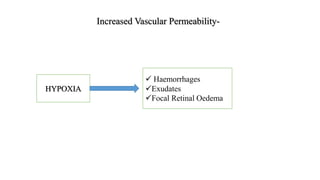
Increased Vascular Permeability-
HYPOXIA
 Haemorrhages
Exudates
Focal Retinal Oedema
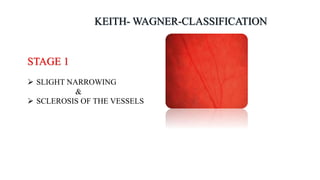
STAGE 1
 SLIGHT NARROWING
&
 SCLEROSIS OF THE VESSELS
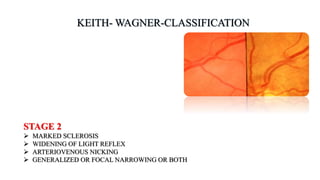
STAGE 2
 MARKED SCLEROSIS
 WIDENING OF LIGHT REFLEX
 ARTERIOVENOUS NICKING
 GENERALIZED OR FOCAL NARROWING OR BOTH
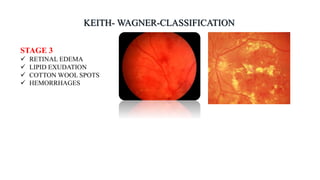
STAGE 3
 RETINAL EDEMA
 LIPID EXUDATION
 COTTON WOOL SPOTS
 HEMORRHAGES
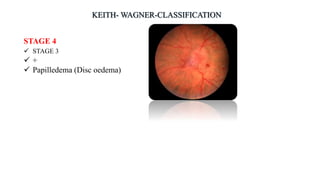
STAGE 4
 STAGE 3
 +
 Papilledema (Disc oedema)
 Poor reliability and reproducibility
 Grades do not correlate with severity of hypertension
 Not sequential in nature
 Grades do not correlate with prognosis,
cardiovascular events, and mortality.
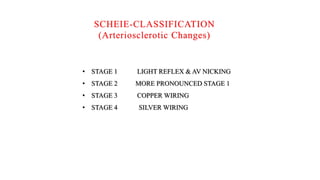
SCHEIE-CLASSIFICATION
(Arteriosclerotic Changes)
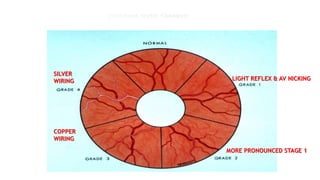
• STAGE 1 LIGHT REFLEX & AV NICKING
• STAGE 2 MORE PRONOUNCED STAGE 1
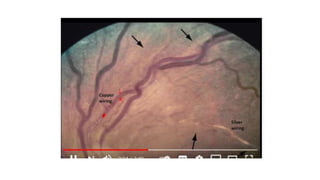
• STAGE 3 COPPER WIRING
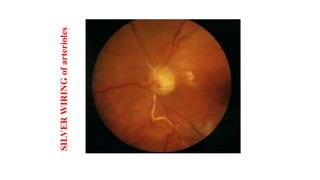
• STAGE 4 SILVER WIRING
(Arteriosclerotic Changes)
SILVER
WIRING
COPPER
WIRING
LIGHT REFLEX & AV NICKING
MORE PRONOUNCED STAGE 1
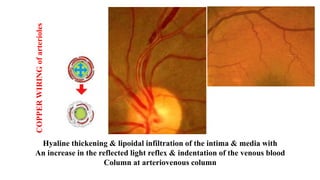
COPPER
WIRING
of
arterioles
Hyaline thickening & lipoidal infiltration of the intima & media with
An increase in the reflected light reflex & indentation of the venous blood
Column at arteriovenous column
SILVER
WIRING
of
arterioles
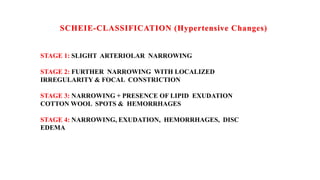
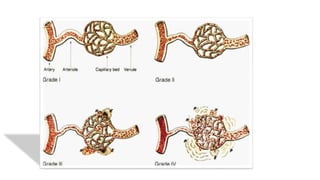
SCHEIE-CLASSIFICATION (Hypertensive Changes)
STAGE 1: SLIGHT ARTERIOLAR NARROWING
STAGE 2: FURTHER NARROWING WITH LOCALIZED
IRREGULARITY & FOCAL CONSTRICTION
STAGE 3: NARROWING + PRESENCE OF LIPID EXUDATION
COTTON WOOL SPOTS & HEMORRHAGES
STAGE 4: NARROWING, EXUDATION, HEMORRHAGES, DISC
EDEMA
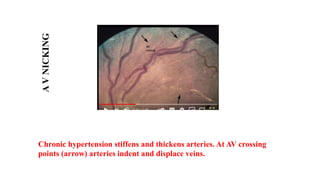
Chronic hypertension stiffens and thickens arteries. At AV crossing
points (arrow) arteries indent and displace veins.
A
V
NICKING
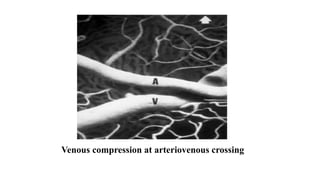
Venous compression at arteriovenous crossing
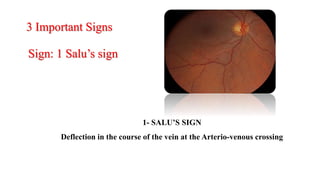
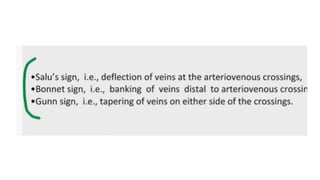
1- SALU’S SIGN
Deflection in the course of the vein at the Arterio-venous crossing
3 Important Signs
Sign: 1 Salu’s sign
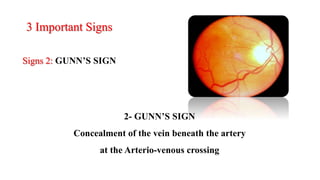
3 Important Signs
Signs 2: GUNN’S SIGN
2- GUNN’S SIGN
Concealment of the vein beneath the artery
at the Arterio-venous crossing
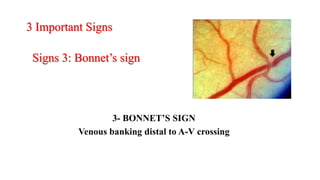
3- BONNET’S SIGN
Venous banking distal to A-V crossing
3 Important Signs
Signs 3: Bonnet’s sign
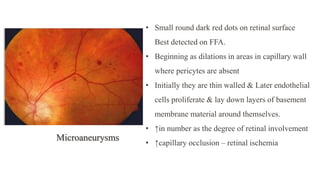
• Small round dark red dots on retinal surface
Best detected on FFA.
• Beginning as dilations in areas in capillary wall
where pericytes are absent
• Initially they are thin walled & Later endothelial
cells proliferate & lay down layers of basement
membrane material around themselves.
• ↑in number as the degree of retinal involvement
• ↑capillary occlusion – retinal ischemia
Microaneurysms
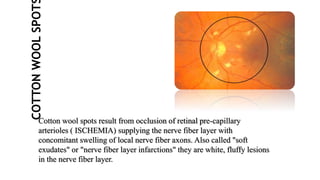
COTTON
WOOL
SPOT
Cotton wool spots result from occlusion of retinal pre-capillary
arterioles ( ISCHEMIA) supplying the nerve fiber layer with
concomitant swelling of local nerve fiber axons. Also called "soft
exudates" or "nerve fiber layer infarctions" they are white, fluffy lesions
in the nerve fiber layer.
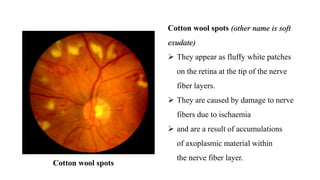
Cotton wool spots (other name is soft
exudate)
 They appear as fluffy white patches
on the retina at the tip of the nerve
fiber layers.
 They are caused by damage to nerve
fibers due to ischaemia
 and are a result of accumulations
of axoplasmic material within
the nerve fiber layer.
Cotton wool spots
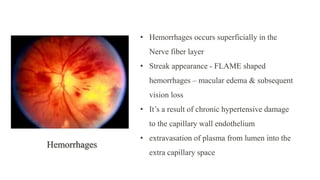
• Hemorrhages occurs superficially in the
Nerve fiber layer
• Streak appearance - FLAME shaped
hemorrhages – macular edema & subsequent
vision loss
• It’s a result of chronic hypertensive damage
to the capillary wall endothelium
• extravasation of plasma from lumen into the
extra capillary space
Hemorrhages
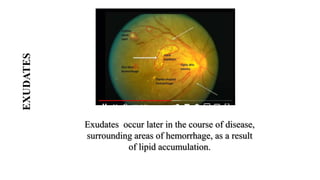
EXUDATES
Exudates occur later in the course of disease,
surrounding areas of hemorrhage, as a result
of lipid accumulation.
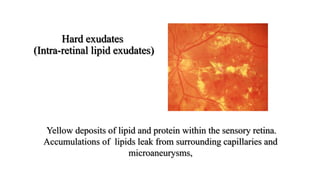
Hard exudates
(Intra-retinal lipid exudates)
Yellow deposits of lipid and protein within the sensory retina.
Accumulations of lipids leak from surrounding capillaries and
microaneurysms,
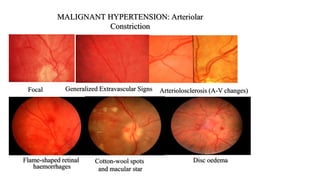
MALIGNANT HYPERTENSION: Arteriolar
Constriction
Focal Generalized Extravascular Signs Arteriolosclerosis (A-V changes)
Flame-shaped retinal
haemorrhages
Cotton-wool spots
and macular star
Disc oedema
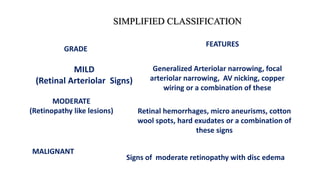
GRADE
SIMPLIFIED CLASSIFICATION
FEATURES
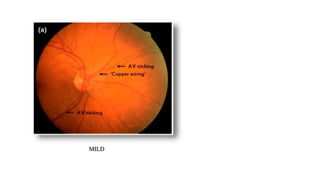
MILD
(Retinal Arteriolar Signs)
Generalized Arteriolar narrowing, focal
arteriolar narrowing, AV nicking, copper
wiring or a combination of these
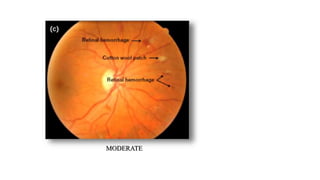
MODERATE
(Retinopathy like lesions) Retinal hemorrhages, micro aneurisms, cotton
wool spots, hard exudates or a combination of
these signs
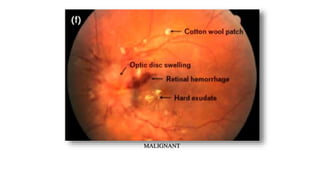
MALIGNANT
Signs of moderate retinopathy with disc edema
MILD
MODERATE
MALIGNANT
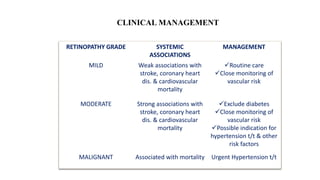
RETINOPATHY GRADE SYSTEMIC
ASSOCIATIONS
MANAGEMENT
MILD Weak associations with
stroke, coronary heart
dis. & cardiovascular
mortality
Routine care
Close monitoring of
vascular risk
MODERATE Strong associations with
stroke, coronary heart
dis. & cardiovascular
mortality
Exclude diabetes
Close monitoring of
vascular risk
Possible indication for
hypertension t/t & other
risk factors
MALIGNANT Associated with mortality Urgent Hypertension t/t
CLINICAL MANAGEMENT
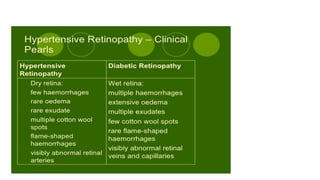
Hypertensive retinopathy

Hypertensive retinopathy

  • 1.
    Hypertension and ocularchanges Dr. Md. Anisur Rahman (Anjum) Professor & Head, Department of Ophthalmology Dhaka Medical College, Dhaka
  • 2.
  • 3.
    Is there anyblood vessels in the body that you can see without invasive procedure?
  • 4.
  • 5.
    So, eye iscalled ā€œgateway of medicineā€
  • 6.
    So, clinicians haveto know how to perform ophthalmoscopy To know ophthalmoscopy is nothing, but practice, practice and practice
  • 9.
    1) Arteries differin color from veins; Artery is lighter in colour than vein. 2) Arteries are thinner than adjacent veins ratio A:V = 2:3 3) The central reflex is wider in arteries than in comparably sized veins
  • 10.
    A retinal imageshowing the retinal artery (red) and vein (blue) and measured caliber (cross-sectional lines)
  • 11.
    Ocular changes inhypertension
  • 12.
    The vascular changesassociated with systemic elevated blood pressure are visible in the retina as hypertensive retinopathy What are the changes?
  • 13.
    Pathogenesis of hypertensiveretinopathy 3 Factors play role : ļ‚§ VASOCONSTRICTION ļ‚§ ARTERIOSCLEROTIC CHANGES ļ‚§ INCREASED VASCULAR PERMEABILITY
  • 14.
  • 15.
    Arteriosclerotic changes Manifest aschanges in  arteriolar reflex A-V nipping Thickening of vessels wall
  • 16.
    Increased Vascular Permeability- HYPOXIA Haemorrhages Exudates Focal Retinal Oedema
  • 17.
    STAGE 1  SLIGHTNARROWING &  SCLEROSIS OF THE VESSELS
  • 18.
    STAGE 2  MARKEDSCLEROSIS  WIDENING OF LIGHT REFLEX  ARTERIOVENOUS NICKING  GENERALIZED OR FOCAL NARROWING OR BOTH
  • 19.
    STAGE 3  RETINALEDEMA  LIPID EXUDATION  COTTON WOOL SPOTS  HEMORRHAGES
  • 20.
    STAGE 4  STAGE3  +  Papilledema (Disc oedema)
  • 21.
     Poor reliabilityand reproducibility  Grades do not correlate with severity of hypertension  Not sequential in nature  Grades do not correlate with prognosis, cardiovascular events, and mortality.
  • 22.
    SCHEIE-CLASSIFICATION (Arteriosclerotic Changes) • STAGE1 LIGHT REFLEX & AV NICKING • STAGE 2 MORE PRONOUNCED STAGE 1 • STAGE 3 COPPER WIRING • STAGE 4 SILVER WIRING
  • 23.
  • 25.
    COPPER WIRING of arterioles Hyaline thickening &lipoidal infiltration of the intima & media with An increase in the reflected light reflex & indentation of the venous blood Column at arteriovenous column
  • 26.
  • 27.
    SCHEIE-CLASSIFICATION (Hypertensive Changes) STAGE1: SLIGHT ARTERIOLAR NARROWING STAGE 2: FURTHER NARROWING WITH LOCALIZED IRREGULARITY & FOCAL CONSTRICTION STAGE 3: NARROWING + PRESENCE OF LIPID EXUDATION COTTON WOOL SPOTS & HEMORRHAGES STAGE 4: NARROWING, EXUDATION, HEMORRHAGES, DISC EDEMA
  • 29.
    Chronic hypertension stiffensand thickens arteries. At AV crossing points (arrow) arteries indent and displace veins. A V NICKING
  • 30.
    Venous compression atarteriovenous crossing
  • 31.
    1- SALU’S SIGN Deflectionin the course of the vein at the Arterio-venous crossing 3 Important Signs Sign: 1 Salu’s sign
  • 32.
    3 Important Signs Signs2: GUNN’S SIGN 2- GUNN’S SIGN Concealment of the vein beneath the artery at the Arterio-venous crossing
  • 33.
    3- BONNET’S SIGN Venousbanking distal to A-V crossing 3 Important Signs Signs 3: Bonnet’s sign
  • 35.
    • Small rounddark red dots on retinal surface Best detected on FFA. • Beginning as dilations in areas in capillary wall where pericytes are absent • Initially they are thin walled & Later endothelial cells proliferate & lay down layers of basement membrane material around themselves. • ↑in number as the degree of retinal involvement • ↑capillary occlusion – retinal ischemia Microaneurysms
  • 36.
    COTTON WOOL SPOT Cotton wool spotsresult from occlusion of retinal pre-capillary arterioles ( ISCHEMIA) supplying the nerve fiber layer with concomitant swelling of local nerve fiber axons. Also called "soft exudates" or "nerve fiber layer infarctions" they are white, fluffy lesions in the nerve fiber layer.
  • 37.
    Cotton wool spots(other name is soft exudate)  They appear as fluffy white patches on the retina at the tip of the nerve fiber layers.  They are caused by damage to nerve fibers due to ischaemia  and are a result of accumulations of axoplasmic material within the nerve fiber layer. Cotton wool spots
  • 38.
    • Hemorrhages occurssuperficially in the Nerve fiber layer • Streak appearance - FLAME shaped hemorrhages – macular edema & subsequent vision loss • It’s a result of chronic hypertensive damage to the capillary wall endothelium • extravasation of plasma from lumen into the extra capillary space Hemorrhages
  • 39.
    EXUDATES Exudates occur laterin the course of disease, surrounding areas of hemorrhage, as a result of lipid accumulation.
  • 40.
    Hard exudates (Intra-retinal lipidexudates) Yellow deposits of lipid and protein within the sensory retina. Accumulations of lipids leak from surrounding capillaries and microaneurysms,
  • 41.
    MALIGNANT HYPERTENSION: Arteriolar Constriction FocalGeneralized Extravascular Signs Arteriolosclerosis (A-V changes) Flame-shaped retinal haemorrhages Cotton-wool spots and macular star Disc oedema
  • 42.
    GRADE SIMPLIFIED CLASSIFICATION FEATURES MILD (Retinal ArteriolarSigns) Generalized Arteriolar narrowing, focal arteriolar narrowing, AV nicking, copper wiring or a combination of these MODERATE (Retinopathy like lesions) Retinal hemorrhages, micro aneurisms, cotton wool spots, hard exudates or a combination of these signs MALIGNANT Signs of moderate retinopathy with disc edema
  • 43.
  • 44.
  • 45.
  • 46.
    RETINOPATHY GRADE SYSTEMIC ASSOCIATIONS MANAGEMENT MILDWeak associations with stroke, coronary heart dis. & cardiovascular mortality Routine care Close monitoring of vascular risk MODERATE Strong associations with stroke, coronary heart dis. & cardiovascular mortality Exclude diabetes Close monitoring of vascular risk Possible indication for hypertension t/t & other risk factors MALIGNANT Associated with mortality Urgent Hypertension t/t CLINICAL MANAGEMENT