Introduction
to
Hydrogeology With
Basic Terminalogies
Hydrology: Processes governing the depletion
and replenishment of water resources of land
areas of the earth.
Dealing with ground water
Hydrogeology: Mode of occurrence,
distribution, movement and chemistry of
water occurring in the subsurface in
relation to the geological environment.
Geohydrology: Emphasising the
hydrologic aspect.
• Importance
• Evaluation of surface water- required
parameters- precipitation, infiltration, slope
• Evaluation of ground water-required
parameters-geometry of basin, storage, yield,
properties of aquifer
• Mineral prospecting and mining- Sulphide
minerals-1ppm Zinc
• Evaluation of sites for geotechnical
construction– reservoir and dam
• Problem related to pollution
• Proper management of water resource-
Problem-
• excess extraction of ground water–
depletion of water level, subsidence of
land surface---- both by artificial recharge
• Excess use of surface water for irrigation–
water logging---by conjuctive use
• Groundwater development
• Stratigraphy
• Petrography
• Structural Geology
• Geomorphology
• ------ Presence of aquifer, type of aquifer,
dimension of aquifer, lithofacies
variation productivity, quality of water,
structure of formation
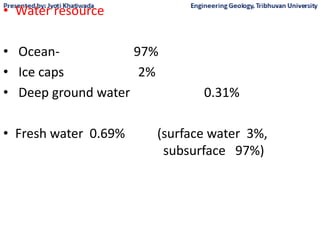
• Water resource
• Ocean- 97%
• Ice caps 2%
• Deep ground water 0.31%
• Fresh water 0.69% (surface water 3%,
subsurface 97%)
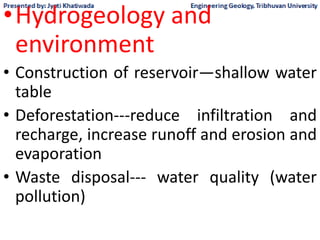
•Hydrogeology and
environment
• Construction of reservoir—shallow water
table
• Deforestation---reduce infiltration and
recharge, increase runoff and erosion and
evaporation
• Waste disposal--- water quality (water
pollution)
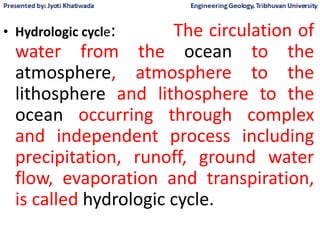
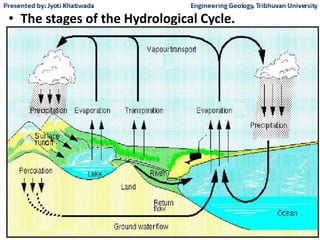
• Hydrologic cycle: The circulation of
water from the ocean to the
atmosphere, atmosphere to the
lithosphere and lithosphere to the
ocean occurring through complex
and independent process including
precipitation, runoff, ground water
flow, evaporation and transpiration,
is called hydrologic cycle.
• The stages of the Hydrological Cycle.
• Hydrologic cycle
• Precipitation
• Evaporation
• Transpiration
• Evapotranspiration
• Field capacity
• Wilting point
• Consumptive use
• Conjunctive use
• Infiltration
• Run off
• 1.Precipitation: It is atmospheric
discharge of water in the form
of the solid, liquid from the
earth surface. The distribution
of water on the surface and
subsurface is governed by
duration and intensity of
precipitations.
• 2. Evaporation and transpiration:
It is the process by which water is
returned to the atmosphere.
Evaporation:
Sublimation:
Transpiration:
Factors affecting evaporation
Meteorological—
Radiation,temperature,humidi
ty,wind, pressure
Physical factors: water quality,
shape and size of evaporating
surface
• (i) Wilting point: Lowest amount of moisture
that is held by soil, not available for
transpiration by vegetation, is the wilting point
• (ii)Field capacity: The maximum water that the
soil can hold against the force of gravity.
• Available soil moisture: Difference between
field capacity and wilting point
• 1. Transpiration: The part of water
reaching the ground is evaporated
through the leaves.
• 2. Evapo-transpiration:The umulative
loss by evaporation and transpiration
• (i) Consumptive use: Term includes
water used in plant metabolism and
evapo-transpiration.
•4. Infiltration: Moving of
precipitated water in to
subsurface. The rate of
infiltration depends on
the rain fall intensity,
duration and texture of
materials.
•Runoff. Runoff is the water
discharged through stream
consisting wholly, or in
part, of water contributed
by overland flow (surface
runoff) and ground water
flow (base flow).
•Vertical distribution
of water or kind of
ground water
• Zone of aeration
• Zone of saturation
•Above water table
•Soil water
•Pellicular water
•Vadose
•Pearched water
•Capillary water
•Below water table
•Free water
•Confined water
•Fixed water
•Connet water
•Zone of saturation
•Aquifer
•Aquitard
•Aquiclude
•Aquifuge
•Types of aquifer
•Unconfined or water table or
phreatic
•Confined or artesian or
pressure
•Leaky or semi confined

Hydrogeology Introduction with basic terms

  • 1.
  • 2.
    Hydrology: Processes governingthe depletion and replenishment of water resources of land areas of the earth. Dealing with ground water Hydrogeology: Mode of occurrence, distribution, movement and chemistry of water occurring in the subsurface in relation to the geological environment. Geohydrology: Emphasising the hydrologic aspect.
  • 3.
    • Importance • Evaluationof surface water- required parameters- precipitation, infiltration, slope • Evaluation of ground water-required parameters-geometry of basin, storage, yield, properties of aquifer • Mineral prospecting and mining- Sulphide minerals-1ppm Zinc • Evaluation of sites for geotechnical construction– reservoir and dam
  • 4.
    • Problem relatedto pollution • Proper management of water resource- Problem- • excess extraction of ground water– depletion of water level, subsidence of land surface---- both by artificial recharge • Excess use of surface water for irrigation– water logging---by conjuctive use
  • 5.
    • Groundwater development •Stratigraphy • Petrography • Structural Geology • Geomorphology • ------ Presence of aquifer, type of aquifer, dimension of aquifer, lithofacies variation productivity, quality of water, structure of formation
  • 6.
    • Water resource •Ocean- 97% • Ice caps 2% • Deep ground water 0.31% • Fresh water 0.69% (surface water 3%, subsurface 97%)
  • 7.
    •Hydrogeology and environment • Constructionof reservoir—shallow water table • Deforestation---reduce infiltration and recharge, increase runoff and erosion and evaporation • Waste disposal--- water quality (water pollution)
  • 8.
    • Hydrologic cycle:The circulation of water from the ocean to the atmosphere, atmosphere to the lithosphere and lithosphere to the ocean occurring through complex and independent process including precipitation, runoff, ground water flow, evaporation and transpiration, is called hydrologic cycle.
  • 9.
    • The stagesof the Hydrological Cycle.
  • 10.
    • Hydrologic cycle •Precipitation • Evaporation • Transpiration • Evapotranspiration • Field capacity • Wilting point • Consumptive use • Conjunctive use • Infiltration • Run off
  • 11.
    • 1.Precipitation: Itis atmospheric discharge of water in the form of the solid, liquid from the earth surface. The distribution of water on the surface and subsurface is governed by duration and intensity of precipitations.
  • 12.
    • 2. Evaporationand transpiration: It is the process by which water is returned to the atmosphere. Evaporation: Sublimation: Transpiration:
  • 13.
    Factors affecting evaporation Meteorological— Radiation,temperature,humidi ty,wind,pressure Physical factors: water quality, shape and size of evaporating surface
  • 14.
    • (i) Wiltingpoint: Lowest amount of moisture that is held by soil, not available for transpiration by vegetation, is the wilting point • (ii)Field capacity: The maximum water that the soil can hold against the force of gravity. • Available soil moisture: Difference between field capacity and wilting point
  • 15.
    • 1. Transpiration:The part of water reaching the ground is evaporated through the leaves. • 2. Evapo-transpiration:The umulative loss by evaporation and transpiration • (i) Consumptive use: Term includes water used in plant metabolism and evapo-transpiration.
  • 16.
    •4. Infiltration: Movingof precipitated water in to subsurface. The rate of infiltration depends on the rain fall intensity, duration and texture of materials.
  • 17.
    •Runoff. Runoff isthe water discharged through stream consisting wholly, or in part, of water contributed by overland flow (surface runoff) and ground water flow (base flow).
  • 18.
    •Vertical distribution of wateror kind of ground water • Zone of aeration • Zone of saturation
  • 19.
    •Above water table •Soilwater •Pellicular water •Vadose •Pearched water •Capillary water
  • 20.
    •Below water table •Freewater •Confined water •Fixed water •Connet water
  • 21.
  • 22.
    •Types of aquifer •Unconfinedor water table or phreatic •Confined or artesian or pressure •Leaky or semi confined