Presented by
PRAMODA G
Geology, 4th semester
DoS In Earth Science,
University of Mysore
CONTENTS
What is fault
Fault terminology
Types of Movements
Relative movements
Causes of faults
Classification of faults
Conclusions
Reference
Introduction
INTRODUCTION
Deformation is the change in the shape, size or position
of the bed due to the applied forces.
Fault is brittle type of deformation in which fracture or
rupture when will be developed before the displacement
of block.
Due to the effect of differential stresses we can observe
verity of deformation structures.
What is fault:-
Faults are rupture along the opposite walls have move past
each other. The essential feature is differential movement
parallel to the surface fracture. Caused by the brittle
deformation.
Depending upon the nature and magnitude of stresses
and the types of the rocks, the rock bodies may get
fractured into different parts , and relative displacement
of blocks may occur for different distances.
These are varying from a few centi meters to many meters
and this displacement may occur in any direction.
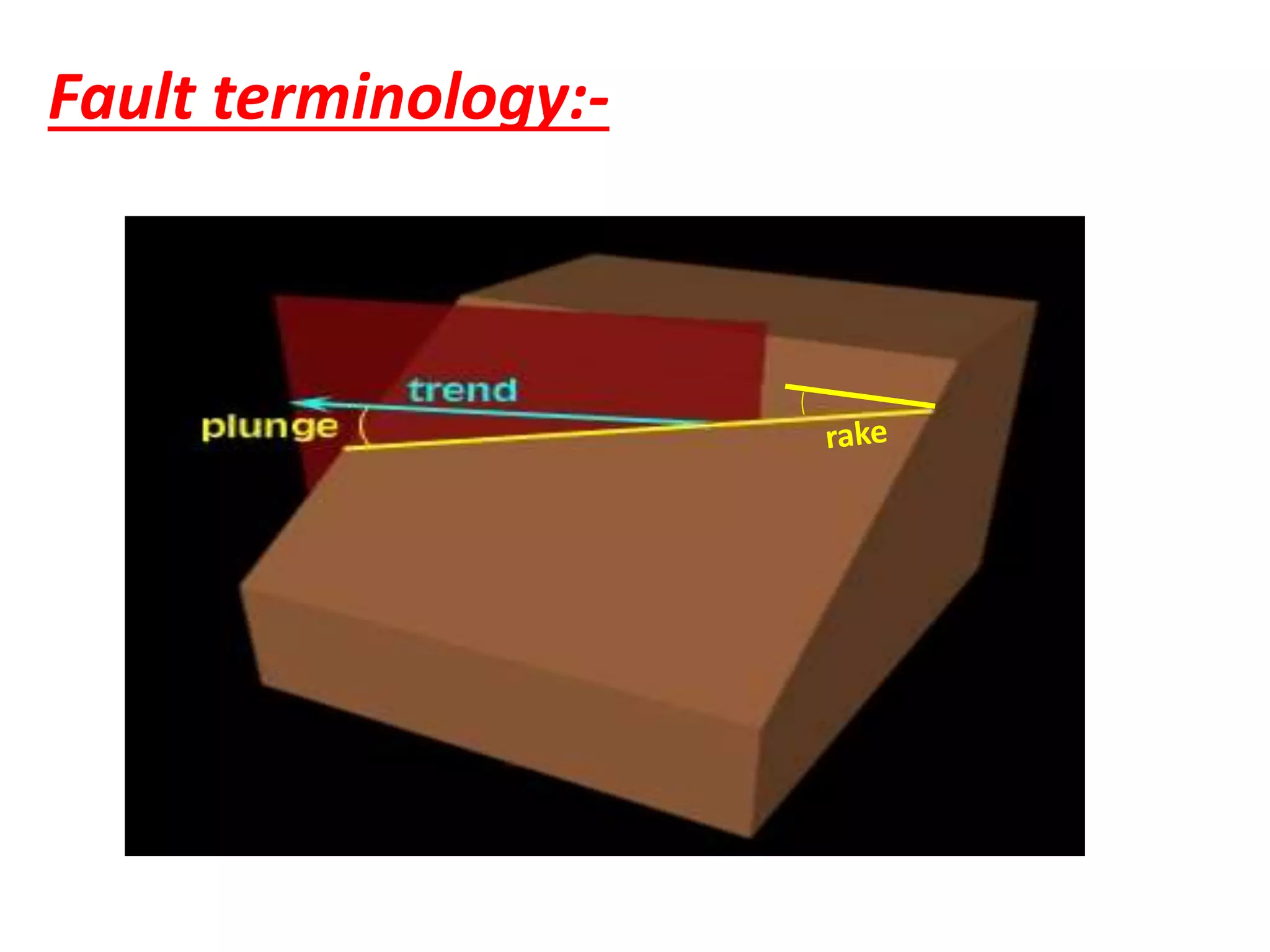
Fault terminology:-
There are disposition of different type of faults
Fault terminology:-
Fault terminology:-
TYPES OF MOVEMENTS:-
There are tow types of movements
Transitional Rotational
Relative movements:-
Strike slip Dip slip
Net slip
a
b a
b
a
b
d
c
Causes of faults:-
Faults are essentially the shear or sliding failures, resulting
from tensional, compressional, rotational stress acting the
crustal rock masses.
They may be due to the shrinking Earth; or due to the
convection currents produced in the Earth.
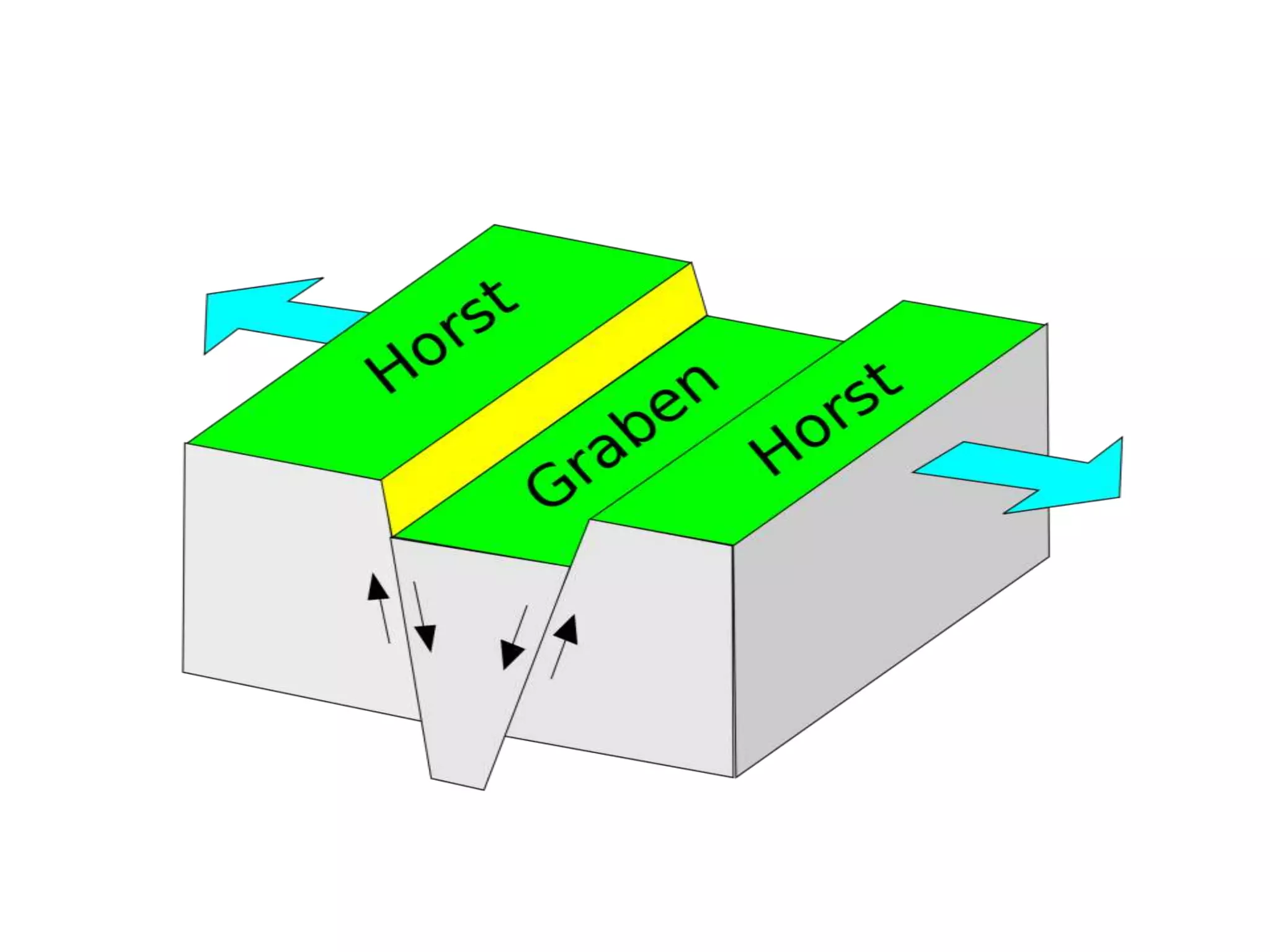
Normal faults are assumed to have been formed under
the horizontal tension.
Thrust faults may be assumed to be originating from
compressive stress, which may throw the rocks into folds,
and these intensely folded getting fractured and faulted
under shear.
The faults occure in volcanic areas and mountain zones,
They are found in plains and plateaus.
Classification of faults:-
Geometrical classification:-
The bases of five different geometrical classification
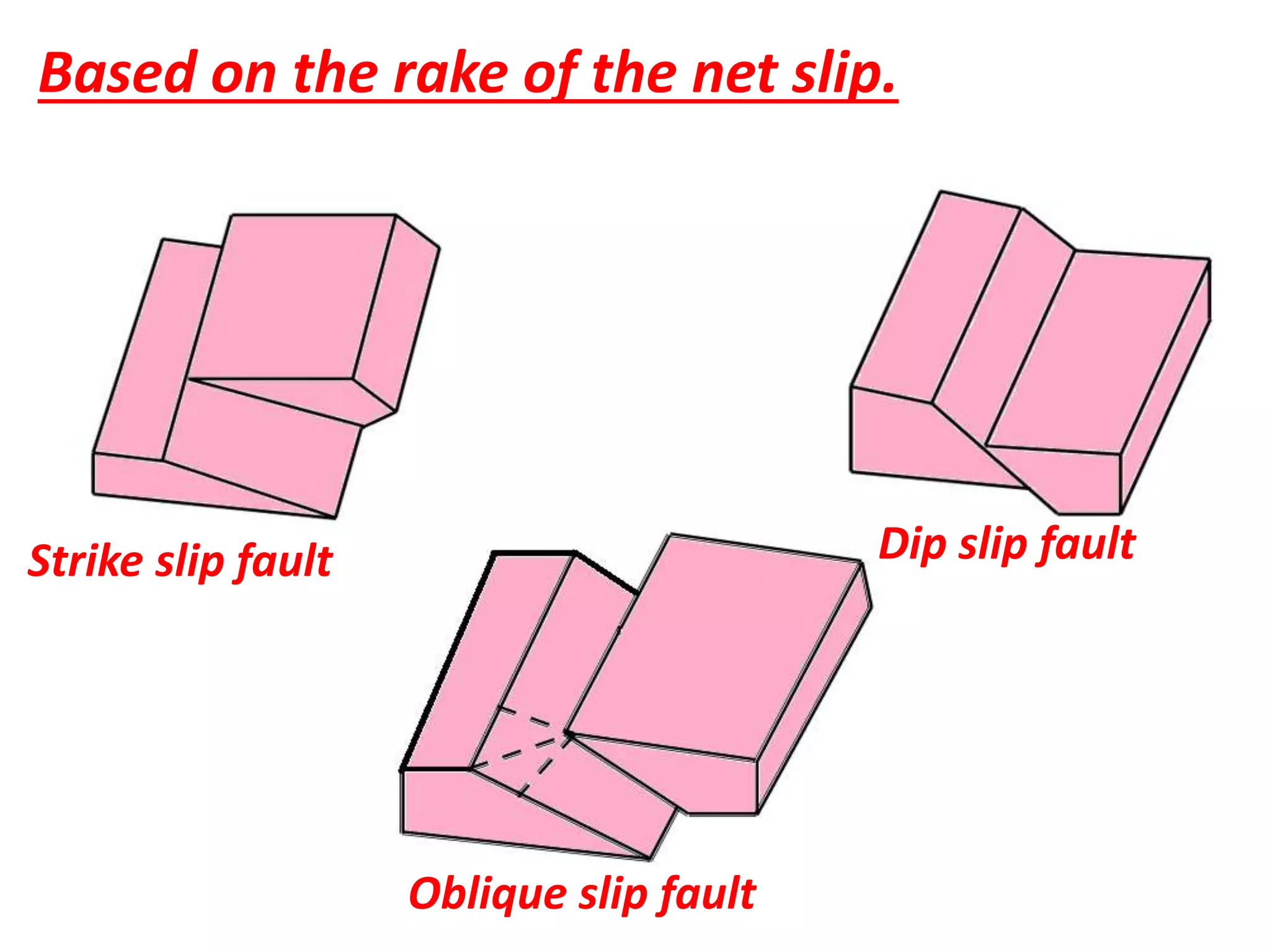
1. The rake of the net slip.
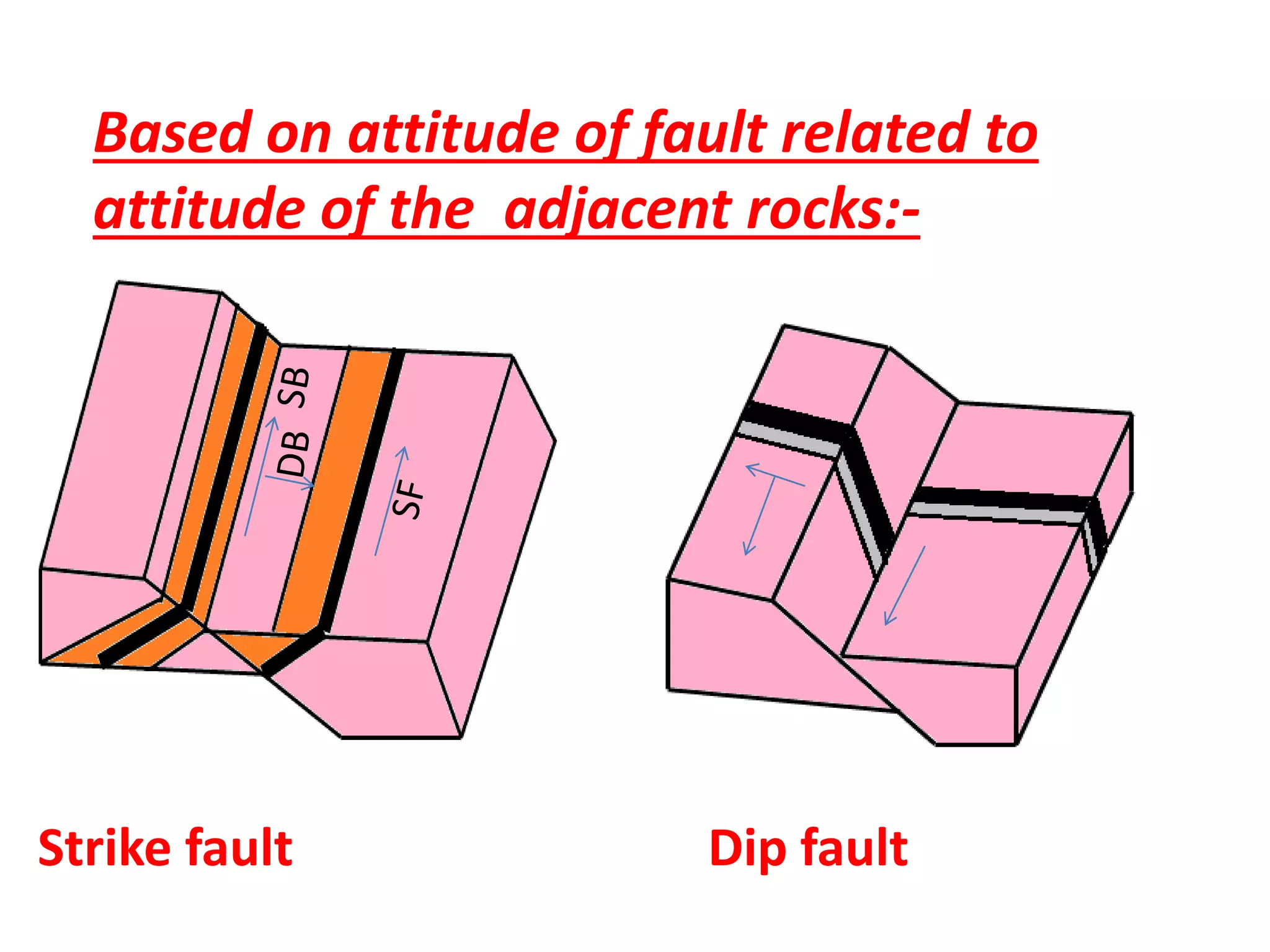
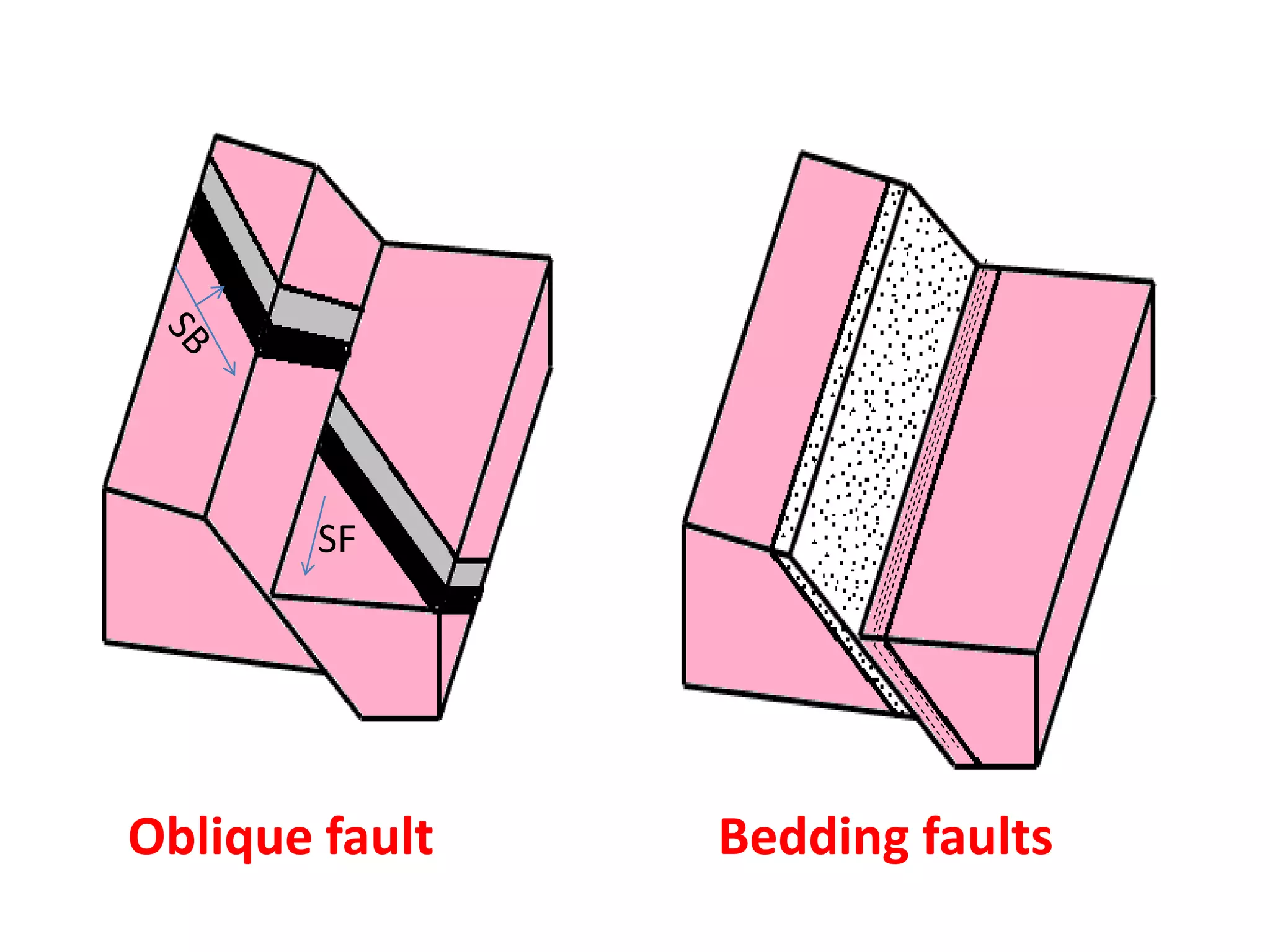
2. The attitude of fault related to attitude of the
adjacent rocs.
3. The pattern of fault.
4. The angle at which the fault dip.
5. The apparent movement on the fault.
Based on the rake of the net slip.
Strike net slip fault Dip net slip fault
Oblique slip fault
Strike slip fault Dip slip fault
Based on attitude of fault related to
attitude of the adjacent rocks:-
Strike fault Dip fault
Oblique fault Bedding faults
SF
Based on the pattern of fault:-
Radial faults Enechelon faults
Peripheral faultStep faults
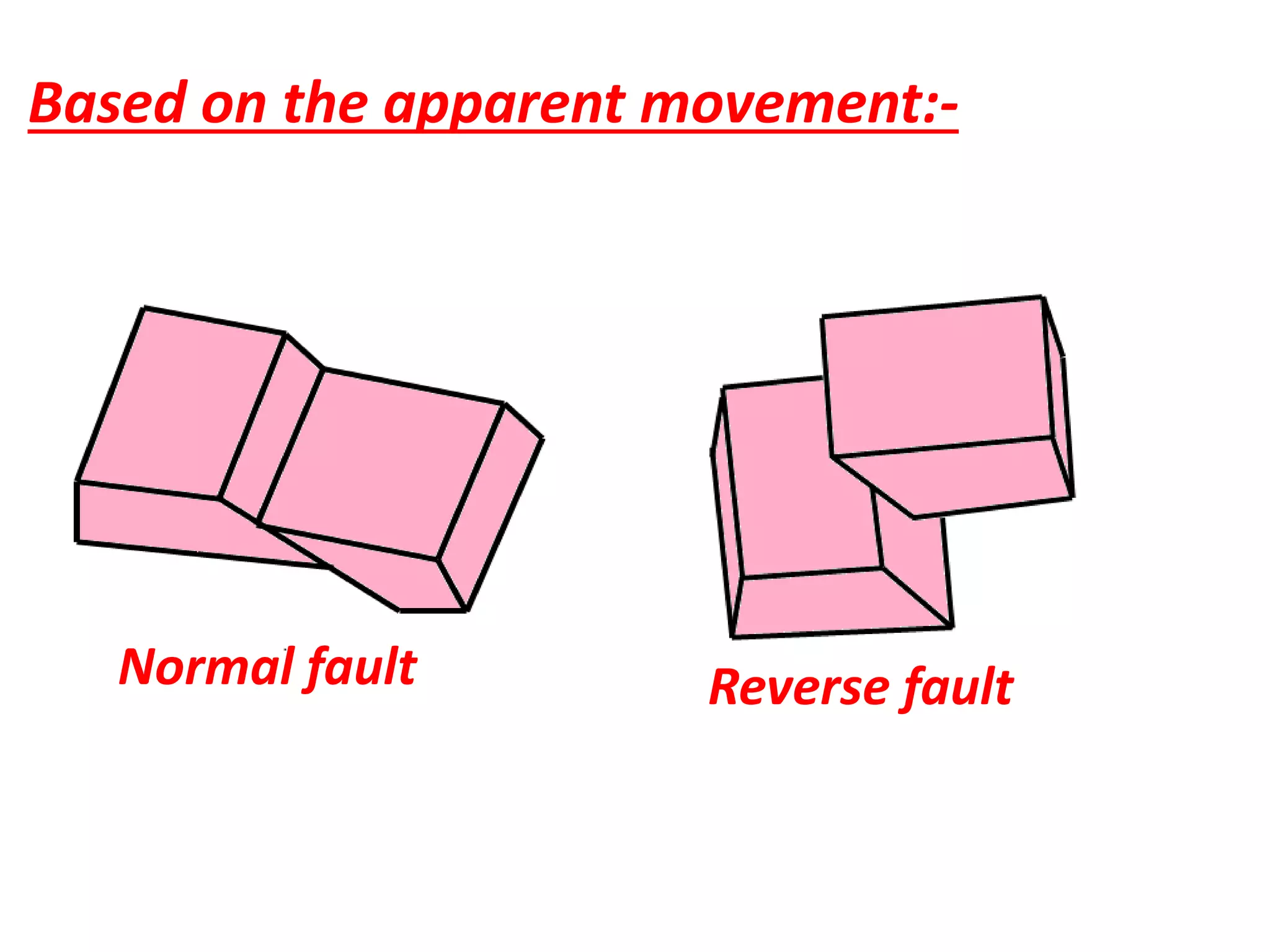
Based on the apparent movement:-
Normal fault Reverse fault
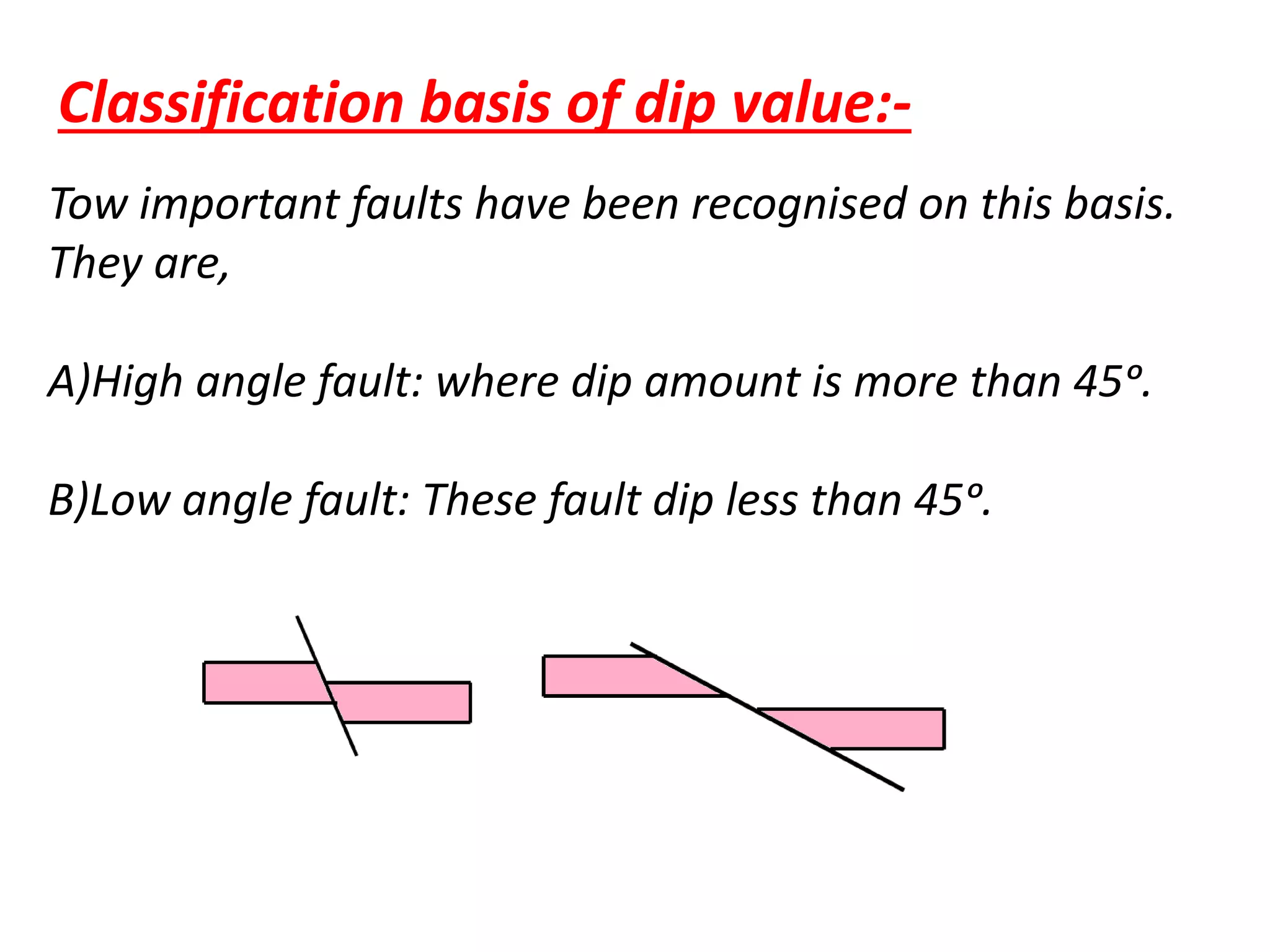
Classification basis of dip value:-
Tow important faults have been recognised on this basis.
They are,
A)High angle fault: where dip amount is more than 45ᵒ.
B)Low angle fault: These fault dip less than 45ᵒ.
Thrust
Gravity
SinistralDextral
Genetic classification:-
CONCLUSONS
Fault is a brittle deformation which can result due to
the different deformational activity.
Study of the faults are very important because ore
deposits of hydrothermal origin can be associated with
regional fault places.
There are two types of approches to classify the
faults ,
1)Based on geometry of the fault, and another one is,
2)Based on differential forces acting on the fault.
REFERENCE
Marland P. Billings(1984), structural geology, 3rd edition
Prentice-hall of India private Ltd, Pp(175-198).
Santosh Kumar Garg(1983), Phisical And Enginering
Geology, Seventh Revised Edition(2012), Published by
Romesh Chander Khanna, Pp(385-403).
D Venkata Reddy(2010), Engineering Geology, Vikas
Publishing House PVT Ltd, Pp(109-112).
Faults

Faults

  • 1.
    Presented by PRAMODA G Geology,4th semester DoS In Earth Science, University of Mysore
  • 2.
    CONTENTS What is fault Faultterminology Types of Movements Relative movements Causes of faults Classification of faults Conclusions Reference Introduction
  • 3.
    INTRODUCTION Deformation is thechange in the shape, size or position of the bed due to the applied forces. Fault is brittle type of deformation in which fracture or rupture when will be developed before the displacement of block. Due to the effect of differential stresses we can observe verity of deformation structures.
  • 4.
    What is fault:- Faultsare rupture along the opposite walls have move past each other. The essential feature is differential movement parallel to the surface fracture. Caused by the brittle deformation. Depending upon the nature and magnitude of stresses and the types of the rocks, the rock bodies may get fractured into different parts , and relative displacement of blocks may occur for different distances. These are varying from a few centi meters to many meters and this displacement may occur in any direction.
  • 5.
    Fault terminology:- There aredisposition of different type of faults
  • 6.
  • 7.
  • 8.
    TYPES OF MOVEMENTS:- Thereare tow types of movements
  • 9.
  • 10.
    Relative movements:- Strike slipDip slip Net slip a b a b a b d c
  • 11.
    Causes of faults:- Faultsare essentially the shear or sliding failures, resulting from tensional, compressional, rotational stress acting the crustal rock masses. They may be due to the shrinking Earth; or due to the convection currents produced in the Earth. Normal faults are assumed to have been formed under the horizontal tension. Thrust faults may be assumed to be originating from compressive stress, which may throw the rocks into folds, and these intensely folded getting fractured and faulted under shear. The faults occure in volcanic areas and mountain zones, They are found in plains and plateaus.
  • 12.
  • 13.
    Geometrical classification:- The basesof five different geometrical classification 1. The rake of the net slip. 2. The attitude of fault related to attitude of the adjacent rocs. 3. The pattern of fault. 4. The angle at which the fault dip. 5. The apparent movement on the fault.
  • 14.
    Based on therake of the net slip. Strike net slip fault Dip net slip fault Oblique slip fault Strike slip fault Dip slip fault
  • 15.
    Based on attitudeof fault related to attitude of the adjacent rocks:- Strike fault Dip fault
  • 16.
  • 17.
    Based on thepattern of fault:- Radial faults Enechelon faults
  • 18.
  • 20.
    Based on theapparent movement:- Normal fault Reverse fault
  • 22.
    Classification basis ofdip value:- Tow important faults have been recognised on this basis. They are, A)High angle fault: where dip amount is more than 45ᵒ. B)Low angle fault: These fault dip less than 45ᵒ.
  • 23.
  • 24.
    CONCLUSONS Fault is abrittle deformation which can result due to the different deformational activity. Study of the faults are very important because ore deposits of hydrothermal origin can be associated with regional fault places. There are two types of approches to classify the faults , 1)Based on geometry of the fault, and another one is, 2)Based on differential forces acting on the fault.
  • 25.
    REFERENCE Marland P. Billings(1984),structural geology, 3rd edition Prentice-hall of India private Ltd, Pp(175-198). Santosh Kumar Garg(1983), Phisical And Enginering Geology, Seventh Revised Edition(2012), Published by Romesh Chander Khanna, Pp(385-403). D Venkata Reddy(2010), Engineering Geology, Vikas Publishing House PVT Ltd, Pp(109-112).