MAGNETIC SURVEY
Date : May 21, 2020
Time : 12 : 30 P.M.
APPLIED GEOPHYSICS
ENGINEERING GEOLOGY
Presenter :
Sudhan Kumar Subedi
Meeting ID : 725 0504 4902
Meeting Password : 5qxJwu
Interested can Join Zoom Meeting
https://us04web.zoom.us/j/6755682948?pwd=YW5xVkZ4MzQxcWVuRjA0SmN4Z3d1QT09
Magnetic Survey Method
May 21, 2020
Magnetic Susceptibility
Magnetic susceptibility is the ratio of intensity of magnetization (I) and magnetic intensity of substance (H).
χ =
I
H
For Ferromagnetic material, χ >> +1
For Paramagnetic material, χ > +1
For Diamagnetic material, χ < 0, i.e. –ve
χ
T
Tc (curie
Temperature)
Ferromagnetic Paramagnetic
Diamagnetic
Magnetic Survey Method
May 21, 2020
Magnetic Susceptibility of rocks
Magnetic Susceptibility of rocks is in principle, controlled by the type and amount of the magnetic minerals
contained in rock.
Dominantly Controlled by
Paramagnetic minerals i.e.
mafic silicates such as
- Olivine
- Pyroxenes
- Amphiboles
- Micas
- Tourmaline
- Garnets
Often controlled by
ferromagnetic minerals
(iron oxides or sulphides :
- Magnetite
- Pyrrhotite
Much less frequently
controlled by diamagnetic
minerals :
- Calcite
- Quartz
Magnetic Survey Method
May 21, 2020
Magnetic Susceptibility of rocks and their ranges
Source : Reynolds, J. M. (2011)
Magnetic Survey Method
May 21, 2020
Magnetic Susceptibility of rocks and their ranges
Source : Telford, W. M., Geldart, L. P., & Sheriff, R. E. (2010)
Magnetic Survey Method
May 21, 2020
Magnetic Susceptibility of rocks and their ranges
 Metamorphic rocks are dependent upon their parent material and thus, metapsammites are likely to have
different susceptibilities as compared with metapelites.
Magnetic Survey Method
May 21, 2020
Magnetic Susceptibility of rocks and their ranges
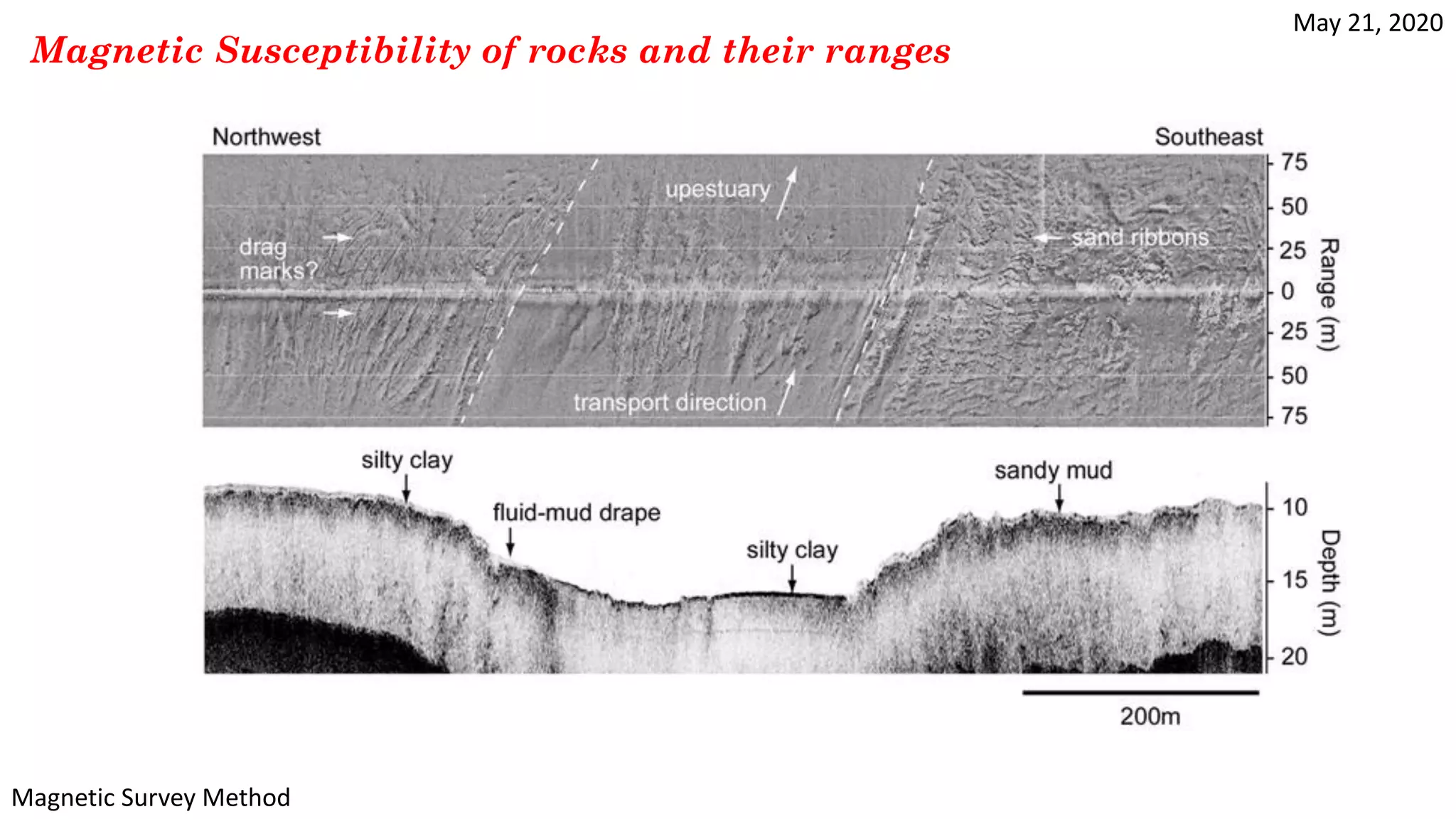
 In addition to mineral composition, Susceptibility depends on the alignment and shape of the magnetic
grains dispersed throughout the rock.
 Magnetic fabric analysis provides a very sensitive indication as to the physical composition of rock or
sediment, which in turn can be important in interpreting the physical processes affecting the rock.
 If there is a marked orientation of particles, such as in sedimentary or metamorphic rocks, a strong
physical anisotropy may exist. The variation of magnetic property as a function of orientation and shape of
the mineral grain is known as ‘Magnetic Fabric’.
For example, it is possible to
correlate the magnetic fabric
variation in estuarine sediments
with sonograph image of estuary
floor.
Magnetic Survey Method
May 21, 2020
Magnetic Susceptibility of rocks and their ranges
Magnetic Survey Method
May 21, 2020
Magnetic Susceptibility of rocks and their ranges
• For Magnetic ore bodies with extremely high susceptibilities (k >> 10 6 SI) , the measured susceptibility
(i.e. apparent susceptibility can be reduced substantially by a shape demagnetization effect.
• This involves a demagnetization factor Nɑ ,
which depends on direction ɑ .
Ka = K / ( 1 + Nɑ K)
For Sphere,
Nɑ = 1/3 in all directions
For thin-sheet like body ,
Nɑ ≈ 1 in transverse directions
Nɑ ≈ 0 in longitudinal directions
Magnetic Survey Method
May 21, 2020
Elements of Earth Magnetic Field
Magnetic Survey Method
May 21, 2020
Elements of Earth Magnetic Field
How did the Earth become differentiated to have different layers ???
• Earth is such a distance away from the sun that water can exist in all the three forms of solid , liquid
and gas.
• Density of water is 1 g/cc.
• Density of the most of the rocks available at the Earth’s surface is ≤ 3 g/cc.
• Overall density of the Earth is about 5.5 g/cc.
• clearly indicates that Earth’s interior consists of layers of increasing densities.
• Dense layers at the depth and higher ones at the surface and most dense at the center of the earth.
• Gravity is the driving force for such a wide sedimentation of different layers over the area.
Magnetic Survey Method
May 21, 2020
Elements of Earth Magnetic Field
Crust
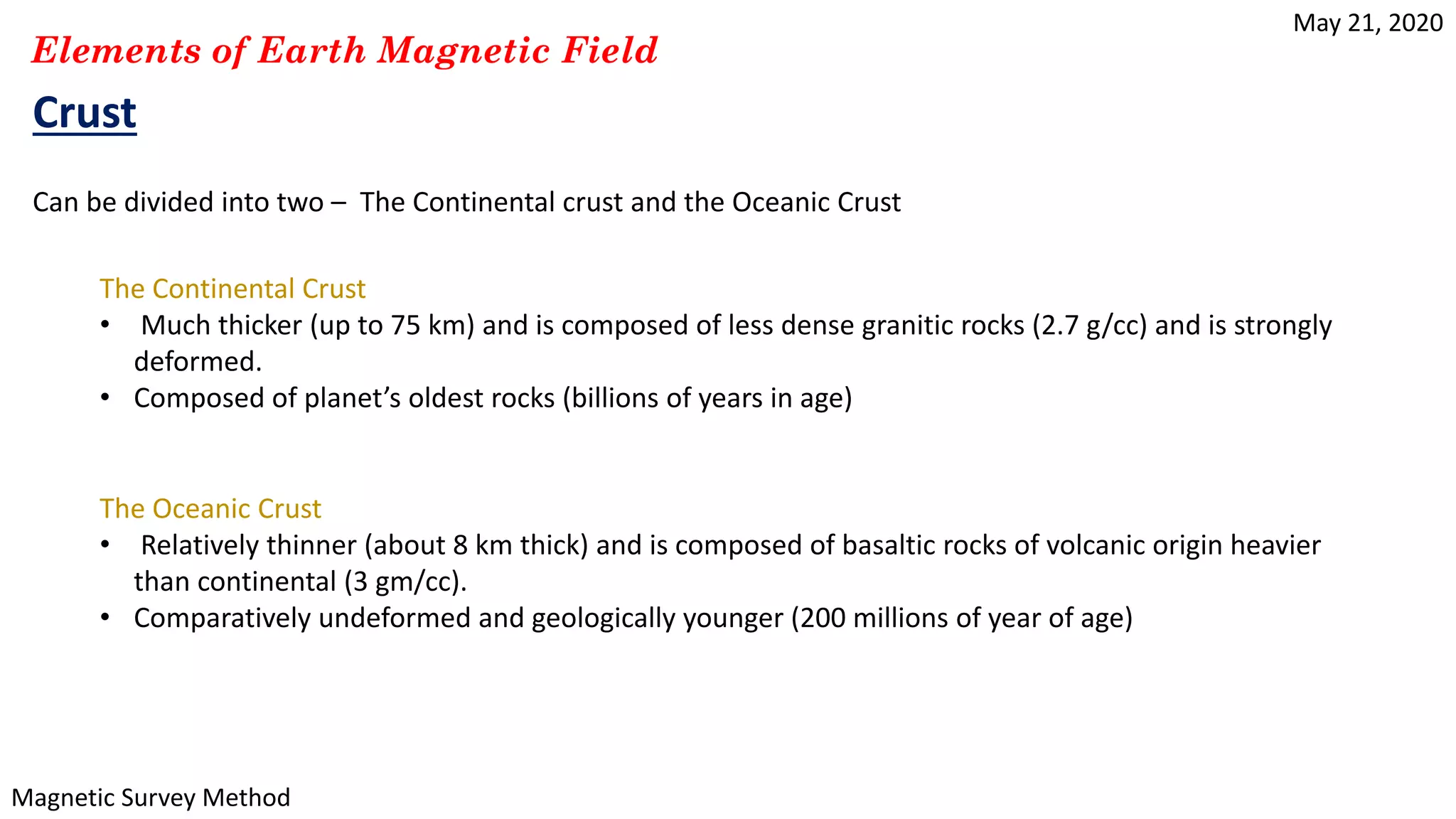
Can be divided into two – The Continental crust and the Oceanic Crust
The Continental Crust
• Much thicker (up to 75 km) and is composed of less dense granitic rocks (2.7 g/cc) and is strongly
deformed.
• Composed of planet’s oldest rocks (billions of years in age)
The Oceanic Crust
• Relatively thinner (about 8 km thick) and is composed of basaltic rocks of volcanic origin heavier
than continental (3 gm/cc).
• Comparatively undeformed and geologically younger (200 millions of year of age)
Magnetic Survey Method
May 21, 2020
Elements of Earth Magnetic Field
Mantle
 Also include iron and magnesium in abundance
 2900 km thick and constitute 82 % of Earth’s volume and 68 % of Earth’s mass.
 Composed of rocks (made from compounds of silicates and oxygen)
 Covers the core
 Fragments of mantle are brought during volcanic eruption.
 Because of pressure of overlying rocks, its density increase with depth (3.2 g/cc in the upper
part to 5.0 g/cc near the core )
State of Mantle
• It is in semi-molten state and exhibit the convection current to the plate tectonics to occur.
• Decay of radioactive material in the lower mantle used to generate lots of heat during Archean age (3800-
2500 Mya. Presently, the rate of decay is less to drive the Plates through convection. Thus, Presently Mantle
is considered as in solid state and not of causing convection current ( Tackley, 2000; Koranaga, 2006)
Magnetic Survey Method
May 21, 2020
Elements of Earth Magnetic Field
Core
 Constitute 16 % of Earth’s volume
 Density increases with depth
 Average density of 10.8 g/cc
 Extending in a diameter of 7000 km
 32 % of Earth’s mass
 Mainly consist of Iron and Nickel
Magnetic Survey Method
May 21, 2020
Elements of Earth Magnetic Field
Core
 Outer Core is extending between 2900 km to 5100 km. Alloy of iron and nickel having temperature range
from 4000°C to 5000°C in liquid form and causing the convection current.
- It causes the Earth’s magnetic field due to its high density and constant motion and metallic properties.
- Causes shift in the magnetic poles
- Leaves record of the rocks in terms of Paleomagnetic value. Useful to understand the movement of
continents over the past
Divided into Outer Core and Inner Core :
 Inner Core is extending between 5100 km to 6400 km. Mostly composed of iron having temperature of
5000°C to 7000°C as high as the surface of the sun.
- Even though the temperature is so high, the overburden pressure is so high that the Iron cannot melt
and thus inner core is in solid state unlike outer core.
Magnetic Survey Method
May 21, 2020
Elements of Earth Magnetic Field
 Considering the presence of iron, at a high temperature in solid core and as a result of convection
current generated due to the temperature variation in outer core, drives the inner core.
 As a result of this, the inner core rotates resulting in generation of electric current.
 Further, magnetic field comes into picture
 For magnetic force to exist, there should be dipole, very much similar to magnet.
 Presence of inclination of axis joining the poles is about 11° with respect to true north.
Magnetic Survey Method
May 21, 2020
Elements of Earth Magnetic Field
 The present configuration of magnetic poles, keep changing.
 Period in which such change occurs is defined as Chrons.
 While Normal Polarity indicates pole configuration matching with present North Pole and South Pole.
 Reverse polarity indicates a situation in which present North pole becomes South pole and present
South pole becomes North pole.
 So far, 183 reversals in magnetic poles has happened in last 83 million years ( Leonardo et. al.,
2014)
Change in Polarity (Geomagnetic Reversal)
 As per Byrd (2018), reversal lasts for almost 200 years.
 A complete reversal known as Laschamp event, occurred about 41000 years ago.
Magnetic Survey Method
May 21, 2020
Elements of Earth Magnetic Field
Change in Polarity (Geomagnetic Reversal)
Magnetic Survey Method
May 21, 2020
Elements of Earth Magnetic Field
 In early part of 20th century, geologists reported to have volcanic deposit showing reverse orientation
on magnetic depositions.
Change in Polarity (Geomagnetic Reversal)
 While some rocks indicated magnetic depositions matching with present pole configuration, other
showing complete reverse field.
 Based on dating method, it was found that rock which were showing reverse magnetic field belonged
to the Pleistocene age (2.5 million years – 0.12 million years).
Magnetic Survey Method
May 21, 2020
Elements of Earth Magnetic Field
 At plate boundaries, mainly divergent boundary, new material from mantle comes to the surface and
gets deposit.
Important Observations
 This way new surface is formed.
 Molten material which is coming to the surface, having magnetic minerals. These minerals will orient
themselves as per the magnetic pole configuration during the time of deposition and cooling.
 This way, magnetic rocks preserve the characteristics of pole configuration to the point.
Magnetic Survey Method
May 21, 2020
Elements of Earth Magnetic Field
 At divergent boundary, deposition of material is a continuous process, which means that just at the
boundary the deposition characteristics will be matching with present configuration.
Important Observations
 However, away from the boundary, depending upon the rate of deposition and configuration of poles
when material was deposited, its mineral orientation will be different and may be closer or far
distance from the boundary.
 Based on age of deposition and mineral orientation, the configuration of magnetic polarities in the
geological time scale can be assessed.
Magnetic Survey Method
May 21, 2020
Elements of Earth Magnetic Field
 Depending upon the characteristics of divergent plate boundary, the mineral deposited in a region
should be indicative of average magnetic properties to be constant throughout.
Magnetic Anomaly
 In case of small magnetic when comes in contact with Earth’s magnetic field, exerts addition force.
 Similar way, presence of material such as ore deposits, unconformity, buried objects, voids etc. which
can cause change in magnetic characteristics in comparison to average characteristics.
 Such a change, if detected, based on field measurement, is known as MAGNETIC ANOMALY.
Magnetic Survey Method
May 21, 2020
Survey Can be done :
 On Ground
 In Air
 Based on Satellite Data
 Offshore Vessels
Magnetic Survey Method
May 21, 2020
Instruments : Magnetometer
Magnetometers are used for measurement of strength of field.
Commonly used magnetometers are :
- Proton Precession Magnetometer
- Alkali-vapor/Optical Pumping Magnetometer
- Flux-gate Magnetometer
Magnetic Survey Method
May 21, 2020
Instruments : Magnetometer
Proton Precession Magnetometer
• Proton Precession Magnetometer operates on the principle that protons in all atoms are spinning on an axis
aligned with the magnetic field, according to Larmor equation.
• Ordinarily, proton tends to line up with the earth’s magnetic
field.
• When subjected to an artificially-induced magnetic field,
the protons will align themselves with the new field. When
this new field ceases, the protons return to their original
alignment with the earth's magnetic field.
Magnetic Survey Method
May 21, 2020
Instruments : Magnetometer
Proton Precession Magnetometer
 In a proton precession magnetometer, a container of fluid
rich in hydrogen atoms, usually a hydrocarbon, is
surrounded by a coil of wire which can be energized by a
direct current to produce a strong magnetic field, forcing all
protons to align in a certain direction.
 The current is then shut off, letting the protons to precess
back to their original direction.
 The precession induces a very weak signal into the same coil, which is measured by a frequency
counter to give a direct readout of the magnetic field strength.
 As they change their alignment, the spinning protons precess, or wobble, like a gyroscope. The
frequency at which the protons precess is directly proportional to the strength of the earth's magnetic
field.
Magnetic Survey Method
May 21, 2020
Instruments : Magnetometer
Proton Precession Magnetometer
Magnetic Survey Method
May 21, 2020
Instruments : Magnetometer
Alkali-vapor/Optically Pumped Magnetometer
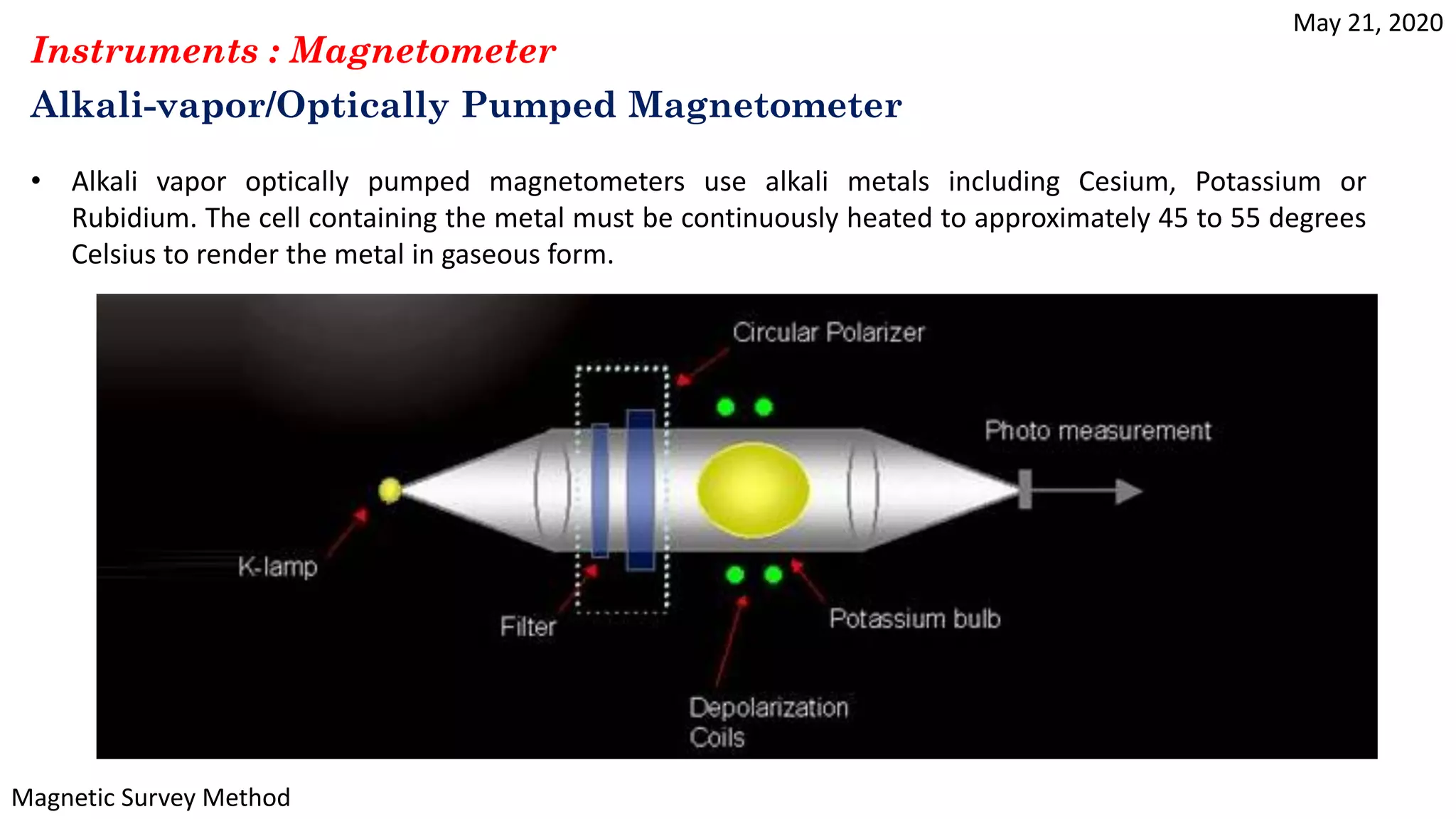
• Alkali vapor optically pumped magnetometers use alkali metals including Cesium, Potassium or
Rubidium. The cell containing the metal must be continuously heated to approximately 45 to 55 degrees
Celsius to render the metal in gaseous form.
Magnetic Survey Method
May 21, 2020
Instruments : Magnetometer
Alkali-vapor/Optically Pumped Magnetometer
• A glass vapour cell containing gaseous metal is exposed (or pumped) by light of very specific wavelength
– an effect called light polarization.
• Electrons at level 3 are not stable, and they spontaneously decay to both energy levels 1 and 2.
Eventually, the level 1 is fully populated (i.e. level 2 is depleted).
• When this happens, the absorption of
polarizing light stops and the vapour
cell becomes more transparent.
• The frequency of light is specifically selected and circularly polarized for each element (i.e. the D1
spectral line) to shift electrons from the ground level 2 to the excited metastable state 3
Magnetic Survey Method
May 21, 2020
Instruments : Magnetometer
Alkali-vapor/Optically Pumped Magnetometer
• This is when RF depolarization comes into play. RF power corresponding to the energy difference between
levels 1 and 2 is applied to the cell to move electrons from level 1 back to level 2 (and the cell becomes
opaque again).
• Depolarization by a circular magnetic field at the Larmor frequency will rebalance populations of the two
ground levels and the vapour cell will start absorbing more of the polarizing light.
• The effect of polarization and depolarization is that light intensity becomes modulated by the RF
frequency. By detecting light modulation and measuring the frequency, we can obtain a value of the
magnetic field.
• The frequency of the RF field required to repopulate level 2 varies with the ambient magnetic field and is
called Larmor frequency.
Magnetic Survey Method
May 21, 2020
Instruments : Magnetometer
Flux-gate Magnetometer
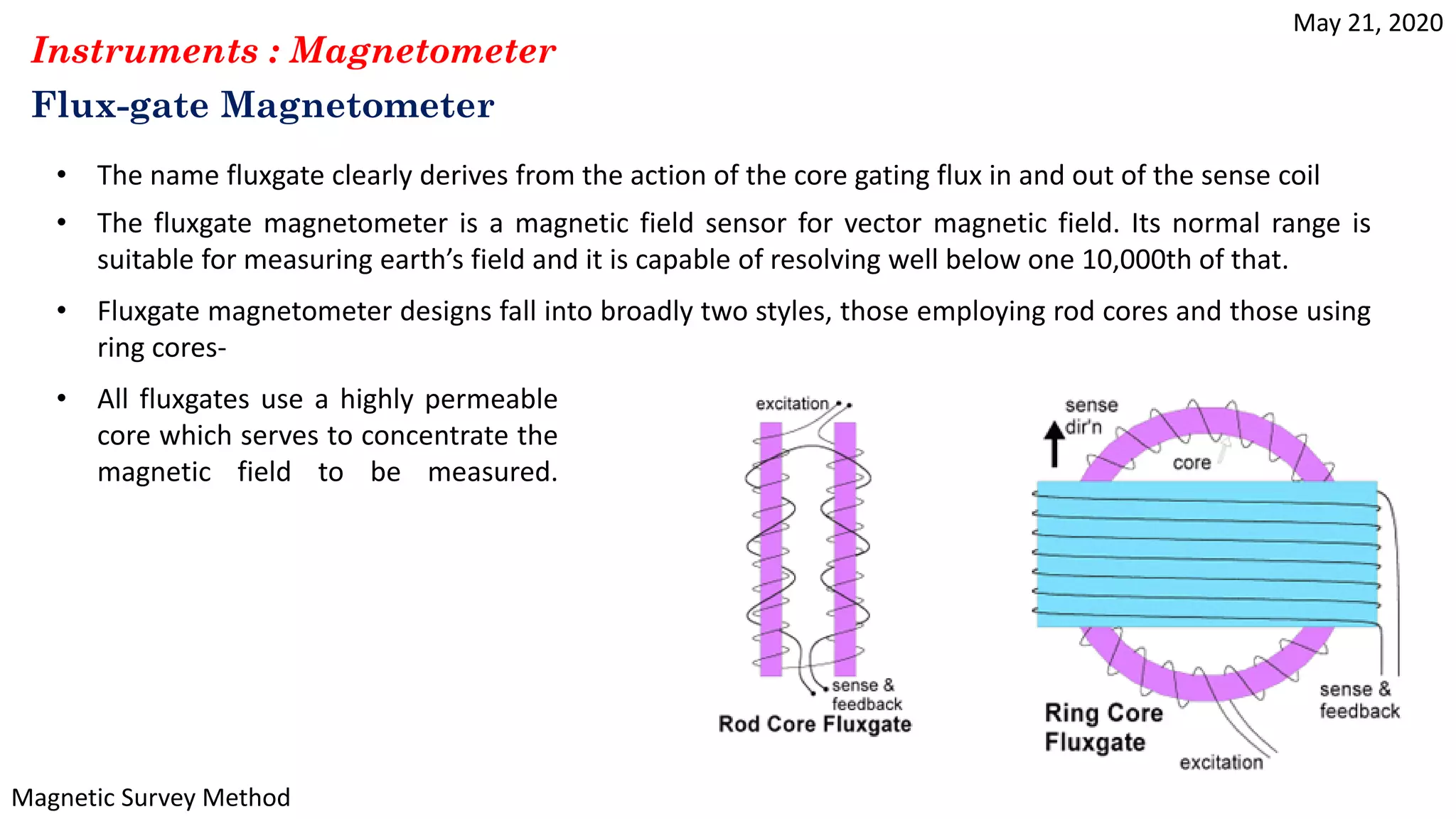
• The fluxgate magnetometer is a magnetic field sensor for vector magnetic field. Its normal range is
suitable for measuring earth’s field and it is capable of resolving well below one 10,000th of that.
• Fluxgate magnetometer designs fall into broadly two styles, those employing rod cores and those using
ring cores-
• The name fluxgate clearly derives from the action of the core gating flux in and out of the sense coil
• All fluxgates use a highly permeable
core which serves to concentrate the
magnetic field to be measured.
Magnetic Survey Method
May 21, 2020
Applications
• Can be used to locate:
- Drums, pipes,
- metallic objects,
- buried military objects such as shells,
- underground coal burns,
- mine shafts
• For Mapping :
- Archaeological remains such as cemeteries,
- Landfills
- Dikes, faults
- underground coal burns,
- Steep Geological features
Magnetic Survey Method
May 21, 2020
Advantages
- Quick method of Exploration
- Field observations are less expensive and easy
- Even possible from small vessel in offshore environment
- Presence of scarp metal and electric cable might alter field observations and thus are
not suitable in urban areas,
- Material with magnetic characteristics can be detected in form of anomaly
- Resolution decreases with depth
Limitations
Magnetic Survey Method
May 21, 2020
Thank you !

Magnetic Survey

  • 1.
    MAGNETIC SURVEY Date :May 21, 2020 Time : 12 : 30 P.M. APPLIED GEOPHYSICS ENGINEERING GEOLOGY Presenter : Sudhan Kumar Subedi Meeting ID : 725 0504 4902 Meeting Password : 5qxJwu Interested can Join Zoom Meeting https://us04web.zoom.us/j/6755682948?pwd=YW5xVkZ4MzQxcWVuRjA0SmN4Z3d1QT09
  • 4.
    Magnetic Survey Method May21, 2020 Magnetic Susceptibility Magnetic susceptibility is the ratio of intensity of magnetization (I) and magnetic intensity of substance (H). χ = I H For Ferromagnetic material, χ >> +1 For Paramagnetic material, χ > +1 For Diamagnetic material, χ < 0, i.e. –ve χ T Tc (curie Temperature) Ferromagnetic Paramagnetic Diamagnetic
  • 5.
    Magnetic Survey Method May21, 2020 Magnetic Susceptibility of rocks Magnetic Susceptibility of rocks is in principle, controlled by the type and amount of the magnetic minerals contained in rock. Dominantly Controlled by Paramagnetic minerals i.e. mafic silicates such as - Olivine - Pyroxenes - Amphiboles - Micas - Tourmaline - Garnets Often controlled by ferromagnetic minerals (iron oxides or sulphides : - Magnetite - Pyrrhotite Much less frequently controlled by diamagnetic minerals : - Calcite - Quartz
  • 6.
    Magnetic Survey Method May21, 2020 Magnetic Susceptibility of rocks and their ranges Source : Reynolds, J. M. (2011)
  • 7.
    Magnetic Survey Method May21, 2020 Magnetic Susceptibility of rocks and their ranges Source : Telford, W. M., Geldart, L. P., & Sheriff, R. E. (2010)
  • 8.
    Magnetic Survey Method May21, 2020 Magnetic Susceptibility of rocks and their ranges  Metamorphic rocks are dependent upon their parent material and thus, metapsammites are likely to have different susceptibilities as compared with metapelites.
  • 9.
    Magnetic Survey Method May21, 2020 Magnetic Susceptibility of rocks and their ranges  In addition to mineral composition, Susceptibility depends on the alignment and shape of the magnetic grains dispersed throughout the rock.  Magnetic fabric analysis provides a very sensitive indication as to the physical composition of rock or sediment, which in turn can be important in interpreting the physical processes affecting the rock.  If there is a marked orientation of particles, such as in sedimentary or metamorphic rocks, a strong physical anisotropy may exist. The variation of magnetic property as a function of orientation and shape of the mineral grain is known as ‘Magnetic Fabric’. For example, it is possible to correlate the magnetic fabric variation in estuarine sediments with sonograph image of estuary floor.
  • 10.
    Magnetic Survey Method May21, 2020 Magnetic Susceptibility of rocks and their ranges
  • 11.
    Magnetic Survey Method May21, 2020 Magnetic Susceptibility of rocks and their ranges • For Magnetic ore bodies with extremely high susceptibilities (k >> 10 6 SI) , the measured susceptibility (i.e. apparent susceptibility can be reduced substantially by a shape demagnetization effect. • This involves a demagnetization factor Nɑ , which depends on direction ɑ . Ka = K / ( 1 + Nɑ K) For Sphere, Nɑ = 1/3 in all directions For thin-sheet like body , Nɑ ≈ 1 in transverse directions Nɑ ≈ 0 in longitudinal directions
  • 12.
    Magnetic Survey Method May21, 2020 Elements of Earth Magnetic Field
  • 13.
    Magnetic Survey Method May21, 2020 Elements of Earth Magnetic Field How did the Earth become differentiated to have different layers ??? • Earth is such a distance away from the sun that water can exist in all the three forms of solid , liquid and gas. • Density of water is 1 g/cc. • Density of the most of the rocks available at the Earth’s surface is ≤ 3 g/cc. • Overall density of the Earth is about 5.5 g/cc. • clearly indicates that Earth’s interior consists of layers of increasing densities. • Dense layers at the depth and higher ones at the surface and most dense at the center of the earth. • Gravity is the driving force for such a wide sedimentation of different layers over the area.
  • 14.
    Magnetic Survey Method May21, 2020 Elements of Earth Magnetic Field Crust Can be divided into two – The Continental crust and the Oceanic Crust The Continental Crust • Much thicker (up to 75 km) and is composed of less dense granitic rocks (2.7 g/cc) and is strongly deformed. • Composed of planet’s oldest rocks (billions of years in age) The Oceanic Crust • Relatively thinner (about 8 km thick) and is composed of basaltic rocks of volcanic origin heavier than continental (3 gm/cc). • Comparatively undeformed and geologically younger (200 millions of year of age)
  • 15.
    Magnetic Survey Method May21, 2020 Elements of Earth Magnetic Field Mantle  Also include iron and magnesium in abundance  2900 km thick and constitute 82 % of Earth’s volume and 68 % of Earth’s mass.  Composed of rocks (made from compounds of silicates and oxygen)  Covers the core  Fragments of mantle are brought during volcanic eruption.  Because of pressure of overlying rocks, its density increase with depth (3.2 g/cc in the upper part to 5.0 g/cc near the core ) State of Mantle • It is in semi-molten state and exhibit the convection current to the plate tectonics to occur. • Decay of radioactive material in the lower mantle used to generate lots of heat during Archean age (3800- 2500 Mya. Presently, the rate of decay is less to drive the Plates through convection. Thus, Presently Mantle is considered as in solid state and not of causing convection current ( Tackley, 2000; Koranaga, 2006)
  • 16.
    Magnetic Survey Method May21, 2020 Elements of Earth Magnetic Field Core  Constitute 16 % of Earth’s volume  Density increases with depth  Average density of 10.8 g/cc  Extending in a diameter of 7000 km  32 % of Earth’s mass  Mainly consist of Iron and Nickel
  • 17.
    Magnetic Survey Method May21, 2020 Elements of Earth Magnetic Field Core  Outer Core is extending between 2900 km to 5100 km. Alloy of iron and nickel having temperature range from 4000°C to 5000°C in liquid form and causing the convection current. - It causes the Earth’s magnetic field due to its high density and constant motion and metallic properties. - Causes shift in the magnetic poles - Leaves record of the rocks in terms of Paleomagnetic value. Useful to understand the movement of continents over the past Divided into Outer Core and Inner Core :  Inner Core is extending between 5100 km to 6400 km. Mostly composed of iron having temperature of 5000°C to 7000°C as high as the surface of the sun. - Even though the temperature is so high, the overburden pressure is so high that the Iron cannot melt and thus inner core is in solid state unlike outer core.
  • 18.
    Magnetic Survey Method May21, 2020 Elements of Earth Magnetic Field  Considering the presence of iron, at a high temperature in solid core and as a result of convection current generated due to the temperature variation in outer core, drives the inner core.  As a result of this, the inner core rotates resulting in generation of electric current.  Further, magnetic field comes into picture  For magnetic force to exist, there should be dipole, very much similar to magnet.  Presence of inclination of axis joining the poles is about 11° with respect to true north.
  • 19.
    Magnetic Survey Method May21, 2020 Elements of Earth Magnetic Field  The present configuration of magnetic poles, keep changing.  Period in which such change occurs is defined as Chrons.  While Normal Polarity indicates pole configuration matching with present North Pole and South Pole.  Reverse polarity indicates a situation in which present North pole becomes South pole and present South pole becomes North pole.  So far, 183 reversals in magnetic poles has happened in last 83 million years ( Leonardo et. al., 2014) Change in Polarity (Geomagnetic Reversal)  As per Byrd (2018), reversal lasts for almost 200 years.  A complete reversal known as Laschamp event, occurred about 41000 years ago.
  • 20.
    Magnetic Survey Method May21, 2020 Elements of Earth Magnetic Field Change in Polarity (Geomagnetic Reversal)
  • 21.
    Magnetic Survey Method May21, 2020 Elements of Earth Magnetic Field  In early part of 20th century, geologists reported to have volcanic deposit showing reverse orientation on magnetic depositions. Change in Polarity (Geomagnetic Reversal)  While some rocks indicated magnetic depositions matching with present pole configuration, other showing complete reverse field.  Based on dating method, it was found that rock which were showing reverse magnetic field belonged to the Pleistocene age (2.5 million years – 0.12 million years).
  • 22.
    Magnetic Survey Method May21, 2020 Elements of Earth Magnetic Field  At plate boundaries, mainly divergent boundary, new material from mantle comes to the surface and gets deposit. Important Observations  This way new surface is formed.  Molten material which is coming to the surface, having magnetic minerals. These minerals will orient themselves as per the magnetic pole configuration during the time of deposition and cooling.  This way, magnetic rocks preserve the characteristics of pole configuration to the point.
  • 23.
    Magnetic Survey Method May21, 2020 Elements of Earth Magnetic Field  At divergent boundary, deposition of material is a continuous process, which means that just at the boundary the deposition characteristics will be matching with present configuration. Important Observations  However, away from the boundary, depending upon the rate of deposition and configuration of poles when material was deposited, its mineral orientation will be different and may be closer or far distance from the boundary.  Based on age of deposition and mineral orientation, the configuration of magnetic polarities in the geological time scale can be assessed.
  • 24.
    Magnetic Survey Method May21, 2020 Elements of Earth Magnetic Field  Depending upon the characteristics of divergent plate boundary, the mineral deposited in a region should be indicative of average magnetic properties to be constant throughout. Magnetic Anomaly  In case of small magnetic when comes in contact with Earth’s magnetic field, exerts addition force.  Similar way, presence of material such as ore deposits, unconformity, buried objects, voids etc. which can cause change in magnetic characteristics in comparison to average characteristics.  Such a change, if detected, based on field measurement, is known as MAGNETIC ANOMALY.
  • 25.
    Magnetic Survey Method May21, 2020 Survey Can be done :  On Ground  In Air  Based on Satellite Data  Offshore Vessels
  • 26.
    Magnetic Survey Method May21, 2020 Instruments : Magnetometer Magnetometers are used for measurement of strength of field. Commonly used magnetometers are : - Proton Precession Magnetometer - Alkali-vapor/Optical Pumping Magnetometer - Flux-gate Magnetometer
  • 27.
    Magnetic Survey Method May21, 2020 Instruments : Magnetometer Proton Precession Magnetometer • Proton Precession Magnetometer operates on the principle that protons in all atoms are spinning on an axis aligned with the magnetic field, according to Larmor equation. • Ordinarily, proton tends to line up with the earth’s magnetic field. • When subjected to an artificially-induced magnetic field, the protons will align themselves with the new field. When this new field ceases, the protons return to their original alignment with the earth's magnetic field.
  • 28.
    Magnetic Survey Method May21, 2020 Instruments : Magnetometer Proton Precession Magnetometer  In a proton precession magnetometer, a container of fluid rich in hydrogen atoms, usually a hydrocarbon, is surrounded by a coil of wire which can be energized by a direct current to produce a strong magnetic field, forcing all protons to align in a certain direction.  The current is then shut off, letting the protons to precess back to their original direction.  The precession induces a very weak signal into the same coil, which is measured by a frequency counter to give a direct readout of the magnetic field strength.  As they change their alignment, the spinning protons precess, or wobble, like a gyroscope. The frequency at which the protons precess is directly proportional to the strength of the earth's magnetic field.
  • 29.
    Magnetic Survey Method May21, 2020 Instruments : Magnetometer Proton Precession Magnetometer
  • 30.
    Magnetic Survey Method May21, 2020 Instruments : Magnetometer Alkali-vapor/Optically Pumped Magnetometer • Alkali vapor optically pumped magnetometers use alkali metals including Cesium, Potassium or Rubidium. The cell containing the metal must be continuously heated to approximately 45 to 55 degrees Celsius to render the metal in gaseous form.
  • 31.
    Magnetic Survey Method May21, 2020 Instruments : Magnetometer Alkali-vapor/Optically Pumped Magnetometer • A glass vapour cell containing gaseous metal is exposed (or pumped) by light of very specific wavelength – an effect called light polarization. • Electrons at level 3 are not stable, and they spontaneously decay to both energy levels 1 and 2. Eventually, the level 1 is fully populated (i.e. level 2 is depleted). • When this happens, the absorption of polarizing light stops and the vapour cell becomes more transparent. • The frequency of light is specifically selected and circularly polarized for each element (i.e. the D1 spectral line) to shift electrons from the ground level 2 to the excited metastable state 3
  • 32.
    Magnetic Survey Method May21, 2020 Instruments : Magnetometer Alkali-vapor/Optically Pumped Magnetometer • This is when RF depolarization comes into play. RF power corresponding to the energy difference between levels 1 and 2 is applied to the cell to move electrons from level 1 back to level 2 (and the cell becomes opaque again). • Depolarization by a circular magnetic field at the Larmor frequency will rebalance populations of the two ground levels and the vapour cell will start absorbing more of the polarizing light. • The effect of polarization and depolarization is that light intensity becomes modulated by the RF frequency. By detecting light modulation and measuring the frequency, we can obtain a value of the magnetic field. • The frequency of the RF field required to repopulate level 2 varies with the ambient magnetic field and is called Larmor frequency.
  • 33.
    Magnetic Survey Method May21, 2020 Instruments : Magnetometer Flux-gate Magnetometer • The fluxgate magnetometer is a magnetic field sensor for vector magnetic field. Its normal range is suitable for measuring earth’s field and it is capable of resolving well below one 10,000th of that. • Fluxgate magnetometer designs fall into broadly two styles, those employing rod cores and those using ring cores- • The name fluxgate clearly derives from the action of the core gating flux in and out of the sense coil • All fluxgates use a highly permeable core which serves to concentrate the magnetic field to be measured.
  • 34.
    Magnetic Survey Method May21, 2020 Applications • Can be used to locate: - Drums, pipes, - metallic objects, - buried military objects such as shells, - underground coal burns, - mine shafts • For Mapping : - Archaeological remains such as cemeteries, - Landfills - Dikes, faults - underground coal burns, - Steep Geological features
  • 35.
    Magnetic Survey Method May21, 2020 Advantages - Quick method of Exploration - Field observations are less expensive and easy - Even possible from small vessel in offshore environment - Presence of scarp metal and electric cable might alter field observations and thus are not suitable in urban areas, - Material with magnetic characteristics can be detected in form of anomaly - Resolution decreases with depth Limitations
  • 36.
    Magnetic Survey Method May21, 2020 Thank you !