1 | HYDROGEN FUEL FOR THE FUTURE GENERATION
AN DOCUMENT ON
FUEL FOR
THE FUTURE GENARATION……..
2 | HYDROGEN FUEL FOR THE FUTURE GENERATION
INDEX:
1. Abstract
2. Discussion
3. Introduction
a) Position of hydrogen in periodic table
b) Occurrence
c) Isotopes
4. Properties of hydrogen
5. Production methods
6. Storage
7. Fuel cells
8. Hydrogen vehicle
9. Hydrogen economy
10. other applications
11. Conclusion
3 | HYDROGEN FUEL FOR THE FUTURE GENERATION
ABSTRACT:
Hydrogen is an energy carrier that can transform our fossil-fuel dependent economy into a
hydrogen economy, which can provide an emissions-free transportation fuel. Literature
reviews and independent research were the main methods of research. Hydrogen storage and
transport are issues of intense research due to hydrogen’s characteristic low density. Is
hydrogen a justifiable means to the attainment of an environmentally beneficial transportation
fuel when methods of production are not utilizing clean, renewable energy sources? What
exactly are the completely emissions-free methods of producing and utilizing hydrogen in
transportation? Can hydrogen be the fuel of the future?
Hydrogen is the fuel of the future. As an avid researcher of alternative fuels and an ambitious
chemistry student, this researcher understands the importance of a shift to a hydrogen
economy. Hydrogen is an energy carrier that can be used in internal combustion engines or
fuel cells producing virtually no greenhouse gas emissions when combusted with oxygen. The
only significant emission is water vapor. Hydrogen production and storage is currently
undergoing extensive research. A solar-hydrogen systemcan provide the means of a totally
emissions-free method of producing hydrogen. Although
Steam reformation of methane is currently the major route to hydrogen production, the
emissions involved can also be controlled much more efficiently than our current system of
transportation fuel. Climate change is a serious issue becoming increasingly evident to much
of the population. Rising CO2 levels have directly contributed to the global warming
phenomenon.
4 | HYDROGEN FUEL FOR THE FUTURE GENERATION
Discussion:
Figure 1 comparison of various fuel structures
An alternative fuel must be technically feasible, economically viable, easily convert to
another energy form when combusted, be safe to use, and be potentially harmless to the
environment. Hydrogen is the most abundant element on earth. Although hydrogen does not
exist freely in nature, it can be produced from a variety of sources such as steamreformation of
natural gas, gasification of coal, and electrolysis of water. Hydrogen gas can used in traditional
gasoline-powered internal combustion engines (ICE) with minimal conversions. However,
vehicles with polymer electrolyte membrane (PEM) fuel cells provide a greater efficiency.
Hydrogen gas combusts with oxygen to produce water vapor. Even the production of hydrogen
gas can be emissions-free with the use of renewable energy sources. The current price of
hydrogen is about $4 per kg, which is about the equivalent of a gallon of gasoline. However, in
fuel cell vehicles, such as the 2009 Honda FCX Clarity, 1 kg provides about 68 miles of travel [3].
Of course the price range is currently very high. Ongoing research and implementation toward
a hydrogen economy is required to make this fuel economically feasible. The current focus is
directed toward hydrogen being a clean alternative fuel that produces insignificant greenhouse
gas emissions. If hydrogen is the next transportation fuel, the primary energy source used to
produce the vast amounts of hydrogen will not necessarily be a renewable, clean source.
5 | HYDROGEN FUEL FOR THE FUTURE GENERATION
Carbon sequestration is referenced frequently as a means to eliminate CO2 emissions from the
burning of coal, where the gases are captured and sequestered in gas wells or depleted oil
wells. However, the availability of these sites is not widespread and the presence of CO2 may
acidify groundwater.
Storage and transport is a major issue due to hydrogen’s low density. Is the investment
in new infrastructure too costly? Can our old infrastructure currently used for natural gas
transport be retrofitted for hydrogen?
The burning of coal and nuclear fission are the main energy sources that will be used to provide
an abundant supply of hydrogen fuel. How does this process help our current global warming
predicament? The U.S. Department of Energy has recently funded a research project to
produce hydrogen from coal at large-scale facilities, with carbon sequestration in mind. Is this
the wrong approach? Should there be more focus on other forms of energy that produce no
greenhouse gas emissions? If the damage to the environment is interpreted into a monetary
cost, the promotion of energy sources such as wind and solar may prove to be a more
economical approach.
The possibility of a hydrogen economy that incorporates the use of hydrogen into every aspect
of transportation requires much further research and development. The most economical and
major source of hydrogen in the US is steamreformation of natural gas, a nonrenewable
resource and a producer of greenhouse gases. The electrolysis of water is a potentially
sustainable method of producing hydrogen, but only if renewable energy sources are used for
the electricity. Today, less than 5% of our electricity comes from renewable sources such as
solar, wind, and hydro. Nuclear power may be considered as a renewable resource to some,
but the waste generated by this energy source becomes a major problem. A rapid shift toward
renewable energy sources is required before this proposed hydrogen economy can prove itself.
Solar photovoltaic (PV) systems are the current focus of my research related to the energy
source required for electrolysis of water. One project conducted at the GM Proving Ground in
Milford, MI employed the use of 40 solar PV modules directly connected to an
electrolyzer/storage/dispenser system. The result was an 8.5% efficiency in
the production of hydrogen, with an average production of 0.5 kg of high-pressure hydrogen
per day. Research similar to this may result in the optimization of the solar- hydrogen energy
system.
Furthermore, the infrastructure for a hydrogen economy will come with high capital costs. The
transport of hydrogen through underground pipes seems to be the most economical when
demand grows enough to require a large centralized facility. However, in places of low
population density, this method may not be economically feasible. The project mentioned
6 | HYDROGEN FUEL FOR THE FUTURE GENERATION
earlier may become an option for individuals to produce their own hydrogen gas at home, with
solar panels lining their roof. A drastic change is needed to slow down the effects of our fossil-
fuel dependent society. Conservation can indeed help, but the lifestyles we are accustomed to
require certain energy demands. Transportation is a necessary part of our current world and
the switch to a hydrogen economy can provide a sustainable solution. Is hydrogen the fuel of
the future? The research presented here encourages one to answer yes.
INTRODUCTION: now letwe know about Hydrogen
POSITION OF HYYDROGE IN PERIODIC TABLE:
Hydrogenisthe firstelementinthe periodictable .itcontainsonlyone electronic configurationissimilar
to the outerelectronicconfigurationof alkali metals(ns1
) ,whichbelongstothe firstgroupof the
periodictable .likehalogens((ns2
np5
) ,itisshortbyone electrontothe correspondingnoblegas
configuration(1s2
) ,whichbelongstothe seventhgroupof the periodictable .
Hydrogentherefore,hasresemblestoalkali metals,whichloseone electrontoformunipositive,as
well aswithhalogens,whichgainone electrontoformuninegative ion .
Like alkali metals,hydrogenformsoxides,halidesandsulfides.however,unlike alkali metalsithasvery
highionizationenthalpyanddoesnotpossesmetalliccharacteristicsundernormal conditions.interms
of ionizationenthalpy,hydrogenresemblesmore withhalogens.
Like halogensitforms a diatomicmolecule ,combineswithelements toformhydridesandalarge
numberof covalentcompounds.however,intermreactivity,itisverylow reactive ascomparedto
halogens.
Hydrogenresemblescertainextentbothwithalkalimetalsandhalogensitdiffersfromthemaswell
.hence hydrogencouldnotbe placedeitherwithalkali metalsorwithhalogens.thusuniquebehavior
and is ,therefore,bestplacedseparatelyinthe periodictable .
Occurrence:
Hydrogenisthe most abundant (92%) elementinthe universe andisprincipleelementinthe universe
and isthe principle elementin the solaratmosphere .the giantplanetsJupiterandSaturnconsists
mostlyof hydrogen.it occurs 15.4% inthe earth crust inthe combinedform.quantitativelyitisthe
ninthelementinorderof abundance inthe earthcrust inthe combinedformbesideswater,itoccurin
plantand animal tissues,coal ,petroleum,clay,carbohydrates,proteinsetc.
ISOTOPESOF HYDROGEN:
Atomsof the same elementhaving same atomicnumberbutdifferentmassnumbersare called
isotopes.isotopeshavingsame numberof protonsandelectronsbutdifferentnumberof neutrons.
7 | HYDROGEN FUEL FOR THE FUTURE GENERATION
Hydrogenhasthree isotopes
I. Protium or normal hydrogen(1H1
)
II. Deuteriumorheavyhydrogen(1H2
or1D2
)
III. Tritium(1H3
or1D3
)
Protium (1H1
):itis the mostcommonlyoccurringisotope of hydrogen.itdoesnotcontainaneutron
itsatomic massis 1.08 amu .a sample of natural hydrogencontains99.984% of the isotope
Deuterium (1H2
or1D2
): itcontains one neutron.itatomicmass is2.014 amu .a sample of natural
hydrogencontains0.0156% of thisisotope
Tritium(1H3
):itcontainstwoneutrons.itsatomicmassis3.016 amu .tritiumoccurs to the extentof
1 part of tritiumin10000000 parts of ordinarily available hydrogen.Tritiumisradioactive isotopeof
hydrogen.itemits particle
1H3→ 2He3 +-1e0
The isotopesof the elementhave the same electronicconfigurationandhence possessthe same
chemical properties.the onlydifference isintheir ratesof reaction,mainlydue totheirdifferent
enthalpyof bonddissociation.however,inphysical propertiesthisisotopesdifferconsiderablydue
to theirlarge massdifference
Some important physical properties of protium , deuterium and tritium
Property Protium Deuterium Tritium
Relative
abundance(%)
99.984 0.0156 10-15
Relative atomic
mass(amu)
1.008 2.014 3.016
Melting Point(K) 13.96 18.73 20.62
Boiling Point(K) 20.39 23.67 25.0
Density(gm/lit) 0.09 0.18 0.27
Enthalpy of
fusion(kJ/mole)
0.117 0.197 0.250
Enthalpy of
vaporization(kJ/mole)
0.904 1.226 1.393
Enthalpy of bond
dissociation
(kJ/mole)
435.88 443.4 446.9
Inter nuclear 74.14 74.14 74.14
8 | HYDROGEN FUEL FOR THE FUTURE GENERATION
distance(pm)
Table 1:
Properties of pure Hydrogen :
table:2 propertiesof hydrogen
Molar
mass
Acentric
factor
Critical
temperature
Tc /k
Critical
pressure
Pc/bar
Critical
compressibility
factor
Zc
Critical
molar
volume
Vc
(cm3/mol)
N.B.P.
Tn/k
2.016 -0.216 33.19 13.13 0.305 64.1 20.4
tabe:3 critical properties
HYDROGEN AS A FUEL:
The key criteria for an IDEAL FUEL are inexhaustibility, cleanliness, convenience, and
independence from foreign control.
Hydrogen as a fuel satisfies all the above requirements. It offers the highest potential benefits in
terms of diversified supply and reduced emissions of pollutants and greenhouse gases. For the past
40 years, environmentalists and several industrial organizations have promoted hydrogen fuel as the
solution to the problems of air pollution and global warming.
9 | HYDROGEN FUEL FOR THE FUTURE GENERATION
Similar to electricity, hydrogen is a high-quality energy carrier, which can be used with a high
efficiency and zero or near-zero emissions at the point of use.
The Hydrogen production is increasing by about 10% every year. As of 2005, the economic value of
all hydrogen produced worldwide was about $135 billion per year. The current global hydrogen
production is 48% from natural gas, 30% from petroleum, 18% from coal, and 4% from
electrolysis.
Hydrogen is primarily consumed in two nonfuel uses:
(1) About 60% to produce NH3 by the Haber process for subsequent use in fertilizer
manufacturing.
(2) About 40%in refinery, chemicals, and petrochemical sectors
Physical Properties:
Hydrogen atom is the lightest element (Ordinary hydrogen has a density of 0.09 kg/m3.), consisting
of only one proton and one electron.
Hydrogen atoms readily form H2 molecules, which are smaller in size when compared to most other
molecules.
Hydrogen is colorless, odorless, and tasteless and is about 14 times lighter than air, and diffuses
faster than any other gas. On cooling, hydrogen condenses to liquid at −253°C and to solid at
−259°C.
Also, the gaseous hydrogen has one of the highest heat capacity (14.4 kJ/kg K).
Chemical Properties:
At ordinary temperatures, H2 is comparatively nonreactive unless it has been activated in some
manner. On the contrary, hydrogen atom is chemically very reactive, and that is why it is not found
chemically free in nature. In fact, very high temperatures are needed to dissociate molecular
hydrogen into atomic hydrogen.
For example, even at 5000 K, about 5% of the hydrogen remains undissociated. In nature, mostly
the hydrogen is bound to either oxygen or carbon atoms. Therefore, hydrogen must be considered
as an energy carrier—a means to store and transmit energy derived from a primary energy source.
From the safety point of view, the following are the most important properties of hydrogen when
compared to other conventional fuels:
Diffusion: Hydrogen diffuses through air much more rapidly than other gaseous fuels. With a diffusion
coefficient in air of .61 cm2/s, the rapid dispersion rate of hydrogen is its greatest safety asset.
Flammability: Flammability of hydrogen is a function of concentration level and is much greater than that of
methane or other fuels. The limit of flammability of hydrogen in air at ambient condition is 4–75%,
methane in air is 4.3–15 vol%, and gasoline in air is 1.4–7.6 vol%.
Fuel Properties:
Hydrogen is highly flammable over a wide range of temperature and concentration. Although its
combustion efficiency is truly outstanding and welcomed as a fuel of the choice for the future, it
10 | HYDROGEN FUEL FOR THE FUTURE GENERATION
inevitably renders several nontrivial technological challenges, such as safety in production, storage,
and transportation
Energy Content:
Hydrogen has the highest energy content per unit mass of any fuel. For example, on a weight basis,
hydrogen has nearly three times the energy content of gasoline (140.4 MJ/kg versus 48.6 MJ/kg).
However, on a volume basis the situation is reversed: 8,491 MJ/m3 for liquid hydrogen versus
31,150 MJ/m3 for gasoline.
The low volumetric density of hydrogen results in storage problem, especially for automotive
applications. A large container is needed to store enough hydrogen for an adequate driving range.
One of the important and attractive features of hydrogen is its electrochemical property, which can
be utilized in a fuel cell. At present, H2/O2 fuel cells are available operating at an efficiency of 50–
60% with a lifetime of up to 3000 h
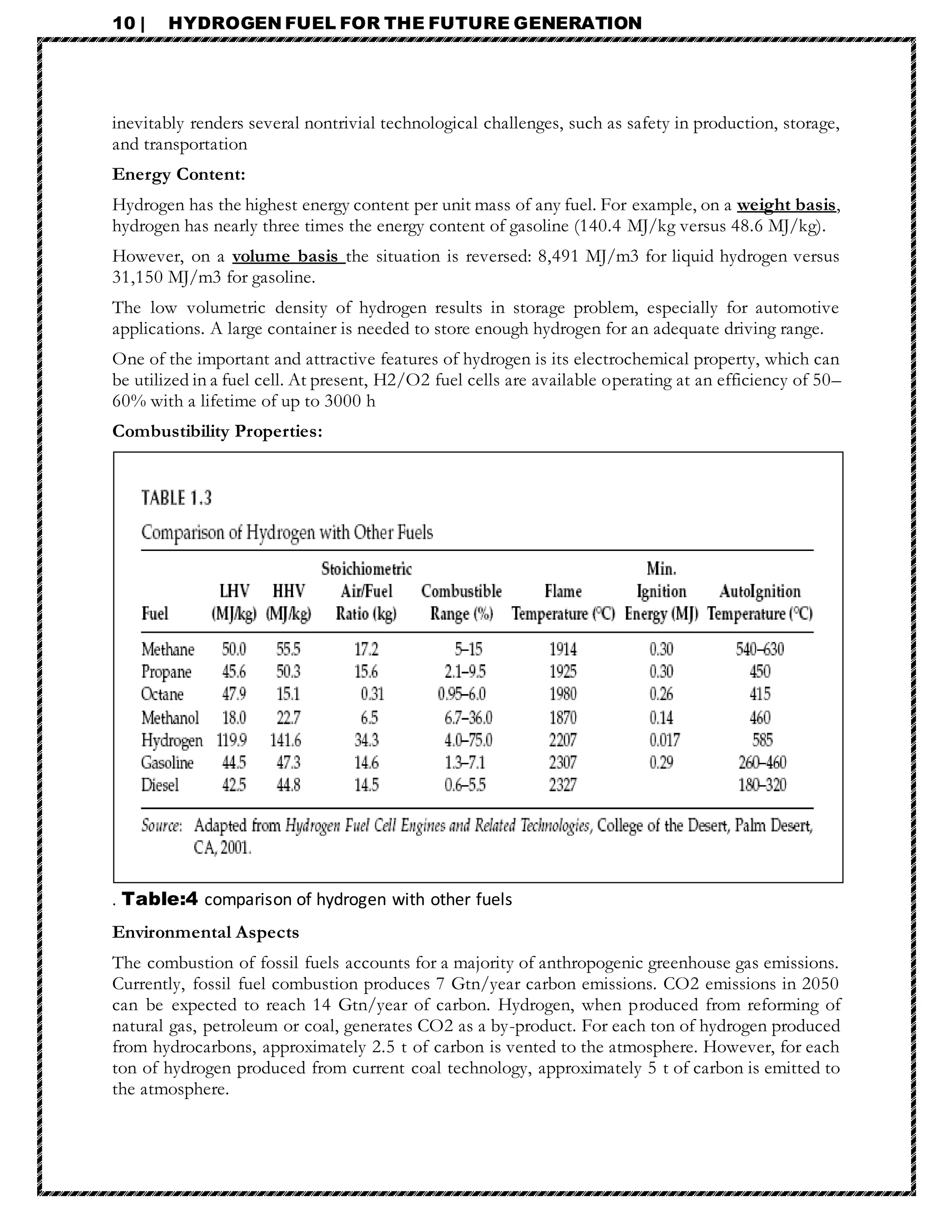
Combustibility Properties:
. Table:4 comparison of hydrogen with other fuels
Environmental Aspects
The combustion of fossil fuels accounts for a majority of anthropogenic greenhouse gas emissions.
Currently, fossil fuel combustion produces 7 Gtn/year carbon emissions. CO2 emissions in 2050
can be expected to reach 14 Gtn/year of carbon. Hydrogen, when produced from reforming of
natural gas, petroleum or coal, generates CO2 as a by-product. For each ton of hydrogen produced
from hydrocarbons, approximately 2.5 t of carbon is vented to the atmosphere. However, for each
ton of hydrogen produced from current coal technology, approximately 5 t of carbon is emitted to
the atmosphere.
11 | HYDROGEN FUEL FOR THE FUTURE GENERATION
PRODUCTION METHODS:
Because pure hydrogen does not occur naturally on Earth in large quantities, it takes a substantial
amount of energy in its industrial production. There are different ways to produce it, such as electrolysis
and steam-methane reforming process. In electrolysis, electricity is run through water to separate the
hydrogen and oxygen atoms. This method can use wind, solar, geothermal, hydro, fossil fuels,
biomass, and many other resources. Obtaining hydrogen from this process is being studied as a viable
way to produce it domestically at a low cost. Steam-methane reforming, the current leading technology for
producing hydrogen in large quantities, extracts the hydrogen from methane. However, this reaction
causes a side production of carbon dioxide and carbon monoxide, which are greenhouse gases and
contribute to global warming.
Hydrogen Production Methods:
1. Production of hydrogen from hydrocarbons
a) Steam Methane Reforming
b) Partial Oxidation of Hydrocarbons
2. Production of hydrogen by Coal Gasification
3. Hydrogen Production from Electrolysis of Water
4. Hydrogen Production from Nuclear Energy
5. Hydrogen Production from Wind Energy
6. Hydrogen Production from Biomass
7. Use of Solar Energy to Produce Hydrogen.
There are several methods for producing hydrogen. We can have a broad classification based on
whether it is from a renewable source like wind energy, solar energy or from a non renewable source
like coal, natural gas. Currently Conventional methods of producing hydrogen are the most widely
employed process for hydrogen production accounting for nearly 90% global hydrogen production.
But the problem with these methods is they liberate large quantities of CO2. Electrolysis of water
accounts for 4% of global production, the advantages of this process is it is having well established
technology & C02 free but Expensive compared to conventional process. The remaining processes
are gaining importance because of their non polluting nature but technology is still at pilot plant
scale level only and cost of production is also high as evident from the below table.
Primary Energy Source Total cost $/kg H2
Natural gas reforming 1.99
Natural gas reforming+CO2 capture 2.17
Coal Gasification 1.91
Coal Gasification+CO2 capture 1.99
Wind Electrolysis 7.60
Biomass gasification 7.04
Biomass pyrolysis 6.22
Nuclear thermal splitting of water 2.33
Gasoline (for reference) 1.12
Table: 5 Estimated cost of Hydrogen Production, Transportation and Distribution (based on year
2003)
12 | HYDROGEN FUEL FOR THE FUTURE GENERATION
HYDROGEN STORAGE:
One of the most critical factors in inducting hydrogen economy is transportation and on-vehicle
storage of hydrogen. The major contribution to the problem is from low gas density of hydrogen.
For example, to store energy equivalent to one gasoline tank, an ambient pressure hydrogen gas tank
would be more than 3000-fold the volume of the gasoline tank. Hydrogen can be stored as a gas,
liquid and metal hydrides.
1. Compressed gas storage: Hydrogen is conveniently stored for many applications in high
pressure cylinders. This method of storage is expensive and bulky because very large sized
vessels are needed for storage of small quantities of hydrogen.
2. Liquid storage: on a small scale or moderate scale, hydrogen is frequently stored under high
pressure in strong steel cylinders. But this kind of process is too costly for large storage
applications. A more practical approach is to store the hydrogen as a liquid at a low temperature
(cryogenic storage in vacuum insulated storage tank). Ex: The liquid hydrogen fuel used a rocket
propellant.
One problem with storing hydrogen as a liquid is its boiling temperature (20K) is very low, so it
has to be stored under temperatures less than 20K. The storage tank has to be insulated, to
preserve temperature, and needs to be reinforced to store the liquid hydrogen under some
pressure.
3. Storage as metal hydride: Considerable interest has been shown recently towards storing
hydrogen in the form of a metal hydride. A number of metals and alloys form solid compounds
called metal hydrides, by direct reaction with hydrogen gas. When the hydride is heated the
hydrogen will release. Ex: FeTiH1.7, LaNi5H6, Mg2NiH4. The percentage of gas absorbed to
volume of the metal is still relatively low, but hydrides offer a valuable solution to hydrogen
storage. The volume of this storage device is only two fold greater than the equivalent gasoline
tank, but unfortunately it is 20-fold heavier. The life of a metal hydride storage tank is directly
related to the purity of the hydrogen it is storing. The alloys act as a sponge, which absorbs
hydrogen, but it also absorbs any impurities introduced into the tank by the hydrogen. Thus, the
hydrogen released from the tank is highly pure, but the tank’s lifetime and ability to store
hydrogen is reduced as the impurities are deposited in the metal pores.
13 | HYDROGEN FUEL FOR THE FUTURE GENERATION
Table:6
BY USING HYDROGN AS A FUEL WE DEVELOP AN FUEL CELL:
FUEL CELLS
• A fuel cell is a device that converts the chemical energy from a fuel into electricity through a
chemical reaction with oxygen or another oxidizing agent. / A Fuel Cell is an
electrochemical devicethat combines hydrogen and oxygen to produce electricity, with water
and heat as its by-product.
• It is a clean, quiet and highly efficient process, as the conversion of the fuel to energy takes
place via an electrochemical process, not combustion.
• It is two to three times more efficient than fuel burning
The Invention of the Fuel Cell
Sir William Grove invented the first fuel cell in 1839. Grove knew that water could be split
into hydrogen and oxygen by sending an electric current through it (a process called electrolysis).
He hypothesized that by reversing the procedure you could produce electricity and water. He
created a primitive fuel cell and called it a gas voltaic battery. Fifty years later, scientists Ludwig
Mond and Charles Langer coined the term fuel cell.
Working of a Fuel Cell:
14 | HYDROGEN FUEL FOR THE FUTURE GENERATION
Figure 2
• Fuel cell works on the principle of reverse electrolysis
• It operates similarly to a battery, but it does not run down nor does it require recharging
• As long as fuel is supplied, a Fuel Cell will produce energy.
• A Fuel Cell consists of two catalyst coated electrodes surrounding an electrolyte. One
electrode is an anode and the other is a cathode. The process begins when Hydrogen
molecules enter the anode. At the anode, catalytic oxidation of hydrogen occurs.
This oxidation half reaction is written as 2H2→ 4H+
+ 4e-
-----1
The catalyst coating separates hydrogen’s negatively charged electrons from the positively
charged protons. The electrolyte allows the protons to pass through to the cathode, but not
the electrons. Instead the electrons are directed through an external circuit which creates
electrical current. While the electrons pass through the external circuit, oxygen molecules
pass through the cathode. There the oxygen and the protons combine with the electrons
after they have passed through the external circuit. When the oxygen and the protons
combine with the electrons it produces water and heat.
The reduction half reaction can be written as O2 + 4H+
+ 4e-
→ 2H2O ----2
Reaction 1 is slightly endothermic, Reaction 2 is heavily exothermic and so heat is
liberated along with water.
The two equations combined give the cell reaction as 2H2+O2 → 2H2O
The power produced by a fuel cell depends on several factors, including the fuel cell type,
size, temperature at which it operates, and pressure at which gases are supplied. A single fuel
cell produces approximately 1 volt or less — barely enough electricity for even the smallest
applications.
• To increase the amount of electricity generated, individual fuel cells are combined in
series to form a stack. (The term “fuel cell” is often used to refer to the entire stack, as
well as to the individual cell.) Depending on the application, a fuel cell stack may contain
only a few or as many as hundreds of individual cells layered together.
15 | HYDROGEN FUEL FOR THE FUTURE GENERATION
Major Types of Fuel Cells:
In general all fuel cells have the same basic configuration - an electrolyte and two electrodes.
Different types of fuel cells are classified by the kind of electrolyte used. The type of electrolyte used
determines the kind of chemical reactions that take place and the temperature range of operation.
• Proton Exchange Membrane (PEM) Fuel Cells
• Direct Methanol (a subset of PEM) Fuel Cells
• Phosphoric Acid Fuel Cells
• Molten Carbonate Fuel Cells
• Solid Oxide Fuel Cells
• Alkaline Fuel Cells
• Regenerative Fuel Cells
1. Proton Exchange Membrane (PEM) Fuel Cells:
• This is the leading cell type for passenger car application
• Uses a polymer membrane as the electrolyte.
• Operates at a relatively low temperature, about 60- 80o
C
• The low operating temperature means that it doesn't take very long for the fuel cell to warm
up and begin generating electricity
• Has a high power density, can vary its output quickly and is suited for applications where
quick startup is required making it popular for automobiles
Limitations:
• Sensitive to fuel impurities
• Performance of the PEM fuel cell is limited by the slow rate of the oxygen reduction half
reaction which is more than 100 times slower than the hydrogen oxidation half reaction.
• Platinum is expensive but is the only catalyst known so far that is capable of generating high
rates of oxygen reduction at relatively low temperatures (about 80 degrees C) at which PEM
fuel cells operate
Working of a PEMFC:
The PEM fuel cell consists of a current collector (including gas channels), gas diffusion layer, and
catalyst layer on the anode and cathode sides as well as an ion conducting polymer membrane.
Reactants enter the cell through gas channels, which are embedded in the current collectors (bipolar
plate). The gas diffusion layers (GDL) are used to uniformly distribute the reactants across the
surface of the catalyst layers (CL). Protons, produced by the oxidation of hydrogen on the anode,
are transported through ion conducting polymer within the catalyst layers and the membrane.
Electrons produced at the anode are transported through the electrically conductive portion of the
catalyst layers to the gas diffusion layers, then to the collector plates and through the load, and
finally to the cathode. Liquid water is transported through the pores in the catalyst and gas diffusion
layers through a mechanism that may be similar to capillary flow. Upon reaching the gas channels,
liquid water is transported out of the cell along with the bulk gas flow. Water may also be
16 | HYDROGEN FUEL FOR THE FUTURE GENERATION
transported, in dissolved form, through the polymer portion of the catalyst layers and through the
membrane. Heat produced in the cell is removed principally by conduction through the cell and
convection by a coolant in contact with the collector plates.
Polymer Electrolyte Membrane:
• In the Proton-Exchange Membrane Fuel Cell (or Polymer-Electrolyte Membrane Fuel Cell)
the electrolyte consists of an acidic polymeric membrane that conducts protons but repels
electrons, which have to travel through the outer circuit providing the electric work.
• The desired characteristics of PEMs are high proton conductivity, good electronic insulation,
high chemical and thermal stability, and low production cost [18].
• One type of PEMs that meets most of these requirements is Nafion.
• Nafion is the most commonly used and investigated PEM in fuel cells
• Nafion® from DuPont™, which consists of a fluoro-carbon backbone, similar to Teflon, with
attached sulfonic acid SO3
-
groups.
• The membrane is characterized by the fixed-charge concentration (the acidic groups): The
higher the concentration of fixed-charges, the higher is the protonic conductivity of the
membrane.
• For optimum fuel cell performance it is crucial to keep the membrane fully humidified at all
times, since the conductivity depends directly on water content.
• The thickness of the membrane is also important, since a thinner membrane reduces the
ohmic losses in a cell.
• However, if the membrane is too thin, hydrogen, which is much more diffusive than oxygen,
will be allowed to cross-over to the cathode side and recombine with the oxygen without
providing electrons for the external circuit.
• Typically, the thickness of a membrane is in the range of 5-300 μm
Catalyst Layer:
• The best catalyst material for both anode and cathode PEM fuel cell is platinum.
• Since the catalytic activity occurs on the surface of the platinum particles, it is desirable to
maximize the surface area of the platinum particles.
• A common procedure for surface maximization is to deposit the platinum particles on larger
carbon black particles
• The electrochemical half-cell reactions can only occur, where all the necessary reactants have
access to the catalyst surface. This means that the carbon particles have to be mixed with some
electrolyte material in order to ensure that the hydrogen protons can migrate towards the
catalyst surface. This "coating" of electrolyte must be sufficiently thin to allow the reactant
gases to dissolve and diffuse towards the catalyst surface
2. Direct Methanol (a subset of PEM) Fuel Cells:
• Methanol fuel cells are comparable to a PEMFC in regards to operating temperature, but are
not as efficient as PEMFC.
17 | HYDROGEN FUEL FOR THE FUTURE GENERATION
• Also, the DMFC requires a relatively large amount of platinum to act as a catalyst, which
makes these fuel cells expensive
• It also uses a polymer membrane as the electrolyte
• Different from PEM because the anode catalyst is able to draw hydrogen from methanol
without a reformer
• Used more for small portable power applications, possibly cell phones and laptops.
3. Phosphoric Acid Fuel Cells:
• This is the most commercially developed fuel cell
• It generates electricity at more than 40% efficiency
• Nearly 85% of the steam produced can be used for cogeneration
• Uses liquid phosphoric acid as the electrolyte and operates at about 450 degrees F
• One main advantage is that it can use impure hydrogen as fuel
• It operates at a higher temperature than polymer exchange membrane fuel cells, so it has a
longer warm-up time. This makes it unsuitable for use in cars.
• The phosphoric-acid fuel cell has potential for use in small stationary power-generation
systems.
4. Molten Carbonate Fuel Cells:
• Promises high fuel-to-electricity efficiency and the
ability to utilize coal based fuels
• Uses an electrolyte composed of a molten
carbonate salt mixtures (Li, Na, K)
• Require carbon dioxide and oxygen to be delivered
to the cathode.
• Operates at extremely high temperatures 12000
F
• They can generate steam that can be used to
generate more power
• Primarily targeted for use as electric utility
applications.
• Have been operated on hydrogen, CO, natural gas,
propane, landfill gas, marine diesel and simulated
coal gasification products
• Because of the extreme high temperatures, non- precious metals can be used as catalysts at the
anode and cathode which helps reduces cost.
• Disadvantage is durability.
Reactions at fuel electrode: H2+CO3
-
= H2O+CO2+2e-
CO+CO3
-
= 2CO2+2e-
Reactions at oxygen electrode: O2+2CO2+4e-
= 2CO3
-
5. Solid Oxide Fuel Cells:
Figure 3
18 | HYDROGEN FUEL FOR THE FUTURE GENERATION
• Uses a hard, non-porous ceramic compound as the electrolyte
• Can reach 60% power-generating efficiency
• Operates at extremely high temperatures 1800 0
F
• Used mainly for large, high powered applications such as industrial generating stations, mainly
because it requires such high temperatures.
table:7 Summary Sheet of All Types of Fuel Cells
6. Alkaline Fuel Cells:
• Used mainly by military and space programs
• Can reach 70% power generating efficiency, but considered too costly for transportation
applications
• Used on the Apollo spacecraft to provide electricity and drinking water
• Uses a solution of KOH in water as the electrolyte and operates at 75-160 0
F
19 | HYDROGEN FUEL FOR THE FUTURE GENERATION
• Can use a variety of non-precious metals as catalyst at the anode and cathode
• Requires pure hydrogen and oxygen because it is very susceptible to carbon contamination
• Purification process of the hydrogen and oxygen is costly
• Low cell lifetime which also affects the cost
7. Regenerative Fuel Cells
• Currently researched by NASA
• This type of fuel cell involves a closed loop form of power generation
• Uses solar energy to separate water into hydrogen and oxygen
• Hydrogen and oxygen are fed into the fuel cell generating electricity, heat and water
• The water byproduct is then recirculated back to the solar-powered electrolyser beginning the
process again
Table:8
Conversion Efficiency of a Fuel Cell:
The Electrical energy generated by a fuel cell depends on the free energy of the overall cell reaction.
The free energy of formation of 1 mole (18g.) of liquid water from hydrogen and oxygen at
atmospheric pressure is 56.67 kcal at 250
C.The heat energy (enthalpy) of the reaction under same
conditions is 68.26 kcal. The Theoretical efficiency of the conversion of heat energy in to electrical
energy in a hydrogen-oxygen fuel cell is (56.67/68.26)*100 = 83%.
Efficiencies as high as 70% have been observed, but the practical cells using pure hydrogen and
oxygen generally having 50-60% efficiency. The efficiency decreases when air is the source for
oxygen. The overall thermal to electrical energy conversion also decreases when hydrogen is derived
from hydrocarbons.
20 | HYDROGEN FUEL FOR THE FUTURE GENERATION
The theoretical e.m.f (voltage) of a fuel cell can be calculated from the reaction free energy. For a
hydrogen-oxygen fuel cell at 250
C with the gasses at atmospheric pressure, the ideal e.m.f is 1.23
volts. For the moderate currents at which the fuel cells operate the e.m.f is 0.7-0.8 volts.
Note: Even in an Ideal hydrogen-oxygen fuel cell, 17 % (100-83) of the chemical reaction energy
(enthalpy) would be liberated as heat.
Importance of Hydrogen
 Fuel Cells require highly purified hydrogen as a fuel
 Researchers are developing a wide range of technologies to produce hydrogen economically
from a variety of resources in environmentally friendly ways
 The biggest challenge regarding hydrogen production is the cost
 Reducing the cost of hydrogen production so as to compete in the transportation sector with
conventional fuels on a per-mile basis is a significant hurdle to Fuel Cell’s success in the
commercial marketplace
 Developing safe, reliable, compact and cost-effective hydrogen storage is one of the biggest
challenges to widespread use of fuel cell technology
 Hydrogen has physical characteristics that make it difficult to store large quantities without
taking up a great deal of space.
Applications of Fuel Cell Technology:
1. Transportation
2. Stationary Power Stations
3. Telecommunications
4. Micro Power
Transportation
a. All major automakers are working to commercialize a fuel cell car
b. Automakers and experts speculate that a fuel cell vehicle will be commercialized by 2010
c. 50 fuel cell buses are currently in use in North and South America, Europe, Asia and
Australia
d. Trains, planes, boats, scooters, forklifts and even bicycles are utilizing fuel cell technology as
well
Stationary Power Stations
a. Over 2,500 fuel cell systems have been installed all over the world in hospitals, nursing
homes, hotels, office buildings, schools and utility power plants
b. Most of these systems are either connected to the electric grid to provide supplemental power
and backup assurance or as a grid-independent generator for locations that are inaccessible by
power lines
Telecommunications
a. Due to computers, the Internet and sophisticated communication networks there is a need
for an incredibly reliable power source
b. Fuel Cells have been proven to be 99.999% reliable
Micro Power
21 | HYDROGEN FUEL FOR THE FUTURE GENERATION
• Consumer electronics could gain drastically longer battery power with Fuel Cell technology
• Cell phones can be powered for 30 days without recharging
• Laptops can be powered for 20 hours without recharging
Benefits of Fuel Cell Technology:
1. Reliability:
a) More reliable power from fuel cells would prevent loss of Business
b) Properly configured fuel cells would result in less than one minute of down time in a six year
period
2. Efficiency:
a) Because no fuel is burned to make energy, fuel cells are fundamentally more efficient than
combustion systems
b) Additionally when the heat comes off of the fuel cell system it can be captured for beneficial
purposes. This is called Cogeneration
c) The gasoline engine in a conventional car is less than 20% efficient in converting the chemical
energy in gasoline into power
d) Fuel Cell motors are much more efficient and use 40-60% of the hydrogen’s energy
e) Fuel Cell cars would lead to a 50% reduction in fuel consumption
f) Fuel Cell vehicles can be up to 3 times more efficient than internal combustion engines
g) Fuel Cell power generation systems in operation today achieve 40% to 50% fuel-to-electricity
efficiency
h) In combination with a turbine, electrical efficiencies can exceed 60%
i) When Cogeneration is used, fuel utilization can exceed 85%
3. Environmental Benefits:
a) Fuels cells can reduce air pollution today and offer the possibility of eliminating pollution in
the future
b) A fuel cell power plant may create less than one ounce of pollution per 1,000 kilowatt-hours of
electricity produced
c) Conventional combustion generating systems produce 25 pounds of pollutants for the same
electricity
d) Fuel Cell Vehicles with hydrogen stored on-board produce ZERO POLLUTION in the
conventional sense
e) The only byproducts of these Fuel Cell vehicles are water and heat
f) Fuel Cell Vehicles with a reformer on board to convert a liquid fuel to hydrogen would
produce a small amount of pollutants, but it would be 90% less than the pollutants produced
from combustion engines
g) Fuel Cell replacements would have an environmental advantage over batteries, since certain
kinds of batteries require special disposal treatment
Challenges to Fuel Cell Technology:
1. Cost:
The cost of fuel cells must be reduced to compete with conventional technologies
22 | HYDROGEN FUEL FOR THE FUTURE GENERATION
Conventional internal combustion engines cost $25-$35/kW; a fuel cell system would need to cost
$30/kW to be competitive
2. Durability and Reliability:
a. Researchers must develop PEMFC membranes that are durable and can operate at
temperatures greater than 100 degrees Celsius and still function at sub-zero ambient
temperatures.
b. A 100 degrees Celsius temperature target is required in order for a fuel cell to have a higher
tolerance to impurities in fuel. Because you start and stop a car relatively frequently, it is
important for the membrane to remain stable under cycling conditions. Currently membranes
tend to degrade while fuel cells cycle on and off, particularly as operating temperatures rise.
c. For stationary systems 40,000 hours of reliable operation in a temperature range of -35 degree
Celsius to 40 degrees Celsius will be required for market acceptance
d. Solid oxide systems have issues with material corrosion.
e. SOFC durability suffers after the cell repeatedly heats up to operating temperature and then
cools down to room temperature System Size
f. The size and weight of current fuel cell systems must be reduced to attain market acceptance,
especially with automobiles.
Storage and Other Considerations
Three hundred miles is a conventional driving range (the distance you can drive in a car with a full
tank of gas). In order to create a comparable result with a fuel cell vehicle, researchers must
overcome hydrogen storage considerations, vehicle weight and volume, cost, and safety.
Conclusion
• Most Promising technology
• Most viable for niche market use in the near future
• Widespread marketplace acceptance and use is still many years away.
HYDROGEN VEHICLE: A hydrogenvehicle isavehicle thatuseshydrogenasitson
board fuel formotive power.Hydrogenvehiclesinclude hydrogenfueledspace rockets,aswell asauto
mobilesandothertransportation vehicles.The powerplantsof suchvehiclesconvert the chemical
energyof hydrogen tomechanical energyitherbyburninghydrogeninaninternal combustion engine,
or by reactinghydrogenwithoxygeninafuel cell torunelectricmotors.Wide spreaduse of hydrogen
for fuelingtransportation isakey elementtoproposedhydrogen economy. Hydrogenfuel doesnot
occur naturally onEarth andthus isnot an energy source;ratheritis an energy carrier.Itis most
frequently made frommethane orotherfossil fuels,butitcanbe producedusingsources(suchas wind,
solar, or nuclear) thatare intermittent, howeverthe conversion losstochemical energy makesthe
approach uneco nomicalonal large-scale.Integratedwind-to-hydrogen(powertogas) plants,using
electrolysisof water,are exploring technologiestodelivercostslow enough,andquantitiesgreat
enough,tocompete with traditional energysources. There are various waystoproduce hydrogenfuel
such as: natural gas, coal,nuclearpower, andrenewableresources.By use of thermochemical
processesone canproduce hydrogenfrombiomass,coal,natural gasand petroleum.Productionof
hydrogen electrolytically canalsobe demonstrated experimentally forpowergeneratedbyuse of
23 | HYDROGEN FUEL FOR THE FUTURE GENERATION
sunlight,windandnuclearsources.
Figure 4
In additiontothis,sunlightalone candrive photolyticproductionof hydrogenfromwaterbyuse of
advanced photocatalyticwatersplittingandphotobiological processeshowevernone of these
approachescan compete with the low costand abundance of natural gas producedby the hydraulic
fracturingof shale’s. Many companiesare workingtodeveloptechnologies thatmightanciently exploit
the potential of hydrogenenergy foruse inmotorvehicles.AsofNovember2013there are
demonstrationfleetsof hydrogenfuelcell vehiclesundergoingfieldtestingincludingthe Chevrolet
Equinox Fuel Cell,HondaFCXClarity,Hyundai ix35Fuel Cell andMercedes-BenzB-ClassF-Cell. The hope
that waswidely promoted forhydrogen asanenergy currency wasthat, hydrogen pre paredwithout
usingfossil fuel inputs, vehiclepropulsion wouldnotcontribute tocarbondioxide emissions, and
howeverthishaspreventable UN economical inlightof the developmentsof fracking.The drawbacksof
hydrogenuse are highcarbon emissionsintensity whenproduced fromnatural gasof over14 kg CO2
perkg of hydrogen, capital costburden, low energy contentperunitvolume, low performanceof fuel
cell vehicles compared withgasoline vehicles, production andcompression of hydrogen, andthe large
investmentininfrastructure thatwouldbe requiredtofuel vehicles.
The Hydrogen Economy: The Hydrogen Economy isahypothetical large-scalesysteminwhich
elementalhydrogen(H2) isthe primaryformof energystorage
Fuel cellswouldbe the primarymethodof conversionof hydrogentoelectrical energy .Efficientand
clean;scalable , In particular,hydrogen(usually)playsacentral role intransportation
Components of the Hydrogen Economy:
24 | HYDROGEN FUEL FOR THE FUTURE GENERATION
Figure 5
Figure 6
25 | HYDROGEN FUEL FOR THE FUTURE GENERATION
Various Applications :
Figure 7
CONCLUSION:
Hydrogen fuel cells will dramatically change our cars, how are homes
and businesses are powered and heated, and it both positively and
negatively change places like the Middle East and third world
countries. They will also clean up the world’s air.
26 | HYDROGEN FUEL FOR THE FUTURE GENERATION
Bibliography:
[7] United States Departmentof Energy. Annual Energy Review 2007.
http://www.eia.doe.gov/emeu/aer/contents.html(October 20, 2008).
[8] Veziroglu TN, Sahin S. 21stCentury’s energy: Hydrogen energy system.
Energy Conversion and Management. 2008, 49, 1820-1831.
[9] Balat M. Potential importance of hydrogen as a future solution to
environmental and transportation problems. InternationalJournalof Hydrogen
Energy. 2008, 33, 4013- 4029.
[10] Dougherty W, Kartha S, Rajan C, Lazarus M, Bailie A, Runkle B, Fencl A.
Greenhousegas reduction benefits and costs of a large-scaletransition to
27 | HYDROGEN FUEL FOR THE FUTURE GENERATION
hydrogen in the USA. Energy Policy (2008), doi:10.1016/j.enpol.2008.06.039
5)..

hydrogen energy fuel for the future

  • 1.
    1 | HYDROGENFUEL FOR THE FUTURE GENERATION AN DOCUMENT ON FUEL FOR THE FUTURE GENARATION……..
  • 2.
    2 | HYDROGENFUEL FOR THE FUTURE GENERATION INDEX: 1. Abstract 2. Discussion 3. Introduction a) Position of hydrogen in periodic table b) Occurrence c) Isotopes 4. Properties of hydrogen 5. Production methods 6. Storage 7. Fuel cells 8. Hydrogen vehicle 9. Hydrogen economy 10. other applications 11. Conclusion
  • 3.
    3 | HYDROGENFUEL FOR THE FUTURE GENERATION ABSTRACT: Hydrogen is an energy carrier that can transform our fossil-fuel dependent economy into a hydrogen economy, which can provide an emissions-free transportation fuel. Literature reviews and independent research were the main methods of research. Hydrogen storage and transport are issues of intense research due to hydrogen’s characteristic low density. Is hydrogen a justifiable means to the attainment of an environmentally beneficial transportation fuel when methods of production are not utilizing clean, renewable energy sources? What exactly are the completely emissions-free methods of producing and utilizing hydrogen in transportation? Can hydrogen be the fuel of the future? Hydrogen is the fuel of the future. As an avid researcher of alternative fuels and an ambitious chemistry student, this researcher understands the importance of a shift to a hydrogen economy. Hydrogen is an energy carrier that can be used in internal combustion engines or fuel cells producing virtually no greenhouse gas emissions when combusted with oxygen. The only significant emission is water vapor. Hydrogen production and storage is currently undergoing extensive research. A solar-hydrogen systemcan provide the means of a totally emissions-free method of producing hydrogen. Although Steam reformation of methane is currently the major route to hydrogen production, the emissions involved can also be controlled much more efficiently than our current system of transportation fuel. Climate change is a serious issue becoming increasingly evident to much of the population. Rising CO2 levels have directly contributed to the global warming phenomenon.
  • 4.
    4 | HYDROGENFUEL FOR THE FUTURE GENERATION Discussion: Figure 1 comparison of various fuel structures An alternative fuel must be technically feasible, economically viable, easily convert to another energy form when combusted, be safe to use, and be potentially harmless to the environment. Hydrogen is the most abundant element on earth. Although hydrogen does not exist freely in nature, it can be produced from a variety of sources such as steamreformation of natural gas, gasification of coal, and electrolysis of water. Hydrogen gas can used in traditional gasoline-powered internal combustion engines (ICE) with minimal conversions. However, vehicles with polymer electrolyte membrane (PEM) fuel cells provide a greater efficiency. Hydrogen gas combusts with oxygen to produce water vapor. Even the production of hydrogen gas can be emissions-free with the use of renewable energy sources. The current price of hydrogen is about $4 per kg, which is about the equivalent of a gallon of gasoline. However, in fuel cell vehicles, such as the 2009 Honda FCX Clarity, 1 kg provides about 68 miles of travel [3]. Of course the price range is currently very high. Ongoing research and implementation toward a hydrogen economy is required to make this fuel economically feasible. The current focus is directed toward hydrogen being a clean alternative fuel that produces insignificant greenhouse gas emissions. If hydrogen is the next transportation fuel, the primary energy source used to produce the vast amounts of hydrogen will not necessarily be a renewable, clean source.
  • 5.
    5 | HYDROGENFUEL FOR THE FUTURE GENERATION Carbon sequestration is referenced frequently as a means to eliminate CO2 emissions from the burning of coal, where the gases are captured and sequestered in gas wells or depleted oil wells. However, the availability of these sites is not widespread and the presence of CO2 may acidify groundwater. Storage and transport is a major issue due to hydrogen’s low density. Is the investment in new infrastructure too costly? Can our old infrastructure currently used for natural gas transport be retrofitted for hydrogen? The burning of coal and nuclear fission are the main energy sources that will be used to provide an abundant supply of hydrogen fuel. How does this process help our current global warming predicament? The U.S. Department of Energy has recently funded a research project to produce hydrogen from coal at large-scale facilities, with carbon sequestration in mind. Is this the wrong approach? Should there be more focus on other forms of energy that produce no greenhouse gas emissions? If the damage to the environment is interpreted into a monetary cost, the promotion of energy sources such as wind and solar may prove to be a more economical approach. The possibility of a hydrogen economy that incorporates the use of hydrogen into every aspect of transportation requires much further research and development. The most economical and major source of hydrogen in the US is steamreformation of natural gas, a nonrenewable resource and a producer of greenhouse gases. The electrolysis of water is a potentially sustainable method of producing hydrogen, but only if renewable energy sources are used for the electricity. Today, less than 5% of our electricity comes from renewable sources such as solar, wind, and hydro. Nuclear power may be considered as a renewable resource to some, but the waste generated by this energy source becomes a major problem. A rapid shift toward renewable energy sources is required before this proposed hydrogen economy can prove itself. Solar photovoltaic (PV) systems are the current focus of my research related to the energy source required for electrolysis of water. One project conducted at the GM Proving Ground in Milford, MI employed the use of 40 solar PV modules directly connected to an electrolyzer/storage/dispenser system. The result was an 8.5% efficiency in the production of hydrogen, with an average production of 0.5 kg of high-pressure hydrogen per day. Research similar to this may result in the optimization of the solar- hydrogen energy system. Furthermore, the infrastructure for a hydrogen economy will come with high capital costs. The transport of hydrogen through underground pipes seems to be the most economical when demand grows enough to require a large centralized facility. However, in places of low population density, this method may not be economically feasible. The project mentioned
  • 6.
    6 | HYDROGENFUEL FOR THE FUTURE GENERATION earlier may become an option for individuals to produce their own hydrogen gas at home, with solar panels lining their roof. A drastic change is needed to slow down the effects of our fossil- fuel dependent society. Conservation can indeed help, but the lifestyles we are accustomed to require certain energy demands. Transportation is a necessary part of our current world and the switch to a hydrogen economy can provide a sustainable solution. Is hydrogen the fuel of the future? The research presented here encourages one to answer yes. INTRODUCTION: now letwe know about Hydrogen POSITION OF HYYDROGE IN PERIODIC TABLE: Hydrogenisthe firstelementinthe periodictable .itcontainsonlyone electronic configurationissimilar to the outerelectronicconfigurationof alkali metals(ns1 ) ,whichbelongstothe firstgroupof the periodictable .likehalogens((ns2 np5 ) ,itisshortbyone electrontothe correspondingnoblegas configuration(1s2 ) ,whichbelongstothe seventhgroupof the periodictable . Hydrogentherefore,hasresemblestoalkali metals,whichloseone electrontoformunipositive,as well aswithhalogens,whichgainone electrontoformuninegative ion . Like alkali metals,hydrogenformsoxides,halidesandsulfides.however,unlike alkali metalsithasvery highionizationenthalpyanddoesnotpossesmetalliccharacteristicsundernormal conditions.interms of ionizationenthalpy,hydrogenresemblesmore withhalogens. Like halogensitforms a diatomicmolecule ,combineswithelements toformhydridesandalarge numberof covalentcompounds.however,intermreactivity,itisverylow reactive ascomparedto halogens. Hydrogenresemblescertainextentbothwithalkalimetalsandhalogensitdiffersfromthemaswell .hence hydrogencouldnotbe placedeitherwithalkali metalsorwithhalogens.thusuniquebehavior and is ,therefore,bestplacedseparatelyinthe periodictable . Occurrence: Hydrogenisthe most abundant (92%) elementinthe universe andisprincipleelementinthe universe and isthe principle elementin the solaratmosphere .the giantplanetsJupiterandSaturnconsists mostlyof hydrogen.it occurs 15.4% inthe earth crust inthe combinedform.quantitativelyitisthe ninthelementinorderof abundance inthe earthcrust inthe combinedformbesideswater,itoccurin plantand animal tissues,coal ,petroleum,clay,carbohydrates,proteinsetc. ISOTOPESOF HYDROGEN: Atomsof the same elementhaving same atomicnumberbutdifferentmassnumbersare called isotopes.isotopeshavingsame numberof protonsandelectronsbutdifferentnumberof neutrons.
  • 7.
    7 | HYDROGENFUEL FOR THE FUTURE GENERATION Hydrogenhasthree isotopes I. Protium or normal hydrogen(1H1 ) II. Deuteriumorheavyhydrogen(1H2 or1D2 ) III. Tritium(1H3 or1D3 ) Protium (1H1 ):itis the mostcommonlyoccurringisotope of hydrogen.itdoesnotcontainaneutron itsatomic massis 1.08 amu .a sample of natural hydrogencontains99.984% of the isotope Deuterium (1H2 or1D2 ): itcontains one neutron.itatomicmass is2.014 amu .a sample of natural hydrogencontains0.0156% of thisisotope Tritium(1H3 ):itcontainstwoneutrons.itsatomicmassis3.016 amu .tritiumoccurs to the extentof 1 part of tritiumin10000000 parts of ordinarily available hydrogen.Tritiumisradioactive isotopeof hydrogen.itemits particle 1H3→ 2He3 +-1e0 The isotopesof the elementhave the same electronicconfigurationandhence possessthe same chemical properties.the onlydifference isintheir ratesof reaction,mainlydue totheirdifferent enthalpyof bonddissociation.however,inphysical propertiesthisisotopesdifferconsiderablydue to theirlarge massdifference Some important physical properties of protium , deuterium and tritium Property Protium Deuterium Tritium Relative abundance(%) 99.984 0.0156 10-15 Relative atomic mass(amu) 1.008 2.014 3.016 Melting Point(K) 13.96 18.73 20.62 Boiling Point(K) 20.39 23.67 25.0 Density(gm/lit) 0.09 0.18 0.27 Enthalpy of fusion(kJ/mole) 0.117 0.197 0.250 Enthalpy of vaporization(kJ/mole) 0.904 1.226 1.393 Enthalpy of bond dissociation (kJ/mole) 435.88 443.4 446.9 Inter nuclear 74.14 74.14 74.14
  • 8.
    8 | HYDROGENFUEL FOR THE FUTURE GENERATION distance(pm) Table 1: Properties of pure Hydrogen : table:2 propertiesof hydrogen Molar mass Acentric factor Critical temperature Tc /k Critical pressure Pc/bar Critical compressibility factor Zc Critical molar volume Vc (cm3/mol) N.B.P. Tn/k 2.016 -0.216 33.19 13.13 0.305 64.1 20.4 tabe:3 critical properties HYDROGEN AS A FUEL: The key criteria for an IDEAL FUEL are inexhaustibility, cleanliness, convenience, and independence from foreign control. Hydrogen as a fuel satisfies all the above requirements. It offers the highest potential benefits in terms of diversified supply and reduced emissions of pollutants and greenhouse gases. For the past 40 years, environmentalists and several industrial organizations have promoted hydrogen fuel as the solution to the problems of air pollution and global warming.
  • 9.
    9 | HYDROGENFUEL FOR THE FUTURE GENERATION Similar to electricity, hydrogen is a high-quality energy carrier, which can be used with a high efficiency and zero or near-zero emissions at the point of use. The Hydrogen production is increasing by about 10% every year. As of 2005, the economic value of all hydrogen produced worldwide was about $135 billion per year. The current global hydrogen production is 48% from natural gas, 30% from petroleum, 18% from coal, and 4% from electrolysis. Hydrogen is primarily consumed in two nonfuel uses: (1) About 60% to produce NH3 by the Haber process for subsequent use in fertilizer manufacturing. (2) About 40%in refinery, chemicals, and petrochemical sectors Physical Properties: Hydrogen atom is the lightest element (Ordinary hydrogen has a density of 0.09 kg/m3.), consisting of only one proton and one electron. Hydrogen atoms readily form H2 molecules, which are smaller in size when compared to most other molecules. Hydrogen is colorless, odorless, and tasteless and is about 14 times lighter than air, and diffuses faster than any other gas. On cooling, hydrogen condenses to liquid at −253°C and to solid at −259°C. Also, the gaseous hydrogen has one of the highest heat capacity (14.4 kJ/kg K). Chemical Properties: At ordinary temperatures, H2 is comparatively nonreactive unless it has been activated in some manner. On the contrary, hydrogen atom is chemically very reactive, and that is why it is not found chemically free in nature. In fact, very high temperatures are needed to dissociate molecular hydrogen into atomic hydrogen. For example, even at 5000 K, about 5% of the hydrogen remains undissociated. In nature, mostly the hydrogen is bound to either oxygen or carbon atoms. Therefore, hydrogen must be considered as an energy carrier—a means to store and transmit energy derived from a primary energy source. From the safety point of view, the following are the most important properties of hydrogen when compared to other conventional fuels: Diffusion: Hydrogen diffuses through air much more rapidly than other gaseous fuels. With a diffusion coefficient in air of .61 cm2/s, the rapid dispersion rate of hydrogen is its greatest safety asset. Flammability: Flammability of hydrogen is a function of concentration level and is much greater than that of methane or other fuels. The limit of flammability of hydrogen in air at ambient condition is 4–75%, methane in air is 4.3–15 vol%, and gasoline in air is 1.4–7.6 vol%. Fuel Properties: Hydrogen is highly flammable over a wide range of temperature and concentration. Although its combustion efficiency is truly outstanding and welcomed as a fuel of the choice for the future, it
  • 10.
    10 | HYDROGENFUEL FOR THE FUTURE GENERATION inevitably renders several nontrivial technological challenges, such as safety in production, storage, and transportation Energy Content: Hydrogen has the highest energy content per unit mass of any fuel. For example, on a weight basis, hydrogen has nearly three times the energy content of gasoline (140.4 MJ/kg versus 48.6 MJ/kg). However, on a volume basis the situation is reversed: 8,491 MJ/m3 for liquid hydrogen versus 31,150 MJ/m3 for gasoline. The low volumetric density of hydrogen results in storage problem, especially for automotive applications. A large container is needed to store enough hydrogen for an adequate driving range. One of the important and attractive features of hydrogen is its electrochemical property, which can be utilized in a fuel cell. At present, H2/O2 fuel cells are available operating at an efficiency of 50– 60% with a lifetime of up to 3000 h Combustibility Properties: . Table:4 comparison of hydrogen with other fuels Environmental Aspects The combustion of fossil fuels accounts for a majority of anthropogenic greenhouse gas emissions. Currently, fossil fuel combustion produces 7 Gtn/year carbon emissions. CO2 emissions in 2050 can be expected to reach 14 Gtn/year of carbon. Hydrogen, when produced from reforming of natural gas, petroleum or coal, generates CO2 as a by-product. For each ton of hydrogen produced from hydrocarbons, approximately 2.5 t of carbon is vented to the atmosphere. However, for each ton of hydrogen produced from current coal technology, approximately 5 t of carbon is emitted to the atmosphere.
  • 11.
    11 | HYDROGENFUEL FOR THE FUTURE GENERATION PRODUCTION METHODS: Because pure hydrogen does not occur naturally on Earth in large quantities, it takes a substantial amount of energy in its industrial production. There are different ways to produce it, such as electrolysis and steam-methane reforming process. In electrolysis, electricity is run through water to separate the hydrogen and oxygen atoms. This method can use wind, solar, geothermal, hydro, fossil fuels, biomass, and many other resources. Obtaining hydrogen from this process is being studied as a viable way to produce it domestically at a low cost. Steam-methane reforming, the current leading technology for producing hydrogen in large quantities, extracts the hydrogen from methane. However, this reaction causes a side production of carbon dioxide and carbon monoxide, which are greenhouse gases and contribute to global warming. Hydrogen Production Methods: 1. Production of hydrogen from hydrocarbons a) Steam Methane Reforming b) Partial Oxidation of Hydrocarbons 2. Production of hydrogen by Coal Gasification 3. Hydrogen Production from Electrolysis of Water 4. Hydrogen Production from Nuclear Energy 5. Hydrogen Production from Wind Energy 6. Hydrogen Production from Biomass 7. Use of Solar Energy to Produce Hydrogen. There are several methods for producing hydrogen. We can have a broad classification based on whether it is from a renewable source like wind energy, solar energy or from a non renewable source like coal, natural gas. Currently Conventional methods of producing hydrogen are the most widely employed process for hydrogen production accounting for nearly 90% global hydrogen production. But the problem with these methods is they liberate large quantities of CO2. Electrolysis of water accounts for 4% of global production, the advantages of this process is it is having well established technology & C02 free but Expensive compared to conventional process. The remaining processes are gaining importance because of their non polluting nature but technology is still at pilot plant scale level only and cost of production is also high as evident from the below table. Primary Energy Source Total cost $/kg H2 Natural gas reforming 1.99 Natural gas reforming+CO2 capture 2.17 Coal Gasification 1.91 Coal Gasification+CO2 capture 1.99 Wind Electrolysis 7.60 Biomass gasification 7.04 Biomass pyrolysis 6.22 Nuclear thermal splitting of water 2.33 Gasoline (for reference) 1.12 Table: 5 Estimated cost of Hydrogen Production, Transportation and Distribution (based on year 2003)
  • 12.
    12 | HYDROGENFUEL FOR THE FUTURE GENERATION HYDROGEN STORAGE: One of the most critical factors in inducting hydrogen economy is transportation and on-vehicle storage of hydrogen. The major contribution to the problem is from low gas density of hydrogen. For example, to store energy equivalent to one gasoline tank, an ambient pressure hydrogen gas tank would be more than 3000-fold the volume of the gasoline tank. Hydrogen can be stored as a gas, liquid and metal hydrides. 1. Compressed gas storage: Hydrogen is conveniently stored for many applications in high pressure cylinders. This method of storage is expensive and bulky because very large sized vessels are needed for storage of small quantities of hydrogen. 2. Liquid storage: on a small scale or moderate scale, hydrogen is frequently stored under high pressure in strong steel cylinders. But this kind of process is too costly for large storage applications. A more practical approach is to store the hydrogen as a liquid at a low temperature (cryogenic storage in vacuum insulated storage tank). Ex: The liquid hydrogen fuel used a rocket propellant. One problem with storing hydrogen as a liquid is its boiling temperature (20K) is very low, so it has to be stored under temperatures less than 20K. The storage tank has to be insulated, to preserve temperature, and needs to be reinforced to store the liquid hydrogen under some pressure. 3. Storage as metal hydride: Considerable interest has been shown recently towards storing hydrogen in the form of a metal hydride. A number of metals and alloys form solid compounds called metal hydrides, by direct reaction with hydrogen gas. When the hydride is heated the hydrogen will release. Ex: FeTiH1.7, LaNi5H6, Mg2NiH4. The percentage of gas absorbed to volume of the metal is still relatively low, but hydrides offer a valuable solution to hydrogen storage. The volume of this storage device is only two fold greater than the equivalent gasoline tank, but unfortunately it is 20-fold heavier. The life of a metal hydride storage tank is directly related to the purity of the hydrogen it is storing. The alloys act as a sponge, which absorbs hydrogen, but it also absorbs any impurities introduced into the tank by the hydrogen. Thus, the hydrogen released from the tank is highly pure, but the tank’s lifetime and ability to store hydrogen is reduced as the impurities are deposited in the metal pores.
  • 13.
    13 | HYDROGENFUEL FOR THE FUTURE GENERATION Table:6 BY USING HYDROGN AS A FUEL WE DEVELOP AN FUEL CELL: FUEL CELLS • A fuel cell is a device that converts the chemical energy from a fuel into electricity through a chemical reaction with oxygen or another oxidizing agent. / A Fuel Cell is an electrochemical devicethat combines hydrogen and oxygen to produce electricity, with water and heat as its by-product. • It is a clean, quiet and highly efficient process, as the conversion of the fuel to energy takes place via an electrochemical process, not combustion. • It is two to three times more efficient than fuel burning The Invention of the Fuel Cell Sir William Grove invented the first fuel cell in 1839. Grove knew that water could be split into hydrogen and oxygen by sending an electric current through it (a process called electrolysis). He hypothesized that by reversing the procedure you could produce electricity and water. He created a primitive fuel cell and called it a gas voltaic battery. Fifty years later, scientists Ludwig Mond and Charles Langer coined the term fuel cell. Working of a Fuel Cell:
  • 14.
    14 | HYDROGENFUEL FOR THE FUTURE GENERATION Figure 2 • Fuel cell works on the principle of reverse electrolysis • It operates similarly to a battery, but it does not run down nor does it require recharging • As long as fuel is supplied, a Fuel Cell will produce energy. • A Fuel Cell consists of two catalyst coated electrodes surrounding an electrolyte. One electrode is an anode and the other is a cathode. The process begins when Hydrogen molecules enter the anode. At the anode, catalytic oxidation of hydrogen occurs. This oxidation half reaction is written as 2H2→ 4H+ + 4e- -----1 The catalyst coating separates hydrogen’s negatively charged electrons from the positively charged protons. The electrolyte allows the protons to pass through to the cathode, but not the electrons. Instead the electrons are directed through an external circuit which creates electrical current. While the electrons pass through the external circuit, oxygen molecules pass through the cathode. There the oxygen and the protons combine with the electrons after they have passed through the external circuit. When the oxygen and the protons combine with the electrons it produces water and heat. The reduction half reaction can be written as O2 + 4H+ + 4e- → 2H2O ----2 Reaction 1 is slightly endothermic, Reaction 2 is heavily exothermic and so heat is liberated along with water. The two equations combined give the cell reaction as 2H2+O2 → 2H2O The power produced by a fuel cell depends on several factors, including the fuel cell type, size, temperature at which it operates, and pressure at which gases are supplied. A single fuel cell produces approximately 1 volt or less — barely enough electricity for even the smallest applications. • To increase the amount of electricity generated, individual fuel cells are combined in series to form a stack. (The term “fuel cell” is often used to refer to the entire stack, as well as to the individual cell.) Depending on the application, a fuel cell stack may contain only a few or as many as hundreds of individual cells layered together.
  • 15.
    15 | HYDROGENFUEL FOR THE FUTURE GENERATION Major Types of Fuel Cells: In general all fuel cells have the same basic configuration - an electrolyte and two electrodes. Different types of fuel cells are classified by the kind of electrolyte used. The type of electrolyte used determines the kind of chemical reactions that take place and the temperature range of operation. • Proton Exchange Membrane (PEM) Fuel Cells • Direct Methanol (a subset of PEM) Fuel Cells • Phosphoric Acid Fuel Cells • Molten Carbonate Fuel Cells • Solid Oxide Fuel Cells • Alkaline Fuel Cells • Regenerative Fuel Cells 1. Proton Exchange Membrane (PEM) Fuel Cells: • This is the leading cell type for passenger car application • Uses a polymer membrane as the electrolyte. • Operates at a relatively low temperature, about 60- 80o C • The low operating temperature means that it doesn't take very long for the fuel cell to warm up and begin generating electricity • Has a high power density, can vary its output quickly and is suited for applications where quick startup is required making it popular for automobiles Limitations: • Sensitive to fuel impurities • Performance of the PEM fuel cell is limited by the slow rate of the oxygen reduction half reaction which is more than 100 times slower than the hydrogen oxidation half reaction. • Platinum is expensive but is the only catalyst known so far that is capable of generating high rates of oxygen reduction at relatively low temperatures (about 80 degrees C) at which PEM fuel cells operate Working of a PEMFC: The PEM fuel cell consists of a current collector (including gas channels), gas diffusion layer, and catalyst layer on the anode and cathode sides as well as an ion conducting polymer membrane. Reactants enter the cell through gas channels, which are embedded in the current collectors (bipolar plate). The gas diffusion layers (GDL) are used to uniformly distribute the reactants across the surface of the catalyst layers (CL). Protons, produced by the oxidation of hydrogen on the anode, are transported through ion conducting polymer within the catalyst layers and the membrane. Electrons produced at the anode are transported through the electrically conductive portion of the catalyst layers to the gas diffusion layers, then to the collector plates and through the load, and finally to the cathode. Liquid water is transported through the pores in the catalyst and gas diffusion layers through a mechanism that may be similar to capillary flow. Upon reaching the gas channels, liquid water is transported out of the cell along with the bulk gas flow. Water may also be
  • 16.
    16 | HYDROGENFUEL FOR THE FUTURE GENERATION transported, in dissolved form, through the polymer portion of the catalyst layers and through the membrane. Heat produced in the cell is removed principally by conduction through the cell and convection by a coolant in contact with the collector plates. Polymer Electrolyte Membrane: • In the Proton-Exchange Membrane Fuel Cell (or Polymer-Electrolyte Membrane Fuel Cell) the electrolyte consists of an acidic polymeric membrane that conducts protons but repels electrons, which have to travel through the outer circuit providing the electric work. • The desired characteristics of PEMs are high proton conductivity, good electronic insulation, high chemical and thermal stability, and low production cost [18]. • One type of PEMs that meets most of these requirements is Nafion. • Nafion is the most commonly used and investigated PEM in fuel cells • Nafion® from DuPont™, which consists of a fluoro-carbon backbone, similar to Teflon, with attached sulfonic acid SO3 - groups. • The membrane is characterized by the fixed-charge concentration (the acidic groups): The higher the concentration of fixed-charges, the higher is the protonic conductivity of the membrane. • For optimum fuel cell performance it is crucial to keep the membrane fully humidified at all times, since the conductivity depends directly on water content. • The thickness of the membrane is also important, since a thinner membrane reduces the ohmic losses in a cell. • However, if the membrane is too thin, hydrogen, which is much more diffusive than oxygen, will be allowed to cross-over to the cathode side and recombine with the oxygen without providing electrons for the external circuit. • Typically, the thickness of a membrane is in the range of 5-300 μm Catalyst Layer: • The best catalyst material for both anode and cathode PEM fuel cell is platinum. • Since the catalytic activity occurs on the surface of the platinum particles, it is desirable to maximize the surface area of the platinum particles. • A common procedure for surface maximization is to deposit the platinum particles on larger carbon black particles • The electrochemical half-cell reactions can only occur, where all the necessary reactants have access to the catalyst surface. This means that the carbon particles have to be mixed with some electrolyte material in order to ensure that the hydrogen protons can migrate towards the catalyst surface. This "coating" of electrolyte must be sufficiently thin to allow the reactant gases to dissolve and diffuse towards the catalyst surface 2. Direct Methanol (a subset of PEM) Fuel Cells: • Methanol fuel cells are comparable to a PEMFC in regards to operating temperature, but are not as efficient as PEMFC.
  • 17.
    17 | HYDROGENFUEL FOR THE FUTURE GENERATION • Also, the DMFC requires a relatively large amount of platinum to act as a catalyst, which makes these fuel cells expensive • It also uses a polymer membrane as the electrolyte • Different from PEM because the anode catalyst is able to draw hydrogen from methanol without a reformer • Used more for small portable power applications, possibly cell phones and laptops. 3. Phosphoric Acid Fuel Cells: • This is the most commercially developed fuel cell • It generates electricity at more than 40% efficiency • Nearly 85% of the steam produced can be used for cogeneration • Uses liquid phosphoric acid as the electrolyte and operates at about 450 degrees F • One main advantage is that it can use impure hydrogen as fuel • It operates at a higher temperature than polymer exchange membrane fuel cells, so it has a longer warm-up time. This makes it unsuitable for use in cars. • The phosphoric-acid fuel cell has potential for use in small stationary power-generation systems. 4. Molten Carbonate Fuel Cells: • Promises high fuel-to-electricity efficiency and the ability to utilize coal based fuels • Uses an electrolyte composed of a molten carbonate salt mixtures (Li, Na, K) • Require carbon dioxide and oxygen to be delivered to the cathode. • Operates at extremely high temperatures 12000 F • They can generate steam that can be used to generate more power • Primarily targeted for use as electric utility applications. • Have been operated on hydrogen, CO, natural gas, propane, landfill gas, marine diesel and simulated coal gasification products • Because of the extreme high temperatures, non- precious metals can be used as catalysts at the anode and cathode which helps reduces cost. • Disadvantage is durability. Reactions at fuel electrode: H2+CO3 - = H2O+CO2+2e- CO+CO3 - = 2CO2+2e- Reactions at oxygen electrode: O2+2CO2+4e- = 2CO3 - 5. Solid Oxide Fuel Cells: Figure 3
  • 18.
    18 | HYDROGENFUEL FOR THE FUTURE GENERATION • Uses a hard, non-porous ceramic compound as the electrolyte • Can reach 60% power-generating efficiency • Operates at extremely high temperatures 1800 0 F • Used mainly for large, high powered applications such as industrial generating stations, mainly because it requires such high temperatures. table:7 Summary Sheet of All Types of Fuel Cells 6. Alkaline Fuel Cells: • Used mainly by military and space programs • Can reach 70% power generating efficiency, but considered too costly for transportation applications • Used on the Apollo spacecraft to provide electricity and drinking water • Uses a solution of KOH in water as the electrolyte and operates at 75-160 0 F
  • 19.
    19 | HYDROGENFUEL FOR THE FUTURE GENERATION • Can use a variety of non-precious metals as catalyst at the anode and cathode • Requires pure hydrogen and oxygen because it is very susceptible to carbon contamination • Purification process of the hydrogen and oxygen is costly • Low cell lifetime which also affects the cost 7. Regenerative Fuel Cells • Currently researched by NASA • This type of fuel cell involves a closed loop form of power generation • Uses solar energy to separate water into hydrogen and oxygen • Hydrogen and oxygen are fed into the fuel cell generating electricity, heat and water • The water byproduct is then recirculated back to the solar-powered electrolyser beginning the process again Table:8 Conversion Efficiency of a Fuel Cell: The Electrical energy generated by a fuel cell depends on the free energy of the overall cell reaction. The free energy of formation of 1 mole (18g.) of liquid water from hydrogen and oxygen at atmospheric pressure is 56.67 kcal at 250 C.The heat energy (enthalpy) of the reaction under same conditions is 68.26 kcal. The Theoretical efficiency of the conversion of heat energy in to electrical energy in a hydrogen-oxygen fuel cell is (56.67/68.26)*100 = 83%. Efficiencies as high as 70% have been observed, but the practical cells using pure hydrogen and oxygen generally having 50-60% efficiency. The efficiency decreases when air is the source for oxygen. The overall thermal to electrical energy conversion also decreases when hydrogen is derived from hydrocarbons.
  • 20.
    20 | HYDROGENFUEL FOR THE FUTURE GENERATION The theoretical e.m.f (voltage) of a fuel cell can be calculated from the reaction free energy. For a hydrogen-oxygen fuel cell at 250 C with the gasses at atmospheric pressure, the ideal e.m.f is 1.23 volts. For the moderate currents at which the fuel cells operate the e.m.f is 0.7-0.8 volts. Note: Even in an Ideal hydrogen-oxygen fuel cell, 17 % (100-83) of the chemical reaction energy (enthalpy) would be liberated as heat. Importance of Hydrogen  Fuel Cells require highly purified hydrogen as a fuel  Researchers are developing a wide range of technologies to produce hydrogen economically from a variety of resources in environmentally friendly ways  The biggest challenge regarding hydrogen production is the cost  Reducing the cost of hydrogen production so as to compete in the transportation sector with conventional fuels on a per-mile basis is a significant hurdle to Fuel Cell’s success in the commercial marketplace  Developing safe, reliable, compact and cost-effective hydrogen storage is one of the biggest challenges to widespread use of fuel cell technology  Hydrogen has physical characteristics that make it difficult to store large quantities without taking up a great deal of space. Applications of Fuel Cell Technology: 1. Transportation 2. Stationary Power Stations 3. Telecommunications 4. Micro Power Transportation a. All major automakers are working to commercialize a fuel cell car b. Automakers and experts speculate that a fuel cell vehicle will be commercialized by 2010 c. 50 fuel cell buses are currently in use in North and South America, Europe, Asia and Australia d. Trains, planes, boats, scooters, forklifts and even bicycles are utilizing fuel cell technology as well Stationary Power Stations a. Over 2,500 fuel cell systems have been installed all over the world in hospitals, nursing homes, hotels, office buildings, schools and utility power plants b. Most of these systems are either connected to the electric grid to provide supplemental power and backup assurance or as a grid-independent generator for locations that are inaccessible by power lines Telecommunications a. Due to computers, the Internet and sophisticated communication networks there is a need for an incredibly reliable power source b. Fuel Cells have been proven to be 99.999% reliable Micro Power
  • 21.
    21 | HYDROGENFUEL FOR THE FUTURE GENERATION • Consumer electronics could gain drastically longer battery power with Fuel Cell technology • Cell phones can be powered for 30 days without recharging • Laptops can be powered for 20 hours without recharging Benefits of Fuel Cell Technology: 1. Reliability: a) More reliable power from fuel cells would prevent loss of Business b) Properly configured fuel cells would result in less than one minute of down time in a six year period 2. Efficiency: a) Because no fuel is burned to make energy, fuel cells are fundamentally more efficient than combustion systems b) Additionally when the heat comes off of the fuel cell system it can be captured for beneficial purposes. This is called Cogeneration c) The gasoline engine in a conventional car is less than 20% efficient in converting the chemical energy in gasoline into power d) Fuel Cell motors are much more efficient and use 40-60% of the hydrogen’s energy e) Fuel Cell cars would lead to a 50% reduction in fuel consumption f) Fuel Cell vehicles can be up to 3 times more efficient than internal combustion engines g) Fuel Cell power generation systems in operation today achieve 40% to 50% fuel-to-electricity efficiency h) In combination with a turbine, electrical efficiencies can exceed 60% i) When Cogeneration is used, fuel utilization can exceed 85% 3. Environmental Benefits: a) Fuels cells can reduce air pollution today and offer the possibility of eliminating pollution in the future b) A fuel cell power plant may create less than one ounce of pollution per 1,000 kilowatt-hours of electricity produced c) Conventional combustion generating systems produce 25 pounds of pollutants for the same electricity d) Fuel Cell Vehicles with hydrogen stored on-board produce ZERO POLLUTION in the conventional sense e) The only byproducts of these Fuel Cell vehicles are water and heat f) Fuel Cell Vehicles with a reformer on board to convert a liquid fuel to hydrogen would produce a small amount of pollutants, but it would be 90% less than the pollutants produced from combustion engines g) Fuel Cell replacements would have an environmental advantage over batteries, since certain kinds of batteries require special disposal treatment Challenges to Fuel Cell Technology: 1. Cost: The cost of fuel cells must be reduced to compete with conventional technologies
  • 22.
    22 | HYDROGENFUEL FOR THE FUTURE GENERATION Conventional internal combustion engines cost $25-$35/kW; a fuel cell system would need to cost $30/kW to be competitive 2. Durability and Reliability: a. Researchers must develop PEMFC membranes that are durable and can operate at temperatures greater than 100 degrees Celsius and still function at sub-zero ambient temperatures. b. A 100 degrees Celsius temperature target is required in order for a fuel cell to have a higher tolerance to impurities in fuel. Because you start and stop a car relatively frequently, it is important for the membrane to remain stable under cycling conditions. Currently membranes tend to degrade while fuel cells cycle on and off, particularly as operating temperatures rise. c. For stationary systems 40,000 hours of reliable operation in a temperature range of -35 degree Celsius to 40 degrees Celsius will be required for market acceptance d. Solid oxide systems have issues with material corrosion. e. SOFC durability suffers after the cell repeatedly heats up to operating temperature and then cools down to room temperature System Size f. The size and weight of current fuel cell systems must be reduced to attain market acceptance, especially with automobiles. Storage and Other Considerations Three hundred miles is a conventional driving range (the distance you can drive in a car with a full tank of gas). In order to create a comparable result with a fuel cell vehicle, researchers must overcome hydrogen storage considerations, vehicle weight and volume, cost, and safety. Conclusion • Most Promising technology • Most viable for niche market use in the near future • Widespread marketplace acceptance and use is still many years away. HYDROGEN VEHICLE: A hydrogenvehicle isavehicle thatuseshydrogenasitson board fuel formotive power.Hydrogenvehiclesinclude hydrogenfueledspace rockets,aswell asauto mobilesandothertransportation vehicles.The powerplantsof suchvehiclesconvert the chemical energyof hydrogen tomechanical energyitherbyburninghydrogeninaninternal combustion engine, or by reactinghydrogenwithoxygeninafuel cell torunelectricmotors.Wide spreaduse of hydrogen for fuelingtransportation isakey elementtoproposedhydrogen economy. Hydrogenfuel doesnot occur naturally onEarth andthus isnot an energy source;ratheritis an energy carrier.Itis most frequently made frommethane orotherfossil fuels,butitcanbe producedusingsources(suchas wind, solar, or nuclear) thatare intermittent, howeverthe conversion losstochemical energy makesthe approach uneco nomicalonal large-scale.Integratedwind-to-hydrogen(powertogas) plants,using electrolysisof water,are exploring technologiestodelivercostslow enough,andquantitiesgreat enough,tocompete with traditional energysources. There are various waystoproduce hydrogenfuel such as: natural gas, coal,nuclearpower, andrenewableresources.By use of thermochemical processesone canproduce hydrogenfrombiomass,coal,natural gasand petroleum.Productionof hydrogen electrolytically canalsobe demonstrated experimentally forpowergeneratedbyuse of
  • 23.
    23 | HYDROGENFUEL FOR THE FUTURE GENERATION sunlight,windandnuclearsources. Figure 4 In additiontothis,sunlightalone candrive photolyticproductionof hydrogenfromwaterbyuse of advanced photocatalyticwatersplittingandphotobiological processeshowevernone of these approachescan compete with the low costand abundance of natural gas producedby the hydraulic fracturingof shale’s. Many companiesare workingtodeveloptechnologies thatmightanciently exploit the potential of hydrogenenergy foruse inmotorvehicles.AsofNovember2013there are demonstrationfleetsof hydrogenfuelcell vehiclesundergoingfieldtestingincludingthe Chevrolet Equinox Fuel Cell,HondaFCXClarity,Hyundai ix35Fuel Cell andMercedes-BenzB-ClassF-Cell. The hope that waswidely promoted forhydrogen asanenergy currency wasthat, hydrogen pre paredwithout usingfossil fuel inputs, vehiclepropulsion wouldnotcontribute tocarbondioxide emissions, and howeverthishaspreventable UN economical inlightof the developmentsof fracking.The drawbacksof hydrogenuse are highcarbon emissionsintensity whenproduced fromnatural gasof over14 kg CO2 perkg of hydrogen, capital costburden, low energy contentperunitvolume, low performanceof fuel cell vehicles compared withgasoline vehicles, production andcompression of hydrogen, andthe large investmentininfrastructure thatwouldbe requiredtofuel vehicles. The Hydrogen Economy: The Hydrogen Economy isahypothetical large-scalesysteminwhich elementalhydrogen(H2) isthe primaryformof energystorage Fuel cellswouldbe the primarymethodof conversionof hydrogentoelectrical energy .Efficientand clean;scalable , In particular,hydrogen(usually)playsacentral role intransportation Components of the Hydrogen Economy:
  • 24.
    24 | HYDROGENFUEL FOR THE FUTURE GENERATION Figure 5 Figure 6
  • 25.
    25 | HYDROGENFUEL FOR THE FUTURE GENERATION Various Applications : Figure 7 CONCLUSION: Hydrogen fuel cells will dramatically change our cars, how are homes and businesses are powered and heated, and it both positively and negatively change places like the Middle East and third world countries. They will also clean up the world’s air.
  • 26.
    26 | HYDROGENFUEL FOR THE FUTURE GENERATION Bibliography: [7] United States Departmentof Energy. Annual Energy Review 2007. http://www.eia.doe.gov/emeu/aer/contents.html(October 20, 2008). [8] Veziroglu TN, Sahin S. 21stCentury’s energy: Hydrogen energy system. Energy Conversion and Management. 2008, 49, 1820-1831. [9] Balat M. Potential importance of hydrogen as a future solution to environmental and transportation problems. InternationalJournalof Hydrogen Energy. 2008, 33, 4013- 4029. [10] Dougherty W, Kartha S, Rajan C, Lazarus M, Bailie A, Runkle B, Fencl A. Greenhousegas reduction benefits and costs of a large-scaletransition to
  • 27.
    27 | HYDROGENFUEL FOR THE FUTURE GENERATION hydrogen in the USA. Energy Policy (2008), doi:10.1016/j.enpol.2008.06.039 5)..