Hydrogen Fuel Cell
By jignesh parmar
AIM:
To study the characteristics, properties and
possibility of H2 as alternative fuel for
automobiles.
OBJECTIVES:
 To Describe properties of H2 in context of automobile
fuel.
 To Compare performance of H2 with petrol and diesel
and other alternative fuels.
 To List advantages & disadvantages of H2 as
automobile fuel.
Why Hydrogen Fuel?
 Considering increasing Energy demands and
consequent high consumption of conventional fuels.
(i.e., petroleum, natural gas and coal), are being
depleted rapidly.
 Also, their combustion products are causing global
problems, such as the greenhouse effect, ozone layer
depletion, acid rains and pollution, which are posing
great danger for our environment.
 Available from renewable energy source. Energy stored
in hydrogen would be available at any time and at any
place on Earth.
MAIN PROPERTIES
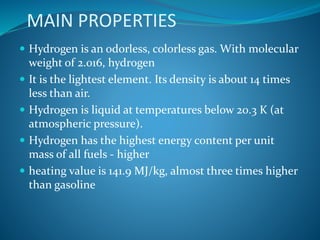
 Hydrogen is an odorless, colorless gas. With molecular
weight of 2.016, hydrogen
 It is the lightest element. Its density is about 14 times
less than air.
 Hydrogen is liquid at temperatures below 20.3 K (at
atmospheric pressure).
 Hydrogen has the highest energy content per unit
mass of all fuels - higher
 heating value is 141.9 MJ/kg, almost three times higher
than gasoline
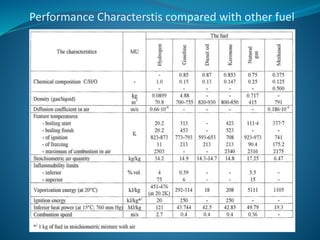
Performance Characterstis compared with other fuel
ADVANTAGES
 Renewable in nature.
 Clean fuel due to low emission of NOx and no CO2
 Can be produced from variety of feed stocks.
 Requires low Ignition energy.
 Superior combustion characterstics.
 Adulteration free.
 High purity level available.
LIMITATIONS
 High flammability leads to an explosive quality to the
fuel-air mixture.
 Leak detection is difficult as it is odourless.
 On board storage is difficult due to low energy volume
density.
 (Huge storage space is required in compared to other
fuels)
 Pre ignition and backflash causes engine design
challenges.
 Expensive as production quantity is limited.
 Lack of distribution infrastructure.
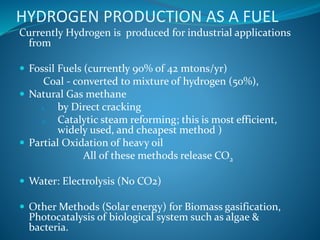
HYDROGEN PRODUCTION AS A FUEL
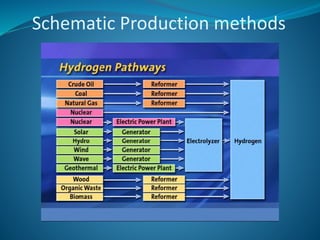
Currently Hydrogen is produced for industrial applications
from
 Fossil Fuels (currently 90% of 42 mtons/yr)
Coal - converted to mixture of hydrogen (50%),
 Natural Gas methane
1. by Direct cracking
2. Catalytic steam reforming; this is most efficient,
widely used, and cheapest method )
 Partial Oxidation of heavy oil
All of these methods release CO2
 Water: Electrolysis (No CO2)
 Other Methods (Solar energy) for Biomass gasification,
Photocatalysis of biological system such as algae &
bacteria.
Schematic Production methods
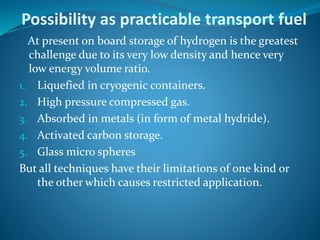
Possibility as practicable transport fuel
At present on board storage of hydrogen is the greatest
challenge due to its very low density and hence very
low energy volume ratio.
1. Liquefied in cryogenic containers.
2. High pressure compressed gas.
3. Absorbed in metals (in form of metal hydride).
4. Activated carbon storage.
5. Glass micro spheres
But all techniques have their limitations of one kind or
the other which causes restricted application.
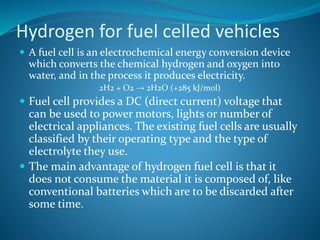
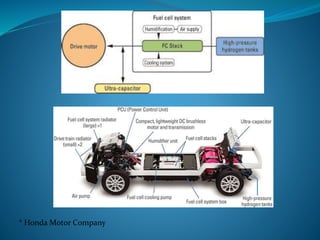
Hydrogen for fuel celled vehicles
 A fuel cell is an electrochemical energy conversion device
which converts the chemical hydrogen and oxygen into
water, and in the process it produces electricity.
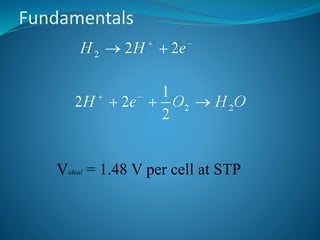
2H2 + O2 → 2H2O (+285 kJ/mol)
 Fuel cell provides a DC (direct current) voltage that
can be used to power motors, lights or number of
electrical appliances. The existing fuel cells are usually
classified by their operating type and the type of
electrolyte they use.
 The main advantage of hydrogen fuel cell is that it
does not consume the material it is composed of, like
conventional batteries which are to be discarded after
some time.
Fundamentals
Videal = 1.48 V per cell at STP
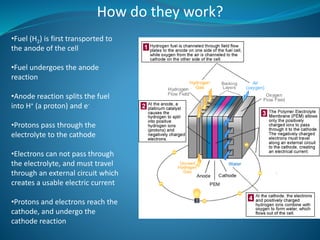
How do they work?
•Fuel (H2) is first transported to
the anode of the cell
•Fuel undergoes the anode
reaction
•Anode reaction splits the fuel
into H+ (a proton) and e-
•Protons pass through the
electrolyte to the cathode
•Electrons can not pass through
the electrolyte, and must travel
through an external circuit which
creates a usable electric current
•Protons and electrons reach the
cathode, and undergo the
cathode reaction
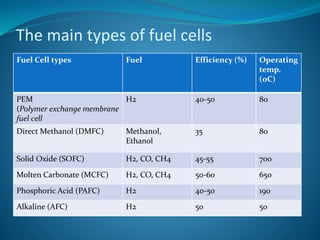
The main types of fuel cells
Fuel Cell types Fuel Efficiency (%) Operating
temp.
(oC)
PEM
(Polymer exchange membrane
fuel cell
H2 40-50 80
Direct Methanol (DMFC) Methanol,
Ethanol
35 80
Solid Oxide (SOFC) H2, CO, CH4 45-55 700
Molten Carbonate (MCFC) H2, CO, CH4 50-60 650
Phosphoric Acid (PAFC) H2 40-50 190
Alkaline (AFC) H2 50 50
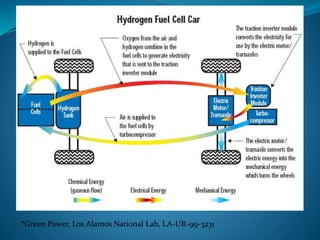
*Green Power, Los Alamos National Lab, LA-UR-99-3231
* Honda Motor Company
Possible Commercial Scale Applications
 Energy Sector
 Motor vehicles
 Aviation
 Space Expolaration
CONCLUSION:
Careful analysis of continuing, large-scale use of
conventional fuels, will lead to the conclusion that
Hydrogen is the ideal energy carrier of the future.
Mainly, we refer to molecular Hydrogen, which is
stable, non-polluting, abundant in nature, with high
mass energy and can be used in practical applications
but with future challenges with regard to
 Storage
 Cost of infrastructure
 Engine Design
 Distribution
 Public Safety

Hydrogen fuel cell Technology

  • 1.
    Hydrogen Fuel Cell Byjignesh parmar
  • 2.
    AIM: To study thecharacteristics, properties and possibility of H2 as alternative fuel for automobiles.
  • 3.
    OBJECTIVES:  To Describeproperties of H2 in context of automobile fuel.  To Compare performance of H2 with petrol and diesel and other alternative fuels.  To List advantages & disadvantages of H2 as automobile fuel.
  • 4.
    Why Hydrogen Fuel? Considering increasing Energy demands and consequent high consumption of conventional fuels. (i.e., petroleum, natural gas and coal), are being depleted rapidly.  Also, their combustion products are causing global problems, such as the greenhouse effect, ozone layer depletion, acid rains and pollution, which are posing great danger for our environment.  Available from renewable energy source. Energy stored in hydrogen would be available at any time and at any place on Earth.
  • 5.
    MAIN PROPERTIES  Hydrogenis an odorless, colorless gas. With molecular weight of 2.016, hydrogen  It is the lightest element. Its density is about 14 times less than air.  Hydrogen is liquid at temperatures below 20.3 K (at atmospheric pressure).  Hydrogen has the highest energy content per unit mass of all fuels - higher  heating value is 141.9 MJ/kg, almost three times higher than gasoline
  • 6.
  • 7.
    ADVANTAGES  Renewable innature.  Clean fuel due to low emission of NOx and no CO2  Can be produced from variety of feed stocks.  Requires low Ignition energy.  Superior combustion characterstics.  Adulteration free.  High purity level available.
  • 8.
    LIMITATIONS  High flammabilityleads to an explosive quality to the fuel-air mixture.  Leak detection is difficult as it is odourless.  On board storage is difficult due to low energy volume density.  (Huge storage space is required in compared to other fuels)  Pre ignition and backflash causes engine design challenges.  Expensive as production quantity is limited.  Lack of distribution infrastructure.
  • 9.
    HYDROGEN PRODUCTION ASA FUEL Currently Hydrogen is produced for industrial applications from  Fossil Fuels (currently 90% of 42 mtons/yr) Coal - converted to mixture of hydrogen (50%),  Natural Gas methane 1. by Direct cracking 2. Catalytic steam reforming; this is most efficient, widely used, and cheapest method )  Partial Oxidation of heavy oil All of these methods release CO2  Water: Electrolysis (No CO2)  Other Methods (Solar energy) for Biomass gasification, Photocatalysis of biological system such as algae & bacteria.
  • 10.
  • 11.
    Possibility as practicabletransport fuel At present on board storage of hydrogen is the greatest challenge due to its very low density and hence very low energy volume ratio. 1. Liquefied in cryogenic containers. 2. High pressure compressed gas. 3. Absorbed in metals (in form of metal hydride). 4. Activated carbon storage. 5. Glass micro spheres But all techniques have their limitations of one kind or the other which causes restricted application.
  • 12.
    Hydrogen for fuelcelled vehicles  A fuel cell is an electrochemical energy conversion device which converts the chemical hydrogen and oxygen into water, and in the process it produces electricity. 2H2 + O2 → 2H2O (+285 kJ/mol)  Fuel cell provides a DC (direct current) voltage that can be used to power motors, lights or number of electrical appliances. The existing fuel cells are usually classified by their operating type and the type of electrolyte they use.  The main advantage of hydrogen fuel cell is that it does not consume the material it is composed of, like conventional batteries which are to be discarded after some time.
  • 13.
    Fundamentals Videal = 1.48V per cell at STP
  • 14.
    How do theywork? •Fuel (H2) is first transported to the anode of the cell •Fuel undergoes the anode reaction •Anode reaction splits the fuel into H+ (a proton) and e- •Protons pass through the electrolyte to the cathode •Electrons can not pass through the electrolyte, and must travel through an external circuit which creates a usable electric current •Protons and electrons reach the cathode, and undergo the cathode reaction
  • 15.
    The main typesof fuel cells Fuel Cell types Fuel Efficiency (%) Operating temp. (oC) PEM (Polymer exchange membrane fuel cell H2 40-50 80 Direct Methanol (DMFC) Methanol, Ethanol 35 80 Solid Oxide (SOFC) H2, CO, CH4 45-55 700 Molten Carbonate (MCFC) H2, CO, CH4 50-60 650 Phosphoric Acid (PAFC) H2 40-50 190 Alkaline (AFC) H2 50 50
  • 16.
    *Green Power, LosAlamos National Lab, LA-UR-99-3231
  • 17.
  • 18.
    Possible Commercial ScaleApplications  Energy Sector  Motor vehicles  Aviation  Space Expolaration
  • 19.
    CONCLUSION: Careful analysis ofcontinuing, large-scale use of conventional fuels, will lead to the conclusion that Hydrogen is the ideal energy carrier of the future. Mainly, we refer to molecular Hydrogen, which is stable, non-polluting, abundant in nature, with high mass energy and can be used in practical applications but with future challenges with regard to  Storage  Cost of infrastructure  Engine Design  Distribution  Public Safety