ANJUMAN INSTITUTE OF TECHNOLOGY
AND MANAGEMENT
Dept. of Mechanical Engineering
A Seminar on
GREEN HYDROGEN AS FUEL
Presented By,
Lohit Shetty
Introduction:
 The emission of GHG mainly from the combustion of fossil fuels,
has become a serious issue while global energy consumption is
rapidly increasing.
 To mitigate the environment impact of greenhouse gases by reducing
the use of fossil fuels, research on alternative fuel has been actively
pursued for decades.
 Hydrogen has high energy and fuel efficiency.
 It has high energy content of 118MJ/kg at 298k.
Classification of Hydrogen:
As we discussed, H2 are present in combination of elements or
molecules, We need a primary source of chemical compounds to
produce following hydrogen.
Green hydrogen:
It is produced from splitting of water (H2O) by electricity where the
primary source of electricity are solar power, wind power, Hydro
power, etc.
Brown hydrogen:
It is produced from burning of fossil fuels, hydrocarbon cracking
and coal gasification which releases CO2 directly to the atmosphere.
Blue hydrogen:
It Produced from steam methane reforming which captures the CO2
and stored in storage tank for long time.
Grey hydrogen:
It produced from steam methane reforming which releases CO2
directly to the atmosphere.
Pink hydrogen:
It produced from splitting of water by electricity where the primary
source of electricity is nuclear energy.
Production:
 The only way to produce hydrogen, without emitting green house
gas would be green hydrogen by water splitting method.
 The water splitting is a process of production of green hydrogen
by the electrolysis of water.
 Electrolysis is an electrochemical process which uses electric
current to breakdown the bond between hydrogen and oxygen in
water.
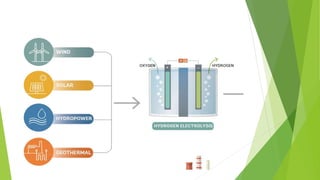
 The primary energy sources of electrolysis are renewable sources
such as solar PV or Wind or Turbine or Geothermal or
Hydropower etc.
 Therefore the production of hydrogen from renewable energy
resources, which doesn’t emit CO2 and other green house gas is
known as green hydrogen.
Advantages:
 It’s not toxic , it doesn’t cause to human health.
 Highly efficient, It is 3 times more powerful than most fossil
based fuel sources.
 It is renewable energy.
Disadvantages:
 Hydrogen is volatile.
 Highly flammable.
 It is difficult to store and transport.
 It can be dangerous.
Thank You !

GREEN HYDROGEN AS FUEL.pptx

  • 1.
    ANJUMAN INSTITUTE OFTECHNOLOGY AND MANAGEMENT Dept. of Mechanical Engineering A Seminar on GREEN HYDROGEN AS FUEL Presented By, Lohit Shetty
  • 2.
    Introduction:  The emissionof GHG mainly from the combustion of fossil fuels, has become a serious issue while global energy consumption is rapidly increasing.  To mitigate the environment impact of greenhouse gases by reducing the use of fossil fuels, research on alternative fuel has been actively pursued for decades.  Hydrogen has high energy and fuel efficiency.  It has high energy content of 118MJ/kg at 298k.
  • 3.
    Classification of Hydrogen: Aswe discussed, H2 are present in combination of elements or molecules, We need a primary source of chemical compounds to produce following hydrogen. Green hydrogen: It is produced from splitting of water (H2O) by electricity where the primary source of electricity are solar power, wind power, Hydro power, etc. Brown hydrogen: It is produced from burning of fossil fuels, hydrocarbon cracking and coal gasification which releases CO2 directly to the atmosphere.
  • 4.
    Blue hydrogen: It Producedfrom steam methane reforming which captures the CO2 and stored in storage tank for long time. Grey hydrogen: It produced from steam methane reforming which releases CO2 directly to the atmosphere. Pink hydrogen: It produced from splitting of water by electricity where the primary source of electricity is nuclear energy.
  • 5.
    Production:  The onlyway to produce hydrogen, without emitting green house gas would be green hydrogen by water splitting method.  The water splitting is a process of production of green hydrogen by the electrolysis of water.  Electrolysis is an electrochemical process which uses electric current to breakdown the bond between hydrogen and oxygen in water.
  • 6.
     The primaryenergy sources of electrolysis are renewable sources such as solar PV or Wind or Turbine or Geothermal or Hydropower etc.  Therefore the production of hydrogen from renewable energy resources, which doesn’t emit CO2 and other green house gas is known as green hydrogen.
  • 8.
    Advantages:  It’s nottoxic , it doesn’t cause to human health.  Highly efficient, It is 3 times more powerful than most fossil based fuel sources.  It is renewable energy.
  • 9.
    Disadvantages:  Hydrogen isvolatile.  Highly flammable.  It is difficult to store and transport.  It can be dangerous.
  • 10.