Inorganic Spectroscopy
RUSSEL SAUNDERS COUPLING
SUBMITTED TO
PROF. MUHAMMAD ALI
INORGANIC SPECTROSCOPY
Inorganic Spectroscopy
Russel-Saunders Coupling
Also named as ls coupling or SPIN-ORBIT COUPLING
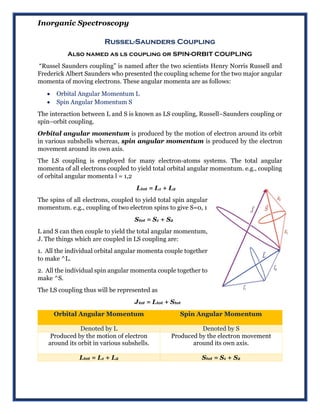
“Russel Saunders coupling” is named after the two scientists Henry Norris Russell and
Frederick Albert Saunders who presented the coupling scheme for the two major angular
momenta of moving electrons. These angular momenta are as follows:
 Orbital Angular Momentum L
 Spin Angular Momentum S
The interaction between L and S is known as LS coupling, Russell–Saunders coupling or
spin–orbit coupling.
Orbital angular momentum is produced by the motion of electron around its orbit
in various subshells whereas, spin angular momentum is produced by the electron
movement around its own axis.
The LS coupling is employed for many electron-atoms systems. The total angular
momenta of all electrons coupled to yield total orbital angular momentum. e.g., coupling
of orbital angular momenta l = 1,2
Ltot = L1 + L2
The spins of all electrons, coupled to yield total spin angular
momentum. e.g., coupling of two electron spins to give S=0, 1
Stot = S1 + S2
L and S can then couple to yield the total angular momentum,
J. The things which are coupled in LS coupling are:
1. All the individual orbital angular momenta couple together
to make ^L.
2. All the individual spin angular momenta couple together to
make ^S.
The LS coupling thus will be represented as
Jtot = Ltot + Stot
Orbital Angular Momentum Spin Angular Momentum
Denoted by L Denoted by S
Produced by the motion of electron
around its orbit in various subshells.
Produced by the electron movement
around its own axis.
Ltot = L1 + L2 Stot = S1 + S2
Inorganic Spectroscopy
Mainly three kinds of interactions have been studied as the spin-spin coupling, orbit-
orbit coupling, and spin-orbit coupling that are produced as a result of the
electrons movement in circular orbits in various subshells.
Explanation
Principle Contributions to Energy
In atomic system, there are two principle contributions to energy that are as follows:
 Inter-electronic repulsion, which is responsible for the energy separation between
the terms arising from a given configuration.
 Spin-orbit interaction, which gives rise to the energy intervals between the
components within a given term.
Assumption
In the L-S or Russel Saunders coupling scheme, it is assumed that electronic repulsion is
much greater than spin-orbit interaction.
Representation
They define an electronic term conventionally designated by a term symbol written in
the form:
2S+1 L J
The addition of L and S gives the total angular momentum quantum number J, which has
the allowed values given by the sequence: L + S, L + S – 1, … , |L – S|. This results in a
multiplicity of 2S + 1 for a given orbital angular momentum L (except when L
= 0). Spin-orbit interaction between the total orbital and spin angular momenta give rise
to different energies for each allowed value of J.
Multiplicity represents the number of possible values of the total angular momentum
quantum number J for certain conditions.
Hund’s Rule
When atomic states are accurately represented by Russell-Saunders coupling, the energy
ordering of different terms arising from a given electron configuration follow Hund's
rules as follows:
 Higher multiplicities have lower energies
 For terms of the same multiplicity, larger L values have lower energies
Hund’s observation was made for the lighter atoms having less atomic number. The S1 –
S2 orientation energy is very strong whereas L1 – L2 orientation energy is not as strong.
Inorganic Spectroscopy
For example, the valence electron configuration of 2p2 for the carbon atom gives rise to
three terms: 3P < 1P < 1D. Spin-orbit interaction between L and S then causes relatively
small intervals of each term for different possible values of J.
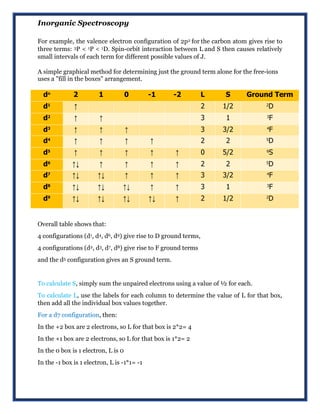
A simple graphical method for determining just the ground term alone for the free-ions
uses a "fill in the boxes" arrangement.
dn
2 1 0 -1 -2 L S Ground Term
d1
↑ 2 1/2 2
D
d2
↑ ↑ 3 1 3
F
d3
↑ ↑ ↑ 3 3/2 4
F
d4
↑ ↑ ↑ ↑ 2 2 5
D
d5
↑ ↑ ↑ ↑ ↑ 0 5/2 6
S
d6
↑↓ ↑ ↑ ↑ ↑ 2 2 5
D
d7
↑↓ ↑↓ ↑ ↑ ↑ 3 3/2 4
F
d8
↑↓ ↑↓ ↑↓ ↑ ↑ 3 1 3
F
d9
↑↓ ↑↓ ↑↓ ↑↓ ↑ 2 1/2 2
D
Overall table shows that:
4 configurations (d1, d4, d6, d9) give rise to D ground terms,
4 configurations (d2, d3, d7, d8) give rise to F ground terms
and the d5 configuration gives an S ground term.
To calculate S, simply sum the unpaired electrons using a value of ½ for each.
To calculate L, use the labels for each column to determine the value of L for that box,
then add all the individual box values together.
For a d7 configuration, then:
In the +2 box are 2 electrons, so L for that box is 2*2= 4
In the +1 box are 2 electrons, so L for that box is 1*2= 2
In the 0 box is 1 electron, L is 0
In the -1 box is 1 electron, L is -1*1= -1
Inorganic Spectroscopy
In the -2 box is 1 electron, L is -2*1= -2
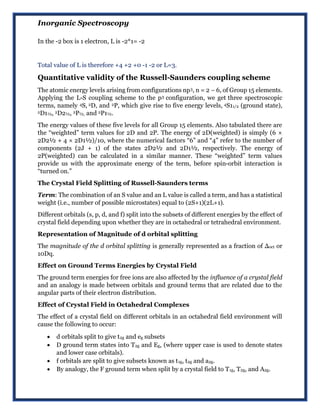
Total value of L is therefore +4 +2 +0 -1 -2 or L=3.
Quantitative validity of the Russell-Saunders coupling scheme
The atomic energy levels arising from configurations np3, n = 2 – 6, of Group 15 elements.
Applying the L-S coupling scheme to the p3 configuration, we get three spectroscopic
terms, namely 4S, 2D, and 2P, which give rise to five energy levels, 4S11/2 (ground state),
2D1½, 2D2½, 2P½, and 2P1½.
The energy values of these five levels for all Group 15 elements. Also tabulated there are
the “weighted” term values for 2D and 2P. The energy of 2D(weighted) is simply (6 ×
2D2½ + 4 × 2D1½)/10, where the numerical factors “6” and “4” refer to the number of
components (2J + 1) of the states 2D2½ and 2D1½, respectively. The energy of
2P(weighted) can be calculated in a similar manner. These “weighted” term values
provide us with the approximate energy of the term, before spin-orbit interaction is
“turned on.”
The Crystal Field Splitting of Russell-Saunders terms
Term: The combination of an S value and an L value is called a term, and has a statistical
weight (i.e., number of possible microstates) equal to (2S+1)(2L+1).
Different orbitals (s, p, d, and f) split into the subsets of different energies by the effect of
crystal field depending upon whether they are in octahedral or tetrahedral environment.
Representation of Magnitude of d orbital splitting
The magnitude of the d orbital splitting is generally represented as a fraction of Δoct or
10Dq.
Effect on Ground Terms Energies by Crystal Field
The ground term energies for free ions are also affected by the influence of a crystal field
and an analogy is made between orbitals and ground terms that are related due to the
angular parts of their electron distribution.
Effect of Crystal Field in Octahedral Complexes
The effect of a crystal field on different orbitals in an octahedral field environment will
cause the following to occur:
 d orbitals split to give t2g and eg subsets
 D ground term states into T2g and Eg, (where upper case is used to denote states
and lower case orbitals).
 f orbitals are split to give subsets known as t1g, t2g and a2g.
 By analogy, the F ground term when split by a crystal field to T1g, T2g, and A2g.
Inorganic Spectroscopy
Effect of Crystal Field in Tetrahedral Complexes
For splitting in a tetrahedral crystal field the components are similar, except that the
symmetry label g (gerade) is absent.
The ground term for first-row transition metal ions is either D, F or S which in high spin
octahedral fields gives rise to A, E or T states. This means that the states are either non-
degenerate, doubly degenerate or triply degenerate.
Landé’s Interval Rule
This rule can be used as a test of how well system can be described by LS-
coupling.
Zeeman Effect
The splitting observed in spectral lines when the source of those lines is placed in an
external magnetic field. Splitting of a single spectral line into three components in the
presence of an external magnetic field is called the normal Zeeman effect.
Any time the g-values of the upper and lower states are the same, this pattern results.
When the g-values are different, much more complicated patterns are possible. These, for
historical reasons, are called the anomalous Zeeman effect.
g is the Land’e g-value defined as:
g= 1+
Paschen–Back effect
This is an approximation which is good as long as any external magnetic fields are weak.
When the applied field is very strong, the coupling between L and S may be broken in
favor of their direct coupling to the magnetic field. The
individual angular momenta, and therefore their
magnetic moments, now process independently about
the field direction.
As the electromagnetic field couples to the spatial
distribution of the electrons, not to the magnetic moment
due to the spin, the presence of the spin now makes no
difference to the energies of the transitions. As a result,
the anomalous Zeeman effect gives way to the normal
Zeeman effect.
This switch from the anomalous effect to the normal
effect is called the Paschen–Back effect.
Inorganic Spectroscopy
SUMMARY
J is total angular momentum for all electrons. The way the angular momenta are
combined to form J depends on the coupling scheme :
J = L + S for LS coupling
For a single electron, the term symbol is not written as S is always 1/2 and L is obvious
from the orbital type.
L, S and J are obtained by using addition rule of angular momentums with given
electronics groups that are to be coupled. It was assumed that electronic repulsion is much
greater than spin-orbit interaction.
2S+1 L J is a level designated from term symbol. Hund’s rule also employed for the lighter
atoms with less atomic number explains multiplicities. Ground terms can be calculated
by the d orbitals in the table. Octahedral and tetrahedral complexes can be explained by
the crystal field splitting. Lande’s Interval rule tests the LS coupling. Paschen back effect
produced when the strong magnetic fields are generated, two momenta break, giving rise
to a different splitting pattern in the energy levels and the size of LS coupling term
becomes small.
END

Russel Saunders Coupling scheme or LS coupling

  • 1.
    Inorganic Spectroscopy RUSSEL SAUNDERSCOUPLING SUBMITTED TO PROF. MUHAMMAD ALI INORGANIC SPECTROSCOPY
  • 2.
    Inorganic Spectroscopy Russel-Saunders Coupling Alsonamed as ls coupling or SPIN-ORBIT COUPLING “Russel Saunders coupling” is named after the two scientists Henry Norris Russell and Frederick Albert Saunders who presented the coupling scheme for the two major angular momenta of moving electrons. These angular momenta are as follows:  Orbital Angular Momentum L  Spin Angular Momentum S The interaction between L and S is known as LS coupling, Russell–Saunders coupling or spin–orbit coupling. Orbital angular momentum is produced by the motion of electron around its orbit in various subshells whereas, spin angular momentum is produced by the electron movement around its own axis. The LS coupling is employed for many electron-atoms systems. The total angular momenta of all electrons coupled to yield total orbital angular momentum. e.g., coupling of orbital angular momenta l = 1,2 Ltot = L1 + L2 The spins of all electrons, coupled to yield total spin angular momentum. e.g., coupling of two electron spins to give S=0, 1 Stot = S1 + S2 L and S can then couple to yield the total angular momentum, J. The things which are coupled in LS coupling are: 1. All the individual orbital angular momenta couple together to make ^L. 2. All the individual spin angular momenta couple together to make ^S. The LS coupling thus will be represented as Jtot = Ltot + Stot Orbital Angular Momentum Spin Angular Momentum Denoted by L Denoted by S Produced by the motion of electron around its orbit in various subshells. Produced by the electron movement around its own axis. Ltot = L1 + L2 Stot = S1 + S2
  • 3.
    Inorganic Spectroscopy Mainly threekinds of interactions have been studied as the spin-spin coupling, orbit- orbit coupling, and spin-orbit coupling that are produced as a result of the electrons movement in circular orbits in various subshells. Explanation Principle Contributions to Energy In atomic system, there are two principle contributions to energy that are as follows:  Inter-electronic repulsion, which is responsible for the energy separation between the terms arising from a given configuration.  Spin-orbit interaction, which gives rise to the energy intervals between the components within a given term. Assumption In the L-S or Russel Saunders coupling scheme, it is assumed that electronic repulsion is much greater than spin-orbit interaction. Representation They define an electronic term conventionally designated by a term symbol written in the form: 2S+1 L J The addition of L and S gives the total angular momentum quantum number J, which has the allowed values given by the sequence: L + S, L + S – 1, … , |L – S|. This results in a multiplicity of 2S + 1 for a given orbital angular momentum L (except when L = 0). Spin-orbit interaction between the total orbital and spin angular momenta give rise to different energies for each allowed value of J. Multiplicity represents the number of possible values of the total angular momentum quantum number J for certain conditions. Hund’s Rule When atomic states are accurately represented by Russell-Saunders coupling, the energy ordering of different terms arising from a given electron configuration follow Hund's rules as follows:  Higher multiplicities have lower energies  For terms of the same multiplicity, larger L values have lower energies Hund’s observation was made for the lighter atoms having less atomic number. The S1 – S2 orientation energy is very strong whereas L1 – L2 orientation energy is not as strong.
  • 4.
    Inorganic Spectroscopy For example,the valence electron configuration of 2p2 for the carbon atom gives rise to three terms: 3P < 1P < 1D. Spin-orbit interaction between L and S then causes relatively small intervals of each term for different possible values of J. A simple graphical method for determining just the ground term alone for the free-ions uses a "fill in the boxes" arrangement. dn 2 1 0 -1 -2 L S Ground Term d1 ↑ 2 1/2 2 D d2 ↑ ↑ 3 1 3 F d3 ↑ ↑ ↑ 3 3/2 4 F d4 ↑ ↑ ↑ ↑ 2 2 5 D d5 ↑ ↑ ↑ ↑ ↑ 0 5/2 6 S d6 ↑↓ ↑ ↑ ↑ ↑ 2 2 5 D d7 ↑↓ ↑↓ ↑ ↑ ↑ 3 3/2 4 F d8 ↑↓ ↑↓ ↑↓ ↑ ↑ 3 1 3 F d9 ↑↓ ↑↓ ↑↓ ↑↓ ↑ 2 1/2 2 D Overall table shows that: 4 configurations (d1, d4, d6, d9) give rise to D ground terms, 4 configurations (d2, d3, d7, d8) give rise to F ground terms and the d5 configuration gives an S ground term. To calculate S, simply sum the unpaired electrons using a value of ½ for each. To calculate L, use the labels for each column to determine the value of L for that box, then add all the individual box values together. For a d7 configuration, then: In the +2 box are 2 electrons, so L for that box is 2*2= 4 In the +1 box are 2 electrons, so L for that box is 1*2= 2 In the 0 box is 1 electron, L is 0 In the -1 box is 1 electron, L is -1*1= -1
  • 5.
    Inorganic Spectroscopy In the-2 box is 1 electron, L is -2*1= -2 Total value of L is therefore +4 +2 +0 -1 -2 or L=3. Quantitative validity of the Russell-Saunders coupling scheme The atomic energy levels arising from configurations np3, n = 2 – 6, of Group 15 elements. Applying the L-S coupling scheme to the p3 configuration, we get three spectroscopic terms, namely 4S, 2D, and 2P, which give rise to five energy levels, 4S11/2 (ground state), 2D1½, 2D2½, 2P½, and 2P1½. The energy values of these five levels for all Group 15 elements. Also tabulated there are the “weighted” term values for 2D and 2P. The energy of 2D(weighted) is simply (6 × 2D2½ + 4 × 2D1½)/10, where the numerical factors “6” and “4” refer to the number of components (2J + 1) of the states 2D2½ and 2D1½, respectively. The energy of 2P(weighted) can be calculated in a similar manner. These “weighted” term values provide us with the approximate energy of the term, before spin-orbit interaction is “turned on.” The Crystal Field Splitting of Russell-Saunders terms Term: The combination of an S value and an L value is called a term, and has a statistical weight (i.e., number of possible microstates) equal to (2S+1)(2L+1). Different orbitals (s, p, d, and f) split into the subsets of different energies by the effect of crystal field depending upon whether they are in octahedral or tetrahedral environment. Representation of Magnitude of d orbital splitting The magnitude of the d orbital splitting is generally represented as a fraction of Δoct or 10Dq. Effect on Ground Terms Energies by Crystal Field The ground term energies for free ions are also affected by the influence of a crystal field and an analogy is made between orbitals and ground terms that are related due to the angular parts of their electron distribution. Effect of Crystal Field in Octahedral Complexes The effect of a crystal field on different orbitals in an octahedral field environment will cause the following to occur:  d orbitals split to give t2g and eg subsets  D ground term states into T2g and Eg, (where upper case is used to denote states and lower case orbitals).  f orbitals are split to give subsets known as t1g, t2g and a2g.  By analogy, the F ground term when split by a crystal field to T1g, T2g, and A2g.
  • 6.
    Inorganic Spectroscopy Effect ofCrystal Field in Tetrahedral Complexes For splitting in a tetrahedral crystal field the components are similar, except that the symmetry label g (gerade) is absent. The ground term for first-row transition metal ions is either D, F or S which in high spin octahedral fields gives rise to A, E or T states. This means that the states are either non- degenerate, doubly degenerate or triply degenerate. Landé’s Interval Rule This rule can be used as a test of how well system can be described by LS- coupling. Zeeman Effect The splitting observed in spectral lines when the source of those lines is placed in an external magnetic field. Splitting of a single spectral line into three components in the presence of an external magnetic field is called the normal Zeeman effect. Any time the g-values of the upper and lower states are the same, this pattern results. When the g-values are different, much more complicated patterns are possible. These, for historical reasons, are called the anomalous Zeeman effect. g is the Land’e g-value defined as: g= 1+ Paschen–Back effect This is an approximation which is good as long as any external magnetic fields are weak. When the applied field is very strong, the coupling between L and S may be broken in favor of their direct coupling to the magnetic field. The individual angular momenta, and therefore their magnetic moments, now process independently about the field direction. As the electromagnetic field couples to the spatial distribution of the electrons, not to the magnetic moment due to the spin, the presence of the spin now makes no difference to the energies of the transitions. As a result, the anomalous Zeeman effect gives way to the normal Zeeman effect. This switch from the anomalous effect to the normal effect is called the Paschen–Back effect.
  • 7.
    Inorganic Spectroscopy SUMMARY J istotal angular momentum for all electrons. The way the angular momenta are combined to form J depends on the coupling scheme : J = L + S for LS coupling For a single electron, the term symbol is not written as S is always 1/2 and L is obvious from the orbital type. L, S and J are obtained by using addition rule of angular momentums with given electronics groups that are to be coupled. It was assumed that electronic repulsion is much greater than spin-orbit interaction. 2S+1 L J is a level designated from term symbol. Hund’s rule also employed for the lighter atoms with less atomic number explains multiplicities. Ground terms can be calculated by the d orbitals in the table. Octahedral and tetrahedral complexes can be explained by the crystal field splitting. Lande’s Interval rule tests the LS coupling. Paschen back effect produced when the strong magnetic fields are generated, two momenta break, giving rise to a different splitting pattern in the energy levels and the size of LS coupling term becomes small. END