CRANIAL NERVES
DR MUSADDIQ KHAN
MBBS MCPS®
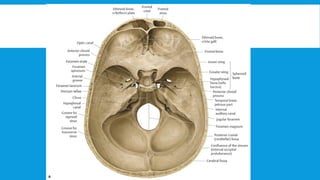
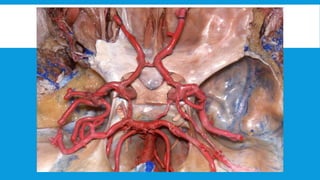
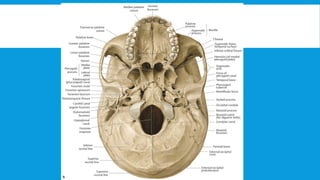
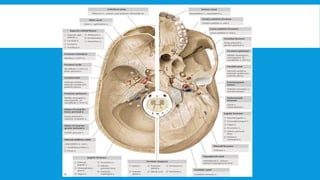
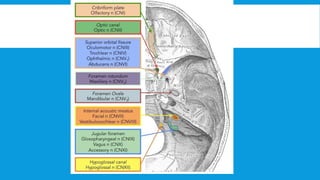
Anterior Cranial Fossa
Middle Cranial Fossa
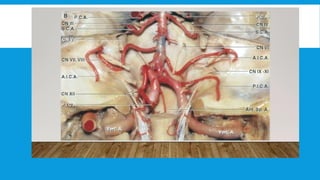
Posterior cranial fossa
CRANIAL NERVES
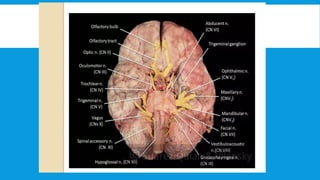
 12 pairs, arising directly from brain
 CN I & CN II → CEREBRUM
 Remaining ten arise from Different parts of brain stem (mid brain, pons,medulla)
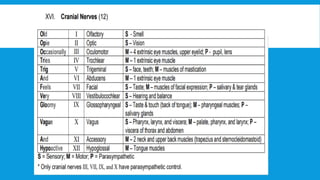
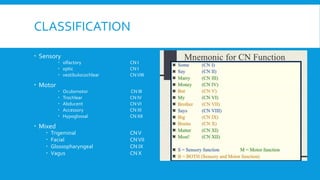
CLASSIFICATION
 Sensory
 olfactory CN I
 optic CN I
 vestibulocochlear CNVIII
 Motor
 Oculomotor CN III
 Trochlear CN IV
 Abducent CNVI
 Accessory CN XI
 Hypoglossal CN XII
 Mixed
 Trigeminal CNV
 Facial CNVII
 Glossopharyngeal CN IX
 Vagus CN X
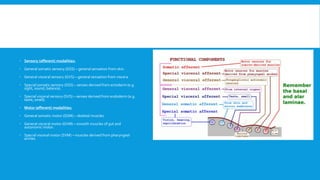
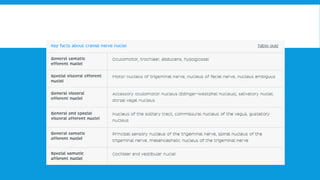
 Sensory (afferent) modalities:
 General somatic sensory (GSS) – general sensation from skin.
 General visceral sensory (GVS) – general sensation from viscera.
 Special somatic sensory (SSS) – senses derived from ectoderm (e.g.
sight, sound, balance).
 Special visceral sensory (SVS) – senses derived from endoderm (e.g.
taste, smell).
 Motor (efferent) modalities:
 General somatic motor (GSM) – skeletal muscles.
 General visceral motor (GVM) – smooth muscles of gut and
autonomic motor.
 Special visceral motor (SVM) – muscles derived from pharyngeal
arches.
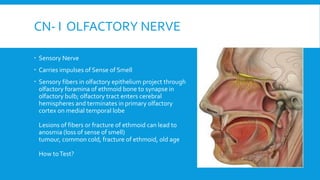
CN- I OLFACTORY NERVE
 Sensory Nerve
 Carries impulses of Sense of Smell
 Sensory fibers in olfactory epithelium project through
olfactory foramina of ethmoid bone to synapse in
olfactory bulb; olfactory tract enters cerebral
hemispheres and terminates in primary olfactory
cortex on medial temporal lobe
Lesions of fibers or fracture of ethmoid can lead to
anosmia (loss of sense of smell)
tumour, common cold, fracture of ethmoid, old age
How toTest?
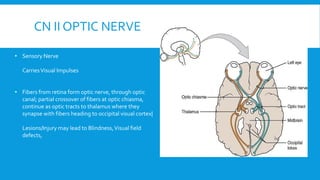
CN II OPTIC NERVE
• Sensory Nerve
CarriesVisual Impulses
• Fibers from retina form optic nerve, through optic
canal; partial crossover of fibers at optic chiasma,
continue as optic tracts to thalamus where they
synapse with fibers heading to occipital visual cortex|
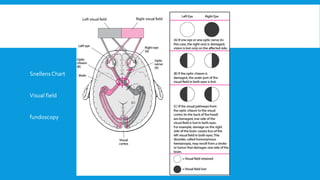
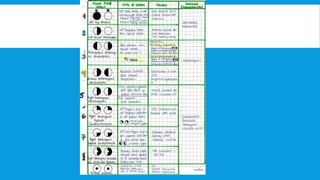
Lesions/Injury may lead to Blindness,Visual field
defects,
Snellens Chart
Visual field
fundoscopy
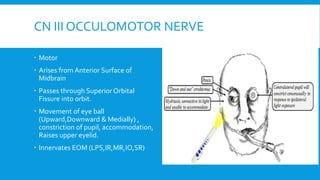
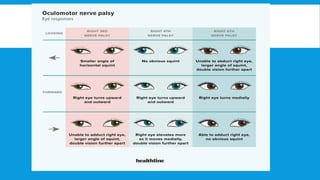
CN III OCCULOMOTOR NERVE
 Motor
 Arises from Anterior Surface of
Midbrain
 Passes through Superior Orbital
Fissure into orbit.
 Movement of eye ball
(Upward,Downward & Medially) ,
constriction of pupil, accommodation,
Raises upper eyelid.
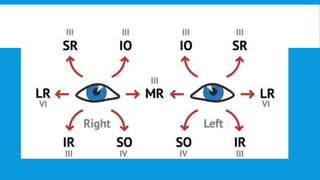
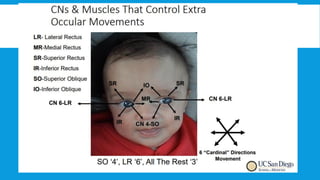
 Innervates EOM (LPS,IR,MR,IO,SR)
CN IVTROCHLEAR NERVE
 midbrain through superior orbital fissures to eyes
 Primarily motor ,somatic motor fibers to one extrinsic eye muscle
 Supplies SO
 Moves eyeball
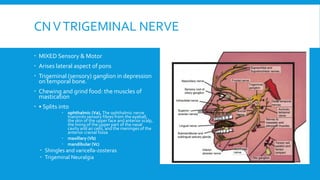
CNVTRIGEMINAL NERVE
 MIXED Sensory & Motor
 Arises lateral aspect of pons
 Trigeminal (sensory) ganglion in depression
on temporal bone.
 Chewing and grind food: the muscles of
mastication
 • Splits into
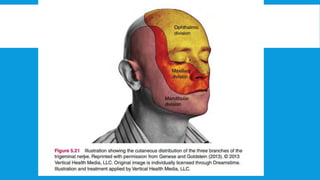
 ophthalmic (Va), The ophthalmic nerve
transmits sensory fibres from the eyeball,
the skin of the upper face and anterior scalp,
the lining of the upper part of the nasal
cavity and air cells, and the meninges of the
anterior cranial fossa
 maxillary (Vb)
 mandibular (Vc)
 Shingles and varicella-zosteras
 Trigeminal Neuralgia
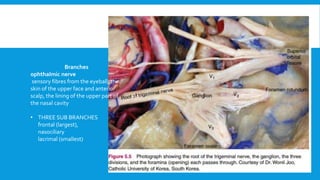
Branches
ophthalmic nerve
sensory fibres from the eyeball, the
skin of the upper face and anterior
scalp, the lining of the upper part of
the nasal cavity
• THREE SUB BRANCHES
frontal (largest),
nasociliary
lacrimal (smallest)
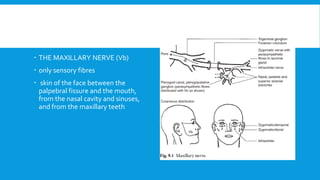
 THE MAXILLARY NERVE (Vb)
 only sensory fibres
 skin of the face between the
palpebral fissure and the mouth,
from the nasal cavity and sinuses,
and from the maxillary teeth
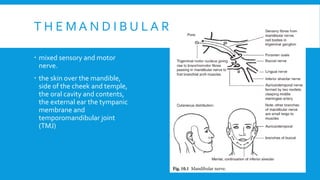
T H E M A N D I B U L A R N E RV E (V-C
 mixed sensory and motor
nerve.
 the skin over the mandible,
side of the cheek and temple,
the oral cavity and contents,
the external ear the tympanic
membrane and
temporomandibular joint
(TMJ)
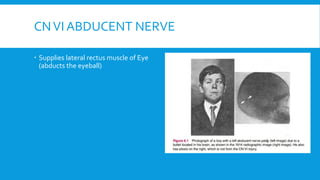
CNVI ABDUCENT NERVE
 Supplies lateral rectus muscle of Eye
(abducts the eyeball)
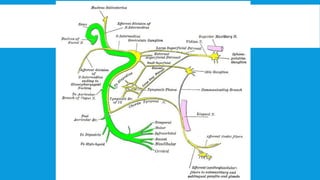
VII FACIAL NERVE
 Mixed Nerve
 Arises from (pons), enters the middle ear and mastoid and exits the skull at the
stylomastoid foramen
 Passes via posterior cranial fossa, enters internal acoustic meatus
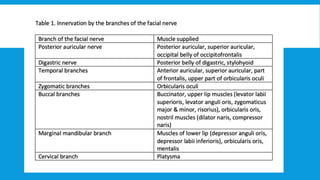
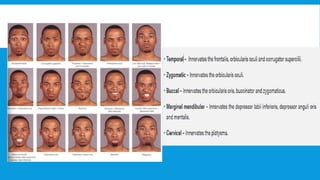
 supplies the muscles of facial expression
 taste sensation from the anterior portion of the tongue and oral cavity
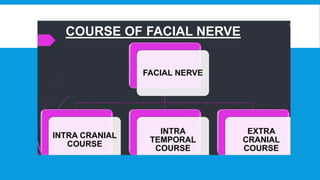
 Intra cranial & Extracranial Part
 parasympathetic secretomotor function of the salivary, lacrimal, nasal and
palatine glands
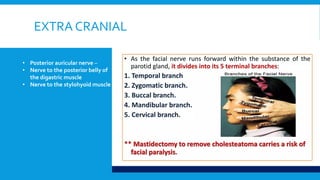
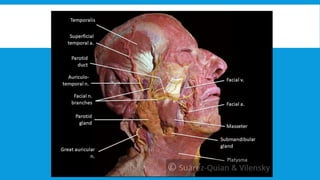
EXTRA CRANIAL
• Posterior auricular nerve –
• Nerve to the posterior belly of
the digastric muscle
• Nerve to the stylohyoid muscle
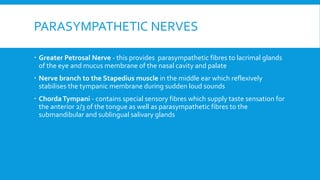
PARASYMPATHETIC NERVES
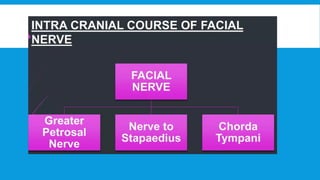
 Greater Petrosal Nerve - this provides parasympathetic fibres to lacrimal glands
of the eye and mucus membrane of the nasal cavity and palate
 Nerve branch to the Stapedius muscle in the middle ear which reflexively
stabilises the tympanic membrane during sudden loud sounds
 ChordaTympani - contains special sensory fibres which supply taste sensation for
the anterior 2/3 of the tongue as well as parasympathetic fibres to the
submandibular and sublingual salivary glands
INTRACRANIAL LESION
 Damage during cranium coarse
 Bells Palsy
 Damage to Chorda tympani → Loss of taste, decreased salvation
 Damage to greater petrosal N. → reduced lacrimation
 Damage to Nerve to stapedius → Hypersensitive to sound
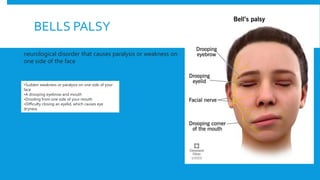
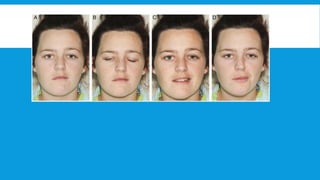
BELLS PALSY
neurological disorder that causes paralysis or weakness on
one side of the face
•Sudden weakness or paralysis on one side of your
face
•A drooping eyebrow and mouth
•Drooling from one side of your mouth
•Difficulty closing an eyelid, which causes eye
dryness
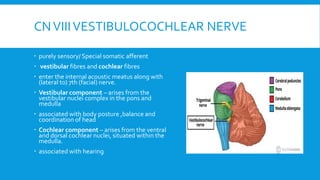
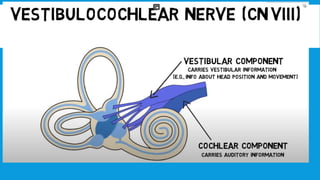
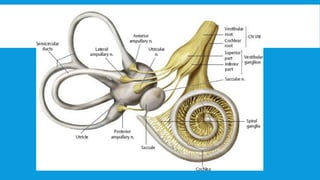
CNVIIIVESTIBULOCOCHLEAR NERVE
 purely sensory/ Special somatic afferent
 vestibular fibres and cochlear fibres
 enter the internal acoustic meatus along with
(lateral to) 7th (facial) nerve.
 Vestibular component – arises from the
vestibular nuclei complex in the pons and
medulla
 associated with body posture ,balance and
coordination of head
 Cochlear component – arises from the ventral
and dorsal cochlear nuclei, situated within the
medulla.
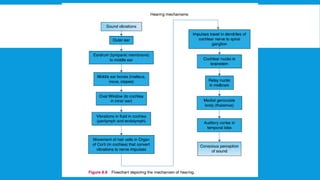
 associated with hearing
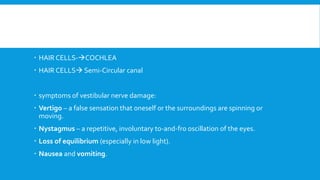
 HAIR CELLS-→COCHLEA
 HAIR CELLS→ Semi-Circular canal
 symptoms of vestibular nerve damage:
 Vertigo – a false sensation that oneself or the surroundings are spinning or
moving.
 Nystagmus – a repetitive, involuntary to-and-fro oscillation of the eyes.
 Loss of equilibrium (especially in low light).
 Nausea and vomiting.
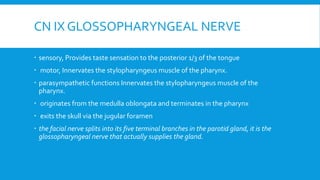
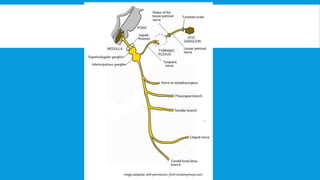
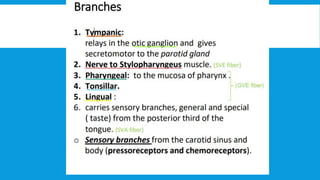
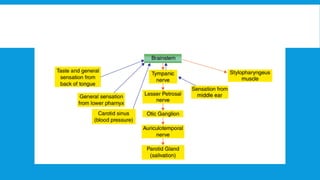
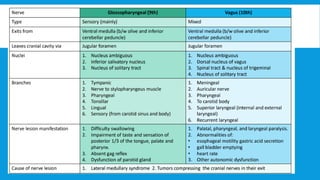
CN IX GLOSSOPHARYNGEAL NERVE
 sensory, Provides taste sensation to the posterior 1/3 of the tongue
 motor, Innervates the stylopharyngeus muscle of the pharynx.
 parasympathetic functions Innervates the stylopharyngeus muscle of the
pharynx.
 originates from the medulla oblongata and terminates in the pharynx
 exits the skull via the jugular foramen
 the facial nerve splits into its five terminal branches in the parotid gland, it is the
glossopharyngeal nerve that actually supplies the gland.
 Gag Reflex compromised
 as stylopharyngeus muscle of the pharynx is innervated by the glossopharyngeal
nerve.This muscle acts to shorten and widen the pharynx and elevate the larynx
during swallowing.
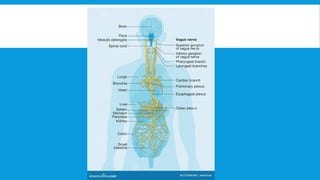
CN XVAGUS NERVE
 Mixed nerve
 Originates from the medulla
 means wandering, goes all the way to abdomen
 longest and most widely distributed cranial nerve
 principal role of the vagus is to provide parasympathetic supply to organs throughout the
thorax and upper abdomen.
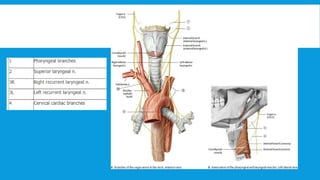
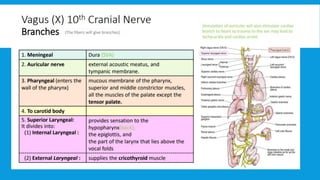
 also gives sensory and motor supply to the pharynx and larynx
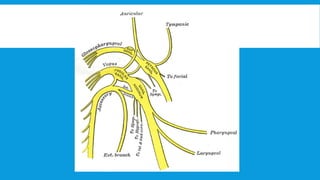
 vagus nerve leaves the skull via the jugular foramen
 vagus nerve descends in the neck, enclosed with the carotid vessels and internal jugular
vein in a common sheath of connective tissue
 left and right vagal nerves join to form the vagal trunk
 motor supply to all the muscles of the larynx, except the cricothyroid.
 Injury will in thyroidectomy will lead to hoarseness of voice or complete loss of
voice
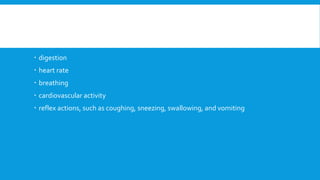
 digestion
 heart rate
 breathing
 cardiovascular activity
 reflex actions, such as coughing, sneezing, swallowing, and vomiting
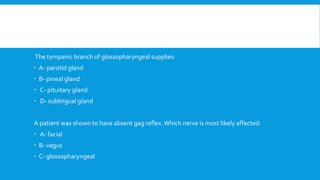
The tympanic branch of glossopharyngeal supplies:
 A- parotid gland
 B- pineal gland
 C- pituitary gland
 D- sublingual gland
A patient was shown to have absent gag reflex.Which nerve is most likely affected:
 A- facial
 B- vagus
 C- glossopharyngeal
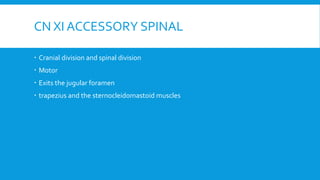
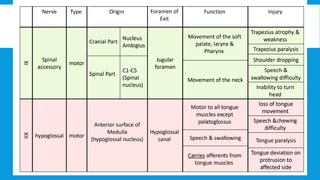
CN XI ACCESSORY SPINAL
 Cranial division and spinal division
 Motor
 Exits the jugular foramen
 trapezius and the sternocleidomastoid muscles
CN XII HYPOGLOSSAL NERVE
 Arises from Medulla
 motor nerve to the muscles of the tongue
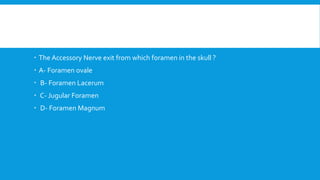
 The Accessory Nerve exit from which foramen in the skull ?
 A- Foramen ovale
 B- Foramen Lacerum
 C- Jugular Foramen
 D- Foramen Magnum
THANK-YOU
 ASSIGNMENT-
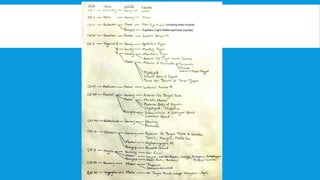
CRANIAL NERVES, ORIGIN,EXIT,COMPONENTS SUPPLY InTabular Form

Cranial Nerves

  • 1.
  • 3.
    Anterior Cranial Fossa MiddleCranial Fossa Posterior cranial fossa
  • 9.
    CRANIAL NERVES  12pairs, arising directly from brain  CN I & CN II → CEREBRUM  Remaining ten arise from Different parts of brain stem (mid brain, pons,medulla)
  • 12.
    CLASSIFICATION  Sensory  olfactoryCN I  optic CN I  vestibulocochlear CNVIII  Motor  Oculomotor CN III  Trochlear CN IV  Abducent CNVI  Accessory CN XI  Hypoglossal CN XII  Mixed  Trigeminal CNV  Facial CNVII  Glossopharyngeal CN IX  Vagus CN X
  • 13.
     Sensory (afferent)modalities:  General somatic sensory (GSS) – general sensation from skin.  General visceral sensory (GVS) – general sensation from viscera.  Special somatic sensory (SSS) – senses derived from ectoderm (e.g. sight, sound, balance).  Special visceral sensory (SVS) – senses derived from endoderm (e.g. taste, smell).  Motor (efferent) modalities:  General somatic motor (GSM) – skeletal muscles.  General visceral motor (GVM) – smooth muscles of gut and autonomic motor.  Special visceral motor (SVM) – muscles derived from pharyngeal arches.
  • 16.
    CN- I OLFACTORYNERVE  Sensory Nerve  Carries impulses of Sense of Smell  Sensory fibers in olfactory epithelium project through olfactory foramina of ethmoid bone to synapse in olfactory bulb; olfactory tract enters cerebral hemispheres and terminates in primary olfactory cortex on medial temporal lobe Lesions of fibers or fracture of ethmoid can lead to anosmia (loss of sense of smell) tumour, common cold, fracture of ethmoid, old age How toTest?
  • 17.
    CN II OPTICNERVE • Sensory Nerve CarriesVisual Impulses • Fibers from retina form optic nerve, through optic canal; partial crossover of fibers at optic chiasma, continue as optic tracts to thalamus where they synapse with fibers heading to occipital visual cortex| Lesions/Injury may lead to Blindness,Visual field defects,
  • 18.
  • 20.
    CN III OCCULOMOTORNERVE  Motor  Arises from Anterior Surface of Midbrain  Passes through Superior Orbital Fissure into orbit.  Movement of eye ball (Upward,Downward & Medially) , constriction of pupil, accommodation, Raises upper eyelid.  Innervates EOM (LPS,IR,MR,IO,SR)
  • 24.
    CN IVTROCHLEAR NERVE midbrain through superior orbital fissures to eyes  Primarily motor ,somatic motor fibers to one extrinsic eye muscle  Supplies SO  Moves eyeball
  • 25.
    CNVTRIGEMINAL NERVE  MIXEDSensory & Motor  Arises lateral aspect of pons  Trigeminal (sensory) ganglion in depression on temporal bone.  Chewing and grind food: the muscles of mastication  • Splits into  ophthalmic (Va), The ophthalmic nerve transmits sensory fibres from the eyeball, the skin of the upper face and anterior scalp, the lining of the upper part of the nasal cavity and air cells, and the meninges of the anterior cranial fossa  maxillary (Vb)  mandibular (Vc)  Shingles and varicella-zosteras  Trigeminal Neuralgia
  • 26.
    Branches ophthalmic nerve sensory fibresfrom the eyeball, the skin of the upper face and anterior scalp, the lining of the upper part of the nasal cavity • THREE SUB BRANCHES frontal (largest), nasociliary lacrimal (smallest)
  • 27.
     THE MAXILLARYNERVE (Vb)  only sensory fibres  skin of the face between the palpebral fissure and the mouth, from the nasal cavity and sinuses, and from the maxillary teeth
  • 28.
    T H EM A N D I B U L A R N E RV E (V-C  mixed sensory and motor nerve.  the skin over the mandible, side of the cheek and temple, the oral cavity and contents, the external ear the tympanic membrane and temporomandibular joint (TMJ)
  • 30.
    CNVI ABDUCENT NERVE Supplies lateral rectus muscle of Eye (abducts the eyeball)
  • 31.
    VII FACIAL NERVE Mixed Nerve  Arises from (pons), enters the middle ear and mastoid and exits the skull at the stylomastoid foramen  Passes via posterior cranial fossa, enters internal acoustic meatus  supplies the muscles of facial expression  taste sensation from the anterior portion of the tongue and oral cavity  Intra cranial & Extracranial Part  parasympathetic secretomotor function of the salivary, lacrimal, nasal and palatine glands
  • 34.
    EXTRA CRANIAL • Posteriorauricular nerve – • Nerve to the posterior belly of the digastric muscle • Nerve to the stylohyoid muscle
  • 38.
    PARASYMPATHETIC NERVES  GreaterPetrosal Nerve - this provides parasympathetic fibres to lacrimal glands of the eye and mucus membrane of the nasal cavity and palate  Nerve branch to the Stapedius muscle in the middle ear which reflexively stabilises the tympanic membrane during sudden loud sounds  ChordaTympani - contains special sensory fibres which supply taste sensation for the anterior 2/3 of the tongue as well as parasympathetic fibres to the submandibular and sublingual salivary glands
  • 40.
    INTRACRANIAL LESION  Damageduring cranium coarse  Bells Palsy  Damage to Chorda tympani → Loss of taste, decreased salvation  Damage to greater petrosal N. → reduced lacrimation  Damage to Nerve to stapedius → Hypersensitive to sound
  • 41.
    BELLS PALSY neurological disorderthat causes paralysis or weakness on one side of the face •Sudden weakness or paralysis on one side of your face •A drooping eyebrow and mouth •Drooling from one side of your mouth •Difficulty closing an eyelid, which causes eye dryness
  • 43.
    CNVIIIVESTIBULOCOCHLEAR NERVE  purelysensory/ Special somatic afferent  vestibular fibres and cochlear fibres  enter the internal acoustic meatus along with (lateral to) 7th (facial) nerve.  Vestibular component – arises from the vestibular nuclei complex in the pons and medulla  associated with body posture ,balance and coordination of head  Cochlear component – arises from the ventral and dorsal cochlear nuclei, situated within the medulla.  associated with hearing
  • 46.
     HAIR CELLS-→COCHLEA HAIR CELLS→ Semi-Circular canal  symptoms of vestibular nerve damage:  Vertigo – a false sensation that oneself or the surroundings are spinning or moving.  Nystagmus – a repetitive, involuntary to-and-fro oscillation of the eyes.  Loss of equilibrium (especially in low light).  Nausea and vomiting.
  • 49.
    CN IX GLOSSOPHARYNGEALNERVE  sensory, Provides taste sensation to the posterior 1/3 of the tongue  motor, Innervates the stylopharyngeus muscle of the pharynx.  parasympathetic functions Innervates the stylopharyngeus muscle of the pharynx.  originates from the medulla oblongata and terminates in the pharynx  exits the skull via the jugular foramen  the facial nerve splits into its five terminal branches in the parotid gland, it is the glossopharyngeal nerve that actually supplies the gland.
  • 53.
     Gag Reflexcompromised  as stylopharyngeus muscle of the pharynx is innervated by the glossopharyngeal nerve.This muscle acts to shorten and widen the pharynx and elevate the larynx during swallowing.
  • 54.
    CN XVAGUS NERVE Mixed nerve  Originates from the medulla  means wandering, goes all the way to abdomen  longest and most widely distributed cranial nerve  principal role of the vagus is to provide parasympathetic supply to organs throughout the thorax and upper abdomen.  also gives sensory and motor supply to the pharynx and larynx  vagus nerve leaves the skull via the jugular foramen  vagus nerve descends in the neck, enclosed with the carotid vessels and internal jugular vein in a common sheath of connective tissue  left and right vagal nerves join to form the vagal trunk
  • 59.
     motor supplyto all the muscles of the larynx, except the cricothyroid.  Injury will in thyroidectomy will lead to hoarseness of voice or complete loss of voice
  • 60.
     digestion  heartrate  breathing  cardiovascular activity  reflex actions, such as coughing, sneezing, swallowing, and vomiting
  • 62.
    The tympanic branchof glossopharyngeal supplies:  A- parotid gland  B- pineal gland  C- pituitary gland  D- sublingual gland A patient was shown to have absent gag reflex.Which nerve is most likely affected:  A- facial  B- vagus  C- glossopharyngeal
  • 63.
    CN XI ACCESSORYSPINAL  Cranial division and spinal division  Motor  Exits the jugular foramen  trapezius and the sternocleidomastoid muscles
  • 64.
    CN XII HYPOGLOSSALNERVE  Arises from Medulla  motor nerve to the muscles of the tongue
  • 66.
     The AccessoryNerve exit from which foramen in the skull ?  A- Foramen ovale  B- Foramen Lacerum  C- Jugular Foramen  D- Foramen Magnum
  • 68.
    THANK-YOU  ASSIGNMENT- CRANIAL NERVES,ORIGIN,EXIT,COMPONENTS SUPPLY InTabular Form