Nervous System
Dr Musaddiq Khan Durrani
MBBS, MCPS®
Institute of Social & Cultural Studies
University Of the Punjab 1
Learning objectives
• Basics of Nervous System
• Spinal Nerves
• Brachial plexus
2
‫ـ‬ َ‫س‬‫ن‬
ِ
ْ
‫ْل‬‫ٱ‬ ‫ا‬َ‫ن‬ْ‫ق‬َ‫ل‬َ‫خ‬ ْ‫د‬َ‫ق‬َ‫ل‬
َ‫ت‬ ‫ى‬‫ن‬ َ‫س‬ْ‫ح‬َ‫ٱ‬ ٓ ‫ى‬
‫ِف‬ َ‫ن‬
‫م‬‫ي‬‫ى‬‫و‬ْ‫ق‬
95:4
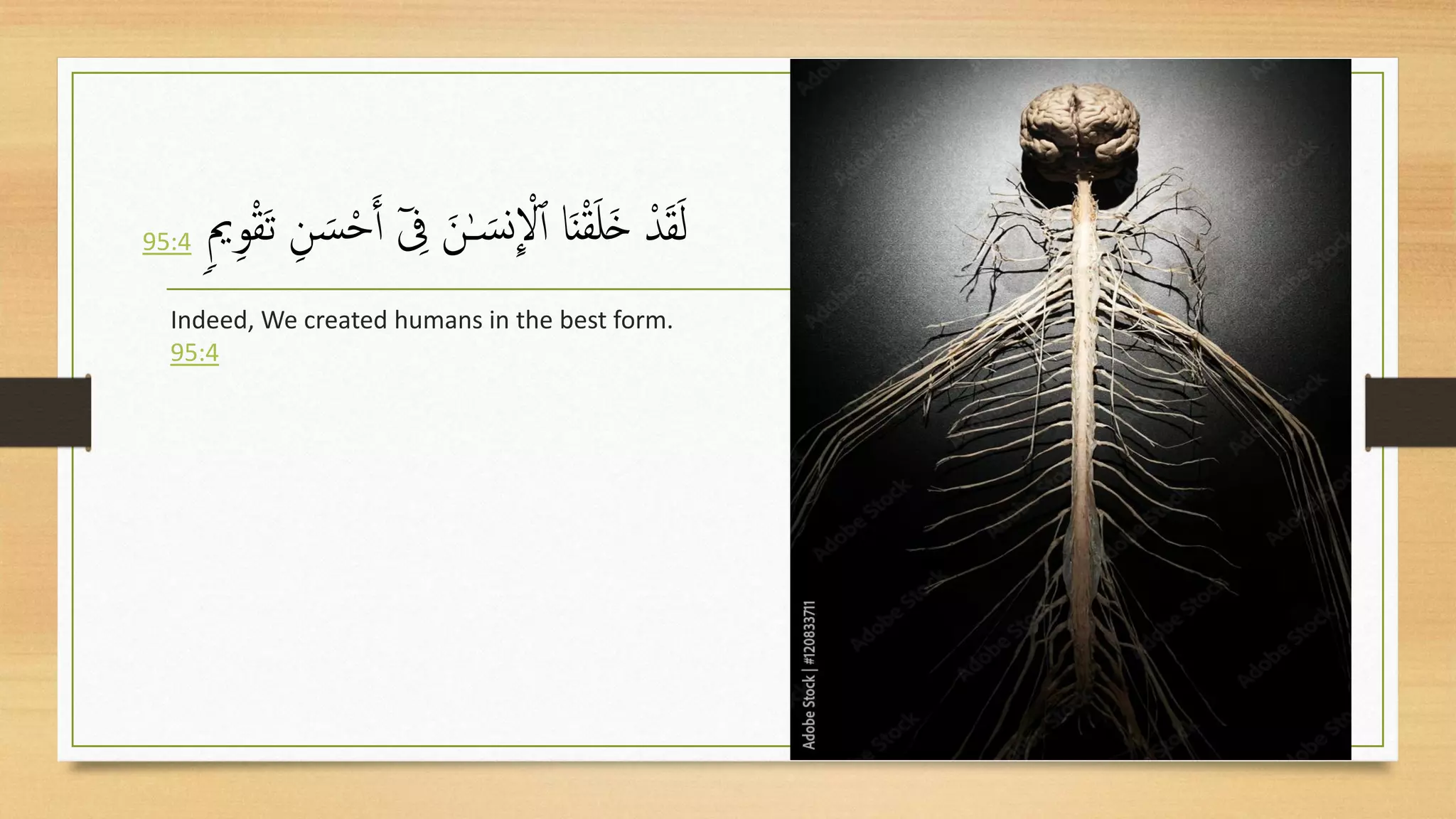
Indeed, We created humans in the best form.
95:4
3
Definition
• A network of neurons that sends, receives and modulates neural impulses
between different body parts.
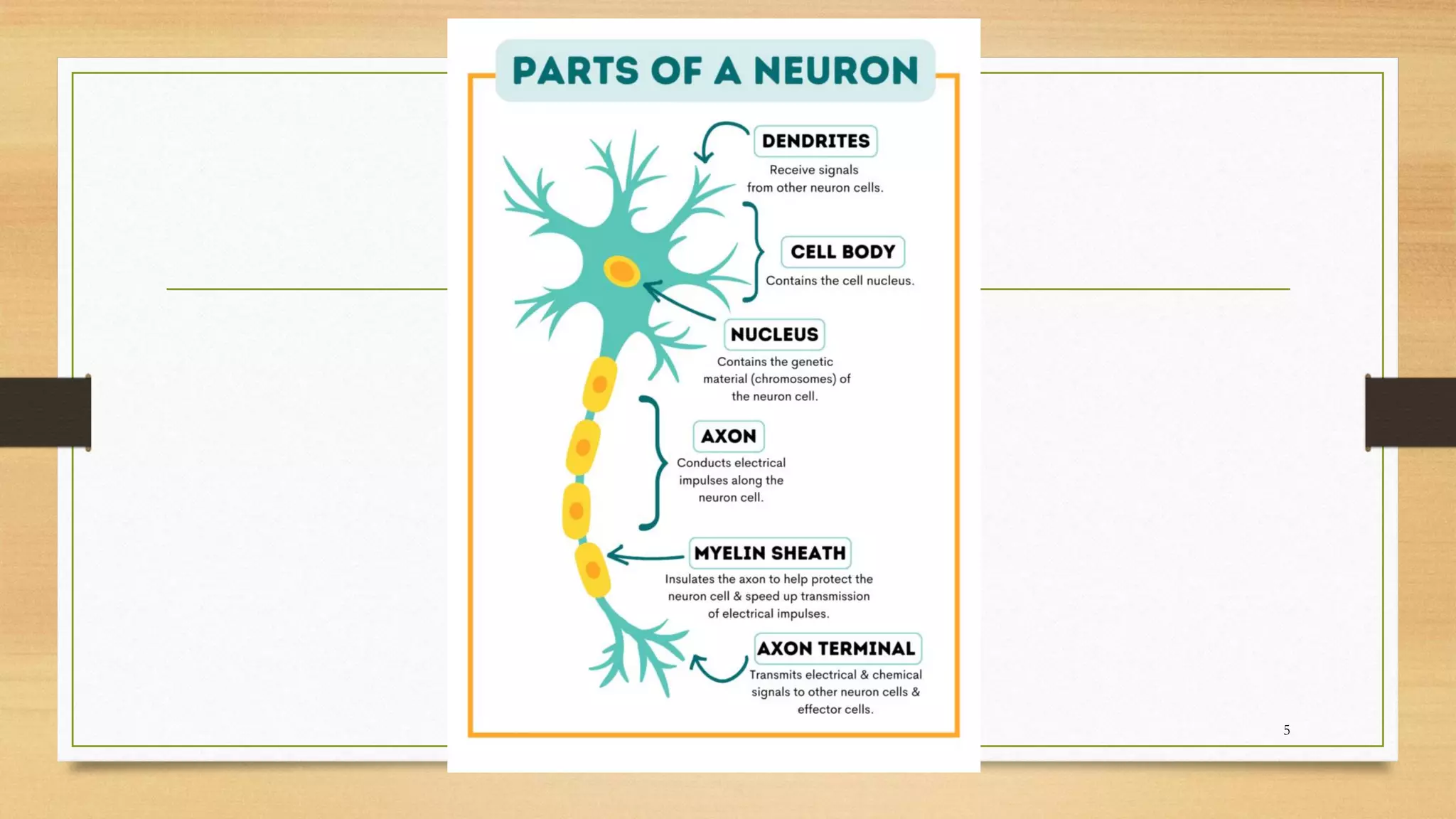
Neuron→ Neurons are the fundamental unit of the nervous system
specialized to transmit information to different parts of the body.
4
5
Classification of Neurons
• Sensory
• Motor
• Interneurons
6
Sub divisions of Nervous System
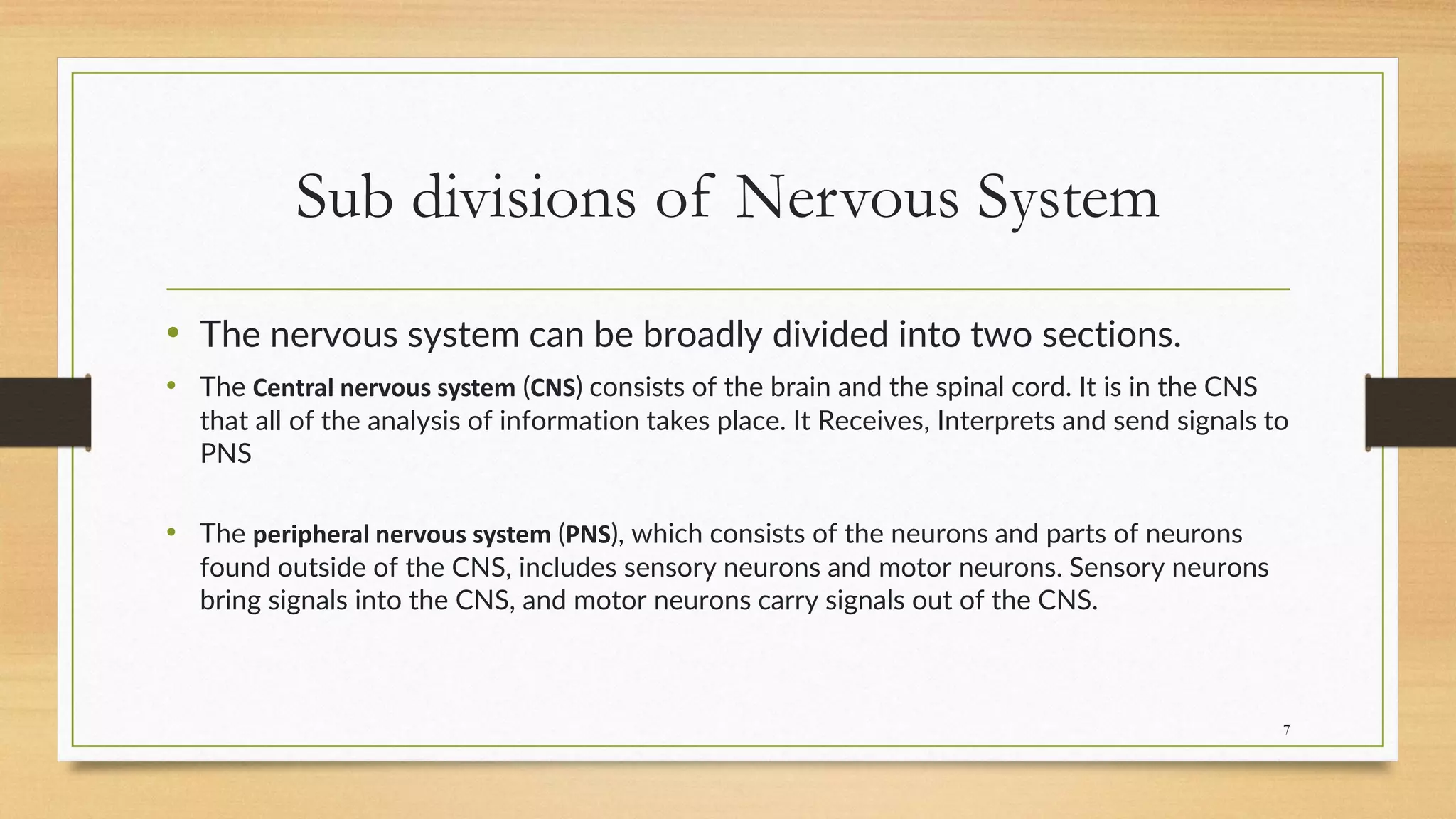
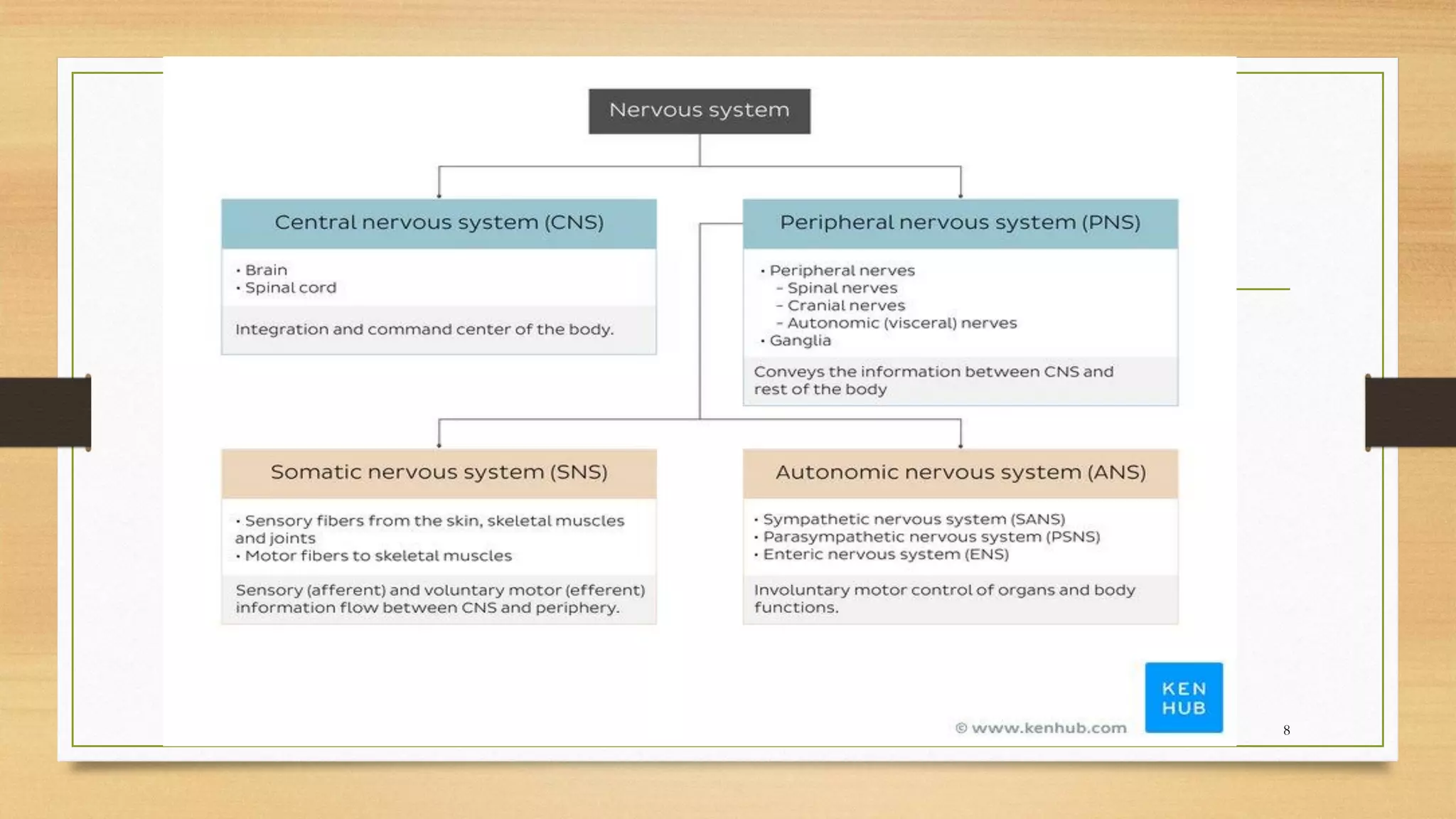
• The nervous system can be broadly divided into two sections.
• The Central nervous system (CNS) consists of the brain and the spinal cord. It is in the CNS
that all of the analysis of information takes place. It Receives, Interprets and send signals to
PNS
• The peripheral nervous system (PNS), which consists of the neurons and parts of neurons
found outside of the CNS, includes sensory neurons and motor neurons. Sensory neurons
bring signals into the CNS, and motor neurons carry signals out of the CNS.
7
8
Central nervous system
• Brain and Spinal Cord,→ protective membranes called
the Meninges, and both float in a crystal-clear Cereberospinal fluid.
9
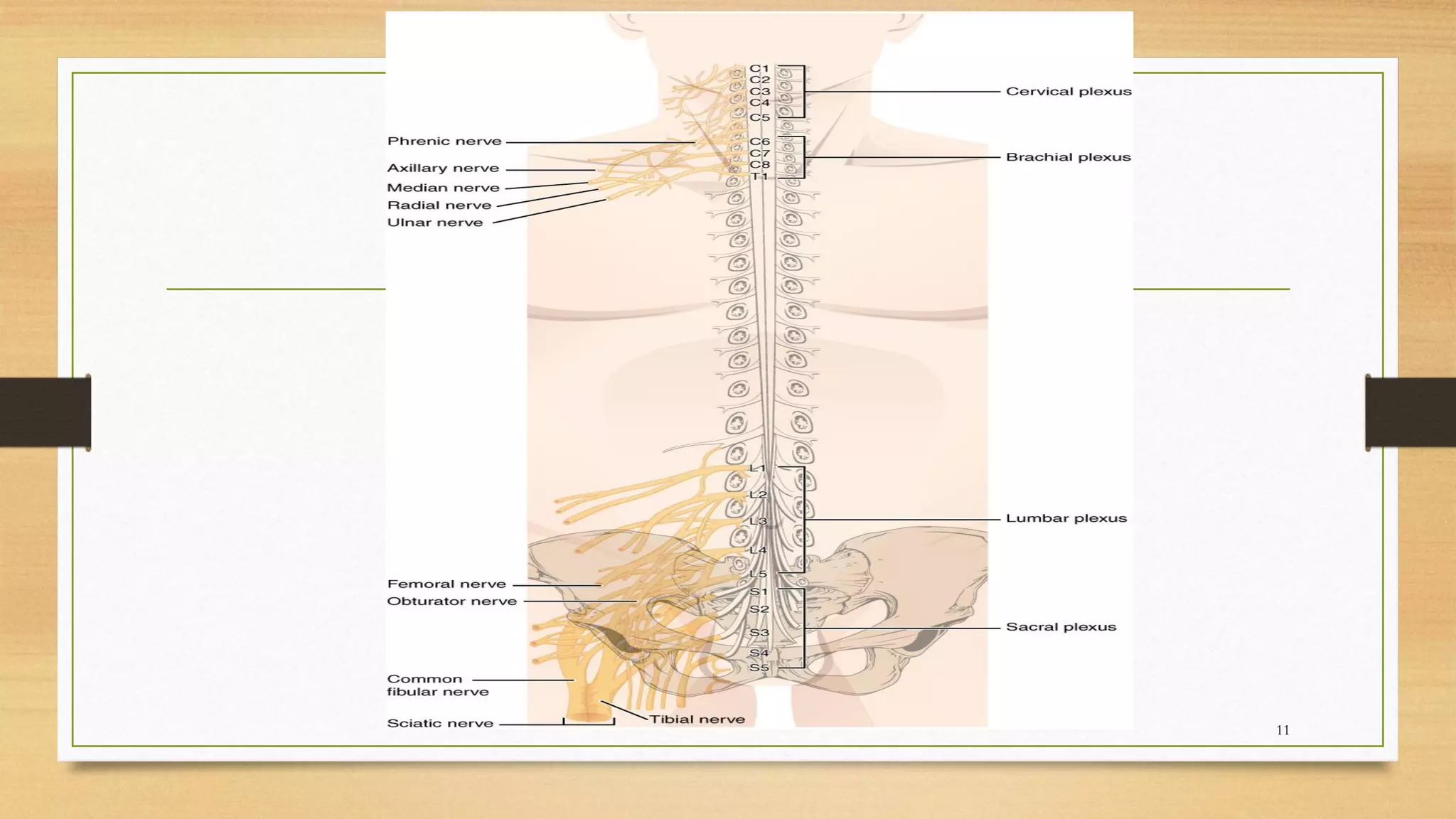
• Spinal Cord→ 31 pair of Spinal Nerves 8 cervical, 12 thoracic, 5 lumbar, 5 sacral, and
1 coccygeal. Each pair connects the spinal cord with a specific region of the body
• Spinal meninges are three membranes that surround the spinal cord – the dura mater,
arachnoid mater, and pia mater. They contain cerebrospinal fluid, acting to support and
protect the spinal cord.
• Network of Nerves are called Plexus,
e.g Brachial Plexus & Sacral Plexus
10
11
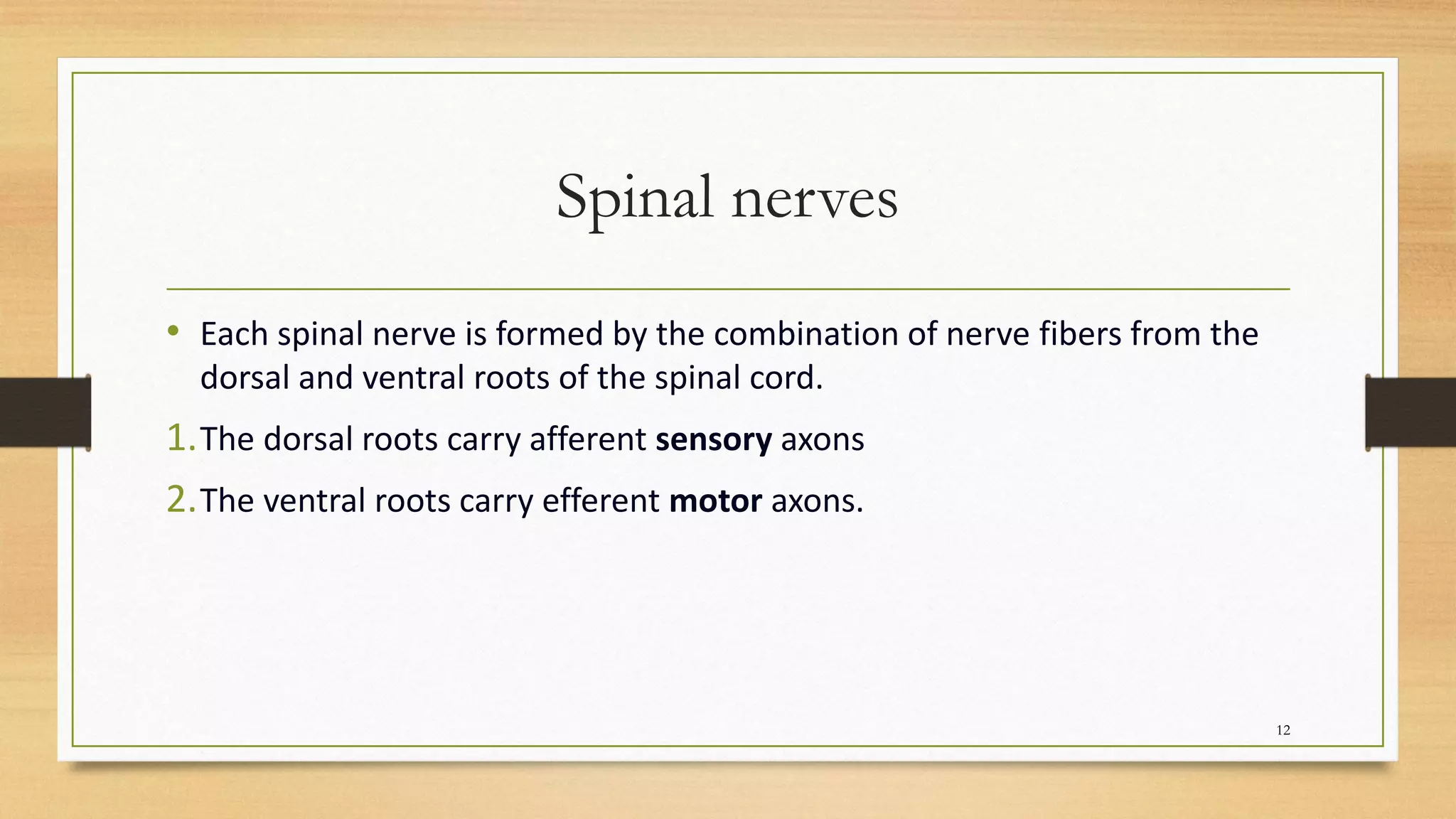
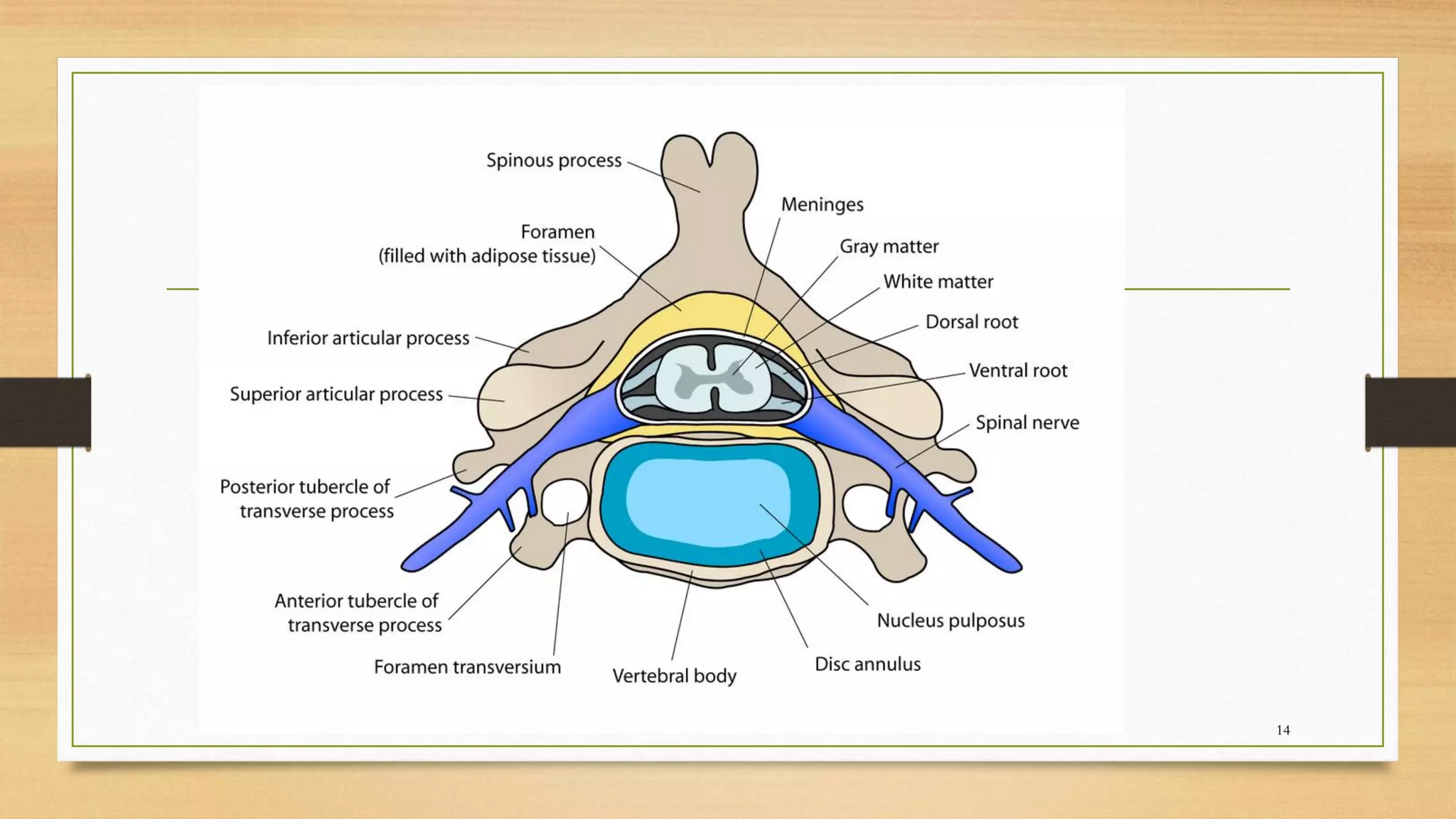
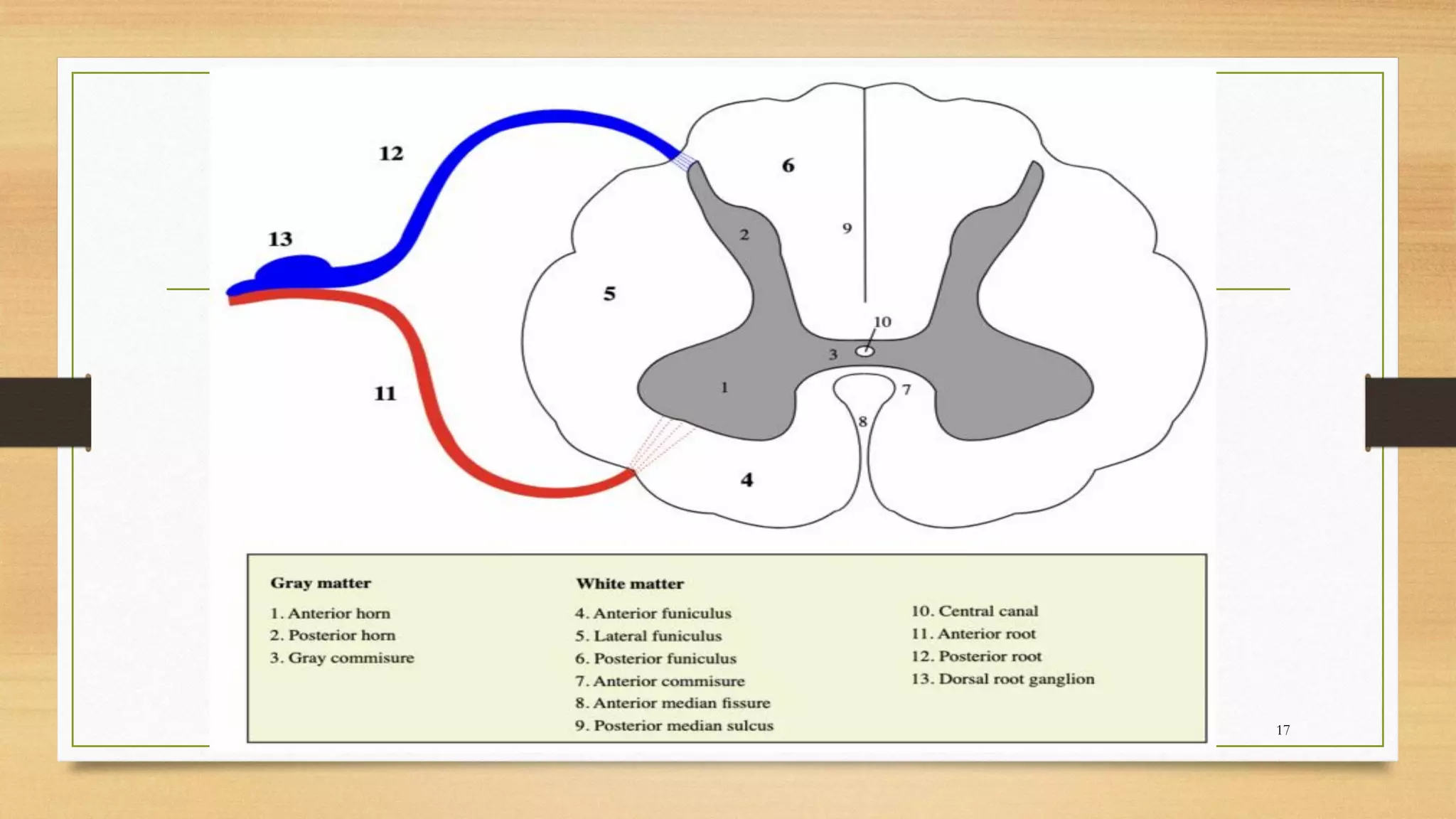
Spinal nerves
• Each spinal nerve is formed by the combination of nerve fibers from the
dorsal and ventral roots of the spinal cord.
1.The dorsal roots carry afferent sensory axons
2.The ventral roots carry efferent motor axons.
12
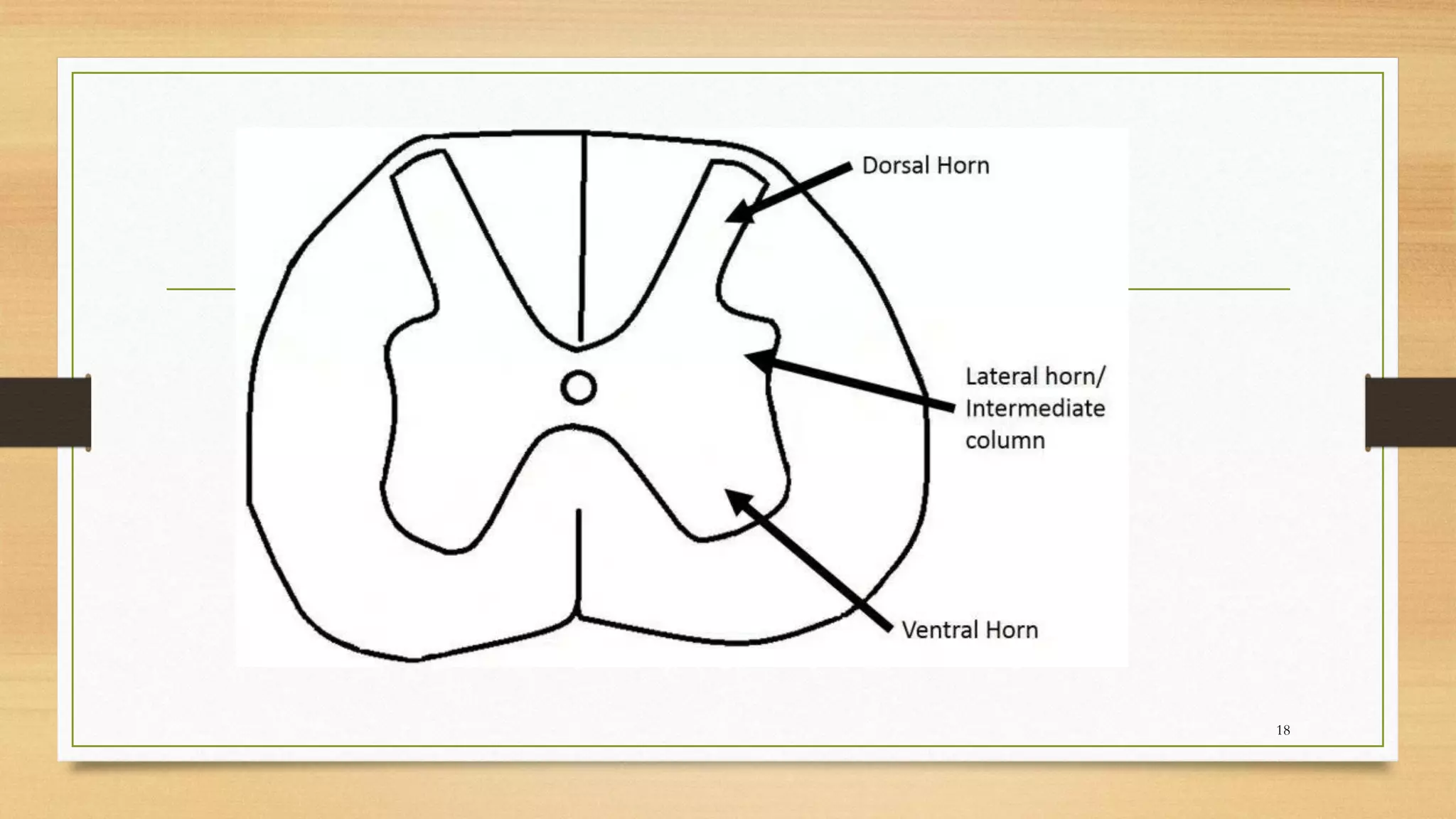
• The dorsal horn (also known as the posterior horn) contains neurons that
receive somatosensory information from the body, which is then
transmitted via the ascending pathways, to the brain.
• The ventral horn (also known as the anterior horn) largely contains motor
neurons that exit the spinal cord to innervate skeletal muscle.
13
14
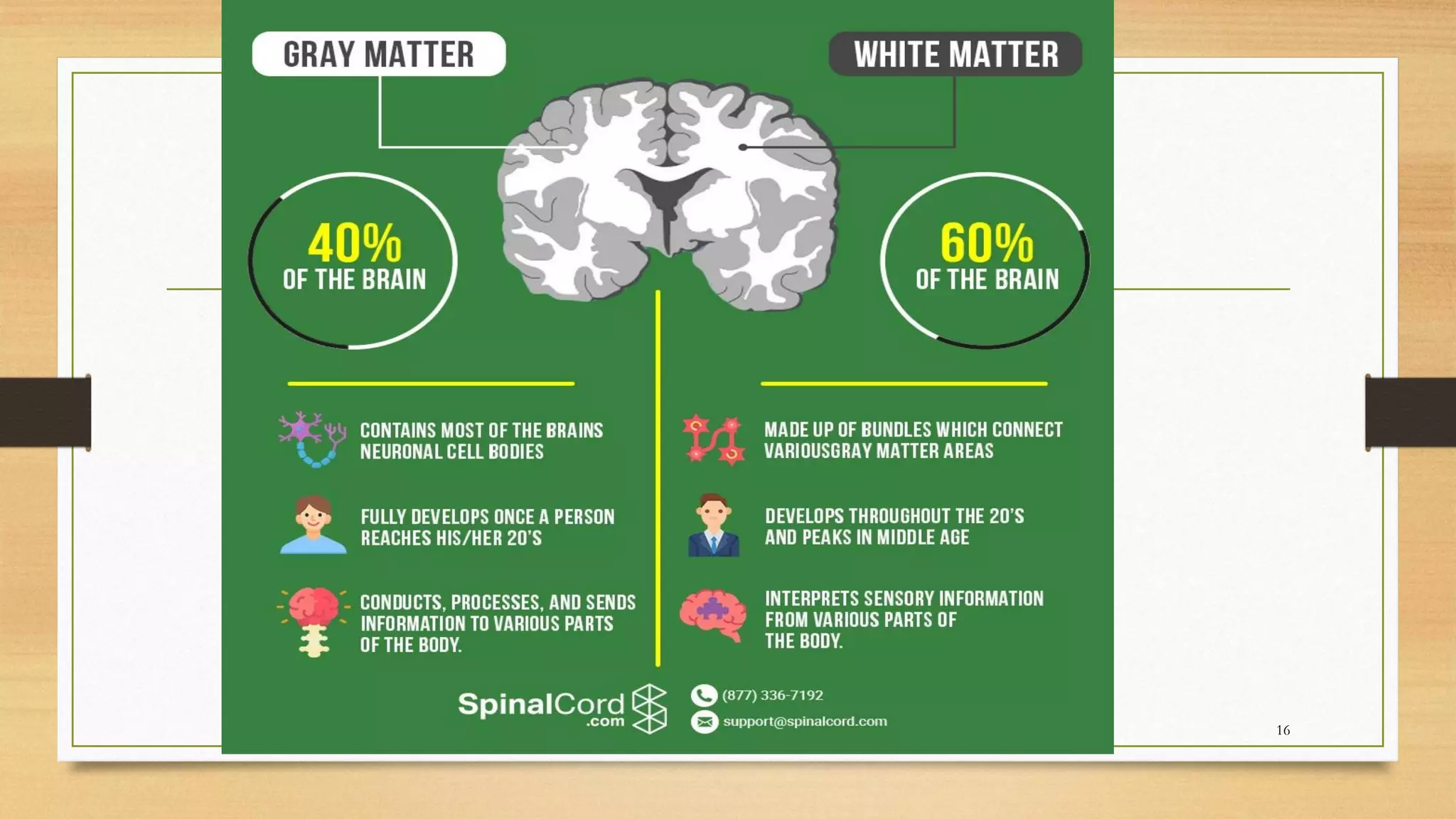
• The gray matter is the areas where the actual "processing" is done whereas
the white matter provides the communication between different gray matter
areas and between the gray matter and the rest of the body.
About 40% of the human brain is made up of gray matter and the other 60%
is white matter. The gray matter, however, consumes about 94% of the total
oxygen used by the brain.
• White matter conducts, processes, and send nerve signals up and down the spinal
15
16
17
18
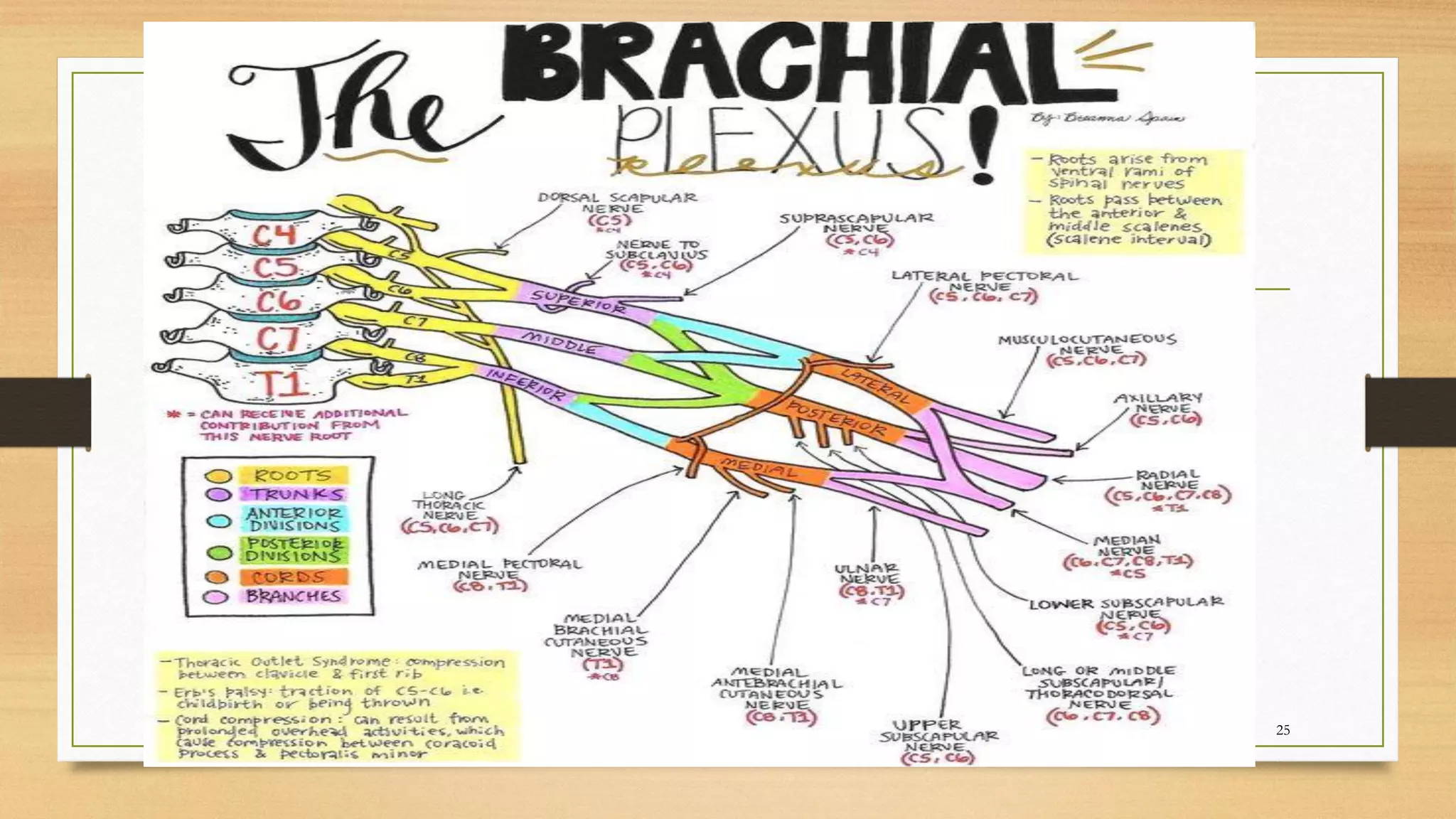
Brachial Plexus
• The brachial plexus is a network of nerves in the shoulder that
carries movement and sensory signals from the spinal cord to
the arms and hands.
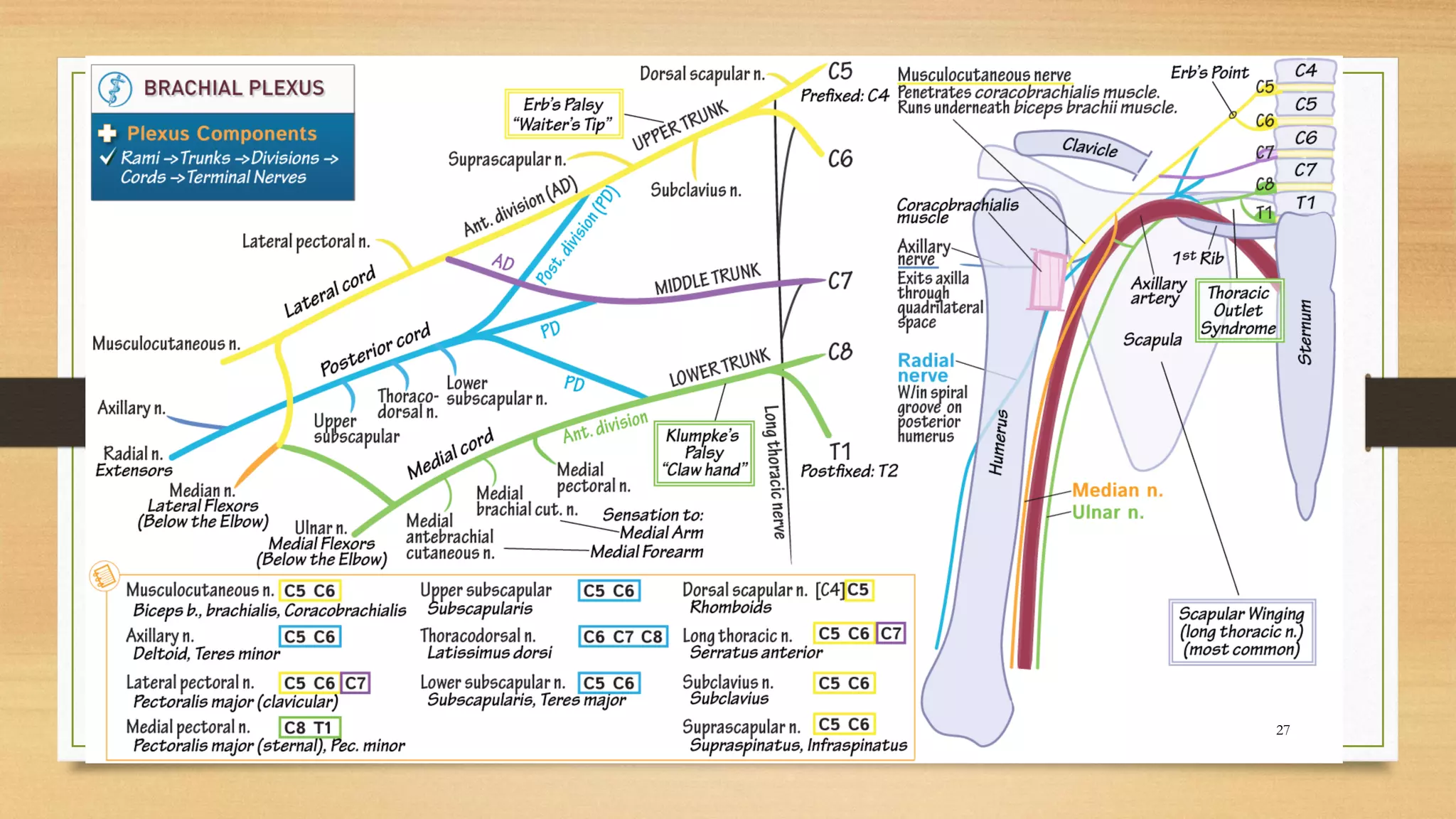
• Brachial plexus is formed by anterior/ventral rami the cervical spinal
nerves C5, C6, C7 and C8, and the first thoracic spinal nerve, T1.
19
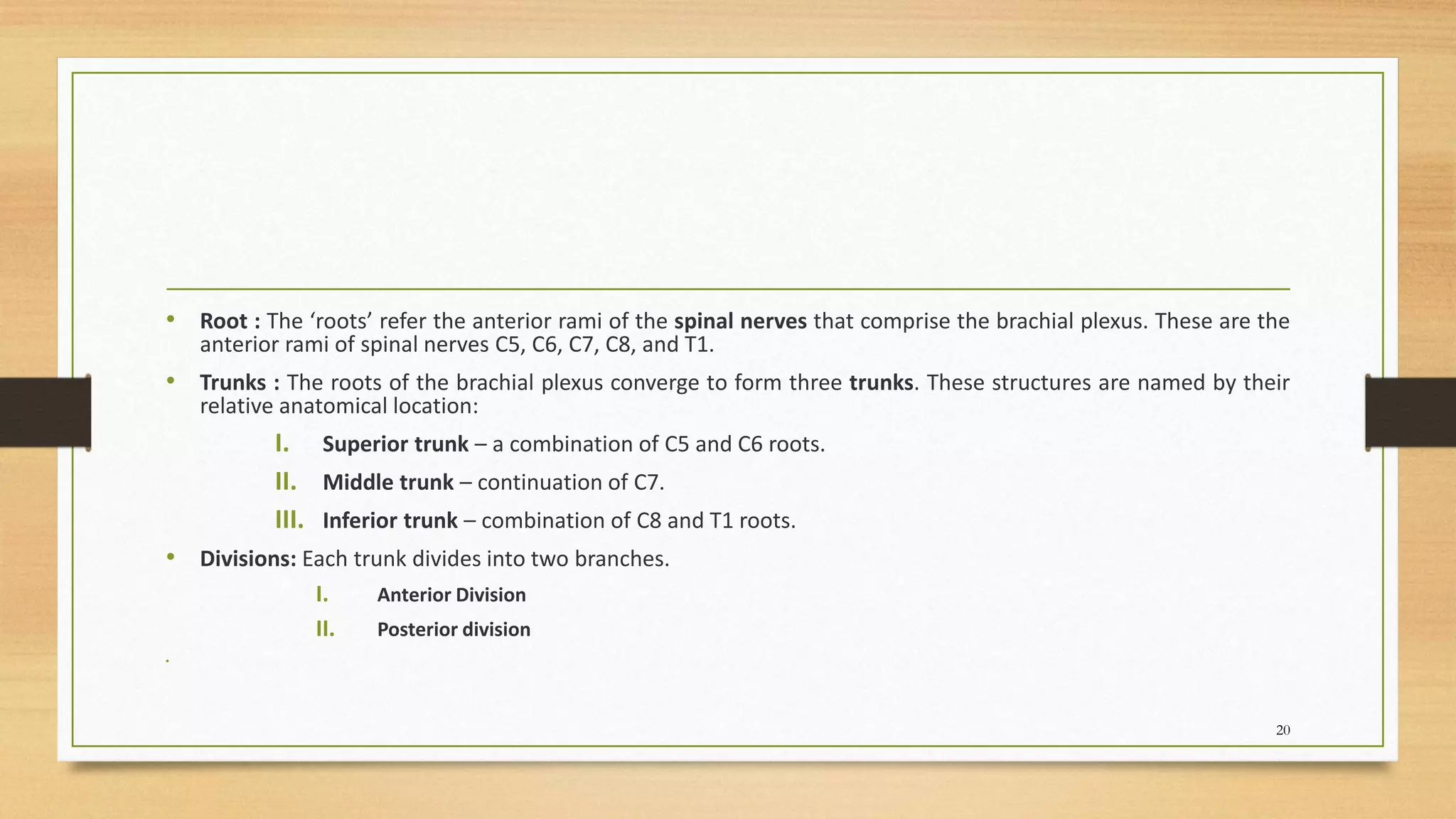
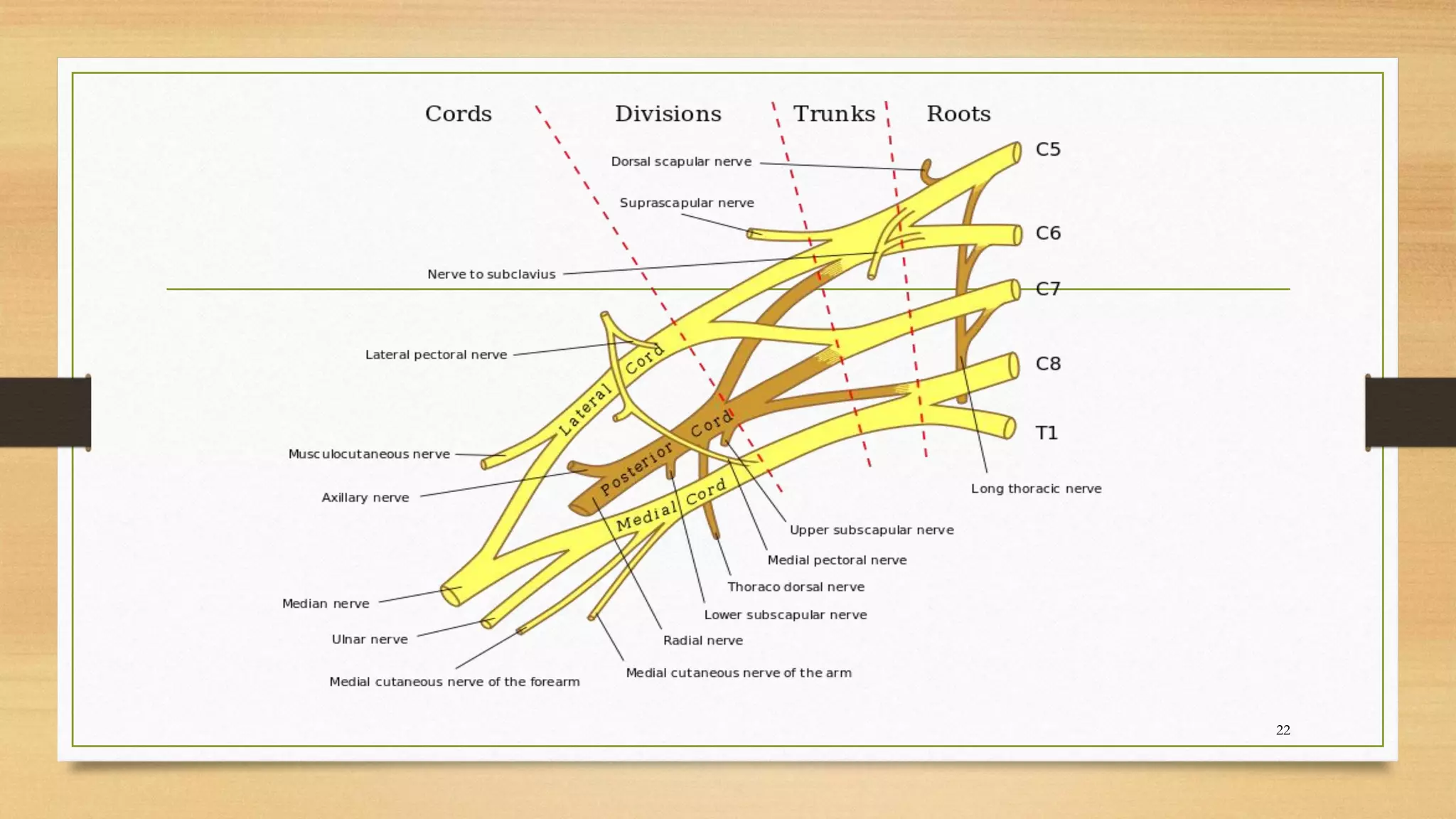
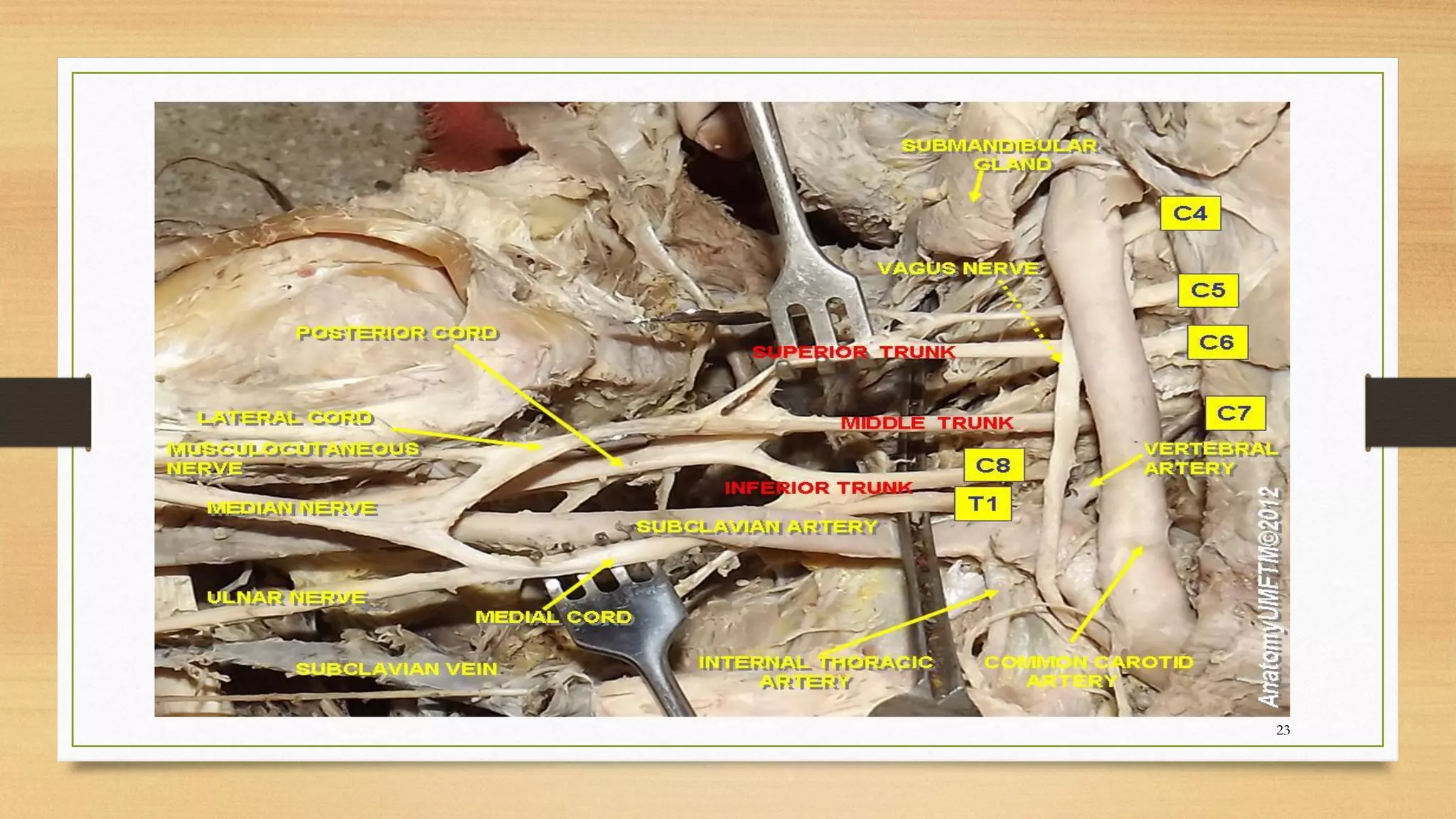
• Root : The ‘roots’ refer the anterior rami of the spinal nerves that comprise the brachial plexus. These are the
anterior rami of spinal nerves C5, C6, C7, C8, and T1.
• Trunks : The roots of the brachial plexus converge to form three trunks. These structures are named by their
relative anatomical location:
I. Superior trunk – a combination of C5 and C6 roots.
II. Middle trunk – continuation of C7.
III. Inferior trunk – combination of C8 and T1 roots.
• Divisions: Each trunk divides into two branches.
I. Anterior Division
II. Posterior division
•
20
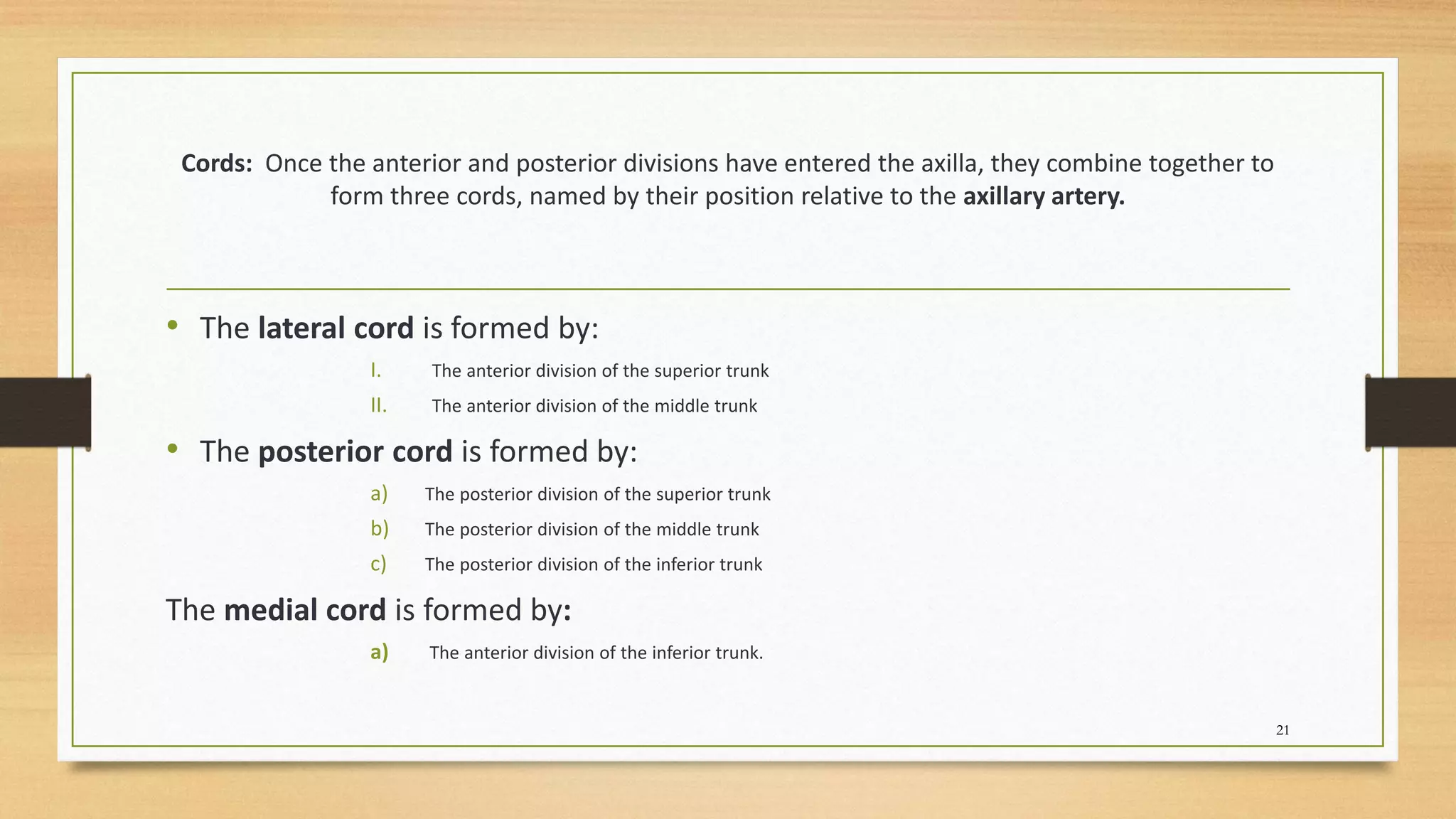
Cords: Once the anterior and posterior divisions have entered the axilla, they combine together to
form three cords, named by their position relative to the axillary artery.
• The lateral cord is formed by:
I. The anterior division of the superior trunk
II. The anterior division of the middle trunk
• The posterior cord is formed by:
a) The posterior division of the superior trunk
b) The posterior division of the middle trunk
c) The posterior division of the inferior trunk
The medial cord is formed by:
a) The anterior division of the inferior trunk.
21
22
23
24
25
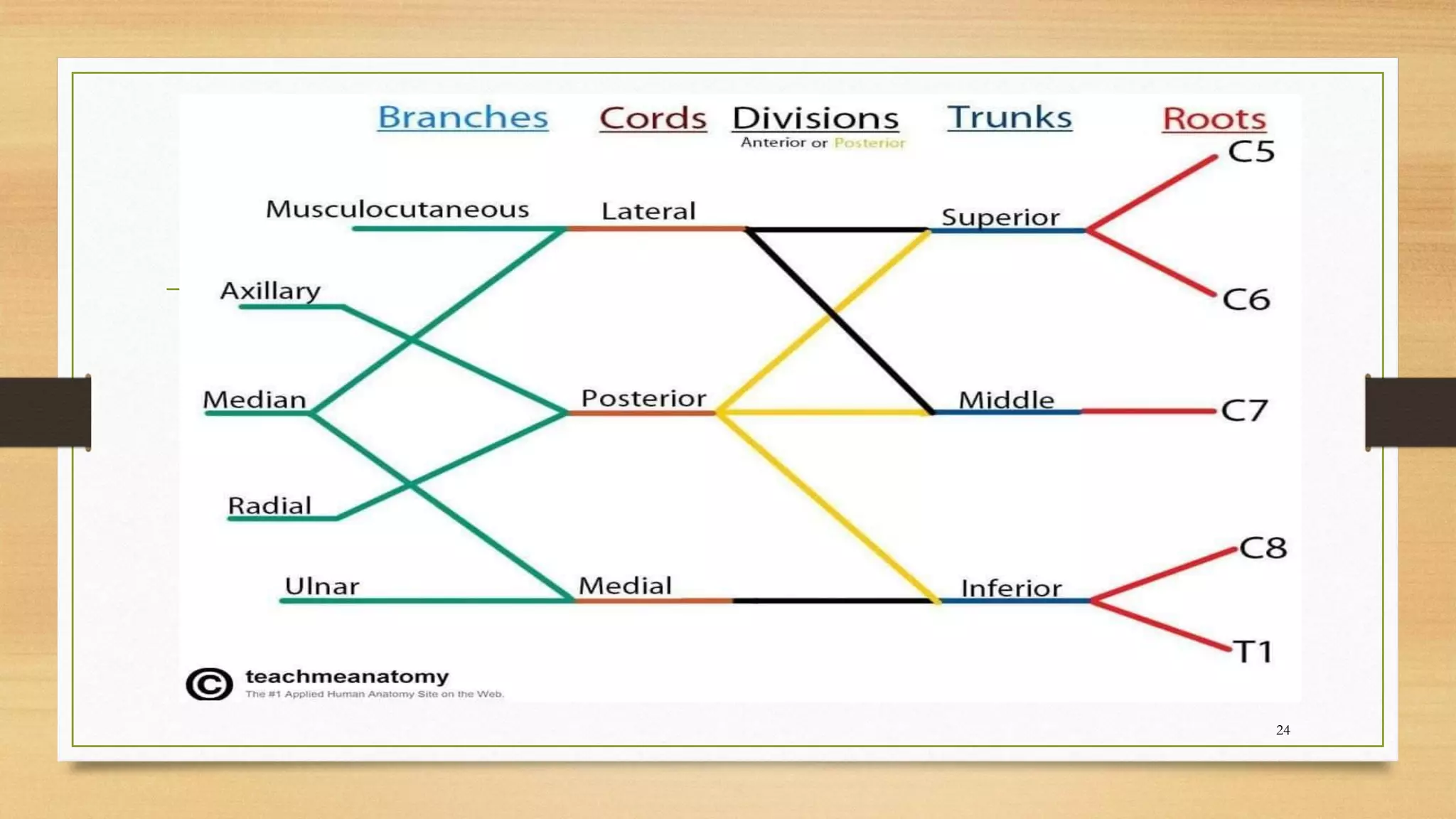
• The brachial plexus ends in five major nerve branches that extend down the arm:
• Musculocutaneous nerve: Originates from nerve roots C5-C7 and flexes muscles in the
upper arm, at both the shoulder and elbow.
• Axillary nerve: Stems from nerve roots C5 and C6; it helps the shoulder rotate and
enables the arm to lift away from the body.
• Median nerve: Starts in nerve roots C6-T1 and enables movement in the forearm and
parts of the hand.
• Radial nerve: Begins in nerve roots C5-T1 and controls various muscles in the upper arm,
elbow, forearm and hand.
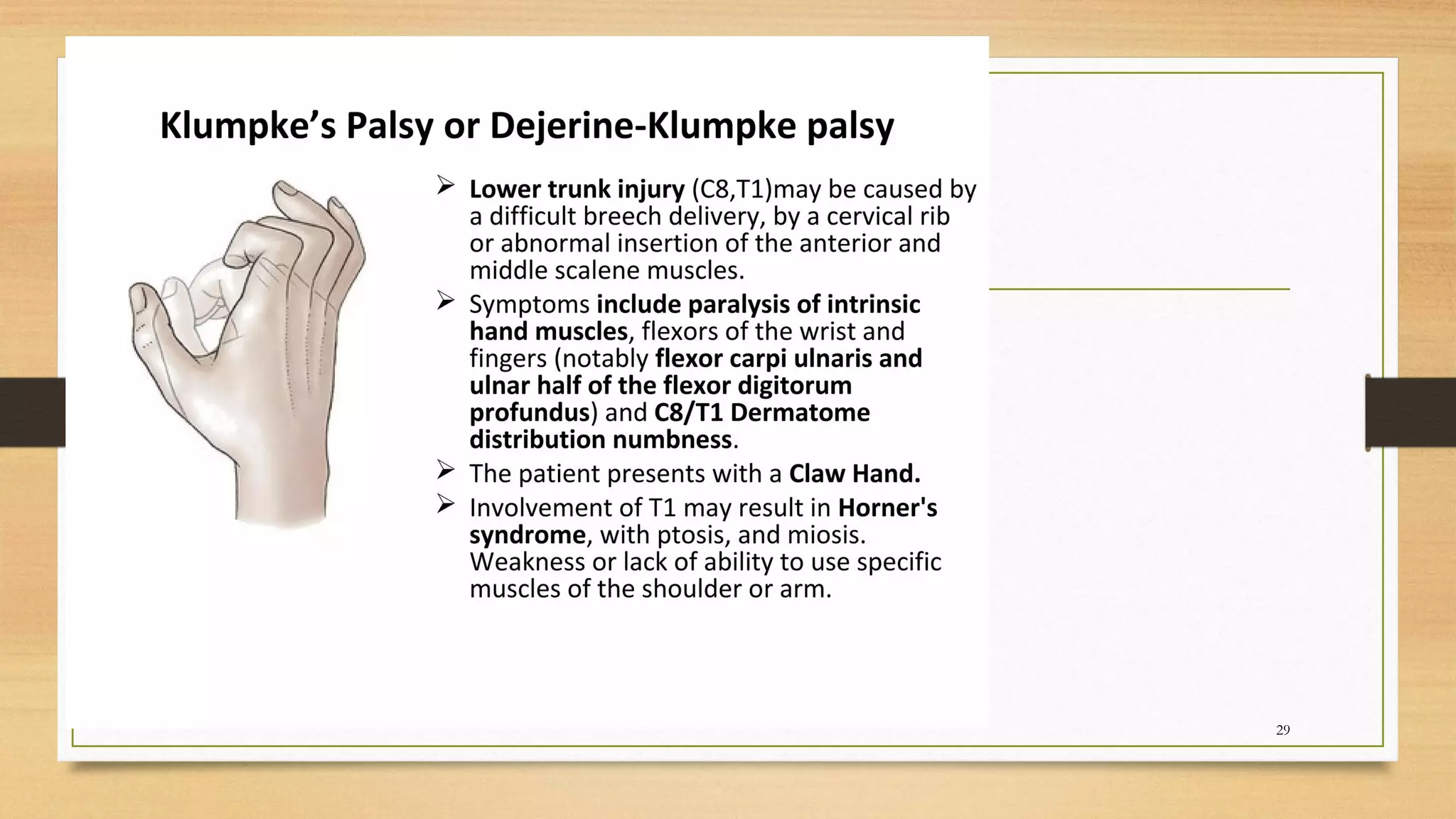
• Ulnar nerve: Rooted in C8-T1, it allows for fine motor control of the fingers.
26
27
28
29
ASSIGNMENT
• DRAW & LABEL BRACHIAL PLEXUS
• DRAW SENSORY INNERVATION OF UPPER ARM
• MUSCLES & NERVES OF BRACHIAL PLEXUS
SUBMIT BEFORE NEXT CLASS
30

Nervous System & Brachial Plexus.pdf

  • 1.
    Nervous System Dr MusaddiqKhan Durrani MBBS, MCPS® Institute of Social & Cultural Studies University Of the Punjab 1
  • 2.
    Learning objectives • Basicsof Nervous System • Spinal Nerves • Brachial plexus 2
  • 3.
    ‫ـ‬ َ‫س‬‫ن‬ ِ ْ ‫ْل‬‫ٱ‬ ‫ا‬َ‫ن‬ْ‫ق‬َ‫ل‬َ‫خ‬ْ‫د‬َ‫ق‬َ‫ل‬ َ‫ت‬ ‫ى‬‫ن‬ َ‫س‬ْ‫ح‬َ‫ٱ‬ ٓ ‫ى‬ ‫ِف‬ َ‫ن‬ ‫م‬‫ي‬‫ى‬‫و‬ْ‫ق‬ 95:4 Indeed, We created humans in the best form. 95:4 3
  • 4.
    Definition • A networkof neurons that sends, receives and modulates neural impulses between different body parts. Neuron→ Neurons are the fundamental unit of the nervous system specialized to transmit information to different parts of the body. 4
  • 5.
  • 6.
    Classification of Neurons •Sensory • Motor • Interneurons 6
  • 7.
    Sub divisions ofNervous System • The nervous system can be broadly divided into two sections. • The Central nervous system (CNS) consists of the brain and the spinal cord. It is in the CNS that all of the analysis of information takes place. It Receives, Interprets and send signals to PNS • The peripheral nervous system (PNS), which consists of the neurons and parts of neurons found outside of the CNS, includes sensory neurons and motor neurons. Sensory neurons bring signals into the CNS, and motor neurons carry signals out of the CNS. 7
  • 8.
  • 9.
    Central nervous system •Brain and Spinal Cord,→ protective membranes called the Meninges, and both float in a crystal-clear Cereberospinal fluid. 9
  • 10.
    • Spinal Cord→31 pair of Spinal Nerves 8 cervical, 12 thoracic, 5 lumbar, 5 sacral, and 1 coccygeal. Each pair connects the spinal cord with a specific region of the body • Spinal meninges are three membranes that surround the spinal cord – the dura mater, arachnoid mater, and pia mater. They contain cerebrospinal fluid, acting to support and protect the spinal cord. • Network of Nerves are called Plexus, e.g Brachial Plexus & Sacral Plexus 10
  • 11.
  • 12.
    Spinal nerves • Eachspinal nerve is formed by the combination of nerve fibers from the dorsal and ventral roots of the spinal cord. 1.The dorsal roots carry afferent sensory axons 2.The ventral roots carry efferent motor axons. 12
  • 13.
    • The dorsalhorn (also known as the posterior horn) contains neurons that receive somatosensory information from the body, which is then transmitted via the ascending pathways, to the brain. • The ventral horn (also known as the anterior horn) largely contains motor neurons that exit the spinal cord to innervate skeletal muscle. 13
  • 14.
  • 15.
    • The graymatter is the areas where the actual "processing" is done whereas the white matter provides the communication between different gray matter areas and between the gray matter and the rest of the body. About 40% of the human brain is made up of gray matter and the other 60% is white matter. The gray matter, however, consumes about 94% of the total oxygen used by the brain. • White matter conducts, processes, and send nerve signals up and down the spinal 15
  • 16.
  • 17.
  • 18.
  • 19.
    Brachial Plexus • Thebrachial plexus is a network of nerves in the shoulder that carries movement and sensory signals from the spinal cord to the arms and hands. • Brachial plexus is formed by anterior/ventral rami the cervical spinal nerves C5, C6, C7 and C8, and the first thoracic spinal nerve, T1. 19
  • 20.
    • Root :The ‘roots’ refer the anterior rami of the spinal nerves that comprise the brachial plexus. These are the anterior rami of spinal nerves C5, C6, C7, C8, and T1. • Trunks : The roots of the brachial plexus converge to form three trunks. These structures are named by their relative anatomical location: I. Superior trunk – a combination of C5 and C6 roots. II. Middle trunk – continuation of C7. III. Inferior trunk – combination of C8 and T1 roots. • Divisions: Each trunk divides into two branches. I. Anterior Division II. Posterior division • 20
  • 21.
    Cords: Once theanterior and posterior divisions have entered the axilla, they combine together to form three cords, named by their position relative to the axillary artery. • The lateral cord is formed by: I. The anterior division of the superior trunk II. The anterior division of the middle trunk • The posterior cord is formed by: a) The posterior division of the superior trunk b) The posterior division of the middle trunk c) The posterior division of the inferior trunk The medial cord is formed by: a) The anterior division of the inferior trunk. 21
  • 22.
  • 23.
  • 24.
  • 25.
  • 26.
    • The brachialplexus ends in five major nerve branches that extend down the arm: • Musculocutaneous nerve: Originates from nerve roots C5-C7 and flexes muscles in the upper arm, at both the shoulder and elbow. • Axillary nerve: Stems from nerve roots C5 and C6; it helps the shoulder rotate and enables the arm to lift away from the body. • Median nerve: Starts in nerve roots C6-T1 and enables movement in the forearm and parts of the hand. • Radial nerve: Begins in nerve roots C5-T1 and controls various muscles in the upper arm, elbow, forearm and hand. • Ulnar nerve: Rooted in C8-T1, it allows for fine motor control of the fingers. 26
  • 27.
  • 28.
  • 29.
  • 30.
    ASSIGNMENT • DRAW &LABEL BRACHIAL PLEXUS • DRAW SENSORY INNERVATION OF UPPER ARM • MUSCLES & NERVES OF BRACHIAL PLEXUS SUBMIT BEFORE NEXT CLASS 30