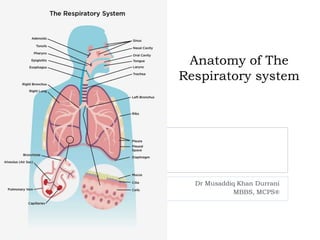
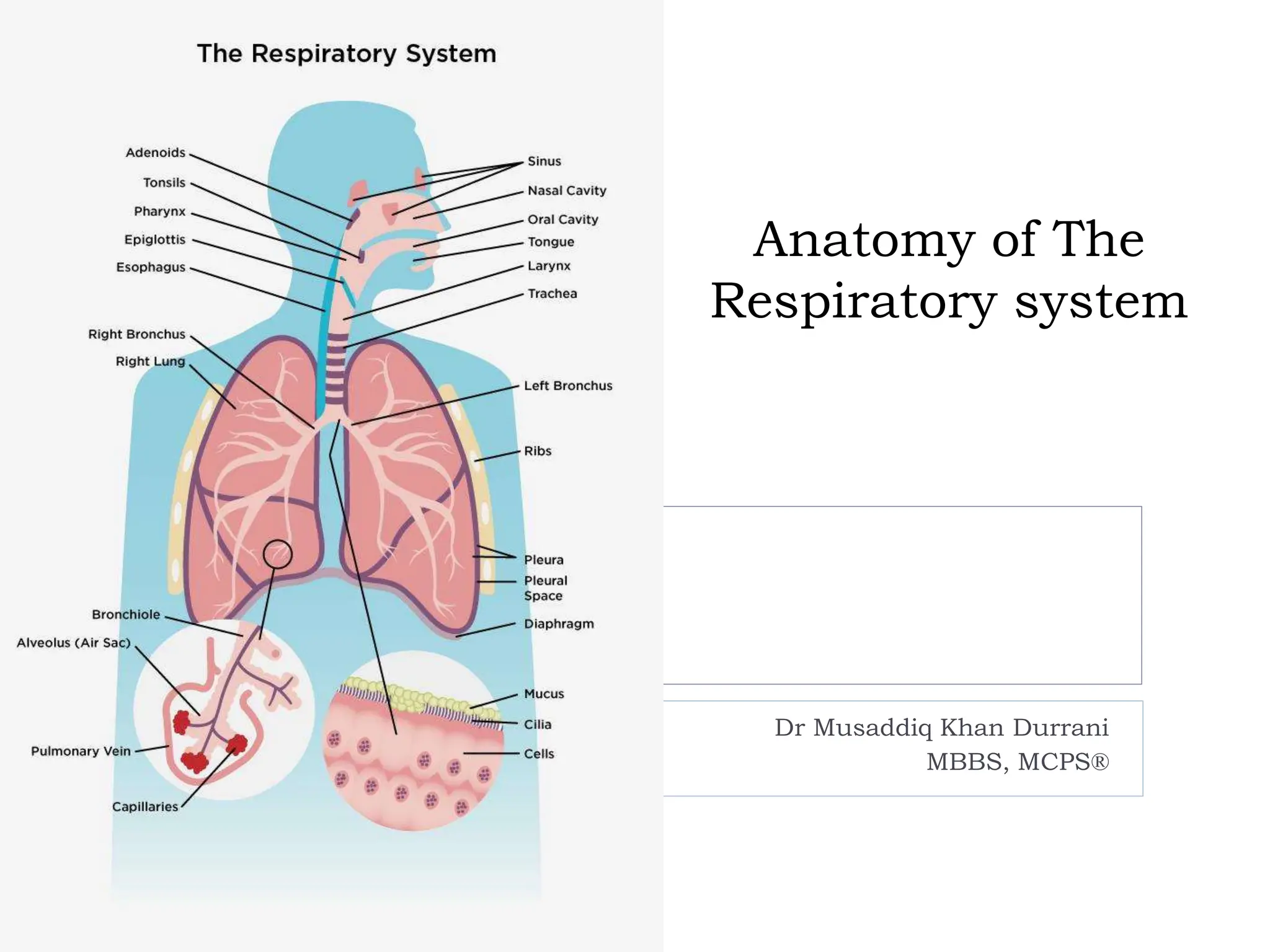
Anatomy of The
Respiratory system
Dr Musaddiq Khan Durrani
MBBS, MCPS®
THORAX
 The thorax (or chest) is the region of the body
between the neck and the abdomen.
 flattened in front and behind but rounded at the sides
 The framework of the walls of the thorax, which is
referred to as the thoracic cage, is formed by the
vertebral column behind, the ribs and intercostal
spaces on either side, and the sternum and
costal cartilages in front.
 Inferiorly it is separated from the abdomen by the
diaphragm.
 The thoracic cage protects the lungs and heart and
affords attachment for the muscles of the thorax,
upper extremity, abdomen, and back.
STERNUM & RIBS
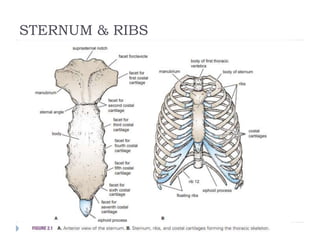
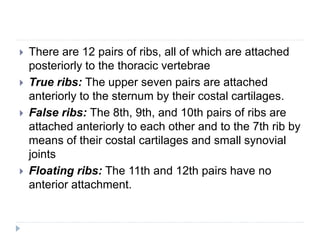
 There are 12 pairs of ribs, all of which are attached
posteriorly to the thoracic vertebrae
 True ribs: The upper seven pairs are attached
anteriorly to the sternum by their costal cartilages.
 False ribs: The 8th, 9th, and 10th pairs of ribs are
attached anteriorly to each other and to the 7th rib by
means of their costal cartilages and small synovial
joints
 Floating ribs: The 11th and 12th pairs have no
anterior attachment.
General Functions of Respiratory System:
 System which is involved in Exchange of Gases
 O2 and CO2 exchange between blood and air
 speech and vocalization
 sense of smell
 helps control acid base balance of body
 breathing movements help promote blood and lymph
flow
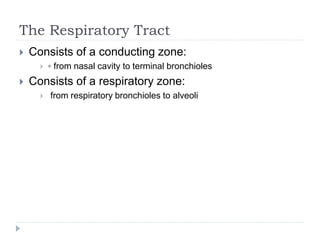
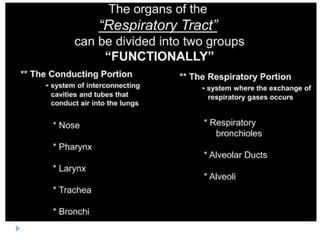
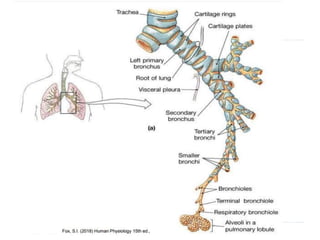
The Respiratory Tract
 Consists of a conducting zone:
 ◦ from nasal cavity to terminal bronchioles
 Consists of a respiratory zone:
 from respiratory bronchioles to alveoli
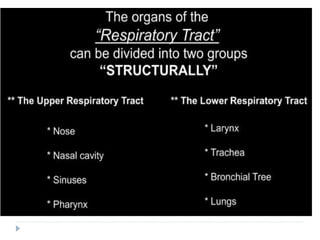
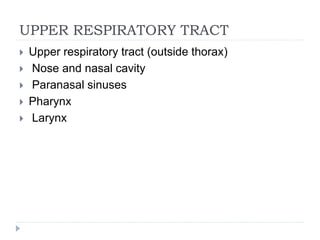
UPPER RESPIRATORY TRACT
 Upper respiratory tract (outside thorax)
 Nose and nasal cavity
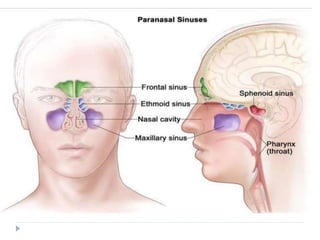
 Paranasal sinuses
 Pharynx
 Larynx
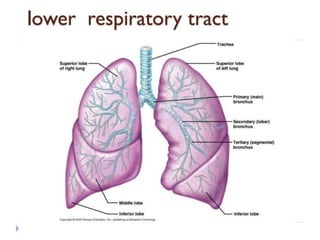
LOWER RESPIRATORY TRACT
 Lower respiratory tract (within thorax)
 Trachea
 Bronchi and their smaller branches
 Lungs, which contain the terminal air sacs (alveoli)
NOSE
 MAIN ROUTE OF AIR ENTRY
 DIVIDED IN TWO CAVITIES VIA
SEPTUM
ant hyalin caritlage
roof  ethmoid bone
floor palate
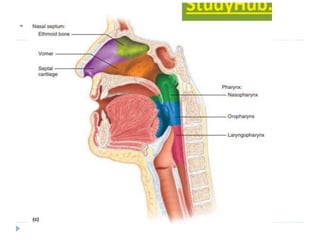
Pharynx
 commonly called the throat
 Passageway connecting nasal cavity to the larynx
and oral cavity to esophagus
 divided into three regions based on location and
anatomy—
 Nasopharynx behind nose to level of soft palate includes uvula
tonsils (adenoids) auditory tube (eustachian tube) drains here
 Oropharynx behind mouth from soft palate to level of
hyoid bone palatine and lingual tonsils
 Laryngopharynx from hyoid bone to esophagus/larynx
`
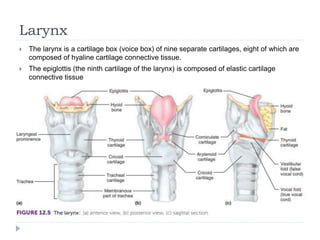
Larynx
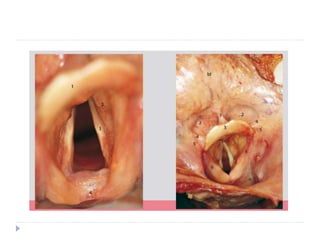
 The larynx is a cartilage box (voice box) of nine separate cartilages, eight of which are
composed of hyaline cartilage connective tissue.
 The epiglottis (the ninth cartilage of the larynx) is composed of elastic cartilage
connective tissue
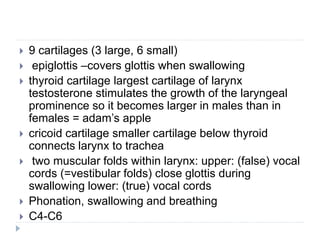
 9 cartilages (3 large, 6 small)
 epiglottis –covers glottis when swallowing
 thyroid cartilage largest cartilage of larynx
testosterone stimulates the growth of the laryngeal
prominence so it becomes larger in males than in
females = adam’s apple
 cricoid cartilage smaller cartilage below thyroid
connects larynx to trachea
 two muscular folds within larynx: upper: (false) vocal
cords (=vestibular folds) close glottis during
swallowing lower: (true) vocal cords
 Phonation, swallowing and breathing
 C4-C6
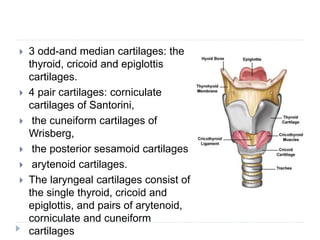
 3 odd-and median cartilages: the
thyroid, cricoid and epiglottis
cartilages.
 4 pair cartilages: corniculate
cartilages of Santorini,
 the cuneiform cartilages of
Wrisberg,
 the posterior sesamoid cartilages
 arytenoid cartilages.
 The laryngeal cartilages consist of
the single thyroid, cricoid and
epiglottis, and pairs of arytenoid,
corniculate and cuneiform
cartilages
 The larynx is innervated by branches of the vagus
nerve (CN X).
 • Sensory – For the laryngopharynx, the internal
laryngeal branch of the superior laryngeal nerve
supplies sensation above the vocal chords
(supraglottis/glottis) and the recurrent laryngeal
nerve supplies sensation below the vocal chords
(subglottis).
 • Motor – All intrinsic muscles are supplied by the
recurrent laryngeal nerve, except for the cricothyroid
which is supplied by the external laryngeal nerve.
 The cricothyroid muscle tenses the vocal folds.
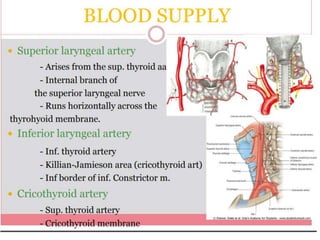
 • Arteries
 Superior and inferior laryngeal arteries (from the
superior and inferior thyroid arteries) accompany the
internal and recurrent laryngeal nerves, respectively.
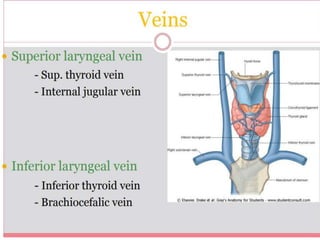
 • Vein – Venous drainage is by corresponding veins.
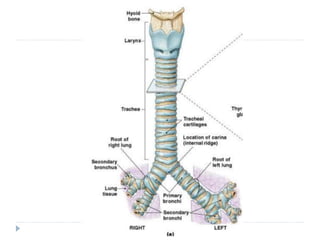
Trachea
 A flexible tube also called windpipe.
 Extends through the mediastinum and lies anterior to the
esophagus and inferior to the larynx..
 Anterior and lateral walls of the trachea supported by 15
to 20 C-shaped tracheal cartilages.
 Cartilage rings reinforce and provide rigidity to the
tracheal wall to ensure that the trachea remains open at
all times
 Posterior part of tube lined by trachealis muscle.
 At the level of the sternal angle,
 the trachea bifurcates into two smaller tubes, called the
right and left primary bronchi.
 Each primary bronchus projects laterally toward each
lung.
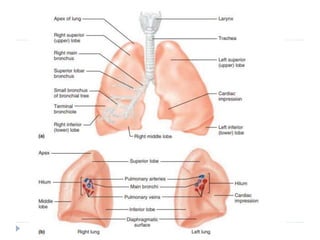
Lungs
 Each lung has a conical shape. Its wide, concave
base rests upon the muscular diaphragm.
 Its superior region called the apex projects
superiorly to a point that is slightly superior and
posterior to the clavicle.
 Both lungs are bordered by the thoracic wall
anteriorly, laterally, and posteriorly, and supported by
the rib cage.
 Toward the midline, the lungs are separated from
each other by the mediastinum.
 The relatively broad, rounded surface in contact with
the thoracic wall is called the costal surface of the
lung.
 Left lung
 divided into 2 lobes by oblique fissure
 smaller than the right lung
 cardiac notch accommodates the heart
 Right
 divided into 3 lobes by oblique and horizontal fissure
 located more superiorly in the body due to liver on
right side
Respiratory system.pptx

Respiratory system.pptx

  • 1.
    Anatomy of The Respiratorysystem Dr Musaddiq Khan Durrani MBBS, MCPS®
  • 2.
    THORAX  The thorax(or chest) is the region of the body between the neck and the abdomen.  flattened in front and behind but rounded at the sides  The framework of the walls of the thorax, which is referred to as the thoracic cage, is formed by the vertebral column behind, the ribs and intercostal spaces on either side, and the sternum and costal cartilages in front.  Inferiorly it is separated from the abdomen by the diaphragm.  The thoracic cage protects the lungs and heart and affords attachment for the muscles of the thorax, upper extremity, abdomen, and back.
  • 4.
  • 5.
     There are12 pairs of ribs, all of which are attached posteriorly to the thoracic vertebrae  True ribs: The upper seven pairs are attached anteriorly to the sternum by their costal cartilages.  False ribs: The 8th, 9th, and 10th pairs of ribs are attached anteriorly to each other and to the 7th rib by means of their costal cartilages and small synovial joints  Floating ribs: The 11th and 12th pairs have no anterior attachment.
  • 7.
    General Functions ofRespiratory System:  System which is involved in Exchange of Gases  O2 and CO2 exchange between blood and air  speech and vocalization  sense of smell  helps control acid base balance of body  breathing movements help promote blood and lymph flow
  • 8.
    The Respiratory Tract Consists of a conducting zone:  ◦ from nasal cavity to terminal bronchioles  Consists of a respiratory zone:  from respiratory bronchioles to alveoli
  • 11.
    UPPER RESPIRATORY TRACT Upper respiratory tract (outside thorax)  Nose and nasal cavity  Paranasal sinuses  Pharynx  Larynx
  • 12.
    LOWER RESPIRATORY TRACT Lower respiratory tract (within thorax)  Trachea  Bronchi and their smaller branches  Lungs, which contain the terminal air sacs (alveoli)
  • 13.
    NOSE  MAIN ROUTEOF AIR ENTRY  DIVIDED IN TWO CAVITIES VIA SEPTUM ant hyalin caritlage roof  ethmoid bone floor palate
  • 16.
    Pharynx  commonly calledthe throat  Passageway connecting nasal cavity to the larynx and oral cavity to esophagus  divided into three regions based on location and anatomy—  Nasopharynx behind nose to level of soft palate includes uvula tonsils (adenoids) auditory tube (eustachian tube) drains here  Oropharynx behind mouth from soft palate to level of hyoid bone palatine and lingual tonsils  Laryngopharynx from hyoid bone to esophagus/larynx
  • 17.
  • 18.
    Larynx  The larynxis a cartilage box (voice box) of nine separate cartilages, eight of which are composed of hyaline cartilage connective tissue.  The epiglottis (the ninth cartilage of the larynx) is composed of elastic cartilage connective tissue
  • 19.
     9 cartilages(3 large, 6 small)  epiglottis –covers glottis when swallowing  thyroid cartilage largest cartilage of larynx testosterone stimulates the growth of the laryngeal prominence so it becomes larger in males than in females = adam’s apple  cricoid cartilage smaller cartilage below thyroid connects larynx to trachea  two muscular folds within larynx: upper: (false) vocal cords (=vestibular folds) close glottis during swallowing lower: (true) vocal cords  Phonation, swallowing and breathing  C4-C6
  • 20.
     3 odd-andmedian cartilages: the thyroid, cricoid and epiglottis cartilages.  4 pair cartilages: corniculate cartilages of Santorini,  the cuneiform cartilages of Wrisberg,  the posterior sesamoid cartilages  arytenoid cartilages.  The laryngeal cartilages consist of the single thyroid, cricoid and epiglottis, and pairs of arytenoid, corniculate and cuneiform cartilages
  • 22.
     The larynxis innervated by branches of the vagus nerve (CN X).  • Sensory – For the laryngopharynx, the internal laryngeal branch of the superior laryngeal nerve supplies sensation above the vocal chords (supraglottis/glottis) and the recurrent laryngeal nerve supplies sensation below the vocal chords (subglottis).  • Motor – All intrinsic muscles are supplied by the recurrent laryngeal nerve, except for the cricothyroid which is supplied by the external laryngeal nerve.  The cricothyroid muscle tenses the vocal folds.
  • 23.
     • Arteries Superior and inferior laryngeal arteries (from the superior and inferior thyroid arteries) accompany the internal and recurrent laryngeal nerves, respectively.  • Vein – Venous drainage is by corresponding veins.
  • 27.
    Trachea  A flexibletube also called windpipe.  Extends through the mediastinum and lies anterior to the esophagus and inferior to the larynx..  Anterior and lateral walls of the trachea supported by 15 to 20 C-shaped tracheal cartilages.  Cartilage rings reinforce and provide rigidity to the tracheal wall to ensure that the trachea remains open at all times  Posterior part of tube lined by trachealis muscle.  At the level of the sternal angle,  the trachea bifurcates into two smaller tubes, called the right and left primary bronchi.  Each primary bronchus projects laterally toward each lung.
  • 30.
    Lungs  Each lunghas a conical shape. Its wide, concave base rests upon the muscular diaphragm.  Its superior region called the apex projects superiorly to a point that is slightly superior and posterior to the clavicle.  Both lungs are bordered by the thoracic wall anteriorly, laterally, and posteriorly, and supported by the rib cage.  Toward the midline, the lungs are separated from each other by the mediastinum.  The relatively broad, rounded surface in contact with the thoracic wall is called the costal surface of the lung.
  • 31.
     Left lung divided into 2 lobes by oblique fissure  smaller than the right lung  cardiac notch accommodates the heart  Right  divided into 3 lobes by oblique and horizontal fissure  located more superiorly in the body due to liver on right side