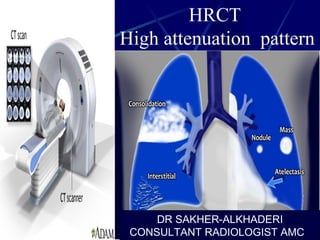
HRCT
High attenuation pattern
DR SAKHER-ALKHADERI
CONSULTANT RADIOLOGIST AMC
Attenuation pattern
High Attenuation pattern
 GROUND GLASS
 CONSOLIDATION
Low Attenuation pattern
 Emphysema
 Lung cysts (LAM, LIP, Langerhans cell histiocytosis)
 Bronchiectasis
 Honeycombing
Dark bronchus sign in ground glass opacity.
Complete obscuration of vessels in consolidation.
GROUND GLASS OPACITY
Dark bronchus sign
Ground-glass opacification/opacity (GGO) is a descriptive
term referring to a hazy area of increased attenuation in the
lung with preserved bronchial and vascular markings. It is a
non-specific sign with a wide aetiology including infection,
chronic interstitial disease and acute alveolar disease.
Ground-glass opacities have a broad aetiology:
normal expiration
partial filling of air spaces
partial collapse of alveoli
interstitial thickening
inflammation
oedema
fibrosis
lepidic proliferation of neoplasm
Ground-glass opacification/opacity (GGO)
Broncho-alveolar cell carcinoma with ground-glass
opacity and consolidation
Causes
The opacification is caused by fluid or solid material within the airways that causes a
difference in the relative attenuation of the lung:
transudate, e.g. pulmonary oedema secondary to heart failure
pus, e.g. bacterial pneumonia
blood, e.g. pulmonary haemorrhage
cells, e.g. bronchoalveolar carcinoma
protein, e.g. alveolar proteinosis
fat, e.g. lipoid pneumonia
gastric contents, e.g. aspiration pneumonia
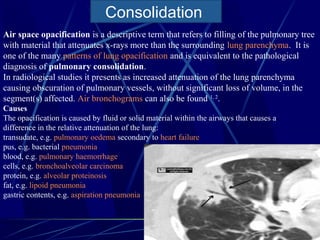
Air space opacification is a descriptive term that refers to filling of the pulmonary tree
with material that attenuates x-rays more than the surrounding lung parenchyma. It is
one of the many patterns of lung opacification and is equivalent to the pathological
diagnosis of pulmonary consolidation.
In radiological studies it presents as increased attenuation of the lung parenchyma
causing obscuration of pulmonary vessels, without significant loss of volume, in the
segment(s) affected. Air bronchograms can also be found 1, 2
.
Consolidation
fat, e.g.
lipoid pneumonia
gastric contents,
e.g.
aspiration pneumonia
Air space filling
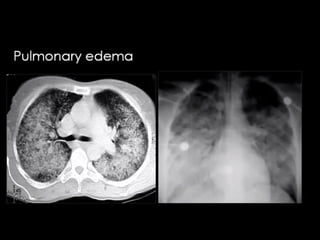
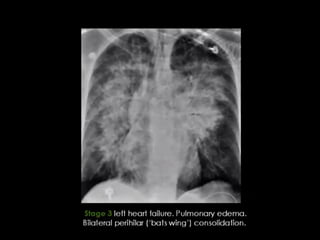
-Pulmonary oedema is a broad descriptive term and is usually 
defined as an abnormal accumulation of fluid in the extra-vascular 
compartments of the lung 1
.
-HRCT findings in cardiogenic pulmonary edema
Bilateral septal thickening and ground-glass opacity.
Perihilar and gravitational distribution predominatly in the 
dependent lung.
Cardiomegaly and pleural fluid.
-Differential diagnosis of cardiogenic pulmonary edema.
Lymphangitic carcinomatosis
Interstitial pneumonia (viral, mycoplasma)
ARDS
Pulmonary hemorrhage
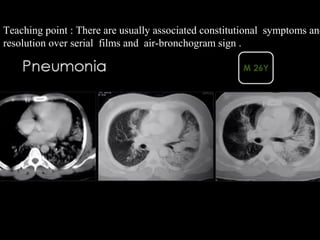
Teaching point : There are usually associated constitutional  symptoms and
resolution over serial  films and  air-bronchogram sign .  
Diffuse alveolar hemorrhage (DAH) is a life-
threatening disorder characterized clinically
by the presence of hemoptysis, falling
hematocrit, diffuse pulmonary infiltrates and
hypoxemic respiratory failure. It refers to
bleeding that originates in the pulmonary
microvasculature instead of the parenchyma
or bronchial circulation. DAH should be
considered a medical emergency due to the
morbidity and mortality associated with
failure to treat the disorder promptly.
Pulmonary renal syndromes, connective
tissue disorders and drugs make up the
majority of the cases of DAH. The treatment
of DAH ranges from supportive care and
withdrawal of offending drugs to high-dose
steroids, immunosuppresents and
plasmapharesis.
DIFFUSE PULMONARY HEMORRHAGE 
Associations
small vessel vasculitides: alveolar haemorrhage secondary to extensive 
parenchymal small-vessel vasculitis is typically more diffuse and initially 
causes more widespread lobular ground-glass opacification with gravity-
dependent density gradients through to air-space consolidation, often with 
interspersed areas of ground-glass opacity; these include
Wegener granulomatosis 2
other connective tissue disorders
systemic lupus erythematosus (SLE) 4,6
post bone marrow transplantation 3
all-trans-retinoic acid (ATRA) syndrome 11
Goodpasture syndrome 10
pulmonary haemosiderosis: idiopathic pulmonary haemosiderosis 7
coagulative disorders: often require another precipitating source such as an 
infection to cause DPH 7
widespread metastatic lung disease: has been described as a very rare 
cause of DPH 
BRONCHOALVEOLAR
CARCINOMA
Broncho-alveolar cell
carcinoma (BAC) may
present as:
solitary nodule or mass
(40% of patients)
focal or diffuse
consolidation (30%) as
in this case.
diffuse ill-defined
centrilobular nodules
(30%) due to
endobronchial spread.
Crazy Paving Pattern
Crazy Paving is a combination of ground glass opacity with
superimposed septal thickening
Crazy Paving can be seen in:
 Alveolar proteinosis
 Sarcoid
 NSIP
 Organizing pneumonia (COP/BOOP)
 Infection (PCP, viral, Mycoplasma, bacterial)
 Neoplasm (Bronchoalveolarca (BAC)
 Pulmonary hemorrhage
 Edema (heart failure, ARDS, AIP)
Mosaic attenuation
The term 'mosaic attenuation' is used to describe density
differences between affected and non-affected lung areas.
Mosaic attenuation
Lung density and attenuation depends
partially on amount of blood in lung tissue.
May be due to
 vascular obstruction,
 abnormal ventilation or
 airway disease
32
Mosaic pattern in a patient with hypersensitivity pneumonitis
Mosaic pattern in a patient with chronic thromboemboli
Air trapping in chest imaging refers to retention of excess
gas (“air”) in all or part of the lung, especially during
expiration, either as a result of complete or partial airway
obstruction or as a result of local abnormalities in pulmonary
compliance1
.
ExpirationInspiration
Small-airway disease Decreased size and number in lucent lung
compared with higher-attenuation lung Air trapping present as
evidenced by no increase in attenuation or decrease in volume of
lucent lung on expiratory CT scans Dyspnea Cough Variable
response to bronchodilators Wheezing No fever Vascular lung
disease Same as small-airway disease No air trapping seen on
expiratory CTscans Exertional dyspnea No cough No response
to bronchodilators No wheezing No fever Infiltrative diseases
Similar size and number of vessels in both regions of lung No air
trapping seen on expiratory CT scans Dyspnea Cough No
response to bronchodilators No wheezing Fever Constitutional
symptoms
Comparison between the three causes of mosaic
lung pattern
Head cheese sign
It refers to mixed
densities which includes
# consolidation
# ground glass
opacities
# normal lung
# Mosaic perfusion
• Signifies mixed
infiltrative and
obstructive disease
Head cheese sign
Common cause are :
1. Hypersensitive pneumonitis
2. Sarcoidosis
3. DIP
40
Headcheese sign
Headcheese sign in
hypersensitivity
pneumonitis.
HRCT scan shows lung with
a geographic appearance,
which represents a
combination of patchy or
lobular ground-glass opacity
(small arrows) and mosaic
perfusion (large arrows).
THE END

HRCT High attenuation pattern