HRCT PATTERNS
Secondary lobule
• It is the basic anatomic unit of pulmonary
structure and function.
•
It is the smallest lung unit that is surrounded
by connective tissue septa.
1-2 cm and is made up of 5-
15 pulmonary acini
Supplied by a small
bronchiole (terminal
bronchiole) in the center,
that is parallelled by the
centrilobular artery.
Pulmonary veins and
lymphatics run in the
periphery
 Two lymphatic systems:
 central network
 peripheral network
Raoof, S. , CHEST 2006; 129:805
6
terminal bronchioles
7
Accompanying pulmonary arterioles
8
Surrounded by lymph vessels
9
Pulmonary veins
10
Pulmonary lymphatics
11
12
Connective Tissue StromaConnective Tissue Stroma
Increased attenuation
Decreased attenuation
interlobular septal thickening
Irregular smooth nodular
Lung distortion
Honey lymphangitic tumor
Combing DDs sarcoidosis
Sarcoidosis,asbestosis
smooth
Thick septa predominant ground glass predominant
Lymphangitic tumor crazy paving DDs
Pulm oedema
Haemorrhage
Amyloid(rare)
Peribronchovascular interstitial thickening
Lymphangitic spread of carcinoma
Lymphoma
Leukaemia
LIP
Interstitial edema
Sarcoidosis
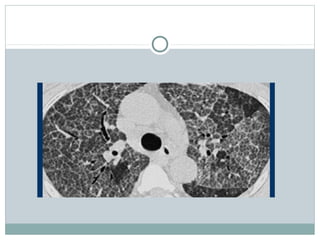
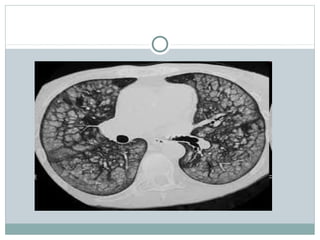
Interlobular septal thickening
Focal septal thickening in lymphangitic carcinomatosis
Septal thickening and ground-glass opacity
with a gravitational distribution in a patient
with cardiogenic pulmonary edema.
Notice the nodules along the fissures indicating a perilymphatic
distribution (red arrows).
The majority of nodules located along the bronchovascular bundle (yellow
arrow).
Nodular septal thickening
Parenchymal bands
Non tapering reticular opacity,1-3 mm in tickness
and 2 to 5 cm in length
Often peripheral and contacts the pleural surface
Represent contiguous thickened interlobulsr
septa,peribronchovascular fibrosis,scars or
atelectasis
DD’S
Asbestosis
Sarcoidosis
Silicosis
TB
Subpleural line
Curvilinear opacity,few mm or les in
thickness,prallelling the pleura and less than 1 cm
from the pleural surface.
Represent fibrosis / localized alveolar collapse /
atelectasis.
Commonly seen in asbestosis
Size, Distribution, Appearance
Nodules and Nodular Opacities
28
SizeSize
Small Nodules: <10 mm Micro - <3 mmSmall Nodules: <10 mm Micro - <3 mm
Large Nodules: >10 mm Masses - >3 cmsLarge Nodules: >10 mm Masses - >3 cms
AppearanceAppearance
Interstitial opacity:
 Well-defined, homogenous,
Soft-tissue density
Obscures the edges of vessels or adjacent structure
Interstitial opacity:
 Well-defined, homogenous,
Soft-tissue density
Obscures the edges of vessels or adjacent structure
Air space:
Ill-defined, inhomogeneous.
Less dense than adjacent vessel – GGO
small nodule is difficult to identify
Air space:
Ill-defined, inhomogeneous.
Less dense than adjacent vessel – GGO
small nodule is difficult to identify
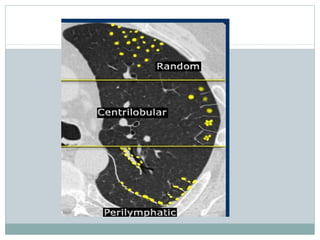
Based on distribution
Perilymphatic
Centrilobular
Random
Sarcoidosis
The majority of nodules located along the
bronchovascular bundle (yellow arrow).
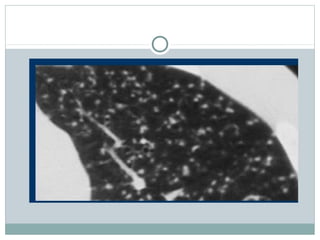
Centrilobular nodules
5 to 10mm away from the pleural surface
Evenly spaced
Associated with pumonary artery branches
If air filled centrilobular bronchiole----lucency
within the nodule
Causes
Bronchiolar and peribronchiolar
Vascular and perivascular
Bronchiolar and peribronchiolar
Endobronchiolar spread
HSP
Bronchiolitis obliterans
Respiratory bronchiolitis
Cystic fibrosis
Bronchiectasis
Vascular and perivascular
Pulmonary edema
Vasculitis
Pulmonary hemorrhage
Pulm HTN
Tree-in-bud
44
 Centrilobular nodules m/b further characterized by presence or
absence of ‘‘tree-in-bud.’’
 Tree-in-bud -- Impaction of centrilobular bronchus with mucous,
pus, or fluid, resulting in dilation of the bronchus, with associated
peribronchiolar inflammation .
 Dilated, impacted bronchi produce Y- or V-shaped structures
 This finding is almost always seen with pulmonary infections.
Tree-in-bud
Typical Tree-in-bud appearance in a patient with active TB.
Random nodules
Hematogenous mets
Miliary TB
Miliary fungal infections
Sarcoidosis ( extensive)
LCH
Langerhans cell histiocytosis: early nodular stage before the typical
cysts appear.
Parenchymal opacification
GGO
Consolidation
Lung calcification and high attenuation opacities
Ground glass opacity
Hazy increase in lung opacity not associated with
obscuration of underlying vessels or bronchial
margins
Significance of GGO
Acute symptoms---asociation with active disease
Subaute or chronic---active disease / fibrosis
Crazy paving pattern
Superimposition of reticular pattern on GGO
PAP
Acute silicosis
Pulmonary edema
Pulmonary haemorrhage
ARDS
P.Carnii pneumonias
Consolidation
Increased lung attenuation with obscuration of
underlying vessels
Lung calcification and high attenuation opacities
Multifocal calcification (often with nodules)
T.B, Histoplasmosis, varicella pneumonia,
sarcoidosis
Diffuse and dense calcification
Metastatic calcification (due to hypercalcemia ,in
patients with CRF, Hyperparathyroidism) –
calcification mainly interstitial.
Disseminated pulmonary ossification
Alveolar microlithiasis (posterior and lower lobe
predominance
Low attenuation
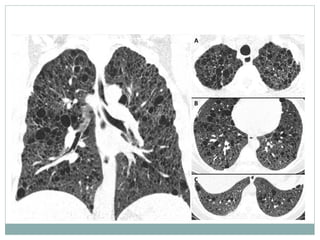
Lung cysts,emphysema and bronchiectasis
Honey combing
Lung cysts
Emphysema
Bullae
Pneumatocoeles
Cavitary nodules
Bronchiectasis
HONEYCOMBING
67
Defined as - small cystic spaces with irregularly
thickened walls composed of fibrous tissue.
Predominate in the peripheral and subpleural lung
regions
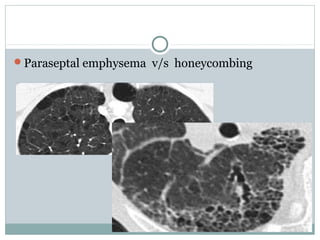
Subpleural honeycomb cysts typically occur in several
contiguous layers. D/D- paraseptal emphysema in
which subpleural cysts usually occur in a single layer.
Honey combing
Air filled cystic spaces
Several mm to cms in diameter
Peripheral and subpleural
Definable walls,1 to 3 mm in thickness
Associated with findings of lung fibrosis
69
Causes
Lower lobe predominance :
1. UIP or interstitial fibrosis
2. Connective tissue disorders
3. Hypersensitivity pneumonitis
4. Asbestosis
5. NSIP (rare)
Upper lobe predominance :
1. End stage sarcodosis
2. Radiation
3. Hypersensitivity Pneumonitis
4. End stage ARDS
Honeycombing
Typical UIP pattern with in a patient with idiopathic pulmonary
fibrosis
Lung cysts
Well defined rounded or circumscribed lesion with a
wall that may be uniform or varied in thickness ( < 2-
3 mm)
LAM
LCH
LIP
Bullae
Pneumatocoeles
Honeycombing
Cystic bronchiectasis
Langerhans cell histiocytosis
HRCT Appearances LAM
Numerous thin-walled cysts, surrounded by normal
parenchyma.
 Round in shape and more or less uniform.
Mediastinal or hilar adenopathy .
Chylous Pleural effusions (40%).
Recurrent pneumothorax (40%)
Multiple thin-walled cysts of roughly uniform size.
Unlike LCH, the cysts in LAM tend to be rounded
and uniformly distributed throughout the
parenchyma with no regional sparing.
There is a conspicuous absence of nodules.
Lymphangiomyomatosis complicated by pneumothorax
Emphysema
Permanent abnormal enlargement of air spaces
distal to terminal bronchiole accompanied by
destruction of walls of involved air spaces
Centrilobular
Paraseptal
Panlobular
Irregular / cicatrical
Bullous
Centrilobular emphysema
Most common type
Upper lobe predominance
Strongly associated with smoking.
Centrilobular emphysema
81
Manifests as multiple small areas of low attenuation without a
perceptible wall, producing a punched-out appearance.
Often the centrilobular artery is visible within the centre of
these lucencies.
Centrilobular emphysema due to smoking. The periphery of the
lung is spared (blue arrows). Centrilobular artery (yellow arrows) is
seen in the center of the hypodense area.
Panlobular emphysema
Affects the whole secondary lobule
Lower lobe predominance
In alpha-1-antitrypsin deficiency, but
also seen in smokers with advanced
emphysema
PANLOBULAR EMPHYSEMA
84
Panlobular emphysema
Paraseptal (distal acinar) emphysema
86
Affects the peripheral parts of the secondary
pulmonary lobule
Produces subpleural lucencies.
Paraseptal emphysema
Paraseptal emphysema v/s honeycombing
Centrilobular emphysema and lung cysts
Bullae and blebs
Bulla : sharply demarcated area of emphysema
measuring 1cm or more in diameter with a wall that
is < 1 mm.
Bleb: focal thin walled lucency contigous with pleura
usually at lung apex
Pneumatocoele
Thin walled gas filled space within the lung,usually
assosciated with pneumonia
Appearance similar to cyst or bulla and cannot be
differentiated
Cavitary nodules
• Thicker and irregular walls than cysts
• LCH
• TB
• Fungal infections
• Sarcoidosis
• Rheumatoid lung disease
• Mets
• wegeners
Bronchiectasis
Localized irrevesible bronchial dilatation with
thickening of the bronchial wall.
Cylindrical
Varicose
Cystic
Traction
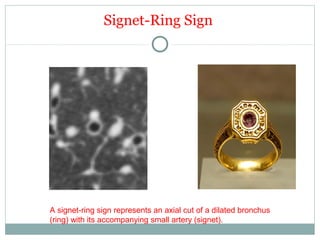
• localized bronchial dilatation. (signet-ring sign)
bronchial wall thickening
lack of normal tapering with visibility of airways in the
peripheral lung
mucus retention in the broncial lumen
ABPA: glove-finger shadow due to mucoid impaction in central
bronchiectasis in a patient with asthma.
Signet-Ring Sign
A signet-ring sign represents an axial cut of a dilated bronchus
(ring) with its accompanying small artery (signet).
Tram Tracks
Mosaic perfusion and attenuation
Due to airway disease
Due to vascular disease
Infiltrative process adjacent to normal lung
Inhomogenous lung opacity
Decreased vessel size Uniform sized vessels
Some regions too lucent Some regions too dense
No reticulation Associated reticulation,
No Nodules Nodules
Mosaic perfusion Ground glass opacity
Inhomogenous lung opacity
Decreased size of vessels uniform sized vessels
(suspect mosaic perfusion) (suspect GGO)
No air trapping air trapping no air
trapping
Vascular disease obstructive disease infiltrative
disease
Chronic PE small airways disease GGO DD’s
large airways disease
Air trapping on expiration
Diagnosis of air trapping in obstructive lung disease
Diagnosis of airway diseases with normal inspiratory
scan
Distinguishing mosaic perfusion from GGO
Allowing the diagnosis of mixed infiltrative and
obstructive diseases
Nodular pattern
1.Hypersensitivity pneumonitis:
2.Miliary TB: random nodules
3.Sarcoidosis
Low Attenuation pattern
Lymphangiomyomatosis (LAM)
LCH
Honeycombing Centrilobular emphysema
Thank you
Mosaic perfusion
Pulmonary hypertension Abnormal airways
Large areas of lucency Lobular lucencies
Vascular disease Obstructive disease
Chronic PE small airways disease
lareg airways disease

lung hrct patterns

Editor's Notes

  • #7 Unit of lung (0.5-3 cm) Irregularly polyhedral متعدد السطوح Supplied by a group of terminal bronchioles and accompanying pulmonary arterioles surrounded by lymph vessels Demarcated by “interlobular septa” pulmonary veins pulmonary lymphatics connective tissue stroma
  • #8 Unit of lung (0.5-3 cm) Irregularly polyhedral متعدد السطوح Supplied by a group of terminal bronchioles and accompanying pulmonary arterioles surrounded by lymph vessels Demarcated by “interlobular septa” pulmonary veins pulmonary lymphatics connective tissue stroma
  • #9 Unit of lung (0.5-3 cm) Irregularly polyhedral متعدد السطوح Supplied by a group of terminal bronchioles and accompanying pulmonary arterioles surrounded by lymph vessels Demarcated by “interlobular septa” pulmonary veins pulmonary lymphatics connective tissue stroma
  • #10 Unit of lung (0.5-3 cm) Irregularly polyhedral متعدد السطوح Supplied by a group of terminal bronchioles and accompanying pulmonary arterioles surrounded by lymph vessels Demarcated by “interlobular septa” pulmonary veins pulmonary lymphatics connective tissue stroma
  • #11 Unit of lung (0.5-3 cm) Irregularly polyhedral متعدد السطوح Supplied by a group of terminal bronchioles and accompanying pulmonary arterioles surrounded by lymph vessels Demarcated by “interlobular septa” pulmonary veins pulmonary lymphatics connective tissue stroma
  • #12 Unit of lung (0.5-3 cm) Irregularly polyhedral متعدد السطوح Supplied by a group of terminal bronchioles and accompanying pulmonary arterioles surrounded by lymph vessels Demarcated by “interlobular septa” pulmonary veins pulmonary lymphatics connective tissue stroma
  • #13 Unit of lung (1 cm to 1 inch) Irregularly polyhedral Supplied by a group of terminal bronchioles and accompanying pulmonary arterioles surrounded by lymph vessels Demarcated by “interlobular septa” pulmonary veins pulmonary lymphatics connective tissue stroma
  • #82 The yellow arrows indicates the pulmonary vessels