CXR
http://www.aic.cuhk.edu.hk/
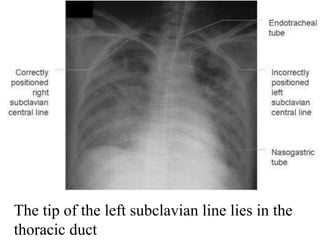
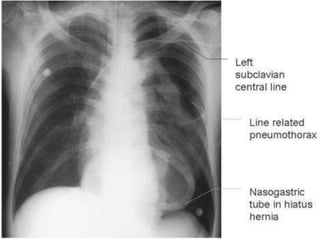
The tip of the left subclavian line lies in the
thoracic duct
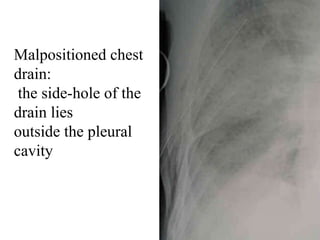
Malpositioned chest
drain:
the side-hole of the
drain lies
outside the pleural
cavity
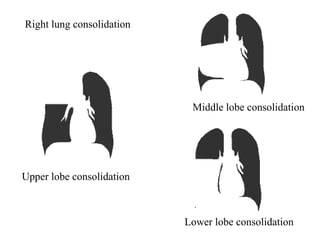
Upper lobe consolidation
Middle lobe consolidation
Lower lobe consolidation
Right lung consolidation
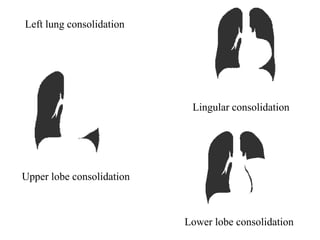
Upper lobe consolidation
Lingular consolidation
Lower lobe consolidation
Left lung consolidation
Pulmonary infiltrates
• An infiltrate is the filling of airspaces with
fluid (pulmonary oedema), inflammatory
exudates (white cells or pus, protein and
immunological substances), or cells
(malignant cells, red cells or haemorrhage)
that fill a region of lung and increase the
visual impression of increased soft tissue
density.
Atelectasis/collapse
• Atelectasis is the collapse of the airspaces
which also results in the visual impression
of increased soft tissue density. This makes
it impossible to distinguish infiltrates from
atelectasis on the basis of visual density
alone. Considering other factors is therefore
required. Atelectasis must have volume loss
by definition (collapse of airspaces must
reduce lung volume), whereas infiltrate
does not.
Atelectasis/collapse
• Atelectasis in ICU patients occurs most
frequently in the left lower lobe, probably
because the heart in the supine position
compresses the lower lobe bronchus. The
following signs of atelectasis can be seen:
– Mild atelectasis – usually not clinically
important
– Basilar shadowing or linear streaks called
subsegmental or “discoid” atelectasis
Atelectasis/collapse
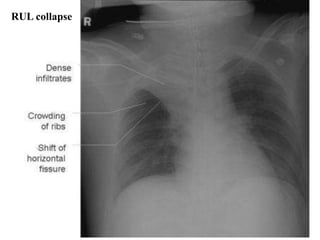
• Severe atelectasis
– Opacification of all or a whole lobe or several
segments of a lobe, associated with volume
loss:
– + crowding of vessels
– + crowding of ribs
– + shift of structures such as interlobar fissures
or the hilum towards areas of lung volume loss
– + elevation of the hemidiaphragm
– Compensatory hyperinflation
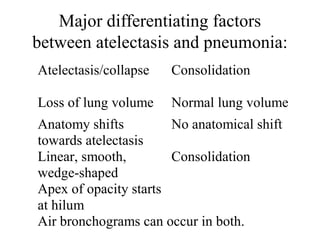
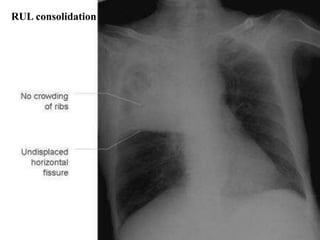
Major differentiating factors
between atelectasis and pneumonia:
Atelectasis/collapse Consolidation
Loss of lung volume Normal lung volume
Anatomy shifts
towards atelectasis
No anatomical shift
Linear, smooth,
wedge-shaped
Consolidation
Apex of opacity starts
at hilum
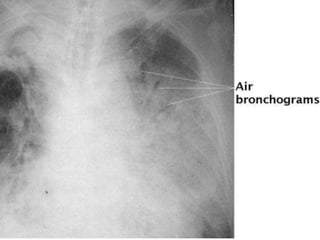
Air bronchograms can occur in both.
RUL collapse
RUL consolidation
Pneumonia
• Severe pneumonia is classically manifested
by airspace disease and consolidation
(alveoli and bronchioles that are completely
filled with bacteria or other
microorganisms, white cells and
inflammatory debris)
• Air bronchograms may occur (air in larger
bronchi, outlined by consolidated
surrounding parenchyma)
Pneumonia
• Other radiographic features include:
– interstitial infiltrates that may be the only
manifestation or may coexist with consolidative
changes.
– ± associated parapneumonic effusion
• Radioopaque masses, such as tumours can
be difficult to distinguish from patches of
consolidation, but are generally more well-
defined.
Pneumonia
• In aspiration pneumonia the lobes affected
are dependent of the gravitational flow of
aspirated contents:
– erect patients: right lower lobe
– supine patients: posterior segment of upper lobe
and superior segment of lower lobe
Pneumonia
• Upper lobe pathology should always lead to
the consideration of tuberculosis (TB) as a
possibility.
• Pneumonia may be complicated by
cavitation or destruction of the lung tissue,
creating abscesses.
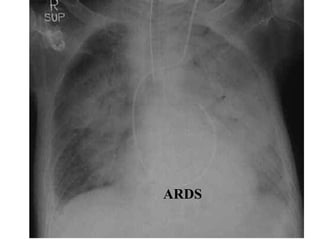
ARDS
• difficult to distinguish from cardiogenic
pulmonary oedema or pneumonia.
• usually causes more uniform opacification.
• Pleural effusions are not typical.
• Kerley B lines are uncommon
• Air bronchograms found in both.
• The distinction from pneumonia is on the
basis of non-radiological investigations.
ARDS
Pulmonary oedema
• Pulmonary oedema is transudate fluid
collecting in the lung tissue. Three
mechanisms lead to pulmonary edema.
These are:
1. Increased hydrostatic gradient
2. Diminished oncotic pressure
3. Increased capillary permeability due to
endothelial injury
Any one or more often a combination of these mechanisms
will cause fluid to enter the alveolar space.
Pulmonary oedema
• Kerley lines are made by the thickening of
the interlobular septa that carry the
lymphatics (Kerley B lines are short thin
lines, 1.5 to 2cm in length, seen in the
periphery of the lower lung, extending to
the pleura). As fluid continues to
accumulate, it leaks into the pleural space
resulting in pleural effusions and into the
alveolar spaces causing the classic alveolar
pattern of pareynchymal pulmonary edema.
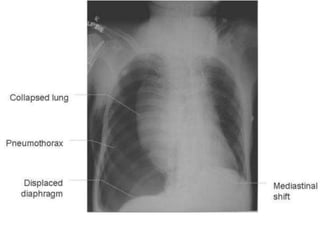
Pneumothorax
• Radiological signs:
– + shift of the heart and mediastinum to the
opposite side
– + depression or inversion the diaphragm
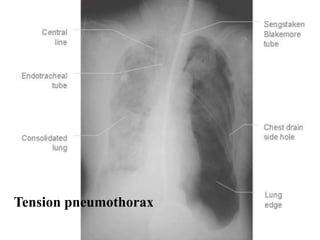
Tension pneumothorax
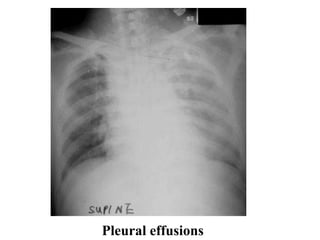
Pleural effusions
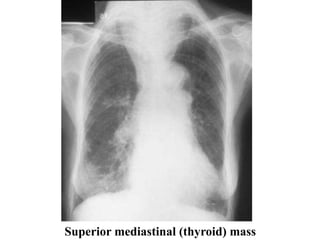
Superior mediastinal (thyroid) mass
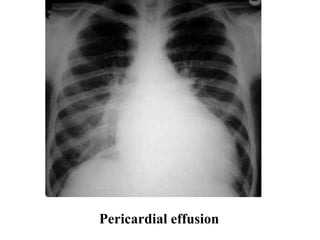
Pericardial effusion

2.CXR.ppt

  • 1.
  • 5.
    The tip ofthe left subclavian line lies in the thoracic duct
  • 8.
    Malpositioned chest drain: the side-holeof the drain lies outside the pleural cavity
  • 11.
    Upper lobe consolidation Middlelobe consolidation Lower lobe consolidation Right lung consolidation
  • 12.
    Upper lobe consolidation Lingularconsolidation Lower lobe consolidation Left lung consolidation
  • 13.
    Pulmonary infiltrates • Aninfiltrate is the filling of airspaces with fluid (pulmonary oedema), inflammatory exudates (white cells or pus, protein and immunological substances), or cells (malignant cells, red cells or haemorrhage) that fill a region of lung and increase the visual impression of increased soft tissue density.
  • 14.
    Atelectasis/collapse • Atelectasis isthe collapse of the airspaces which also results in the visual impression of increased soft tissue density. This makes it impossible to distinguish infiltrates from atelectasis on the basis of visual density alone. Considering other factors is therefore required. Atelectasis must have volume loss by definition (collapse of airspaces must reduce lung volume), whereas infiltrate does not.
  • 15.
    Atelectasis/collapse • Atelectasis inICU patients occurs most frequently in the left lower lobe, probably because the heart in the supine position compresses the lower lobe bronchus. The following signs of atelectasis can be seen: – Mild atelectasis – usually not clinically important – Basilar shadowing or linear streaks called subsegmental or “discoid” atelectasis
  • 16.
    Atelectasis/collapse • Severe atelectasis –Opacification of all or a whole lobe or several segments of a lobe, associated with volume loss: – + crowding of vessels – + crowding of ribs – + shift of structures such as interlobar fissures or the hilum towards areas of lung volume loss – + elevation of the hemidiaphragm – Compensatory hyperinflation
  • 17.
    Major differentiating factors betweenatelectasis and pneumonia: Atelectasis/collapse Consolidation Loss of lung volume Normal lung volume Anatomy shifts towards atelectasis No anatomical shift Linear, smooth, wedge-shaped Consolidation Apex of opacity starts at hilum Air bronchograms can occur in both.
  • 18.
  • 19.
  • 20.
    Pneumonia • Severe pneumoniais classically manifested by airspace disease and consolidation (alveoli and bronchioles that are completely filled with bacteria or other microorganisms, white cells and inflammatory debris) • Air bronchograms may occur (air in larger bronchi, outlined by consolidated surrounding parenchyma)
  • 21.
    Pneumonia • Other radiographicfeatures include: – interstitial infiltrates that may be the only manifestation or may coexist with consolidative changes. – ± associated parapneumonic effusion • Radioopaque masses, such as tumours can be difficult to distinguish from patches of consolidation, but are generally more well- defined.
  • 22.
    Pneumonia • In aspirationpneumonia the lobes affected are dependent of the gravitational flow of aspirated contents: – erect patients: right lower lobe – supine patients: posterior segment of upper lobe and superior segment of lower lobe
  • 23.
    Pneumonia • Upper lobepathology should always lead to the consideration of tuberculosis (TB) as a possibility. • Pneumonia may be complicated by cavitation or destruction of the lung tissue, creating abscesses.
  • 25.
    ARDS • difficult todistinguish from cardiogenic pulmonary oedema or pneumonia. • usually causes more uniform opacification. • Pleural effusions are not typical. • Kerley B lines are uncommon • Air bronchograms found in both. • The distinction from pneumonia is on the basis of non-radiological investigations.
  • 26.
  • 27.
    Pulmonary oedema • Pulmonaryoedema is transudate fluid collecting in the lung tissue. Three mechanisms lead to pulmonary edema. These are: 1. Increased hydrostatic gradient 2. Diminished oncotic pressure 3. Increased capillary permeability due to endothelial injury Any one or more often a combination of these mechanisms will cause fluid to enter the alveolar space.
  • 28.
    Pulmonary oedema • Kerleylines are made by the thickening of the interlobular septa that carry the lymphatics (Kerley B lines are short thin lines, 1.5 to 2cm in length, seen in the periphery of the lower lung, extending to the pleura). As fluid continues to accumulate, it leaks into the pleural space resulting in pleural effusions and into the alveolar spaces causing the classic alveolar pattern of pareynchymal pulmonary edema.
  • 29.
    Pneumothorax • Radiological signs: –+ shift of the heart and mediastinum to the opposite side – + depression or inversion the diaphragm
  • 31.
  • 32.
  • 34.
  • 35.