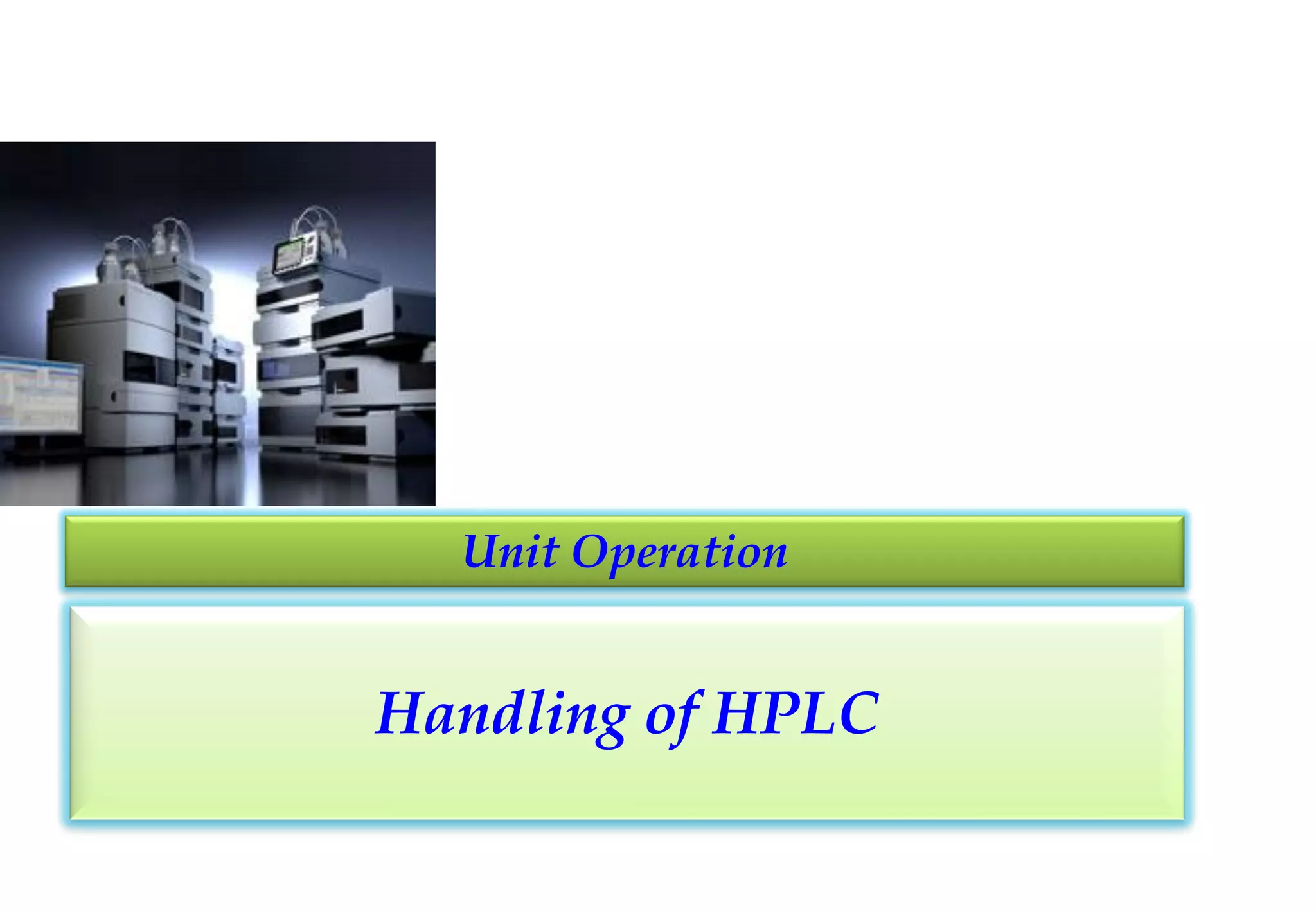
Handling of HPLC 
Unit Operation
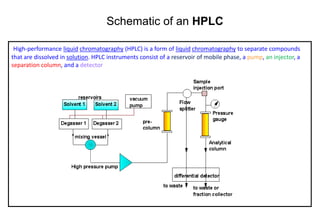
Schematic of an HPLC 
High-performance liquidchromatography(HPLC) is a form of liquidchromatographyto separate compounds that are dissolved in solution. HPLC instruments consist of a reservoir of mobile phase, a pump, an injector, a separation column, and a detector
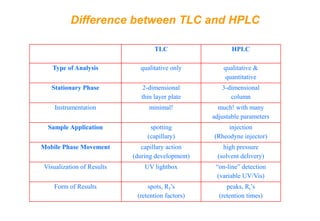
Difference between TLC and HPLC 
TLC 
HPLC 
Type of Analysis 
qualitative only 
qualitative & 
quantitative 
Stationary Phase 
2-dimensional 
thin layer plate 
3-dimensional 
column 
Instrumentation 
minimal! 
much! with many 
adjustable parameters 
Sample Application 
spotting 
(capillary) 
injection 
(Rheodyne injector) 
Mobile Phase Movement 
capillary action 
(during development) 
high pressure 
(solvent delivery) 
Visualization of Results 
UV lightbox 
“on-line” detection 
(variable UV/Vis) 
Form of Results 
spots, Rf’s 
(retention factors) 
peaks, Rt’s 
(retention times)
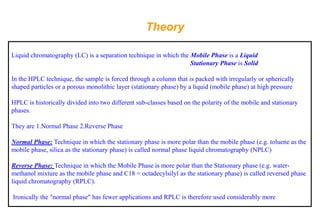
Theory 
Liquid chromatography (LC) is a separation technique in which the Mobile Phase is a Liquid 
Stationary Phase is Solid 
In the HPLC technique, the sample is forced through a column that is packed with irregularly or spherically shaped particles or a porous monolithic layer (stationary phase) by a liquid (mobile phase) at high pressure 
HPLC is historically divided into two different sub-classes based on the polarity of the mobile and stationary phases. 
They are 1.Normal Phase 2.Reverse Phase 
Normal Phase:Technique in which the stationary phase is more polar than the mobile phase (e.g. toluene as the mobile phase, silica as the stationary phase) is called normal phase liquid chromatography (NPLC) 
Reverse Phase: Technique in which the Mobile Phase is more polar than the Stationary phase (e.g. water- methanol mixture as the mobile phase and C18 = octadecylsilylas the stationary phase) is called reversed phase liquid chromatography (RPLC). 
Ironically the "normal phase" has fewer applications and RPLC is therefore used considerably more
Proposed Reverse phase Mechanisms 
Hydrophobic Theory 
Partition Theory 
Adsorption Theory 
Hydrophobic Theory 
Chromatography of “cavities” in solvent created by hydrophobic portion of analyte molecule 
Surface Tension 
Interaction of polar functions with solvent 
Stationary phase is passive
Proposed Reverse phase Mechanisms 
Partition Theory 
Analyte distributes between aqueous mobile phase and organic stationary phase 
Correlation between log P and retention 
“organic” phase is attached on one end 
Does not explain shape selectivity effects 
Adsorption Theory 
Analytes “land” on surface -do not penetrate 
Non-polar interactions between analyte hydrophobic portion and bonded phase 
Weak interactions 
dipole-dipole 
dipole-induced dipole 
induced dipole-induced dipole
How The Separation of Analyte in Columns 
Separation of compounds is based on the competition of the solute and the mobile phase for binding places on the stationary phase. For instance, if normal phase silica gel is used as the stationary phase it can be considered polar. Given two compounds which differ in polarity, the most polar compound has a stronger interaction with the silica and is therefore more capable to dispel the mobile phase from the binding places. Consequently, the less polar compound eluted first and follows the Next compound.
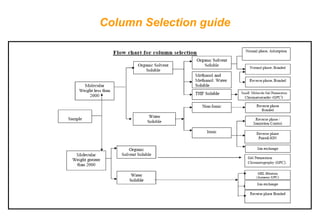
Column Selection guide
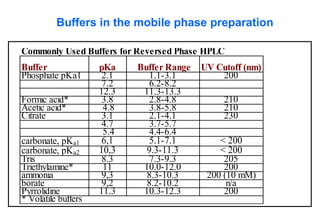
Buffers in the mobile phase preparation 
Commonly Used Buffers for Reversed Phase HPLCBufferpKa Buffer RangeUV Cutoff (nm) Phosphate pKa12.11.1-3.12007.26.2-8.212.311.3-13.3Formic acid*3.82.8-4.8210Acetic acid* 4.83.8-5.8210Citrate3.12.1-4.12304.73.7-5.7 5.44.4-6.4carbonate, pKa16,15.1-7.1< 200carbonate, pKa210,39.3-11.3< 200Tris8.37.3-9.3205Triethylamine*1110.0-12.0200ammonia9,38.3-10.3200 (10 mM) borate9,28.2-10.2n/aPyrrolidine11.310.3-12.3200* Volatile buffers
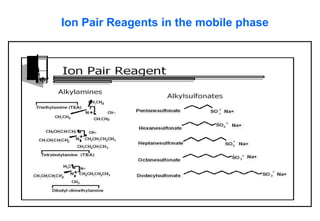
Ion Pair Reagents in the mobile phase
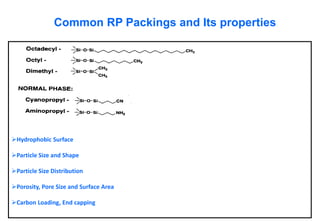
Common RP Packings and Its properties 
Hydrophobic Surface 
Particle Size and Shape 
Particle Size Distribution 
Porosity, Pore Size and Surface Area 
Carbon Loading, End capping
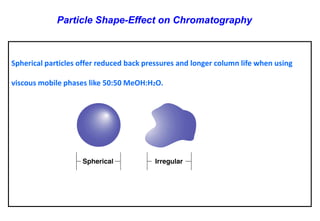
Spherical particles offer reduced back pressures and longer column life when using viscous mobile phases like 50:50 MeOH:H2O. 
Particle Shape-Effect on Chromatography
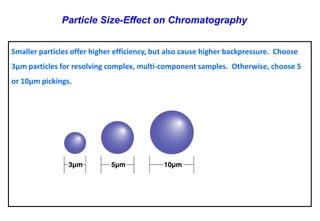
Smaller particles offer higher efficiency, but also cause higher backpressure. Choose 3μm particles for resolving complex, multi-component samples. Otherwise, choose 5 or 10μm pickings. 
Particle Size-Effect on Chromatography
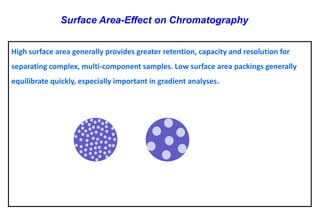
High surface area generally provides greater retention, capacity and resolution for separating complex, multi-component samples. Low surface area packingsgenerally equilibrate quickly, especially important in gradient analyses. 
Surface Area-Effect on Chromatography
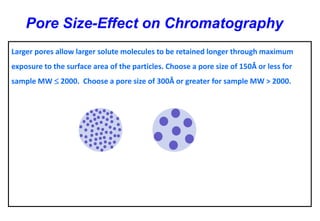
Larger pores allow larger solute molecules to be retained longer through maximum exposure to the surface area of the particles. Choose a pore size of 150Å or less for sample MW 2000. Choose a pore size of 300Å or greater for sample MW > 2000. 
Pore Size-Effect on Chromatography
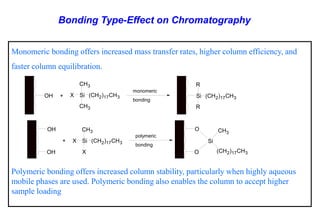
Monomeric bonding offers increased mass transfer rates, higher column efficiency, and 
faster column equilibration. 
Polymeric bonding offers increased column stability, particularly when highly aqueous 
mobile phases are used. Polymeric bonding also enables the column to accept higher 
sample loading 
Bonding Type-Effect on Chromatography 
Si 
R 
R 
(CH2)17CH3 Si 
CH3 
CH3 
OH + X (CH2)17CH3 
monomeric 
bonding 
Si 
CH3 
X 
+ X (CH2)17CH3 
polymeric 
bonding 
OH 
OH O 
O 
Si 
CH3 
(CH2)17CH3
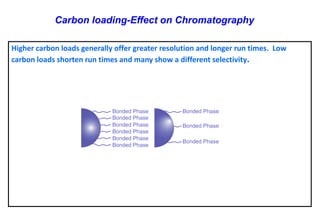
Higher carbon loads generally offer greater resolution and longer run times. Low carbon loads shorten run times and many show a different selectivity. 
Carbon loading-Effect on Chromatography
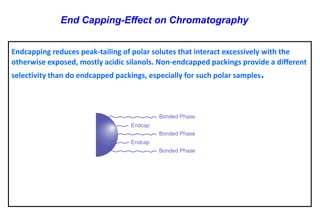
Endcappingreduces peak-tailing of polar solutes that interact excessively with the otherwise exposed, mostly acidic silanols. Non-endcappedpackingsprovide a different selectivity than do endcappedpackings, especially for such polar samples. 
End Capping-Effect on Chromatography
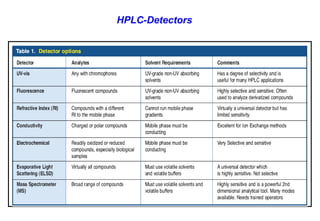
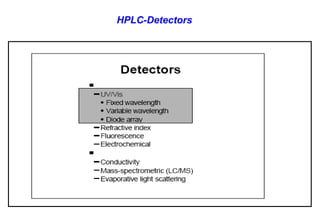
HPLC-Detectors
HPLC-Detectors
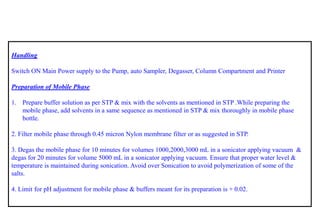
Handling 
Switch ON Main Power supply to the Pump, auto Sampler, Degasser, Column Compartment and Printer 
Preparation of Mobile Phase 
1.Prepare buffer solution as per STP & mix with the solvents as mentioned in STP .While preparing the mobile phase, add solvents in a same sequence as mentioned in STP & mix thoroughly in mobile phase bottle. 
2. Filter mobile phase through 0.45 micron Nylon membrane filter or as suggested in STP. 
3. Degas the mobile phase for 10 minutes for volumes 1000,2000,3000 mLin a sonicatorapplying vacuum & degas for 20 minutes for volume 5000 mLin a sonicatorapplying vacuum. Ensure that proper water level & temperature is maintained during sonication. Avoid over Sonication to avoid polymerization of some of the salts. 
4. Limit for pH adjustment for mobile phase & buffers meant for its preparation is + 0.02.
Selection of Column 
Select the Column as Mentioned in the STPor Method 
Ensure that there is no air Bubble in 4 Channels 
Flush the Column, prior to use, for at least 30 minutes using HPLC Grade Methanol at a flow rate of about 
1 mL/minnute 
Saturate the Column with Mobile Phase For at least 30 Minutes 
Put Appropriate Needle Wash, Seal wash solutions ,Wash Vials as applicable 
Preparation of Sample and Standard Solutions 
Prepare Standard, Sample and system suitability Solutions as per STP 
Use filter as mentioned in STP. First rinse the syringe with diluents, discard initial volume of diluents solution through a filter holder, collect the required volume & after filtration discard the membrane filter. 
Check the System suitability Parameters then only Proceed for Next Step
Preparation of Sample and Standard Solutions 
Prepare Standard, Sample and system suitability Solutions as per STP ormethod 
Use filter as mentioned in STP. First rinse the syringe with diluents, discard initial volume of diluents solution through a filter holder, collect the required volume & after filtration discard the membrane filter 
Check the System suitability parameters then only Proceed for Next Step
Filling of the Vials and Labeling Of the Vials 
Discard the First 5 mLof Solution from the Standard and Sample Solution. 
Use Fresh Vials for each Preparation 
Rinse the HPLC Vials with Respective solution 
Fill the Each Vial with Enough Sample solution for all injection 
Crimp the vial properly 
Label all the test and standard solutions for all tests with at least details such as A.R.No,Solution Name and appropriate replicate preparation number when ever applicable 
Label the HPLC,GC Vials with legible marker pen for as follows 
XYY, Where X=Unique Quick set YY-Is position at that is to be placed
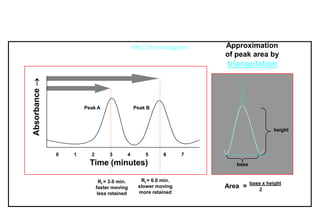
HPLC Chromatograms 
0 1 2 3 4 5 6 7 
Time (minutes) 
Absorbance Area =base x height2 
base 
height 
Peak A 
Peak B 
Approximation 
of peak area by 
triangulation 
Rt = 3.0 min. 
faster moving 
less retained 
Rt = 6.0 min. slower movingmore retained
USP <1225> 
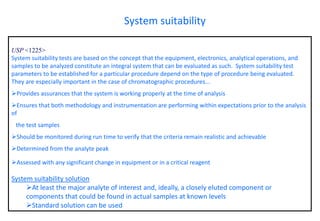
System suitability tests are based on the concept that the equipment, electronics, analytical operations, and samples to be analyzed constitute an integral system that can be evaluated as such. System suitability test parameters to be established for a particular procedure depend on the type of procedure being evaluated. They are especially important in the case of chromatographic procedures... 
Provides assurances that the system is working properly at the time of analysis 
Ensures that both methodology and instrumentation are performing within expectations prior to the analysis of 
the test samples 
Should be monitored during run time to verify that the criteria remain realistic and achievable 
Determined from the analyte peak 
Assessed with any significant change in equipment or in a critical reagent 
System suitability solution 
At least the major analyte of interest and, ideally, a closely eluted component or components that could be found in actual samples at known levels 
Standard solution can be used 
System suitability
System suitability 
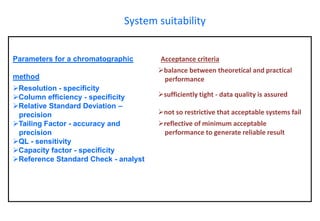
Acceptance criteria 
balance between theoretical and practical performance 
sufficiently tight -data quality is assured 
not so restrictive that acceptable systems fail 
reflective of minimum acceptable performance to generate reliable result 
Parameters for a chromatographic method 
Resolution -specificity 
Column efficiency -specificity 
Relative Standard Deviation – precision 
Tailing Factor -accuracy and precision 
QL -sensitivity 
Capacity factor -specificity 
Reference Standard Check -analyst
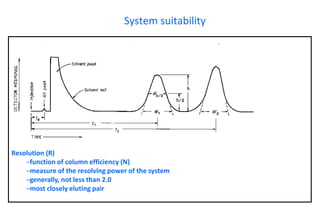
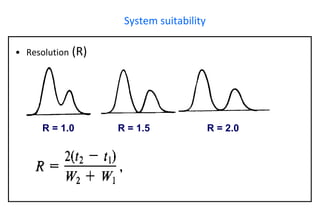
Resolution (R) 
–function of column efficiency (N) 
–measure of the resolving power of the system 
–generally, not less than 2.0 
–most closely eluting pair 
System suitability
System suitability 
•Resolution(R) R = 1.0 R = 1.5 R = 2.0
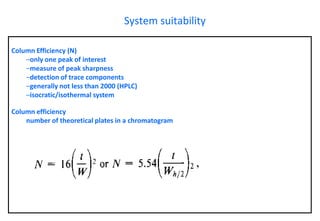
Column Efficiency (N) 
–only one peak of interest 
–measure of peak sharpness 
–detection of trace components 
–generally not less than 2000 (HPLC) 
–isocratic/isothermal systemColumn efficiencynumber of theoretical plates in a chromatogram 
System suitability
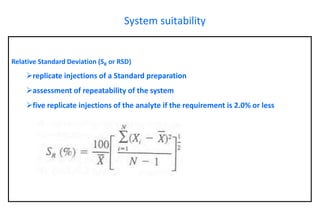
Relative Standard Deviation (SRor RSD) 
replicate injections of a Standard preparation 
assessment of repeatability of the system 
five replicate injections of the analyte if the requirement is 2.0% or less 
System suitability
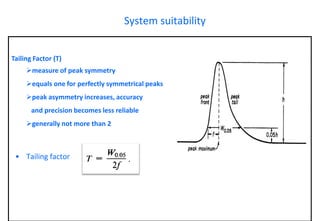
Tailing Factor (T) 
measure of peak symmetry 
equals one for perfectly symmetrical peaks 
peak asymmetry increases, accuracy 
and precision becomes less reliable 
generally not more than 2 
System suitability 
•Tailing factor
System suitability 
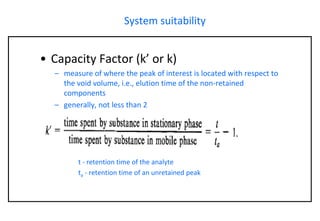
•Capacity Factor (k’ or k) 
–measure of where the peak of interest is located with respect to the void volume, i.e., elution time of the non-retained components 
–generally, not less than 2t -retention time of the analyteta-retention time of an unretainedpeak
System suitability 
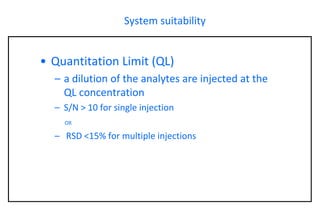
•Quantitation Limit (QL) 
–a dilution of the analytes are injected at the QL concentration 
–S/N > 10 for single injection OR 
–RSD <15% for multiple injections
System suitability 
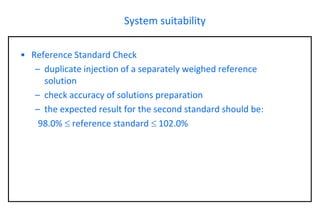
•Reference Standard Check 
–duplicate injection of a separately weighed reference solution 
–check accuracy of solutions preparation 
–the expected result for the second standard should be: 
98.0% reference standard 102.0%
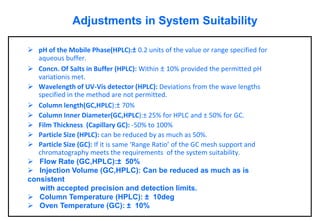
Adjustments in System Suitability 
pH of the Mobile Phase(HPLC):±0.2 units of the value or range specified for aqueous buffer. 
Concn. Of Salts in Buffer (HPLC):Within ±10% provided the permitted pH variationismet. 
Wavelength of UV-Vis detector (HPLC):Deviations from the wave lengths specified in the method are not permitted. 
Column length(GC,HPLC):±70% 
Column Inner Diameter(GC,HPLC):±25% for HPLC and ±50% for GC. 
Film Thickness (Capillary GC):-50% to 100% 
Particle Size (HPLC):can be reduced by as much as 50%. 
Particle Size (GC):If it is same ‘Range Ratio’ of the GC mesh support and chromatography meets the requirements of the system suitability. 
Flow Rate (GC,HPLC):±50% 
Injection Volume (GC,HPLC): Can be reduced as much as is consistent with accepted precision and detection limits. 
Column Temperature (HPLC): ±10deg 
Oven Temperature (GC): ±10%
Adjustments in System Suitability 
Ratio of the Components in Mobile Phase (HPLC): Apply to Minor components of 50% or less. 
±30% relative. Change in any component cannot exceed ±10% absolute ( i.e. in relation to the mobile phase). Binary Mixtures: eg. For 50:50 : Thirty percent of 50 is 15% absolute but ±10% is only permitted. That means either 40:60 or 60:40 can be made. Ternary Mixtures: for eg.60:35:5: 30% of 35 is 10.5% absolute but only ±10% is permitted. That means change can be made between 25% and 45%. In all cases , a sufficient quantity of the first component is used to give a total of 100%.There fore, Mixture ranges of 50:45:5 to 70:25:5 or 58.5:35:6.5 to 61.5:35:3.5.
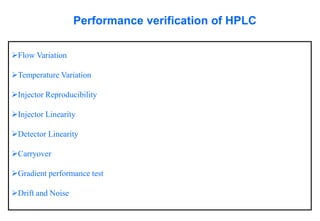
Flow Variation 
Temperature Variation 
Injector Reproducibility 
Injector Linearity 
DetectorLinearity 
Carryover 
Gradient performance test 
Drift and Noise 
Performance verification of HPLC
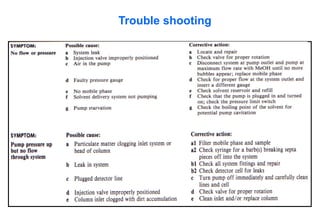
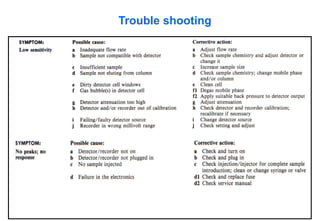
Trouble shooting
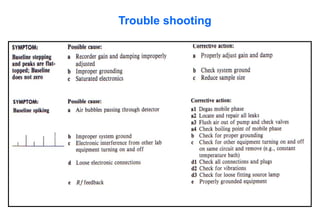
Trouble shooting
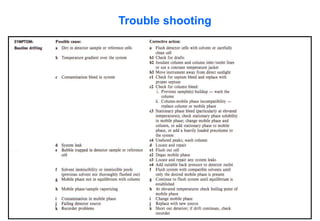
Trouble shooting
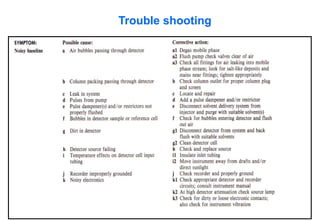
Trouble shooting
Trouble shooting
Trouble shooting
Trouble shooting
Trouble shooting
Trouble shooting
Hplc

Hplc

  • 1.
    Handling of HPLC Unit Operation
  • 2.
    Schematic of anHPLC High-performance liquidchromatography(HPLC) is a form of liquidchromatographyto separate compounds that are dissolved in solution. HPLC instruments consist of a reservoir of mobile phase, a pump, an injector, a separation column, and a detector
  • 3.
    Difference between TLCand HPLC TLC HPLC Type of Analysis qualitative only qualitative & quantitative Stationary Phase 2-dimensional thin layer plate 3-dimensional column Instrumentation minimal! much! with many adjustable parameters Sample Application spotting (capillary) injection (Rheodyne injector) Mobile Phase Movement capillary action (during development) high pressure (solvent delivery) Visualization of Results UV lightbox “on-line” detection (variable UV/Vis) Form of Results spots, Rf’s (retention factors) peaks, Rt’s (retention times)
  • 4.
    Theory Liquid chromatography(LC) is a separation technique in which the Mobile Phase is a Liquid Stationary Phase is Solid In the HPLC technique, the sample is forced through a column that is packed with irregularly or spherically shaped particles or a porous monolithic layer (stationary phase) by a liquid (mobile phase) at high pressure HPLC is historically divided into two different sub-classes based on the polarity of the mobile and stationary phases. They are 1.Normal Phase 2.Reverse Phase Normal Phase:Technique in which the stationary phase is more polar than the mobile phase (e.g. toluene as the mobile phase, silica as the stationary phase) is called normal phase liquid chromatography (NPLC) Reverse Phase: Technique in which the Mobile Phase is more polar than the Stationary phase (e.g. water- methanol mixture as the mobile phase and C18 = octadecylsilylas the stationary phase) is called reversed phase liquid chromatography (RPLC). Ironically the "normal phase" has fewer applications and RPLC is therefore used considerably more
  • 5.
    Proposed Reverse phaseMechanisms Hydrophobic Theory Partition Theory Adsorption Theory Hydrophobic Theory Chromatography of “cavities” in solvent created by hydrophobic portion of analyte molecule Surface Tension Interaction of polar functions with solvent Stationary phase is passive
  • 6.
    Proposed Reverse phaseMechanisms Partition Theory Analyte distributes between aqueous mobile phase and organic stationary phase Correlation between log P and retention “organic” phase is attached on one end Does not explain shape selectivity effects Adsorption Theory Analytes “land” on surface -do not penetrate Non-polar interactions between analyte hydrophobic portion and bonded phase Weak interactions dipole-dipole dipole-induced dipole induced dipole-induced dipole
  • 7.
    How The Separationof Analyte in Columns Separation of compounds is based on the competition of the solute and the mobile phase for binding places on the stationary phase. For instance, if normal phase silica gel is used as the stationary phase it can be considered polar. Given two compounds which differ in polarity, the most polar compound has a stronger interaction with the silica and is therefore more capable to dispel the mobile phase from the binding places. Consequently, the less polar compound eluted first and follows the Next compound.
  • 8.
  • 9.
    Buffers in themobile phase preparation Commonly Used Buffers for Reversed Phase HPLCBufferpKa Buffer RangeUV Cutoff (nm) Phosphate pKa12.11.1-3.12007.26.2-8.212.311.3-13.3Formic acid*3.82.8-4.8210Acetic acid* 4.83.8-5.8210Citrate3.12.1-4.12304.73.7-5.7 5.44.4-6.4carbonate, pKa16,15.1-7.1< 200carbonate, pKa210,39.3-11.3< 200Tris8.37.3-9.3205Triethylamine*1110.0-12.0200ammonia9,38.3-10.3200 (10 mM) borate9,28.2-10.2n/aPyrrolidine11.310.3-12.3200* Volatile buffers
  • 10.
    Ion Pair Reagentsin the mobile phase
  • 12.
    Common RP Packingsand Its properties Hydrophobic Surface Particle Size and Shape Particle Size Distribution Porosity, Pore Size and Surface Area Carbon Loading, End capping
  • 13.
    Spherical particles offerreduced back pressures and longer column life when using viscous mobile phases like 50:50 MeOH:H2O. Particle Shape-Effect on Chromatography
  • 14.
    Smaller particles offerhigher efficiency, but also cause higher backpressure. Choose 3μm particles for resolving complex, multi-component samples. Otherwise, choose 5 or 10μm pickings. Particle Size-Effect on Chromatography
  • 15.
    High surface areagenerally provides greater retention, capacity and resolution for separating complex, multi-component samples. Low surface area packingsgenerally equilibrate quickly, especially important in gradient analyses. Surface Area-Effect on Chromatography
  • 16.
    Larger pores allowlarger solute molecules to be retained longer through maximum exposure to the surface area of the particles. Choose a pore size of 150Å or less for sample MW 2000. Choose a pore size of 300Å or greater for sample MW > 2000. Pore Size-Effect on Chromatography
  • 17.
    Monomeric bonding offersincreased mass transfer rates, higher column efficiency, and faster column equilibration. Polymeric bonding offers increased column stability, particularly when highly aqueous mobile phases are used. Polymeric bonding also enables the column to accept higher sample loading Bonding Type-Effect on Chromatography Si R R (CH2)17CH3 Si CH3 CH3 OH + X (CH2)17CH3 monomeric bonding Si CH3 X + X (CH2)17CH3 polymeric bonding OH OH O O Si CH3 (CH2)17CH3
  • 18.
    Higher carbon loadsgenerally offer greater resolution and longer run times. Low carbon loads shorten run times and many show a different selectivity. Carbon loading-Effect on Chromatography
  • 19.
    Endcappingreduces peak-tailing ofpolar solutes that interact excessively with the otherwise exposed, mostly acidic silanols. Non-endcappedpackingsprovide a different selectivity than do endcappedpackings, especially for such polar samples. End Capping-Effect on Chromatography
  • 20.
  • 21.
  • 22.
    Handling Switch ONMain Power supply to the Pump, auto Sampler, Degasser, Column Compartment and Printer Preparation of Mobile Phase 1.Prepare buffer solution as per STP & mix with the solvents as mentioned in STP .While preparing the mobile phase, add solvents in a same sequence as mentioned in STP & mix thoroughly in mobile phase bottle. 2. Filter mobile phase through 0.45 micron Nylon membrane filter or as suggested in STP. 3. Degas the mobile phase for 10 minutes for volumes 1000,2000,3000 mLin a sonicatorapplying vacuum & degas for 20 minutes for volume 5000 mLin a sonicatorapplying vacuum. Ensure that proper water level & temperature is maintained during sonication. Avoid over Sonication to avoid polymerization of some of the salts. 4. Limit for pH adjustment for mobile phase & buffers meant for its preparation is + 0.02.
  • 23.
    Selection of Column Select the Column as Mentioned in the STPor Method Ensure that there is no air Bubble in 4 Channels Flush the Column, prior to use, for at least 30 minutes using HPLC Grade Methanol at a flow rate of about 1 mL/minnute Saturate the Column with Mobile Phase For at least 30 Minutes Put Appropriate Needle Wash, Seal wash solutions ,Wash Vials as applicable Preparation of Sample and Standard Solutions Prepare Standard, Sample and system suitability Solutions as per STP Use filter as mentioned in STP. First rinse the syringe with diluents, discard initial volume of diluents solution through a filter holder, collect the required volume & after filtration discard the membrane filter. Check the System suitability Parameters then only Proceed for Next Step
  • 24.
    Preparation of Sampleand Standard Solutions Prepare Standard, Sample and system suitability Solutions as per STP ormethod Use filter as mentioned in STP. First rinse the syringe with diluents, discard initial volume of diluents solution through a filter holder, collect the required volume & after filtration discard the membrane filter Check the System suitability parameters then only Proceed for Next Step
  • 25.
    Filling of theVials and Labeling Of the Vials Discard the First 5 mLof Solution from the Standard and Sample Solution. Use Fresh Vials for each Preparation Rinse the HPLC Vials with Respective solution Fill the Each Vial with Enough Sample solution for all injection Crimp the vial properly Label all the test and standard solutions for all tests with at least details such as A.R.No,Solution Name and appropriate replicate preparation number when ever applicable Label the HPLC,GC Vials with legible marker pen for as follows XYY, Where X=Unique Quick set YY-Is position at that is to be placed
  • 26.
    HPLC Chromatograms 01 2 3 4 5 6 7 Time (minutes) Absorbance Area =base x height2 base height Peak A Peak B Approximation of peak area by triangulation Rt = 3.0 min. faster moving less retained Rt = 6.0 min. slower movingmore retained
  • 27.
    USP <1225> Systemsuitability tests are based on the concept that the equipment, electronics, analytical operations, and samples to be analyzed constitute an integral system that can be evaluated as such. System suitability test parameters to be established for a particular procedure depend on the type of procedure being evaluated. They are especially important in the case of chromatographic procedures... Provides assurances that the system is working properly at the time of analysis Ensures that both methodology and instrumentation are performing within expectations prior to the analysis of the test samples Should be monitored during run time to verify that the criteria remain realistic and achievable Determined from the analyte peak Assessed with any significant change in equipment or in a critical reagent System suitability solution At least the major analyte of interest and, ideally, a closely eluted component or components that could be found in actual samples at known levels Standard solution can be used System suitability
  • 28.
    System suitability Acceptancecriteria balance between theoretical and practical performance sufficiently tight -data quality is assured not so restrictive that acceptable systems fail reflective of minimum acceptable performance to generate reliable result Parameters for a chromatographic method Resolution -specificity Column efficiency -specificity Relative Standard Deviation – precision Tailing Factor -accuracy and precision QL -sensitivity Capacity factor -specificity Reference Standard Check -analyst
  • 29.
    Resolution (R) –functionof column efficiency (N) –measure of the resolving power of the system –generally, not less than 2.0 –most closely eluting pair System suitability
  • 30.
    System suitability •Resolution(R)R = 1.0 R = 1.5 R = 2.0
  • 31.
    Column Efficiency (N) –only one peak of interest –measure of peak sharpness –detection of trace components –generally not less than 2000 (HPLC) –isocratic/isothermal systemColumn efficiencynumber of theoretical plates in a chromatogram System suitability
  • 32.
    Relative Standard Deviation(SRor RSD) replicate injections of a Standard preparation assessment of repeatability of the system five replicate injections of the analyte if the requirement is 2.0% or less System suitability
  • 33.
    Tailing Factor (T) measure of peak symmetry equals one for perfectly symmetrical peaks peak asymmetry increases, accuracy and precision becomes less reliable generally not more than 2 System suitability •Tailing factor
  • 34.
    System suitability •CapacityFactor (k’ or k) –measure of where the peak of interest is located with respect to the void volume, i.e., elution time of the non-retained components –generally, not less than 2t -retention time of the analyteta-retention time of an unretainedpeak
  • 35.
    System suitability •QuantitationLimit (QL) –a dilution of the analytes are injected at the QL concentration –S/N > 10 for single injection OR –RSD <15% for multiple injections
  • 36.
    System suitability •ReferenceStandard Check –duplicate injection of a separately weighed reference solution –check accuracy of solutions preparation –the expected result for the second standard should be: 98.0% reference standard 102.0%
  • 37.
    Adjustments in SystemSuitability pH of the Mobile Phase(HPLC):±0.2 units of the value or range specified for aqueous buffer. Concn. Of Salts in Buffer (HPLC):Within ±10% provided the permitted pH variationismet. Wavelength of UV-Vis detector (HPLC):Deviations from the wave lengths specified in the method are not permitted. Column length(GC,HPLC):±70% Column Inner Diameter(GC,HPLC):±25% for HPLC and ±50% for GC. Film Thickness (Capillary GC):-50% to 100% Particle Size (HPLC):can be reduced by as much as 50%. Particle Size (GC):If it is same ‘Range Ratio’ of the GC mesh support and chromatography meets the requirements of the system suitability. Flow Rate (GC,HPLC):±50% Injection Volume (GC,HPLC): Can be reduced as much as is consistent with accepted precision and detection limits. Column Temperature (HPLC): ±10deg Oven Temperature (GC): ±10%
  • 38.
    Adjustments in SystemSuitability Ratio of the Components in Mobile Phase (HPLC): Apply to Minor components of 50% or less. ±30% relative. Change in any component cannot exceed ±10% absolute ( i.e. in relation to the mobile phase). Binary Mixtures: eg. For 50:50 : Thirty percent of 50 is 15% absolute but ±10% is only permitted. That means either 40:60 or 60:40 can be made. Ternary Mixtures: for eg.60:35:5: 30% of 35 is 10.5% absolute but only ±10% is permitted. That means change can be made between 25% and 45%. In all cases , a sufficient quantity of the first component is used to give a total of 100%.There fore, Mixture ranges of 50:45:5 to 70:25:5 or 58.5:35:6.5 to 61.5:35:3.5.
  • 39.
    Flow Variation TemperatureVariation Injector Reproducibility Injector Linearity DetectorLinearity Carryover Gradient performance test Drift and Noise Performance verification of HPLC
  • 40.
  • 41.
  • 42.
  • 43.
  • 44.
  • 45.
  • 46.
  • 47.
  • 48.