High performance liquid
chromatography [HPLC]
1
Chromatography
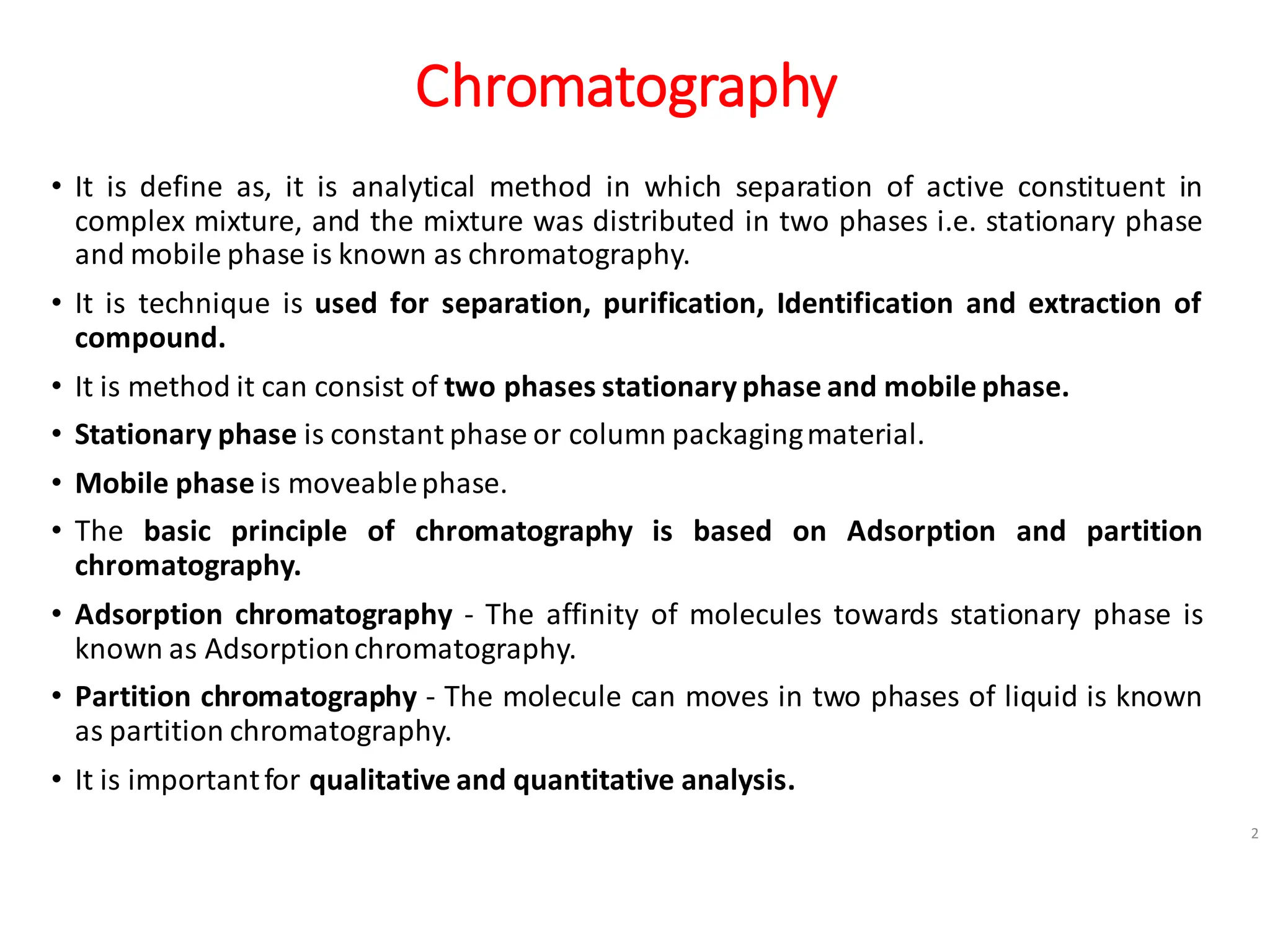
• It is define as, it is analytical method in which separation of active constituent in
complex mixture, and the mixture was distributed in two phases i.e. stationary phase
and mobile phase is known as chromatography.
• It is technique is used for separation, purification, Identification and extraction of
compound.
• It is method it can consist of two phases stationary phase and mobile phase.
• Stationary phase is constant phase or column packagingmaterial.
• Mobile phase is moveablephase.
• The basic principle of chromatography is based on Adsorption and partition
chromatography.
• Adsorption chromatography - The affinity of molecules towards stationary phase is
known as Adsorptionchromatography.
• Partition chromatography - The molecule can moves in two phases of liquid is known
as partition chromatography.
• It is importantfor qualitative and quantitative analysis.
2
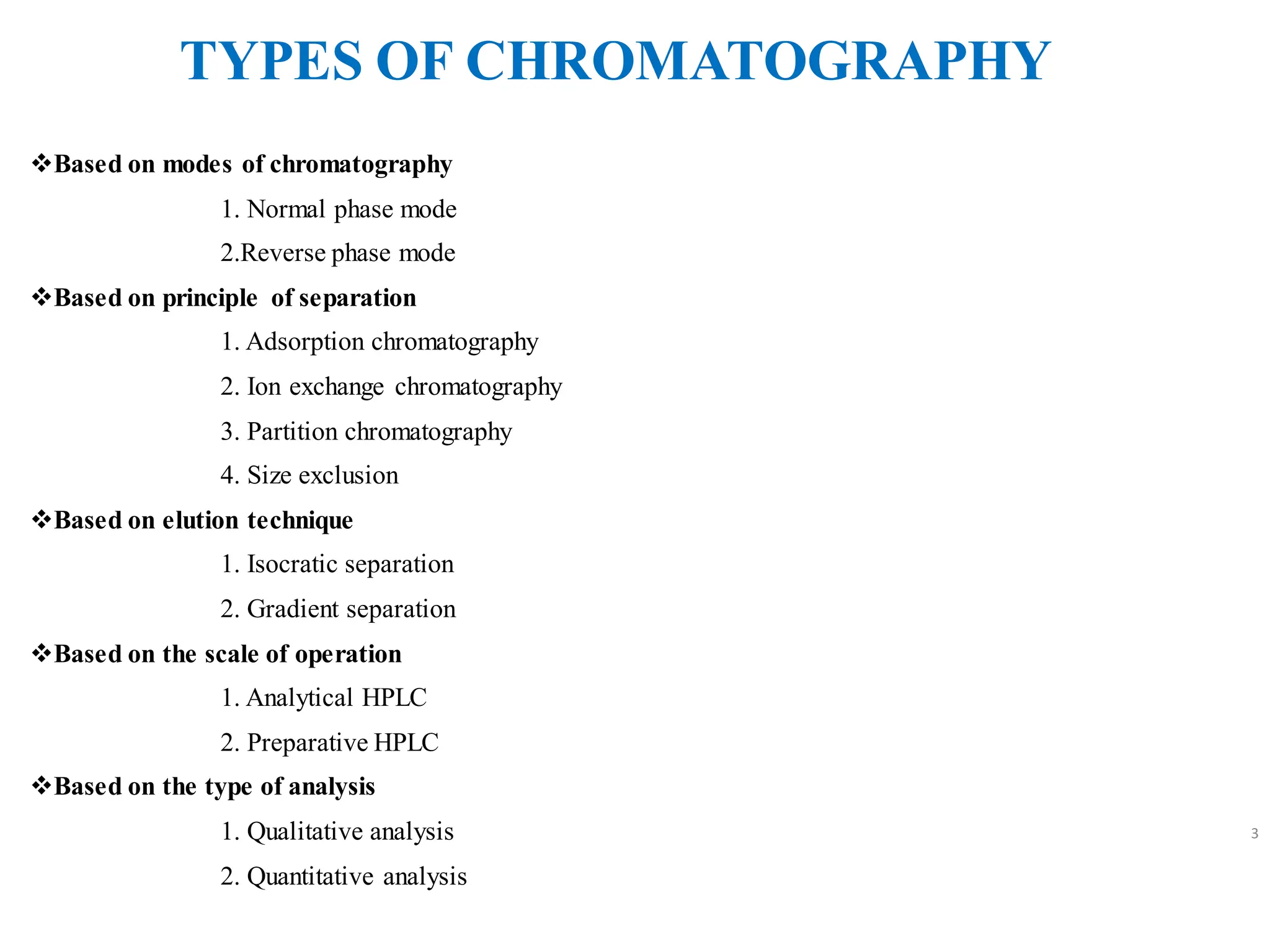
TYPES OF CHROMATOGRAPHY
❖Based on modes of chromatography
1. Normal phase mode
2.Reverse phase mode
❖Based on principle of separation
1. Adsorption chromatography
2. Ion exchange chromatography
3. Partition chromatography
4. Size exclusion
❖Based on elution technique
1. Isocratic separation
2. Gradient separation
❖Based on the scale of operation
1. Analytical HPLC
2. Preparative HPLC
❖Based on the type of analysis
1. Qualitative analysis
2. Quantitative analysis
3
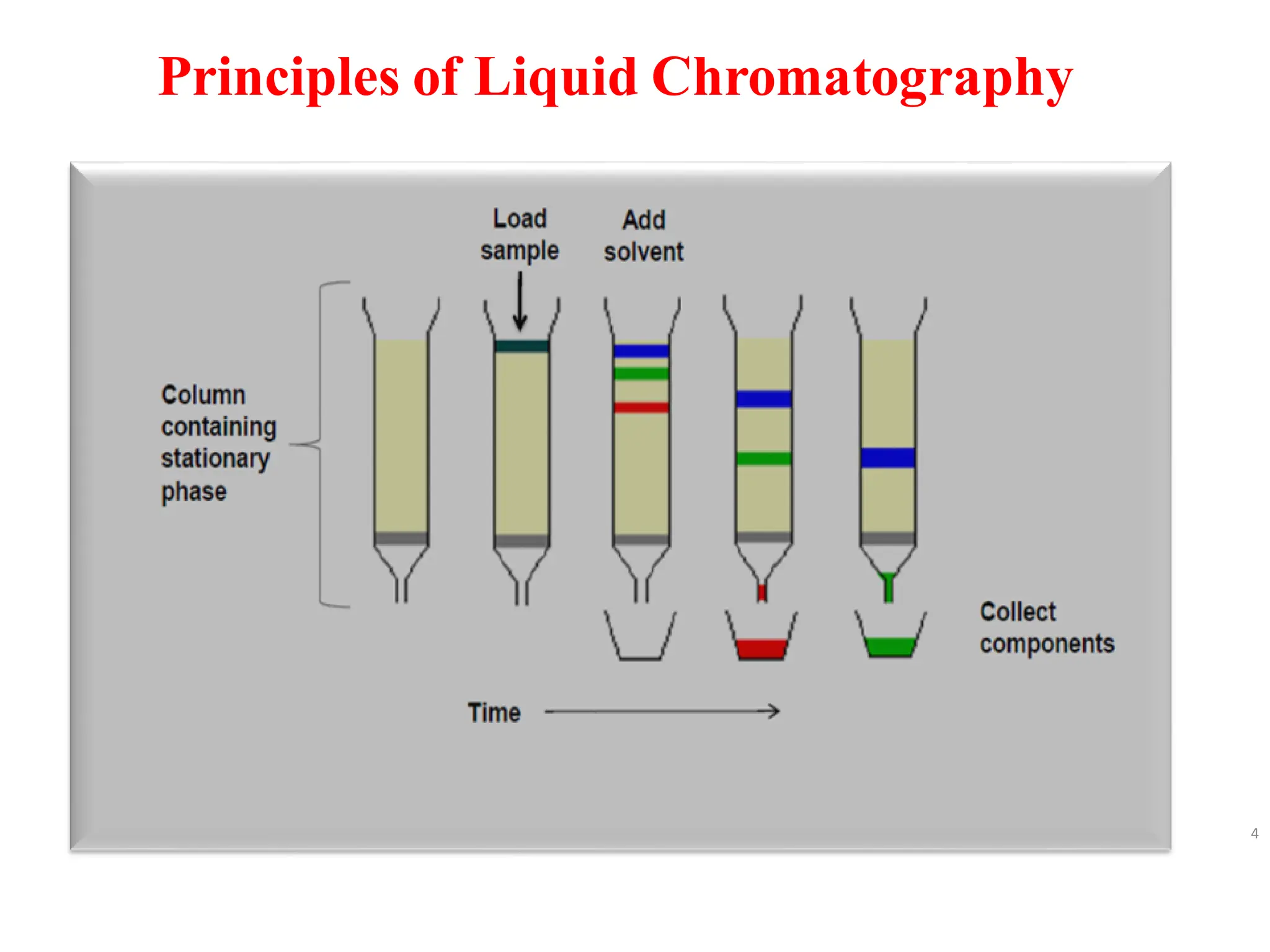
Principles of Liquid Chromatography
4
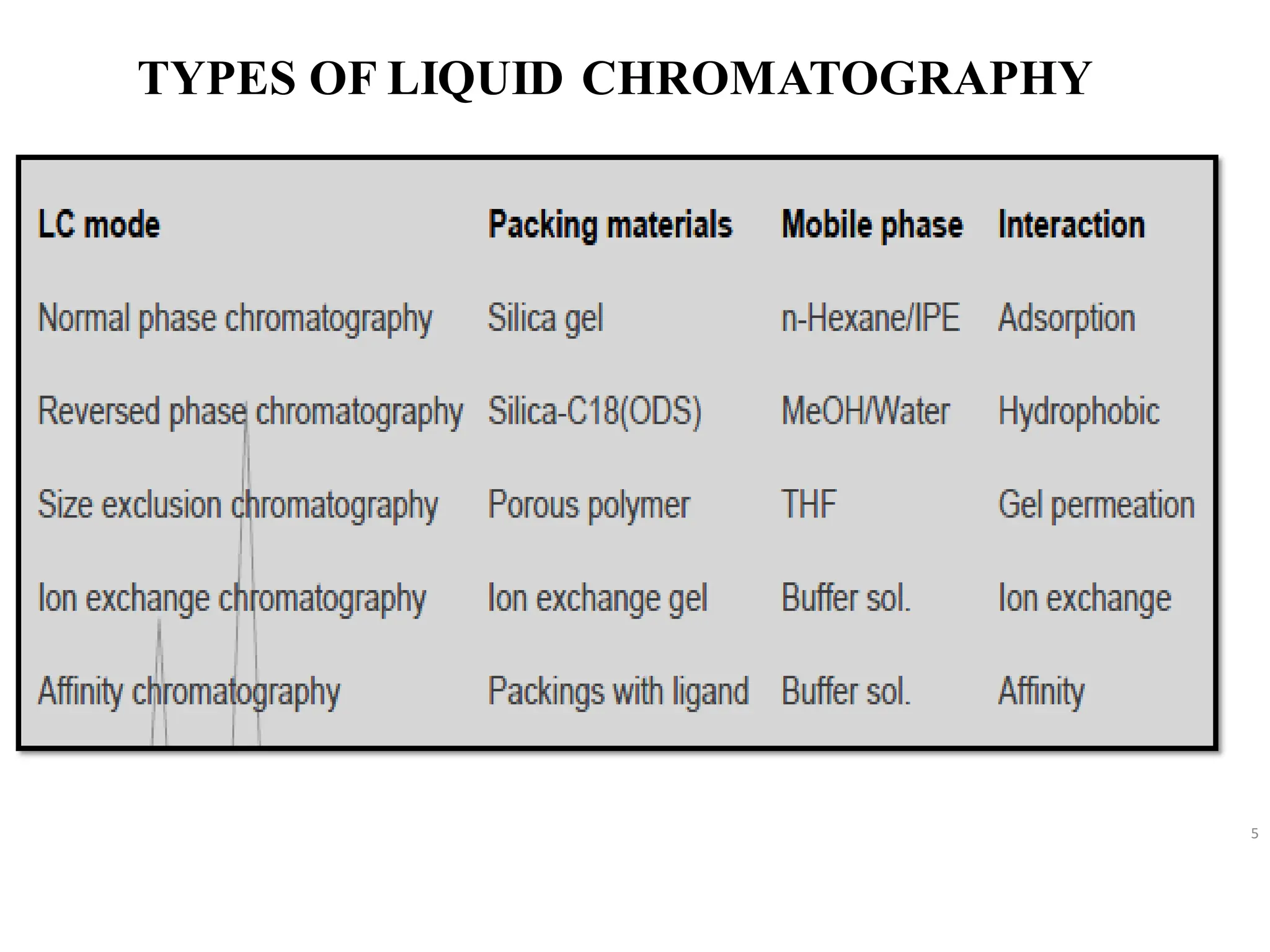
TYPES OF LIQUID CHROMATOGRAPHY
5
hplc
• HPLC is a High Performance liquid Chromatography.
• High Pressure Liquid Chromatography.
• High Priced Liquid Chromatography.
• It is column chromatography.
• It is Liquid Chromatography.
• It is modified from of gas chromatography, it is applicable for both Volatile as well as
Non volatile compound.
• It can mainly divided by two types 1. Normal phase HPLC 2. Reversed Phase HPLC.
• It is having a high resolution and separation capacity.
• It is used as qualitative as well as quantitative analysis.
• High performance liquid chromatography (HPLC) is a chromatographic technique used to
separate a mixture of compounds in analytical chemistry and biochemistry with the
purpose of identifying, quantifying or purifying the individual components of the
mixture.
6
7
Principle
• High Performance Liquid Chromatography [HPLC] is principle is based on adsorption as
well as partition chromatography is depending on the nature of stationary phase, if
stationary phase is solid principle is based on adsorption chromatography and if
stationaryphase is liquidprinciple is based on partitionchromatography.
• It is importantfor determination of volatile and non volatile compounds.
• It is importantfor determination qualitative and quantitative analysis.
• It is important for determination of Retention Time (the time is required , after sample
injectionmaximum angle peak reaches to detector)
8
9
Advantages
• It is simple, rapid , reproducible.
• High sensitivity.
• High performance.
• Rapid process and hence time saving.
• It is having a high resolution and separation capacity.
• Accuracy and Precision.
• Stationary phase was chemically innert.
• Wide varities of stationary phase.
• Mobile phase was chemically innert.
• Less requirement of mobile phase in developing chamber.
• Early recovery of separated component.
• Easy visualization of separated components.
• It is having Good reproducibility and repeatability.
• It is analytical technique is important for validation of product, quality control studies
of product.
• It is important for qualitative and quantitative analysis.
• It is used for both analytical and preparative purpose. 10
Types of HPLC Separations
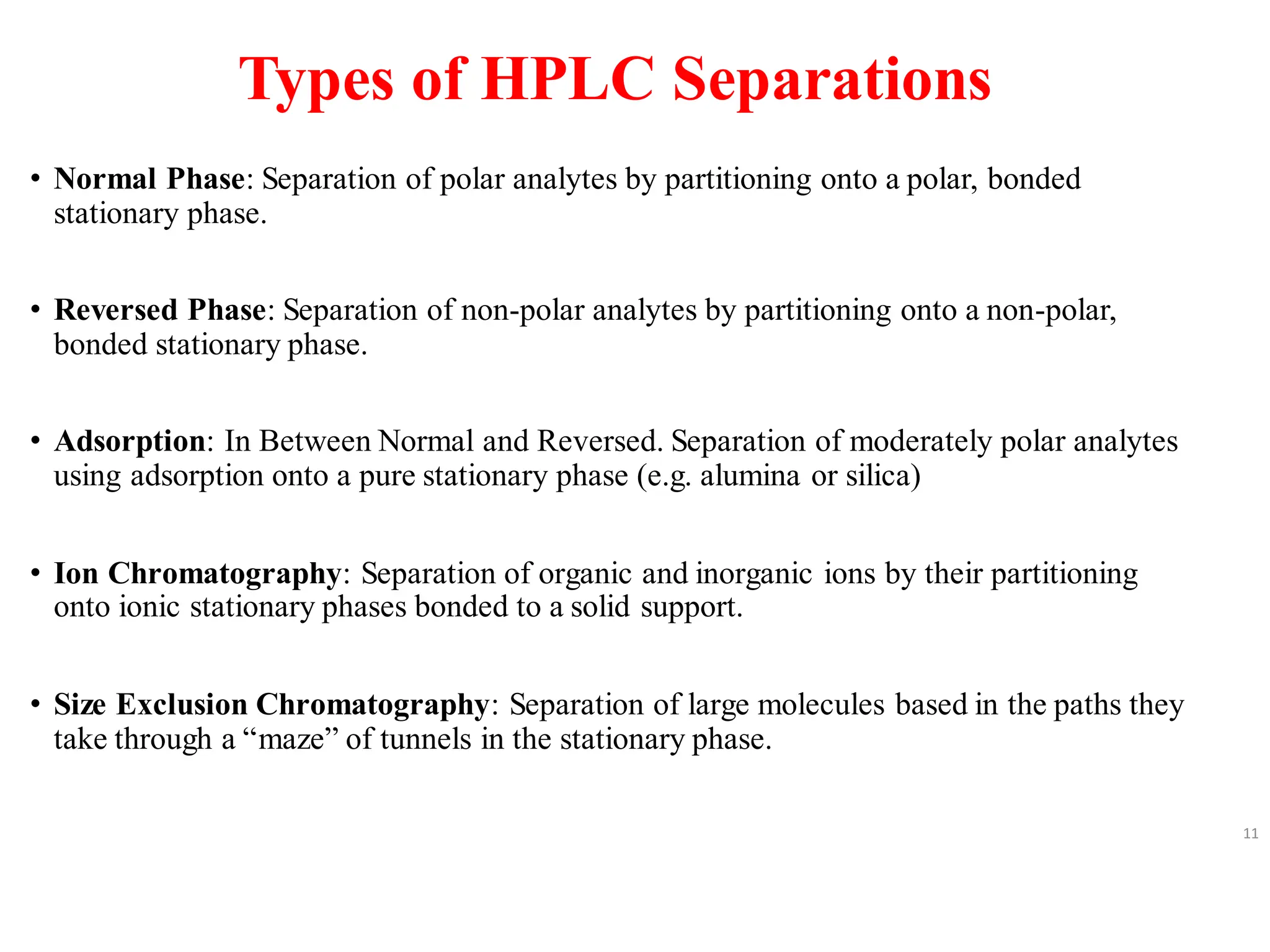
• Normal Phase: Separation of polar analytes by partitioning onto a polar, bonded
stationary phase.
• Reversed Phase: Separation of non-polar analytes by partitioning onto a non-polar,
bonded stationary phase.
• Adsorption: In Between Normal and Reversed. Separation of moderately polar analytes
using adsorption onto a pure stationary phase (e.g. alumina or silica)
• Ion Chromatography: Separation of organic and inorganic ions by their partitioning
onto ionic stationary phases bonded to a solid support.
• Size Exclusion Chromatography: Separation of large molecules based in the paths they
take through a “maze” of tunnels in the stationary phase.
11
12
HPLC Methods
 Parameter Group Method Compounds
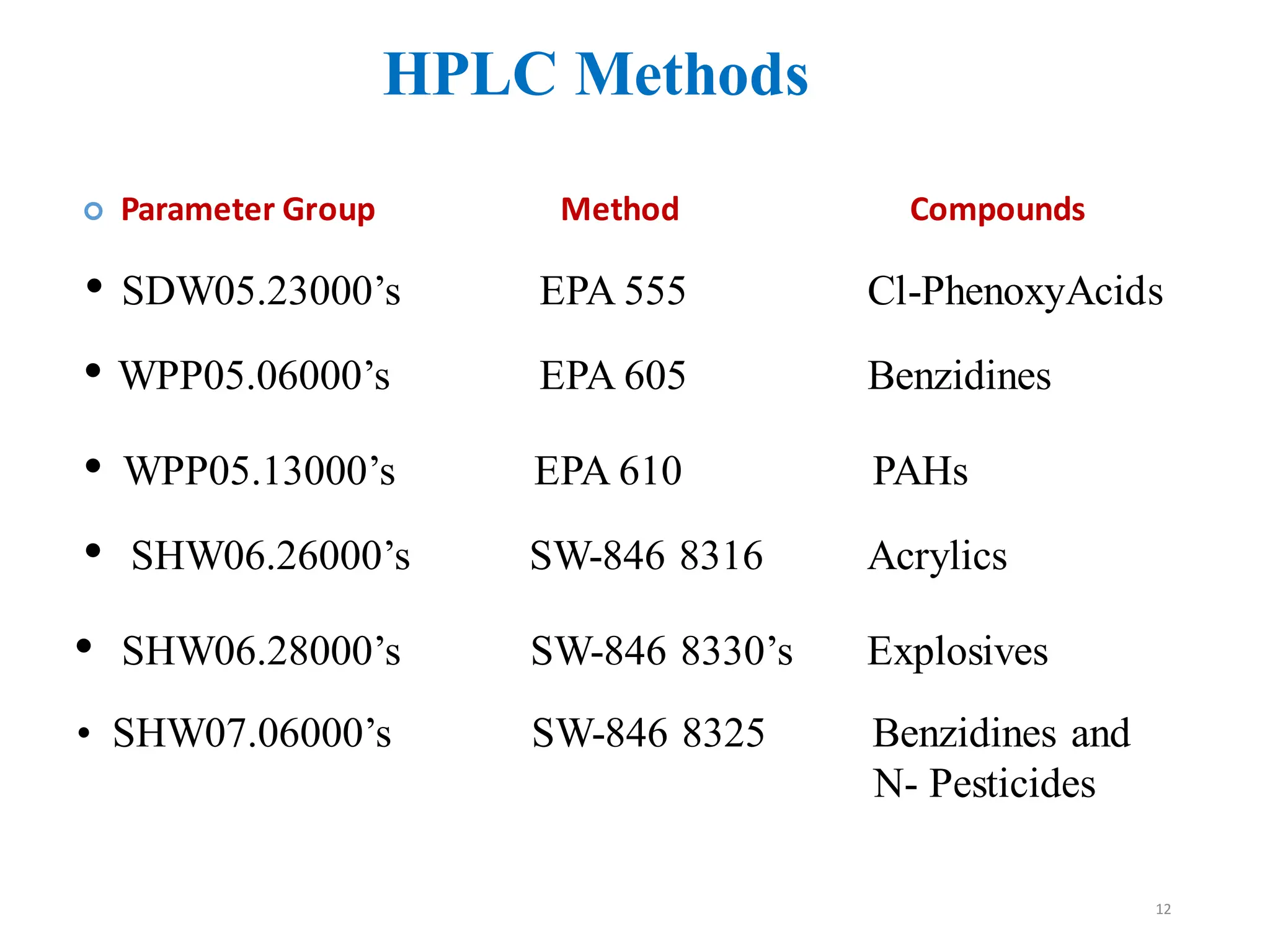
• SDW05.23000’s EPA 555 Cl-PhenoxyAcids
• WPP05.13000’s EPA 610 PAHs
• WPP05.06000’s EPA 605 Benzidines
• SHW06.26000’s SW-846 8316 Acrylics
• SHW06.28000’s SW-846 8330’s Explosives
• SHW07.06000’s SW-846 8325 Benzidines and
N- Pesticides
Modes of High Performance Liquid Chromatography
13
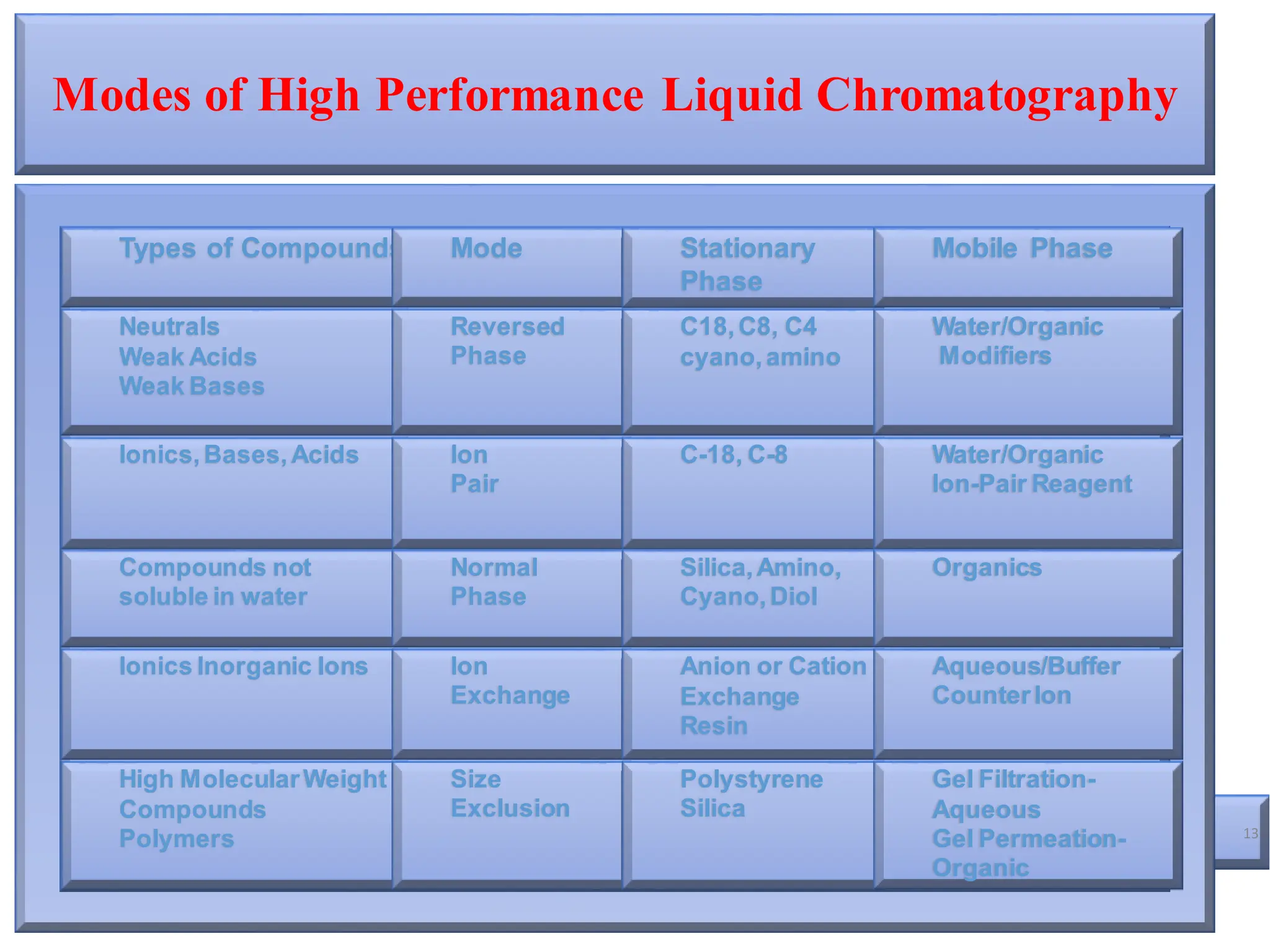
Types of Compounds Mode Stationary
Phase
Mobile Phase
Neutrals
Weak Acids
Weak Bases
Reversed
Phase
C18,C8, C4
cyano,amino
Water/Organic
Modifiers
Ionics,Bases,Acids Ion
Pair
C-18, C-8 Water/Organic
Ion-Pair Reagent
Compounds not
soluble in water
Normal
Phase
Silica,Amino,
Cyano,Diol
Organics
Ionics Inorganic Ions Ion
Exchange
Anion or Cation
Exchange
Resin
Aqueous/Buffer
CounterIon
High MolecularWeight
Compounds
Polymers
Size
Exclusion
Polystyrene
Silica
Gel Filtration-
Aqueous
Gel Permeation-
Organic
HPLC Contain
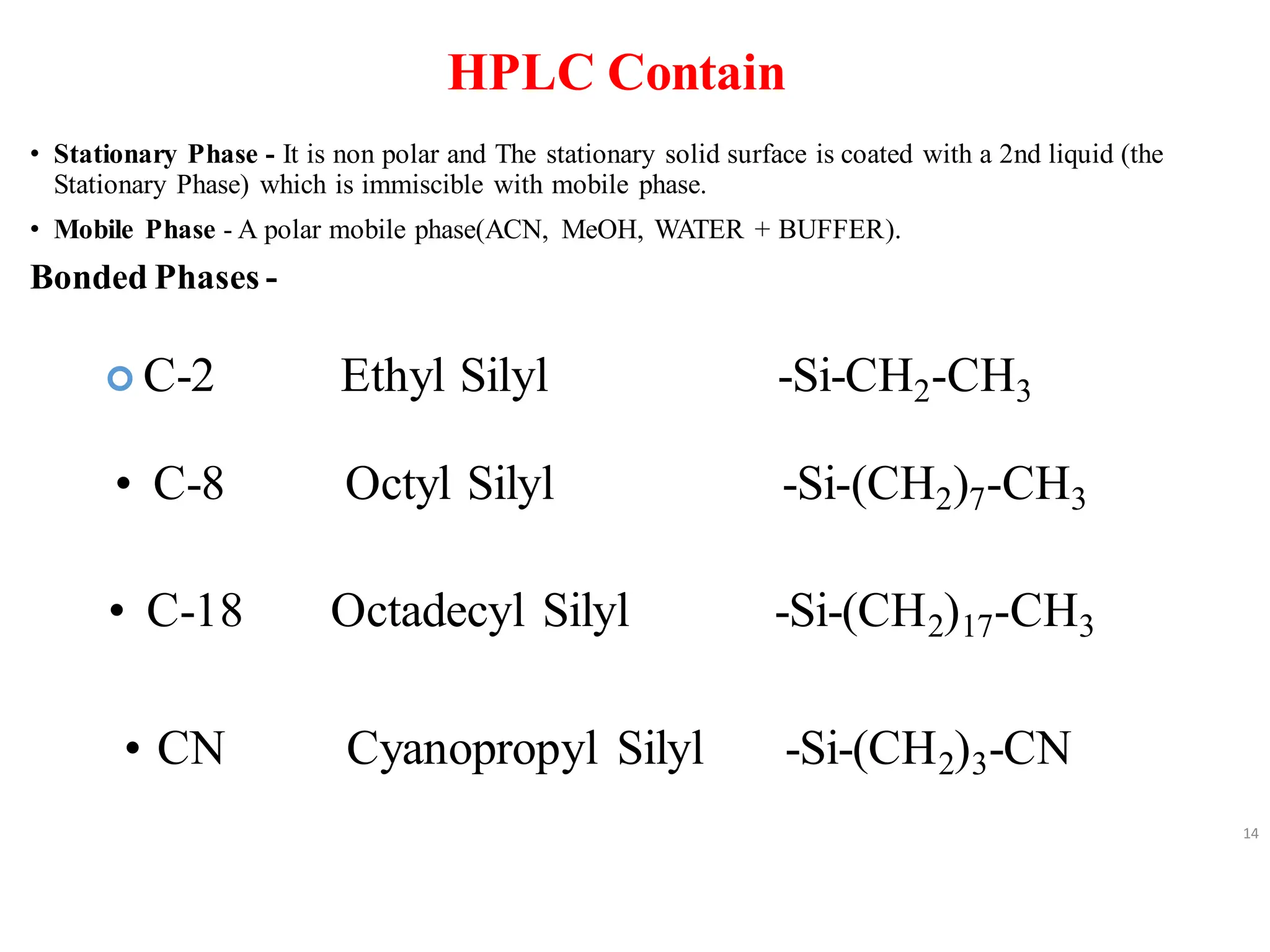
• Stationary Phase - It is non polar and The stationary solid surface is coated with a 2nd liquid (the
Stationary Phase) which is immiscible with mobile phase.
• Mobile Phase - A polar mobile phase(ACN, MeOH, WATER + BUFFER).
Bonded Phases -
14
 C-2 Ethyl Silyl -Si-CH2-CH3
• CN Cyanopropyl Silyl -Si-(CH2)3-CN
• C-18 Octadecyl Silyl -Si-(CH2)17-CH3
• C-8 Octyl Silyl -Si-(CH2)7-CH3
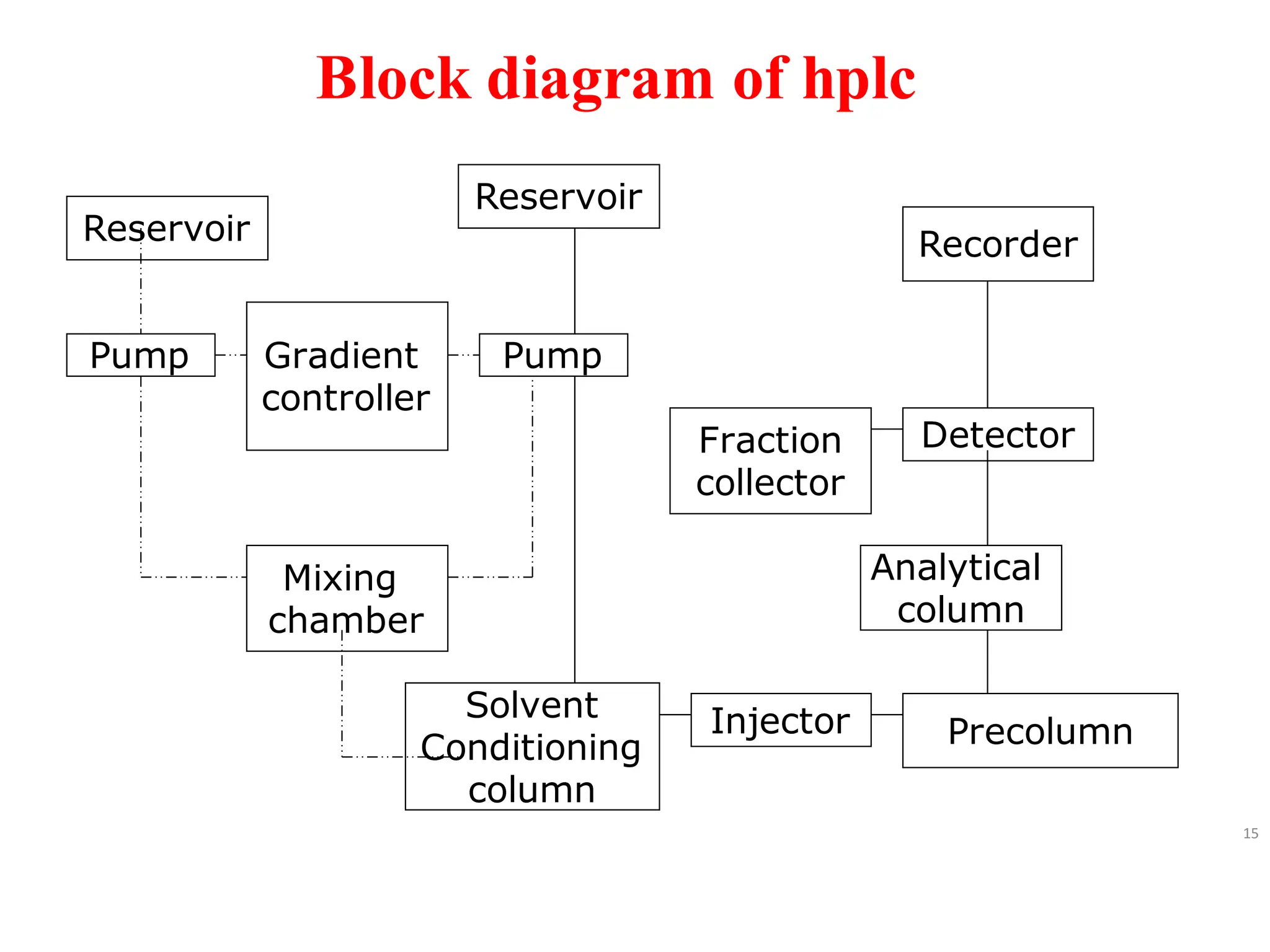
Block diagram of hplc
15
Reservoir
Pump Gradient
controller
Mixing
chamber
Pump
Solvent
Conditioning
column
Reservoir
Injector Precolumn
Analytical
column
Detector
Recorder
Fraction
collector
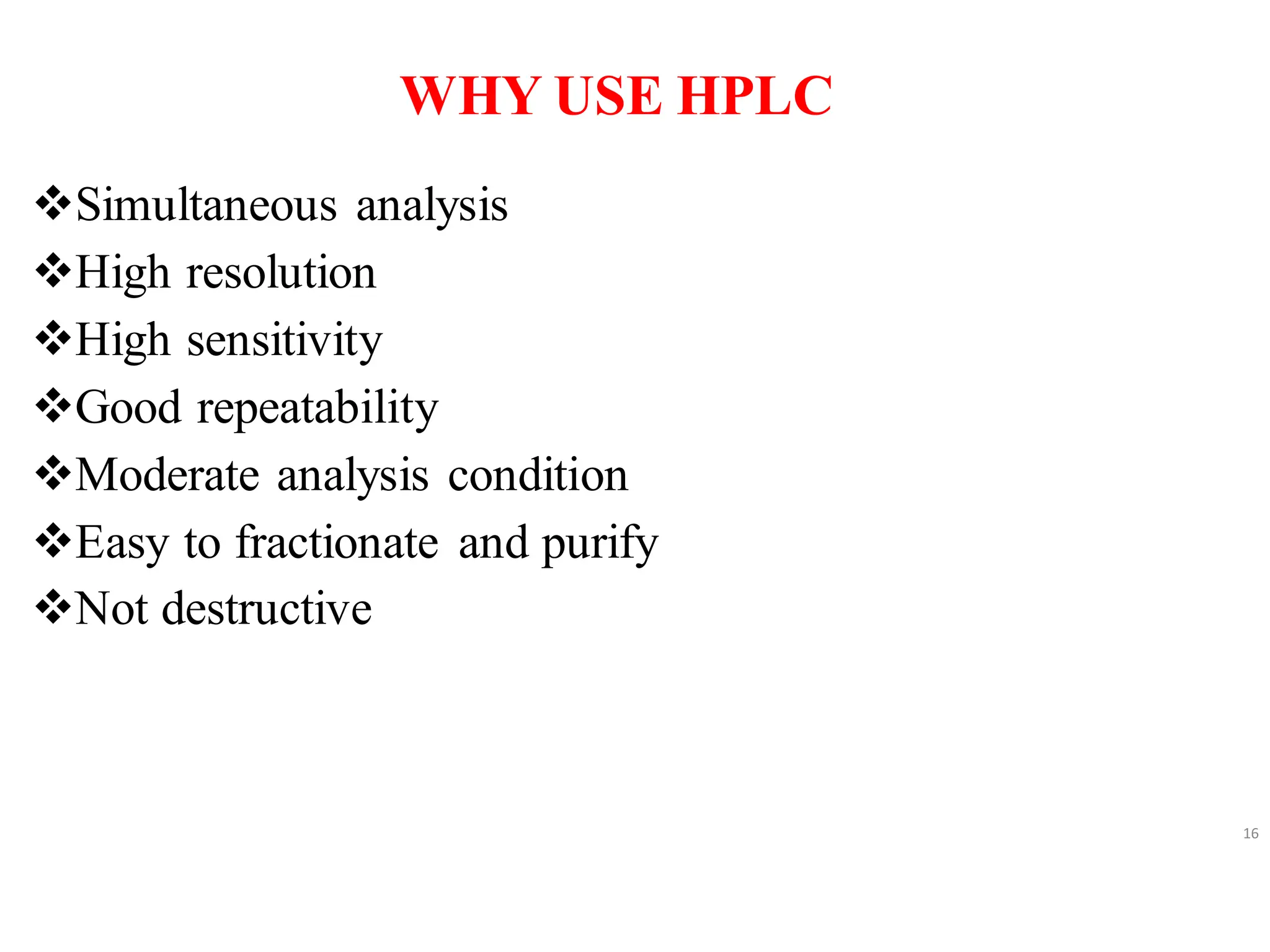
WHY USE HPLC
❖Simultaneous analysis
❖High resolution
❖High sensitivity
❖Good repeatability
❖Moderate analysis condition
❖Easy to fractionate and purify
❖Not destructive
16
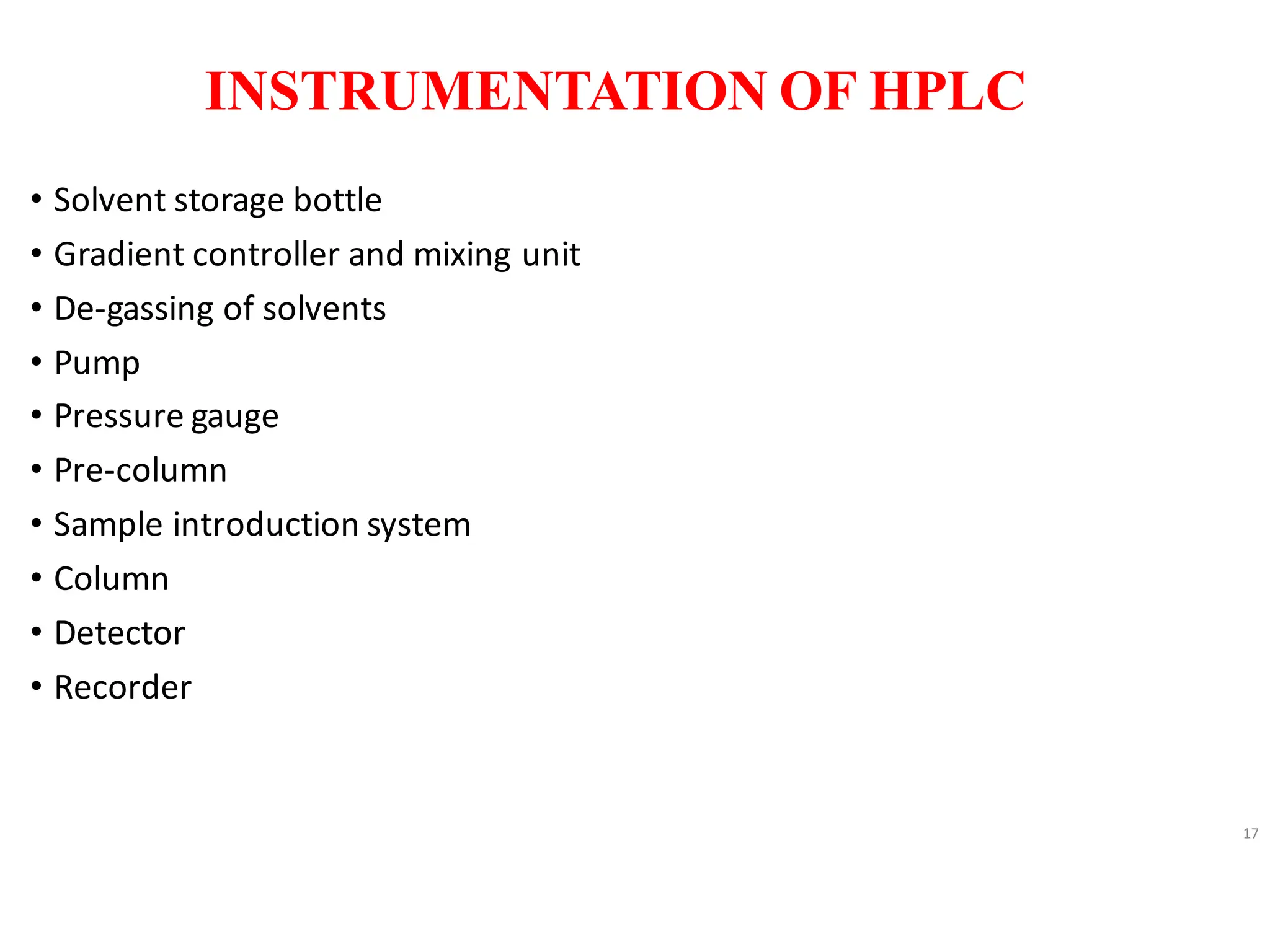
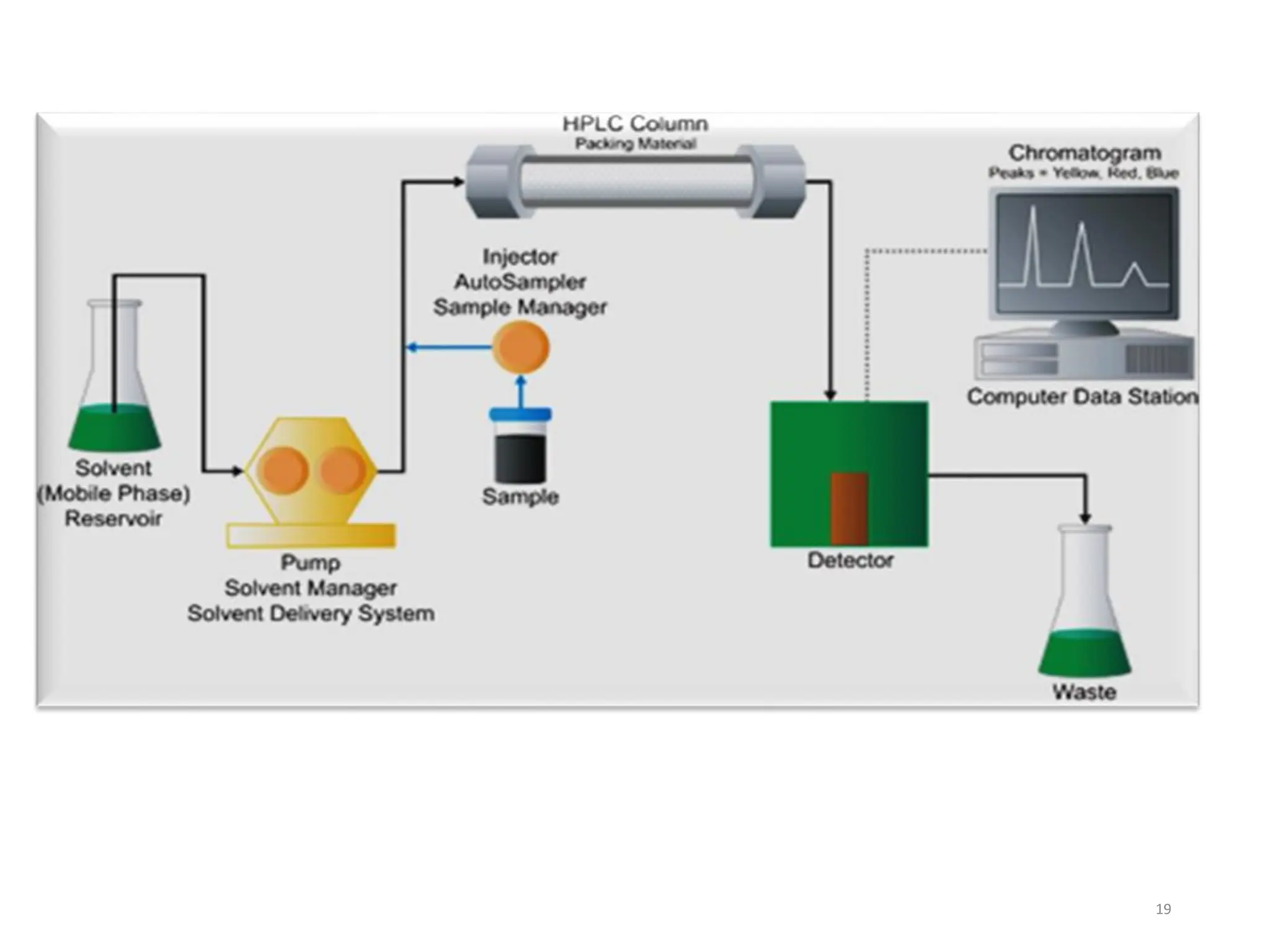
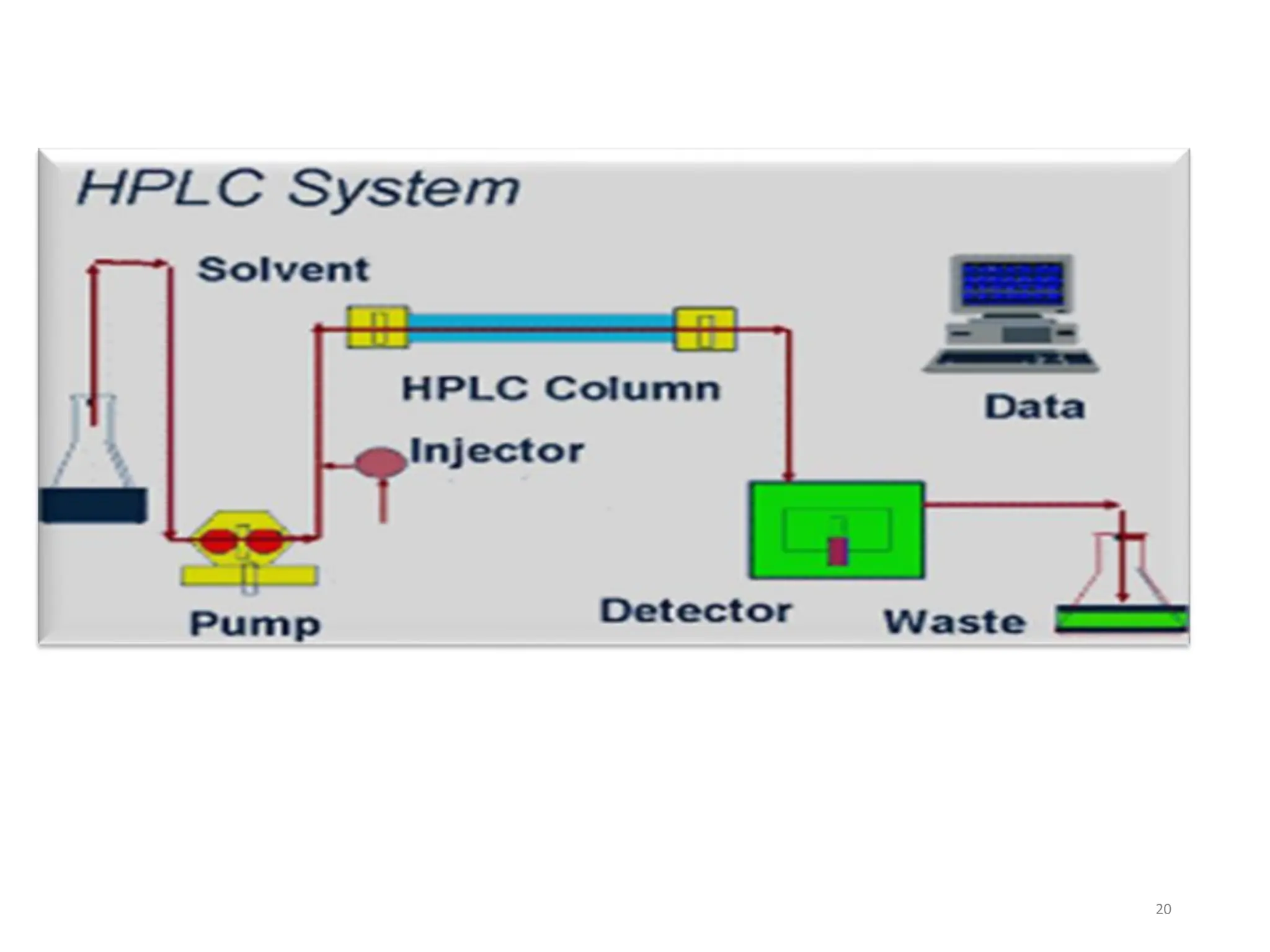
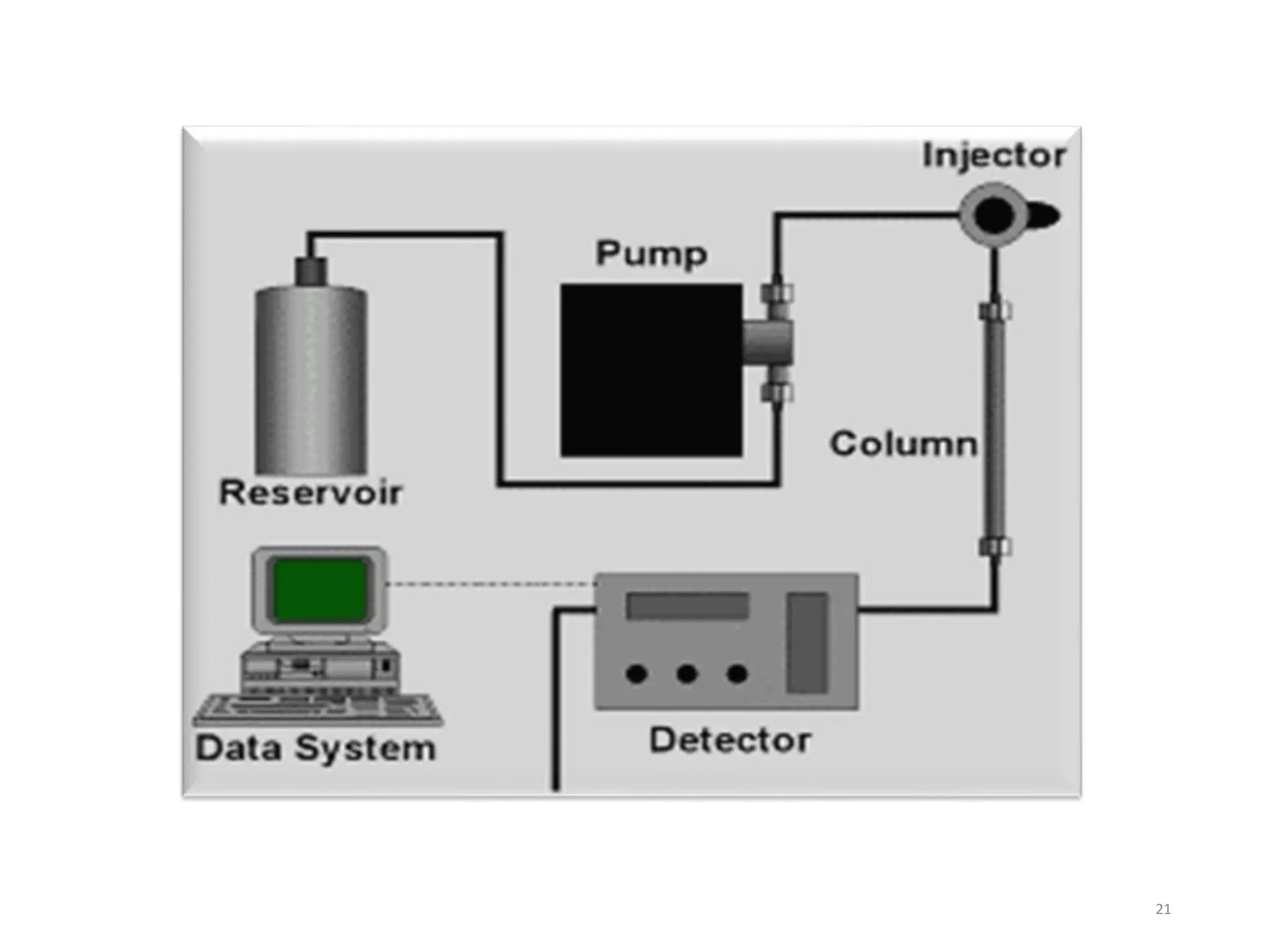
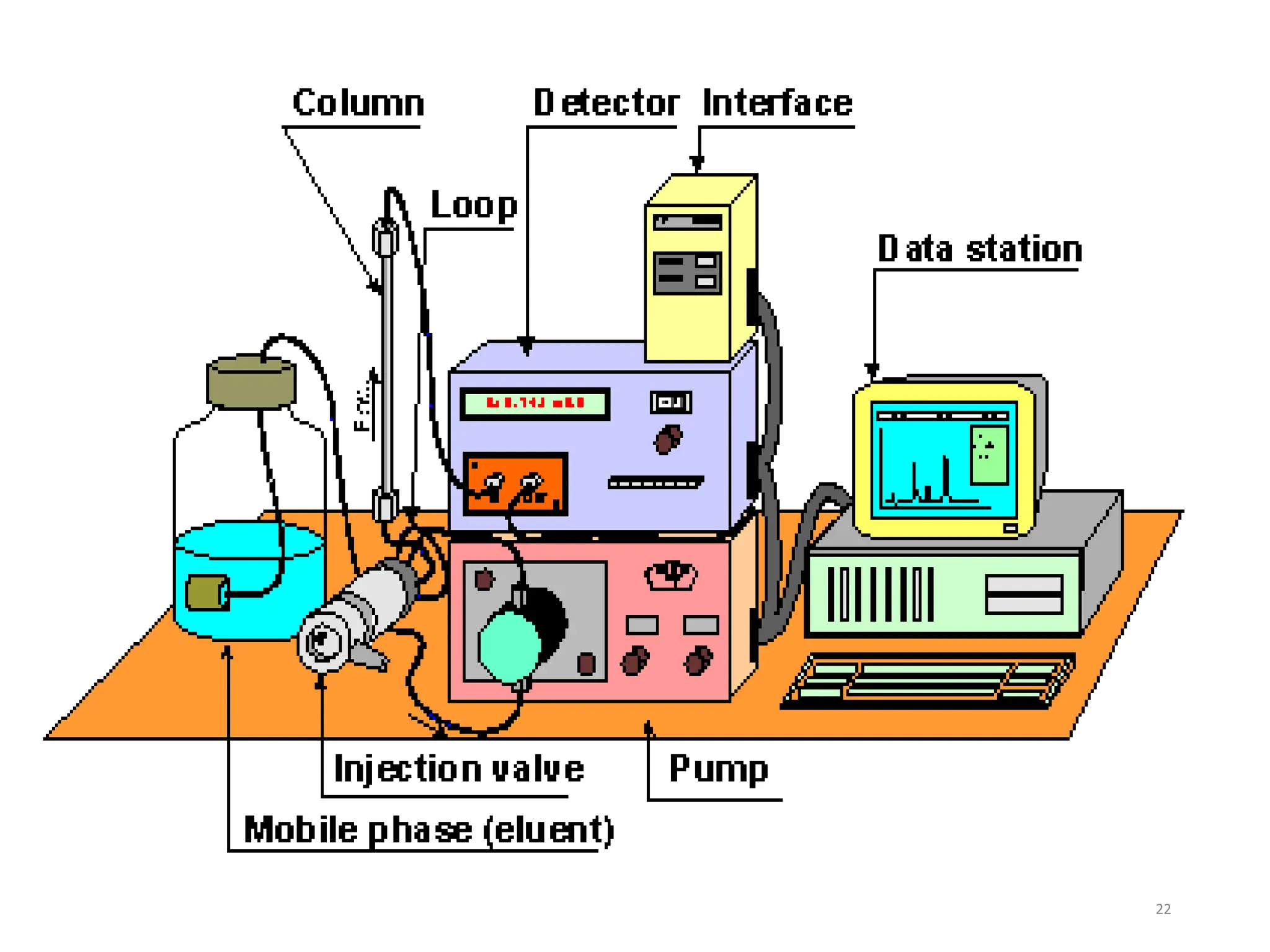
INSTRUMENTATION OF HPLC
• Solvent storage bottle
• Gradient controller and mixing unit
• De-gassing of solvents
• Pump
• Pressure gauge
• Pre-column
• Sample introduction system
• Column
• Detector
• Recorder
17
18
19
20
21
22
23
23
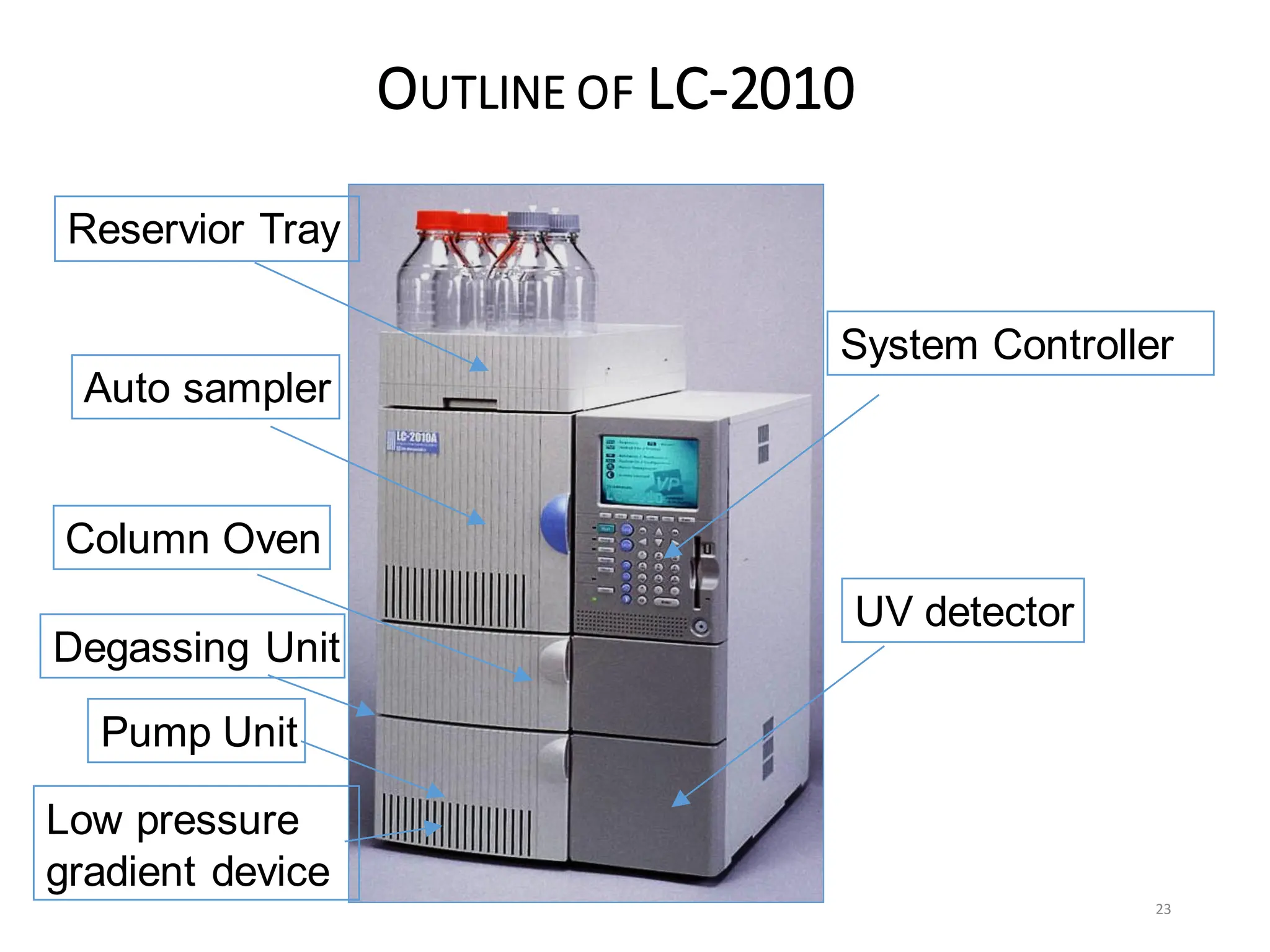
OUTLINE OF LC-2010
System Controller
UV detector
Auto sampler
Column Oven
Pump Unit
Reservior Tray
Degassing Unit
Low pressure
gradient device
24
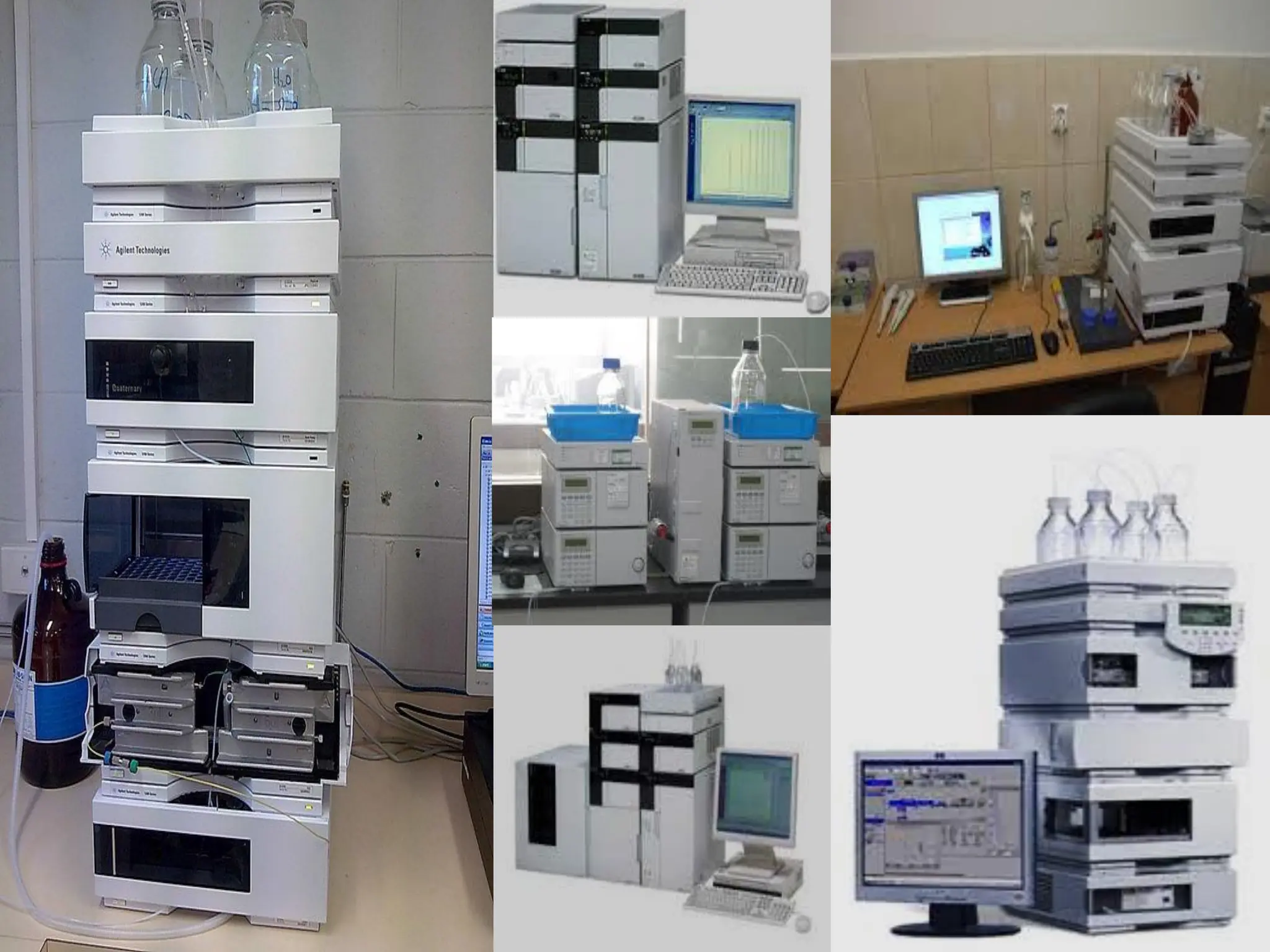
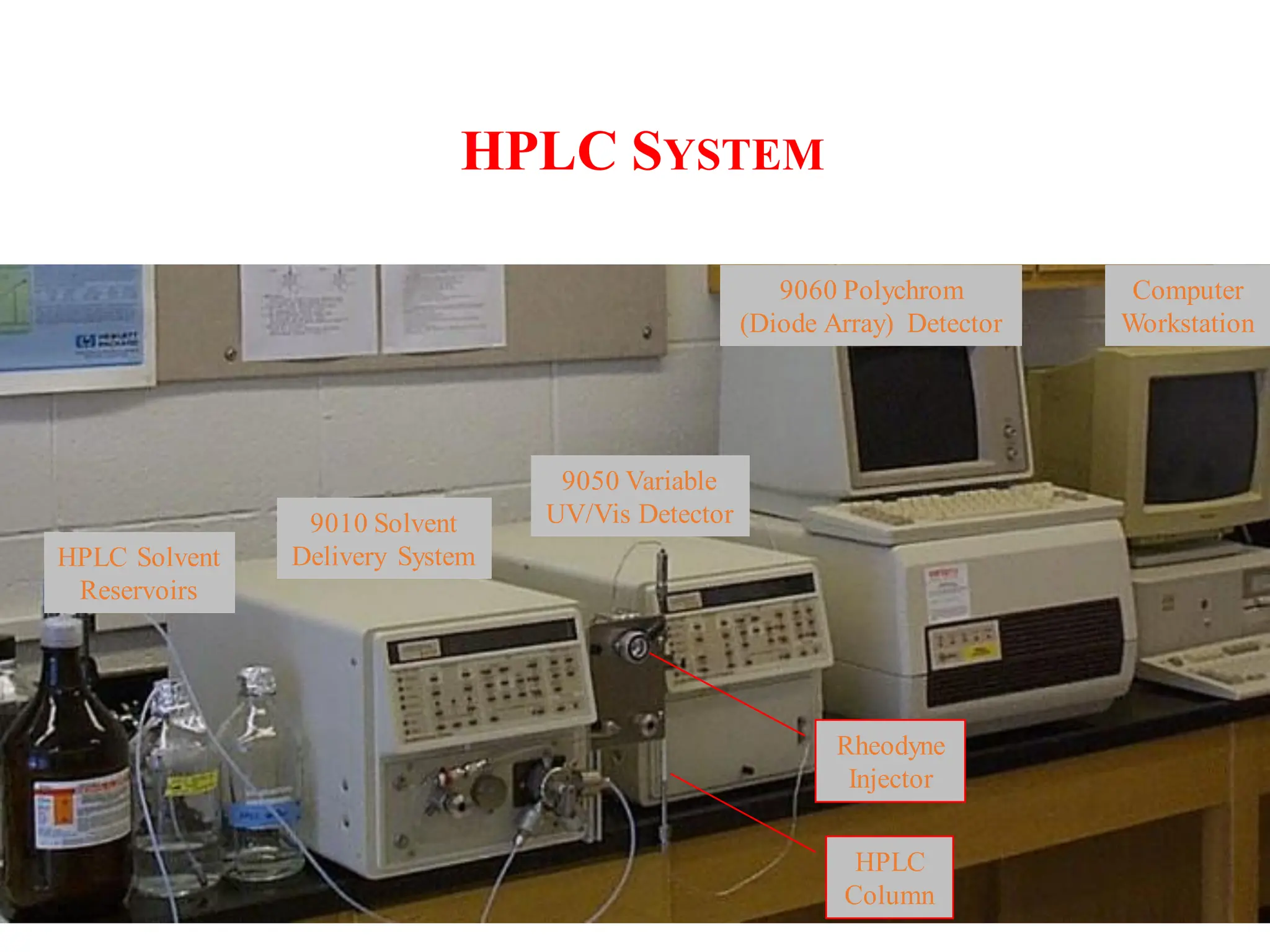
HPLC SYSTEM
9010 Solvent
Delivery System
9050 Variable
UV/Vis Detector
HPLC Solvent
Reservoirs
HPLC
Column
Rheodyne
Injector
9060 Polychrom
(Diode Array) Detector
Computer
Workstation
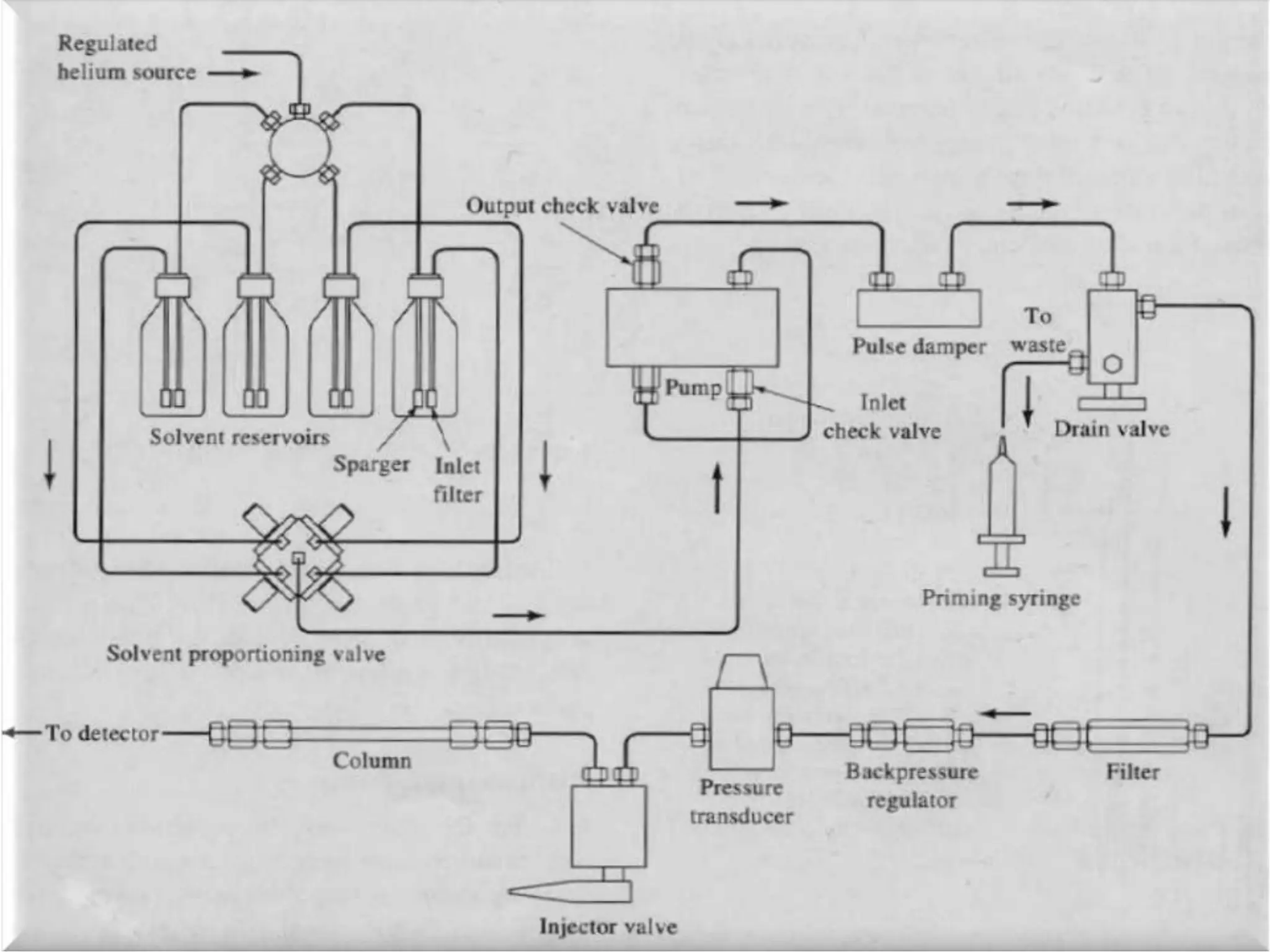
Solvent/ mobile phase reservoirs
• Glass or stainless-steel containers capable of holding up to 1 liter mobile
phase (pure organic solvents or aqueous solutions of salts and buffers)
• Inert to a variety of aqueous and non aqueous mobile phases.
• Stainless steel should be avoided for use with solvents containing halide
ions.
25
Degassing& filtrationof mobile phase
• In many cases, aqueous solvents & some organic solvents are degassed prior
to use
• Degassing is done to prevent formation of gas bubbles in the pump or
detector ( Mobile phases are degassed by stirring of the mobile phase under
vacuum, sonication or sparing with helium gas)
• The mobile phase are filtered to remove particulate matter that may clog the
system
Tubing
• Shouldbe inert,
• have ability to withstand pressure
• able to carry sufficient volume
26
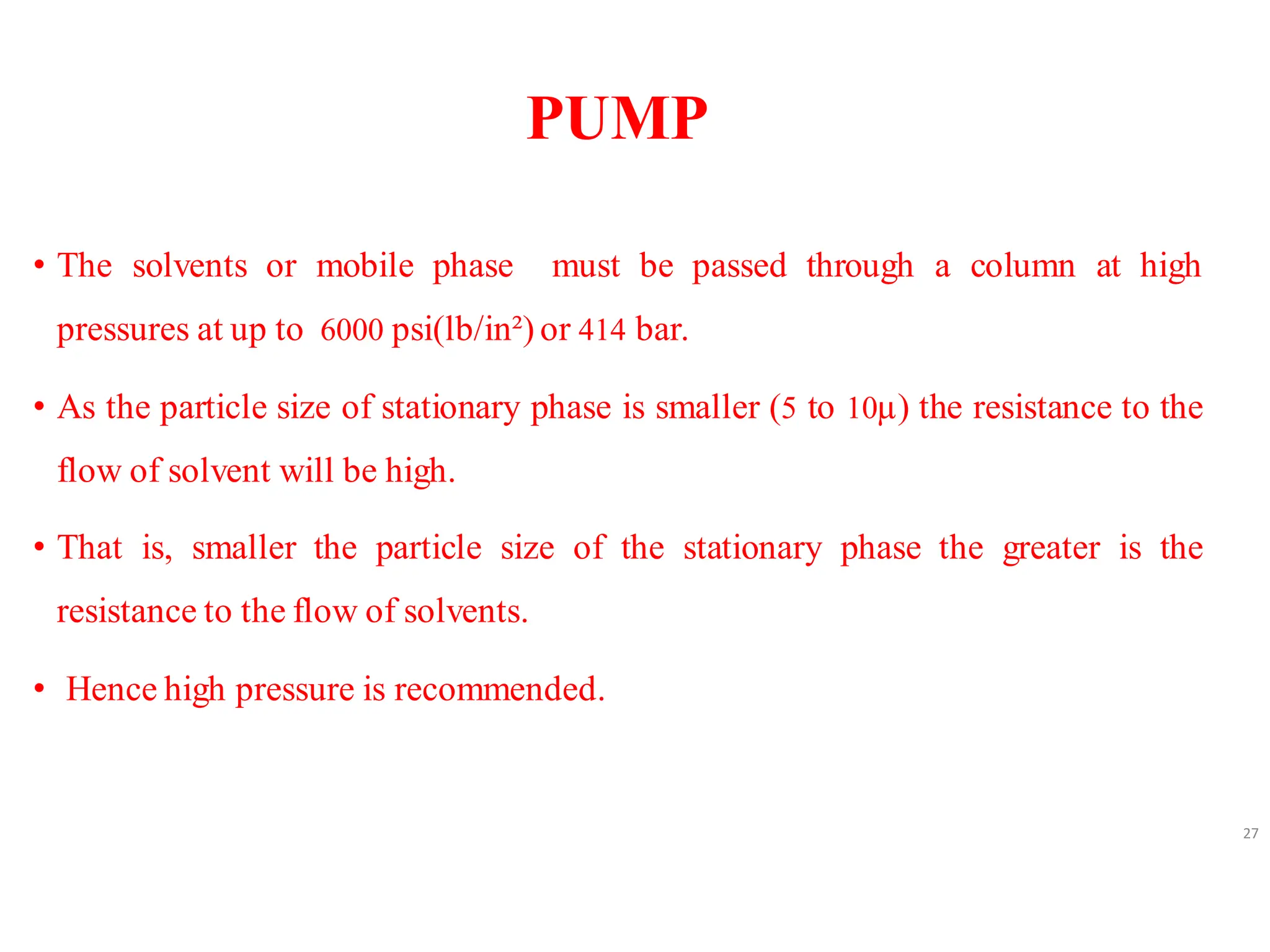
PUMP
• The solvents or mobile phase must be passed through a column at high
pressures at up to 6000 psi(lb/in²) or 414 bar.
• As the particle size of stationary phase is smaller (5 to 10µ) the resistance to the
flow of solvent will be high.
• That is, smaller the particle size of the stationary phase the greater is the
resistance to the flow of solvents.
• Hence high pressure is recommended.
27
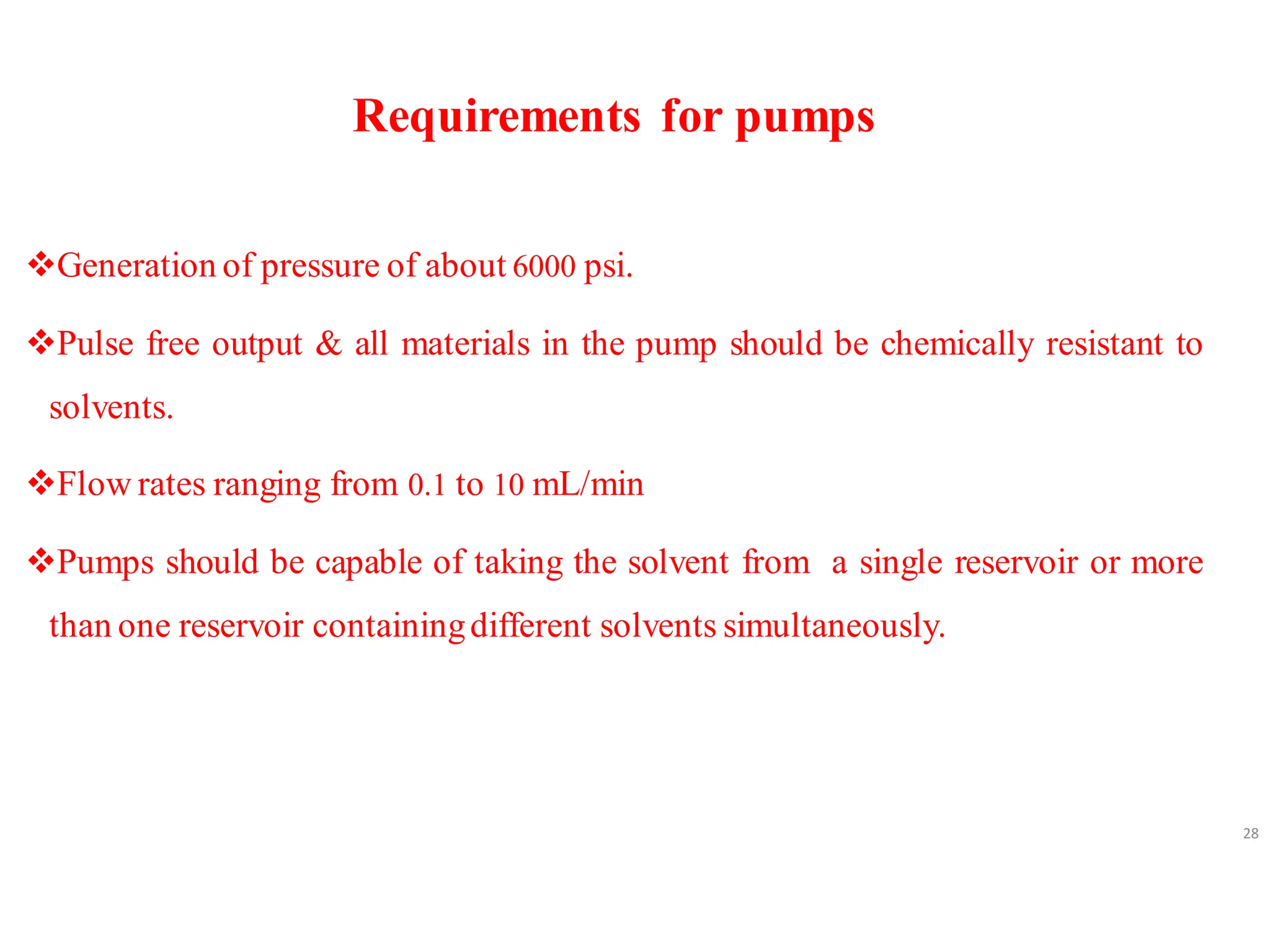
Requirements for pumps
❖Generation of pressure of about 6000 psi.
❖Pulse free output & all materials in the pump should be chemically resistant to
solvents.
❖Flow rates ranging from 0.1 to 10 mL/min
❖Pumps should be capable of taking the solvent from a single reservoir or more
than one reservoir containingdifferent solvents simultaneously.
28
29
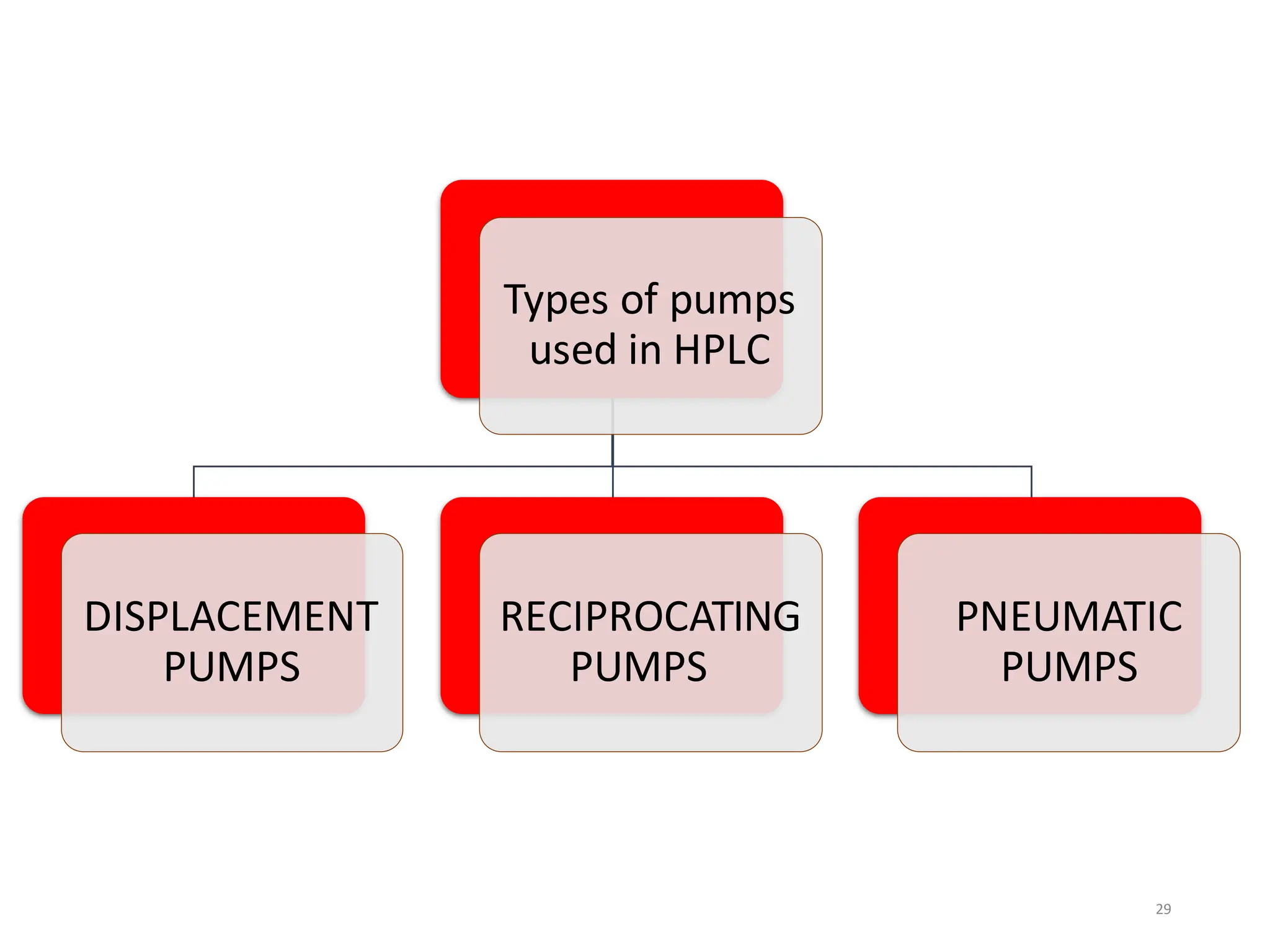
Types of pumps
used in HPLC
DISPLACEMENT
PUMPS
RECIPROCATING
PUMPS
PNEUMATIC
PUMPS
30
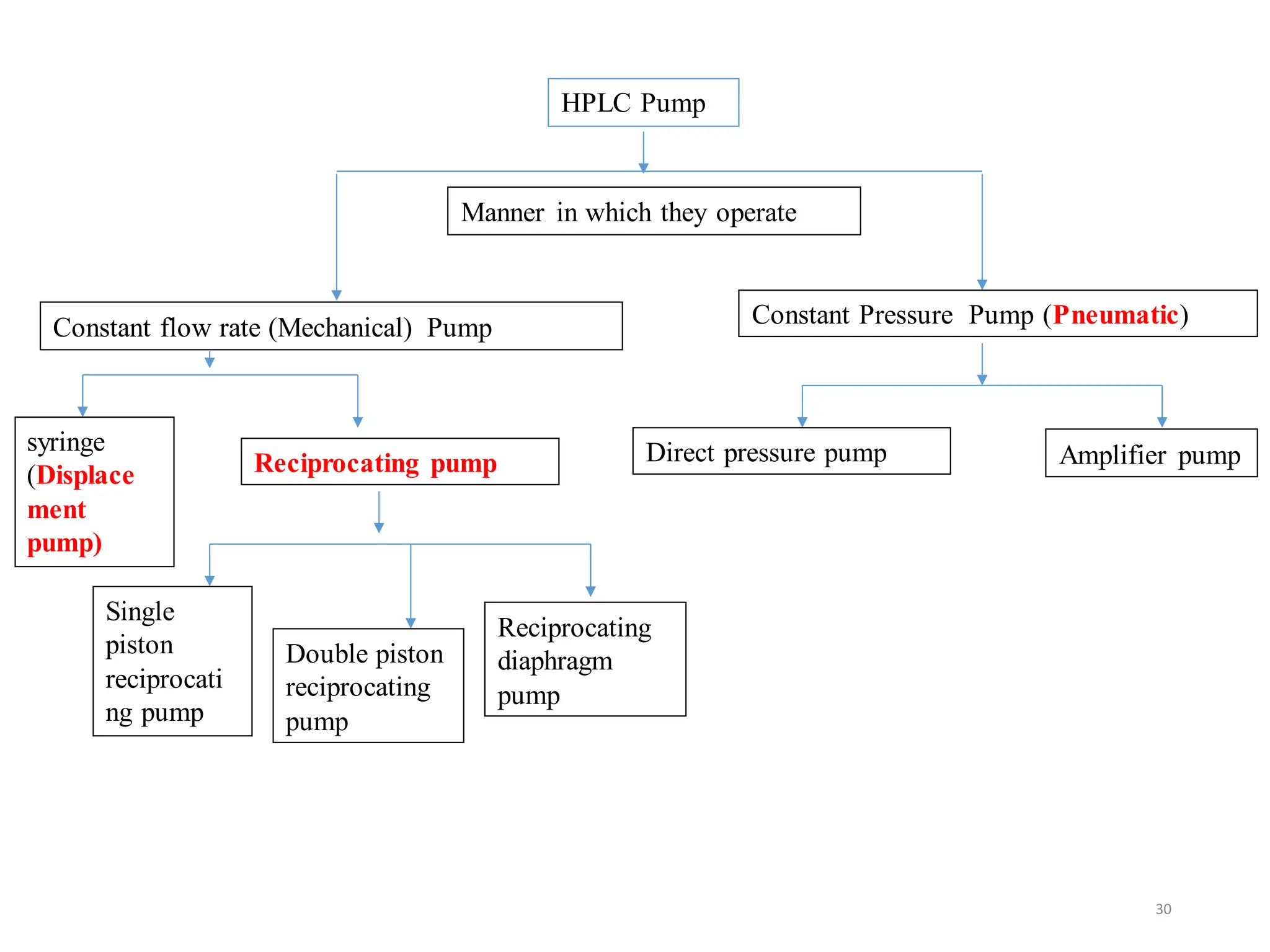
HPLC Pump
Constant flow rate (Mechanical) Pump Constant Pressure Pump (Pneumatic)
Manner in which they operate
syringe
(Displace
ment
pump)
Reciprocating pump
Single
piston
reciprocati
ng pump
Double piston
reciprocating
pump
Reciprocating
diaphragm
pump
Direct pressure pump Amplifier pump
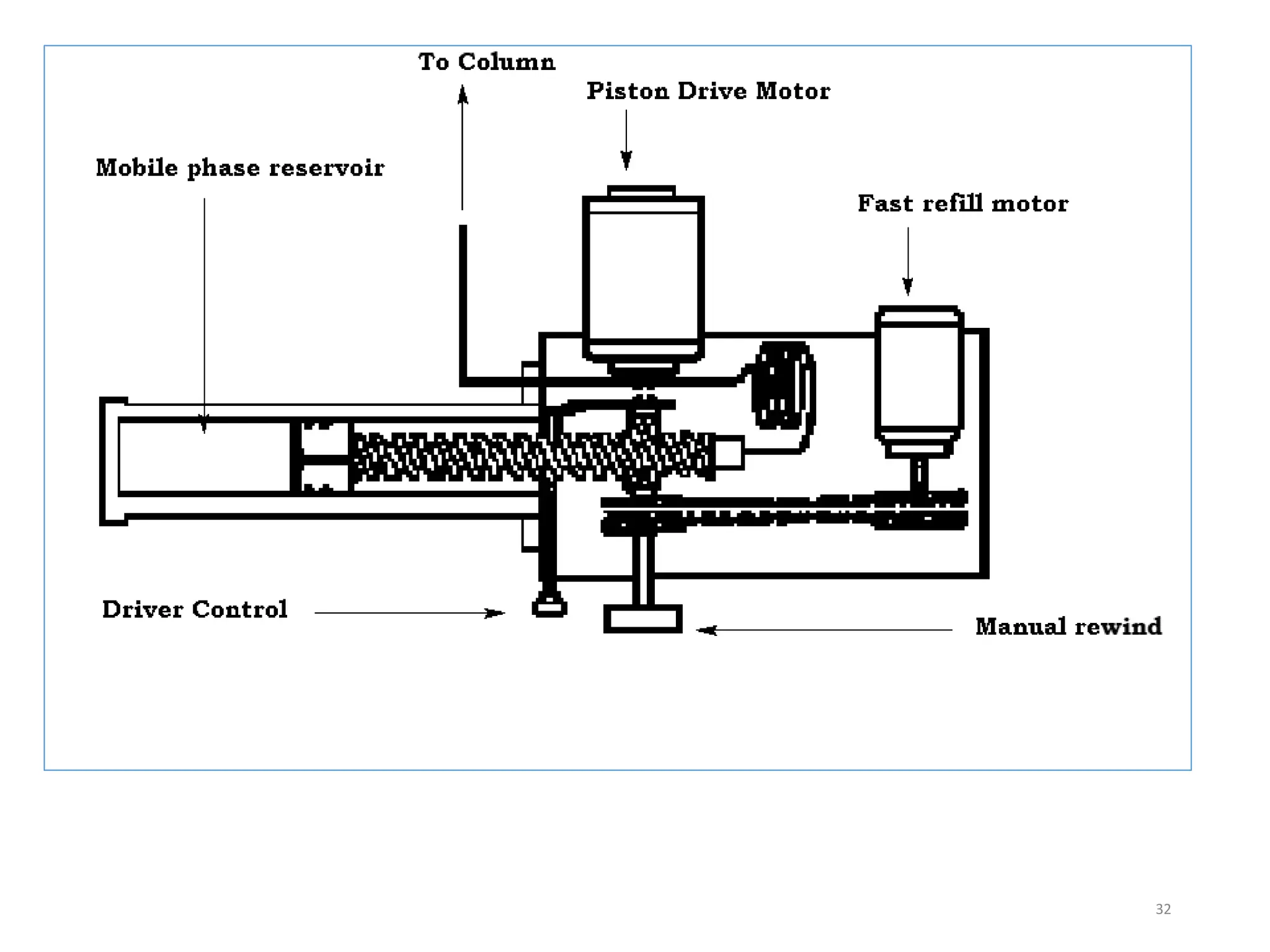
DISPLACEMENT PUMPS
It consists of large, syringe like chambers equipped with a plunger activated
by a screw driven mechanism powered by a stepping motor.
So it is also called as Screw Driven Syringe Type Pump.
Advantages:- It produces a flow that tends to be independent of viscosity &
back pressure.
Disadvantages:- It has a limited solvent capacity(~250) & considerably
inconvenient when solvents must be changed.
31
32
RECIPROCATING PUMPS
• This pump transmits alternative pressure to the solvent via a flexible
diaphragm ,which in turn is hydraulically pumped by a reciprocating pump.
• Disadvantages
Produces a pulsed flow which is damped because pulses appear as baseline
noise on the chromatograph.
This can be overcome by use of dual pump heads or elliptical cams to
minimize such pulsations.
33
34
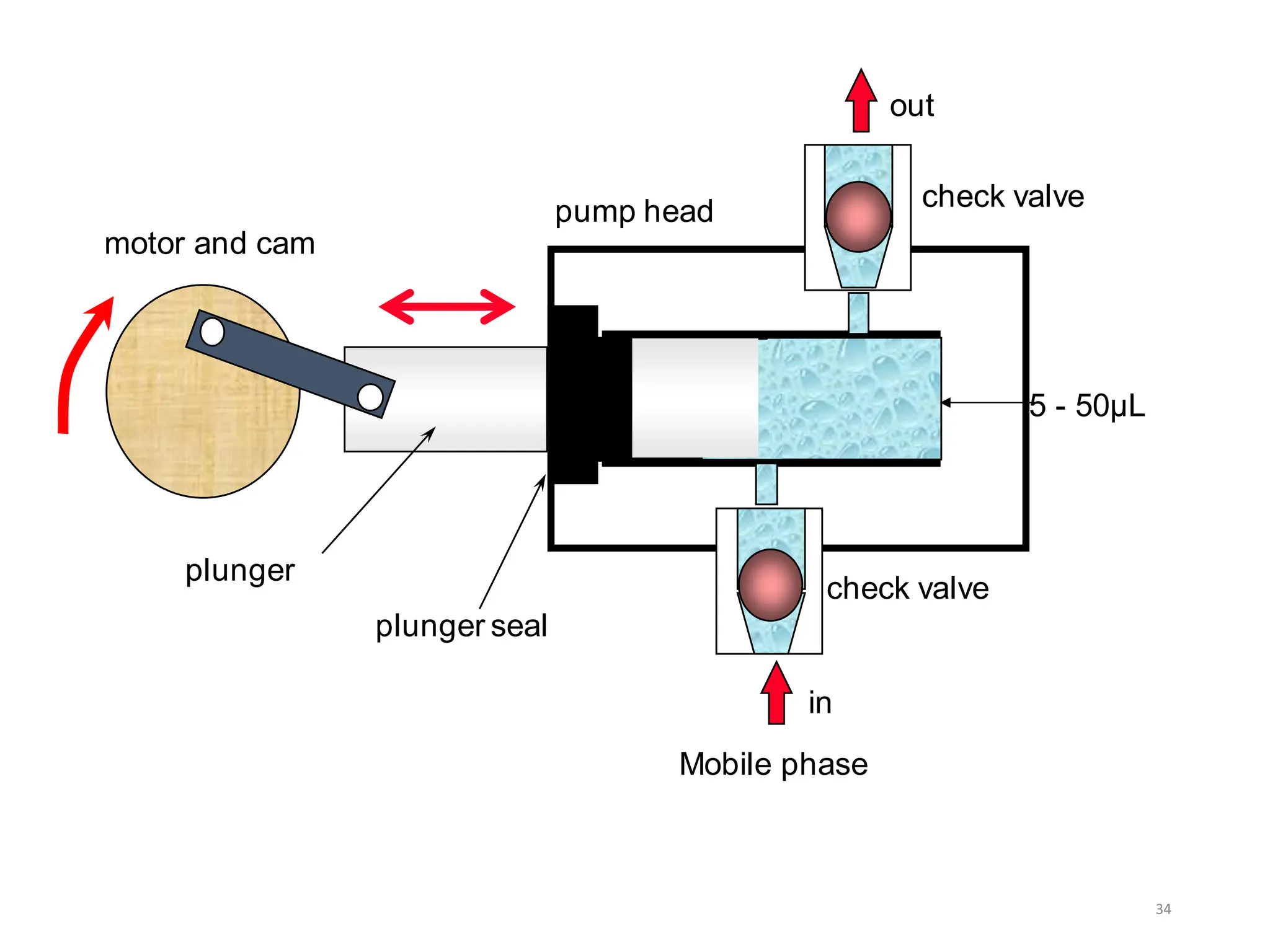
motor and cam
plunger
plunger seal
check valve
pump head
5 - 50µL
out
in
Mobile phase
check valve
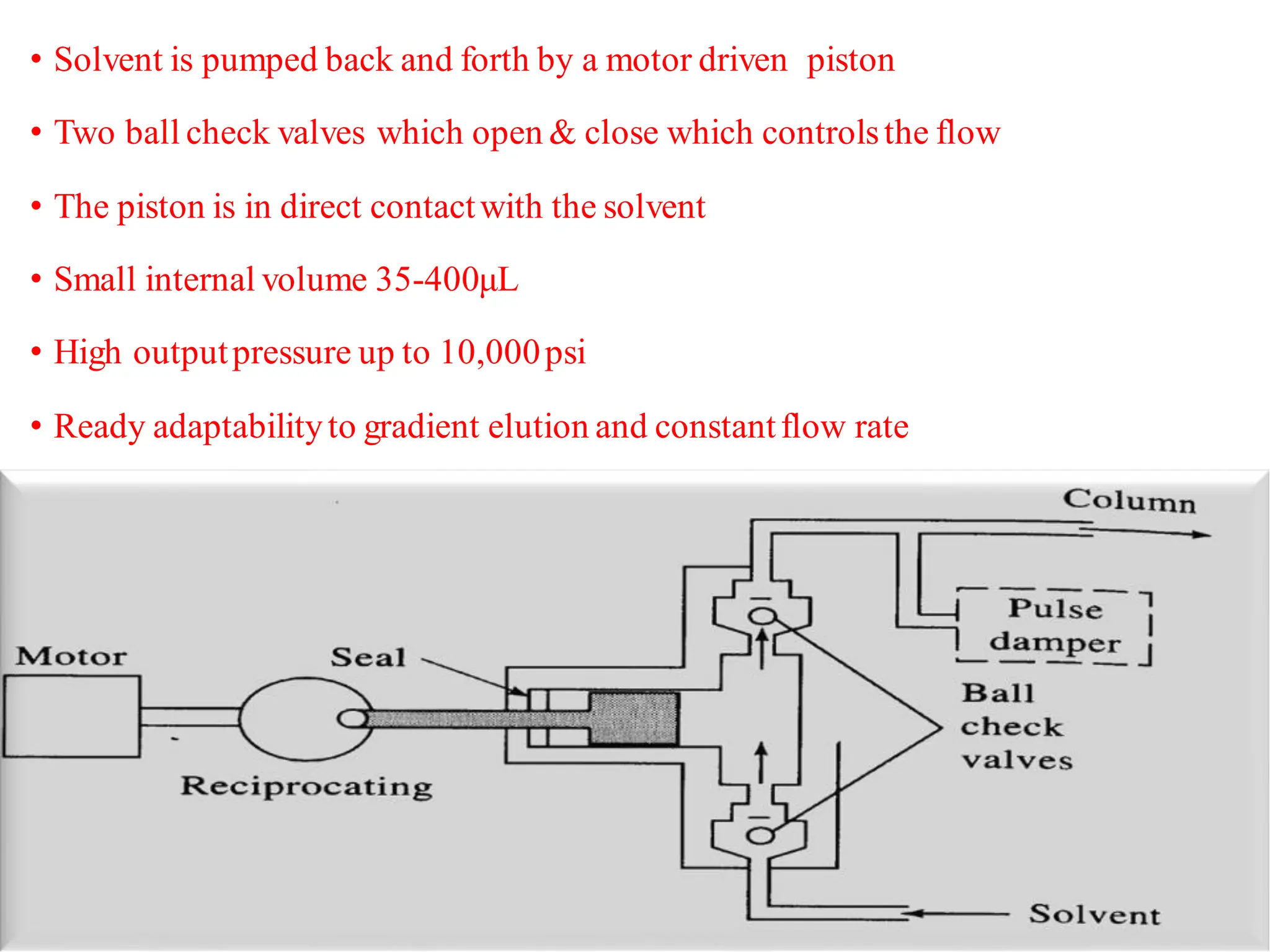
• Solvent is pumped back and forth by a motor driven piston
• Two ball check valves which open & close which controlsthe flow
• The piston is in direct contactwith the solvent
• Small internal volume 35-400μL
• High outputpressure up to 10,000psi
• Ready adaptabilityto gradient elution and constantflow rate
35
36
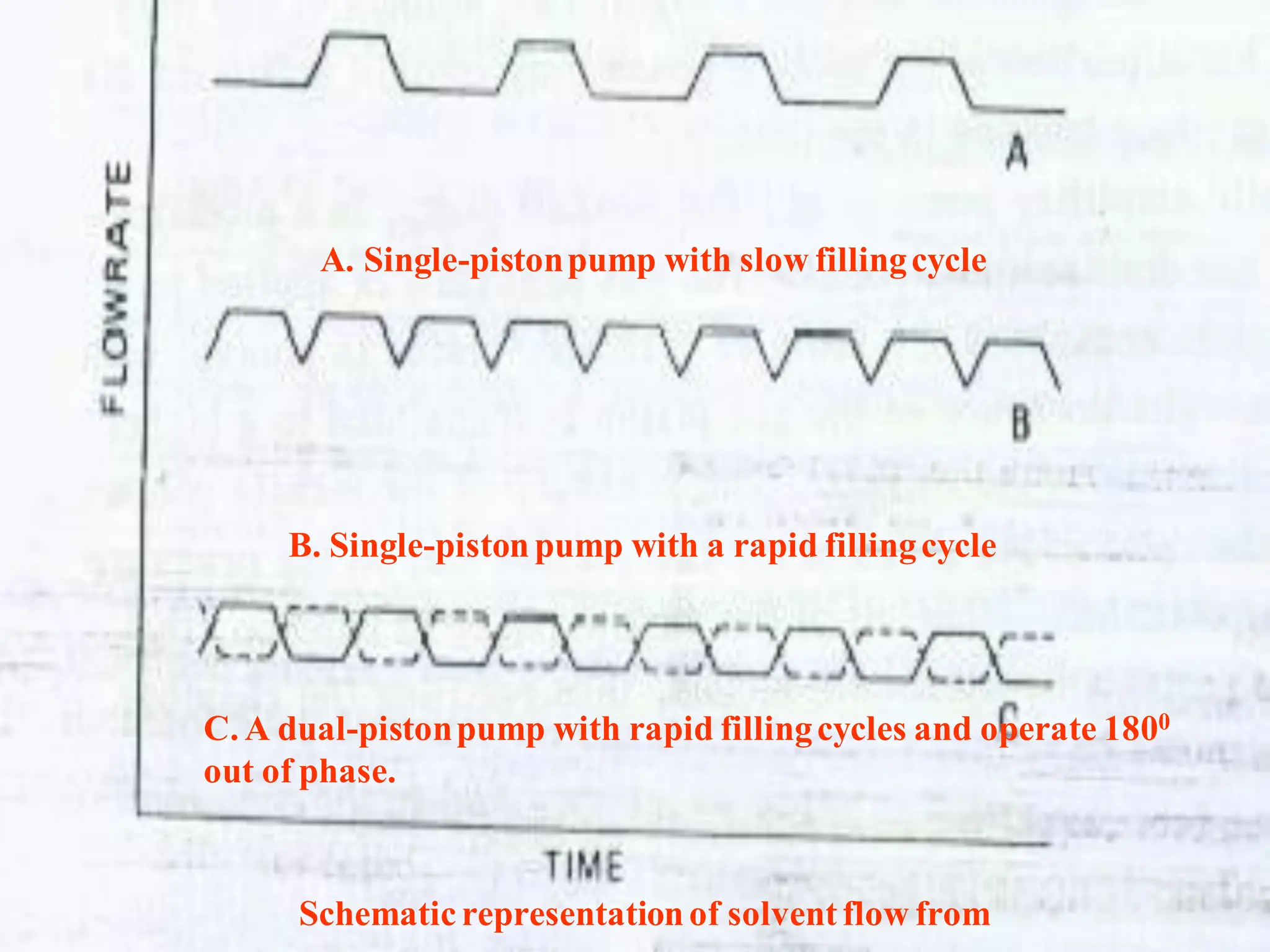
Schematicrepresentationof solventflow from
A. Single-pistonpump with slow fillingcycle
B. Single-pistonpump with a rapid fillingcycle
C. A dual-pistonpump with rapid fillingcycles and operate 1800
out of phase.
• Advantages
• Have small internal volume of 35-400µL
• Higher output pressures up to 10,000 psi.
• Adaptabilityto gradient elution.
• Large solvent capacities & constantflow rates.
• Largely independentof column back pressure & solvent viscosity.
37
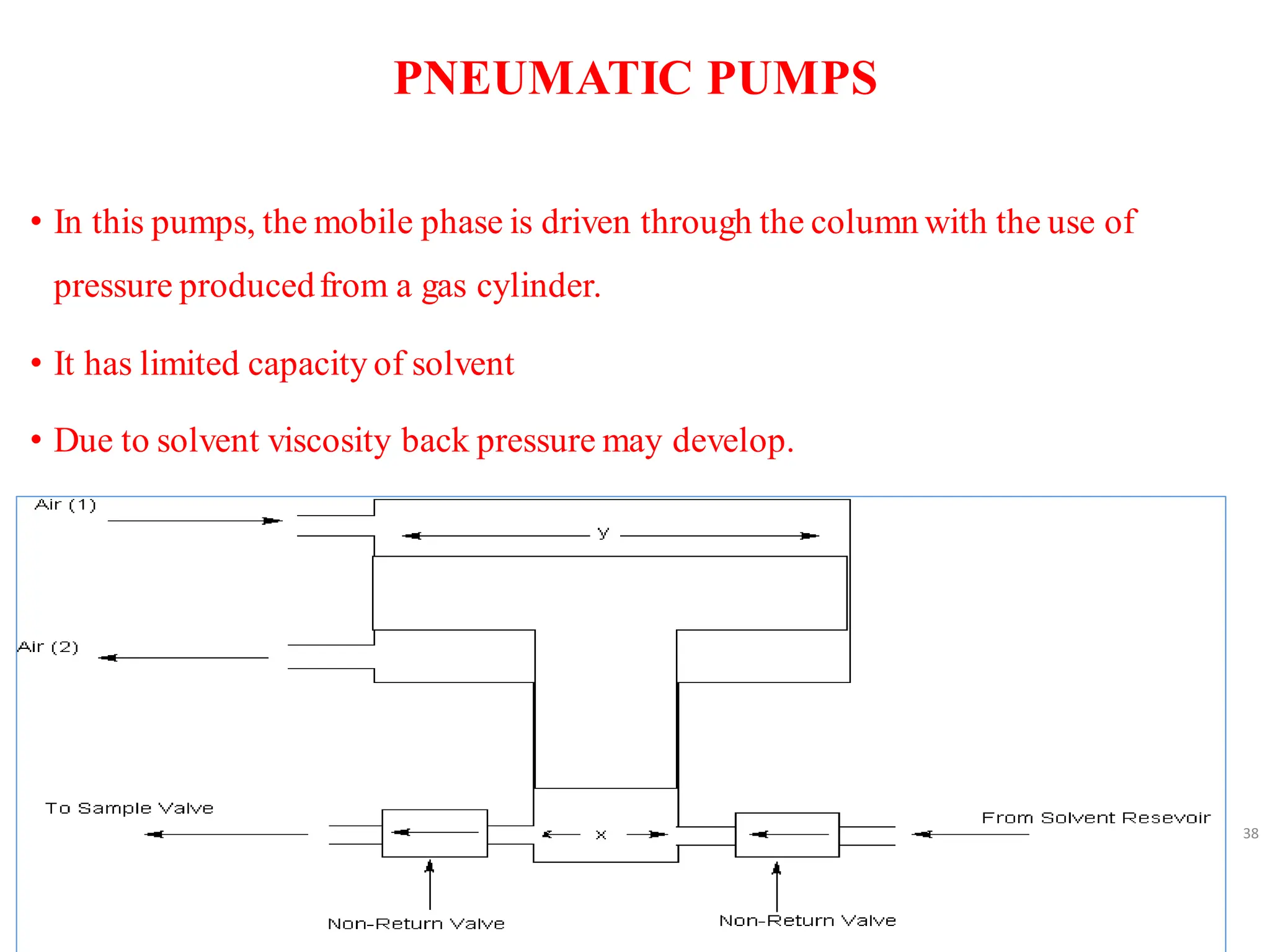
PNEUMATIC PUMPS
• In this pumps, the mobile phase is driven through the column with the use of
pressure producedfrom a gas cylinder.
• It has limited capacity of solvent
• Due to solvent viscosity back pressure may develop.
38
SAMPLE INJECTOR SYSTEM
• Several injector devices are available either for manual or auto injection of the
sample.
(i) Septum Injector
(ii) Stop Flow Injector
(iii) Rheodyne Injector
39
i. Septum Injector
These are used for injecting the sample through a rubber septum.
This kind of injectors cannot be commonly used , since the septum has to
withstand high pressures.
ii. Stop Flow
▪ In this type the flow of mobile phase is stopped for a while & the sample is
injected through a valve.
40
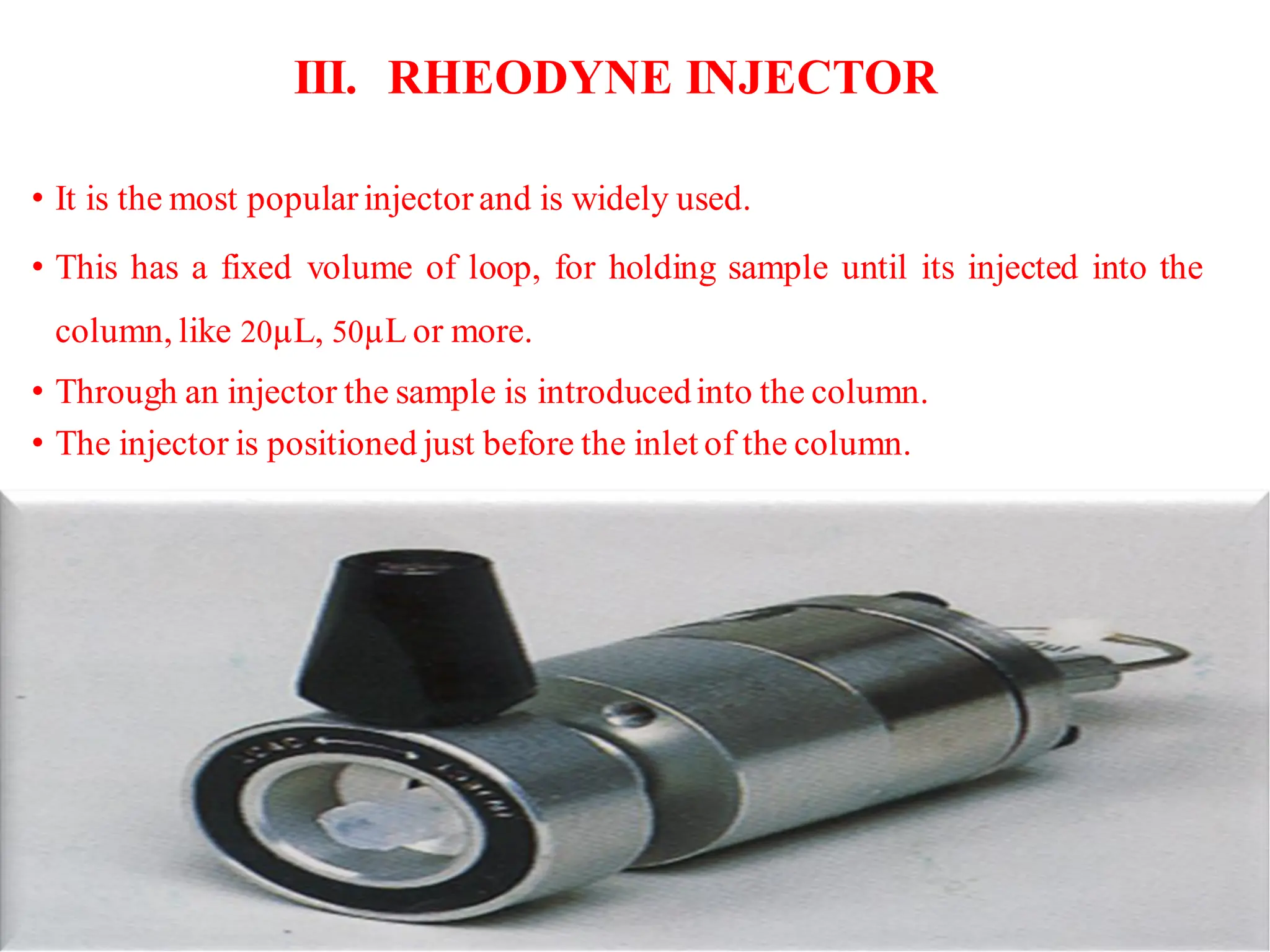
III. RHEODYNE INJECTOR
• It is the most popular injector and is widely used.
• This has a fixed volume of loop, for holding sample until its injected into the
column, like 20µL, 50µL or more.
• Through an injector the sample is introducedinto the column.
• The injector is positioned just before the inlet of the column.
41
42
43
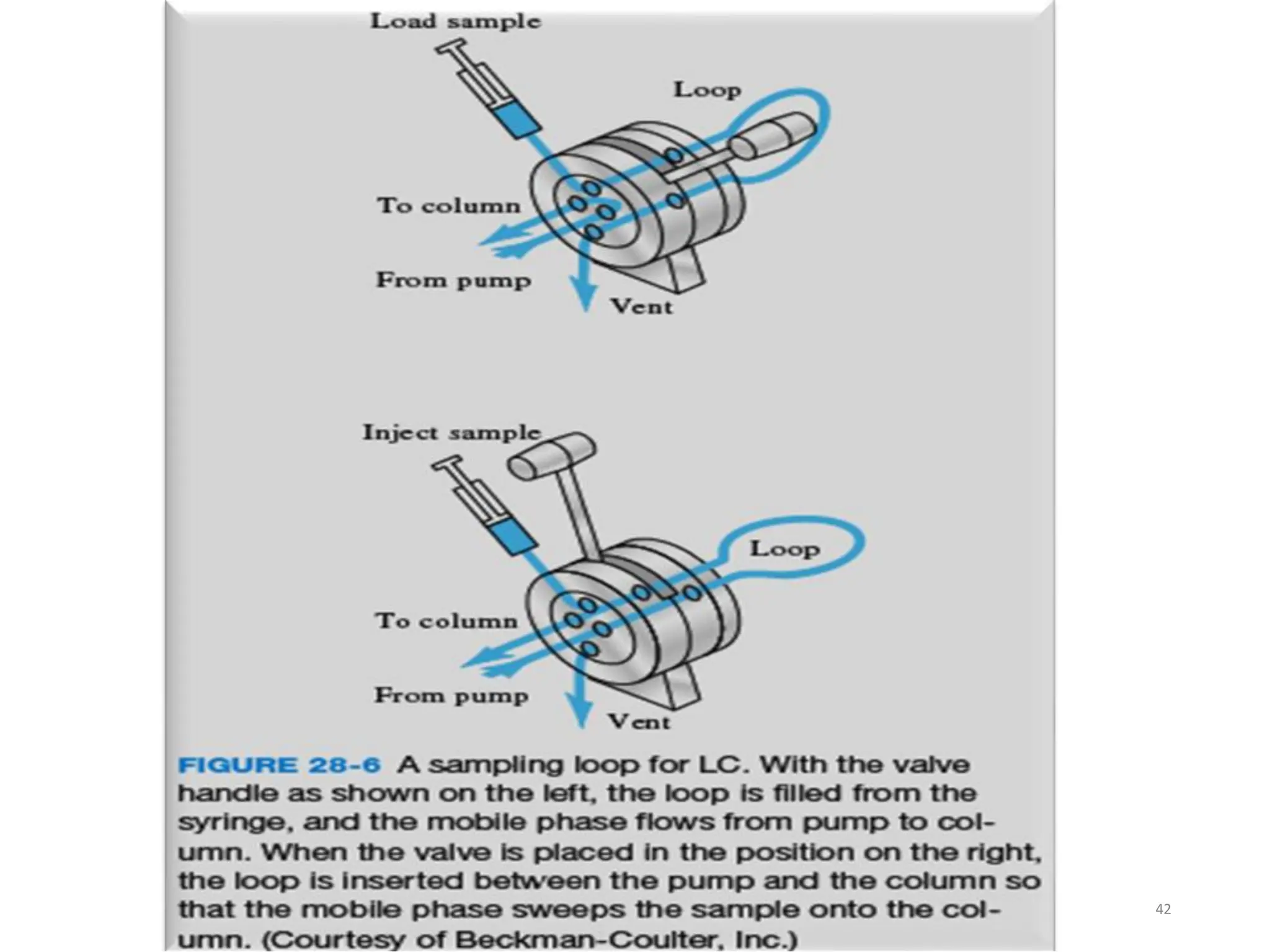
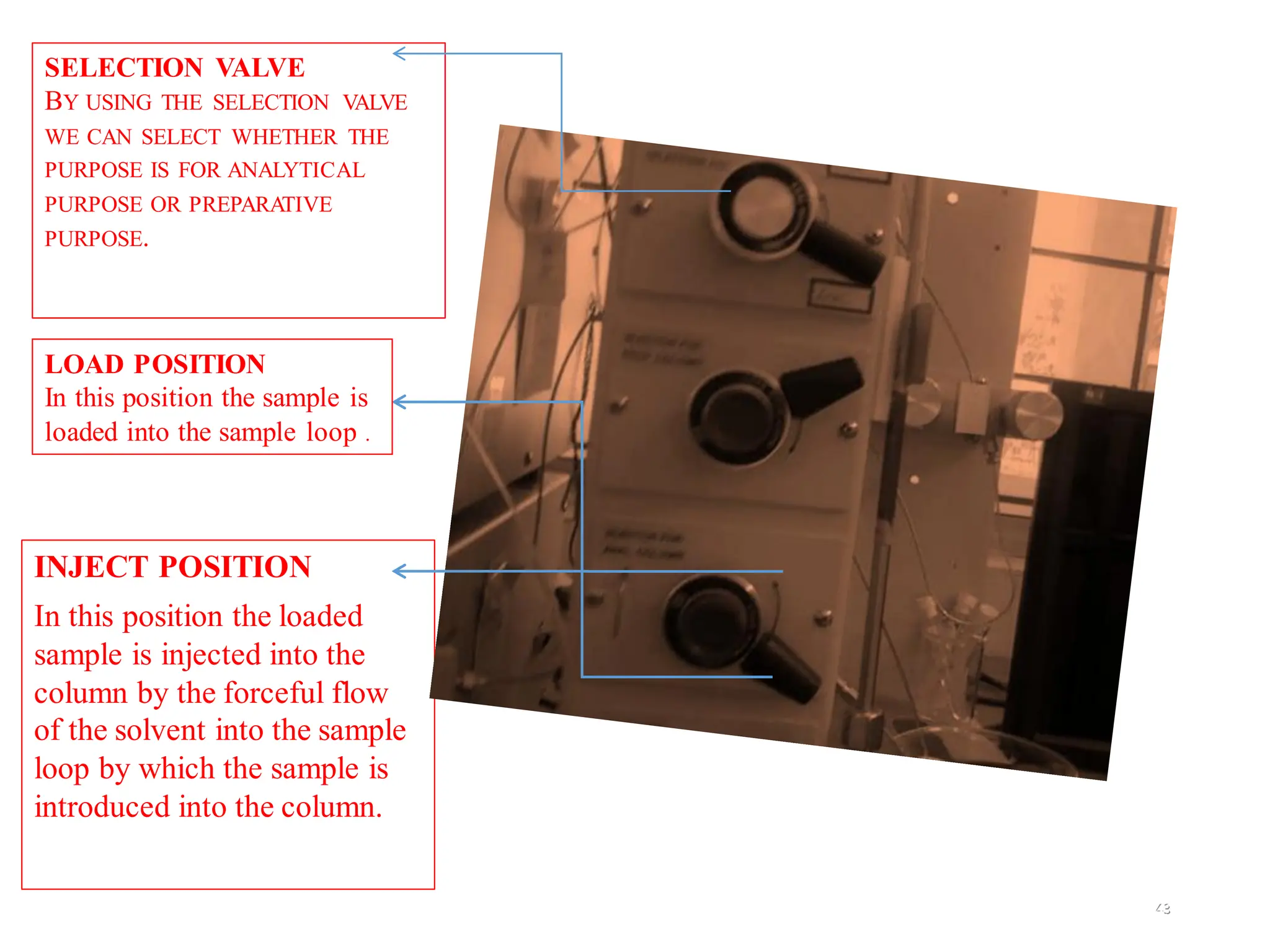
SELECTION VALVE
BY USING THE SELECTION VALVE
WE CAN SELECT WHETHER THE
PURPOSE IS FOR ANALYTICAL
PURPOSE OR PREPARATIVE
PURPOSE.
INJECT POSITION
In this position the loaded
sample is injected into the
column by the forceful flow
of the solvent into the sample
loop by which the sample is
introduced into the column.
LOAD POSITION
In this position the sample is
loaded into the sample loop .
43
44
44
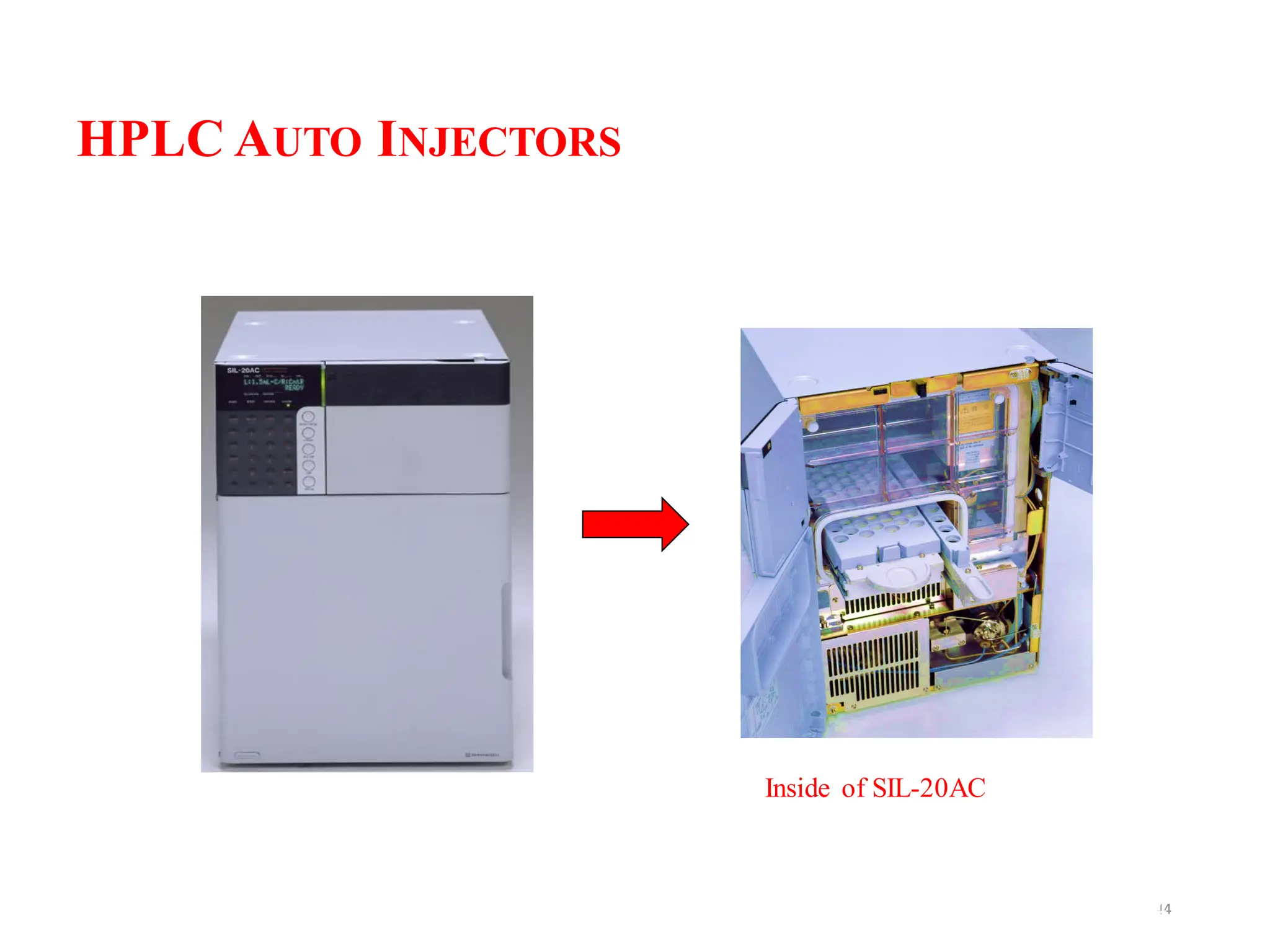
HPLC AUTO INJECTORS
Inside of SIL-20AC
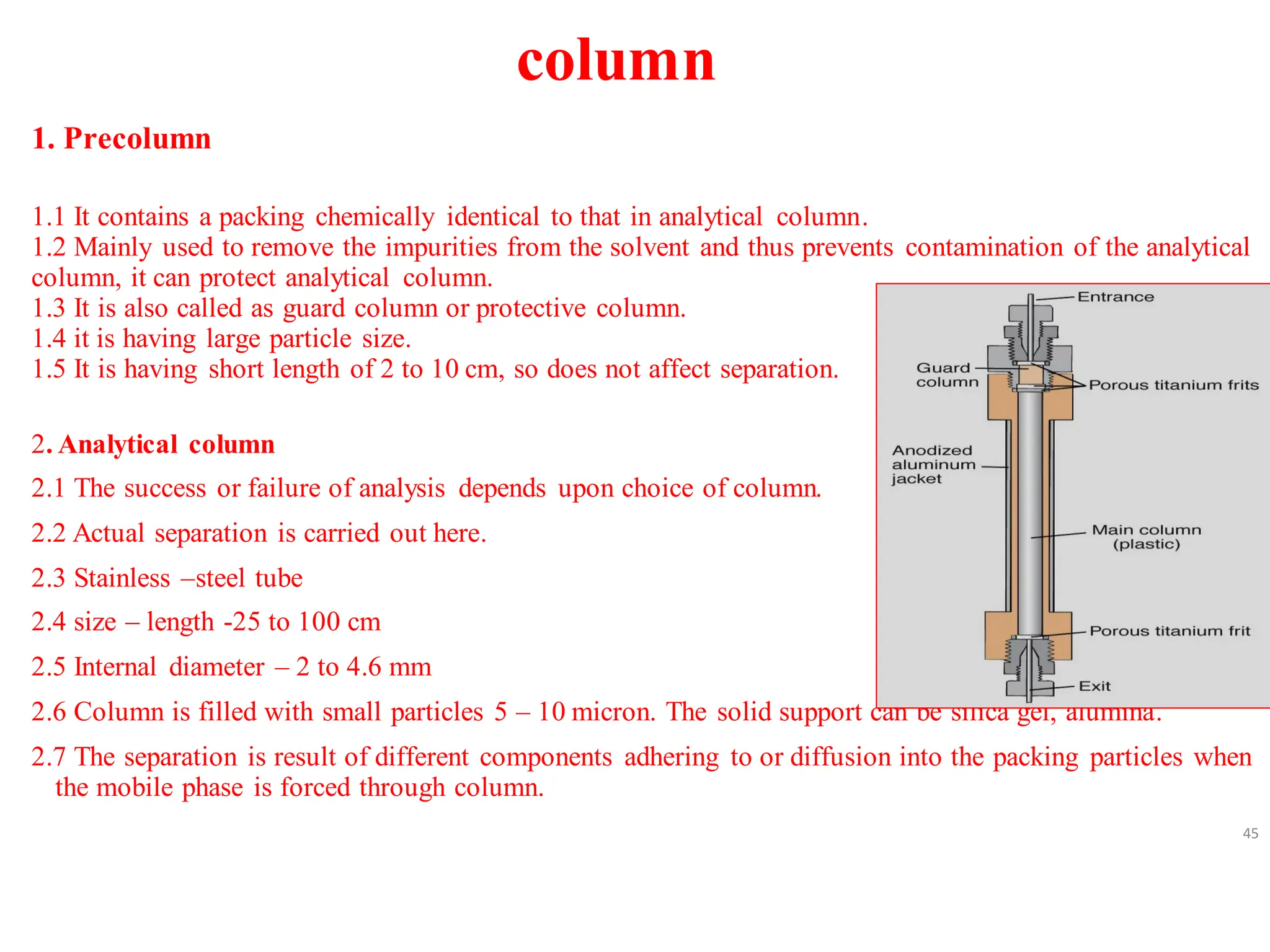
column
1. Precolumn
1.1 It contains a packing chemically identical to that in analytical column.
1.2 Mainly used to remove the impurities from the solvent and thus prevents contamination of the analytical
column, it can protect analytical column.
1.3 It is also called as guard column or protective column.
1.4 it is having large particle size.
1.5 It is having short length of 2 to 10 cm, so does not affect separation.
2. Analytical column
2.1 The success or failure of analysis depends upon choice of column.
2.2 Actual separation is carried out here.
2.3 Stainless –steel tube
2.4 size – length -25 to 100 cm
2.5 Internal diameter – 2 to 4.6 mm
2.6 Column is filled with small particles 5 – 10 micron. The solid support can be silica gel, alumina.
2.7 The separation is result of different components adhering to or diffusion into the packing particles when
the mobile phase is forced through column.
45
2.8 C8 and C18 columns are considered as examples of reversed phase liquid
chromatography(RP).
2.9 The stationary phase here is seen as a thin film of non-polar liquid phase that
has been designed to be chemically similar to an inert material (Silica gel
particles).
2.10 The non-polar layer is chemically linked to the silica particles surface by
reaction with the polar silanol groups on the stationary phase surface and so
rendering themless polaror non-polar.
2.11 The difference between the two columns will be in the length of the carbon-
chain attached to the silica surface.
2.12 Accordingly C8 hplc columns have packing material composed of silica
particles attachedto C8 carbon units.
2.13 C18 will, of course, have packing materials coated with C18 hydrophobic
units.
2.14 Categorically both are reversed phase but C18 columns will definitely be
more "hydrophobicratherthan the C8 columns.
46
Detectors
▪ Absorbance(UV/Vis and PDA)
▪ Refractiveindex (detectsthe change in turbidity)
▪ Fluorescence(if the analyteis fluorescent)
▪ Electrochemical (measures current flowing through a pair of electrodes, on
which a potential difference is imposed, due to oxidation or reduction of
solute)
▪ Conductivity (for ions)
▪ Light scattering
▪ Mass spectrometry(HPLC-MS)
47
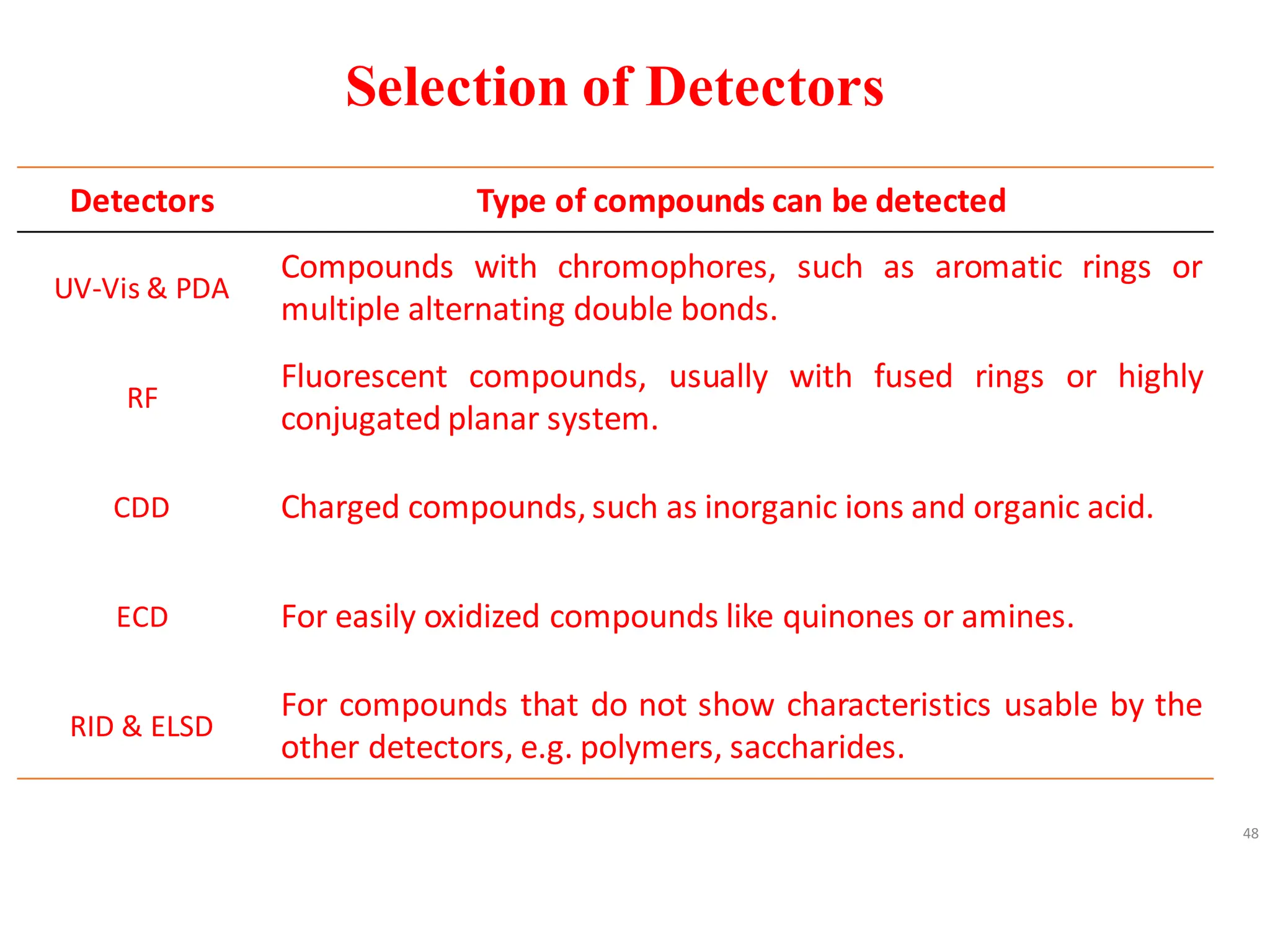
Selection of Detectors
48
Detectors Type of compounds can be detected
UV-Vis & PDA
Compounds with chromophores, such as aromatic rings or
multiple alternating double bonds.
RF
Fluorescent compounds, usually with fused rings or highly
conjugated planar system.
CDD Charged compounds, such as inorganic ions and organic acid.
ECD For easily oxidized compounds like quinones or amines.
RID & ELSD
For compounds that do not show characteristics usable by the
other detectors, e.g. polymers, saccharides.
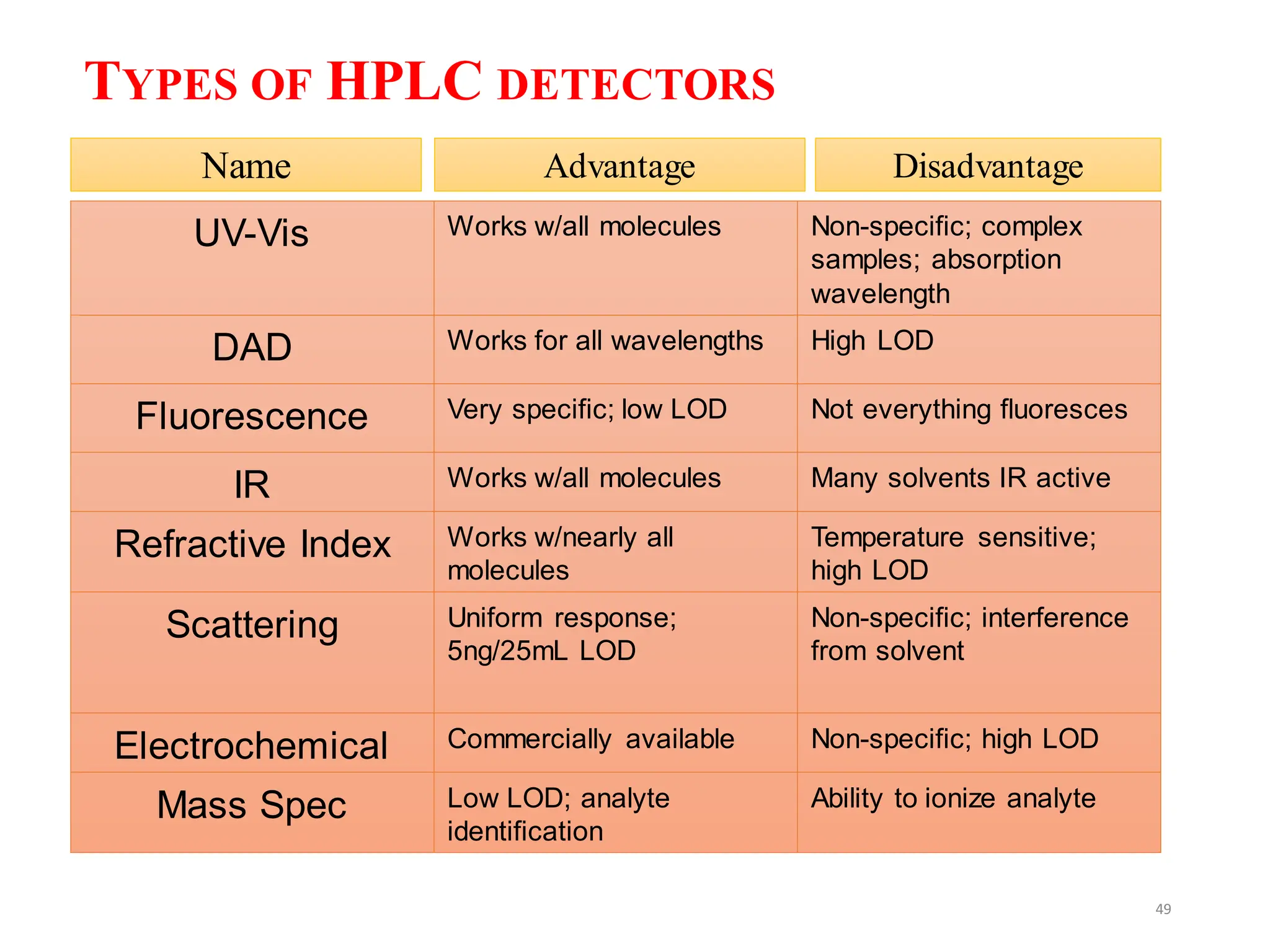
49
TYPES OF HPLC DETECTORS
UV-Vis Works w/all molecules Non-specific; complex
samples; absorption
wavelength
DAD Works for all wavelengths High LOD
Fluorescence Very specific; low LOD Not everything fluoresces
IR Works w/all molecules Many solvents IR active
Refractive Index Works w/nearly all
molecules
Temperature sensitive;
high LOD
Scattering Uniform response;
5ng/25mL LOD
Non-specific; interference
from solvent
Electrochemical Commercially available Non-specific; high LOD
Mass Spec Low LOD; analyte
identification
Ability to ionize analyte
Name Advantage Disadvantage
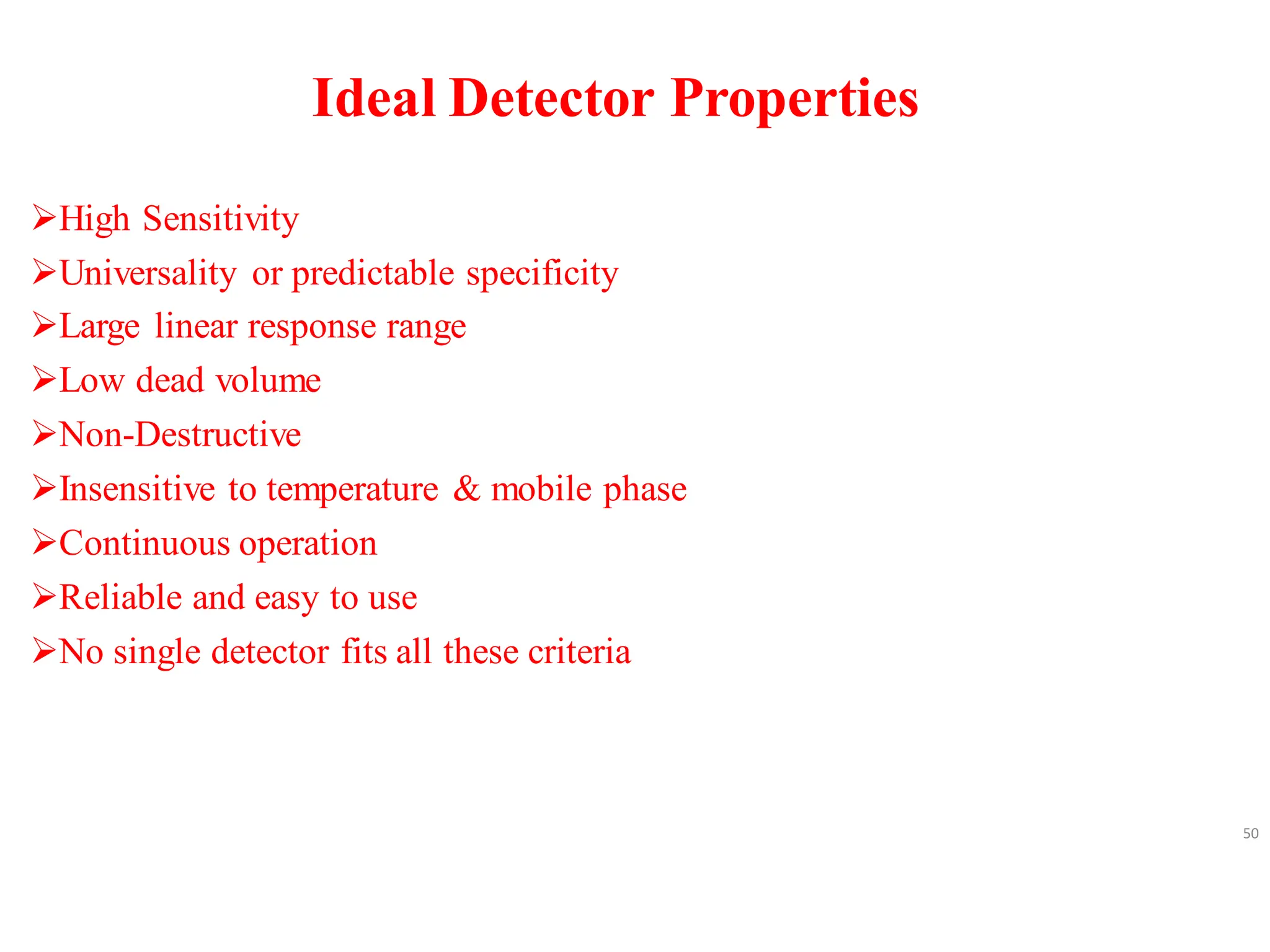
Ideal Detector Properties
➢High Sensitivity
➢Universality or predictable specificity
➢Large linear response range
➢Low dead volume
➢Non-Destructive
➢Insensitive to temperature & mobile phase
➢Continuous operation
➢Reliable and easy to use
➢No single detector fits all these criteria
50
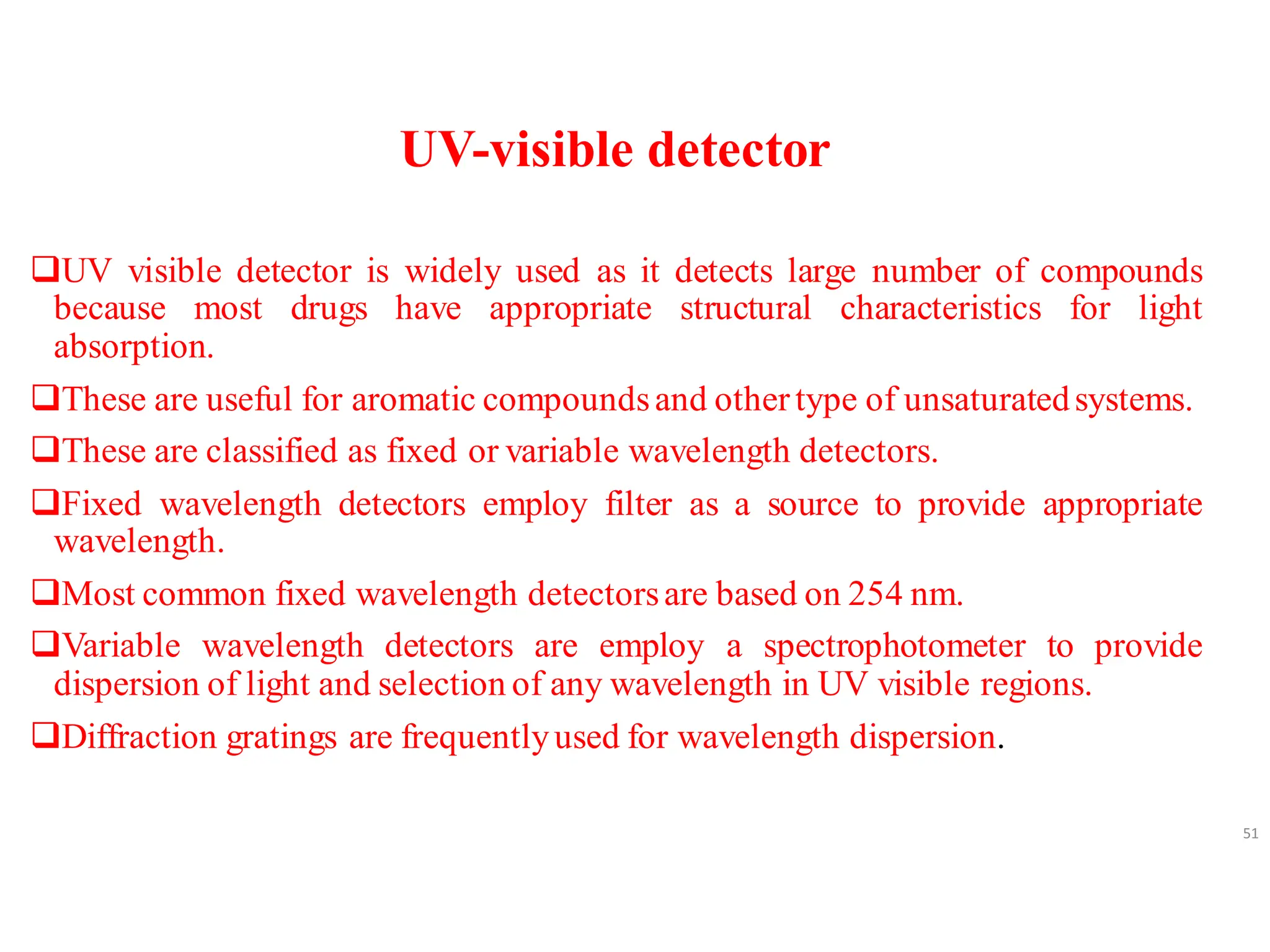
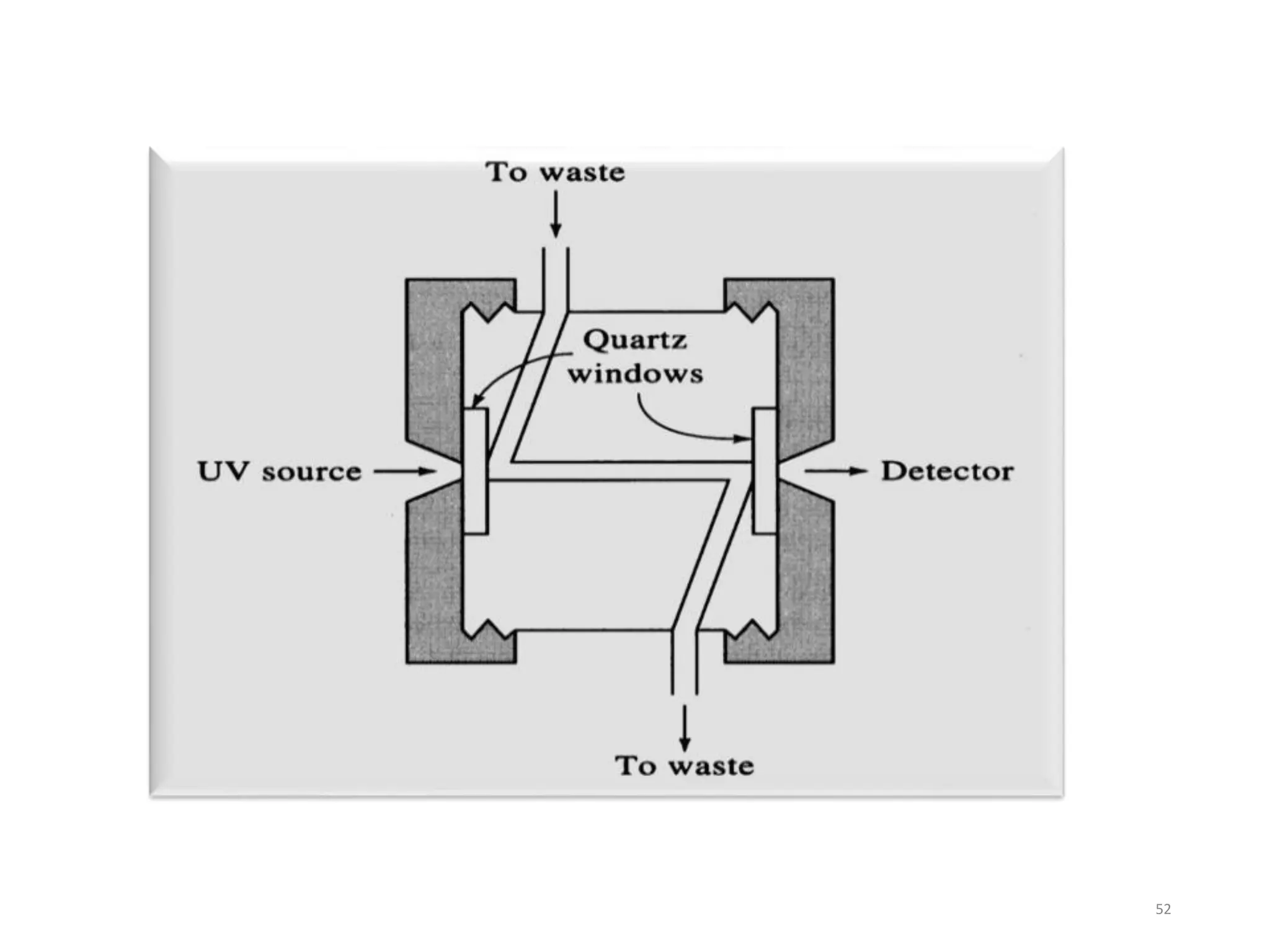
UV-visible detector
❑UV visible detector is widely used as it detects large number of compounds
because most drugs have appropriate structural characteristics for light
absorption.
❑These are useful for aromatic compoundsand other type of unsaturatedsystems.
❑These are classified as fixed or variable wavelength detectors.
❑Fixed wavelength detectors employ filter as a source to provide appropriate
wavelength.
❑Most common fixed wavelength detectorsare based on 254 nm.
❑Variable wavelength detectors are employ a spectrophotometer to provide
dispersion of light and selection of any wavelength in UV visible regions.
❑Diffraction gratings are frequentlyused for wavelength dispersion.
51
52
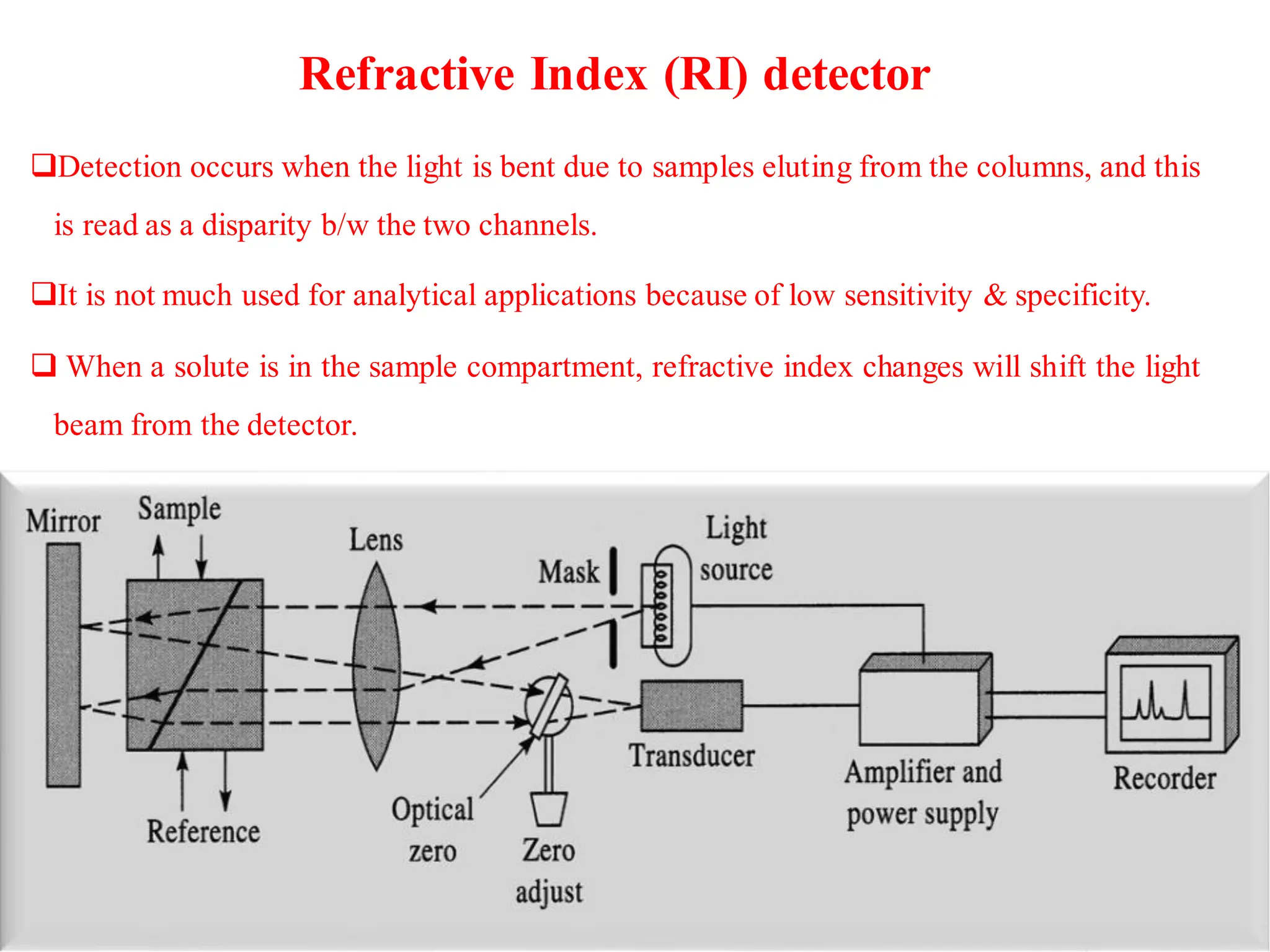
Refractive Index (RI) detector
❑Detection occurs when the light is bent due to samples eluting from the columns, and this
is read as a disparity b/w the two channels.
❑It is not much used for analytical applications because of low sensitivity & specificity.
❑ When a solute is in the sample compartment, refractive index changes will shift the light
beam from the detector.
53
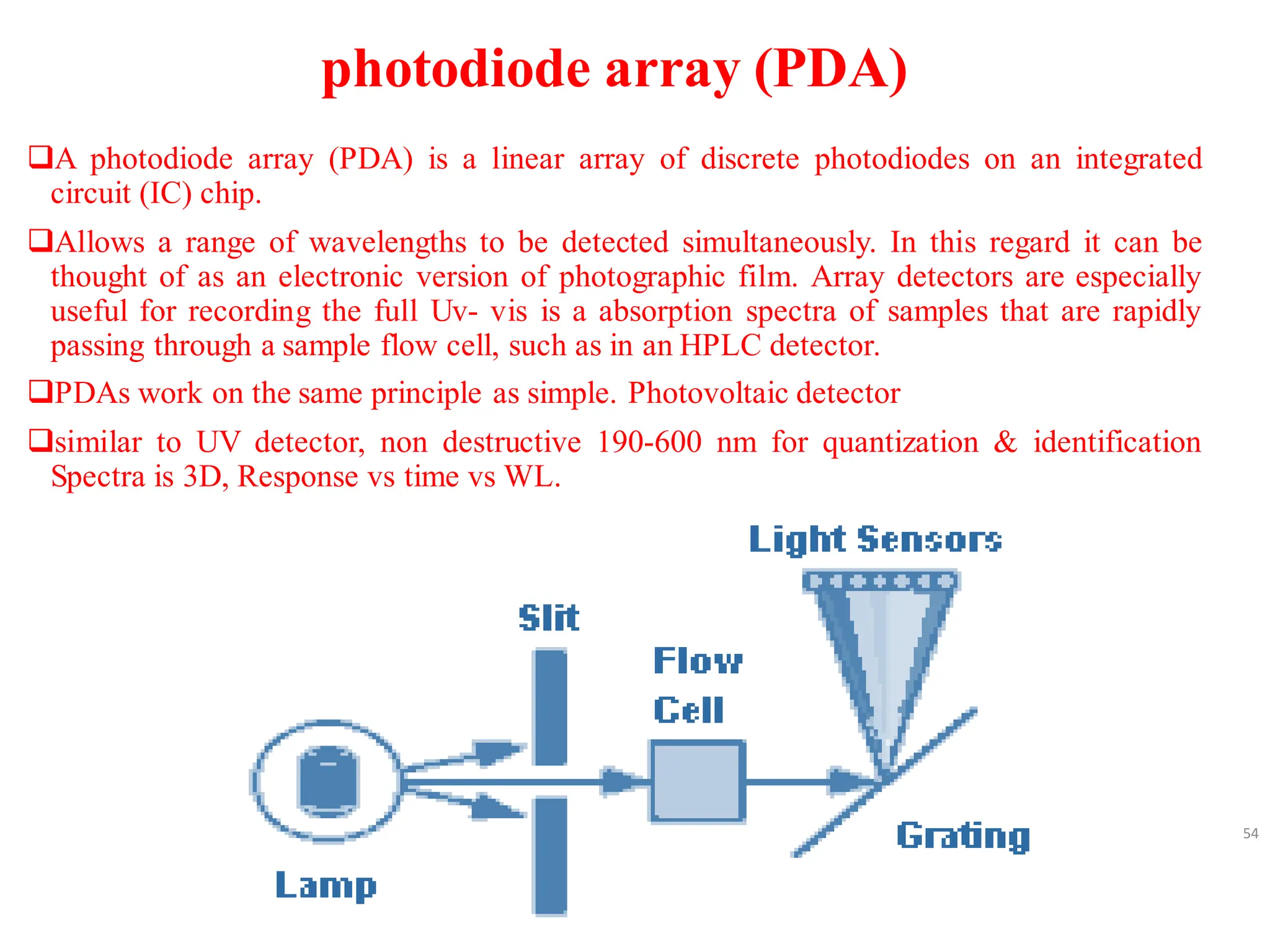
photodiode array (PDA)
❑A photodiode array (PDA) is a linear array of discrete photodiodes on an integrated
circuit (IC) chip.
❑Allows a range of wavelengths to be detected simultaneously. In this regard it can be
thought of as an electronic version of photographic film. Array detectors are especially
useful for recording the full Uv- vis is a absorption spectra of samples that are rapidly
passing through a sample flow cell, such as in an HPLC detector.
❑PDAs work on the same principle as simple. Photovoltaic detector
❑similar to UV detector, non destructive 190-600 nm for quantization & identification
Spectra is 3D, Response vs time vs WL.
54
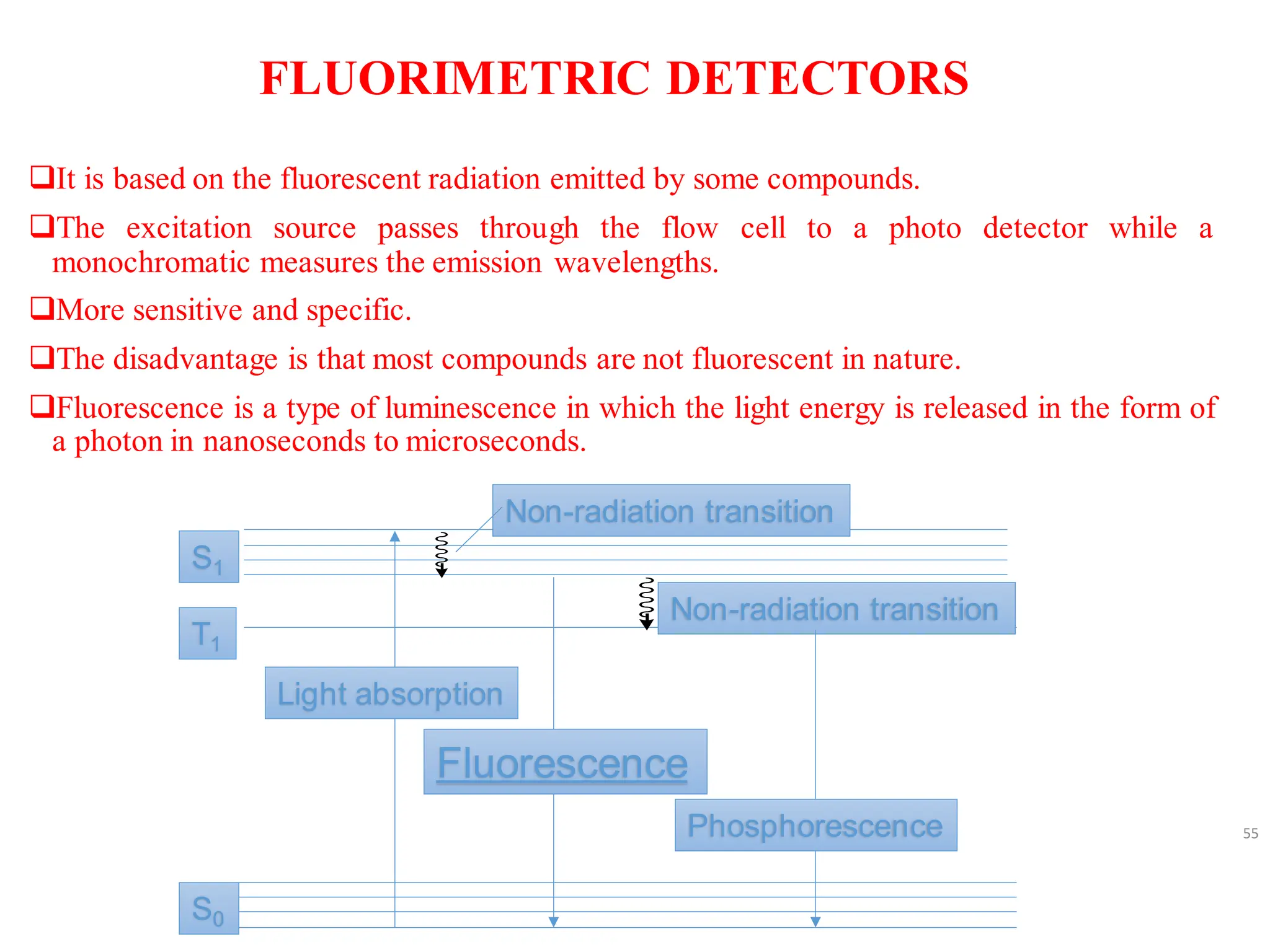
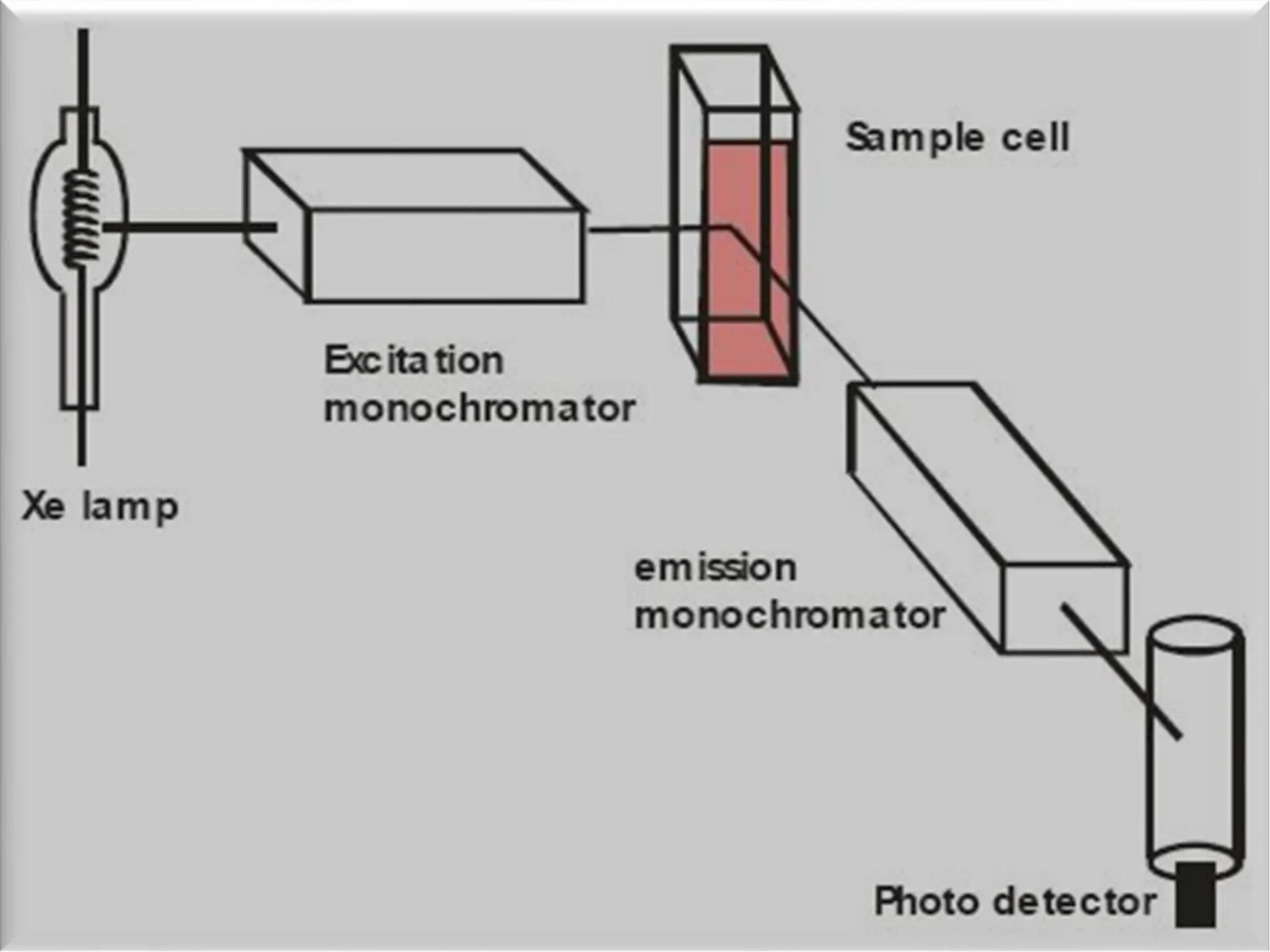
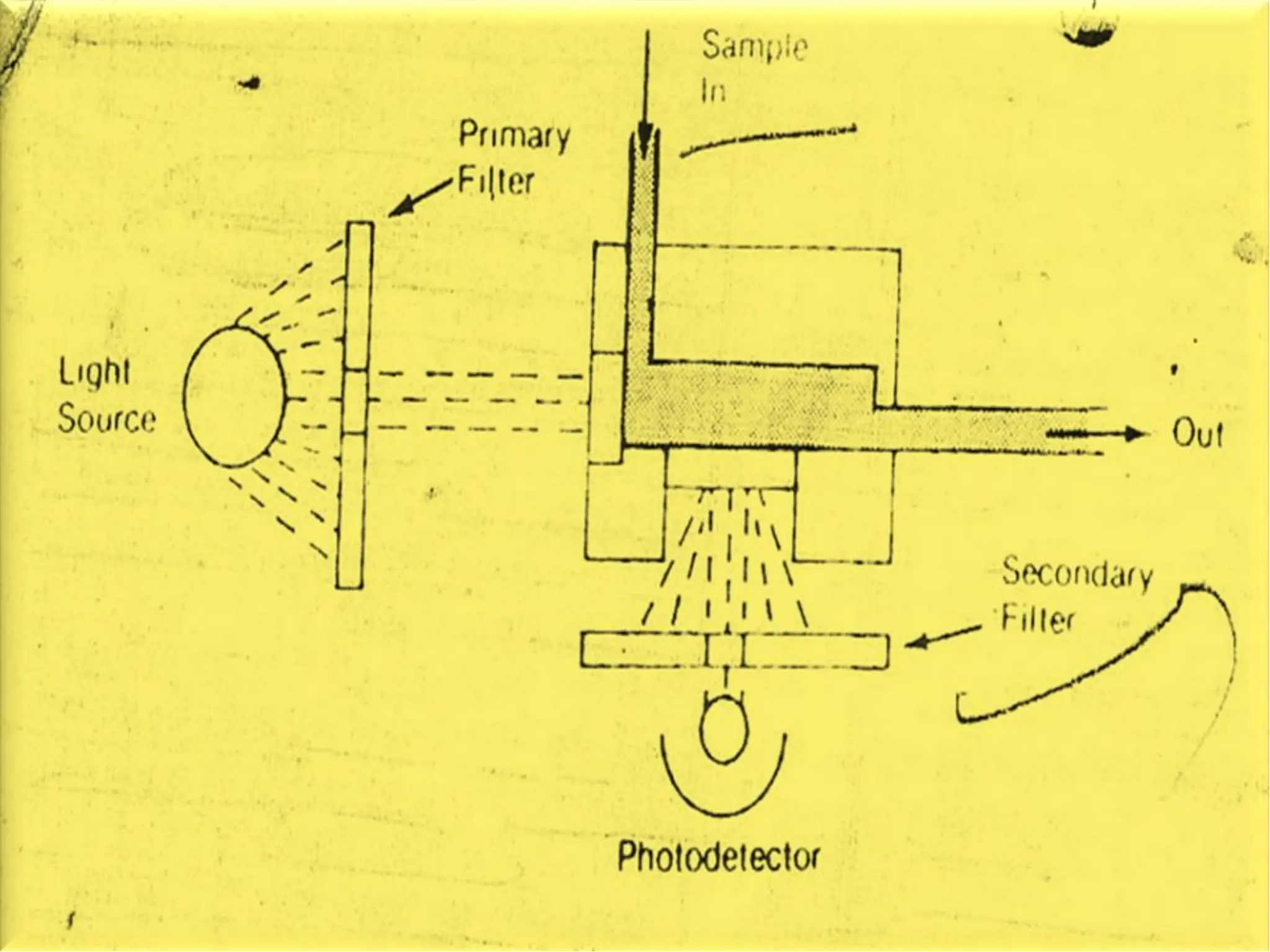
FLUORIMETRIC DETECTORS
❑It is based on the fluorescent radiation emitted by some compounds.
❑The excitation source passes through the flow cell to a photo detector while a
monochromatic measures the emission wavelengths.
❑More sensitive and specific.
❑The disadvantage is that most compounds are not fluorescent in nature.
❑Fluorescence is a type of luminescence in which the light energy is released in the form of
a photon in nanoseconds to microseconds.
55
S1
T1
S0
Light absorption
Non-radiation transition
Fluorescence
Phosphorescence
56
57
RECORDERS AND INTEGRATORS
• Recorders are used to record responses obtained from the detectors after amplification, if
necessary.
• They record the baseline & all the peaks obtained with respect tot time.
• Retention time can be found out from this recordings, but area under curve cannot be
determined.
• The Integrators are improved versions of recorders with some data processing
capabilities.
• They can record the individual peaks with retention time, height, width of peaks, peak
area, percentage area, etc.
• Integrators provides more information on peaks than recorders.
• In recent days computers and printers are used for recording and processing the obtained
data & for controlling several operations.
58
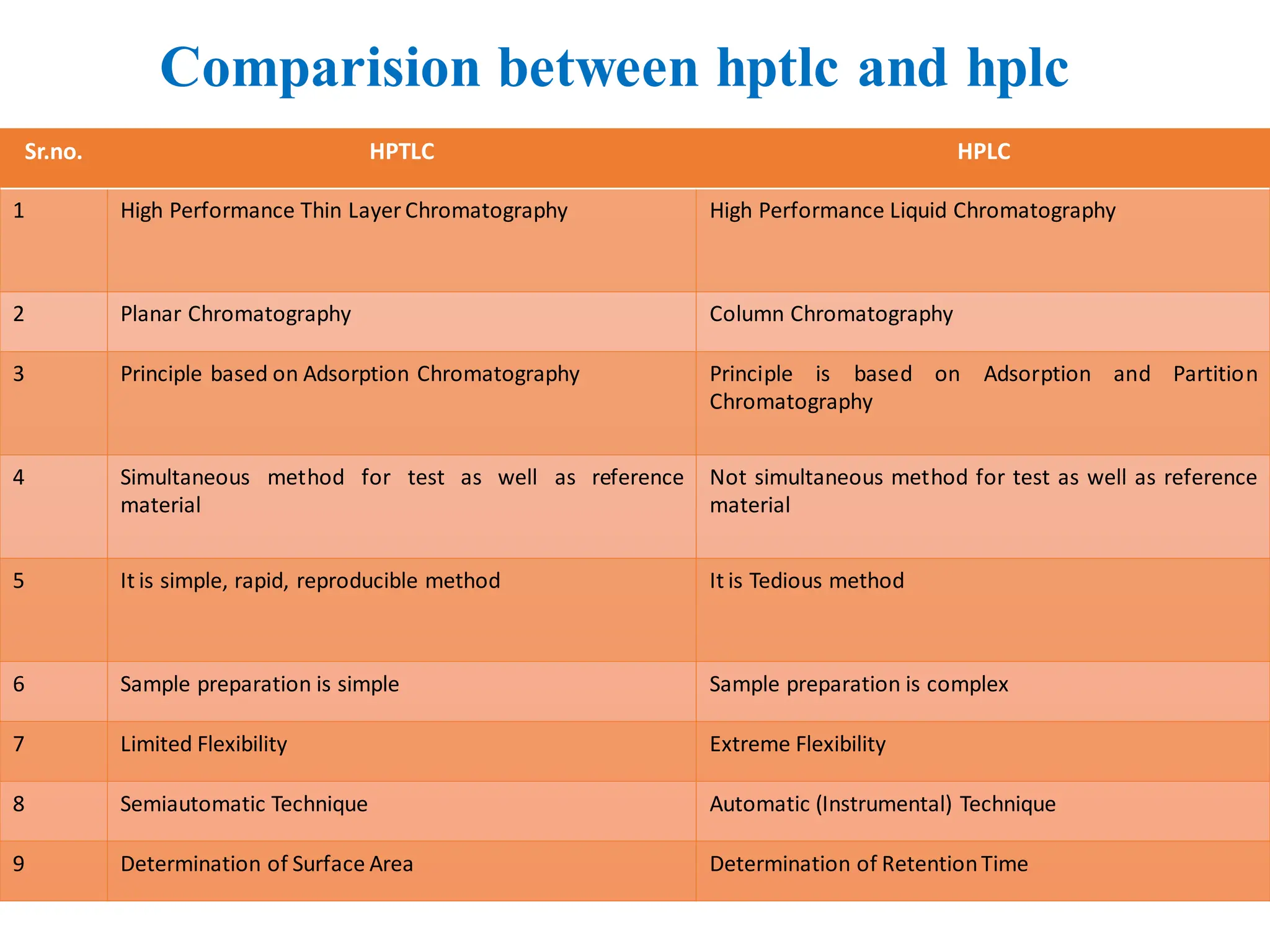
Comparision between hptlc and hplc
59
Sr.no. HPTLC HPLC
1 High Performance Thin Layer Chromatography High Performance Liquid Chromatography
2 Planar Chromatography Column Chromatography
3 Principle based on Adsorption Chromatography Principle is based on Adsorption and Partition
Chromatography
4 Simultaneous method for test as well as reference
material
Not simultaneous method for test as well as reference
material
5 It is simple, rapid, reproducible method It is Tedious method
6 Sample preparation is simple Sample preparation is complex
7 Limited Flexibility Extreme Flexibility
8 Semiautomatic Technique Automatic (Instrumental) Technique
9 Determination of Surface Area Determination of RetentionTime
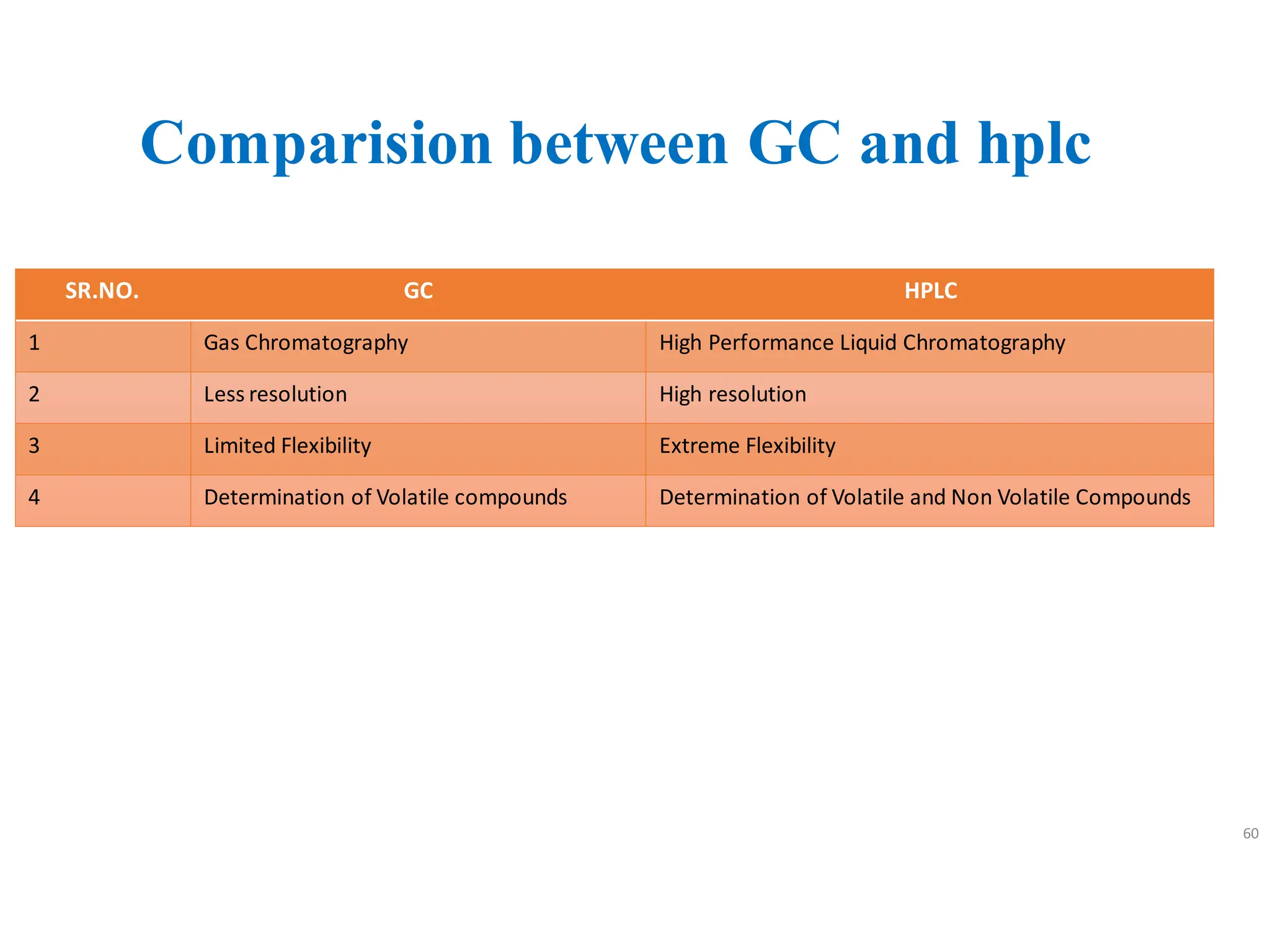
Comparision between GC and hplc
60
SR.NO. GC HPLC
1 Gas Chromatography High Performance Liquid Chromatography
2 Less resolution High resolution
3 Limited Flexibility Extreme Flexibility
4 Determination of Volatile compounds Determination of Volatile and Non Volatile Compounds
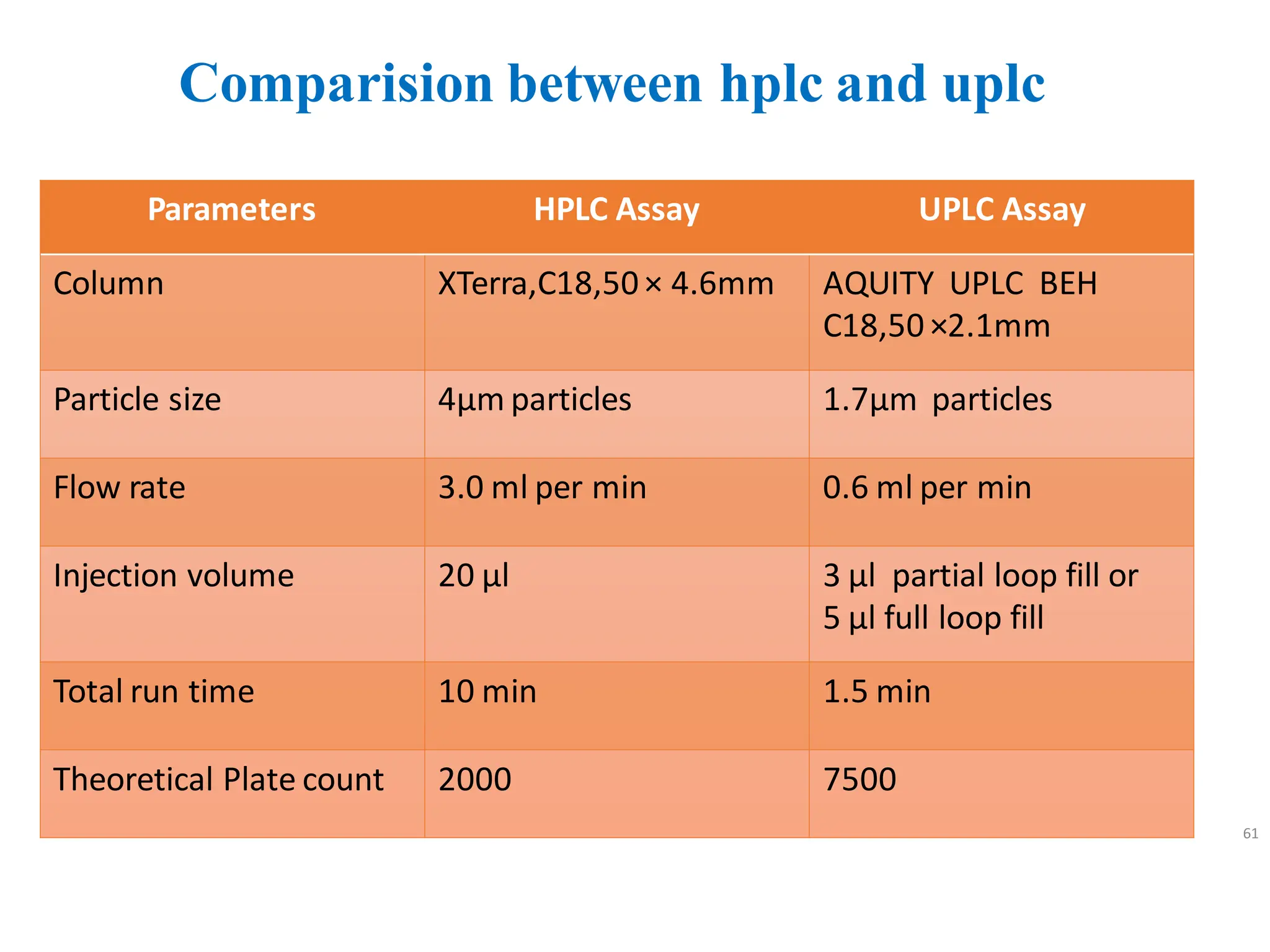
Comparision between hplc and uplc
61
Parameters HPLC Assay UPLC Assay
Column XTerra,C18,50 × 4.6mm AQUITY UPLC BEH
C18,50 ×2.1mm
Particle size 4µm particles 1.7µm particles
Flow rate 3.0 ml per min 0.6 ml per min
Injection volume 20 µl 3 µl partial loop fill or
5 µl full loop fill
Total run time 10 min 1.5 min
Theoretical Plate count 2000 7500
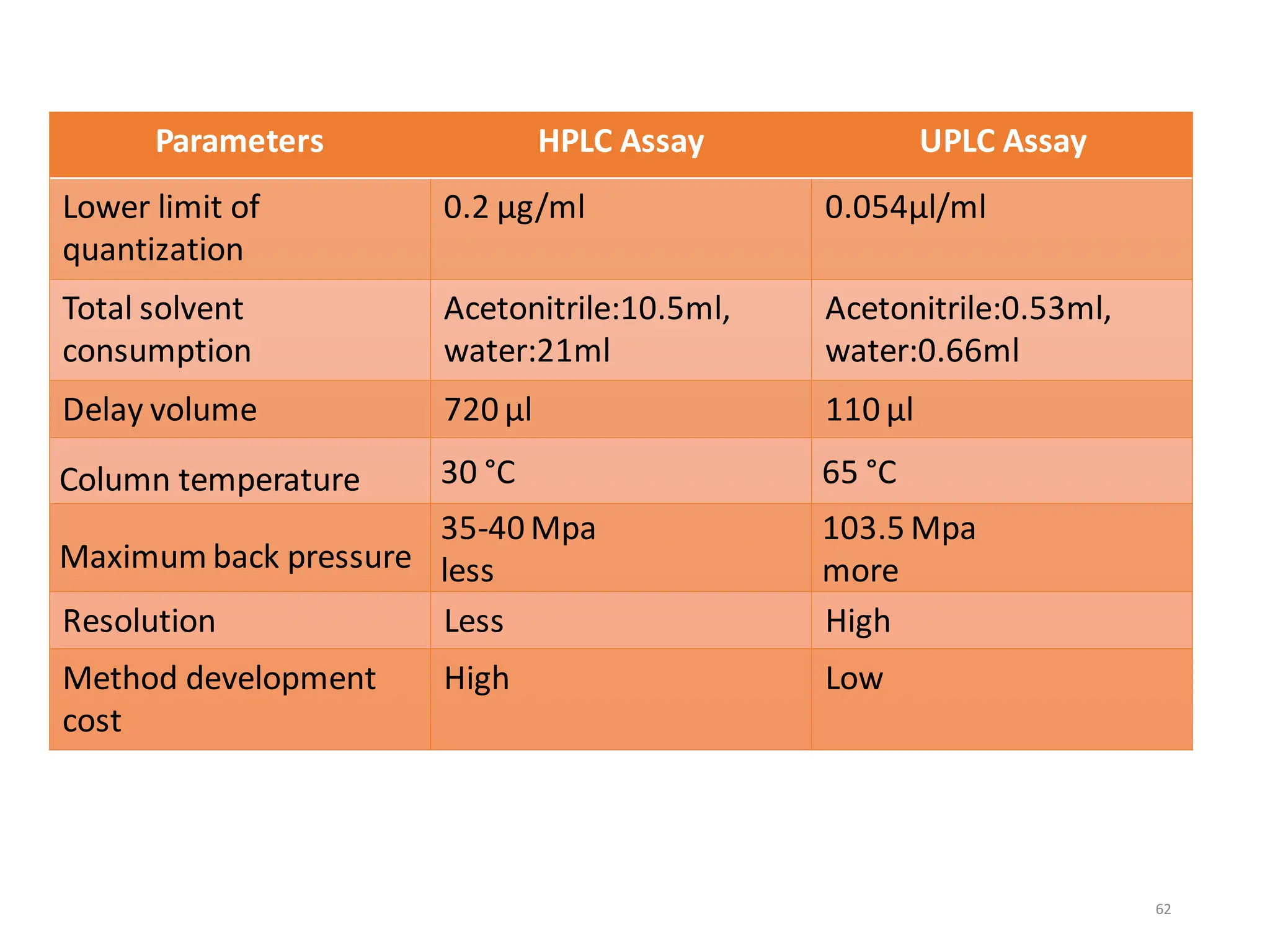
62
Parameters HPLC Assay UPLC Assay
Lower limit of
quantization
0.2 µg/ml 0.054µl/ml
Total solvent
consumption
Acetonitrile:10.5ml,
water:21ml
Acetonitrile:0.53ml,
water:0.66ml
Delay volume 720 µl 110 µl
Column temperature 30 °C 65 °C
Maximum back pressure
35-40 Mpa
less
103.5 Mpa
more
Resolution Less High
Method development
cost
High Low
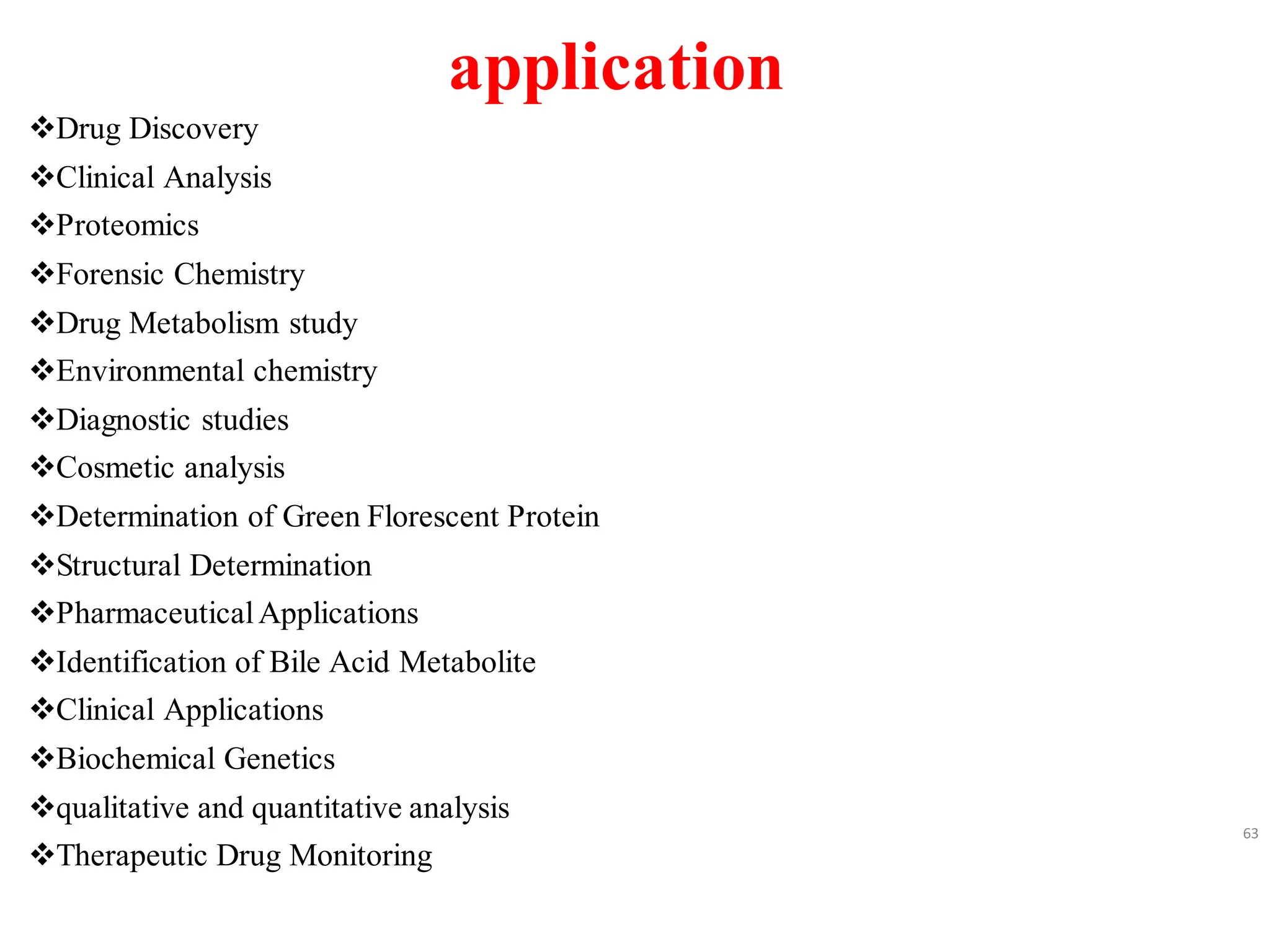
application
❖Drug Discovery
❖Clinical Analysis
❖Proteomics
❖Forensic Chemistry
❖Drug Metabolism study
❖Environmental chemistry
❖Diagnostic studies
❖Cosmetic analysis
❖Determination of Green Florescent Protein
❖Structural Determination
❖PharmaceuticalApplications
❖Identification of Bile Acid Metabolite
❖Clinical Applications
❖Biochemical Genetics
❖qualitative and quantitative analysis
❖Therapeutic Drug Monitoring
63

HIGH PERFORMANCE LIQUID CHROMATOGRAPHY (HPLC)

  • 1.
  • 2.
    Chromatography • It isdefine as, it is analytical method in which separation of active constituent in complex mixture, and the mixture was distributed in two phases i.e. stationary phase and mobile phase is known as chromatography. • It is technique is used for separation, purification, Identification and extraction of compound. • It is method it can consist of two phases stationary phase and mobile phase. • Stationary phase is constant phase or column packagingmaterial. • Mobile phase is moveablephase. • The basic principle of chromatography is based on Adsorption and partition chromatography. • Adsorption chromatography - The affinity of molecules towards stationary phase is known as Adsorptionchromatography. • Partition chromatography - The molecule can moves in two phases of liquid is known as partition chromatography. • It is importantfor qualitative and quantitative analysis. 2
  • 3.
    TYPES OF CHROMATOGRAPHY ❖Basedon modes of chromatography 1. Normal phase mode 2.Reverse phase mode ❖Based on principle of separation 1. Adsorption chromatography 2. Ion exchange chromatography 3. Partition chromatography 4. Size exclusion ❖Based on elution technique 1. Isocratic separation 2. Gradient separation ❖Based on the scale of operation 1. Analytical HPLC 2. Preparative HPLC ❖Based on the type of analysis 1. Qualitative analysis 2. Quantitative analysis 3
  • 4.
    Principles of LiquidChromatography 4
  • 5.
    TYPES OF LIQUIDCHROMATOGRAPHY 5
  • 6.
    hplc • HPLC isa High Performance liquid Chromatography. • High Pressure Liquid Chromatography. • High Priced Liquid Chromatography. • It is column chromatography. • It is Liquid Chromatography. • It is modified from of gas chromatography, it is applicable for both Volatile as well as Non volatile compound. • It can mainly divided by two types 1. Normal phase HPLC 2. Reversed Phase HPLC. • It is having a high resolution and separation capacity. • It is used as qualitative as well as quantitative analysis. • High performance liquid chromatography (HPLC) is a chromatographic technique used to separate a mixture of compounds in analytical chemistry and biochemistry with the purpose of identifying, quantifying or purifying the individual components of the mixture. 6
  • 7.
  • 8.
    Principle • High PerformanceLiquid Chromatography [HPLC] is principle is based on adsorption as well as partition chromatography is depending on the nature of stationary phase, if stationary phase is solid principle is based on adsorption chromatography and if stationaryphase is liquidprinciple is based on partitionchromatography. • It is importantfor determination of volatile and non volatile compounds. • It is importantfor determination qualitative and quantitative analysis. • It is important for determination of Retention Time (the time is required , after sample injectionmaximum angle peak reaches to detector) 8
  • 9.
  • 10.
    Advantages • It issimple, rapid , reproducible. • High sensitivity. • High performance. • Rapid process and hence time saving. • It is having a high resolution and separation capacity. • Accuracy and Precision. • Stationary phase was chemically innert. • Wide varities of stationary phase. • Mobile phase was chemically innert. • Less requirement of mobile phase in developing chamber. • Early recovery of separated component. • Easy visualization of separated components. • It is having Good reproducibility and repeatability. • It is analytical technique is important for validation of product, quality control studies of product. • It is important for qualitative and quantitative analysis. • It is used for both analytical and preparative purpose. 10
  • 11.
    Types of HPLCSeparations • Normal Phase: Separation of polar analytes by partitioning onto a polar, bonded stationary phase. • Reversed Phase: Separation of non-polar analytes by partitioning onto a non-polar, bonded stationary phase. • Adsorption: In Between Normal and Reversed. Separation of moderately polar analytes using adsorption onto a pure stationary phase (e.g. alumina or silica) • Ion Chromatography: Separation of organic and inorganic ions by their partitioning onto ionic stationary phases bonded to a solid support. • Size Exclusion Chromatography: Separation of large molecules based in the paths they take through a “maze” of tunnels in the stationary phase. 11
  • 12.
    12 HPLC Methods  ParameterGroup Method Compounds • SDW05.23000’s EPA 555 Cl-PhenoxyAcids • WPP05.13000’s EPA 610 PAHs • WPP05.06000’s EPA 605 Benzidines • SHW06.26000’s SW-846 8316 Acrylics • SHW06.28000’s SW-846 8330’s Explosives • SHW07.06000’s SW-846 8325 Benzidines and N- Pesticides
  • 13.
    Modes of HighPerformance Liquid Chromatography 13 Types of Compounds Mode Stationary Phase Mobile Phase Neutrals Weak Acids Weak Bases Reversed Phase C18,C8, C4 cyano,amino Water/Organic Modifiers Ionics,Bases,Acids Ion Pair C-18, C-8 Water/Organic Ion-Pair Reagent Compounds not soluble in water Normal Phase Silica,Amino, Cyano,Diol Organics Ionics Inorganic Ions Ion Exchange Anion or Cation Exchange Resin Aqueous/Buffer CounterIon High MolecularWeight Compounds Polymers Size Exclusion Polystyrene Silica Gel Filtration- Aqueous Gel Permeation- Organic
  • 14.
    HPLC Contain • StationaryPhase - It is non polar and The stationary solid surface is coated with a 2nd liquid (the Stationary Phase) which is immiscible with mobile phase. • Mobile Phase - A polar mobile phase(ACN, MeOH, WATER + BUFFER). Bonded Phases - 14  C-2 Ethyl Silyl -Si-CH2-CH3 • CN Cyanopropyl Silyl -Si-(CH2)3-CN • C-18 Octadecyl Silyl -Si-(CH2)17-CH3 • C-8 Octyl Silyl -Si-(CH2)7-CH3
  • 15.
    Block diagram ofhplc 15 Reservoir Pump Gradient controller Mixing chamber Pump Solvent Conditioning column Reservoir Injector Precolumn Analytical column Detector Recorder Fraction collector
  • 16.
    WHY USE HPLC ❖Simultaneousanalysis ❖High resolution ❖High sensitivity ❖Good repeatability ❖Moderate analysis condition ❖Easy to fractionate and purify ❖Not destructive 16
  • 17.
    INSTRUMENTATION OF HPLC •Solvent storage bottle • Gradient controller and mixing unit • De-gassing of solvents • Pump • Pressure gauge • Pre-column • Sample introduction system • Column • Detector • Recorder 17
  • 18.
  • 19.
  • 20.
  • 21.
  • 22.
  • 23.
    23 23 OUTLINE OF LC-2010 SystemController UV detector Auto sampler Column Oven Pump Unit Reservior Tray Degassing Unit Low pressure gradient device
  • 24.
    24 HPLC SYSTEM 9010 Solvent DeliverySystem 9050 Variable UV/Vis Detector HPLC Solvent Reservoirs HPLC Column Rheodyne Injector 9060 Polychrom (Diode Array) Detector Computer Workstation
  • 25.
    Solvent/ mobile phasereservoirs • Glass or stainless-steel containers capable of holding up to 1 liter mobile phase (pure organic solvents or aqueous solutions of salts and buffers) • Inert to a variety of aqueous and non aqueous mobile phases. • Stainless steel should be avoided for use with solvents containing halide ions. 25
  • 26.
    Degassing& filtrationof mobilephase • In many cases, aqueous solvents & some organic solvents are degassed prior to use • Degassing is done to prevent formation of gas bubbles in the pump or detector ( Mobile phases are degassed by stirring of the mobile phase under vacuum, sonication or sparing with helium gas) • The mobile phase are filtered to remove particulate matter that may clog the system Tubing • Shouldbe inert, • have ability to withstand pressure • able to carry sufficient volume 26
  • 27.
    PUMP • The solventsor mobile phase must be passed through a column at high pressures at up to 6000 psi(lb/in²) or 414 bar. • As the particle size of stationary phase is smaller (5 to 10µ) the resistance to the flow of solvent will be high. • That is, smaller the particle size of the stationary phase the greater is the resistance to the flow of solvents. • Hence high pressure is recommended. 27
  • 28.
    Requirements for pumps ❖Generationof pressure of about 6000 psi. ❖Pulse free output & all materials in the pump should be chemically resistant to solvents. ❖Flow rates ranging from 0.1 to 10 mL/min ❖Pumps should be capable of taking the solvent from a single reservoir or more than one reservoir containingdifferent solvents simultaneously. 28
  • 29.
    29 Types of pumps usedin HPLC DISPLACEMENT PUMPS RECIPROCATING PUMPS PNEUMATIC PUMPS
  • 30.
    30 HPLC Pump Constant flowrate (Mechanical) Pump Constant Pressure Pump (Pneumatic) Manner in which they operate syringe (Displace ment pump) Reciprocating pump Single piston reciprocati ng pump Double piston reciprocating pump Reciprocating diaphragm pump Direct pressure pump Amplifier pump
  • 31.
    DISPLACEMENT PUMPS It consistsof large, syringe like chambers equipped with a plunger activated by a screw driven mechanism powered by a stepping motor. So it is also called as Screw Driven Syringe Type Pump. Advantages:- It produces a flow that tends to be independent of viscosity & back pressure. Disadvantages:- It has a limited solvent capacity(~250) & considerably inconvenient when solvents must be changed. 31
  • 32.
  • 33.
    RECIPROCATING PUMPS • Thispump transmits alternative pressure to the solvent via a flexible diaphragm ,which in turn is hydraulically pumped by a reciprocating pump. • Disadvantages Produces a pulsed flow which is damped because pulses appear as baseline noise on the chromatograph. This can be overcome by use of dual pump heads or elliptical cams to minimize such pulsations. 33
  • 34.
    34 motor and cam plunger plungerseal check valve pump head 5 - 50µL out in Mobile phase check valve
  • 35.
    • Solvent ispumped back and forth by a motor driven piston • Two ball check valves which open & close which controlsthe flow • The piston is in direct contactwith the solvent • Small internal volume 35-400μL • High outputpressure up to 10,000psi • Ready adaptabilityto gradient elution and constantflow rate 35
  • 36.
    36 Schematicrepresentationof solventflow from A.Single-pistonpump with slow fillingcycle B. Single-pistonpump with a rapid fillingcycle C. A dual-pistonpump with rapid fillingcycles and operate 1800 out of phase.
  • 37.
    • Advantages • Havesmall internal volume of 35-400µL • Higher output pressures up to 10,000 psi. • Adaptabilityto gradient elution. • Large solvent capacities & constantflow rates. • Largely independentof column back pressure & solvent viscosity. 37
  • 38.
    PNEUMATIC PUMPS • Inthis pumps, the mobile phase is driven through the column with the use of pressure producedfrom a gas cylinder. • It has limited capacity of solvent • Due to solvent viscosity back pressure may develop. 38
  • 39.
    SAMPLE INJECTOR SYSTEM •Several injector devices are available either for manual or auto injection of the sample. (i) Septum Injector (ii) Stop Flow Injector (iii) Rheodyne Injector 39
  • 40.
    i. Septum Injector Theseare used for injecting the sample through a rubber septum. This kind of injectors cannot be commonly used , since the septum has to withstand high pressures. ii. Stop Flow ▪ In this type the flow of mobile phase is stopped for a while & the sample is injected through a valve. 40
  • 41.
    III. RHEODYNE INJECTOR •It is the most popular injector and is widely used. • This has a fixed volume of loop, for holding sample until its injected into the column, like 20µL, 50µL or more. • Through an injector the sample is introducedinto the column. • The injector is positioned just before the inlet of the column. 41
  • 42.
  • 43.
    43 SELECTION VALVE BY USINGTHE SELECTION VALVE WE CAN SELECT WHETHER THE PURPOSE IS FOR ANALYTICAL PURPOSE OR PREPARATIVE PURPOSE. INJECT POSITION In this position the loaded sample is injected into the column by the forceful flow of the solvent into the sample loop by which the sample is introduced into the column. LOAD POSITION In this position the sample is loaded into the sample loop . 43
  • 44.
  • 45.
    column 1. Precolumn 1.1 Itcontains a packing chemically identical to that in analytical column. 1.2 Mainly used to remove the impurities from the solvent and thus prevents contamination of the analytical column, it can protect analytical column. 1.3 It is also called as guard column or protective column. 1.4 it is having large particle size. 1.5 It is having short length of 2 to 10 cm, so does not affect separation. 2. Analytical column 2.1 The success or failure of analysis depends upon choice of column. 2.2 Actual separation is carried out here. 2.3 Stainless –steel tube 2.4 size – length -25 to 100 cm 2.5 Internal diameter – 2 to 4.6 mm 2.6 Column is filled with small particles 5 – 10 micron. The solid support can be silica gel, alumina. 2.7 The separation is result of different components adhering to or diffusion into the packing particles when the mobile phase is forced through column. 45
  • 46.
    2.8 C8 andC18 columns are considered as examples of reversed phase liquid chromatography(RP). 2.9 The stationary phase here is seen as a thin film of non-polar liquid phase that has been designed to be chemically similar to an inert material (Silica gel particles). 2.10 The non-polar layer is chemically linked to the silica particles surface by reaction with the polar silanol groups on the stationary phase surface and so rendering themless polaror non-polar. 2.11 The difference between the two columns will be in the length of the carbon- chain attached to the silica surface. 2.12 Accordingly C8 hplc columns have packing material composed of silica particles attachedto C8 carbon units. 2.13 C18 will, of course, have packing materials coated with C18 hydrophobic units. 2.14 Categorically both are reversed phase but C18 columns will definitely be more "hydrophobicratherthan the C8 columns. 46
  • 47.
    Detectors ▪ Absorbance(UV/Vis andPDA) ▪ Refractiveindex (detectsthe change in turbidity) ▪ Fluorescence(if the analyteis fluorescent) ▪ Electrochemical (measures current flowing through a pair of electrodes, on which a potential difference is imposed, due to oxidation or reduction of solute) ▪ Conductivity (for ions) ▪ Light scattering ▪ Mass spectrometry(HPLC-MS) 47
  • 48.
    Selection of Detectors 48 DetectorsType of compounds can be detected UV-Vis & PDA Compounds with chromophores, such as aromatic rings or multiple alternating double bonds. RF Fluorescent compounds, usually with fused rings or highly conjugated planar system. CDD Charged compounds, such as inorganic ions and organic acid. ECD For easily oxidized compounds like quinones or amines. RID & ELSD For compounds that do not show characteristics usable by the other detectors, e.g. polymers, saccharides.
  • 49.
    49 TYPES OF HPLCDETECTORS UV-Vis Works w/all molecules Non-specific; complex samples; absorption wavelength DAD Works for all wavelengths High LOD Fluorescence Very specific; low LOD Not everything fluoresces IR Works w/all molecules Many solvents IR active Refractive Index Works w/nearly all molecules Temperature sensitive; high LOD Scattering Uniform response; 5ng/25mL LOD Non-specific; interference from solvent Electrochemical Commercially available Non-specific; high LOD Mass Spec Low LOD; analyte identification Ability to ionize analyte Name Advantage Disadvantage
  • 50.
    Ideal Detector Properties ➢HighSensitivity ➢Universality or predictable specificity ➢Large linear response range ➢Low dead volume ➢Non-Destructive ➢Insensitive to temperature & mobile phase ➢Continuous operation ➢Reliable and easy to use ➢No single detector fits all these criteria 50
  • 51.
    UV-visible detector ❑UV visibledetector is widely used as it detects large number of compounds because most drugs have appropriate structural characteristics for light absorption. ❑These are useful for aromatic compoundsand other type of unsaturatedsystems. ❑These are classified as fixed or variable wavelength detectors. ❑Fixed wavelength detectors employ filter as a source to provide appropriate wavelength. ❑Most common fixed wavelength detectorsare based on 254 nm. ❑Variable wavelength detectors are employ a spectrophotometer to provide dispersion of light and selection of any wavelength in UV visible regions. ❑Diffraction gratings are frequentlyused for wavelength dispersion. 51
  • 52.
  • 53.
    Refractive Index (RI)detector ❑Detection occurs when the light is bent due to samples eluting from the columns, and this is read as a disparity b/w the two channels. ❑It is not much used for analytical applications because of low sensitivity & specificity. ❑ When a solute is in the sample compartment, refractive index changes will shift the light beam from the detector. 53
  • 54.
    photodiode array (PDA) ❑Aphotodiode array (PDA) is a linear array of discrete photodiodes on an integrated circuit (IC) chip. ❑Allows a range of wavelengths to be detected simultaneously. In this regard it can be thought of as an electronic version of photographic film. Array detectors are especially useful for recording the full Uv- vis is a absorption spectra of samples that are rapidly passing through a sample flow cell, such as in an HPLC detector. ❑PDAs work on the same principle as simple. Photovoltaic detector ❑similar to UV detector, non destructive 190-600 nm for quantization & identification Spectra is 3D, Response vs time vs WL. 54
  • 55.
    FLUORIMETRIC DETECTORS ❑It isbased on the fluorescent radiation emitted by some compounds. ❑The excitation source passes through the flow cell to a photo detector while a monochromatic measures the emission wavelengths. ❑More sensitive and specific. ❑The disadvantage is that most compounds are not fluorescent in nature. ❑Fluorescence is a type of luminescence in which the light energy is released in the form of a photon in nanoseconds to microseconds. 55 S1 T1 S0 Light absorption Non-radiation transition Non-radiation transition Fluorescence Phosphorescence
  • 56.
  • 57.
  • 58.
    RECORDERS AND INTEGRATORS •Recorders are used to record responses obtained from the detectors after amplification, if necessary. • They record the baseline & all the peaks obtained with respect tot time. • Retention time can be found out from this recordings, but area under curve cannot be determined. • The Integrators are improved versions of recorders with some data processing capabilities. • They can record the individual peaks with retention time, height, width of peaks, peak area, percentage area, etc. • Integrators provides more information on peaks than recorders. • In recent days computers and printers are used for recording and processing the obtained data & for controlling several operations. 58
  • 59.
    Comparision between hptlcand hplc 59 Sr.no. HPTLC HPLC 1 High Performance Thin Layer Chromatography High Performance Liquid Chromatography 2 Planar Chromatography Column Chromatography 3 Principle based on Adsorption Chromatography Principle is based on Adsorption and Partition Chromatography 4 Simultaneous method for test as well as reference material Not simultaneous method for test as well as reference material 5 It is simple, rapid, reproducible method It is Tedious method 6 Sample preparation is simple Sample preparation is complex 7 Limited Flexibility Extreme Flexibility 8 Semiautomatic Technique Automatic (Instrumental) Technique 9 Determination of Surface Area Determination of RetentionTime
  • 60.
    Comparision between GCand hplc 60 SR.NO. GC HPLC 1 Gas Chromatography High Performance Liquid Chromatography 2 Less resolution High resolution 3 Limited Flexibility Extreme Flexibility 4 Determination of Volatile compounds Determination of Volatile and Non Volatile Compounds
  • 61.
    Comparision between hplcand uplc 61 Parameters HPLC Assay UPLC Assay Column XTerra,C18,50 × 4.6mm AQUITY UPLC BEH C18,50 ×2.1mm Particle size 4µm particles 1.7µm particles Flow rate 3.0 ml per min 0.6 ml per min Injection volume 20 µl 3 µl partial loop fill or 5 µl full loop fill Total run time 10 min 1.5 min Theoretical Plate count 2000 7500
  • 62.
    62 Parameters HPLC AssayUPLC Assay Lower limit of quantization 0.2 µg/ml 0.054µl/ml Total solvent consumption Acetonitrile:10.5ml, water:21ml Acetonitrile:0.53ml, water:0.66ml Delay volume 720 µl 110 µl Column temperature 30 °C 65 °C Maximum back pressure 35-40 Mpa less 103.5 Mpa more Resolution Less High Method development cost High Low
  • 63.
    application ❖Drug Discovery ❖Clinical Analysis ❖Proteomics ❖ForensicChemistry ❖Drug Metabolism study ❖Environmental chemistry ❖Diagnostic studies ❖Cosmetic analysis ❖Determination of Green Florescent Protein ❖Structural Determination ❖PharmaceuticalApplications ❖Identification of Bile Acid Metabolite ❖Clinical Applications ❖Biochemical Genetics ❖qualitative and quantitative analysis ❖Therapeutic Drug Monitoring 63