Multiple Inteligence
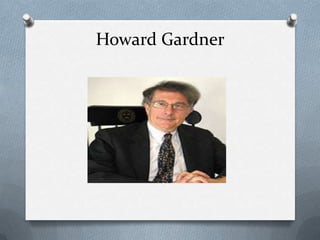
Howard Gardner
History of the theory of
Multiple Intelligence
O Author: Psychologist Howard Gardner

under the zero draft of Harvard University
Definition of Intelligence too narrow: CI
Intelligence is considered as an ability to
solve problems and create products suitable
environment.
O What are the multiple intelligence?
O What are the uses of these intelligences?
O How do we develop them?

O What are the effective factors for the

development of multiple intelligences?
O How to integrate technology in the
development of multiple intelligences?
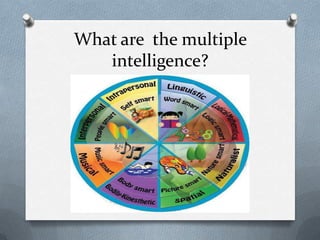
What are the multiple
intelligence?
O One Intelligence is the individual's ability

to solve everyday problems, to generate
approaches, to create products or offer
services with in their own cultural sphere.
They have identified eight multiple
intelligences, based on the most common
areas of human development.
Logical-Mathematical
Intelligence
O The ability to use numbers effectively for

example, as an accountant or a statistical
mathematical and reasoning properly for
example, as a scientist, a computer
programmer or a specialist in logic.
Linguistic Intelligence
O The ability to use words effectively, either

orally (for example, as a storyteller, a
speaker or a politician) or in writing (for
example, as a poet, a playwright, an editor
or a journalist ).
Spatial Intelligence
The ability to accurately perceive
the visual-spatial world (for
example, as a hunter, a scout or
guide) and to perform
transformations upon those
perceptions (eg, as an interior
decorator, an architect, an artist or
a inventor).
Body-Kinetic Intelligence
O He ability to use the whole body to

express ideas and feelings (eg, as an
actor, a mime, an athlete or a dancer) and
facility in using one's hands to produce or
transform things (eg, as a craftsman , a
sculptor, a mechanic or a surgeon).
Musical Intelligence
O The ability to perceive (such as a lover of

music), discriminating (such as a music
critic), transformed (for example, as a
composer) and express (such as the
person who plays an instrument) musical
forms.
Intrapersonal Intelligence
O The self-knowledge and the ability to

adapt own ways from that knowledge.
This intelligence includes having an
accurate picture of oneself (one's own
powers and limitations), be aware of the
inner moods, intentions, motivations,
temperaments and desires, and the
capacity for self-discipline, selfunderstanding and esteem.
Interpersonal Intelligence
O The ability to perceive and make

distinctions in the
moods, intentions, motivations and
feelings of other people.
Other intelligences in study
O spirituality
O moral sensitivity
O humor
O intuition

O creativity
O Skill culinary (cooking)
O Perception olfactory (sense of smell)
What are the effective factors
for the development of
multiple intelligences?.
O biological endowment
O Personal Life Story
O Cultural and historical background
O Crystallizing experiences (key points

"Feldman")
O Experiences stun (inhibitory intelligences)
THE INTEGRATION OF TECHNOLOGY IN THE
DEVELOPMENT OF MULTIPLE INTELLIGENCE
O The technology has become the focus of

attention, especially in relation to their
impact as instructional tool.
O It is a priority for educators, curriculum for
technicians and managers of educational
policy development.
O It is an alternative to see the real world
from the classroom
My lesson plan

Presentation of_multiple_intelligences

  • 1.
  • 2.
  • 3.
    History of thetheory of Multiple Intelligence O Author: Psychologist Howard Gardner under the zero draft of Harvard University Definition of Intelligence too narrow: CI Intelligence is considered as an ability to solve problems and create products suitable environment.
  • 4.
    O What arethe multiple intelligence? O What are the uses of these intelligences? O How do we develop them? O What are the effective factors for the development of multiple intelligences? O How to integrate technology in the development of multiple intelligences?
  • 5.
    What are themultiple intelligence?
  • 6.
    O One Intelligenceis the individual's ability to solve everyday problems, to generate approaches, to create products or offer services with in their own cultural sphere. They have identified eight multiple intelligences, based on the most common areas of human development.
  • 7.
    Logical-Mathematical Intelligence O The abilityto use numbers effectively for example, as an accountant or a statistical mathematical and reasoning properly for example, as a scientist, a computer programmer or a specialist in logic.
  • 8.
    Linguistic Intelligence O Theability to use words effectively, either orally (for example, as a storyteller, a speaker or a politician) or in writing (for example, as a poet, a playwright, an editor or a journalist ).
  • 9.
    Spatial Intelligence The abilityto accurately perceive the visual-spatial world (for example, as a hunter, a scout or guide) and to perform transformations upon those perceptions (eg, as an interior decorator, an architect, an artist or a inventor).
  • 10.
    Body-Kinetic Intelligence O Heability to use the whole body to express ideas and feelings (eg, as an actor, a mime, an athlete or a dancer) and facility in using one's hands to produce or transform things (eg, as a craftsman , a sculptor, a mechanic or a surgeon).
  • 11.
    Musical Intelligence O Theability to perceive (such as a lover of music), discriminating (such as a music critic), transformed (for example, as a composer) and express (such as the person who plays an instrument) musical forms.
  • 12.
    Intrapersonal Intelligence O Theself-knowledge and the ability to adapt own ways from that knowledge. This intelligence includes having an accurate picture of oneself (one's own powers and limitations), be aware of the inner moods, intentions, motivations, temperaments and desires, and the capacity for self-discipline, selfunderstanding and esteem.
  • 13.
    Interpersonal Intelligence O Theability to perceive and make distinctions in the moods, intentions, motivations and feelings of other people.
  • 14.
    Other intelligences instudy O spirituality O moral sensitivity O humor O intuition O creativity O Skill culinary (cooking) O Perception olfactory (sense of smell)
  • 15.
    What are theeffective factors for the development of multiple intelligences?. O biological endowment O Personal Life Story O Cultural and historical background O Crystallizing experiences (key points "Feldman") O Experiences stun (inhibitory intelligences)
  • 16.
    THE INTEGRATION OFTECHNOLOGY IN THE DEVELOPMENT OF MULTIPLE INTELLIGENCE O The technology has become the focus of attention, especially in relation to their impact as instructional tool. O It is a priority for educators, curriculum for technicians and managers of educational policy development. O It is an alternative to see the real world from the classroom
  • 17.