MULTIPLE
INTELLIGENCES
THEORY
Howard Gardner (1943-)
Pioneer of Multiple
Intelligences Theory
Gardner’s theory
broadens the field of how
individuals display their
intelligence by including:
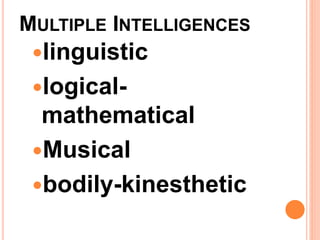
MULTIPLE INTELLIGENCES
linguistic
logical-
mathematical
Musical
bodily-kinesthetic
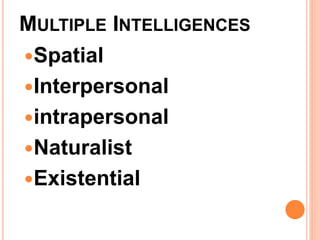
Spatial
Interpersonal
intrapersonal
Naturalist
Existential
MULTIPLE INTELLIGENCES
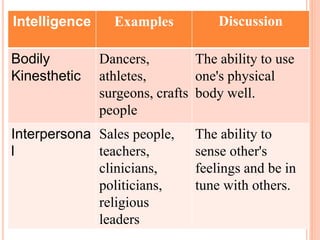
Intelligence Examples Discussion
Bodily
Kinesthetic
Dancers,
athletes,
surgeons, crafts
people
The ability to use
one's physical
body well.
Interpersona
l
Sales people,
teachers,
clinicians,
politicians,
religious
leaders
The ability to
sense other's
feelings and be in
tune with others.
Intrapers
onal
People who have
good insight into
themselves and
make effective
use of their other
intelligences
Self-awareness.
The ability to
know your own
body and mind.
Linguistic Poets, writers,
orators,
communicators
The ability to
communicate well,
perhaps both orally
and in writing,
perhaps in several
languages.
Logic
al
Math
emati
cal
Mathemati
cians,
logicians
The ability to
learn higher
mathematics. The
ability to handle
complex logical
arguments.
Music
al
Musicians,
composers
The ability to learn,
perform, and
compose music.
Naturali
stic
Biologists,
naturalists
The ability to understand
different species, recognize
patterns in nature, classify
natural objects.
Spatial Sailors navigating
without modern
navigational aids,
surgeons,
sculptors, painters
The ability to know where you
are relative to fixed locations.
The ability to accomplish
tasks requiring three-
dimensional visualization and
placement of your hands or
other parts of your body.
Existent
ial
Priest, Pastors
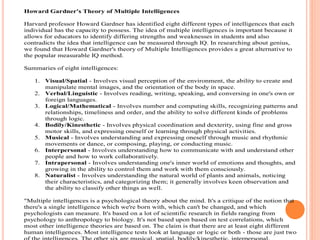
Howard Gardner's Theory of Multiple Intelligences
Harvard professor Howard Gardner has identified eight different types of intelligences that each
individual has the capacity to possess. The idea of multiple intelligences is important because it
allows for educators to identify differing strengths and weaknesses in students and also
contradicts the idea that intelligence can be measured through IQ. In researching about genius,
we found that Howard Gardner's theory of Multiple Intelligences provides a great alternative to
the popular measurable IQ method.
Summaries of eight intelligences:
1. Visual/Spatial - Involves visual perception of the environment, the ability to create and
manipulate mental images, and the orientation of the body in space.
2. Verbal/Linguistic - Involves reading, writing, speaking, and conversing in one's own or
foreign languages.
3. Logical/Mathematical - Involves number and computing skills, recognizing patterns and
relationships, timeliness and order, and the ability to solve different kinds of problems
through logic.
4. Bodily/Kinesthetic - Involves physical coordination and dexterity, using fine and gross
motor skills, and expressing oneself or learning through physical activities.
5. Musical - Involves understanding and expressing oneself through music and rhythmic
movements or dance, or composing, playing, or conducting music.
6. Interpersonal - Involves understanding how to communicate with and understand other
people and how to work collaboratively.
7. Intrapersonal - Involves understanding one's inner world of emotions and thoughts, and
growing in the ability to control them and work with them consciously.
8. Naturalist - Involves understanding the natural world of plants and animals, noticing
their characteristics, and categorizing them; it generally involves keen observation and
the ability to classify other things as well.
"Multiple intelligences is a psychological theory about the mind. It's a critique of the notion that
there's a single intelligence which we're born with, which can't be changed, and which
psychologists can measure. It's based on a lot of scientific research in fields ranging from
psychology to anthropology to biology. It's not based upon based on test correlations, which
most other intelligence theories are based on. The claim is that there are at least eight different
human intelligences. Most intelligence tests look at language or logic or both - those are just two

HOWARD GARDNER.pptx

  • 1.
  • 2.
    Howard Gardner (1943-) Pioneerof Multiple Intelligences Theory Gardner’s theory broadens the field of how individuals display their intelligence by including:
  • 3.
  • 4.
  • 5.
    Intelligence Examples Discussion Bodily Kinesthetic Dancers, athletes, surgeons,crafts people The ability to use one's physical body well. Interpersona l Sales people, teachers, clinicians, politicians, religious leaders The ability to sense other's feelings and be in tune with others.
  • 6.
    Intrapers onal People who have goodinsight into themselves and make effective use of their other intelligences Self-awareness. The ability to know your own body and mind. Linguistic Poets, writers, orators, communicators The ability to communicate well, perhaps both orally and in writing, perhaps in several languages.
  • 7.
    Logic al Math emati cal Mathemati cians, logicians The ability to learnhigher mathematics. The ability to handle complex logical arguments. Music al Musicians, composers The ability to learn, perform, and compose music.
  • 8.
    Naturali stic Biologists, naturalists The ability tounderstand different species, recognize patterns in nature, classify natural objects. Spatial Sailors navigating without modern navigational aids, surgeons, sculptors, painters The ability to know where you are relative to fixed locations. The ability to accomplish tasks requiring three- dimensional visualization and placement of your hands or other parts of your body. Existent ial Priest, Pastors
  • 9.
    Howard Gardner's Theoryof Multiple Intelligences Harvard professor Howard Gardner has identified eight different types of intelligences that each individual has the capacity to possess. The idea of multiple intelligences is important because it allows for educators to identify differing strengths and weaknesses in students and also contradicts the idea that intelligence can be measured through IQ. In researching about genius, we found that Howard Gardner's theory of Multiple Intelligences provides a great alternative to the popular measurable IQ method. Summaries of eight intelligences: 1. Visual/Spatial - Involves visual perception of the environment, the ability to create and manipulate mental images, and the orientation of the body in space. 2. Verbal/Linguistic - Involves reading, writing, speaking, and conversing in one's own or foreign languages. 3. Logical/Mathematical - Involves number and computing skills, recognizing patterns and relationships, timeliness and order, and the ability to solve different kinds of problems through logic. 4. Bodily/Kinesthetic - Involves physical coordination and dexterity, using fine and gross motor skills, and expressing oneself or learning through physical activities. 5. Musical - Involves understanding and expressing oneself through music and rhythmic movements or dance, or composing, playing, or conducting music. 6. Interpersonal - Involves understanding how to communicate with and understand other people and how to work collaboratively. 7. Intrapersonal - Involves understanding one's inner world of emotions and thoughts, and growing in the ability to control them and work with them consciously. 8. Naturalist - Involves understanding the natural world of plants and animals, noticing their characteristics, and categorizing them; it generally involves keen observation and the ability to classify other things as well. "Multiple intelligences is a psychological theory about the mind. It's a critique of the notion that there's a single intelligence which we're born with, which can't be changed, and which psychologists can measure. It's based on a lot of scientific research in fields ranging from psychology to anthropology to biology. It's not based upon based on test correlations, which most other intelligence theories are based on. The claim is that there are at least eight different human intelligences. Most intelligence tests look at language or logic or both - those are just two