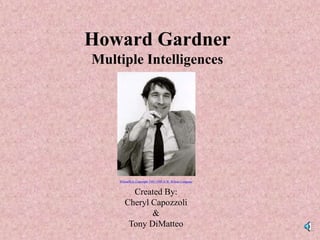
Howard Gardner
Multiple Intelligences
WilsonWeb Copyright 1997-1999 H.W. Wilson Company
Created By:
Cheryl Capozzoli
&
Tony DiMatteo
Gardner’s Life
 Jewish parents who were refugees that fled from Germany in 1938
 Howard Earl Gardner born July 11, 1943 in Scranton, PA
 His older brother killed in a sledding accident
 A good student
 A pianist and thought it could be a professional career
 Married to Ellen Winner
 Has four children
 Enjoys traveling and a range of art forms.
Gardner’s Education
 Attended Preparatory School in Kingston, Pennsylvania
 Attended Harvard College - studied history preparing for a
law career
 1965 - Graduate Gardner received his B.A. summa cum
laude in Social Relations from Harvard College
 1971 - Ph.D. in Developmental Psychology from Harvard
University
Gardner’s Career
 1972 - Boston V.A. Hospital, research psychologist
 1973- Harvard University, Co-director of Project Zero
 (a research group that studies human cognition and focuses mainly on the arts)
 1979 - Professor of Medicine Boston Univ. School of Medicine
 1986 - Professor of Education at Harvard Graduate School of
Education
 1984 – Professor of Neurology at Boston University School of
Medicine
Some of Gardner’s
Publications
 The Arts and Human Development (1973)
 Art, Mind, and Brain: A Cognitive Approach to Creativity (1982)
 Frames of Mind: The Theory of Multiple Intelligence (1983)
 The Unschooled Mind: How Children Think and How Schools Should
Teach (1991)
 Multiple Intelligences: The Theory in Practice (1993)
 Changing the World: A Framework for the Study of Creativity(1994)
 Who Owns Intelligence? (1999)
 Book Publications
http://adulted.about.com/gi/dynamic/offsite.htm?site=http%3A%2F%
2Fteachers.net%2Farchive%2Fgardner092899.html
A Definition of
Multiple Intelligences
 A psychological theory about the mind.
 Human beings learn in various levels of intelligences
 Eight different human intelligences.
 Humans learn, remember, perform, and understand in
different ways and have all of these intelligences
 Most intelligence tests only identify general intelligence
(language/logic)
 Genetics, environment, and experiences influence one’s
level of intelligences
 Multiple Intelligences is a tool not a goal
 All humans possess these intelligences, but each person
owns their unique learning style combination
Gardner’s Theory of
Multiple Intelligences
This theory is based on Gardner’s belief that “students have
very different minds and they learn, remember, perform, and
understand in various ways.”
( The Distance Learning Technology Resource Guide," by Carla Lane )
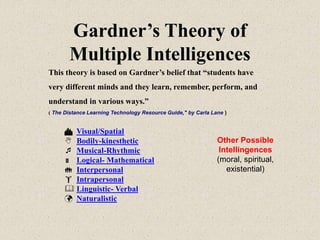
 Visual/Spatial
 Bodily-kinesthetic
 Musical-Rhythmic
 Logical- Mathematical
 Interpersonal
 Intrapersonal
 Linguistic- Verbal
 Naturalistic
Other Possible
Intellingences
(moral, spiritual,
existential)
How Technology Enhances
Multiple Intelligences
Check out some good examples of
how to incorporate technology into
Your lesson plans to help engage all
types of learners.
America Tomorrow
Take the
Multiple Intelligence Test
SPAN
Statewide Parent Advocacy Network
• Identify your multiple intelligences styles by take the test
located at this site.
• Identify your students multiple intelligences so that you can
develop sound lesson plans for individual learning styles.
• Check out some Examples of Learning Styles and what they
indicate about you and your students.
Impact on Today’s Curriculum
Educators- Strong Positive Response
• Some schools looked to structure curriculum
according to intelligences.
• Some schools tried to design classrooms to
reflect the understandings of Gardner.
Impact on Today’s Curriculum
Teaching Techniques
• Students think and learn in many different ways.
• Provides educators with framework for
organizing and reflection on curriculum
assessment and pedagogical practices.
• Approach meets needs of class learners.
Impact on Today’s Curriculum
Alternative Ways of Thinking for Educators
• A broad vision of education- teachers need to attend to all
intelligences.
• Developing local and flexible programs.
• Looking to how morality and intelligence work together.
Impact on Today’s Curriculum
Gardner’s Educational Philosophy
• Cover too much material dooms the achievement of
understanding.
• Most likely to enhance understanding if we probe deeply
in a small number of topics.
Key School
• First school in world organized around Multiple Intelligneces
Theory.
• Gardner- psychologist not an educator, did not know best
ways to teach a class or run a school.
Using Multiple Intelligences
Theory for Assessment
Original Research
• Desire to get away from tests.
• Look at Naturalistic sources of information. How
people develop skills is important to their way of life.
• Intelligence, on one level, is not adequate measure of
a person’s intellectual abilities.
Using Multiple Intelligences
Theory for Assessment
Added Research
• Project Spectrum- goal to create a set of measures where
by one could ascertain the intellectual profile of young
children.
• Practical Intelligences for School- developed a set of
curriculum and assessment for middle school curriculum
• Project Zoo- work on design of performance based
assessments, education for understanding, and the use of
multiple intelligences to achieve more personalized
curriculum, instruction, and assessment
Using Multiple Intelligences
Theory for Assessment
• Multiple Intelligence should not in and of itself be
an educational goal.
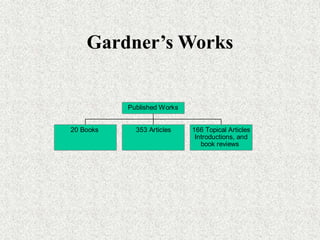
Gardner’s Works
20 Books 353 Articles 166 Topical Articles
Introductions, and
book reviews
Published Works
Gardner’s Future Work
• Propose new intelligences- sexual, digital.
• How the intelligences can best be mobilized to achieve
specific pedagogical goals.
• Explore the ways in which societal activities and domains
of knowledge emerge and become periodically
reconfigured.
Gardner’s Future Work
• Multiple Intelligence Theory’s reliance on biological
evidence.
• Biological basis of Multiple Intelligence Theory needs
urgently to be brought up to date.
Web Site References
1. NEA
2. America Tomorrow
3. SPAN - http://www.spannj.org/BasicRights/index.html
4. ERIC Digest - http://www.ericfacility.net/ericdigests/ed410226.html
5. SUMIT- http://www.pz.harvard.edu.SUMIT/MISUMIT,HTM
6. Swopnet - http://www.swopnet.com/ed/TAG/7_Intelligences.html
7. Multiple Intelligences after Twenty Years http://pzweb.harvard.edu/PIs/HG_MI_after_20_years.pdf
8. Photo - WilsonWeb Copyright 1997-1999 H.W. Wilson Company
9. Wav Files - Wisconsin Education Association
10. Gardner, Howard Earl (1943- ) Gale Encyclopedia of Psychology by Marie Doorey
11. Indiana University Human Intelligence http://www.indiana.edu/%7Eintell/gardner.shtml
A Good Instructional
Resource

Howard Gardner

  • 1.
    Howard Gardner Multiple Intelligences WilsonWebCopyright 1997-1999 H.W. Wilson Company Created By: Cheryl Capozzoli & Tony DiMatteo
  • 2.
    Gardner’s Life  Jewishparents who were refugees that fled from Germany in 1938  Howard Earl Gardner born July 11, 1943 in Scranton, PA  His older brother killed in a sledding accident  A good student  A pianist and thought it could be a professional career  Married to Ellen Winner  Has four children  Enjoys traveling and a range of art forms.
  • 3.
    Gardner’s Education  AttendedPreparatory School in Kingston, Pennsylvania  Attended Harvard College - studied history preparing for a law career  1965 - Graduate Gardner received his B.A. summa cum laude in Social Relations from Harvard College  1971 - Ph.D. in Developmental Psychology from Harvard University
  • 4.
    Gardner’s Career  1972- Boston V.A. Hospital, research psychologist  1973- Harvard University, Co-director of Project Zero  (a research group that studies human cognition and focuses mainly on the arts)  1979 - Professor of Medicine Boston Univ. School of Medicine  1986 - Professor of Education at Harvard Graduate School of Education  1984 – Professor of Neurology at Boston University School of Medicine
  • 5.
    Some of Gardner’s Publications The Arts and Human Development (1973)  Art, Mind, and Brain: A Cognitive Approach to Creativity (1982)  Frames of Mind: The Theory of Multiple Intelligence (1983)  The Unschooled Mind: How Children Think and How Schools Should Teach (1991)  Multiple Intelligences: The Theory in Practice (1993)  Changing the World: A Framework for the Study of Creativity(1994)  Who Owns Intelligence? (1999)  Book Publications http://adulted.about.com/gi/dynamic/offsite.htm?site=http%3A%2F% 2Fteachers.net%2Farchive%2Fgardner092899.html
  • 6.
    A Definition of MultipleIntelligences  A psychological theory about the mind.  Human beings learn in various levels of intelligences  Eight different human intelligences.  Humans learn, remember, perform, and understand in different ways and have all of these intelligences  Most intelligence tests only identify general intelligence (language/logic)  Genetics, environment, and experiences influence one’s level of intelligences  Multiple Intelligences is a tool not a goal  All humans possess these intelligences, but each person owns their unique learning style combination
  • 7.
    Gardner’s Theory of MultipleIntelligences This theory is based on Gardner’s belief that “students have very different minds and they learn, remember, perform, and understand in various ways.” ( The Distance Learning Technology Resource Guide," by Carla Lane )  Visual/Spatial  Bodily-kinesthetic  Musical-Rhythmic  Logical- Mathematical  Interpersonal  Intrapersonal  Linguistic- Verbal  Naturalistic Other Possible Intellingences (moral, spiritual, existential)
  • 8.
    How Technology Enhances MultipleIntelligences Check out some good examples of how to incorporate technology into Your lesson plans to help engage all types of learners. America Tomorrow
  • 9.
    Take the Multiple IntelligenceTest SPAN Statewide Parent Advocacy Network • Identify your multiple intelligences styles by take the test located at this site. • Identify your students multiple intelligences so that you can develop sound lesson plans for individual learning styles. • Check out some Examples of Learning Styles and what they indicate about you and your students.
  • 10.
    Impact on Today’sCurriculum Educators- Strong Positive Response • Some schools looked to structure curriculum according to intelligences. • Some schools tried to design classrooms to reflect the understandings of Gardner.
  • 11.
    Impact on Today’sCurriculum Teaching Techniques • Students think and learn in many different ways. • Provides educators with framework for organizing and reflection on curriculum assessment and pedagogical practices. • Approach meets needs of class learners.
  • 12.
    Impact on Today’sCurriculum Alternative Ways of Thinking for Educators • A broad vision of education- teachers need to attend to all intelligences. • Developing local and flexible programs. • Looking to how morality and intelligence work together.
  • 13.
    Impact on Today’sCurriculum Gardner’s Educational Philosophy • Cover too much material dooms the achievement of understanding. • Most likely to enhance understanding if we probe deeply in a small number of topics.
  • 14.
    Key School • Firstschool in world organized around Multiple Intelligneces Theory. • Gardner- psychologist not an educator, did not know best ways to teach a class or run a school.
  • 15.
    Using Multiple Intelligences Theoryfor Assessment Original Research • Desire to get away from tests. • Look at Naturalistic sources of information. How people develop skills is important to their way of life. • Intelligence, on one level, is not adequate measure of a person’s intellectual abilities.
  • 16.
    Using Multiple Intelligences Theoryfor Assessment Added Research • Project Spectrum- goal to create a set of measures where by one could ascertain the intellectual profile of young children. • Practical Intelligences for School- developed a set of curriculum and assessment for middle school curriculum • Project Zoo- work on design of performance based assessments, education for understanding, and the use of multiple intelligences to achieve more personalized curriculum, instruction, and assessment
  • 17.
    Using Multiple Intelligences Theoryfor Assessment • Multiple Intelligence should not in and of itself be an educational goal.
  • 18.
    Gardner’s Works 20 Books353 Articles 166 Topical Articles Introductions, and book reviews Published Works
  • 19.
    Gardner’s Future Work •Propose new intelligences- sexual, digital. • How the intelligences can best be mobilized to achieve specific pedagogical goals. • Explore the ways in which societal activities and domains of knowledge emerge and become periodically reconfigured.
  • 20.
    Gardner’s Future Work •Multiple Intelligence Theory’s reliance on biological evidence. • Biological basis of Multiple Intelligence Theory needs urgently to be brought up to date.
  • 21.
    Web Site References 1.NEA 2. America Tomorrow 3. SPAN - http://www.spannj.org/BasicRights/index.html 4. ERIC Digest - http://www.ericfacility.net/ericdigests/ed410226.html 5. SUMIT- http://www.pz.harvard.edu.SUMIT/MISUMIT,HTM 6. Swopnet - http://www.swopnet.com/ed/TAG/7_Intelligences.html 7. Multiple Intelligences after Twenty Years http://pzweb.harvard.edu/PIs/HG_MI_after_20_years.pdf 8. Photo - WilsonWeb Copyright 1997-1999 H.W. Wilson Company 9. Wav Files - Wisconsin Education Association 10. Gardner, Howard Earl (1943- ) Gale Encyclopedia of Psychology by Marie Doorey 11. Indiana University Human Intelligence http://www.indiana.edu/%7Eintell/gardner.shtml A Good Instructional Resource