Howard Gardner’s
Theory Of Multiple
Intelligences
Discussants: Chery Lyn A. Caspe
Arlyn M. Casas
Rusiamy Loraña
Med-Social Science
Howard Gardner, (born July 11, 1943, Scranton, Pennsylvania,
U.S.), American cognitive psychologist and author, best known for
his theory of multiple intelligences. First presented in Frames of
Mind: The Theory of Multiple Intelligences (1983) and
subsequently refined and extended in Multiple Intelligences: The
Theory in Practice (1993), Intelligence Reframed: Multiple
Intelligences for the 21st Century (1999), and Multiple
Intelligences: New Horizons (2006), Gardner’s theory inspired
teachers, school leaders, and special educators to embrace the
notion that there are many ways to be intelligent.
• Gardner was the son of Jewish refugees from Nazi Germany. He was a
studious child who loved to read, and he developed into a gifted pianist.
He retained a lifelong passion for music that contributed to his
nonunitary cinception of human cognitive capacity.
• Gardner undertook most of his formal training and graduate work at
Harvard University, where he earned a bachelor’s degree in social
relations in 1965 and a doctoral degree in developmental psychology in
1971. His many academic appointments included a professorship of
neurology at Boston University School of Medicine (1984–2005) and a
professorship of education at the Harvard Graduate School of
Education (1986–98), where he was appointed the John H. and
Elisabeth A. Hobbs Professor of Cognition and Education in 1998.
What is Multiple Intelligences Theory?
• Multiple Intelligence theory is a psychological theory
developed by Howard Gardner in 1983.
• According to this theory, intelligence is not a single, fixed
entity, but rather a combination of different types of
intelligences that individuals possess to varying degrees.
• Howard Gardner’s theory of multiple intelligences proposes that
people are not born with all of the intelligence they will ever have.
• This theory challenged the traditional notion that there is one single
type of intelligence, sometimes known as “g” for general intelligence,
that only focuses on cognitive abilities.
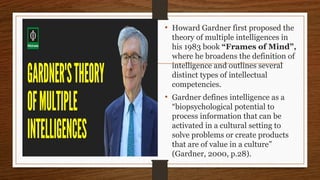
• Howard Gardner first proposed the
theory of multiple intelligences in
his 1983 book “Frames of Mind”,
where he broadens the definition of
intelligence and outlines several
distinct types of intellectual
competencies.
• Gardner defines intelligence as a
“biopsychological potential to
process information that can be
activated in a cultural setting to
solve problems or create products
that are of value in a culture”
(Gardner, 2000, p.28).
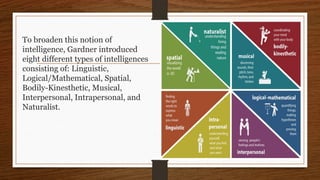
To broaden this notion of
intelligence, Gardner introduced
eight different types of intelligences
consisting of: Linguistic,
Logical/Mathematical, Spatial,
Bodily-Kinesthetic, Musical,
Interpersonal, Intrapersonal, and
Naturalist.
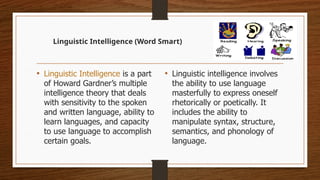
Linguistic Intelligence (Word Smart)
• Linguistic Intelligence is a part
of Howard Gardner’s multiple
intelligence theory that deals
with sensitivity to the spoken
and written language, ability to
learn languages, and capacity
to use language to accomplish
certain goals.
• Linguistic intelligence involves
the ability to use language
masterfully to express oneself
rhetorically or poetically. It
includes the ability to
manipulate syntax, structure,
semantics, and phonology of
language.
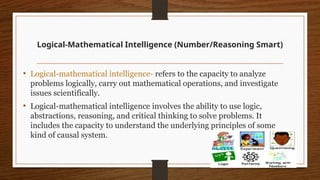
Logical-Mathematical Intelligence (Number/Reasoning Smart)
• Logical-mathematical intelligence- refers to the capacity to analyze
problems logically, carry out mathematical operations, and investigate
issues scientifically.
• Logical-mathematical intelligence involves the ability to use logic,
abstractions, reasoning, and critical thinking to solve problems. It
includes the capacity to understand the underlying principles of some
kind of causal system.
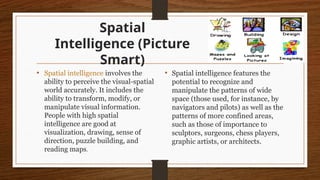
Spatial
Intelligence (Picture
Smart)
• Spatial intelligence involves the
ability to perceive the visual-spatial
world accurately. It includes the
ability to transform, modify, or
manipulate visual information.
People with high spatial
intelligence are good at
visualization, drawing, sense of
direction, puzzle building, and
reading maps.
• Spatial intelligence features the
potential to recognize and
manipulate the patterns of wide
space (those used, for instance, by
navigators and pilots) as well as the
patterns of more confined areas,
such as those of importance to
sculptors, surgeons, chess players,
graphic artists, or architects.
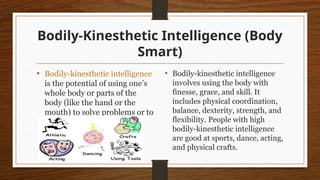
Bodily-Kinesthetic Intelligence (Body
Smart)
• Bodily-kinesthetic intelligence
is the potential of using one’s
whole body or parts of the
body (like the hand or the
mouth) to solve problems or to
fashion products.
• Bodily-kinesthetic intelligence
involves using the body with
finesse, grace, and skill. It
includes physical coordination,
balance, dexterity, strength, and
flexibility. People with high
bodily-kinesthetic intelligence
are good at sports, dance, acting,
and physical crafts.
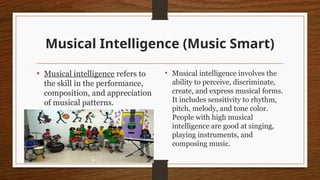
Musical Intelligence (Music Smart)
• Musical intelligence refers to
the skill in the performance,
composition, and appreciation
of musical patterns.
• Musical intelligence involves the
ability to perceive, discriminate,
create, and express musical forms.
It includes sensitivity to rhythm,
pitch, melody, and tone color.
People with high musical
intelligence are good at singing,
playing instruments, and
composing music.
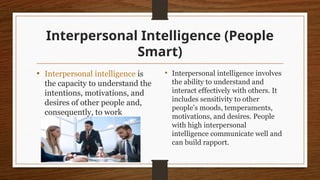
Interpersonal Intelligence (People
Smart)
• Interpersonal intelligence is
the capacity to understand the
intentions, motivations, and
desires of other people and,
consequently, to work
effectively with others.
• Interpersonal intelligence involves
the ability to understand and
interact effectively with others. It
includes sensitivity to other
people’s moods, temperaments,
motivations, and desires. People
with high interpersonal
intelligence communicate well and
can build rapport.
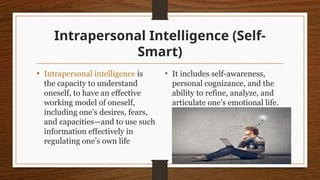
Intrapersonal Intelligence (Self-
Smart)
• Intrapersonal intelligence is
the capacity to understand
oneself, to have an effective
working model of oneself,
including one’s desires, fears,
and capacities—and to use such
information effectively in
regulating one’s own life
• It includes self-awareness,
personal cognizance, and the
ability to refine, analyze, and
articulate one’s emotional life.
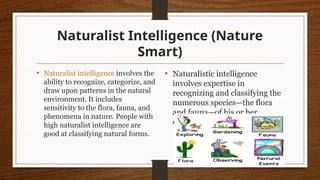
Naturalist Intelligence (Nature
Smart)
• Naturalist intelligence involves the
ability to recognize, categorize, and
draw upon patterns in the natural
environment. It includes
sensitivity to the flora, fauna, and
phenomena in nature. People with
high naturalist intelligence are
good at classifying natural forms.
• Naturalistic intelligence
involves expertise in
recognizing and classifying the
numerous species—the flora
and fauna—of his or her
environment.
Existential Intelligence
• Existential Intelligence is
concerned with the inner
life of mind and spirit and
its relationship to being in
the world.
• it implies a capacity for a deep
understanding of existential
questions and insights into
multiple levels of
consciousness; and also
implies awareness of spirit as
the creative life force of
evolution.
Benefits and Importance
• 1. Recognizing Diverse Talents:
The theory acknowledges that
individuals have different
intellectual strengths and
talents.
• 2. Personalized Education:
Understanding multiple
intelligences allows for
personalized and differentiated
education, catering to
students' unique strengths and
learning styles.
Benefits and Importance
• 3. Holistic View of Intelligence:
The theory challenges the
traditional view of intelligence as
solely based on linguistic and
mathematical abilities. It
recognizes a broader spectrum
of intelligence, including musical,
bodily-kinesthetic, interpersonal,
and intrapersonal domains.
• 4. Enhancing Self-Concept:
Emphasizing multiple
intelligences can help
individuals recognize and
appreciate their unique
strengths, leading to enhanced
self-esteem and a positive self-
concept.
The implications of Howard Gardner's
theory of multiple intelligences
• 1. Educational Practices: The
theory challenges traditional
educational practices by
encouraging educators to
develop and implement
teaching methods that cater to
different types of intelligence.
• 2. Assessment Methods: The
theory encourages the use of
diverse assessment methods to
evaluate students' abilities
beyond traditional measures,
such as standardized tests.
The implications of Howard Gardner's
theory of multiple intelligences
• 3. Individualized Learning:
Recognizing multiple
intelligences suggests the
importance of individualized
learning plans that
accommodate each student's
unique strengths and needs.
• 4. Talent Development: The
theory supports the
development of talents beyond
traditional academic domains,
acknowledging the value of
nurturing abilities in areas such
as the arts, athletics, and
interpersonal skills.
The implications of Howard Gardner's
theory of multiple intelligences
• 5. Positive Self-Concept:
Emphasizing multiple
intelligences can have
implications for individuals'
self-concept and self-esteem
by helping them recognize and
appreciate their unique
strengths and abilities.
EVALUATION
1. How does multiple
intelligence affect the
academic performance of
students?
2. What is the purpose of
applying multiple
intelligence activities?
for Listening!!!

Multiple-Intelligences by Howard Gardner-1.pptx

  • 1.
    Howard Gardner’s Theory OfMultiple Intelligences Discussants: Chery Lyn A. Caspe Arlyn M. Casas Rusiamy Loraña Med-Social Science
  • 2.
    Howard Gardner, (bornJuly 11, 1943, Scranton, Pennsylvania, U.S.), American cognitive psychologist and author, best known for his theory of multiple intelligences. First presented in Frames of Mind: The Theory of Multiple Intelligences (1983) and subsequently refined and extended in Multiple Intelligences: The Theory in Practice (1993), Intelligence Reframed: Multiple Intelligences for the 21st Century (1999), and Multiple Intelligences: New Horizons (2006), Gardner’s theory inspired teachers, school leaders, and special educators to embrace the notion that there are many ways to be intelligent.
  • 3.
    • Gardner wasthe son of Jewish refugees from Nazi Germany. He was a studious child who loved to read, and he developed into a gifted pianist. He retained a lifelong passion for music that contributed to his nonunitary cinception of human cognitive capacity. • Gardner undertook most of his formal training and graduate work at Harvard University, where he earned a bachelor’s degree in social relations in 1965 and a doctoral degree in developmental psychology in 1971. His many academic appointments included a professorship of neurology at Boston University School of Medicine (1984–2005) and a professorship of education at the Harvard Graduate School of Education (1986–98), where he was appointed the John H. and Elisabeth A. Hobbs Professor of Cognition and Education in 1998.
  • 4.
    What is MultipleIntelligences Theory? • Multiple Intelligence theory is a psychological theory developed by Howard Gardner in 1983. • According to this theory, intelligence is not a single, fixed entity, but rather a combination of different types of intelligences that individuals possess to varying degrees.
  • 5.
    • Howard Gardner’stheory of multiple intelligences proposes that people are not born with all of the intelligence they will ever have. • This theory challenged the traditional notion that there is one single type of intelligence, sometimes known as “g” for general intelligence, that only focuses on cognitive abilities.
  • 6.
    • Howard Gardnerfirst proposed the theory of multiple intelligences in his 1983 book “Frames of Mind”, where he broadens the definition of intelligence and outlines several distinct types of intellectual competencies. • Gardner defines intelligence as a “biopsychological potential to process information that can be activated in a cultural setting to solve problems or create products that are of value in a culture” (Gardner, 2000, p.28).
  • 7.
    To broaden thisnotion of intelligence, Gardner introduced eight different types of intelligences consisting of: Linguistic, Logical/Mathematical, Spatial, Bodily-Kinesthetic, Musical, Interpersonal, Intrapersonal, and Naturalist.
  • 8.
    Linguistic Intelligence (WordSmart) • Linguistic Intelligence is a part of Howard Gardner’s multiple intelligence theory that deals with sensitivity to the spoken and written language, ability to learn languages, and capacity to use language to accomplish certain goals. • Linguistic intelligence involves the ability to use language masterfully to express oneself rhetorically or poetically. It includes the ability to manipulate syntax, structure, semantics, and phonology of language.
  • 9.
    Logical-Mathematical Intelligence (Number/ReasoningSmart) • Logical-mathematical intelligence- refers to the capacity to analyze problems logically, carry out mathematical operations, and investigate issues scientifically. • Logical-mathematical intelligence involves the ability to use logic, abstractions, reasoning, and critical thinking to solve problems. It includes the capacity to understand the underlying principles of some kind of causal system.
  • 10.
    Spatial Intelligence (Picture Smart) • Spatialintelligence involves the ability to perceive the visual-spatial world accurately. It includes the ability to transform, modify, or manipulate visual information. People with high spatial intelligence are good at visualization, drawing, sense of direction, puzzle building, and reading maps. • Spatial intelligence features the potential to recognize and manipulate the patterns of wide space (those used, for instance, by navigators and pilots) as well as the patterns of more confined areas, such as those of importance to sculptors, surgeons, chess players, graphic artists, or architects.
  • 11.
    Bodily-Kinesthetic Intelligence (Body Smart) •Bodily-kinesthetic intelligence is the potential of using one’s whole body or parts of the body (like the hand or the mouth) to solve problems or to fashion products. • Bodily-kinesthetic intelligence involves using the body with finesse, grace, and skill. It includes physical coordination, balance, dexterity, strength, and flexibility. People with high bodily-kinesthetic intelligence are good at sports, dance, acting, and physical crafts.
  • 12.
    Musical Intelligence (MusicSmart) • Musical intelligence refers to the skill in the performance, composition, and appreciation of musical patterns. • Musical intelligence involves the ability to perceive, discriminate, create, and express musical forms. It includes sensitivity to rhythm, pitch, melody, and tone color. People with high musical intelligence are good at singing, playing instruments, and composing music.
  • 13.
    Interpersonal Intelligence (People Smart) •Interpersonal intelligence is the capacity to understand the intentions, motivations, and desires of other people and, consequently, to work effectively with others. • Interpersonal intelligence involves the ability to understand and interact effectively with others. It includes sensitivity to other people’s moods, temperaments, motivations, and desires. People with high interpersonal intelligence communicate well and can build rapport.
  • 14.
    Intrapersonal Intelligence (Self- Smart) •Intrapersonal intelligence is the capacity to understand oneself, to have an effective working model of oneself, including one’s desires, fears, and capacities—and to use such information effectively in regulating one’s own life • It includes self-awareness, personal cognizance, and the ability to refine, analyze, and articulate one’s emotional life.
  • 15.
    Naturalist Intelligence (Nature Smart) •Naturalist intelligence involves the ability to recognize, categorize, and draw upon patterns in the natural environment. It includes sensitivity to the flora, fauna, and phenomena in nature. People with high naturalist intelligence are good at classifying natural forms. • Naturalistic intelligence involves expertise in recognizing and classifying the numerous species—the flora and fauna—of his or her environment.
  • 16.
    Existential Intelligence • ExistentialIntelligence is concerned with the inner life of mind and spirit and its relationship to being in the world. • it implies a capacity for a deep understanding of existential questions and insights into multiple levels of consciousness; and also implies awareness of spirit as the creative life force of evolution.
  • 17.
    Benefits and Importance •1. Recognizing Diverse Talents: The theory acknowledges that individuals have different intellectual strengths and talents. • 2. Personalized Education: Understanding multiple intelligences allows for personalized and differentiated education, catering to students' unique strengths and learning styles.
  • 18.
    Benefits and Importance •3. Holistic View of Intelligence: The theory challenges the traditional view of intelligence as solely based on linguistic and mathematical abilities. It recognizes a broader spectrum of intelligence, including musical, bodily-kinesthetic, interpersonal, and intrapersonal domains. • 4. Enhancing Self-Concept: Emphasizing multiple intelligences can help individuals recognize and appreciate their unique strengths, leading to enhanced self-esteem and a positive self- concept.
  • 19.
    The implications ofHoward Gardner's theory of multiple intelligences • 1. Educational Practices: The theory challenges traditional educational practices by encouraging educators to develop and implement teaching methods that cater to different types of intelligence. • 2. Assessment Methods: The theory encourages the use of diverse assessment methods to evaluate students' abilities beyond traditional measures, such as standardized tests.

  • 20.
    The implications ofHoward Gardner's theory of multiple intelligences • 3. Individualized Learning: Recognizing multiple intelligences suggests the importance of individualized learning plans that accommodate each student's unique strengths and needs. • 4. Talent Development: The theory supports the development of talents beyond traditional academic domains, acknowledging the value of nurturing abilities in areas such as the arts, athletics, and interpersonal skills.
  • 21.
    The implications ofHoward Gardner's theory of multiple intelligences • 5. Positive Self-Concept: Emphasizing multiple intelligences can have implications for individuals' self-concept and self-esteem by helping them recognize and appreciate their unique strengths and abilities.
  • 22.
    EVALUATION 1. How doesmultiple intelligence affect the academic performance of students? 2. What is the purpose of applying multiple intelligence activities?
  • 23.