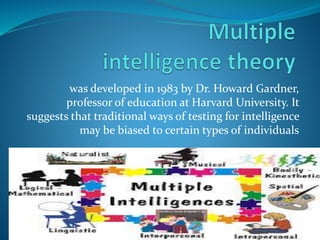
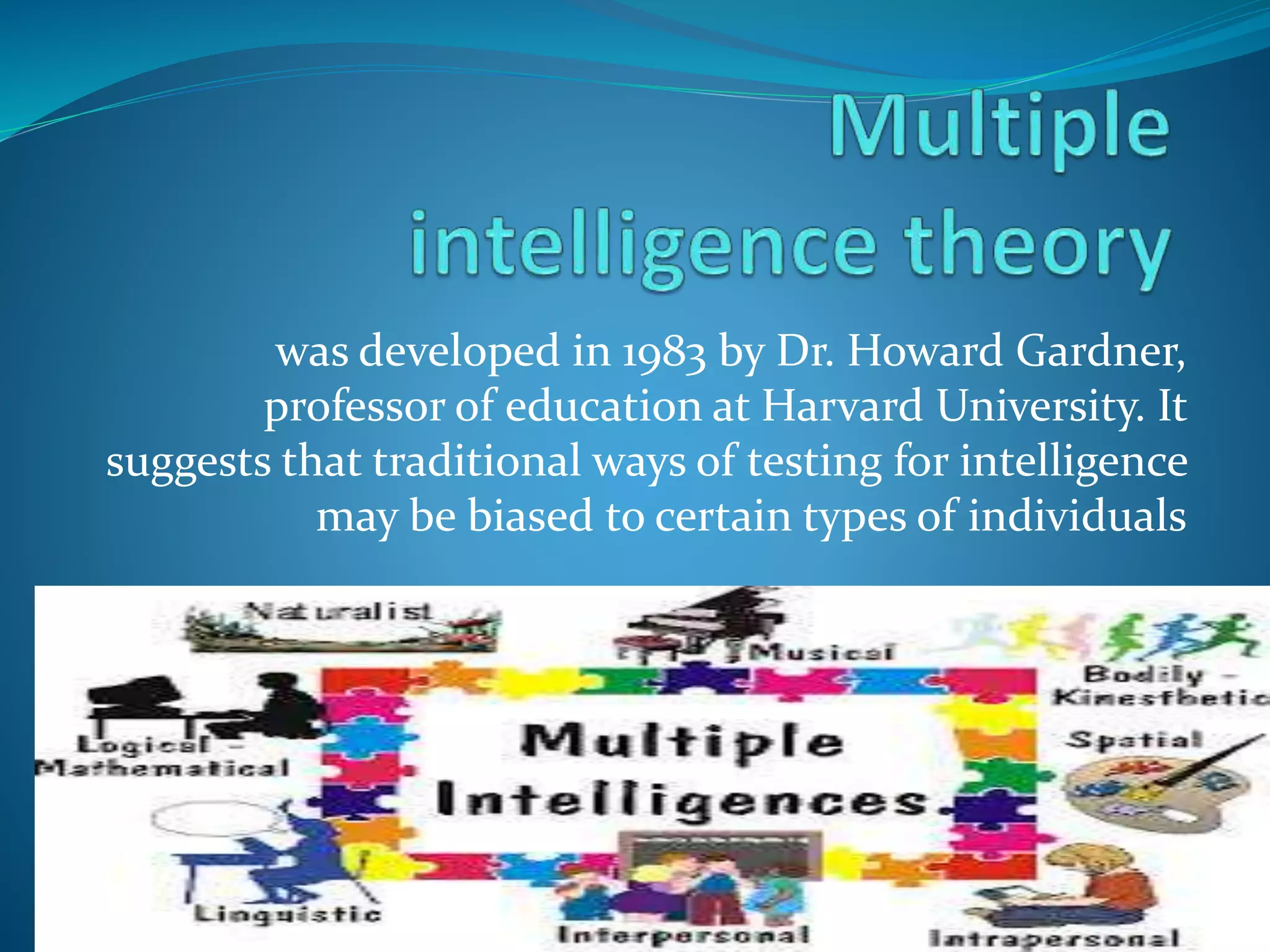
was developed in 1983 by Dr. Howard Gardner, 
professor of education at Harvard University. It 
suggests that traditional ways of testing for intelligence 
may be biased to certain types of individuals
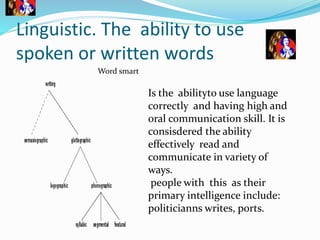
Linguistic. The ability to use 
spoken or written words 
Word smart 
Is the abilityto use language 
correctly and having high and 
oral communication skill. It is 
consisdered the ability 
effectively read and 
communicate in variety of 
ways. 
people with this as their 
primary intelligence include: 
politicianns writes, ports.
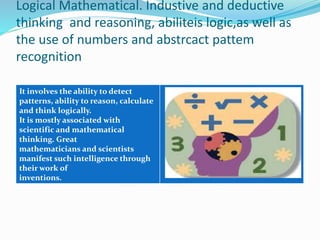
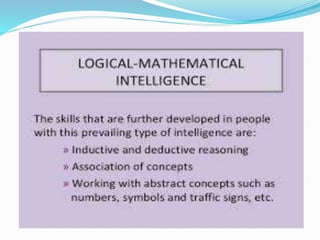
Logical Mathematical. Industive and deductive 
thinking and reasoning, abiliteis logic,as well as 
the use of numbers and abstrcact pattem 
recognition 
It involves the ability to detect 
patterns, ability to reason, calculate 
and think logically. 
It is mostly associated with 
scientific and mathematical 
thinking. Great 
mathematicians and scientists 
manifest such intelligence through 
their work of 
inventions.
VISUAL SPATIAL 
 It involves the ability to create and manipulate images 
in order to solve problems. 
 It can be used in the fields of arts or in the sciences. 
 It is not limited to the visual domain; even blind 
children possess this intelligence. 
 Scientists, mathematicians and philosophers - they all 
possess this intelligence
Bodily-Kinesthetic 
Intelligence 
 It is the ability to solve problems using one’s own body 
parts. It challenges the popular belief that mental and 
physical activities are unrelated. 
 Athletes, surgeons, dancers and choreographers - they 
all exhibit this intelligence.
MUSICAL INTELLIGENCE 
 It involves the ability to create music and understand 
and appreciate it. 
 Musicians and Composers reveal their musical 
intelligence through their brilliant 
 musical masterpieces.
Interpersonal Intelligence 
 It is the ability to understand others and their 
emotions. 
 Teachers, parents, politicians, psychologists and 
salespeople rely on this intelligence.
INTRAPERSONAL INTELLIGENCE 
 It is the ability to understand one’s own feeling and build 
one’s own models, which 
 help one function effectively throughout life.
Strengths of the Multiple 
Intelligences Theory 
 By understanding that all learners are unique and have 
multiple intelligences, using a variety of learning 
mechanisms that focus on the different intelligences, 
educators have the ability to reach ALL students. 
 ·The Multiple Intelligences theory was based off of 
developmental, clinical, case study and educational 
evidence. 
 · The educators are given the opportunity to get to know 
their students individually in order for each student to 
perform to the best of their ability. 
 It recognizes that educators need to differentiate 
instruction in their classroom.
Weaknesses of Multiple 
Intelligences 
 ·Limiting the list of intelligences to eight may be too 
narrow. 
 How do you differentiate skill versus intelligence and 
where do you draw the line? 
 There needs to be more testing, scientific evidence, and 
research placed on how to distinguish what distinct 
intelligence a student is classified under. 
 The theory does not show how or why some individuals are 
more “intelligent” than others. 
 Developing a variety of differentiated instruction in the 
classroom to fit the needs of all the multiple intelligences 
takes time, planning, and practice
Association with Constructivism 
 Howard Gardner's theory on Multiple Intelligences is 
closely associated with constructivism because it does 
not attempt to mold all students into one desired 
prototype. Instead, it allows students to experiment 
and use their own ideas and knowledge to create an 
individualized product. Although Gardner see somes 
value in reward and punishment, ultimately he belives, 
"grounding one's teaching in such schedules of 
reinforcement can't work in the long run.
The Integration of Technology into the 
Classroom in Relation to the Multiple 
Intelligences Theory 
 Teachers using the Multiple Intelligence theory in 
their classroom will need to differentiate instruction, 
have a variety of technological resources available, and 
focus on the particular intelligences of the students.
RESOURCES 
 http://prezi.com/dvv0qgcqixnd/multiple-intelligence-theory/ 
 http://lizkari-multipleintelligences. 
wikispaces.com/Multiple+Intelli 
gences 
 file:///C:/Users/COMPUMAX/Downloads/gardnersm 
ultipleintelligence-12625682577075-phpapp01 
 https://www.youtube.com/watch?v=l2QtSbP4FRg

Multiple intelligence theory

  • 1.
    was developed in1983 by Dr. Howard Gardner, professor of education at Harvard University. It suggests that traditional ways of testing for intelligence may be biased to certain types of individuals
  • 3.
    Linguistic. The abilityto use spoken or written words Word smart Is the abilityto use language correctly and having high and oral communication skill. It is consisdered the ability effectively read and communicate in variety of ways. people with this as their primary intelligence include: politicianns writes, ports.
  • 4.
    Logical Mathematical. Industiveand deductive thinking and reasoning, abiliteis logic,as well as the use of numbers and abstrcact pattem recognition It involves the ability to detect patterns, ability to reason, calculate and think logically. It is mostly associated with scientific and mathematical thinking. Great mathematicians and scientists manifest such intelligence through their work of inventions.
  • 6.
    VISUAL SPATIAL It involves the ability to create and manipulate images in order to solve problems.  It can be used in the fields of arts or in the sciences.  It is not limited to the visual domain; even blind children possess this intelligence.  Scientists, mathematicians and philosophers - they all possess this intelligence
  • 7.
    Bodily-Kinesthetic Intelligence It is the ability to solve problems using one’s own body parts. It challenges the popular belief that mental and physical activities are unrelated.  Athletes, surgeons, dancers and choreographers - they all exhibit this intelligence.
  • 8.
    MUSICAL INTELLIGENCE It involves the ability to create music and understand and appreciate it.  Musicians and Composers reveal their musical intelligence through their brilliant  musical masterpieces.
  • 9.
    Interpersonal Intelligence It is the ability to understand others and their emotions.  Teachers, parents, politicians, psychologists and salespeople rely on this intelligence.
  • 10.
    INTRAPERSONAL INTELLIGENCE It is the ability to understand one’s own feeling and build one’s own models, which  help one function effectively throughout life.
  • 11.
    Strengths of theMultiple Intelligences Theory  By understanding that all learners are unique and have multiple intelligences, using a variety of learning mechanisms that focus on the different intelligences, educators have the ability to reach ALL students.  ·The Multiple Intelligences theory was based off of developmental, clinical, case study and educational evidence.  · The educators are given the opportunity to get to know their students individually in order for each student to perform to the best of their ability.  It recognizes that educators need to differentiate instruction in their classroom.
  • 12.
    Weaknesses of Multiple Intelligences  ·Limiting the list of intelligences to eight may be too narrow.  How do you differentiate skill versus intelligence and where do you draw the line?  There needs to be more testing, scientific evidence, and research placed on how to distinguish what distinct intelligence a student is classified under.  The theory does not show how or why some individuals are more “intelligent” than others.  Developing a variety of differentiated instruction in the classroom to fit the needs of all the multiple intelligences takes time, planning, and practice
  • 13.
    Association with Constructivism  Howard Gardner's theory on Multiple Intelligences is closely associated with constructivism because it does not attempt to mold all students into one desired prototype. Instead, it allows students to experiment and use their own ideas and knowledge to create an individualized product. Although Gardner see somes value in reward and punishment, ultimately he belives, "grounding one's teaching in such schedules of reinforcement can't work in the long run.
  • 14.
    The Integration ofTechnology into the Classroom in Relation to the Multiple Intelligences Theory  Teachers using the Multiple Intelligence theory in their classroom will need to differentiate instruction, have a variety of technological resources available, and focus on the particular intelligences of the students.
  • 15.
    RESOURCES  http://prezi.com/dvv0qgcqixnd/multiple-intelligence-theory/  http://lizkari-multipleintelligences. wikispaces.com/Multiple+Intelli gences  file:///C:/Users/COMPUMAX/Downloads/gardnersm ultipleintelligence-12625682577075-phpapp01  https://www.youtube.com/watch?v=l2QtSbP4FRg