How to write a scientific paper for publication?
Dr Md Anisur Rahman AnjumMonday, July 14, 2014
anjumk38dmc@gmail,com
01711-832397
Associate Professor
National institute of Ophthalmology
Dhaka. Bangladesh
Before 1950 no structured formed.
In 1950 IMRAD structure established.
 in 1978 the Vancouver Group, establish
guidelines for the format of manuscripts
submitted to their journals.

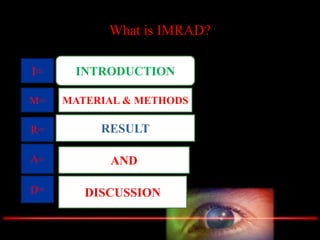
What is IMRAD?
INTRODUCTIONI=
M=
R=
A=
D=
MATERIAL & METHODS
RESULT
AND
DISCUSSION
• IMRAD Format can’t cover all the field of a
paper so it was modified with two other
acrynom.
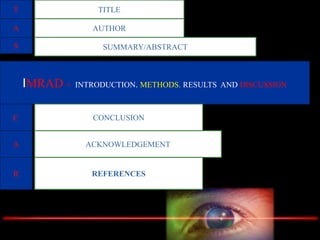
• TAS ….. IMRAD ….. CAR.
T
A
S
C
TITLE
AUTHOR
SUMMARY/ABSTRACT
IMRAD = INTRODUCTION. METHODS. RESULTS AND DISCUSSION
CONCLUSION
A ACKNOWLEDGEMENT
REFERENCESR
Title
Title
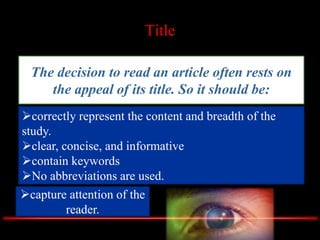
The decision to read an article often rests on
the appeal of its title. So it should be:
correctly represent the content and breadth of the
study.
clear, concise, and informative
contain keywords
No abbreviations are used.
capture attention of the
reader.
Author
Author
.Designation, degree, affiliation and address
of authors are to be clearly indicated,
With additional details like telephone number,
email address of the corresponding author.
Abstract & Keywords
Abstract & Keywords
Abstract should cover each and every
component of the study
150 words for ‘unstructured abstract’
250 words for ‘structured’ abstracts.
It should state
the purpose of the study
basic procedures,
the principal conclusion and implications.
Abstract & Keywords
contain precise information and should not
contain abbreviations.
Key words (or short phrases)
3 to 10, should be listed covering all the
aspects of the study.
Use preferably the terms listed as Medical
subject headings (MESH) in Index Medicus
(Medline)
Key words (or short phrases)
Introduction and Review of Literature
The goal or purpose of the study is clearly
stated.
The introduction should contain:
detailed information about the problem being
studied,
and about the specific research question/
hypothesis.
Introduction and Review of Literature
Four or five pertinent publications related to
the problem should be presented and critiqued.
 No data or conclusions are to be reported.
Do not review the literature extensively.
The existing gaps in the knowledge or
conflicting data is to be highlighted.
Material & Methods
Material & Methods
• The selection of the subjects for the study has
to be described clearly.
• Inclusion and exclusion criteria are to be
mentioned with method of allocation to
groups.
Material & Methods
The research design is to be described in
detail.
Research design is the plan that is chosen to
answer the research question.
The methods, apparatus and procedures are to
be identified in sufficient detail to allow other
workers to reproduce the results, if necessary.
Material & Methods
Give references of all the methods used in the
study including statistical methods.
Identify precisely all drugs and chemicals
used, including generic names, doses and
routes of administration.
Material & Methods
Methods of elimination of errors viz blinding,
introduction of control group and placebo,
randomization etc are to be mentioned distinctly.
The measurement instrument including its
psychometric qualities is described clearly. The
psychometric qualities include validity, reliability,
objectivity and precision.
Material & Methods
The data collection procedure is to be clearly
described. The setting in which the study took
place is describe. This information is useful to
the reader in deciding whether results can be
applied to his/her setting. The data analysis
procedures are stated in precise terms.
Results
Results
 Present your results in logical sequence in the text,
tables and illustrations.
 Do not repeat in the text all the data, in the tables or
illustrations.
Emphasize or summarise important observations.
Results section should contain only actuals, and no
Opinions.
Results
 All the patients included in the study should
be accounted for.
There should not be any hesitation in
reporting any negative or unexpected result.
Discussion
Discussion
The discussion should cover all the debatable aspects
of the study.
It can go beyond the results obtained and can cover
methodological and the critical issues.
 It should not be misused as a platform to state
opinions.
Readers should not be side tracked in to another topic
Discussion
 Relate the observations to the other relevant
studies.
Bring out similarities and conflicts.
The new and important aspects of the study
and the conclusions drawn are to be
emphasized.
The implications of the findings and their
limitations are to be discussed.
Discussion
 Scope and need for future additional research is to be
discussed.
Link conclusions with goals of the study but avoid
unqualified statements and conclusions not supported
by your data.
State new hypothesis when warranted .
Recommendations when appropriate may be
included.
Conclusion
Conclusion
A good paper ends with strong clear conclusion.
A good paper is a “thunderbolt in reverse” it begins
with thunder and ends with lightning
Conclusion should be linked with the goals of the
study
It should be limited to the boundaries of the study
Acknowledgement
Acknowledgement
• Who will be acknowledge:
Person, whom has contribution for the article
but do not justify authorship should be
acknowledge. Such as
General support by a department chair.
Acknowledgement of technical help.
Acknowledgement of financial (?) or material
support.
Acknowledgement
At an appropriate place in the article
the title page.
footnote or
an appendix to the text
depending on the journal requirement you can
write the acknowledgement
Reference
Reference
This is the most disturbing aspect in
publications.
It is a wrong notion amongst the authors that
providing a long list of references increases the
validity (of their article) which is wrong.
References are to be written correctly with due
care.
Reference
Correct abbreviated, accepted names, of the
journals to be mentioned.
The number of references should be
reasonable (neither too many nor too few); in
original article it will be not more than 30 but
in review article it may be 50
Reference
The references are presented according to
standard rules of publication as specified by a
particular journal. for eg,
whether Vancour style or
Harward style is followed.
Some General Consideration
Abbreviations
Abbreviations. Use standard abbreviations (hr, min,
sec, etc) instead of writing complete words.
Define all other abbreviations the first time they are
used, then subsequently use the abbreviation [e.g.
Ampicillin resistant (AmpR)].
 As a general rule, do not use an abbreviation unless a
term is used at least three times in the manuscript.
Abbreviations
 With two exceptions (the degree symbol and
percent symbol), a space should be left
between numbers and the accompanying unit.
In general, abbreviations should not be written
in the plural form (e.g. 1 ml or 5 ml, not mls).
Past, present, and future tense
• Past, present, and future tense. Results
described in your paper should be described in
past tense (you’ve done these experiments, but
your results are not yet accepted “facts”).
Results from published papers should be
described in the present tense (based upon the
assumption that published results are “facts”).
Only experiments that you plan to do in the
future should be described in the future tense.
•
Third vs first person
• Third vs first person. It is OK to use first person in scientific writing,
but it should be used
• sparingly – reserve the use of first person for things that you want to
emphasize that “you” uniquely did (i.e. not things that many others
have done as well).
• Most text should be written in the third person to avoid sounding like
an autobiographical account penned by a narcissistic author.
However, it is better to say “It is possible to ..” than to say “One
could ...”. Writing that uses the impersonal pronoun “one” often
seems noncommittal and dry.
• In addition, inanimate objects (like genes, proteins, etc) should be
described in third person, not with anthropomorphic or possessive
terms.
Thank You

How to write a scientific paper for publication

  • 1.
    How to writea scientific paper for publication? Dr Md Anisur Rahman AnjumMonday, July 14, 2014 anjumk38dmc@gmail,com 01711-832397 Associate Professor National institute of Ophthalmology Dhaka. Bangladesh
  • 2.
    Before 1950 nostructured formed. In 1950 IMRAD structure established.  in 1978 the Vancouver Group, establish guidelines for the format of manuscripts submitted to their journals.
  • 3.
  • 4.
    • IMRAD Formatcan’t cover all the field of a paper so it was modified with two other acrynom. • TAS ….. IMRAD ….. CAR.
  • 5.
    T A S C TITLE AUTHOR SUMMARY/ABSTRACT IMRAD = INTRODUCTION.METHODS. RESULTS AND DISCUSSION CONCLUSION A ACKNOWLEDGEMENT REFERENCESR
  • 6.
  • 7.
    Title The decision toread an article often rests on the appeal of its title. So it should be: correctly represent the content and breadth of the study. clear, concise, and informative contain keywords No abbreviations are used. capture attention of the reader.
  • 8.
  • 9.
    Author .Designation, degree, affiliationand address of authors are to be clearly indicated, With additional details like telephone number, email address of the corresponding author.
  • 10.
  • 11.
    Abstract & Keywords Abstractshould cover each and every component of the study 150 words for ‘unstructured abstract’ 250 words for ‘structured’ abstracts. It should state the purpose of the study basic procedures, the principal conclusion and implications.
  • 12.
    Abstract & Keywords containprecise information and should not contain abbreviations. Key words (or short phrases) 3 to 10, should be listed covering all the aspects of the study. Use preferably the terms listed as Medical subject headings (MESH) in Index Medicus (Medline) Key words (or short phrases)
  • 13.
  • 14.
    Introduction and Reviewof Literature The goal or purpose of the study is clearly stated. The introduction should contain: detailed information about the problem being studied, and about the specific research question/ hypothesis.
  • 15.
    Introduction and Reviewof Literature Four or five pertinent publications related to the problem should be presented and critiqued.  No data or conclusions are to be reported. Do not review the literature extensively. The existing gaps in the knowledge or conflicting data is to be highlighted.
  • 16.
  • 17.
    Material & Methods •The selection of the subjects for the study has to be described clearly. • Inclusion and exclusion criteria are to be mentioned with method of allocation to groups.
  • 18.
    Material & Methods Theresearch design is to be described in detail. Research design is the plan that is chosen to answer the research question. The methods, apparatus and procedures are to be identified in sufficient detail to allow other workers to reproduce the results, if necessary.
  • 19.
    Material & Methods Givereferences of all the methods used in the study including statistical methods. Identify precisely all drugs and chemicals used, including generic names, doses and routes of administration.
  • 20.
    Material & Methods Methodsof elimination of errors viz blinding, introduction of control group and placebo, randomization etc are to be mentioned distinctly. The measurement instrument including its psychometric qualities is described clearly. The psychometric qualities include validity, reliability, objectivity and precision.
  • 21.
    Material & Methods Thedata collection procedure is to be clearly described. The setting in which the study took place is describe. This information is useful to the reader in deciding whether results can be applied to his/her setting. The data analysis procedures are stated in precise terms.
  • 22.
  • 23.
    Results  Present yourresults in logical sequence in the text, tables and illustrations.  Do not repeat in the text all the data, in the tables or illustrations. Emphasize or summarise important observations. Results section should contain only actuals, and no Opinions.
  • 24.
    Results  All thepatients included in the study should be accounted for. There should not be any hesitation in reporting any negative or unexpected result.
  • 25.
  • 26.
    Discussion The discussion shouldcover all the debatable aspects of the study. It can go beyond the results obtained and can cover methodological and the critical issues.  It should not be misused as a platform to state opinions. Readers should not be side tracked in to another topic
  • 27.
    Discussion  Relate theobservations to the other relevant studies. Bring out similarities and conflicts. The new and important aspects of the study and the conclusions drawn are to be emphasized. The implications of the findings and their limitations are to be discussed.
  • 28.
    Discussion  Scope andneed for future additional research is to be discussed. Link conclusions with goals of the study but avoid unqualified statements and conclusions not supported by your data. State new hypothesis when warranted . Recommendations when appropriate may be included.
  • 29.
  • 30.
    Conclusion A good paperends with strong clear conclusion. A good paper is a “thunderbolt in reverse” it begins with thunder and ends with lightning Conclusion should be linked with the goals of the study It should be limited to the boundaries of the study
  • 31.
  • 32.
    Acknowledgement • Who willbe acknowledge: Person, whom has contribution for the article but do not justify authorship should be acknowledge. Such as General support by a department chair. Acknowledgement of technical help. Acknowledgement of financial (?) or material support.
  • 33.
    Acknowledgement At an appropriateplace in the article the title page. footnote or an appendix to the text depending on the journal requirement you can write the acknowledgement
  • 34.
  • 35.
    Reference This is themost disturbing aspect in publications. It is a wrong notion amongst the authors that providing a long list of references increases the validity (of their article) which is wrong. References are to be written correctly with due care.
  • 36.
    Reference Correct abbreviated, acceptednames, of the journals to be mentioned. The number of references should be reasonable (neither too many nor too few); in original article it will be not more than 30 but in review article it may be 50
  • 37.
    Reference The references arepresented according to standard rules of publication as specified by a particular journal. for eg, whether Vancour style or Harward style is followed.
  • 38.
  • 39.
    Abbreviations Abbreviations. Use standardabbreviations (hr, min, sec, etc) instead of writing complete words. Define all other abbreviations the first time they are used, then subsequently use the abbreviation [e.g. Ampicillin resistant (AmpR)].  As a general rule, do not use an abbreviation unless a term is used at least three times in the manuscript.
  • 40.
    Abbreviations  With twoexceptions (the degree symbol and percent symbol), a space should be left between numbers and the accompanying unit. In general, abbreviations should not be written in the plural form (e.g. 1 ml or 5 ml, not mls).
  • 41.
    Past, present, andfuture tense • Past, present, and future tense. Results described in your paper should be described in past tense (you’ve done these experiments, but your results are not yet accepted “facts”). Results from published papers should be described in the present tense (based upon the assumption that published results are “facts”). Only experiments that you plan to do in the future should be described in the future tense. •
  • 42.
    Third vs firstperson • Third vs first person. It is OK to use first person in scientific writing, but it should be used • sparingly – reserve the use of first person for things that you want to emphasize that “you” uniquely did (i.e. not things that many others have done as well). • Most text should be written in the third person to avoid sounding like an autobiographical account penned by a narcissistic author. However, it is better to say “It is possible to ..” than to say “One could ...”. Writing that uses the impersonal pronoun “one” often seems noncommittal and dry. • In addition, inanimate objects (like genes, proteins, etc) should be described in third person, not with anthropomorphic or possessive terms.
  • 43.