How To Write A Scientific Paper_1_good abstract.pptx
1.
How to writea scientific
paper
By Prof. Dr. Khadiga Gaafar
Zoology Dept., Faculty of
Science,
Cairo University
2.
A scientificexperiment is not
complete until the results have
been published and understood.
A scientific paper is a written
and published report describing
original research results.
3.
What is ScientificWriting
The purpose of scientific writing is
to communicate new scientific
findings
Thus it has to be clear, simple and
well ordered communication to
transmit new scientific findings
Scientific writing must use proper
English which gives the sense in the
fewest short words
4.
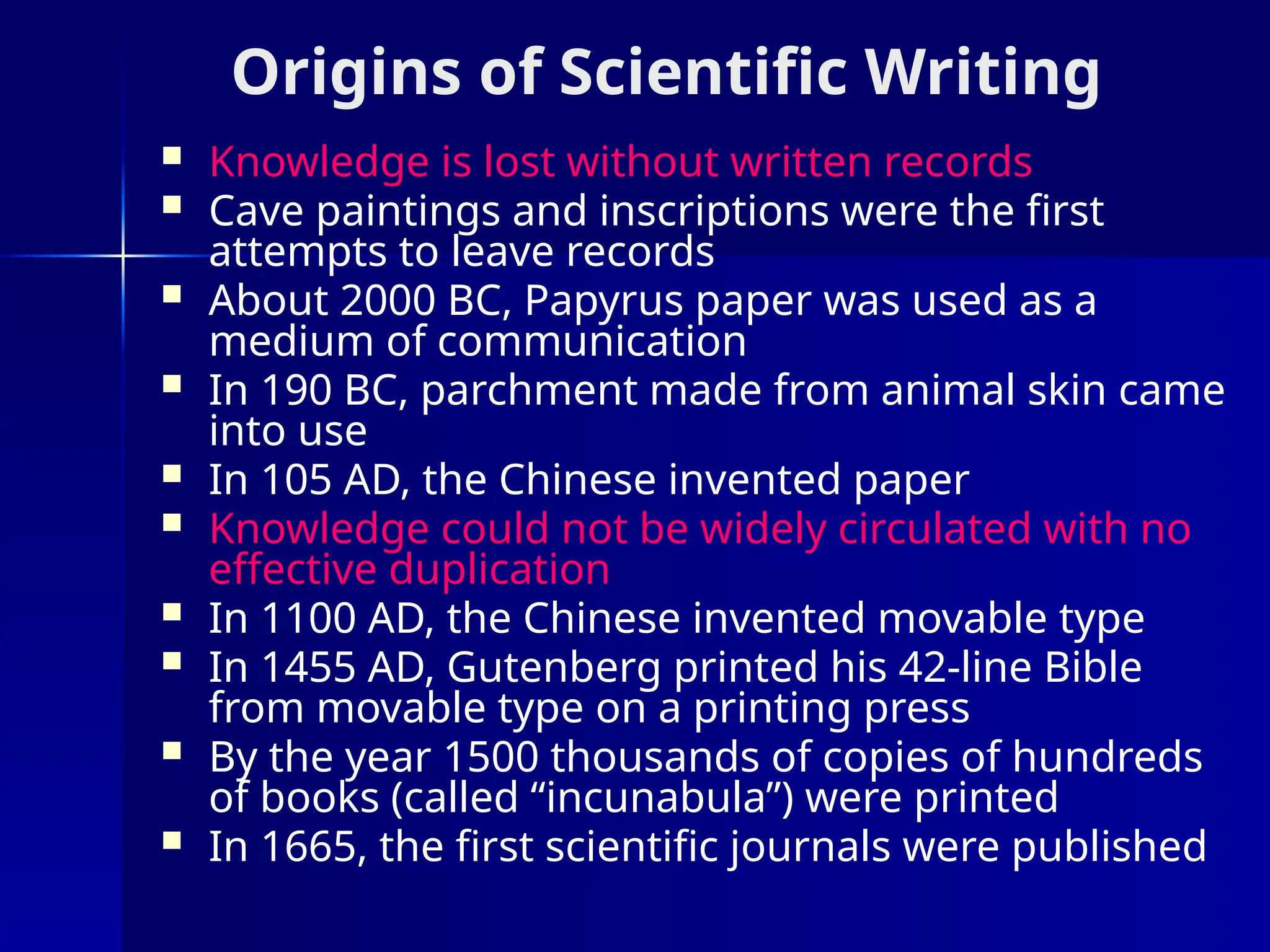
Origins of ScientificWriting
Knowledge is lost without written records
Cave paintings and inscriptions were the first
attempts to leave records
About 2000 BC, Papyrus paper was used as a
medium of communication
In 190 BC, parchment made from animal skin came
into use
In 105 AD, the Chinese invented paper
Knowledge could not be widely circulated with no
effective duplication
In 1100 AD, the Chinese invented movable type
In 1455 AD, Gutenberg printed his 42-line Bible
from movable type on a printing press
By the year 1500 thousands of copies of hundreds
of books (called “incunabula”) were printed
In 1665, the first scientific journals were published
5.
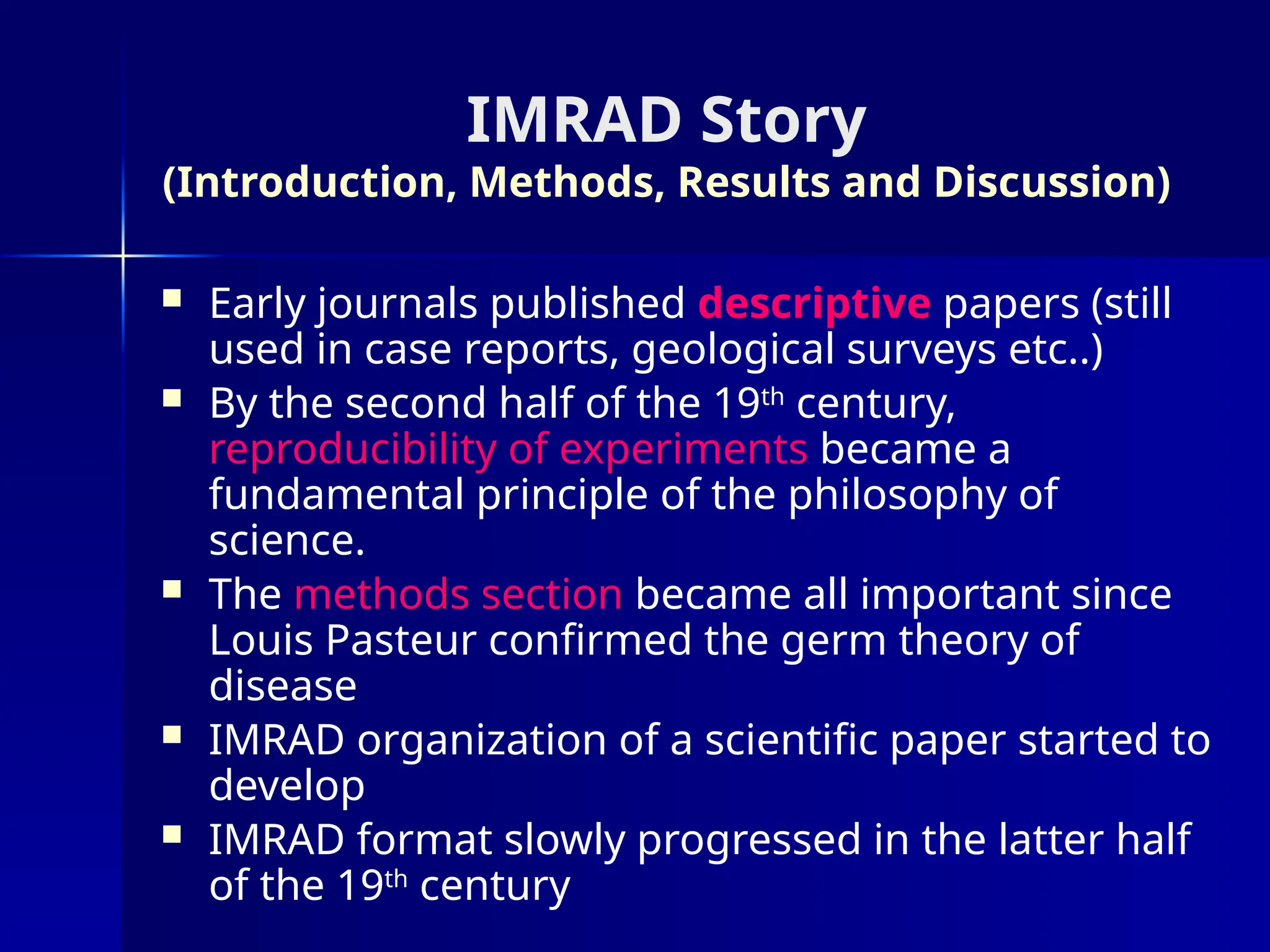
IMRAD Story
(Introduction, Methods,Results and Discussion)
Early journals published descriptive papers (still
used in case reports, geological surveys etc..)
By the second half of the 19th
century,
reproducibility of experiments became a
fundamental principle of the philosophy of
science.
The methods section became all important since
Louis Pasteur confirmed the germ theory of
disease
IMRAD organization of a scientific paper started to
develop
IMRAD format slowly progressed in the latter half
of the 19th
century
6.
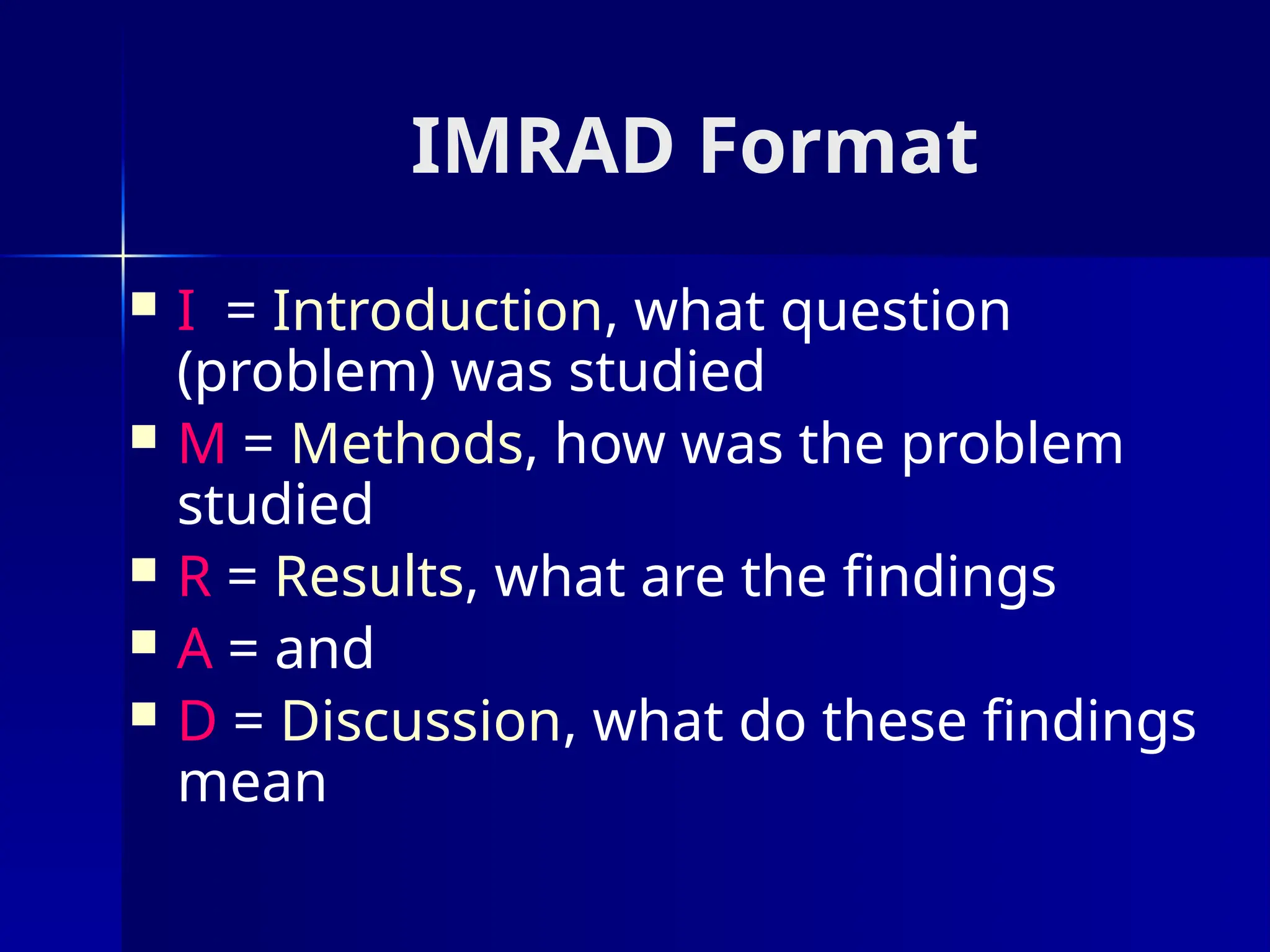
IMRAD Format
I= Introduction, what question
(problem) was studied
M = Methods, how was the problem
studied
R = Results, what are the findings
A = and
D = Discussion, what do these findings
mean
7.
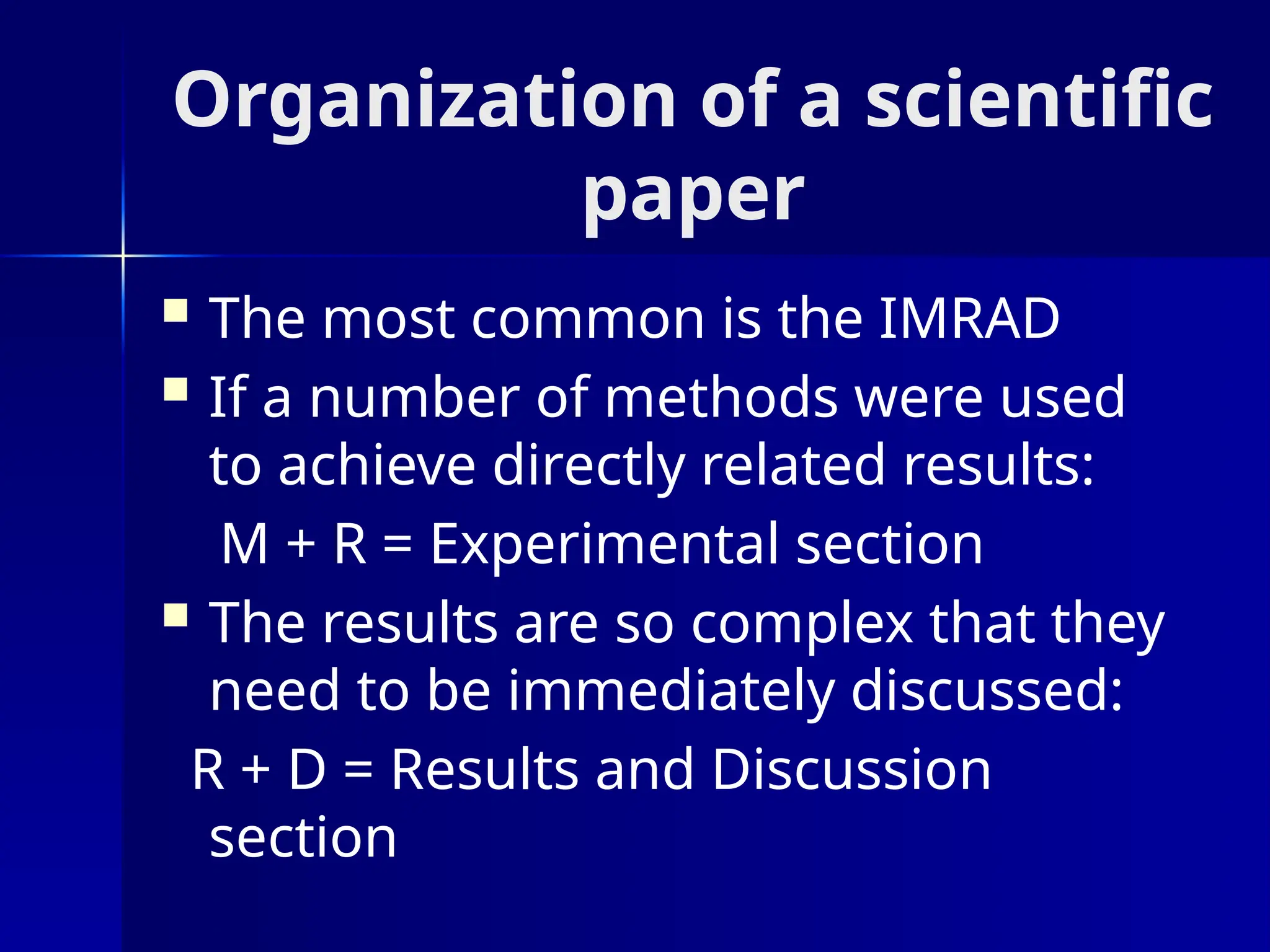
Organization of ascientific
paper
The most common is the IMRAD
If a number of methods were used
to achieve directly related results:
M + R = Experimental section
The results are so complex that they
need to be immediately discussed:
R + D = Results and Discussion
section
8.
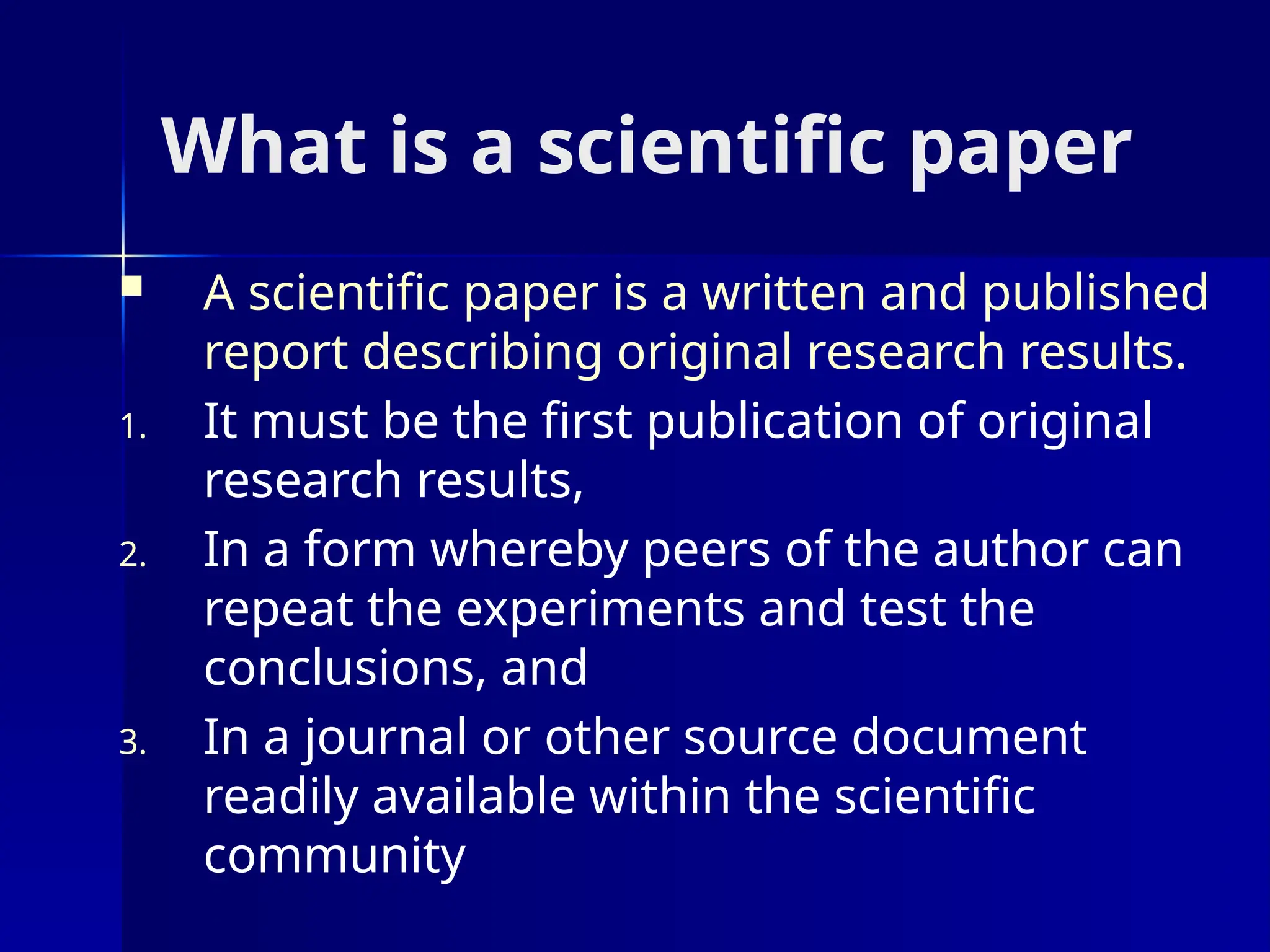
What is ascientific paper
A scientific paper is a written and published
report describing original research results.
1. It must be the first publication of original
research results,
2. In a form whereby peers of the author can
repeat the experiments and test the
conclusions, and
3. In a journal or other source document
readily available within the scientific
community
9.
Definition of Scientificpaper
An accepted original scientific publication
containing scientific information to enable
peers:
1. To assess observations
2. To repeat experiments
3. To evaluate intellectual processes
4. Must have an impact
5. Available to scientific community without
restriction
6. Available for regular screening by one or
more of the major recognized secondary
services (Biological abstracts, Index Medicus,
10.
Some important Languagepoints:
Poor experimentation cannot be
masked by brilliant writing; however,
poor writing can mask brilliant
experimentation
Avoid complex sentence structure
Use simple and clear English
Always keep in mind that the
paragraph is the essential unit of
thought
11.
Before Starting toWrite
the Paper
Record your readings (results)
Make tables
Draw graphs
Keep file to record summaries of results
and any observation however
insignificant
Date the files
Revise your readings, you may need to
repeat an experiment while you still have
the materials.
Write ideas when ever they come to you
12.
Essential Parts ofa Scientific paper
Title: Describe concisely the core contents of the
paper
Abstract: Summarize the major elements of the
paper
Introduction: provide context and rationale for the
study
Materials: Describe the experimental design so it is
reproducible
Methods: Describe the experimental procedures
Results: Summarize the findings without
interpretation
Discussion: Interpret the findings of the study
Summary: Summarize the findings
Acknowledgement: Give credit to those who helped
you
References: List all scientific papers, books and
13.
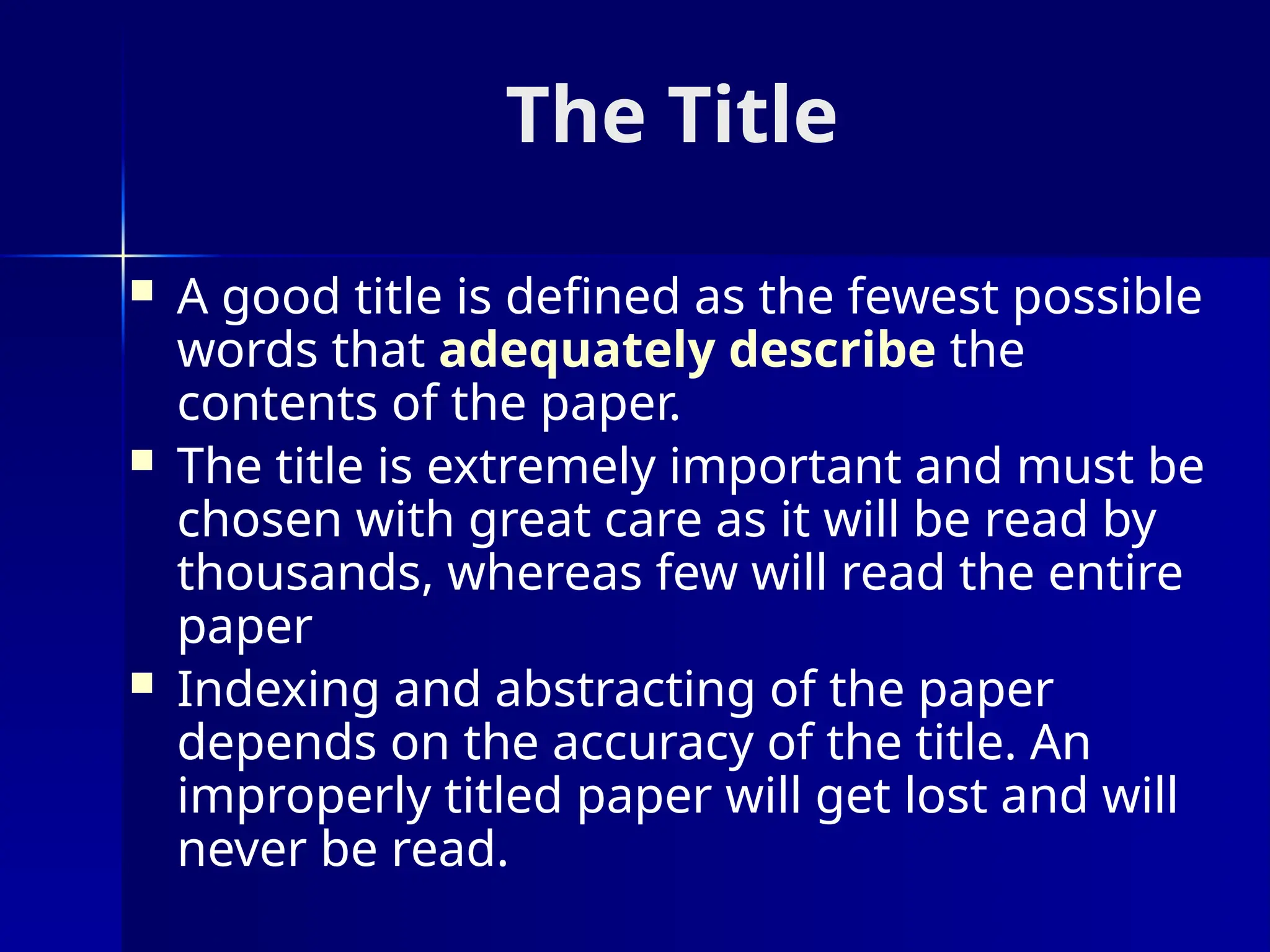
The Title
Agood title is defined as the fewest possible
words that adequately describe the
contents of the paper.
The title is extremely important and must be
chosen with great care as it will be read by
thousands, whereas few will read the entire
paper
Indexing and abstracting of the paper
depends on the accuracy of the title. An
improperly titled paper will get lost and will
never be read.
14.
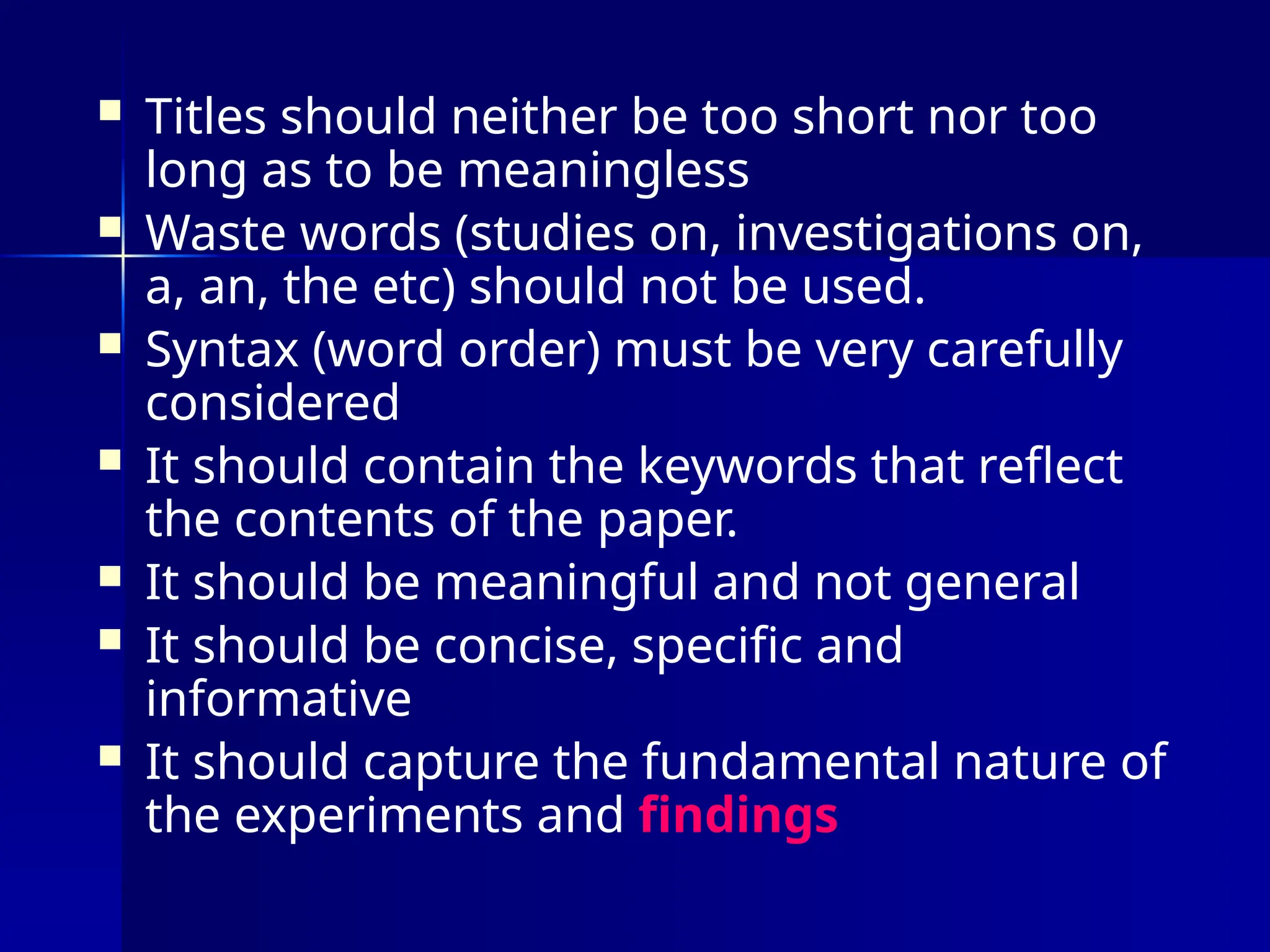
Titles shouldneither be too short nor too
long as to be meaningless
Waste words (studies on, investigations on,
a, an, the etc) should not be used.
Syntax (word order) must be very carefully
considered
It should contain the keywords that reflect
the contents of the paper.
It should be meaningful and not general
It should be concise, specific and
informative
It should capture the fundamental nature of
the experiments and findings
15.
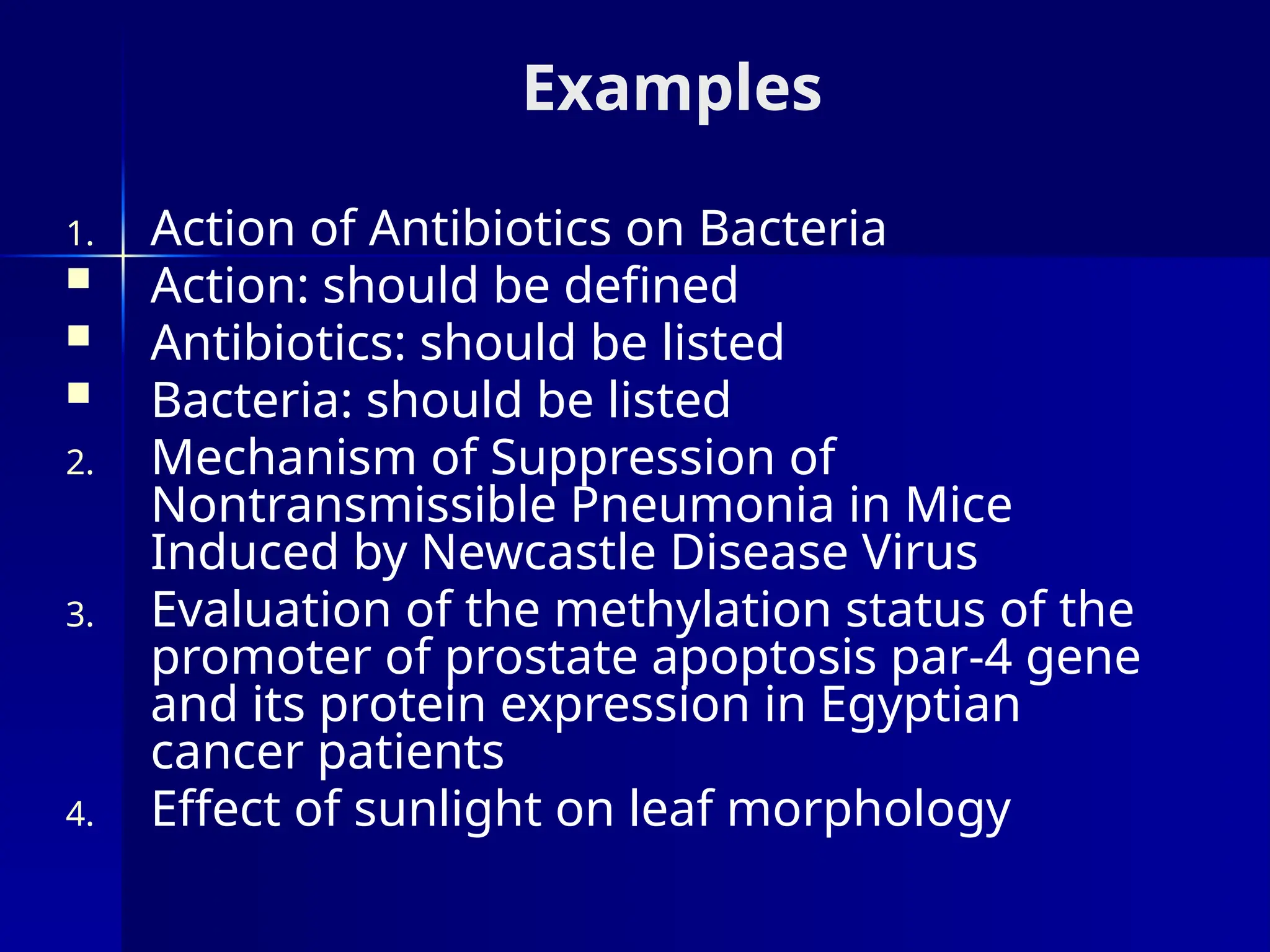
Examples
1. Action ofAntibiotics on Bacteria
Action: should be defined
Antibiotics: should be listed
Bacteria: should be listed
2. Mechanism of Suppression of
Nontransmissible Pneumonia in Mice
Induced by Newcastle Disease Virus
3. Evaluation of the methylation status of the
promoter of prostate apoptosis par-4 gene
and its protein expression in Egyptian
cancer patients
4. Effect of sunlight on leaf morphology
16.
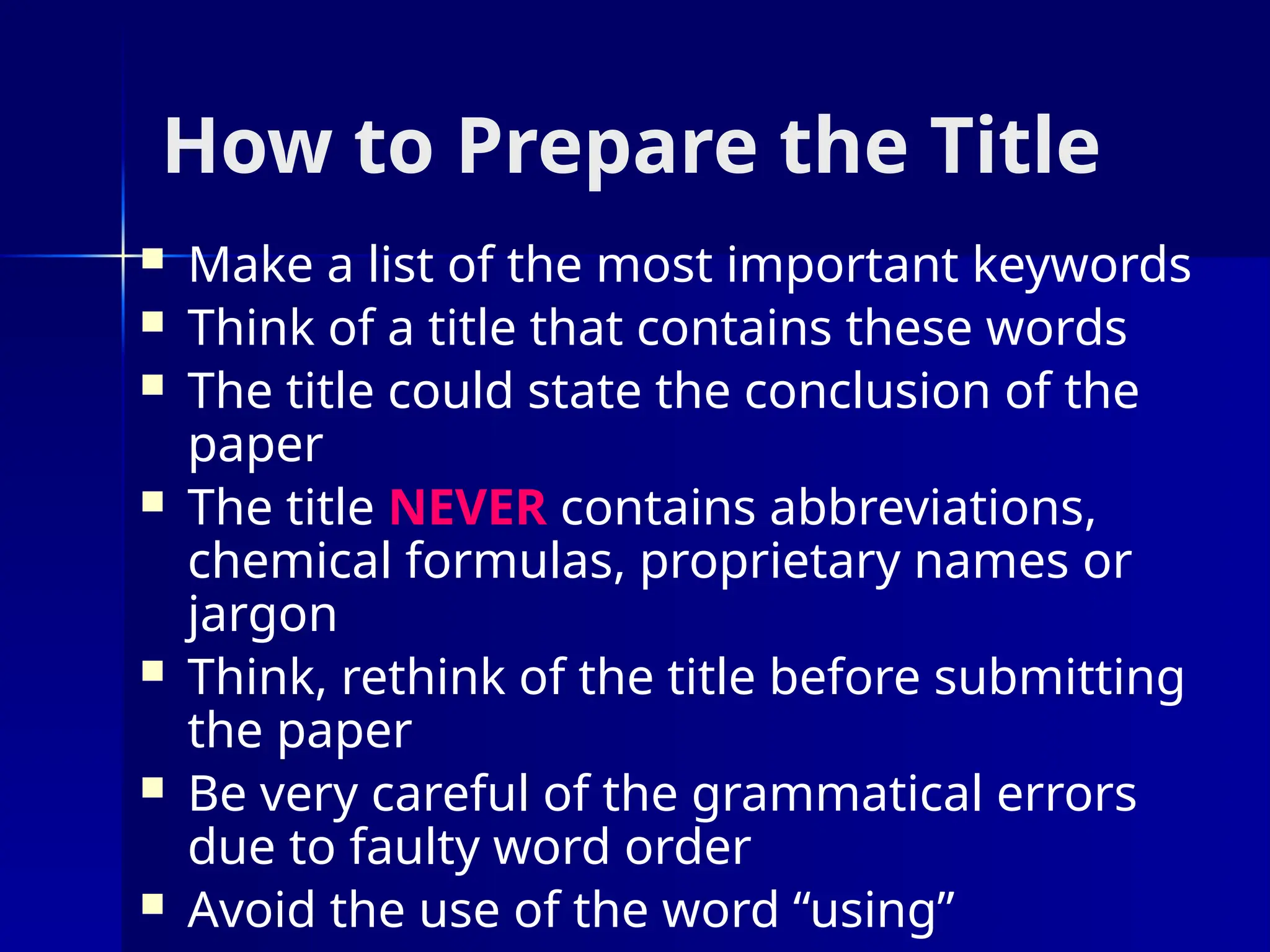
How to Preparethe Title
Make a list of the most important keywords
Think of a title that contains these words
The title could state the conclusion of the
paper
The title NEVER contains abbreviations,
chemical formulas, proprietary names or
jargon
Think, rethink of the title before submitting
the paper
Be very careful of the grammatical errors
due to faulty word order
Avoid the use of the word “using”
17.
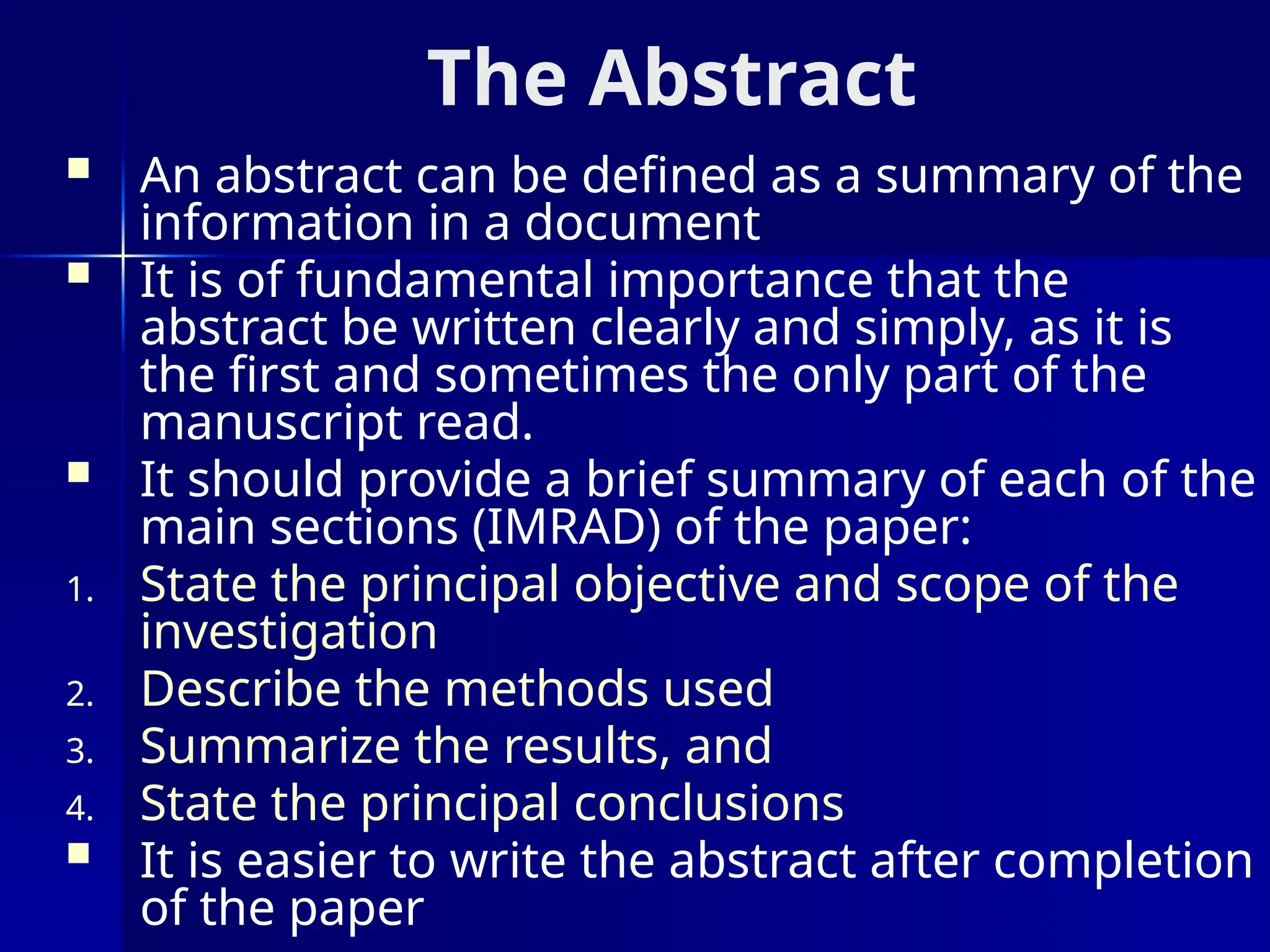
The Abstract
Anabstract can be defined as a summary of the
information in a document
It is of fundamental importance that the
abstract be written clearly and simply, as it is
the first and sometimes the only part of the
manuscript read.
It should provide a brief summary of each of the
main sections (IMRAD) of the paper:
1. State the principal objective and scope of the
investigation
2. Describe the methods used
3. Summarize the results, and
4. State the principal conclusions
It is easier to write the abstract after completion
of the paper
18.
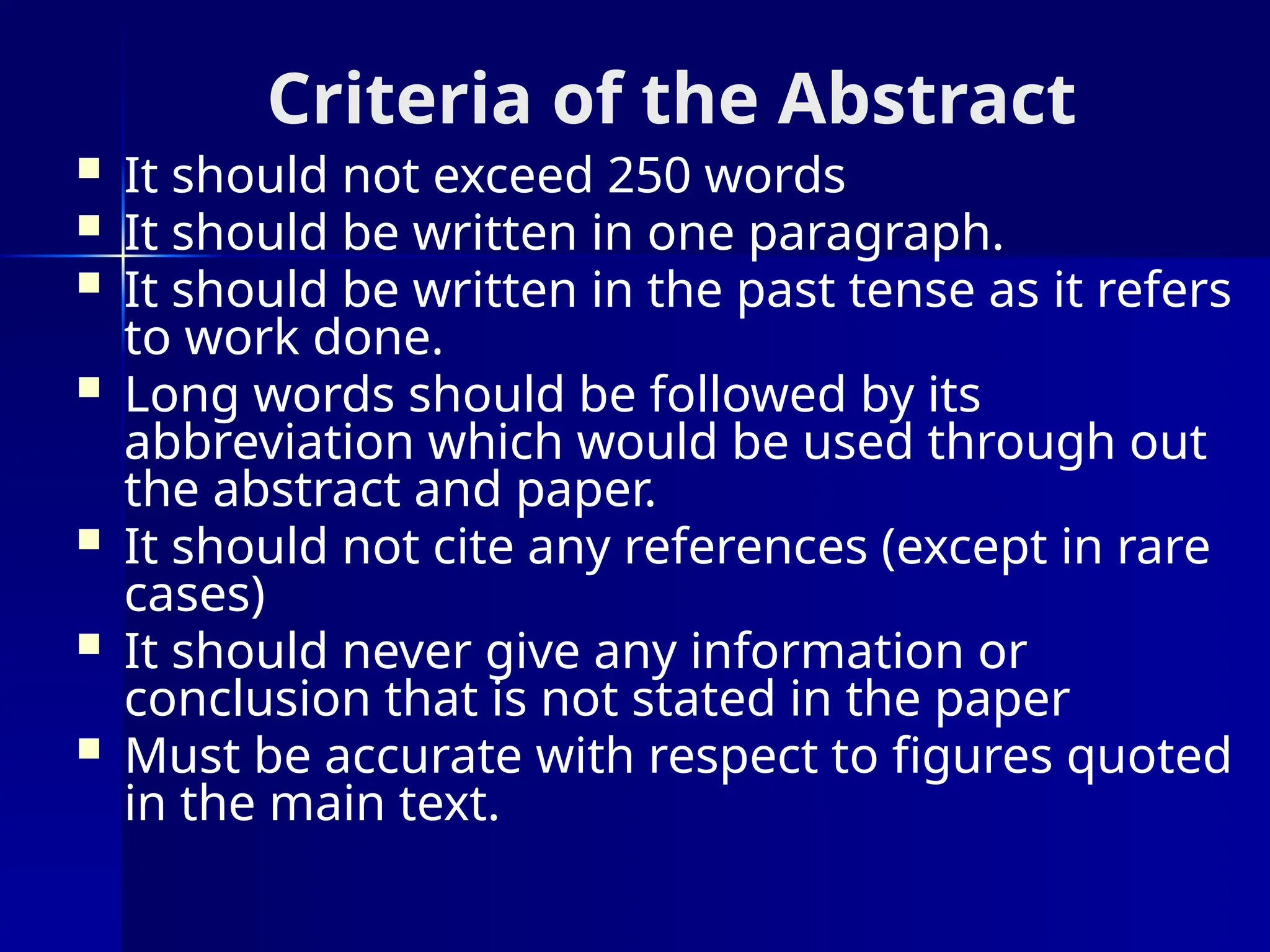
Criteria of theAbstract
It should not exceed 250 words
It should be written in one paragraph.
It should be written in the past tense as it refers
to work done.
Long words should be followed by its
abbreviation which would be used through out
the abstract and paper.
It should not cite any references (except in rare
cases)
It should never give any information or
conclusion that is not stated in the paper
Must be accurate with respect to figures quoted
in the main text.
19.
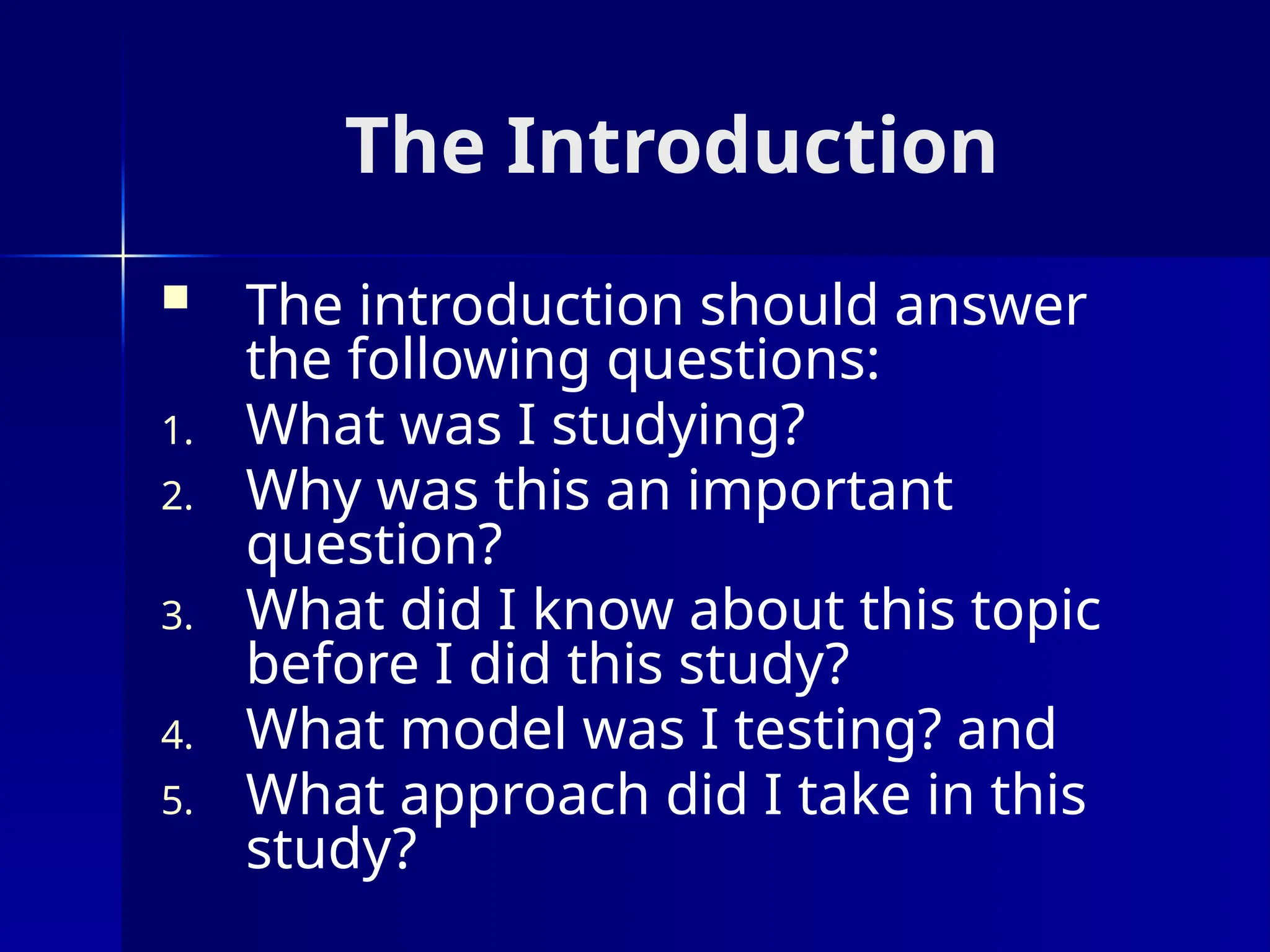
The Introduction
Theintroduction should answer
the following questions:
1. What was I studying?
2. Why was this an important
question?
3. What did I know about this topic
before I did this study?
4. What model was I testing? and
5. What approach did I take in this
study?
20.
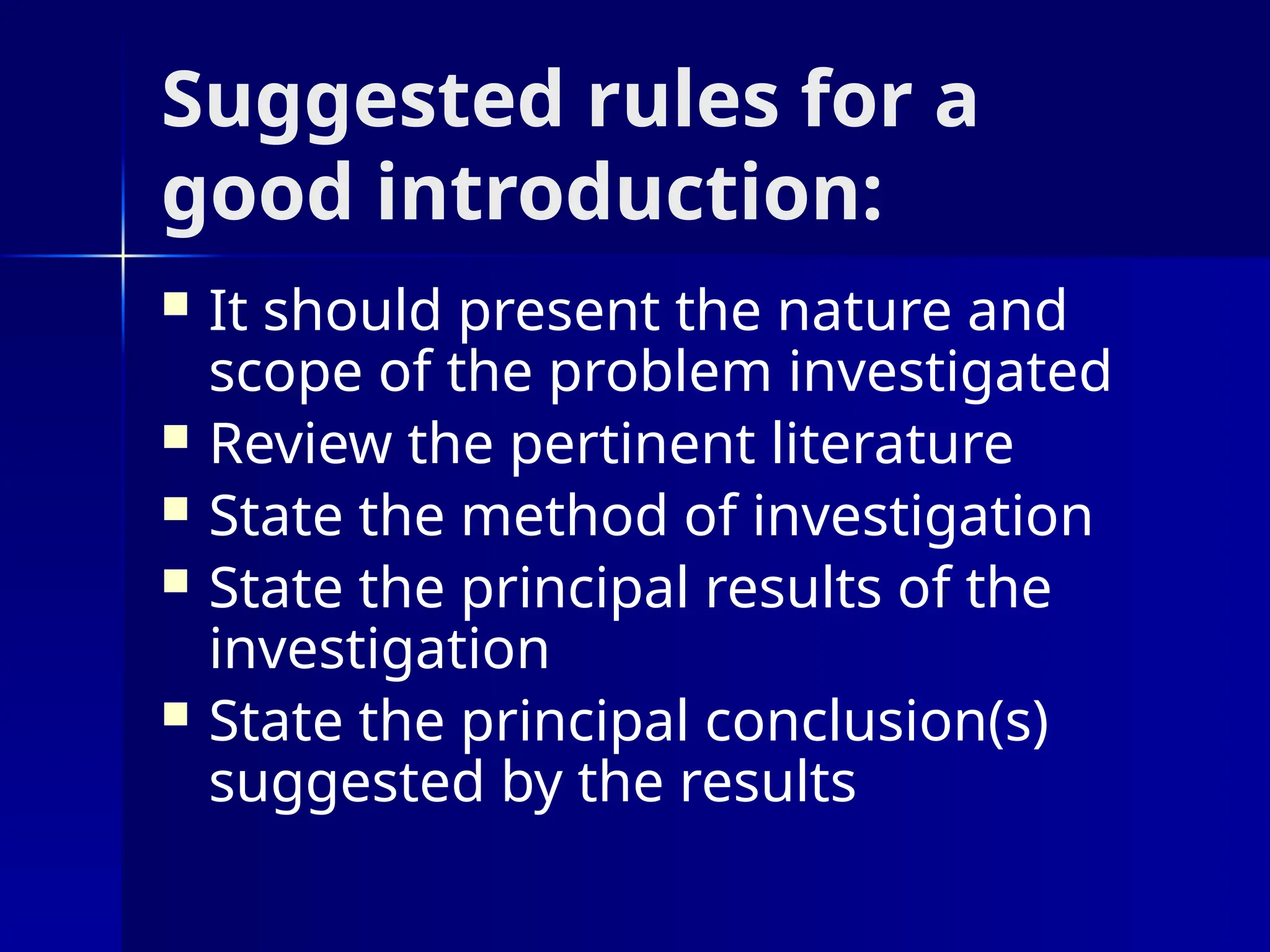
Suggested rules fora
good introduction:
It should present the nature and
scope of the problem investigated
Review the pertinent literature
State the method of investigation
State the principal results of the
investigation
State the principal conclusion(s)
suggested by the results
21.
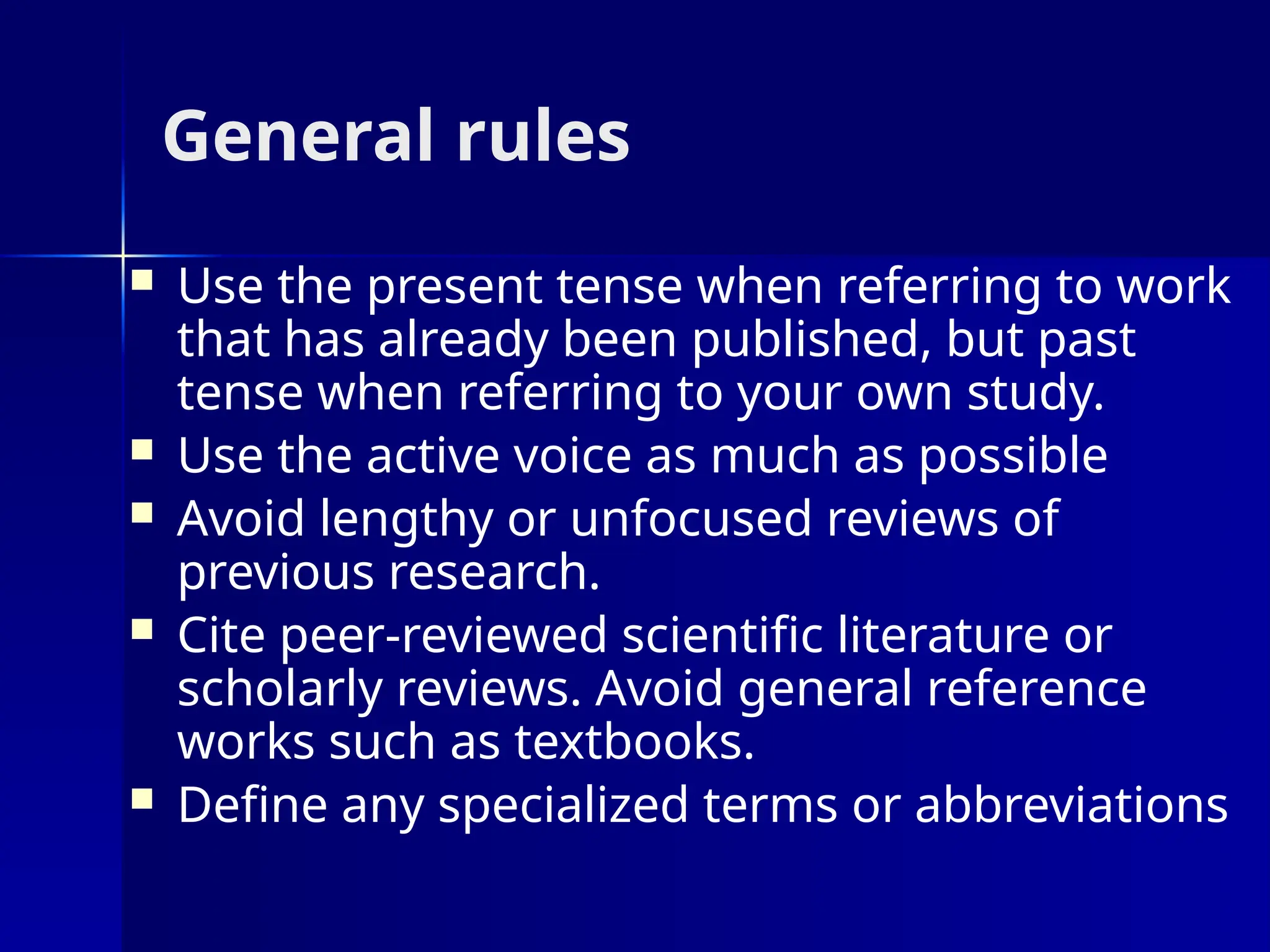
General rules
Usethe present tense when referring to work
that has already been published, but past
tense when referring to your own study.
Use the active voice as much as possible
Avoid lengthy or unfocused reviews of
previous research.
Cite peer-reviewed scientific literature or
scholarly reviews. Avoid general reference
works such as textbooks.
Define any specialized terms or abbreviations
22.
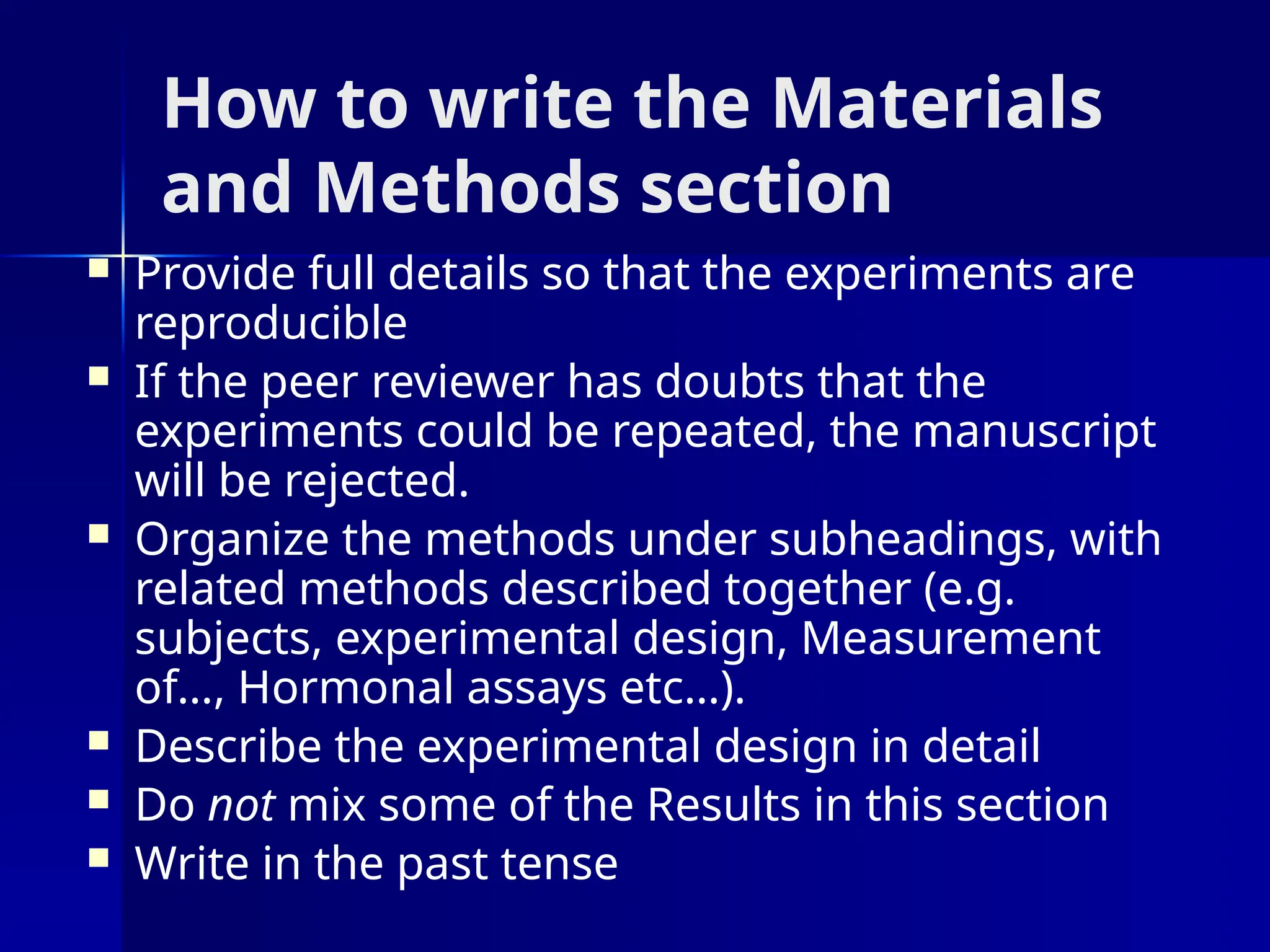
How to writethe Materials
and Methods section
Provide full details so that the experiments are
reproducible
If the peer reviewer has doubts that the
experiments could be repeated, the manuscript
will be rejected.
Organize the methods under subheadings, with
related methods described together (e.g.
subjects, experimental design, Measurement
of…, Hormonal assays etc…).
Describe the experimental design in detail
Do not mix some of the Results in this section
Write in the past tense
23.
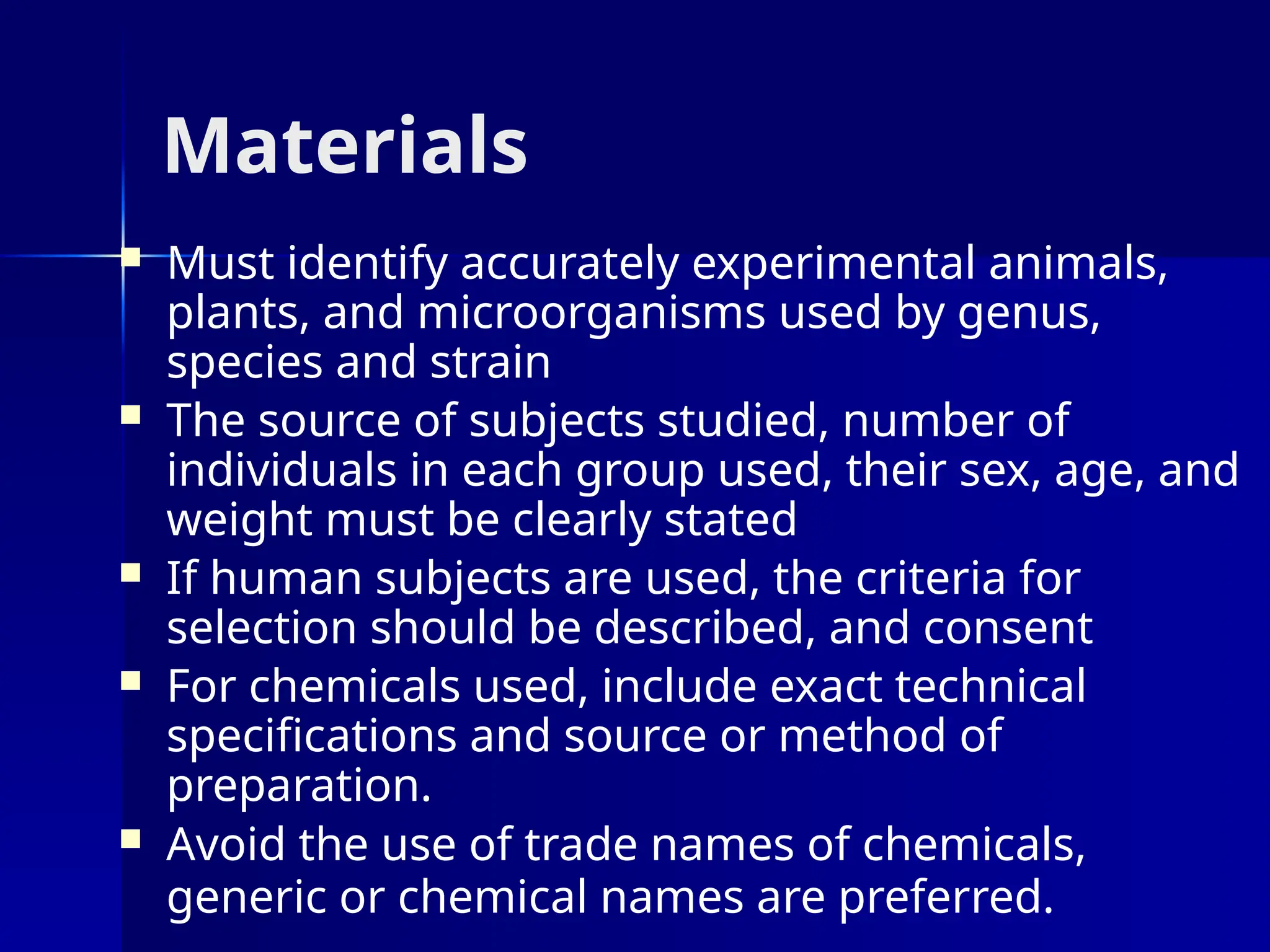
Materials
Must identifyaccurately experimental animals,
plants, and microorganisms used by genus,
species and strain
The source of subjects studied, number of
individuals in each group used, their sex, age, and
weight must be clearly stated
If human subjects are used, the criteria for
selection should be described, and consent
For chemicals used, include exact technical
specifications and source or method of
preparation.
Avoid the use of trade names of chemicals,
generic or chemical names are preferred.
24.
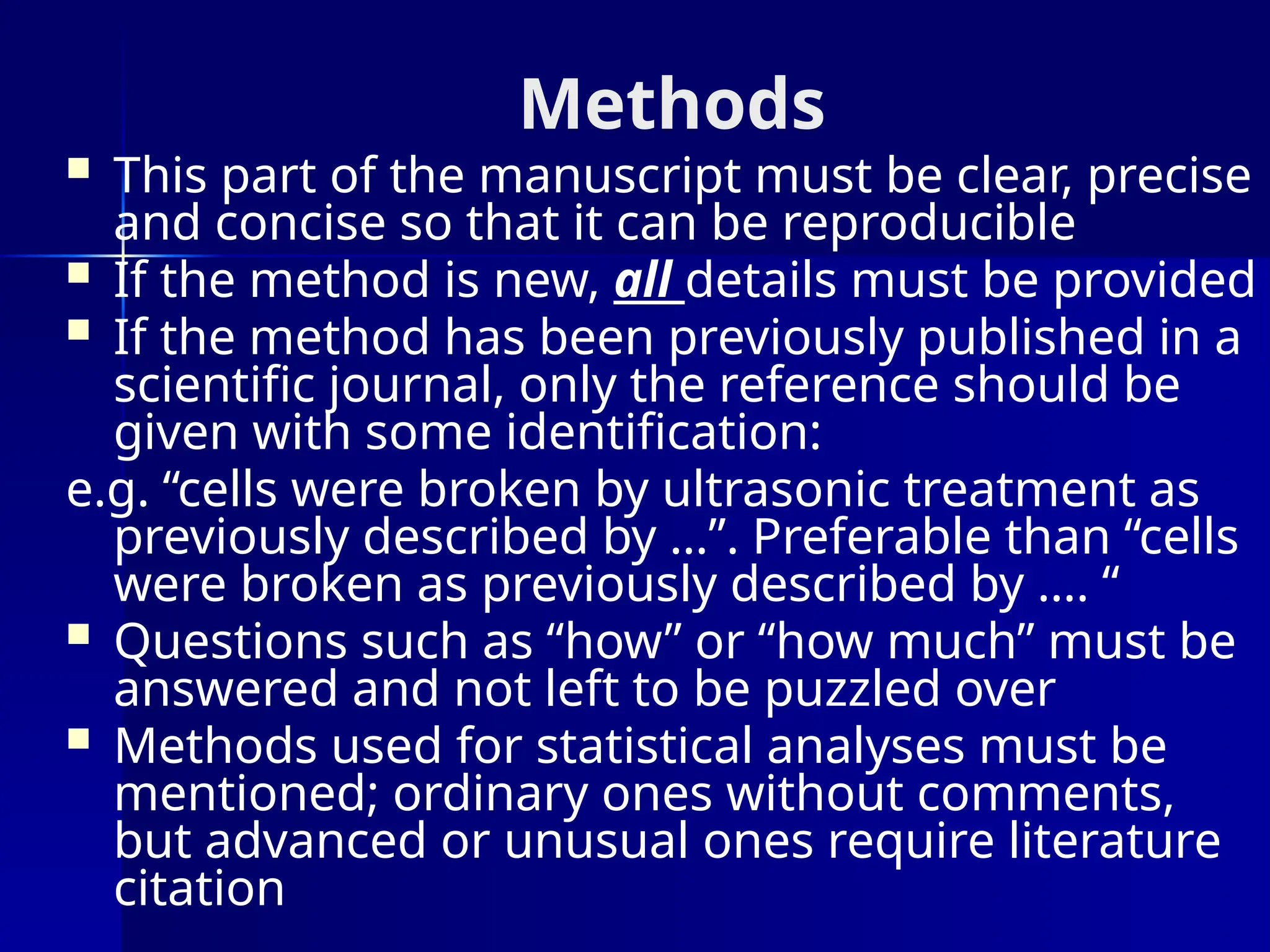
Methods
This partof the manuscript must be clear, precise
and concise so that it can be reproducible
If the method is new, all details must be provided
If the method has been previously published in a
scientific journal, only the reference should be
given with some identification:
e.g. “cells were broken by ultrasonic treatment as
previously described by …”. Preferable than “cells
were broken as previously described by …. “
Questions such as “how” or “how much” must be
answered and not left to be puzzled over
Methods used for statistical analyses must be
mentioned; ordinary ones without comments,
but advanced or unusual ones require literature
citation
25.
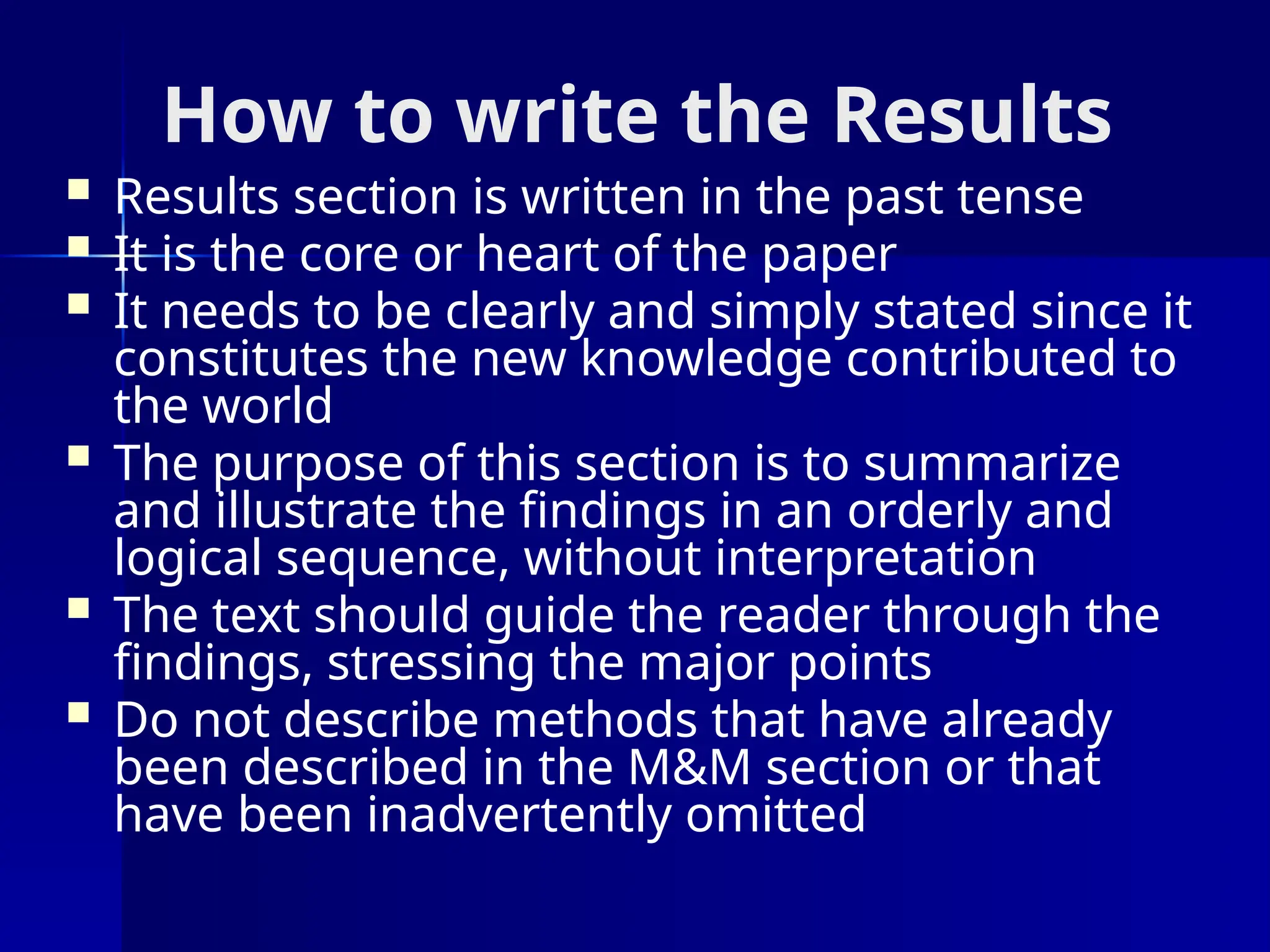
How to writethe Results
Results section is written in the past tense
It is the core or heart of the paper
It needs to be clearly and simply stated since it
constitutes the new knowledge contributed to
the world
The purpose of this section is to summarize
and illustrate the findings in an orderly and
logical sequence, without interpretation
The text should guide the reader through the
findings, stressing the major points
Do not describe methods that have already
been described in the M&M section or that
have been inadvertently omitted
26.
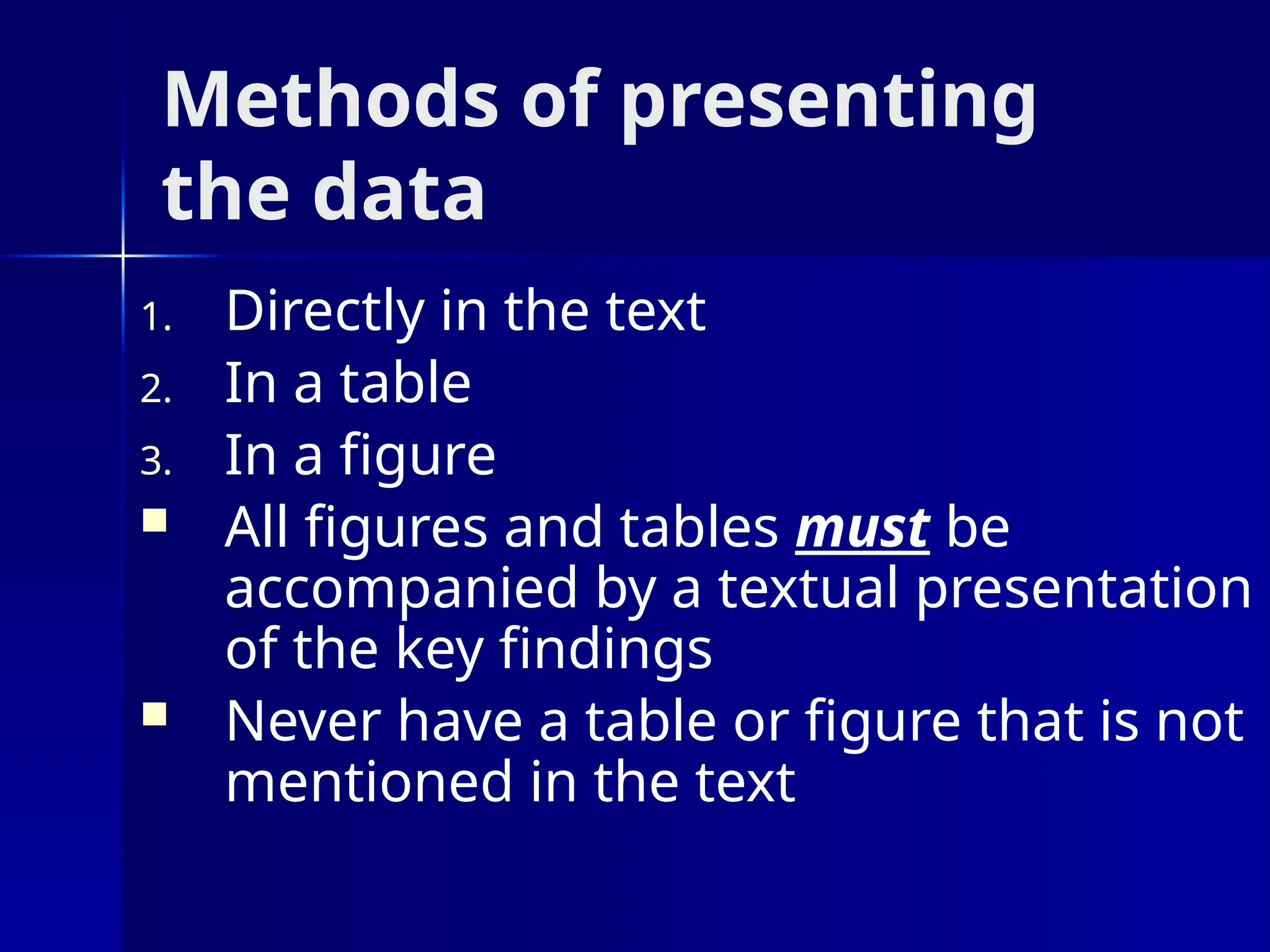
Methods of presenting
thedata
1. Directly in the text
2. In a table
3. In a figure
All figures and tables must be
accompanied by a textual presentation
of the key findings
Never have a table or figure that is not
mentioned in the text
27.
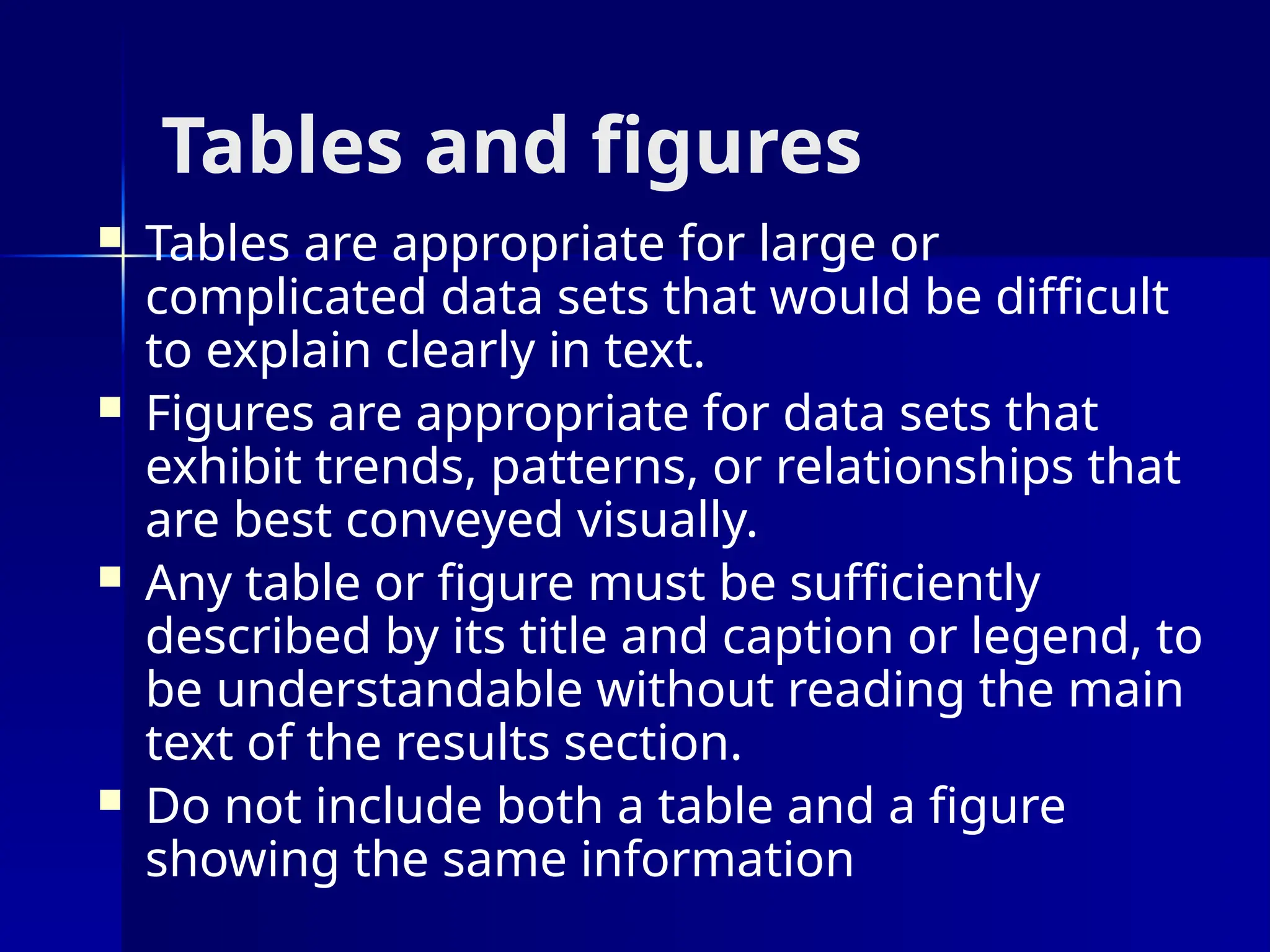
Tables and figures
Tables are appropriate for large or
complicated data sets that would be difficult
to explain clearly in text.
Figures are appropriate for data sets that
exhibit trends, patterns, or relationships that
are best conveyed visually.
Any table or figure must be sufficiently
described by its title and caption or legend, to
be understandable without reading the main
text of the results section.
Do not include both a table and a figure
showing the same information
28.
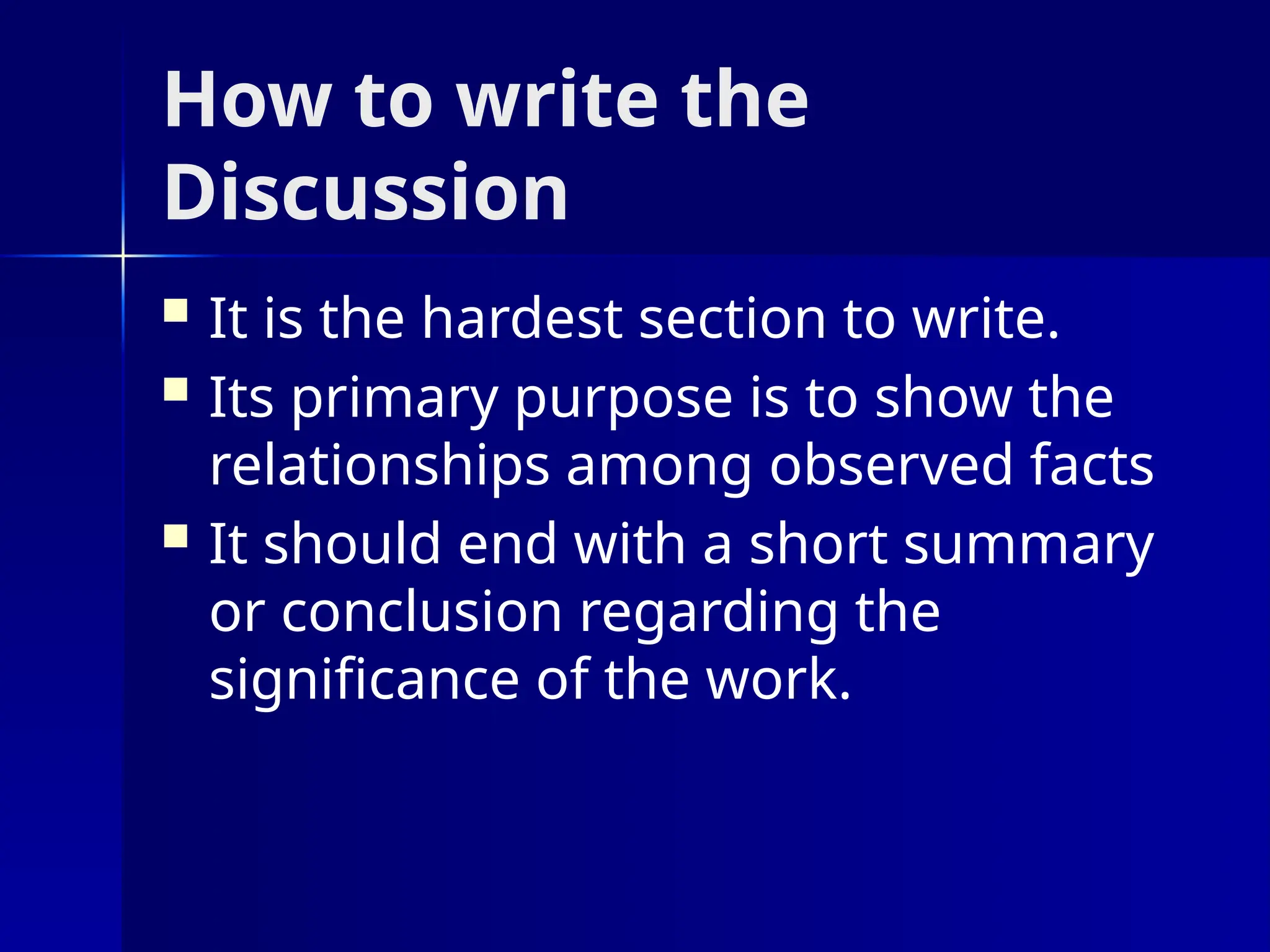
How to writethe
Discussion
It is the hardest section to write.
Its primary purpose is to show the
relationships among observed facts
It should end with a short summary
or conclusion regarding the
significance of the work.
29.
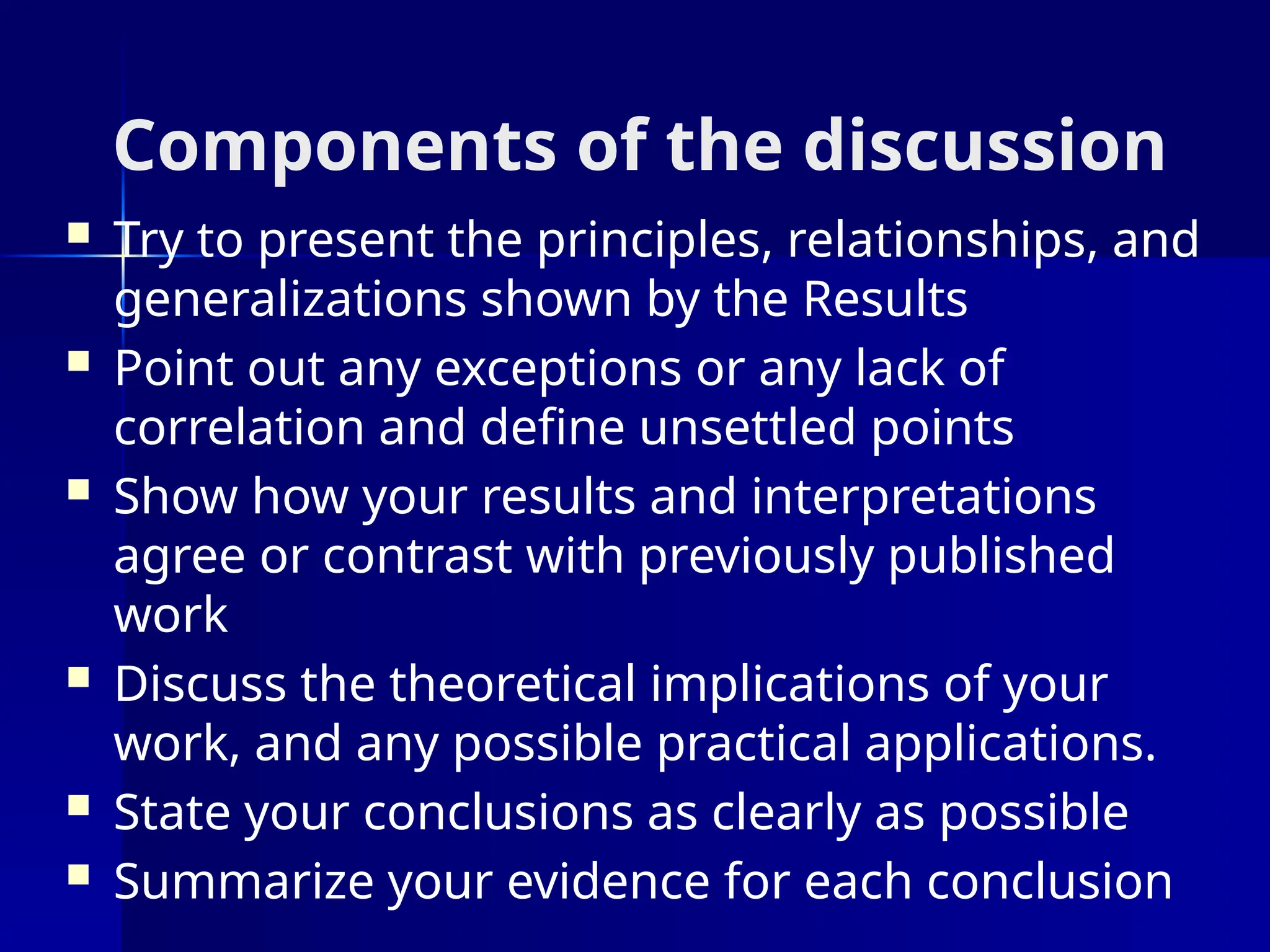
Components of thediscussion
Try to present the principles, relationships, and
generalizations shown by the Results
Point out any exceptions or any lack of
correlation and define unsettled points
Show how your results and interpretations
agree or contrast with previously published
work
Discuss the theoretical implications of your
work, and any possible practical applications.
State your conclusions as clearly as possible
Summarize your evidence for each conclusion
30.
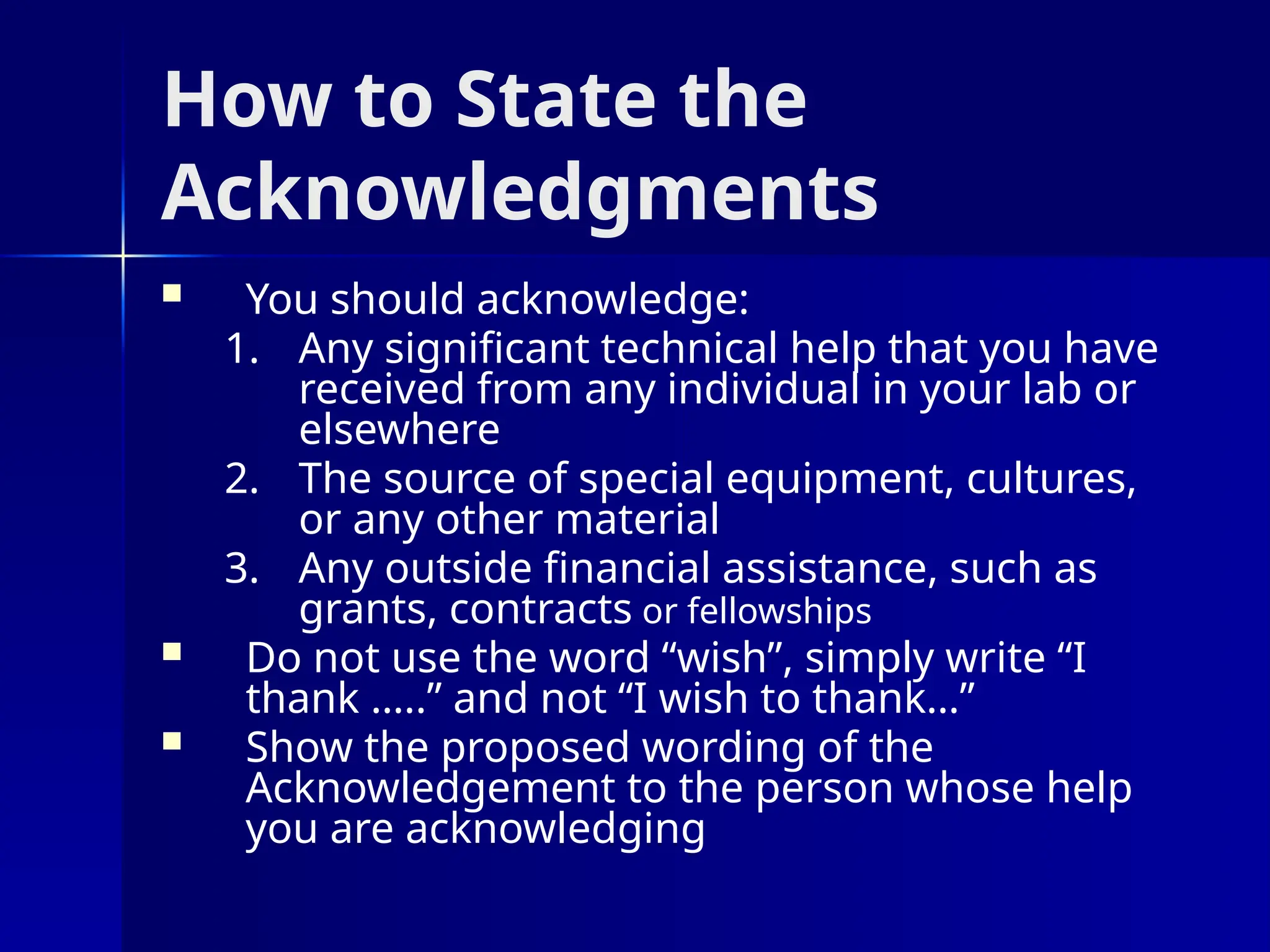
How to Statethe
Acknowledgments
You should acknowledge:
1. Any significant technical help that you have
received from any individual in your lab or
elsewhere
2. The source of special equipment, cultures,
or any other material
3. Any outside financial assistance, such as
grants, contracts or fellowships
Do not use the word “wish”, simply write “I
thank …..” and not “I wish to thank…”
Show the proposed wording of the
Acknowledgement to the person whose help
you are acknowledging
31.
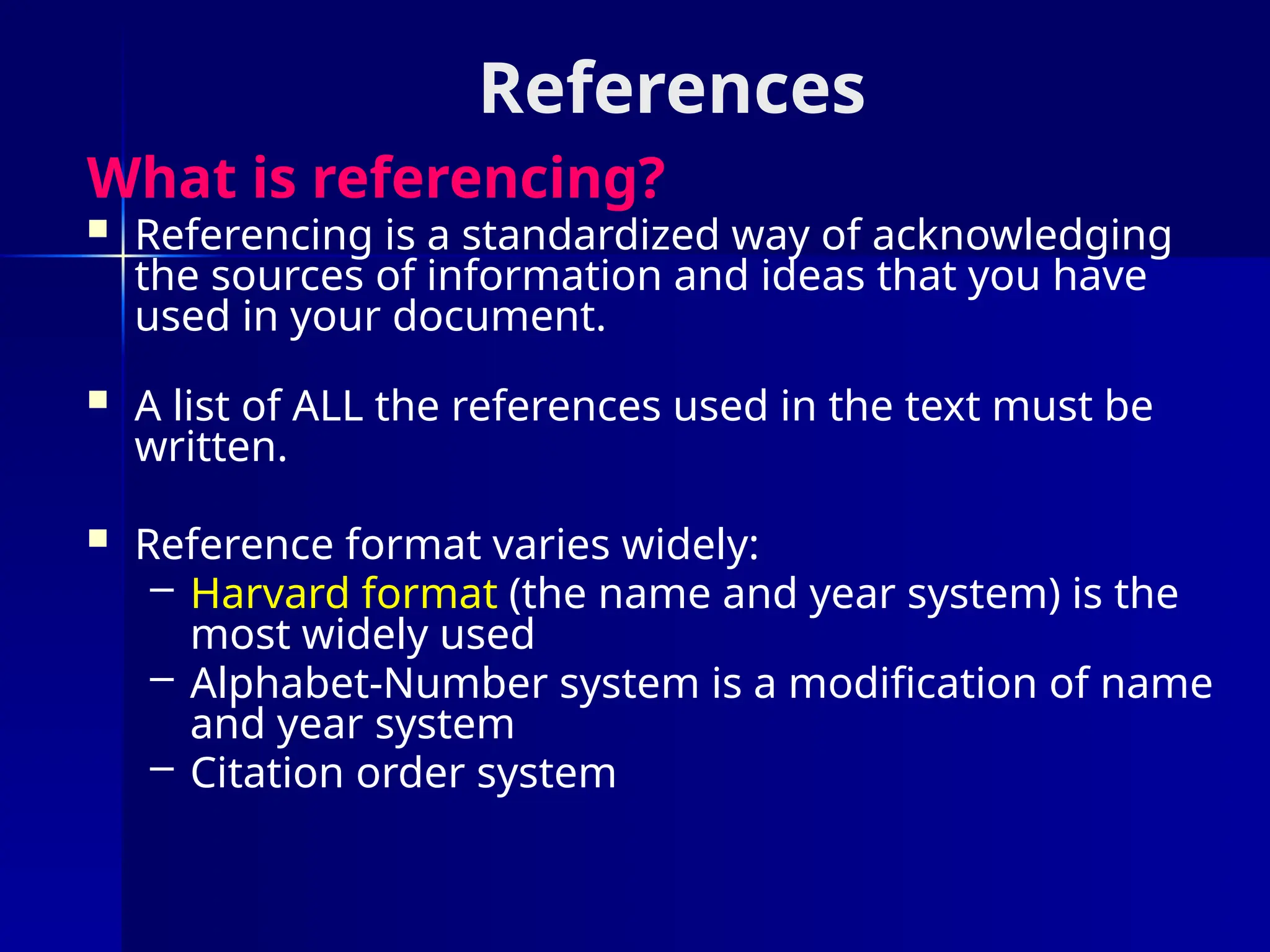
References
What is referencing?
Referencing is a standardized way of acknowledging
the sources of information and ideas that you have
used in your document.
A list of ALL the references used in the text must be
written.
Reference format varies widely:
– Harvard format (the name and year system) is the
most widely used
– Alphabet-Number system is a modification of name
and year system
– Citation order system
32.
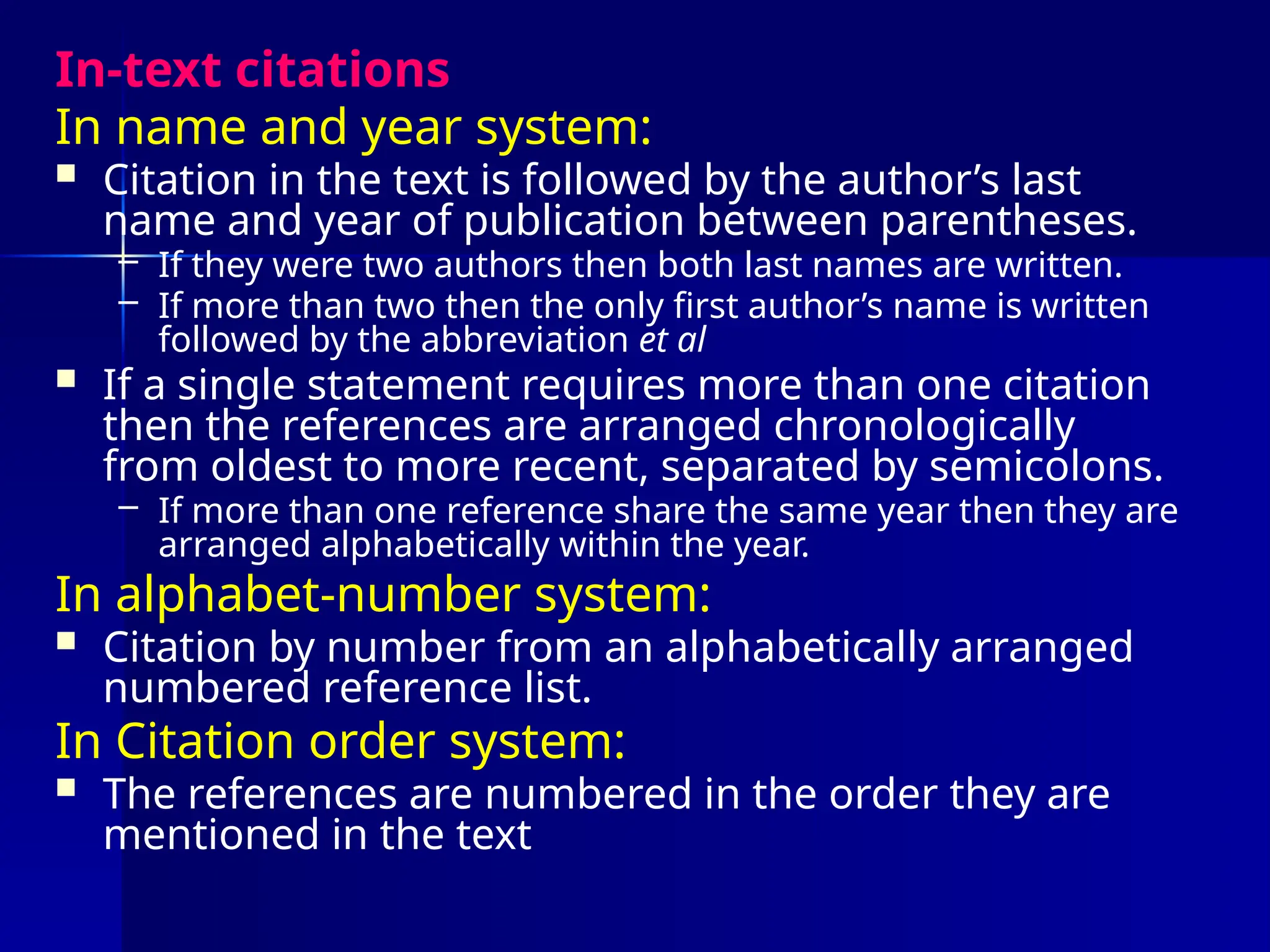
In-text citations
In nameand year system:
Citation in the text is followed by the author’s last
name and year of publication between parentheses.
– If they were two authors then both last names are written.
– If more than two then the only first author’s name is written
followed by the abbreviation et al
If a single statement requires more than one citation
then the references are arranged chronologically
from oldest to more recent, separated by semicolons.
– If more than one reference share the same year then they are
arranged alphabetically within the year.
In alphabet-number system:
Citation by number from an alphabetically arranged
numbered reference list.
In Citation order system:
The references are numbered in the order they are
mentioned in the text
33.
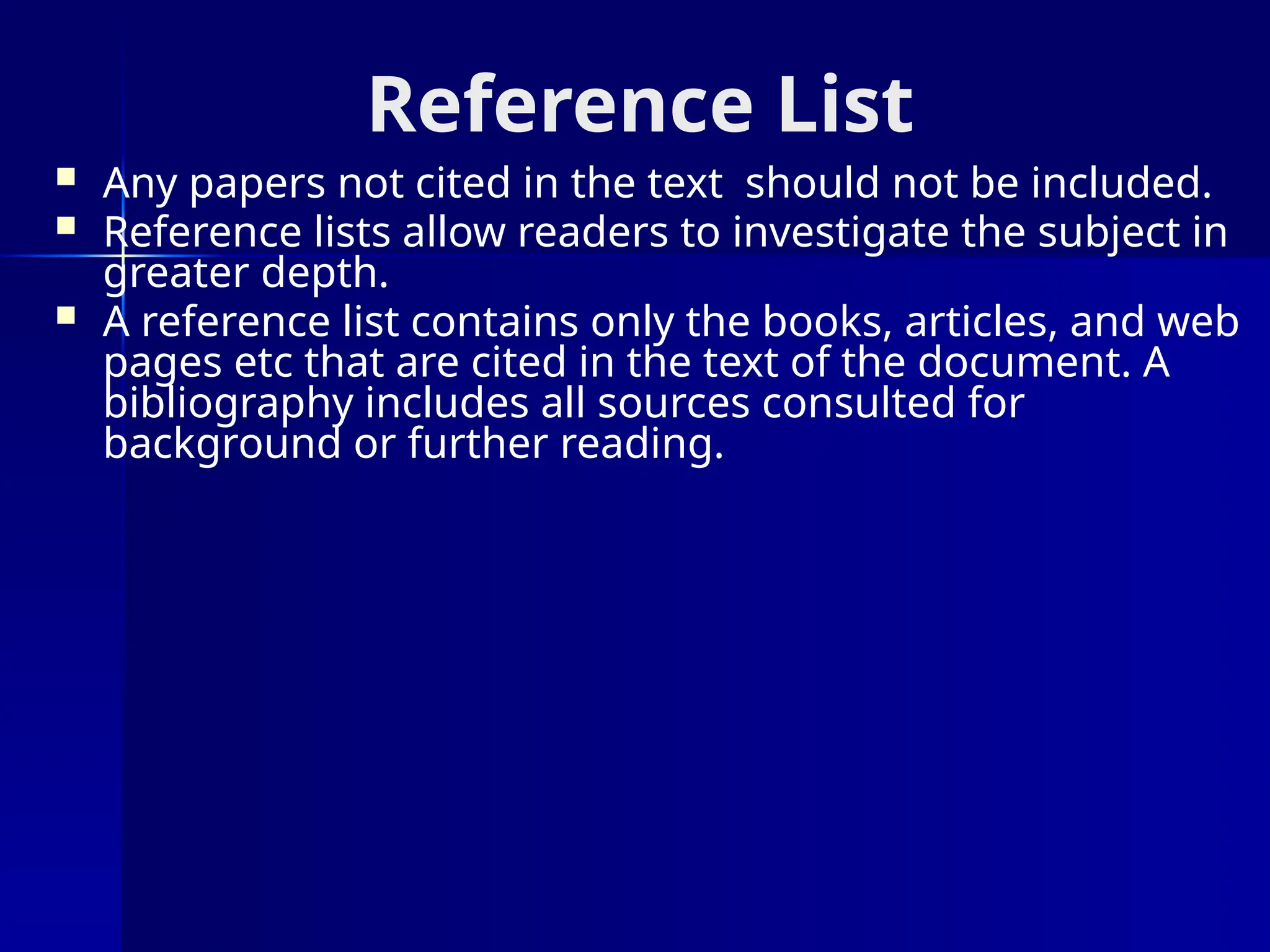
Reference List
Anypapers not cited in the text should not be included.
Reference lists allow readers to investigate the subject in
greater depth.
A reference list contains only the books, articles, and web
pages etc that are cited in the text of the document. A
bibliography includes all sources consulted for
background or further reading.
34.
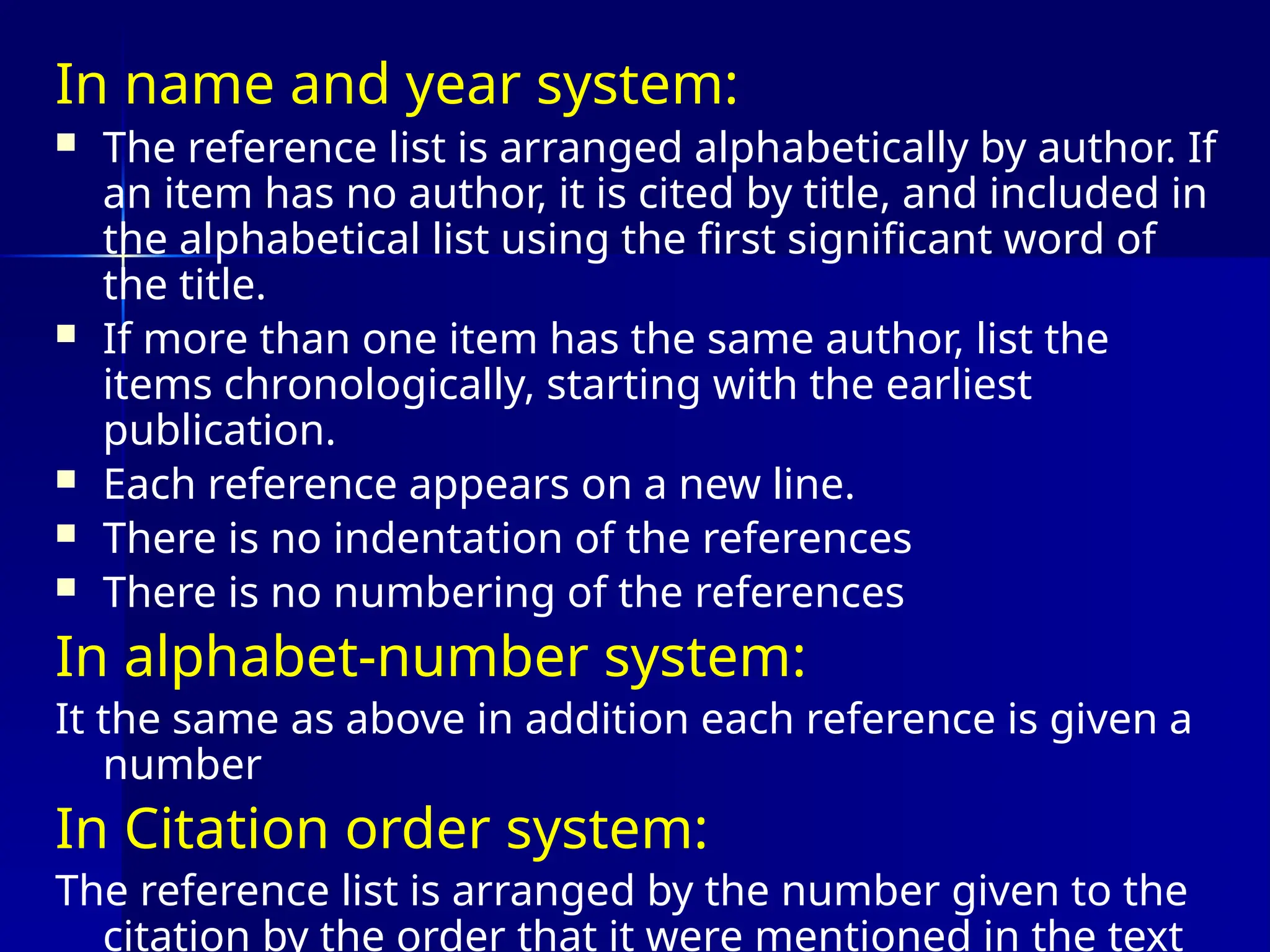
In name andyear system:
The reference list is arranged alphabetically by author. If
an item has no author, it is cited by title, and included in
the alphabetical list using the first significant word of
the title.
If more than one item has the same author, list the
items chronologically, starting with the earliest
publication.
Each reference appears on a new line.
There is no indentation of the references
There is no numbering of the references
In alphabet-number system:
It the same as above in addition each reference is given a
number
In Citation order system:
The reference list is arranged by the number given to the
citation by the order that it were mentioned in the text
35.
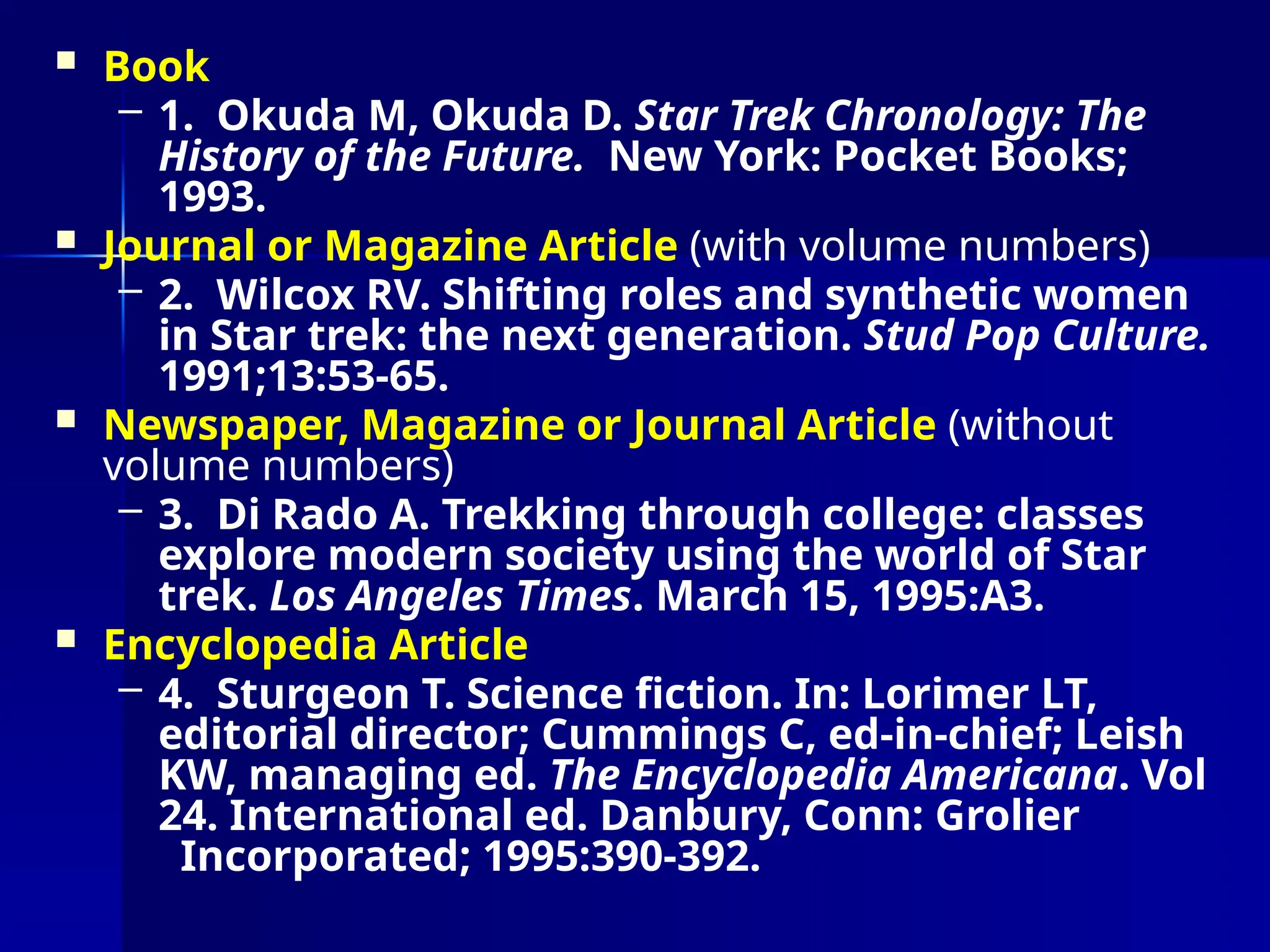
Book
– 1.Okuda M, Okuda D. Star Trek Chronology: The
History of the Future. New York: Pocket Books;
1993.
Journal or Magazine Article (with volume numbers)
– 2. Wilcox RV. Shifting roles and synthetic women
in Star trek: the next generation. Stud Pop Culture.
1991;13:53-65.
Newspaper, Magazine or Journal Article (without
volume numbers)
– 3. Di Rado A. Trekking through college: classes
explore modern society using the world of Star
trek. Los Angeles Times. March 15, 1995:A3.
Encyclopedia Article
– 4. Sturgeon T. Science fiction. In: Lorimer LT,
editorial director; Cummings C, ed-in-chief; Leish
KW, managing ed. The Encyclopedia Americana. Vol
24. International ed. Danbury, Conn: Grolier
Incorporated; 1995:390-392.
36.
Book Articleor Chapter
– 5. James NE. Two sides of paradise: the Eden myth
according to Kirk and Spock. In: Palumbo D, ed. Spectrum
of the Fantastic. Westport, Conn: Greenwood; 1988:219-
223.
ERIC Document
– 6. Fuss-Reineck M. Sibling Communication in Star Trek: The
Next Generation: Conflicts Between Brothers. Miami, Fla:
Annual Meeting of the Speech Communication
Association; 1993. ERIC Document Reproduction Service
ED364932.
Website
– 7. Lynch T. DSN trials and tribble-ations review. Psi Phi:
Bradley's Science Fiction Club Web site. 1996. Available
at:
http://www.bradley.edu/campusorg/psiphi/DS9/ep
/503r.htm. Accessed October 8, 1997.
Journal Article on the Internet
– 8. McCoy LH. Respiratory changes in Vulcans during pon
farr. J Extr Med [serial online]. 1999;47:237-247. Available
at:
http://infotrac.galegroup.com/itweb/nysl_li_liu.
Accessed April 7, 1999.
37.
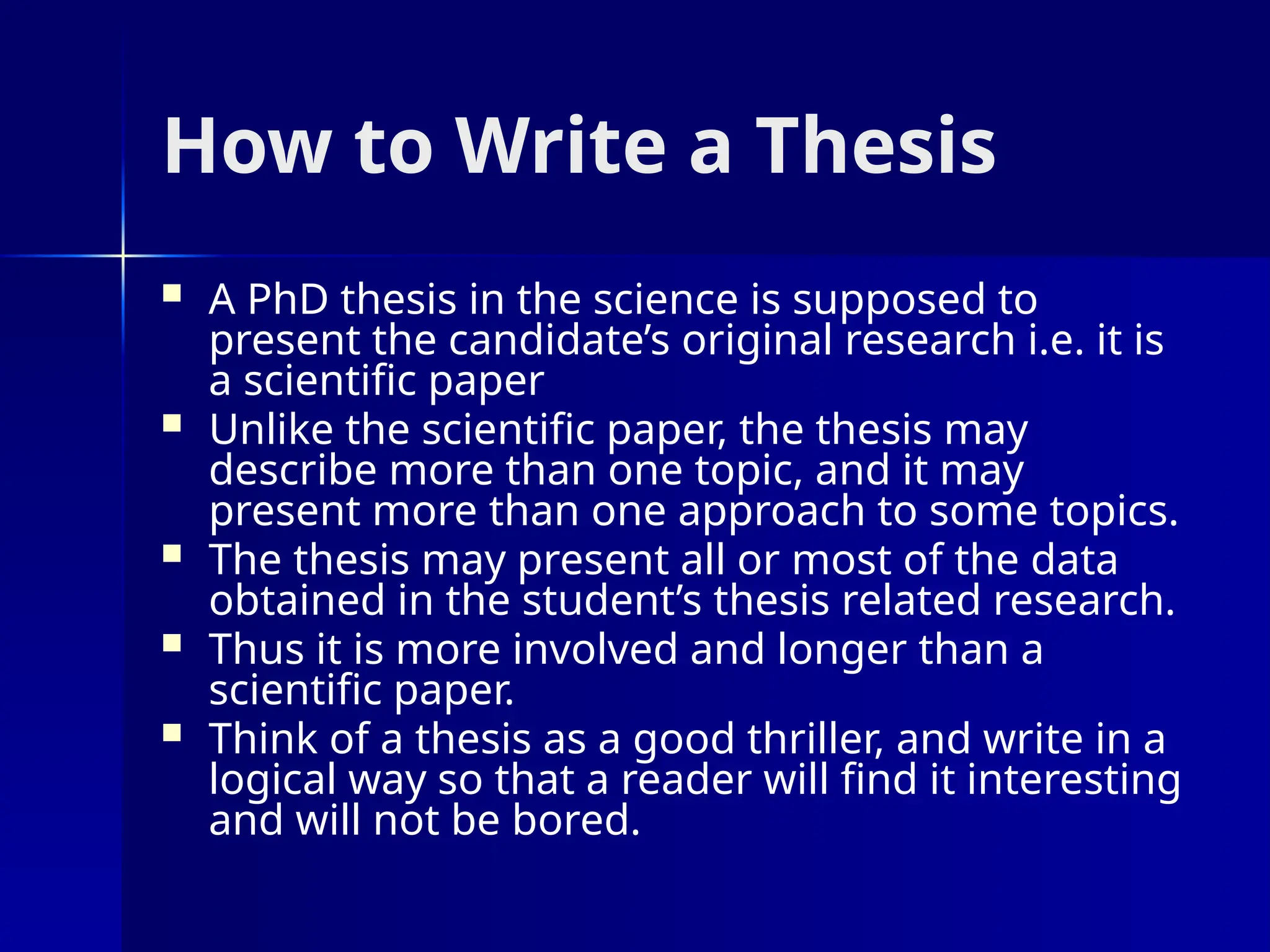
How to Writea Thesis
A PhD thesis in the science is supposed to
present the candidate’s original research i.e. it is
a scientific paper
Unlike the scientific paper, the thesis may
describe more than one topic, and it may
present more than one approach to some topics.
The thesis may present all or most of the data
obtained in the student’s thesis related research.
Thus it is more involved and longer than a
scientific paper.
Think of a thesis as a good thriller, and write in a
logical way so that a reader will find it interesting
and will not be bored.
38.
Ethics, Rights and
Permissions
Beware of originality and copyrights
of others.
Do not copy anything without giving
the credit to the owner by
referencing it.
In some cases permissions are
needed
Repetitive publication of the same
data is considered plagiarism
39.
References
Robert Day(1995): How to write and
publish a scientific paper. 4th
Edition,
Cambridge University Press
University of Queensland (2009)
References/Bibliography Harvard Style
http://www.library.uq.edu.au/
training/citation/harvard_6.pdf
![ Book Article or Chapter
– 5. James NE. Two sides of paradise: the Eden myth
according to Kirk and Spock. In: Palumbo D, ed. Spectrum
of the Fantastic. Westport, Conn: Greenwood; 1988:219-
223.
ERIC Document
– 6. Fuss-Reineck M. Sibling Communication in Star Trek: The
Next Generation: Conflicts Between Brothers. Miami, Fla:
Annual Meeting of the Speech Communication
Association; 1993. ERIC Document Reproduction Service
ED364932.
Website
– 7. Lynch T. DSN trials and tribble-ations review. Psi Phi:
Bradley's Science Fiction Club Web site. 1996. Available
at:
http://www.bradley.edu/campusorg/psiphi/DS9/ep
/503r.htm. Accessed October 8, 1997.
Journal Article on the Internet
– 8. McCoy LH. Respiratory changes in Vulcans during pon
farr. J Extr Med [serial online]. 1999;47:237-247. Available
at:
http://infotrac.galegroup.com/itweb/nysl_li_liu.
Accessed April 7, 1999.](https://image.slidesharecdn.com/howtowriteascientificpaper1goodabstract-251005102354-4a0888c5/75/How-To-Write-A-Scientific-Paper_1_good-abstract-pptx-36-2048.jpg)


![iStat Menus 7.20 Crack for MacOS 2026 Full Version [Latest] pptx](https://cdn.slidesharecdn.com/ss_thumbnails/softwareoverview-251207191544-22b737dc-thumbnail.jpg?width=640&height=640&fit=bounds)
![CleanMyMac X v5.2.8 Crack for MacOS Full Version [Latest] pptx](https://cdn.slidesharecdn.com/ss_thumbnails/softwareoverview-251207194121-a81f0142-thumbnail.jpg?width=640&height=640&fit=bounds)
![Moho Pro 14.4 Crack for MacOS Works Until 2050 [Latest] pptx](https://cdn.slidesharecdn.com/ss_thumbnails/softwareoverview-251207192639-797289c4-thumbnail.jpg?width=640&height=640&fit=bounds)
![AnyTrans for iOS 8.9.14.20251127 With Crack for MacOS [Latest] pptx](https://cdn.slidesharecdn.com/ss_thumbnails/softwareoverview-251207190907-2316965f-thumbnail.jpg?width=640&height=640&fit=bounds)
![WinRAR Crack 7.13 Final Mac Keygen 2026 Download [Latest] Software.pptx](https://cdn.slidesharecdn.com/ss_thumbnails/software-251207185858-eb450678-thumbnail.jpg?width=640&height=640&fit=bounds)


![Chapter4_Initiation_of_Sediment_Motion_v2[1].pptx](https://cdn.slidesharecdn.com/ss_thumbnails/chapter4initiationofsedimentmotionv21-251208223747-f94ef163-thumbnail.jpg?width=640&height=640&fit=bounds)


