Central Tendency and Dispersion
Prof Md Anisur Rahman
MBBS, DO, FCPS (eye)
Head of the department
(Ophthalmology) DMC
5/10/2021 1
anjumk38dmc@gmail.com
. Characteristic of central tendency
 Central tendency of a data set is the tendency of data to cluster
around a central point of the series.
 Measures of central tendency is a single typical value of a data
set that represent a set of data and around which other values
of data set are found to cluster.
 To get a single value, that represents the entire data &
describes the characteristic of whole set of data.
5/10/2021 2
anjumk38dmc@gmail.com
What are the central tendencies?
1. Mean
2. Median
To some extent
3. Mode
5/10/2021 3
anjumk38dmc@gmail.com
Measures of central tendency: (Mean)
1) What is mean?
2) Advantages of mean
3) Disadvantages of mean
4) Formula to calculate the mean
5) Solve the problem
5/10/2021 anjumk38dmc@gmail.com 4
What is Mean?
Mean is the sum of scores divided by the total
number of Observations. It is commonly used in
statistics.
Sometimes mean is denoted by µ (mui) and sometimes
by (X bar)
BUT WHY?
5/10/2021 5
anjumk38dmc@gmail.com
Measures of central tendency (Mean)
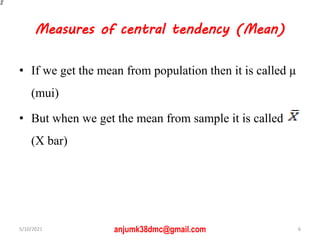
• If we get the mean from population then it is called µ
(mui)
• But when we get the mean from sample it is called
(X bar)
5/10/2021 6
anjumk38dmc@gmail.com
Measures of central tendency (Mean)
n
X
X


N
X



Mean of a sample
Mean of a population
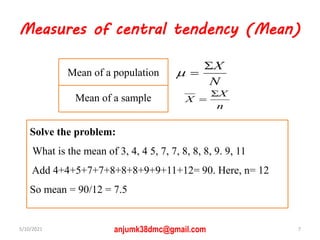
Solve the problem:
What is the mean of 3, 4, 4 5, 7, 7, 8, 8, 8, 9. 9, 11
Add 4+4+5+7+7+8+8+8+9+9+11+12= 90. Here, n= 12
So mean = 90/12 = 7.5
5/10/2021 7
anjumk38dmc@gmail.com
Advantages of mean
1. Uniqueness: only one mean for a set of data.
2. Simplicity: easy to calculate and understand.
3. Sensitivity: sensitive to and affected by all values,
that means it uses all the information in the
distribution.
5/10/2021 8
anjumk38dmc@gmail.com
Advantages of mean
4. Can be applied in all normally distributed numerical
data.
5. Used as the basis of further most common and most
powerful statistical computation.
6. Means of sub-groups may be combined to get the
mean of entire group. (Unlike median & mode).
5/10/2021 anjumk38dmc@gmail.com 9
Disadvantages of mean
1) Grossly affected by extreme values (outliers) of
data.
2) Not useful in skewed distribution of data.
5/10/2021 10
anjumk38dmc@gmail.com
Measures of central tendency: (Median)
1) When we use median?
2) How to calculate median?
3) Solve the problem
4) Advantages of median
5) Disadvantage of median
6) Why median is not enough?
5/10/2021 11
anjumk38dmc@gmail.com
Measures of central tendency: (Median)
Have you ever think that, why some scientific article
use median, in spite of mean? Remember when the
data set is not in normal shaped, it is skewed in spite
of mean we use median.
5/10/2021 12
anjumk38dmc@gmail.com
How to calculate median?
 Middle most value of data set arranged in ascending
or descending order.
 If odd number of values, middle most value is the
median
 If even number of values, mean of the middle two
values is the median.
5/10/2021 13
anjumk38dmc@gmail.com
Measures of central tendency: (Median)
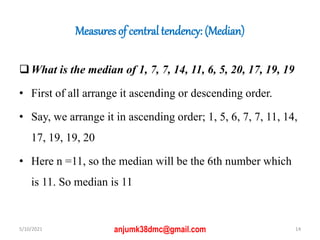
What is the median of 1, 7, 7, 14, 11, 6, 5, 20, 17, 19, 19
• First of all arrange it ascending or descending order.
• Say, we arrange it in ascending order; 1, 5, 6, 7, 7, 11, 14,
17, 19, 19, 20
• Here n =11, so the median will be the 6th number which
is 11. So median is 11
5/10/2021 14
anjumk38dmc@gmail.com
Measures of central tendency: (Median)
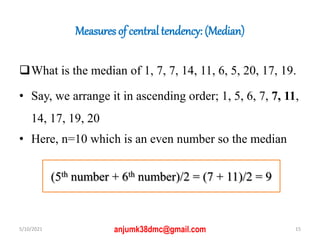
What is the median of 1, 7, 7, 14, 11, 6, 5, 20, 17, 19.
• Say, we arrange it in ascending order; 1, 5, 6, 7, 7, 11,
14, 17, 19, 20
• Here, n=10 which is an even number so the median
5/10/2021 15
anjumk38dmc@gmail.com
(5th number + 6th number)/2 = (7 + 11)/2 = 9
Advantages of median
1) Not affected by extreme value.
2) Good for ordinal data.
3) Good for numerical skewed data.
4) Uniqueness.
5) Simplicity
5/10/2021 16
anjumk38dmc@gmail.com
Disadvantage of median
1) Ignore most of the information.
2) Does not take into account all values.
3) It requires ranking of all the scores and counting to
find out the middle.
4) Its use in further statistical computation is somewhat
limited.
5/10/2021 17
anjumk38dmc@gmail.com
Why median is not enough?
The median is known as a measure of location; that
is, it tells us where the data are.
As stated in, we do not need to know all the exact
values to calculate the median; if we made the
smallest value even smaller or the largest value even
larger, it would not change the value of the median.
5/10/2021 18
anjumk38dmc@gmail.com
Why median is not enough?
Thus the median does not use all the information in
the data and so it can be shown to be less efficient
than the mean or average, which does use all values
of the data.
5/10/2021 19
anjumk38dmc@gmail.com
Measures of central tendency
(Mode)
1) What is mode?
2) Advantages of mode
3) Disadvantages of mode
4) Solve the problems
5/10/2021 anjumk38dmc@gmail.com 20
What is mode?
It is the most frequent and repeated values observed
in a data set.
It is the most common score in a frequency
distribution e.g. in a data set: 1, 2, 2, 2, 3, 4, 5, 6; the
mode is 2
5/10/2021 anjumk38dmc@gmail.com 21
Advantages of mode
1) Not affected by extreme values and the skewness of
data.
2) Simplicity.
3) Good for bimodal distribution.
5/10/2021 anjumk38dmc@gmail.com 22
Disadvantages of mode
1) Often not clear defined.
2) Not much used in statistics.
3) Ignore most of the information
5/10/2021 anjumk38dmc@gmail.com 23
Measures of Dispersion
In statistics, dispersion denotes how stretched or
squeezed a distribution is.
Dispersion is contrasted with location or central
tendency, and together they are the most used
properties of distributions.
5/10/2021 anjumk38dmc@gmail.com 24
Following are the measures of dispersion of individual
observation
1) Range
2) Interquartile range
3) Mean deviation
4) Variance
5) Standard deviation
6) Co-efficient of variation
5/10/2021 anjumk38dmc@gmail.com 25
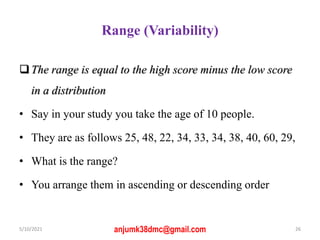
Range (Variability)
The range is equal to the high score minus the low score
in a distribution
• Say in your study you take the age of 10 people.
• They are as follows 25, 48, 22, 34, 33, 34, 38, 40, 60, 29,
• What is the range?
• You arrange them in ascending or descending order
5/10/2021 anjumk38dmc@gmail.com 26
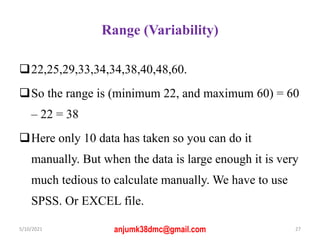
Range (Variability)
22,25,29,33,34,34,38,40,48,60.
So the range is (minimum 22, and maximum 60) = 60
– 22 = 38
Here only 10 data has taken so you can do it
manually. But when the data is large enough it is very
much tedious to calculate manually. We have to use
SPSS. Or EXCEL file.
5/10/2021 anjumk38dmc@gmail.com 27
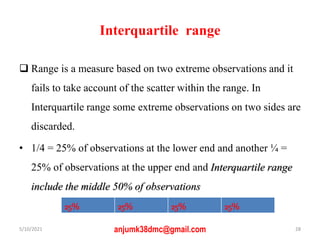
Interquartile range
 Range is a measure based on two extreme observations and it
fails to take account of the scatter within the range. In
Interquartile range some extreme observations on two sides are
discarded.
• 1/4 = 25% of observations at the lower end and another ¼ =
25% of observations at the upper end and Interquartile range
include the middle 50% of observations
5/10/2021 anjumk38dmc@gmail.com 28
25% 25% 25% 25%
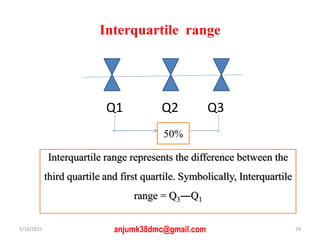
Interquartile range
Q1 Q2 Q3
5/10/2021 anjumk38dmc@gmail.com 29
50%
Interquartile range represents the difference between the
third quartile and first quartile. Symbolically, Interquartile
range = Q3―Q1
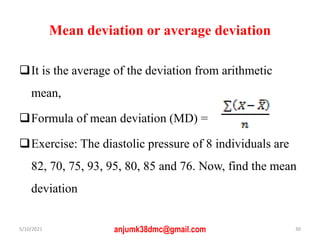
Mean deviation or average deviation
It is the average of the deviation from arithmetic
mean,
Formula of mean deviation (MD) =
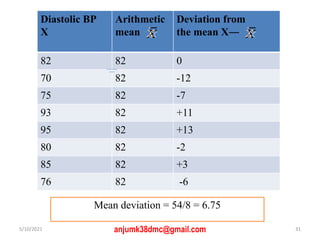
Exercise: The diastolic pressure of 8 individuals are
82, 70, 75, 93, 95, 80, 85 and 76. Now, find the mean
deviation
5/10/2021 anjumk38dmc@gmail.com 30
Diastolic BP
X
Arithmetic
mean
Deviation from
the mean X―
82 82 0
70 82 -12
75 82 -7
93 82 +11
95 82 +13
80 82 -2
85 82 +3
76 82 -6
5/10/2021 anjumk38dmc@gmail.com 31
Mean deviation = 54/8 = 6.75
Variance and standard deviation
• In case of mean deviation we have problem of ignoring signs.
We can overcome the problem by-
 Squaring the deviation
 Averaging this sums of squared deviation that is by dividing
the sums of squared deviation with number of observations (n)
which is called variance
 Now if we take square root the variance it will become
standard deviation.
5/10/2021 anjumk38dmc@gmail.com 32
Variance and standard deviation
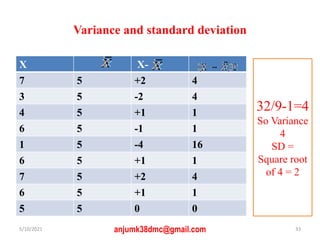
X X-
7 5 +2 4
3 5 -2 4
4 5 +1 1
6 5 -1 1
1 5 -4 16
6 5 +1 1
7 5 +2 4
6 5 +1 1
5 5 0 0
5/10/2021 anjumk38dmc@gmail.com 33
32/9-1=4
So Variance
4
SD =
Square root
of 4 = 2
Variance and standard deviation
• Variance is used most commonly with more advanced
statistical procedures such as regression analysis,
analysis of variance (ANOVA), and the determination
of the reliability of a test
• The variance is also known as the mean square
(MS)
5/10/2021 anjumk38dmc@gmail.com 34
To calculate the standard deviation follows the following
stages
1) First of all to calculate the arithmetic mean of all
deviations
2) Now to take the deviation of each value from the
arithmetic mean
3) Then square each deviation
4) To add up the squared deviation
5/10/2021 anjumk38dmc@gmail.com 35
5) To divide the result by the number of observations n
or n-1 (for population n, for sample size less than
30, n-1)
6) Then to take the square root, which gives the
standard deviation
5/10/2021 anjumk38dmc@gmail.com 36
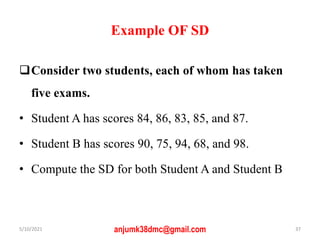
Example OF SD
Consider two students, each of whom has taken
five exams.
• Student A has scores 84, 86, 83, 85, and 87.
• Student B has scores 90, 75, 94, 68, and 98.
• Compute the SD for both Student A and Student B
5/10/2021 anjumk38dmc@gmail.com 37
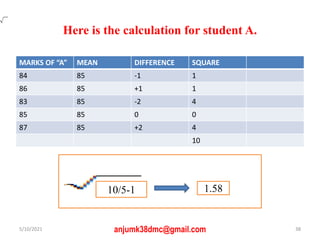
Here is the calculation for student A.
MARKS OF “A” MEAN DIFFERENCE SQUARE
84 85 -1 1
86 85 +1 1
83 85 -2 4
85 85 0 0
87 85 +2 4
10
5/10/2021 anjumk38dmc@gmail.com 38
10/5-1 1.58
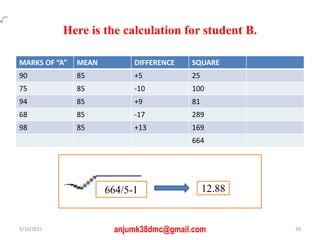
Here is the calculation for student B.
MARKS OF “A” MEAN DIFFERENCE SQUARE
90 85 +5 25
75 85 -10 100
94 85 +9 81
68 85 -17 289
98 85 +13 169
664
5/10/2021 anjumk38dmc@gmail.com 39
664/5-1 12.88
• Since the standard deviation of Student B’s scores is greater
than that of Student A’s (12.88 > 1.58), Student B’s scores are
not as consistent as those of Student A.
• Standard deviation gives us an idea of the “spread” of
the dispersion; that the larger the Standard deviation, the
greater the dispersion of values about the mean.
5/10/2021 anjumk38dmc@gmail.com 40
Exercise: 1
Average weight of baby at birth is 3.05 kg with the
SD of 0.39 kg. If the birth is normally distributed
would you regard as weight of 4 kg is abnormal? And
weight of 2.5 kg is normal?
5/10/2021 anjumk38dmc@gmail.com 41
Solution:
Normal limits of weight at ± 1.96 SD (3.05 ± 1.96 x
0.39) will be 2.29 kg and 3.81 kg. The weight of 4 kg
falls outside the normal limits (since 4> 3.81) so it is
taken as abnormal.
The weight of 2.5 kg lies within the normal limits of
2.29 and 3.81 so it is not taken as abnormal.
5/10/2021 anjumk38dmc@gmail.com 42
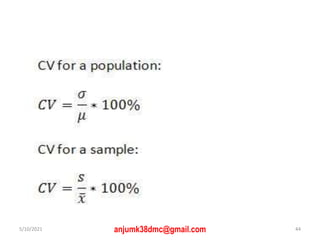
coefficient of variation (CV)
• The coefficient of variation is a measure of spread
that describes the amount of variability relative to the
mean. Because the coefficient of variation is unit less,
we can use it instead of the standard deviation to
compare the spread of data sets that have different
units or different means.
5/10/2021 anjumk38dmc@gmail.com 43
5/10/2021 anjumk38dmc@gmail.com 44
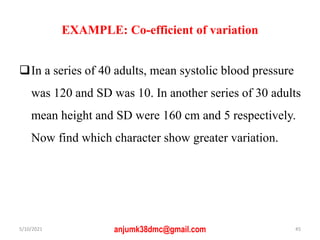
EXAMPLE: Co-efficient of variation
In a series of 40 adults, mean systolic blood pressure
was 120 and SD was 10. In another series of 30 adults
mean height and SD were 160 cm and 5 respectively.
Now find which character show greater variation.
5/10/2021 anjumk38dmc@gmail.com 45
5/10/2021 anjumk38dmc@gmail.com 46
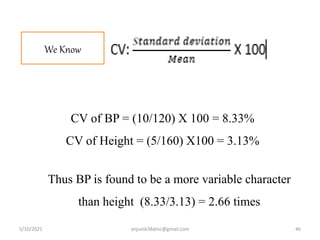
We Know
CV of BP = (10/120) X 100 = 8.33%
CV of Height = (5/160) X100 = 3.13%
Thus BP is found to be a more variable character
than height (8.33/3.13) = 2.66 times
Distribution of Data
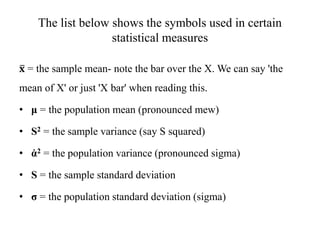
The list below shows the symbols used in certain
statistical measures
𝐱 = the sample mean- note the bar over the X. We can say 'the
mean of X' or just 'X bar' when reading this.
• μ = the population mean (pronounced mew)
• S2 = the sample variance (say S squared)
• ἀ2 = the population variance (pronounced sigma)
• S = the sample standard deviation
• σ = the population standard deviation (sigma)
Population statistics are referred to using
Greek symbols and
sample statistics use letter from the Roman
alphabet.
5/10/2021 anjumk38dmc@gmail.com 49
 There are several types of data distribution in statistics.
 Normal distribution
 Binomial distribution
 Poisson distribution
 And many other types.
• Among them all, Normal distribution of data is widely used
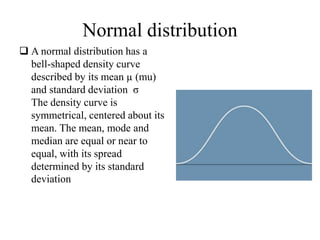
Normal distribution
 A normal distribution has a
bell-shaped density curve
described by its mean µ (mu)
and standard deviation σ
The density curve is
symmetrical, centered about its
mean. The mean, mode and
median are equal or near to
equal, with its spread
determined by its standard
deviation
Binomial distribution model
It is an important probability model that is used when
there are two possible outcomes (hence "binomial").Each
replication of the process results in one of two possible
outcome (success or failure), The probability of success is
the same for each replication, and the replications are
independent, meaning here that a success in one patient
does not influence the probability of success in another.
The Normal Distribution. Why it is important?
 It is very important to test data whether data is normally
distributed or not, because statistical test depends upon the
data distribution.
 If data is normally distributed then parametric test will be
done.
 If data is not normally distributing then non-parametric test
 Parametric tests are more powerful than non-parametric test
Parametric & Non-parametric Test
 t test,
 ANOVA test
 Wilcoxon test,
 sign test,
 Mann-Whitney test,
5/10/2021 anjumk38dmc@gmail.com 54
Properties of a normal distribution
a) The mean, median and mode are all equal.
b) The curve is symmetric at the center (i.e. around
the mean, μ).
c) Exactly half of the values are to the left of center
and exactly half the values are to the right.
d) The total area under the curve is 1.
Describing the normal distribution:
 A normal distribution is more commonly known as a bell
curve. This type of curve shows up throughout statistics and
the real world.
 For example, after we give a test in any of our classes, one
thing that we like to do is to make a graph of all the scores. We
typically write down 10 point ranges such as 60-69, 70-79, and
80-89, then put a tally mark for each test score in that range.
Almost every time we do this, a familiar shape emerges.
• A few students do very well and a few do very
poorly. A bunch of scores end up clumped around
the mean score. Different tests may result in
different means and standard deviations, but the
shape of the graph is nearly always the same. This
shape is commonly called the bell curve.
Important features of bell curve:
 There are several features of bell curve that is important and
distinguishes them from other curves in statistics:
 A bell curve has one mode, which coincides with the mean
and median. This is the center of the curve where it is at its
highest.
 A bell curve is symmetric. If it were folded along a vertical
line at the mean, both halves would match perfectly because
they are mirror images of each other.
A bell curve follows the 68-95-99.7 rule,
 A bell curve follows the 68-95-99.7 rule, which provides a
convenient way to carry out estimated calculations:
 Approximately 68% of all of the data lies within one
standard deviation of the mean.
 Approximately 95% of all the data is within two standard
deviations of the mean.
 Approximately 99.7% of the data is within three standard
deviations of the mean.
An example:
Suppose we have 100 students who took a statistics test
with mean score of 70 and standard deviation of 10.
 The standard deviation is 10. Subtract and add 10 to the
mean. This gives us 60 and 80.
 By the 68-95-99.7 rule we would expect about 68% of
100, or 68 students to score between 60 and 80 on the
test.
• Two times the standard deviation is 20. If we subtract and add
20 to the mean we have 50 and 90. We would expect about
95% of 100, or 95 students to score between 50 and 90 on the
test.
• A similar calculation tells us that effectively everyone scored
between 40 and 100 on the test.
• Average weight of baby at birth is 3.05 kg with the SD of 0.39 kg. If
the birth is normally distributed would you regard as weight of 4 kg
is abnormal? And weight of 2.5 kg is normal?
• Solution:
• Normal limits of weight at ± 1.96 SD (3.05 ± 1.96 x 0.39)
will be 2.29 kg and 3.81 kg. The weight of 4 kg falls outside the
normal limits (since 4> 3.81) so it is taken as abnormal.
• The weight of 2.5 kg lies within the normal limits of 2.29 and 3.81
so it is not taken as abnormal.
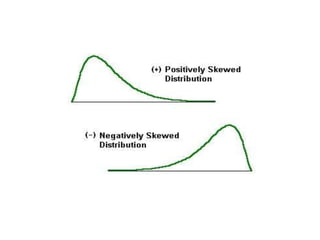
Asymmetrical Distribution of data: Skewness/Kurtosis
Skewness is the degree of departure from symmetry of a distribution. A
skewed data distribution or bell curve can be either positive or negative.
A positive skew means that the extreme data results are larger. This skews
the data in that it brings the mean (average) up. The mean will be larger
than the median in a skewed data set. A negative skew means the opposite:
that the extreme data results are smaller. This means that the mean is
brought down, and the median is larger than the mean.
Central tendency and dispersion

Central tendency and dispersion

  • 1.
    Central Tendency andDispersion Prof Md Anisur Rahman MBBS, DO, FCPS (eye) Head of the department (Ophthalmology) DMC 5/10/2021 1 anjumk38dmc@gmail.com
  • 2.
    . Characteristic ofcentral tendency  Central tendency of a data set is the tendency of data to cluster around a central point of the series.  Measures of central tendency is a single typical value of a data set that represent a set of data and around which other values of data set are found to cluster.  To get a single value, that represents the entire data & describes the characteristic of whole set of data. 5/10/2021 2 anjumk38dmc@gmail.com
  • 3.
    What are thecentral tendencies? 1. Mean 2. Median To some extent 3. Mode 5/10/2021 3 anjumk38dmc@gmail.com
  • 4.
    Measures of centraltendency: (Mean) 1) What is mean? 2) Advantages of mean 3) Disadvantages of mean 4) Formula to calculate the mean 5) Solve the problem 5/10/2021 anjumk38dmc@gmail.com 4
  • 5.
    What is Mean? Meanis the sum of scores divided by the total number of Observations. It is commonly used in statistics. Sometimes mean is denoted by µ (mui) and sometimes by (X bar) BUT WHY? 5/10/2021 5 anjumk38dmc@gmail.com
  • 6.
    Measures of centraltendency (Mean) • If we get the mean from population then it is called µ (mui) • But when we get the mean from sample it is called (X bar) 5/10/2021 6 anjumk38dmc@gmail.com
  • 7.
    Measures of centraltendency (Mean) n X X   N X    Mean of a sample Mean of a population Solve the problem: What is the mean of 3, 4, 4 5, 7, 7, 8, 8, 8, 9. 9, 11 Add 4+4+5+7+7+8+8+8+9+9+11+12= 90. Here, n= 12 So mean = 90/12 = 7.5 5/10/2021 7 anjumk38dmc@gmail.com
  • 8.
    Advantages of mean 1.Uniqueness: only one mean for a set of data. 2. Simplicity: easy to calculate and understand. 3. Sensitivity: sensitive to and affected by all values, that means it uses all the information in the distribution. 5/10/2021 8 anjumk38dmc@gmail.com
  • 9.
    Advantages of mean 4.Can be applied in all normally distributed numerical data. 5. Used as the basis of further most common and most powerful statistical computation. 6. Means of sub-groups may be combined to get the mean of entire group. (Unlike median & mode). 5/10/2021 anjumk38dmc@gmail.com 9
  • 10.
    Disadvantages of mean 1)Grossly affected by extreme values (outliers) of data. 2) Not useful in skewed distribution of data. 5/10/2021 10 anjumk38dmc@gmail.com
  • 11.
    Measures of centraltendency: (Median) 1) When we use median? 2) How to calculate median? 3) Solve the problem 4) Advantages of median 5) Disadvantage of median 6) Why median is not enough? 5/10/2021 11 anjumk38dmc@gmail.com
  • 12.
    Measures of centraltendency: (Median) Have you ever think that, why some scientific article use median, in spite of mean? Remember when the data set is not in normal shaped, it is skewed in spite of mean we use median. 5/10/2021 12 anjumk38dmc@gmail.com
  • 13.
    How to calculatemedian?  Middle most value of data set arranged in ascending or descending order.  If odd number of values, middle most value is the median  If even number of values, mean of the middle two values is the median. 5/10/2021 13 anjumk38dmc@gmail.com
  • 14.
    Measures of centraltendency: (Median) What is the median of 1, 7, 7, 14, 11, 6, 5, 20, 17, 19, 19 • First of all arrange it ascending or descending order. • Say, we arrange it in ascending order; 1, 5, 6, 7, 7, 11, 14, 17, 19, 19, 20 • Here n =11, so the median will be the 6th number which is 11. So median is 11 5/10/2021 14 anjumk38dmc@gmail.com
  • 15.
    Measures of centraltendency: (Median) What is the median of 1, 7, 7, 14, 11, 6, 5, 20, 17, 19. • Say, we arrange it in ascending order; 1, 5, 6, 7, 7, 11, 14, 17, 19, 20 • Here, n=10 which is an even number so the median 5/10/2021 15 anjumk38dmc@gmail.com (5th number + 6th number)/2 = (7 + 11)/2 = 9
  • 16.
    Advantages of median 1)Not affected by extreme value. 2) Good for ordinal data. 3) Good for numerical skewed data. 4) Uniqueness. 5) Simplicity 5/10/2021 16 anjumk38dmc@gmail.com
  • 17.
    Disadvantage of median 1)Ignore most of the information. 2) Does not take into account all values. 3) It requires ranking of all the scores and counting to find out the middle. 4) Its use in further statistical computation is somewhat limited. 5/10/2021 17 anjumk38dmc@gmail.com
  • 18.
    Why median isnot enough? The median is known as a measure of location; that is, it tells us where the data are. As stated in, we do not need to know all the exact values to calculate the median; if we made the smallest value even smaller or the largest value even larger, it would not change the value of the median. 5/10/2021 18 anjumk38dmc@gmail.com
  • 19.
    Why median isnot enough? Thus the median does not use all the information in the data and so it can be shown to be less efficient than the mean or average, which does use all values of the data. 5/10/2021 19 anjumk38dmc@gmail.com
  • 20.
    Measures of centraltendency (Mode) 1) What is mode? 2) Advantages of mode 3) Disadvantages of mode 4) Solve the problems 5/10/2021 anjumk38dmc@gmail.com 20
  • 21.
    What is mode? Itis the most frequent and repeated values observed in a data set. It is the most common score in a frequency distribution e.g. in a data set: 1, 2, 2, 2, 3, 4, 5, 6; the mode is 2 5/10/2021 anjumk38dmc@gmail.com 21
  • 22.
    Advantages of mode 1)Not affected by extreme values and the skewness of data. 2) Simplicity. 3) Good for bimodal distribution. 5/10/2021 anjumk38dmc@gmail.com 22
  • 23.
    Disadvantages of mode 1)Often not clear defined. 2) Not much used in statistics. 3) Ignore most of the information 5/10/2021 anjumk38dmc@gmail.com 23
  • 24.
    Measures of Dispersion Instatistics, dispersion denotes how stretched or squeezed a distribution is. Dispersion is contrasted with location or central tendency, and together they are the most used properties of distributions. 5/10/2021 anjumk38dmc@gmail.com 24
  • 25.
    Following are themeasures of dispersion of individual observation 1) Range 2) Interquartile range 3) Mean deviation 4) Variance 5) Standard deviation 6) Co-efficient of variation 5/10/2021 anjumk38dmc@gmail.com 25
  • 26.
    Range (Variability) The rangeis equal to the high score minus the low score in a distribution • Say in your study you take the age of 10 people. • They are as follows 25, 48, 22, 34, 33, 34, 38, 40, 60, 29, • What is the range? • You arrange them in ascending or descending order 5/10/2021 anjumk38dmc@gmail.com 26
  • 27.
    Range (Variability) 22,25,29,33,34,34,38,40,48,60. So therange is (minimum 22, and maximum 60) = 60 – 22 = 38 Here only 10 data has taken so you can do it manually. But when the data is large enough it is very much tedious to calculate manually. We have to use SPSS. Or EXCEL file. 5/10/2021 anjumk38dmc@gmail.com 27
  • 28.
    Interquartile range  Rangeis a measure based on two extreme observations and it fails to take account of the scatter within the range. In Interquartile range some extreme observations on two sides are discarded. • 1/4 = 25% of observations at the lower end and another ¼ = 25% of observations at the upper end and Interquartile range include the middle 50% of observations 5/10/2021 anjumk38dmc@gmail.com 28 25% 25% 25% 25%
  • 29.
    Interquartile range Q1 Q2Q3 5/10/2021 anjumk38dmc@gmail.com 29 50% Interquartile range represents the difference between the third quartile and first quartile. Symbolically, Interquartile range = Q3―Q1
  • 30.
    Mean deviation oraverage deviation It is the average of the deviation from arithmetic mean, Formula of mean deviation (MD) = Exercise: The diastolic pressure of 8 individuals are 82, 70, 75, 93, 95, 80, 85 and 76. Now, find the mean deviation 5/10/2021 anjumk38dmc@gmail.com 30
  • 31.
    Diastolic BP X Arithmetic mean Deviation from themean X― 82 82 0 70 82 -12 75 82 -7 93 82 +11 95 82 +13 80 82 -2 85 82 +3 76 82 -6 5/10/2021 anjumk38dmc@gmail.com 31 Mean deviation = 54/8 = 6.75
  • 32.
    Variance and standarddeviation • In case of mean deviation we have problem of ignoring signs. We can overcome the problem by-  Squaring the deviation  Averaging this sums of squared deviation that is by dividing the sums of squared deviation with number of observations (n) which is called variance  Now if we take square root the variance it will become standard deviation. 5/10/2021 anjumk38dmc@gmail.com 32
  • 33.
    Variance and standarddeviation X X- 7 5 +2 4 3 5 -2 4 4 5 +1 1 6 5 -1 1 1 5 -4 16 6 5 +1 1 7 5 +2 4 6 5 +1 1 5 5 0 0 5/10/2021 anjumk38dmc@gmail.com 33 32/9-1=4 So Variance 4 SD = Square root of 4 = 2
  • 34.
    Variance and standarddeviation • Variance is used most commonly with more advanced statistical procedures such as regression analysis, analysis of variance (ANOVA), and the determination of the reliability of a test • The variance is also known as the mean square (MS) 5/10/2021 anjumk38dmc@gmail.com 34
  • 35.
    To calculate thestandard deviation follows the following stages 1) First of all to calculate the arithmetic mean of all deviations 2) Now to take the deviation of each value from the arithmetic mean 3) Then square each deviation 4) To add up the squared deviation 5/10/2021 anjumk38dmc@gmail.com 35
  • 36.
    5) To dividethe result by the number of observations n or n-1 (for population n, for sample size less than 30, n-1) 6) Then to take the square root, which gives the standard deviation 5/10/2021 anjumk38dmc@gmail.com 36
  • 37.
    Example OF SD Considertwo students, each of whom has taken five exams. • Student A has scores 84, 86, 83, 85, and 87. • Student B has scores 90, 75, 94, 68, and 98. • Compute the SD for both Student A and Student B 5/10/2021 anjumk38dmc@gmail.com 37
  • 38.
    Here is thecalculation for student A. MARKS OF “A” MEAN DIFFERENCE SQUARE 84 85 -1 1 86 85 +1 1 83 85 -2 4 85 85 0 0 87 85 +2 4 10 5/10/2021 anjumk38dmc@gmail.com 38 10/5-1 1.58
  • 39.
    Here is thecalculation for student B. MARKS OF “A” MEAN DIFFERENCE SQUARE 90 85 +5 25 75 85 -10 100 94 85 +9 81 68 85 -17 289 98 85 +13 169 664 5/10/2021 anjumk38dmc@gmail.com 39 664/5-1 12.88
  • 40.
    • Since thestandard deviation of Student B’s scores is greater than that of Student A’s (12.88 > 1.58), Student B’s scores are not as consistent as those of Student A. • Standard deviation gives us an idea of the “spread” of the dispersion; that the larger the Standard deviation, the greater the dispersion of values about the mean. 5/10/2021 anjumk38dmc@gmail.com 40
  • 41.
    Exercise: 1 Average weightof baby at birth is 3.05 kg with the SD of 0.39 kg. If the birth is normally distributed would you regard as weight of 4 kg is abnormal? And weight of 2.5 kg is normal? 5/10/2021 anjumk38dmc@gmail.com 41
  • 42.
    Solution: Normal limits ofweight at ± 1.96 SD (3.05 ± 1.96 x 0.39) will be 2.29 kg and 3.81 kg. The weight of 4 kg falls outside the normal limits (since 4> 3.81) so it is taken as abnormal. The weight of 2.5 kg lies within the normal limits of 2.29 and 3.81 so it is not taken as abnormal. 5/10/2021 anjumk38dmc@gmail.com 42
  • 43.
    coefficient of variation(CV) • The coefficient of variation is a measure of spread that describes the amount of variability relative to the mean. Because the coefficient of variation is unit less, we can use it instead of the standard deviation to compare the spread of data sets that have different units or different means. 5/10/2021 anjumk38dmc@gmail.com 43
  • 44.
  • 45.
    EXAMPLE: Co-efficient ofvariation In a series of 40 adults, mean systolic blood pressure was 120 and SD was 10. In another series of 30 adults mean height and SD were 160 cm and 5 respectively. Now find which character show greater variation. 5/10/2021 anjumk38dmc@gmail.com 45
  • 46.
    5/10/2021 anjumk38dmc@gmail.com 46 WeKnow CV of BP = (10/120) X 100 = 8.33% CV of Height = (5/160) X100 = 3.13% Thus BP is found to be a more variable character than height (8.33/3.13) = 2.66 times
  • 47.
  • 48.
    The list belowshows the symbols used in certain statistical measures 𝐱 = the sample mean- note the bar over the X. We can say 'the mean of X' or just 'X bar' when reading this. • μ = the population mean (pronounced mew) • S2 = the sample variance (say S squared) • ἀ2 = the population variance (pronounced sigma) • S = the sample standard deviation • σ = the population standard deviation (sigma)
  • 49.
    Population statistics arereferred to using Greek symbols and sample statistics use letter from the Roman alphabet. 5/10/2021 anjumk38dmc@gmail.com 49
  • 50.
     There areseveral types of data distribution in statistics.  Normal distribution  Binomial distribution  Poisson distribution  And many other types. • Among them all, Normal distribution of data is widely used
  • 51.
    Normal distribution  Anormal distribution has a bell-shaped density curve described by its mean µ (mu) and standard deviation σ The density curve is symmetrical, centered about its mean. The mean, mode and median are equal or near to equal, with its spread determined by its standard deviation
  • 52.
    Binomial distribution model Itis an important probability model that is used when there are two possible outcomes (hence "binomial").Each replication of the process results in one of two possible outcome (success or failure), The probability of success is the same for each replication, and the replications are independent, meaning here that a success in one patient does not influence the probability of success in another.
  • 53.
    The Normal Distribution.Why it is important?  It is very important to test data whether data is normally distributed or not, because statistical test depends upon the data distribution.  If data is normally distributed then parametric test will be done.  If data is not normally distributing then non-parametric test  Parametric tests are more powerful than non-parametric test
  • 54.
    Parametric & Non-parametricTest  t test,  ANOVA test  Wilcoxon test,  sign test,  Mann-Whitney test, 5/10/2021 anjumk38dmc@gmail.com 54
  • 55.
    Properties of anormal distribution a) The mean, median and mode are all equal. b) The curve is symmetric at the center (i.e. around the mean, μ). c) Exactly half of the values are to the left of center and exactly half the values are to the right. d) The total area under the curve is 1.
  • 56.
    Describing the normaldistribution:  A normal distribution is more commonly known as a bell curve. This type of curve shows up throughout statistics and the real world.  For example, after we give a test in any of our classes, one thing that we like to do is to make a graph of all the scores. We typically write down 10 point ranges such as 60-69, 70-79, and 80-89, then put a tally mark for each test score in that range. Almost every time we do this, a familiar shape emerges.
  • 57.
    • A fewstudents do very well and a few do very poorly. A bunch of scores end up clumped around the mean score. Different tests may result in different means and standard deviations, but the shape of the graph is nearly always the same. This shape is commonly called the bell curve.
  • 58.
    Important features ofbell curve:  There are several features of bell curve that is important and distinguishes them from other curves in statistics:  A bell curve has one mode, which coincides with the mean and median. This is the center of the curve where it is at its highest.  A bell curve is symmetric. If it were folded along a vertical line at the mean, both halves would match perfectly because they are mirror images of each other.
  • 59.
    A bell curvefollows the 68-95-99.7 rule,  A bell curve follows the 68-95-99.7 rule, which provides a convenient way to carry out estimated calculations:  Approximately 68% of all of the data lies within one standard deviation of the mean.  Approximately 95% of all the data is within two standard deviations of the mean.  Approximately 99.7% of the data is within three standard deviations of the mean.
  • 60.
    An example: Suppose wehave 100 students who took a statistics test with mean score of 70 and standard deviation of 10.  The standard deviation is 10. Subtract and add 10 to the mean. This gives us 60 and 80.  By the 68-95-99.7 rule we would expect about 68% of 100, or 68 students to score between 60 and 80 on the test.
  • 61.
    • Two timesthe standard deviation is 20. If we subtract and add 20 to the mean we have 50 and 90. We would expect about 95% of 100, or 95 students to score between 50 and 90 on the test. • A similar calculation tells us that effectively everyone scored between 40 and 100 on the test.
  • 62.
    • Average weightof baby at birth is 3.05 kg with the SD of 0.39 kg. If the birth is normally distributed would you regard as weight of 4 kg is abnormal? And weight of 2.5 kg is normal? • Solution: • Normal limits of weight at ± 1.96 SD (3.05 ± 1.96 x 0.39) will be 2.29 kg and 3.81 kg. The weight of 4 kg falls outside the normal limits (since 4> 3.81) so it is taken as abnormal. • The weight of 2.5 kg lies within the normal limits of 2.29 and 3.81 so it is not taken as abnormal.
  • 63.
    Asymmetrical Distribution ofdata: Skewness/Kurtosis Skewness is the degree of departure from symmetry of a distribution. A skewed data distribution or bell curve can be either positive or negative. A positive skew means that the extreme data results are larger. This skews the data in that it brings the mean (average) up. The mean will be larger than the median in a skewed data set. A negative skew means the opposite: that the extreme data results are smaller. This means that the mean is brought down, and the median is larger than the mean.