Neuro-Ophthalmology: Optic Nerve
Dr. Md. Anisur Rahman (Anjum)
Professor & Head, Department of Ophthalmology
Dhaka Medical College, Dhaka
Optic Nerve
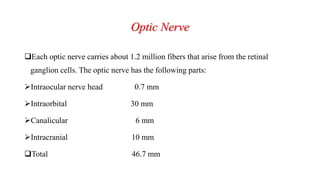
Each optic nerve carries about 1.2 million fibers that arise from the retinal
ganglion cells. The optic nerve has the following parts:
Intraocular nerve head 0.7 mm
Intraorbital 30 mm
Canalicular 6 mm
Intracranial 10 mm
Total 46.7 mm
Diseases of the optic nerve
a) Congenital anomalies
b) Oedema: Papilloedema
c) Inflammation: Optic neuritis
d) Atrophy: Optic atrophy
e) Tumours
Optic atrophy
• Optic atrophy refers to the death of the retinal ganglion cell axons that comprise
the optic nerve
• Optic atrophy is an end stage that arises from myriad causes of optic nerve
damage anywhere along the path from the retina to the lateral geniculate.
• Optic atrophy is somewhat of a misnomer as atrophy implies disuse,
and thus optic nerve damage is better termed optic neuropathy.
Optic atrophy:
Optic atrophy: Degeneration of optic nerve
There are 3 types of optic atrophy
a) Primary optic atrophy
b) Secondary optic atrophy
c) Consecutive optic atrophy
d) There is another type of optic atrophy which is called glaucomatous optic
atrophy
Primary optic atrophy
In conditions with primary optic atrophy (eg, pituitary tumor, optic nerve tumor,
traumatic optic neuropathy, multiple sclerosis), optic nerve fibers degenerate in an
orderly manner and are replaced by columns of glial cells without alteration in the
architecture of the optic nerve head.
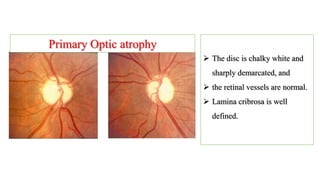
Primary Optic atrophy
 The disc is chalky white and
sharply demarcated, and
 the retinal vessels are normal.
 Lamina cribrosa is well
defined.
Secondary optic atrophy
In conditions with secondary optic atrophy (eg, papilledema, papillitis), the
atrophy is secondary to papilledema.
Optic nerve fibers exhibit marked degeneration, with excessive proliferation of
glial tissue.
The architecture is lost, resulting in indistinct margins.
On visual fields, progressive contraction of visual fields may be seen
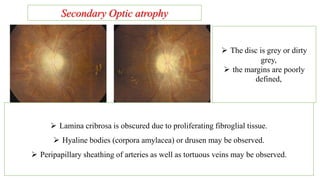
 The disc is grey or dirty
grey,
 the margins are poorly
defined,
 Lamina cribrosa is obscured due to proliferating fibroglial tissue.
 Hyaline bodies (corpora amylacea) or drusen may be observed.
 Peripapillary sheathing of arteries as well as tortuous veins may be observed.
Secondary Optic atrophy
Consecutive optic atrophy
Consecutive atrophy is an ascending type of atrophy (eg,
chorioretinitis, pigmentary retinal dystrophy, cerebromacular
degeneration) that usually results from diseases of the choroid or the
retina.
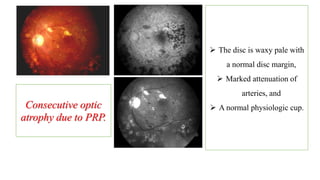
Consecutive optic
atrophy due to PRP.
 The disc is waxy pale with
a normal disc margin,
 Marked attenuation of
arteries, and
 A normal physiologic cup.
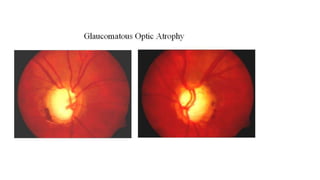
Glaucomatous optic atrophy
Characteristics include
vertical enlargement of cup,
visibility of the laminar pores (laminar dot sign),
backward bowing of the lamina cribrosa,
bayoneting and nasal shifting of the retinal vessels, and peripapillary halo and
atrophy.
Splinter hemorrhage at the disc margin may be observed.
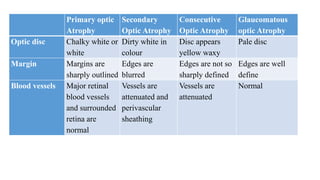
Primary optic
Atrophy
Secondary
Optic Atrophy
Consecutive
Optic Atrophy
Glaucomatous
optic Atrophy
Optic disc Chalky white or
white
Dirty white in
colour
Disc appears
yellow waxy
Pale disc
Margin Margins are
sharply outlined
Edges are
blurred
Edges are not so
sharply defined
Edges are well
define
Blood vessels Major retinal
blood vessels
and surrounded
retina are
normal
Vessels are
attenuated and
perivascular
sheathing
Vessels are
attenuated
Normal
Important causes of primary OA
a) Optic neuritis RBN
b) Compression by tumours and aneurysms.
c) Hereditary optic neuropathies.
d) Toxic and nutritional optic neuropathies; these may give temporal pallor,
particularly in early/milder cases when the papillomacular fibers are
preferentially affected
e) Some drugs: such as Ethambutol, Quinine
f) Trauma
Inflammation of the Optic Nerve (Optic Neuritis)
An inflammation of the optic nerve is known as optic neuritis. The optic nerve
may be affected by inflammation in any part of its course, but for clinical
convenience it is usual to divide inflammatory conditions into two categories:
Those affecting the part of the nerve ophthalmoscopically visible at the disc and
therefore showing obvious signs of disease:
a) Papillitis, or
b) Neuroretinitis, and
Inflammation of the Optic Nerve (Optic Neuritis)
Those which attack the nerve proximal to this region and therefore show no
ophthalmoscopic changes, so that the diagnosis has to be made on the basis of
symptoms alone:
Retrobulbar neuritis.
Papillitis
• Papillitis is characterized by hyperaemia and oedema of the optic disc, which may
be associated with peripapillary flame-shaped haemorrhages.
• Cells may be seen in the posterior vitreous.
• Papillitis is the most common type of optic neuritis in children, but can also affect
adults
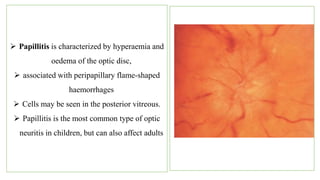
 Papillitis is characterized by hyperaemia and
oedema of the optic disc,
 associated with peripapillary flame-shaped
haemorrhages
 Cells may be seen in the posterior vitreous.
 Papillitis is the most common type of optic
neuritis in children, but can also affect adults
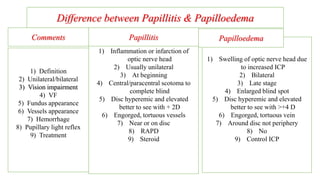
Difference between Papillitis & Papilloedema
1) Inflammation or infarction of
optic nerve head
2) Usually unilateral
3) At beginning
4) Central/paracentral scotoma to
complete blind
5) Disc hyperemic and elevated
better to see with + 2D
6) Engorged, tortuous vessels
7) Near or on disc
8) RAPD
9) Steroid
1) Swelling of optic nerve head due
to increased ICP
2) Bilateral
3) Late stage
4) Enlarged blind spot
5) Disc hyperemic and elevated
better to see with >+4 D
6) Engorged, tortuous vein
7) Around disc not periphery
8) No
9) Control ICP
1) Definition
2) Unilateral/bilateral
3) Vision impairment
4) VF
5) Fundus appearance
6) Vessels appearance
7) Hemorrhage
8) Pupillary light reflex
9) Treatment
Comments Papillitis Papilloedema
Toxic, Nutritional and Hereditary Optic Neuropathy (Parson’s):
Toxic, Nutritional and Hereditary Optic Neuropathy
(Parson’s): Aetiopathogenesis
Many nutritional deficiencies, toxic and hereditary optic neuropathies produce a
very similar clinical picture because there are common pathways by which these
vitamins work and by which many of these toxins interact
Vitamin deficiencies associated with poor diet may be compounded by the
ingestion of cassava and elevated levels of cyanide.
Cassava is the third-largest source of food
carbohydrates in the tropics,
after rice and maize. Cassava is a
major staple food in the developing world,
providing a basic diet for over half a
billion peoples. Nigeria is the world's
largest producer of cassava, while Thailand
is the largest exporter of cassava starch.
It must be properly prepared before
consumption, as improper preparation of
cassava can leave enough
residual cyanide to cause acute cyanide
intoxication
Cassava
Toxic, Nutritional and Hereditary Optic Neuropathy
(Parson’s): Aetiopathogenesis
• Within the mitochondria, oxidative phosphorylation involves the process of
electron transfer to oxygen at one end and the production of adenosine
triphosphate (ATP) at the other end.
• Vitamins such as B12 and folic acid are crucial to this process.
• Agents such as cyanide or formate (a metabolic product of methanol) block this
electron transport.
Toxic, Nutritional and Hereditary Optic Neuropathy
(Parson’s): Aetiopathogenesis
• The net result of these deficiencies and toxins is the decreased production of ATP
by mitochondria within all the cells of the body, most of which have compensatory
mechanisms to cope with this metabolic stress, such as muscle cells, which can
produce more mitochondria.
• Neurones with very low, very thin or unmyelinated axons, such as the
papillomacular bundle, are at a great disadvantage and more prone to be damaged
by these disorders.
Clinical Features
Usually, there is a sudden or rapid painless bilateral vision loss.
Simultaneous involvement of both eyes is more common with nutritional
deficiency, toxic and some hereditary disorders,
but monocular onset and fellow eye involvement occurring later (days, weeks or
months) is more common with Leber hereditary optic neuropathy.
Visual loss occurs, ranging from mild [6/7.5 (20/25)] to severe (finger-counting).
Clinical Features
Other clinical signs include disturbed colour perception and field defects typically
characterized by a centrocaecal scotoma.
Later, a temporal pallor of the disc becomes evident.
Associated neurological features such as paraesthesiae, ataxia and impaired
hearing may be seen
Differential Diagnosis
Leber hereditary optic neuropathy
Kjer autosomal dominant optic neuropathy
Compressive optic neuropathy (pituitary adeno ma or craniopharyngioma
compressing the optic chiasma)
Bilateral optic neuritis
Treatment
Avoidance of smoking, improvement of diet, nutritional supplementation and
administration of vitamins (B1, B6, B12) may show good results if the diagnosis is
made early and treatment instituted.
Vision can return to normal or near normal over several months. However, visual
loss is permanent in chronic, long-standing nutritional or toxic optic neuropathy
Toxic Optic Neuropathies
These include a number of conditions in which the optic nerve fibres are damaged
by exogenous poisons. Previously, these were called the toxic amblyopias, which is
a misnomer going by the modern definition of amblyopia.
The most common of these poisons are
 tobacco,
 ethyl alcohol,
 methyl alcohol,
 arsenic,
 lead,
 thallium,
 carbon disulphide,
 stramonium and
 Cannabis indica
 In some of them (tobacco, methyl
alcohol), the disease is primarily retinal
and follows poisoning of the ganglion
cells of the retina which results in
degeneration of the nerve fibres.
 Others are due to a direct effect on the
nerve fibres themselves.
The neuropathy produced by diabetes, carbon disulphide (seen in the rayon
industry), and iodoform resembles that of tobacco.
Tobacco-induced Optic Neuropathy: Pathogenesis
This results from the excessive use of tobacco, either pipe smoking or chewing,
and from the absorption of dust in tobacco factories. Cigars suffer the most;
cigarette smokers are rarely affected.
In many cases there is also an over-indulgence of alcohol but this is not invariable.
Patients, usually 35–50 years of age, may have smoked excessively for years with
digestive disturbance.
The potent factor is cyanide in tobacco associated with a deficiency of vitamin B12.
Tobacco-induced Optic Neuropathy: Symptoms
Pathologically, the condition is due to degeneration of the ganglion cells of the retina,
particularly of the macular area. In the nerve, the papillomacular bundle is degenerated
Clinically, the patient complains of increasing fogginess of vision, usually least marked in
the evening and in dull light.
Central vision is greatly diminished, so that reading and near work become difficult.
Although the condition is bilateral, one eye is usually more affected.
Tobacco-induced Optic Neuropathy: Diagnosis
The fundus is normal or a slight temporal pallor may be seen in the disc
but the diagnosis is made from the characteristic defects in the central fields.
These primarily involve the centrocaecal area between the fixation point and the
blind spot.
The scotoma gradually extends to involve the fixation area itself so that central
vision may be lost but the peripheral field remains unaffected.
Tobacco-induced Optic Neuropathy: Treatment
Consists of abstaining from tobacco and alcohol.
If this is done the prognosis is eventually good
Improvement may be hastened by intramuscular injections of 1000 mg
hydroxycobalamine. This dose should be repeated five times at intervals of 4 days
then at 2-weekly intervals for a few months.
Recovery may be monitored by the VEPs.
Optic Neuropathy: Ethyl Alcohol
Although alcohol is usually an adjuvant in tobacco-induced optic neuropathy,
it may cause a similar neuropathy in the absence of the latter.
Such patients frequently suffer from alcoholic peripheral neuritis.
The disease, characterized by a central scotoma,
may be due essentially to avitaminosis owing to chronic lack of nourishment.
Optic Neuropathy: Ethyl Alcohol
No specific therapy is available.
General measures such as stopping alcohol intake,
improved diet and
injections of hydroxycobalamine as outlined above can be tried.
Steroid therapy has not been found to be of any benefit.
Optic Neuropathy: Methyl Alcohol
Poisoning from drinking wood alcohol has always been common in countries
during prohibition, and occurs sporadically from drinking methylated spirit.
Individual susceptibility is marked.
It may occur in an acute or chronic form.
In the acute form there may be severe metabolic acidosis with nausea, headache
and giddiness followed by coma.
Optic Neuropathy: Methyl Alcohol
If the patient survives, vision fails very rapidly, passing through the stages of
contracted fields and
absolute central scotomata to
blindness.
The vision may improve, but usually relapses, becoming gradually abolished by
progressive optic atrophy.
Restoration of sight is rarely complete.
Optic Neuropathy: Methyl Alcohol
Ophthalmoscopically, there may be:
blurring of the edges of the discs and
diminution in the size of the vessels in the early stages.
Later there are signs of optic atrophy, usually of the primary type.
Pathologically:
there is widespread degeneration of the ganglion cells
Optic Neuropathy: Methyl Alcohol
Treatment
in the acute stage includes intra-venous bicarbonate and ethyl alcohol.
In the chronic form there is a gradual, progressive loss of vision with the
development of optic atrophy.
Optic Neuropathy: Arsenic
This is especially liable to cause optic atrophy, usually total.
Manifestations of acute toxicity include
burning in the throat, difficulty in swallowing,
nausea, vomiting, diarrhoea and abdominal pain,
with cyanosis, hypotension, delirium, seizures and haemolysis.
Optic Neuropathy: Arsenic
Manifestations of chronic poisoning include
erythroderma, hyperkeratosis,
hyperpigmentation, exfoliative dermatitis,
skin carcinoma,
bronchitis and polyneuritis.
Optic Neuropathy: Arsenic
The condition is diagnosed by the detection of arsenic in the hair and nails and the
measurement of arsenic levels in the blood (normal ,3 mg/dl) and urine (normal
,100 mg/L).
Acute ingestion is treated as a medical emergency. with gastric lavage and
dimercaprol.
D-penicillamine is useful in the treatment of chronic poisoning.
Optic Neuropathy: Lead
Lead poisoning is rarely seen nowadays since precautions have been taken to
eliminate salts of this metal from pottery glazes, children’s paints, painted toys,
etc.
However, it may still be a major problem due to vehicular pollution in some part
of the world.
Indigenous systems of medicine may include therapy with heavy metals for
prolonged periods.
Optic Neuropathy: Lead
• The ocular signs are optic neuritis or optic atrophy, which may be primary or post-
neuritic.
Optic Neuropathy: Ethambutol
Is used in the treatment of tuberculosis,
but acute or chronic optic neuritis, of uncertain mechanism, can occur.
Toxicity is broadly dose- and duration-dependent; the incidence is as high as 18%
at a daily dose over 35 mg/kg, but is rare (<1%) with a standard daily dose of 15
mg/kg or lower.
Toxicity typically occurs between 3 and 6 months of starting treatment,
Optic Neuropathy: Ethambutol
Symptoms may be absent.
but typically include painless bilateral blurring,
usually central though sometimes paracentral or peripheral.
Impairment of colour vision may be noticed
Optic Neuropathy: Ethambutol (Signs)
Minimal to severe reduction in VA,
normal or slightly swollen optic discs with splinter-shaped haemorrhages,
normal or sluggish pupils.
Red–green dyschromatopsia is the most common objective abnormality of colour
vision,
but subtle (undetectable on Ishihara testing) blue–yellow defects may be an early
finding.
Optic Neuropathy: Ethambutol
Visual field defects can be central or peripheral.
Prognosis is good following cessation of treatment, although recovery can be
prolonged.
A minority sustain permanent visual impairment, with optic atrophy.
Optic Neuropathy: Ethambutol (Screening)
Baseline VA and Ishihara testing are prudent prior to starting ethambutol, and the
patient should be advised of the necessity of reporting any visual disturbance.
Repeat testing should be performed frequently – possibly monthly – when the
dose is more than 15 mg/kg, and every 3–6 months with lower doses.
Ethambutol should be stopped immediately if toxicity develops, with
consideration also given to discontinuation of isoniazid if being used
synchronously.
Optic Neuropathy: Isoniazid
Isoniazid may very rarely cause toxic optic neuropathy; the risk is higher when
given in combination with ethambutol
Optic Neuropathy: Amiodarone
Optic neuropathy, probably demyelinative, affects 1–2% of patients on
long-term amiodarone treatment.
It is almost certainly not dose-related.
Distinction from non-arteritic anterior ischaemic optic neuropathy
(NAION), which also affects patients with systemic vascular disease, may
be difficult; it has been suggested that NAION is more common in patients
on amiodarone.
Optic Neuropathy: Amiodarone
Differentiation is clinically important as it is key to a decision about whether to
discontinue the drug.
The presence of a crowded optic disc,
speed of onset,
bilaterality,
duration of disc swelling and features of systemic amiodarone toxicity may be
helpful in this regard.
Optic Neuropathy: Amiodarone
• Presentation is with sudden or insidious unilateral or bilateral visual impairment,
after a mean period of 6–9 months taking the drug. About one-third of patients are
asymptomatic.
• Signs in a majority are unilateral or bilateral optic disc swelling that may persist
for a few months after medication is stopped. Corneal is Vortex keratopathy
(cornea verticillata)
Optic Neuropathy: Amiodarone
Investigation: Cranial imaging may be indicated when bilateral disc swelling is
present.
• Visual field defects are of varied configuration and severity, and may be reversible
or permanent
Prognosis is variable; cessation of the drug usually improves vision, but 20% may
deteriorate further. Final VA of worse than 6/60 occurs in around 20% of eyes.
Screening: Patients should be warned of the risk and cautioned to report visual
symptoms immediately

03 lecture neuro

  • 1.
    Neuro-Ophthalmology: Optic Nerve Dr.Md. Anisur Rahman (Anjum) Professor & Head, Department of Ophthalmology Dhaka Medical College, Dhaka
  • 2.
    Optic Nerve Each opticnerve carries about 1.2 million fibers that arise from the retinal ganglion cells. The optic nerve has the following parts: Intraocular nerve head 0.7 mm Intraorbital 30 mm Canalicular 6 mm Intracranial 10 mm Total 46.7 mm
  • 3.
    Diseases of theoptic nerve a) Congenital anomalies b) Oedema: Papilloedema c) Inflammation: Optic neuritis d) Atrophy: Optic atrophy e) Tumours
  • 4.
    Optic atrophy • Opticatrophy refers to the death of the retinal ganglion cell axons that comprise the optic nerve • Optic atrophy is an end stage that arises from myriad causes of optic nerve damage anywhere along the path from the retina to the lateral geniculate. • Optic atrophy is somewhat of a misnomer as atrophy implies disuse, and thus optic nerve damage is better termed optic neuropathy.
  • 5.
    Optic atrophy: Optic atrophy:Degeneration of optic nerve There are 3 types of optic atrophy a) Primary optic atrophy b) Secondary optic atrophy c) Consecutive optic atrophy d) There is another type of optic atrophy which is called glaucomatous optic atrophy
  • 6.
    Primary optic atrophy Inconditions with primary optic atrophy (eg, pituitary tumor, optic nerve tumor, traumatic optic neuropathy, multiple sclerosis), optic nerve fibers degenerate in an orderly manner and are replaced by columns of glial cells without alteration in the architecture of the optic nerve head.
  • 7.
    Primary Optic atrophy The disc is chalky white and sharply demarcated, and  the retinal vessels are normal.  Lamina cribrosa is well defined.
  • 8.
    Secondary optic atrophy Inconditions with secondary optic atrophy (eg, papilledema, papillitis), the atrophy is secondary to papilledema. Optic nerve fibers exhibit marked degeneration, with excessive proliferation of glial tissue. The architecture is lost, resulting in indistinct margins. On visual fields, progressive contraction of visual fields may be seen
  • 9.
     The discis grey or dirty grey,  the margins are poorly defined,  Lamina cribrosa is obscured due to proliferating fibroglial tissue.  Hyaline bodies (corpora amylacea) or drusen may be observed.  Peripapillary sheathing of arteries as well as tortuous veins may be observed. Secondary Optic atrophy
  • 10.
    Consecutive optic atrophy Consecutiveatrophy is an ascending type of atrophy (eg, chorioretinitis, pigmentary retinal dystrophy, cerebromacular degeneration) that usually results from diseases of the choroid or the retina.
  • 11.
    Consecutive optic atrophy dueto PRP.  The disc is waxy pale with a normal disc margin,  Marked attenuation of arteries, and  A normal physiologic cup.
  • 12.
    Glaucomatous optic atrophy Characteristicsinclude vertical enlargement of cup, visibility of the laminar pores (laminar dot sign), backward bowing of the lamina cribrosa, bayoneting and nasal shifting of the retinal vessels, and peripapillary halo and atrophy. Splinter hemorrhage at the disc margin may be observed.
  • 15.
    Primary optic Atrophy Secondary Optic Atrophy Consecutive OpticAtrophy Glaucomatous optic Atrophy Optic disc Chalky white or white Dirty white in colour Disc appears yellow waxy Pale disc Margin Margins are sharply outlined Edges are blurred Edges are not so sharply defined Edges are well define Blood vessels Major retinal blood vessels and surrounded retina are normal Vessels are attenuated and perivascular sheathing Vessels are attenuated Normal
  • 16.
    Important causes ofprimary OA a) Optic neuritis RBN b) Compression by tumours and aneurysms. c) Hereditary optic neuropathies. d) Toxic and nutritional optic neuropathies; these may give temporal pallor, particularly in early/milder cases when the papillomacular fibers are preferentially affected
  • 17.
    e) Some drugs:such as Ethambutol, Quinine f) Trauma
  • 20.
    Inflammation of theOptic Nerve (Optic Neuritis)
  • 21.
    Inflammation of theOptic Nerve (Optic Neuritis) An inflammation of the optic nerve is known as optic neuritis. The optic nerve may be affected by inflammation in any part of its course, but for clinical convenience it is usual to divide inflammatory conditions into two categories: Those affecting the part of the nerve ophthalmoscopically visible at the disc and therefore showing obvious signs of disease: a) Papillitis, or b) Neuroretinitis, and
  • 22.
    Inflammation of theOptic Nerve (Optic Neuritis) Those which attack the nerve proximal to this region and therefore show no ophthalmoscopic changes, so that the diagnosis has to be made on the basis of symptoms alone: Retrobulbar neuritis.
  • 23.
    Papillitis • Papillitis ischaracterized by hyperaemia and oedema of the optic disc, which may be associated with peripapillary flame-shaped haemorrhages. • Cells may be seen in the posterior vitreous. • Papillitis is the most common type of optic neuritis in children, but can also affect adults
  • 24.
     Papillitis ischaracterized by hyperaemia and oedema of the optic disc,  associated with peripapillary flame-shaped haemorrhages  Cells may be seen in the posterior vitreous.  Papillitis is the most common type of optic neuritis in children, but can also affect adults
  • 25.
    Difference between Papillitis& Papilloedema 1) Inflammation or infarction of optic nerve head 2) Usually unilateral 3) At beginning 4) Central/paracentral scotoma to complete blind 5) Disc hyperemic and elevated better to see with + 2D 6) Engorged, tortuous vessels 7) Near or on disc 8) RAPD 9) Steroid 1) Swelling of optic nerve head due to increased ICP 2) Bilateral 3) Late stage 4) Enlarged blind spot 5) Disc hyperemic and elevated better to see with >+4 D 6) Engorged, tortuous vein 7) Around disc not periphery 8) No 9) Control ICP 1) Definition 2) Unilateral/bilateral 3) Vision impairment 4) VF 5) Fundus appearance 6) Vessels appearance 7) Hemorrhage 8) Pupillary light reflex 9) Treatment Comments Papillitis Papilloedema
  • 26.
    Toxic, Nutritional andHereditary Optic Neuropathy (Parson’s):
  • 27.
    Toxic, Nutritional andHereditary Optic Neuropathy (Parson’s): Aetiopathogenesis Many nutritional deficiencies, toxic and hereditary optic neuropathies produce a very similar clinical picture because there are common pathways by which these vitamins work and by which many of these toxins interact Vitamin deficiencies associated with poor diet may be compounded by the ingestion of cassava and elevated levels of cyanide.
  • 28.
    Cassava is thethird-largest source of food carbohydrates in the tropics, after rice and maize. Cassava is a major staple food in the developing world, providing a basic diet for over half a billion peoples. Nigeria is the world's largest producer of cassava, while Thailand is the largest exporter of cassava starch. It must be properly prepared before consumption, as improper preparation of cassava can leave enough residual cyanide to cause acute cyanide intoxication Cassava
  • 29.
    Toxic, Nutritional andHereditary Optic Neuropathy (Parson’s): Aetiopathogenesis • Within the mitochondria, oxidative phosphorylation involves the process of electron transfer to oxygen at one end and the production of adenosine triphosphate (ATP) at the other end. • Vitamins such as B12 and folic acid are crucial to this process. • Agents such as cyanide or formate (a metabolic product of methanol) block this electron transport.
  • 30.
    Toxic, Nutritional andHereditary Optic Neuropathy (Parson’s): Aetiopathogenesis • The net result of these deficiencies and toxins is the decreased production of ATP by mitochondria within all the cells of the body, most of which have compensatory mechanisms to cope with this metabolic stress, such as muscle cells, which can produce more mitochondria. • Neurones with very low, very thin or unmyelinated axons, such as the papillomacular bundle, are at a great disadvantage and more prone to be damaged by these disorders.
  • 31.
    Clinical Features Usually, thereis a sudden or rapid painless bilateral vision loss. Simultaneous involvement of both eyes is more common with nutritional deficiency, toxic and some hereditary disorders, but monocular onset and fellow eye involvement occurring later (days, weeks or months) is more common with Leber hereditary optic neuropathy. Visual loss occurs, ranging from mild [6/7.5 (20/25)] to severe (finger-counting).
  • 32.
    Clinical Features Other clinicalsigns include disturbed colour perception and field defects typically characterized by a centrocaecal scotoma. Later, a temporal pallor of the disc becomes evident. Associated neurological features such as paraesthesiae, ataxia and impaired hearing may be seen
  • 33.
    Differential Diagnosis Leber hereditaryoptic neuropathy Kjer autosomal dominant optic neuropathy Compressive optic neuropathy (pituitary adeno ma or craniopharyngioma compressing the optic chiasma) Bilateral optic neuritis
  • 34.
    Treatment Avoidance of smoking,improvement of diet, nutritional supplementation and administration of vitamins (B1, B6, B12) may show good results if the diagnosis is made early and treatment instituted. Vision can return to normal or near normal over several months. However, visual loss is permanent in chronic, long-standing nutritional or toxic optic neuropathy
  • 35.
    Toxic Optic Neuropathies Theseinclude a number of conditions in which the optic nerve fibres are damaged by exogenous poisons. Previously, these were called the toxic amblyopias, which is a misnomer going by the modern definition of amblyopia.
  • 36.
    The most commonof these poisons are  tobacco,  ethyl alcohol,  methyl alcohol,  arsenic,  lead,  thallium,  carbon disulphide,  stramonium and  Cannabis indica  In some of them (tobacco, methyl alcohol), the disease is primarily retinal and follows poisoning of the ganglion cells of the retina which results in degeneration of the nerve fibres.  Others are due to a direct effect on the nerve fibres themselves.
  • 37.
    The neuropathy producedby diabetes, carbon disulphide (seen in the rayon industry), and iodoform resembles that of tobacco.
  • 38.
    Tobacco-induced Optic Neuropathy:Pathogenesis This results from the excessive use of tobacco, either pipe smoking or chewing, and from the absorption of dust in tobacco factories. Cigars suffer the most; cigarette smokers are rarely affected. In many cases there is also an over-indulgence of alcohol but this is not invariable. Patients, usually 35–50 years of age, may have smoked excessively for years with digestive disturbance. The potent factor is cyanide in tobacco associated with a deficiency of vitamin B12.
  • 39.
    Tobacco-induced Optic Neuropathy:Symptoms Pathologically, the condition is due to degeneration of the ganglion cells of the retina, particularly of the macular area. In the nerve, the papillomacular bundle is degenerated Clinically, the patient complains of increasing fogginess of vision, usually least marked in the evening and in dull light. Central vision is greatly diminished, so that reading and near work become difficult. Although the condition is bilateral, one eye is usually more affected.
  • 40.
    Tobacco-induced Optic Neuropathy:Diagnosis The fundus is normal or a slight temporal pallor may be seen in the disc but the diagnosis is made from the characteristic defects in the central fields. These primarily involve the centrocaecal area between the fixation point and the blind spot. The scotoma gradually extends to involve the fixation area itself so that central vision may be lost but the peripheral field remains unaffected.
  • 41.
    Tobacco-induced Optic Neuropathy:Treatment Consists of abstaining from tobacco and alcohol. If this is done the prognosis is eventually good Improvement may be hastened by intramuscular injections of 1000 mg hydroxycobalamine. This dose should be repeated five times at intervals of 4 days then at 2-weekly intervals for a few months. Recovery may be monitored by the VEPs.
  • 42.
    Optic Neuropathy: EthylAlcohol Although alcohol is usually an adjuvant in tobacco-induced optic neuropathy, it may cause a similar neuropathy in the absence of the latter. Such patients frequently suffer from alcoholic peripheral neuritis. The disease, characterized by a central scotoma, may be due essentially to avitaminosis owing to chronic lack of nourishment.
  • 43.
    Optic Neuropathy: EthylAlcohol No specific therapy is available. General measures such as stopping alcohol intake, improved diet and injections of hydroxycobalamine as outlined above can be tried. Steroid therapy has not been found to be of any benefit.
  • 44.
    Optic Neuropathy: MethylAlcohol Poisoning from drinking wood alcohol has always been common in countries during prohibition, and occurs sporadically from drinking methylated spirit. Individual susceptibility is marked. It may occur in an acute or chronic form. In the acute form there may be severe metabolic acidosis with nausea, headache and giddiness followed by coma.
  • 45.
    Optic Neuropathy: MethylAlcohol If the patient survives, vision fails very rapidly, passing through the stages of contracted fields and absolute central scotomata to blindness. The vision may improve, but usually relapses, becoming gradually abolished by progressive optic atrophy. Restoration of sight is rarely complete.
  • 46.
    Optic Neuropathy: MethylAlcohol Ophthalmoscopically, there may be: blurring of the edges of the discs and diminution in the size of the vessels in the early stages. Later there are signs of optic atrophy, usually of the primary type. Pathologically: there is widespread degeneration of the ganglion cells
  • 47.
    Optic Neuropathy: MethylAlcohol Treatment in the acute stage includes intra-venous bicarbonate and ethyl alcohol. In the chronic form there is a gradual, progressive loss of vision with the development of optic atrophy.
  • 48.
    Optic Neuropathy: Arsenic Thisis especially liable to cause optic atrophy, usually total. Manifestations of acute toxicity include burning in the throat, difficulty in swallowing, nausea, vomiting, diarrhoea and abdominal pain, with cyanosis, hypotension, delirium, seizures and haemolysis.
  • 49.
    Optic Neuropathy: Arsenic Manifestationsof chronic poisoning include erythroderma, hyperkeratosis, hyperpigmentation, exfoliative dermatitis, skin carcinoma, bronchitis and polyneuritis.
  • 50.
    Optic Neuropathy: Arsenic Thecondition is diagnosed by the detection of arsenic in the hair and nails and the measurement of arsenic levels in the blood (normal ,3 mg/dl) and urine (normal ,100 mg/L). Acute ingestion is treated as a medical emergency. with gastric lavage and dimercaprol. D-penicillamine is useful in the treatment of chronic poisoning.
  • 51.
    Optic Neuropathy: Lead Leadpoisoning is rarely seen nowadays since precautions have been taken to eliminate salts of this metal from pottery glazes, children’s paints, painted toys, etc. However, it may still be a major problem due to vehicular pollution in some part of the world. Indigenous systems of medicine may include therapy with heavy metals for prolonged periods.
  • 52.
    Optic Neuropathy: Lead •The ocular signs are optic neuritis or optic atrophy, which may be primary or post- neuritic.
  • 53.
    Optic Neuropathy: Ethambutol Isused in the treatment of tuberculosis, but acute or chronic optic neuritis, of uncertain mechanism, can occur. Toxicity is broadly dose- and duration-dependent; the incidence is as high as 18% at a daily dose over 35 mg/kg, but is rare (<1%) with a standard daily dose of 15 mg/kg or lower. Toxicity typically occurs between 3 and 6 months of starting treatment,
  • 54.
    Optic Neuropathy: Ethambutol Symptomsmay be absent. but typically include painless bilateral blurring, usually central though sometimes paracentral or peripheral. Impairment of colour vision may be noticed
  • 55.
    Optic Neuropathy: Ethambutol(Signs) Minimal to severe reduction in VA, normal or slightly swollen optic discs with splinter-shaped haemorrhages, normal or sluggish pupils. Red–green dyschromatopsia is the most common objective abnormality of colour vision, but subtle (undetectable on Ishihara testing) blue–yellow defects may be an early finding.
  • 56.
    Optic Neuropathy: Ethambutol Visualfield defects can be central or peripheral. Prognosis is good following cessation of treatment, although recovery can be prolonged. A minority sustain permanent visual impairment, with optic atrophy.
  • 57.
    Optic Neuropathy: Ethambutol(Screening) Baseline VA and Ishihara testing are prudent prior to starting ethambutol, and the patient should be advised of the necessity of reporting any visual disturbance. Repeat testing should be performed frequently – possibly monthly – when the dose is more than 15 mg/kg, and every 3–6 months with lower doses. Ethambutol should be stopped immediately if toxicity develops, with consideration also given to discontinuation of isoniazid if being used synchronously.
  • 58.
    Optic Neuropathy: Isoniazid Isoniazidmay very rarely cause toxic optic neuropathy; the risk is higher when given in combination with ethambutol
  • 59.
    Optic Neuropathy: Amiodarone Opticneuropathy, probably demyelinative, affects 1–2% of patients on long-term amiodarone treatment. It is almost certainly not dose-related. Distinction from non-arteritic anterior ischaemic optic neuropathy (NAION), which also affects patients with systemic vascular disease, may be difficult; it has been suggested that NAION is more common in patients on amiodarone.
  • 60.
    Optic Neuropathy: Amiodarone Differentiationis clinically important as it is key to a decision about whether to discontinue the drug. The presence of a crowded optic disc, speed of onset, bilaterality, duration of disc swelling and features of systemic amiodarone toxicity may be helpful in this regard.
  • 61.
    Optic Neuropathy: Amiodarone •Presentation is with sudden or insidious unilateral or bilateral visual impairment, after a mean period of 6–9 months taking the drug. About one-third of patients are asymptomatic. • Signs in a majority are unilateral or bilateral optic disc swelling that may persist for a few months after medication is stopped. Corneal is Vortex keratopathy (cornea verticillata)
  • 62.
    Optic Neuropathy: Amiodarone Investigation:Cranial imaging may be indicated when bilateral disc swelling is present. • Visual field defects are of varied configuration and severity, and may be reversible or permanent Prognosis is variable; cessation of the drug usually improves vision, but 20% may deteriorate further. Final VA of worse than 6/60 occurs in around 20% of eyes. Screening: Patients should be warned of the risk and cautioned to report visual symptoms immediately