HOW TO WRITE A MEDICAL
ORIGINAL ARTICLE
Elsayed SALIH MD
Associate professor of urology
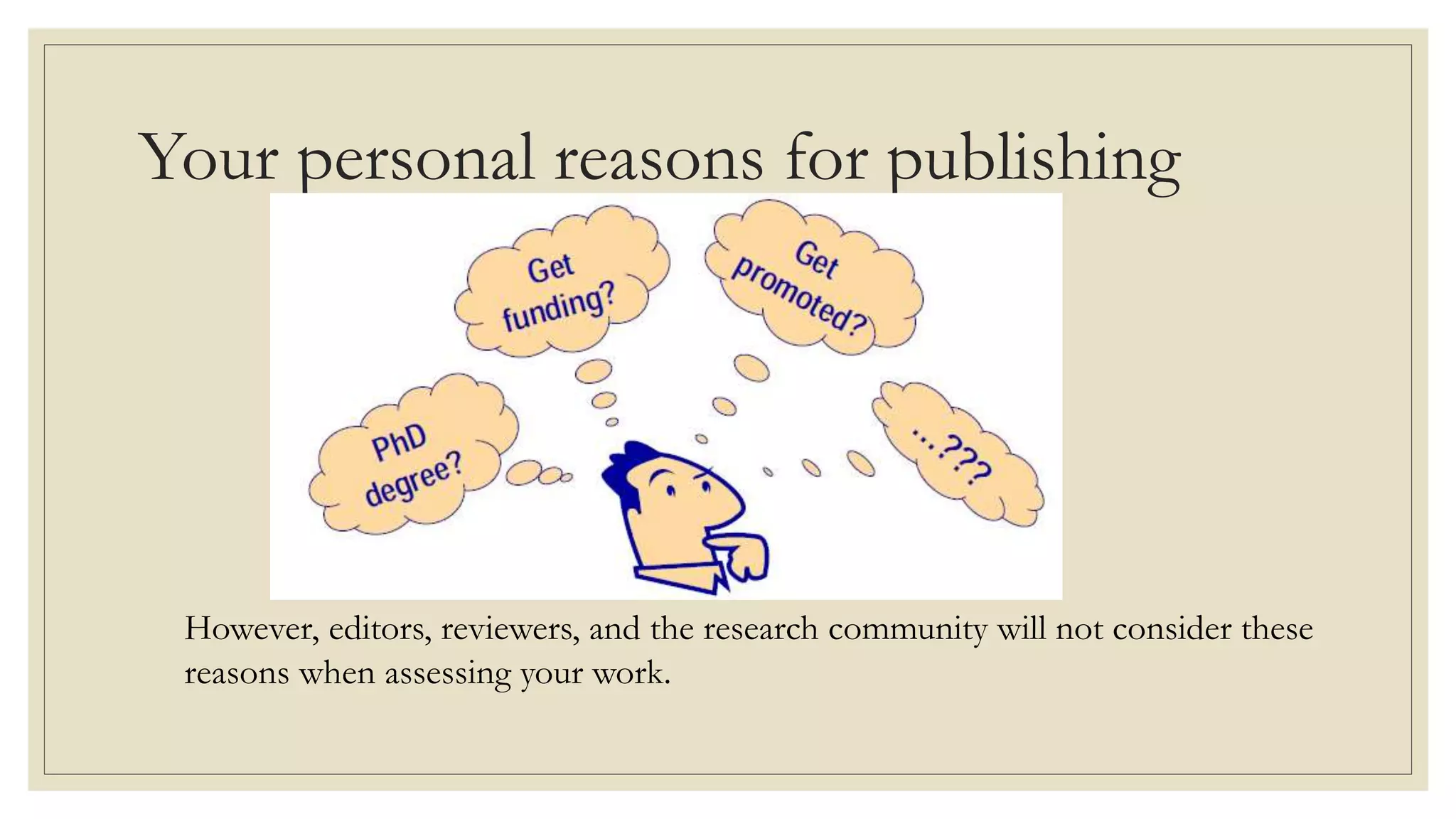
Your personal reasons for publishing
However, editors, reviewers, and the research community will not consider these
reasons when assessing your work.
Introduction
◦ Editors reject ill-prepared manuscripts and try to improve those
accepted.
◦ Referees provide a detailed criticism of the content of papers submitted
◦ many authors find difficulty in placing a piece of writing which has
taken much time and trouble to prepare, and might contain work of
importance.
◦ Doctors spend a great deal of time with ‘pen in hand’.
basic triad of an original article
1. A subject worth reporting,
2. Knowledge of the basic structure of a peer-reviewed article,
3. Knowledge of the essentials of good writing.
The subject
◦ Must be an addition to the existing literature.
◦ read the previous relevant reports carefully
◦ Not repeating what has been done successfully before.
◦ Do not waste your time in writing a paper which will never be published.
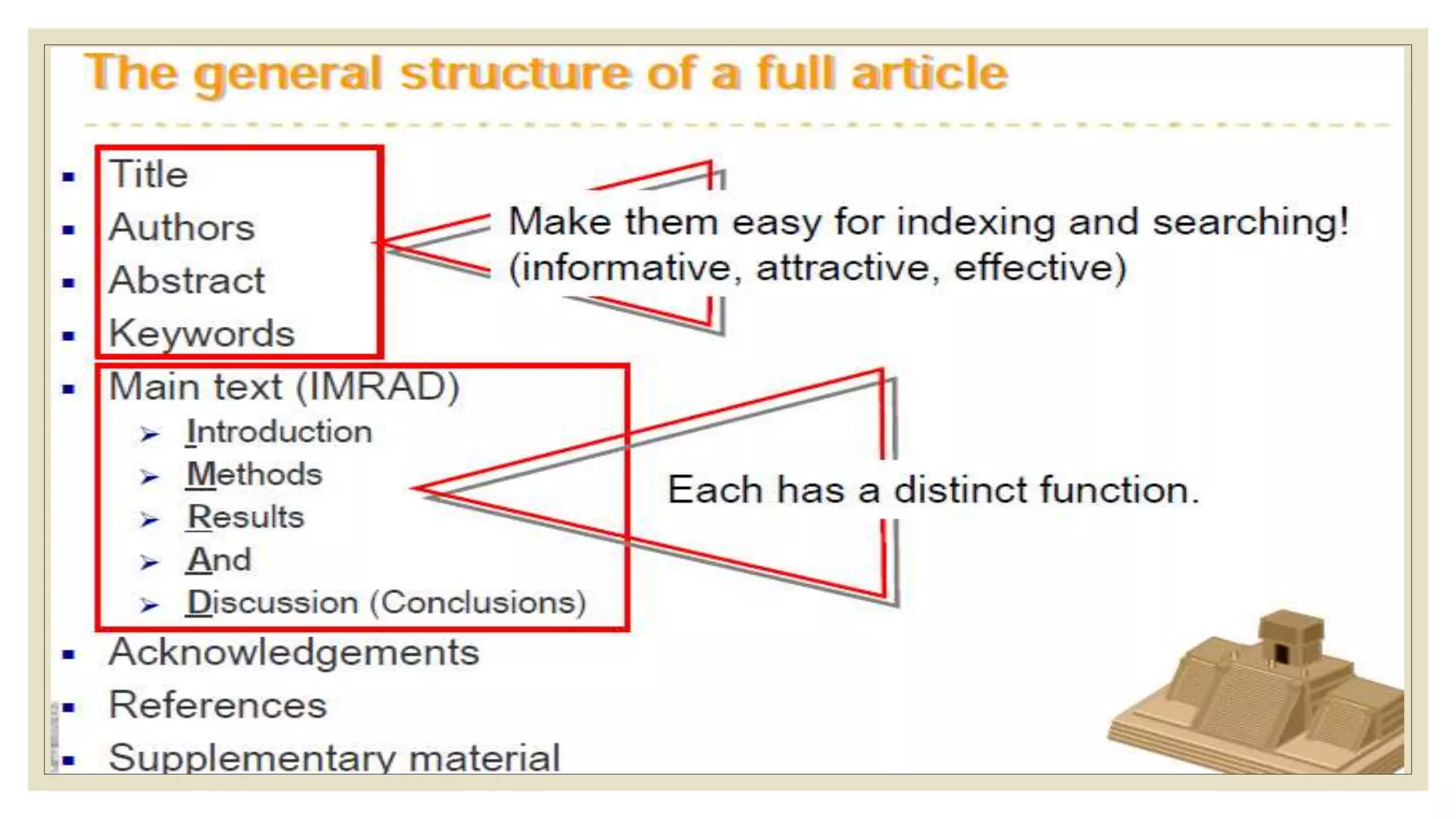
The basic structure of an article
1. A title page,
2. Abstract,
3. Introduction,
4. Patients (or materials)
and methods,
5. Results,
6. Discussion,
7. Summary
8. Conclusion,
9. The references,
10. Tables,
11. Figures,
12. Legends to figures
13. Acknowledgements.
checklist
A. The author’s check list
B. The reviewer’s checklist
The author’s check list
1. Introduction
◦ Short review
◦ Shortcomings of the existing reports
◦ Aim of the study
◦ Scope of the study
3. Patients (or materials) and methods
◦ Full description of patients/materials
◦ Full description of methods
◦ Study design
◦ Statistical analysis
◦ Ethical considerations
4. Results
◦ Presentation of data
◦ Correlation of data
5. Discussion
◦ Introduction to discussion
◦ Discussion of the results
◦ Advantages of the study
◦ Limitations of the study
◦ Recommendations of authors
The reviewer’s checklist
1. Introduction
◦ Are the objectives clear?
◦ Is the importance of the study adequately emphasized ?
◦ Is the subject matter of the study new?
◦ Is previous work on the subject adequately cited?
The reviewer’s checklist
2. Patients (materials) and methods
◦ Is the study population detailed adequately ?
◦ Are the methods described well enough to reproduce the experiment?
◦ Is the study design clear?
◦ Are statistical methods included?
◦ Are ethical considerations provided?
The reviewer’s checklist
3. Results
◦ Can the reader assess the results based on the data provided?
◦ Is the information straightforward and not confusing?
◦ Are there adequate controls?
◦ Are statistical methods appropriate?
The reviewer’s checklist
4. Discussion
◦ Do the authors comment adequately on all their results?
◦ Have the authors explained why and how their study differs from others
already published?
◦ Do the authors discuss the potential problems and limitations with their
study?
◦ Are the authors’ conclusions supported by the results?
The title page
◦ Contains
1. The title,
2. List of authors,
3. Institutions,
4. Running title,
5. Keywords,
6. Word count,
7. Correspondence address
The title
◦ should be informative, specific, comprehensive and accurate
◦ stating exactly what the article is about.
◦ convey maximum information in a minimum of words.
◦ express the main issue of the study and preferably the type of study.
◦ state the subject, never the conclusion.
◦ reassessed frequently,
◦ when the paper is finished the final title is the last sentence to be written.
The authors
◦ The person must have contributed such as
1. Creative thinking,
2. Performing diagnostic
3. Therapeutic techniques that are essential to the study,
4. Collecting data,
5. Writing the paper.
The Vancouver protocol
◦ Detect the authorship on publications.
◦ Authorship credit should be based only on substantial contributions to:
◦ 1) conception and design, the acquisition of the data, and/* or analysis and
interpretation of data
◦ 2) drafting the article or revising it critically for important intellectual content
◦ 3) final approval of the version to be published.
◦ Conditions 1, 2, and 3 must all be met.
◦ not enough to have completed just one or two of these tasks, and a legitimate
author would need to be involved in all three to be acknowledged as an author.
who should be the first author?
◦ the first author is the one who has done the most work.
◦ with equal contributions, the advantage to the junior
◦ For two authors, in the first publication the advantage to the junior and in the
second publication, redress the balance.
◦ Papers from thesis the candidate is first and the most senior the last.
◦ use only one name with the same spelling for the family, initial and middle
names in all publications. For example, ‘Abdulrahman’ is different from
‘Abdelrahman and abdel Rahman ’.
Institutions
◦ The affiliations should be listed in the title page only.
◦ do not provide the affiliations or information within the main text
◦ to avoid bias by the referees.
◦ After a successful review the name of the institutions and affiliations added.
Running title, keywords, word count and
correspondence address
◦ The title page should contain a short running title and a few keywords
(usually six) to facilitate database searches.
◦ Most journals require a limited length (2000–3000 words)
◦ The title page should contain a full address of a corresponding author who
will be responsible for contact with the editors.
Abstract
◦ This is the first text to appear and should be last to be written.
◦ It contains the most important ideas of the article.
◦ structured into four paragraphs, i.e., objectives, patients (or materials) and
methods, results, and conclusions.
◦ The abstract is limited to 200–300 words by most journals.
◦ Conclusions should satisfy the objectives of the study.
Introduction
◦ To gain the reader’s attention by giving sufficient information to outline
the problem or matter of the article.
◦ Must be short, easy to read and to the point.
◦ Some referees and editors consider the introduction as the most important
part of the paper
◦ It sets the tone and quality of the entire paper.
Introduction
1. A short review of the main subject of the study,
2. The shortcomings of previous studies,
3. The aim of the study
4. The scope of the study.
The short review
◦ Outlines the core of the subject.
◦ Concise, interesting and informative.
◦ Long historical reviews are dull.
◦ The review varies in length
◦ Supported by the major and more recent references.
◦ Do not use too many references
Shortcomings of the existing studies
◦ Addressing
1. the problems,
2. limitations
3. shortcomings of previous studies.
The aim of the study
◦ The study should answer a timely and important question,
◦ the rationale of the study must be strong and very clear,
◦ the results should be an addition to the existing knowledge.
Scope of the study
◦ At the end of the introduction there must be a short paragraph setting out
the scope of the study, providing a quick overview of the organisation of
the study that follows.
Evaluating the introduction
◦ To evaluate the introduction, the reviewer will ask the following questions:
1. Are the objectives clear?
2. Is the importance of the study adequately emphasised?
3. Is the subject matter of the study new?
4. Is previous work on the subject adequately cited?
Patients (or materials) and methods
◦ full description of
1. the materials,
2. the methods
3. the design of the study
4. the statistical methods used
5. ethical considerations.
Patients or materials
◦ The patients fully described,
◦ The demographic characteristics of the patients
◦ All information relevant to the study must be detailed.
Methods
◦ All the methods used must be described as:
1. The surgical technique,
2. Radiological technique,
3. Drugs used (preparation, dose, route of administration, timing, etc.)
◦ Only new methods need to be described in detail.
◦ For a common previously published method, use only a reference
◦ For an uncommon method give a short summary in addition to the reference.
◦ Any manufacturer’s details must be mentioned.
Methods
◦ should be entirely relevant to satisfying the objectives of the study
◦ do not detail any irrelevant methods
◦ Remember that the results of all methods mentioned in this section must be
provided in the results section
Design of the study
◦ A separate paragraph
◦ Provide a full description of the design of the study.
◦ If controlled, describe the control,
◦ If randomised, provide the type and method of randomisation
Statistical methods
◦ A separate paragraph
◦ Describe the statistical methods used.
◦ For uncommonly used statistical methods provide a reference,
◦ Not necessary to detail software sources if the methods used are standard.
Ethical considerations
◦ Any informed consent required.
◦ Ethical approval by a committee.
◦ The funding source.
◦ Conflict of interest statement.
◦ A statement about compliance with the declaration of helsinki for animal
studies (if applicable).
Evaluation of the methods section
◦ the reviewer will ask the following questions:
1. Is the study population described in adequate detail?
2. Are the methods described well enough to reproduce the experiment?
3. Is the study design clear?
4. Are statistical methods included?
5. Are ethical considerations provided?
Results
1. The presentation of data
2. Analysis of the results.
The presentation of data
◦ Provided in a respective and systematic manner.
◦ Present the results as text, tables or graphs, but do not repeat the same data in
more than one.
◦ The data presented in a logical order, not the order in which the work was done.
◦ Do not write any result for a method not mentioned in ‘materials and methods’.
◦ Results must be written in a clear unequivocal and unambiguous manner.
Analysis of the results
◦ The statistical analysis should be used to obtain an objective proof
◦ In comparative studies, each comparison provided with its specific statistical
evaluation.
Evaluation of the results
◦ the reviewer will ask the following questions:
1. Can the reader assess the results based on the data provided?
2. Is the information straightforward and not confusing?
3. Are there adequate controls?
4. Are the statistical methods appropriate?
The discussion
1. An introduction to the discussion
2. Discussion of the results,
3. New findings provided by the study,
4. The limitations of the study,
5. Recommendations relevant to practice.
Introduction
◦ It is preferable to start the discussion with a short paragraph summarising
the important findings from the results section.
Discussion of the results
◦ Each result obtained must be adequately discussed and compared with
similar previous studies in a respective, logical and clear manner.
◦ If the results of the study differ from previous give explanation.
◦ Each issue must be discussed in only one place
◦ Avoiding any repetition of ideas.
◦ Avoid opinion bias.
◦ Previous studies must be highlighted regardless of their results
Advantages and disadvantages of the study
and Recommendations
◦ describe the advantages and any new findings .
◦ Mention the disadvantages, limitations and shortcomings, and how these could
be avoided in future studies.
◦ Recommendations based on the results of the study.
Evaluation of the discussion
◦ the reviewer will ask the following questions:
1. Do the authors comment adequately on all their results?
2. Have the authors explained why and how their study differs from others already
published?
3. Do the authors discuss the potential problems and limitations of their study?
4. Are the authors’ conclusions supported by the results?
The summary
◦ Written as a separate section or as the last paragraph of the discussion.
◦ Stress the most relevant findings of the study.
◦ It is the ‘takehome message’
◦ A digest of the whole study.
◦ It is not a repetition of the abstract, but an extended conclusion.
◦ It justifies and explains the conclusion of the study.
The references
◦ Styles:
1. The alphabetical (Harvard) system
2. the Vancouver system.
The alphabetical (Harvard) system
◦ Is commonly used in a thesis,
◦ The reference in the text is written as the name of the author(s) followed by the
year of publication, e.G., (Khalaf, 2005), while in the reference section the
references are arranged alphabetically rather than a numerical list.
In the Vancouver system
◦ Most medical journals use it
◦ The references expressed in the text as numbers.
◦ The references are arranged numerically in the reference section according
to their order of appearance in the text
General advice
◦ Each journal has its own style of references (house-style)
◦ Read the instructions and examine a recent copy of the journal.
◦ All references should be written in the same style with the same
arrangement
◦ Recent references are better than older ones
◦ book references are of the least significance.
◦ The integrity of the references is the responsibility of the author only
◦ Some journals have a maximum number of references not exceeded.
Evaluation of the references
◦ Most referees check some references at random.
◦ References are a very sensitive indicator of the whole article.
◦ If the author is lax with references, he or she might have been careless
with the entire paper
Tables (Objectives and characters)
◦ objectives of the table are to detail the content without reading the text
◦ provide comprehensible results at a glance.
◦ A good table is a single unit of communication, i.e., completely
informative and completely intelligible to others.
◦ It should supply maximum of information with minimum of words.
◦ provide additional information not present in the text, to avoid redundancy.
How to design a good table
◦ To design a clear table the data should be arranged in the correct order,
omitting unimportant values and eliminating unnecessary words.
◦ Tables should be carefully designed to avoid any repetition of headings
and to be simple, clear, not confusing, and easy to follow.
◦ Tables must be condensed, avoiding the splitting of similar data, so that all
possible relevant information is presented together in one table.
Illustrations and figures (Objectives)
◦ grasp the message easily.
◦ A common phrase is ‘one picture is worth a thousand words’.
◦ The purpose of the illustration is not to beautify the paper, but to convey
clear information (introduce, explain or summarise).
Designing a good illustration or figure
◦ a good illustration must be simple.
◦ Avoid sophistication and secondary details.
◦ Avoid using the unnecessary features common in graphics packages like
three-dimensional bars or pie charts.
◦ There should be no repetition and no contradiction to the information
mentioned in the text or tables.
◦ Consider that potentially good reproduction on photocopying by not using
light colours like yellow, light green or light orange.
Acknowledgements
◦ Persons who are not included among authors and who helped at any stage
of the study, starting from searching a subject and ending by submission
of the manuscript.
Common reasons for rejection
◦ The article is not relevant to the journal.
◦ The paper is not styled for the journal.
◦ It was a poorly designed trial.
◦ The article was badly written.
◦ The conclusions are unjustified.
◦ There was reviewer/editor bias.
How to write a medical original article

How to write a medical original article

  • 1.
    HOW TO WRITEA MEDICAL ORIGINAL ARTICLE Elsayed SALIH MD Associate professor of urology
  • 2.
    Your personal reasonsfor publishing However, editors, reviewers, and the research community will not consider these reasons when assessing your work.
  • 3.
    Introduction ◦ Editors rejectill-prepared manuscripts and try to improve those accepted. ◦ Referees provide a detailed criticism of the content of papers submitted ◦ many authors find difficulty in placing a piece of writing which has taken much time and trouble to prepare, and might contain work of importance. ◦ Doctors spend a great deal of time with ‘pen in hand’.
  • 4.
    basic triad ofan original article 1. A subject worth reporting, 2. Knowledge of the basic structure of a peer-reviewed article, 3. Knowledge of the essentials of good writing.
  • 5.
    The subject ◦ Mustbe an addition to the existing literature. ◦ read the previous relevant reports carefully ◦ Not repeating what has been done successfully before. ◦ Do not waste your time in writing a paper which will never be published.
  • 6.
    The basic structureof an article 1. A title page, 2. Abstract, 3. Introduction, 4. Patients (or materials) and methods, 5. Results, 6. Discussion, 7. Summary 8. Conclusion, 9. The references, 10. Tables, 11. Figures, 12. Legends to figures 13. Acknowledgements.
  • 8.
    checklist A. The author’scheck list B. The reviewer’s checklist
  • 9.
    The author’s checklist 1. Introduction ◦ Short review ◦ Shortcomings of the existing reports ◦ Aim of the study ◦ Scope of the study 3. Patients (or materials) and methods ◦ Full description of patients/materials ◦ Full description of methods ◦ Study design ◦ Statistical analysis ◦ Ethical considerations 4. Results ◦ Presentation of data ◦ Correlation of data 5. Discussion ◦ Introduction to discussion ◦ Discussion of the results ◦ Advantages of the study ◦ Limitations of the study ◦ Recommendations of authors
  • 10.
    The reviewer’s checklist 1.Introduction ◦ Are the objectives clear? ◦ Is the importance of the study adequately emphasized ? ◦ Is the subject matter of the study new? ◦ Is previous work on the subject adequately cited?
  • 11.
    The reviewer’s checklist 2.Patients (materials) and methods ◦ Is the study population detailed adequately ? ◦ Are the methods described well enough to reproduce the experiment? ◦ Is the study design clear? ◦ Are statistical methods included? ◦ Are ethical considerations provided?
  • 12.
    The reviewer’s checklist 3.Results ◦ Can the reader assess the results based on the data provided? ◦ Is the information straightforward and not confusing? ◦ Are there adequate controls? ◦ Are statistical methods appropriate?
  • 13.
    The reviewer’s checklist 4.Discussion ◦ Do the authors comment adequately on all their results? ◦ Have the authors explained why and how their study differs from others already published? ◦ Do the authors discuss the potential problems and limitations with their study? ◦ Are the authors’ conclusions supported by the results?
  • 15.
    The title page ◦Contains 1. The title, 2. List of authors, 3. Institutions, 4. Running title, 5. Keywords, 6. Word count, 7. Correspondence address
  • 16.
    The title ◦ shouldbe informative, specific, comprehensive and accurate ◦ stating exactly what the article is about. ◦ convey maximum information in a minimum of words. ◦ express the main issue of the study and preferably the type of study. ◦ state the subject, never the conclusion. ◦ reassessed frequently, ◦ when the paper is finished the final title is the last sentence to be written.
  • 17.
    The authors ◦ Theperson must have contributed such as 1. Creative thinking, 2. Performing diagnostic 3. Therapeutic techniques that are essential to the study, 4. Collecting data, 5. Writing the paper.
  • 18.
    The Vancouver protocol ◦Detect the authorship on publications. ◦ Authorship credit should be based only on substantial contributions to: ◦ 1) conception and design, the acquisition of the data, and/* or analysis and interpretation of data ◦ 2) drafting the article or revising it critically for important intellectual content ◦ 3) final approval of the version to be published. ◦ Conditions 1, 2, and 3 must all be met. ◦ not enough to have completed just one or two of these tasks, and a legitimate author would need to be involved in all three to be acknowledged as an author.
  • 19.
    who should bethe first author? ◦ the first author is the one who has done the most work. ◦ with equal contributions, the advantage to the junior ◦ For two authors, in the first publication the advantage to the junior and in the second publication, redress the balance. ◦ Papers from thesis the candidate is first and the most senior the last. ◦ use only one name with the same spelling for the family, initial and middle names in all publications. For example, ‘Abdulrahman’ is different from ‘Abdelrahman and abdel Rahman ’.
  • 20.
    Institutions ◦ The affiliationsshould be listed in the title page only. ◦ do not provide the affiliations or information within the main text ◦ to avoid bias by the referees. ◦ After a successful review the name of the institutions and affiliations added.
  • 21.
    Running title, keywords,word count and correspondence address ◦ The title page should contain a short running title and a few keywords (usually six) to facilitate database searches. ◦ Most journals require a limited length (2000–3000 words) ◦ The title page should contain a full address of a corresponding author who will be responsible for contact with the editors.
  • 22.
    Abstract ◦ This isthe first text to appear and should be last to be written. ◦ It contains the most important ideas of the article. ◦ structured into four paragraphs, i.e., objectives, patients (or materials) and methods, results, and conclusions. ◦ The abstract is limited to 200–300 words by most journals. ◦ Conclusions should satisfy the objectives of the study.
  • 23.
    Introduction ◦ To gainthe reader’s attention by giving sufficient information to outline the problem or matter of the article. ◦ Must be short, easy to read and to the point. ◦ Some referees and editors consider the introduction as the most important part of the paper ◦ It sets the tone and quality of the entire paper.
  • 24.
    Introduction 1. A shortreview of the main subject of the study, 2. The shortcomings of previous studies, 3. The aim of the study 4. The scope of the study.
  • 25.
    The short review ◦Outlines the core of the subject. ◦ Concise, interesting and informative. ◦ Long historical reviews are dull. ◦ The review varies in length ◦ Supported by the major and more recent references. ◦ Do not use too many references
  • 26.
    Shortcomings of theexisting studies ◦ Addressing 1. the problems, 2. limitations 3. shortcomings of previous studies.
  • 27.
    The aim ofthe study ◦ The study should answer a timely and important question, ◦ the rationale of the study must be strong and very clear, ◦ the results should be an addition to the existing knowledge.
  • 28.
    Scope of thestudy ◦ At the end of the introduction there must be a short paragraph setting out the scope of the study, providing a quick overview of the organisation of the study that follows.
  • 29.
    Evaluating the introduction ◦To evaluate the introduction, the reviewer will ask the following questions: 1. Are the objectives clear? 2. Is the importance of the study adequately emphasised? 3. Is the subject matter of the study new? 4. Is previous work on the subject adequately cited?
  • 30.
    Patients (or materials)and methods ◦ full description of 1. the materials, 2. the methods 3. the design of the study 4. the statistical methods used 5. ethical considerations.
  • 31.
    Patients or materials ◦The patients fully described, ◦ The demographic characteristics of the patients ◦ All information relevant to the study must be detailed.
  • 32.
    Methods ◦ All themethods used must be described as: 1. The surgical technique, 2. Radiological technique, 3. Drugs used (preparation, dose, route of administration, timing, etc.) ◦ Only new methods need to be described in detail. ◦ For a common previously published method, use only a reference ◦ For an uncommon method give a short summary in addition to the reference. ◦ Any manufacturer’s details must be mentioned.
  • 33.
    Methods ◦ should beentirely relevant to satisfying the objectives of the study ◦ do not detail any irrelevant methods ◦ Remember that the results of all methods mentioned in this section must be provided in the results section
  • 34.
    Design of thestudy ◦ A separate paragraph ◦ Provide a full description of the design of the study. ◦ If controlled, describe the control, ◦ If randomised, provide the type and method of randomisation
  • 35.
    Statistical methods ◦ Aseparate paragraph ◦ Describe the statistical methods used. ◦ For uncommonly used statistical methods provide a reference, ◦ Not necessary to detail software sources if the methods used are standard.
  • 36.
    Ethical considerations ◦ Anyinformed consent required. ◦ Ethical approval by a committee. ◦ The funding source. ◦ Conflict of interest statement. ◦ A statement about compliance with the declaration of helsinki for animal studies (if applicable).
  • 37.
    Evaluation of themethods section ◦ the reviewer will ask the following questions: 1. Is the study population described in adequate detail? 2. Are the methods described well enough to reproduce the experiment? 3. Is the study design clear? 4. Are statistical methods included? 5. Are ethical considerations provided?
  • 38.
    Results 1. The presentationof data 2. Analysis of the results.
  • 39.
    The presentation ofdata ◦ Provided in a respective and systematic manner. ◦ Present the results as text, tables or graphs, but do not repeat the same data in more than one. ◦ The data presented in a logical order, not the order in which the work was done. ◦ Do not write any result for a method not mentioned in ‘materials and methods’. ◦ Results must be written in a clear unequivocal and unambiguous manner.
  • 40.
    Analysis of theresults ◦ The statistical analysis should be used to obtain an objective proof ◦ In comparative studies, each comparison provided with its specific statistical evaluation.
  • 41.
    Evaluation of theresults ◦ the reviewer will ask the following questions: 1. Can the reader assess the results based on the data provided? 2. Is the information straightforward and not confusing? 3. Are there adequate controls? 4. Are the statistical methods appropriate?
  • 42.
    The discussion 1. Anintroduction to the discussion 2. Discussion of the results, 3. New findings provided by the study, 4. The limitations of the study, 5. Recommendations relevant to practice.
  • 43.
    Introduction ◦ It ispreferable to start the discussion with a short paragraph summarising the important findings from the results section.
  • 44.
    Discussion of theresults ◦ Each result obtained must be adequately discussed and compared with similar previous studies in a respective, logical and clear manner. ◦ If the results of the study differ from previous give explanation. ◦ Each issue must be discussed in only one place ◦ Avoiding any repetition of ideas. ◦ Avoid opinion bias. ◦ Previous studies must be highlighted regardless of their results
  • 45.
    Advantages and disadvantagesof the study and Recommendations ◦ describe the advantages and any new findings . ◦ Mention the disadvantages, limitations and shortcomings, and how these could be avoided in future studies. ◦ Recommendations based on the results of the study.
  • 46.
    Evaluation of thediscussion ◦ the reviewer will ask the following questions: 1. Do the authors comment adequately on all their results? 2. Have the authors explained why and how their study differs from others already published? 3. Do the authors discuss the potential problems and limitations of their study? 4. Are the authors’ conclusions supported by the results?
  • 47.
    The summary ◦ Writtenas a separate section or as the last paragraph of the discussion. ◦ Stress the most relevant findings of the study. ◦ It is the ‘takehome message’ ◦ A digest of the whole study. ◦ It is not a repetition of the abstract, but an extended conclusion. ◦ It justifies and explains the conclusion of the study.
  • 48.
    The references ◦ Styles: 1.The alphabetical (Harvard) system 2. the Vancouver system.
  • 49.
    The alphabetical (Harvard)system ◦ Is commonly used in a thesis, ◦ The reference in the text is written as the name of the author(s) followed by the year of publication, e.G., (Khalaf, 2005), while in the reference section the references are arranged alphabetically rather than a numerical list.
  • 50.
    In the Vancouversystem ◦ Most medical journals use it ◦ The references expressed in the text as numbers. ◦ The references are arranged numerically in the reference section according to their order of appearance in the text
  • 51.
    General advice ◦ Eachjournal has its own style of references (house-style) ◦ Read the instructions and examine a recent copy of the journal. ◦ All references should be written in the same style with the same arrangement ◦ Recent references are better than older ones ◦ book references are of the least significance. ◦ The integrity of the references is the responsibility of the author only ◦ Some journals have a maximum number of references not exceeded.
  • 52.
    Evaluation of thereferences ◦ Most referees check some references at random. ◦ References are a very sensitive indicator of the whole article. ◦ If the author is lax with references, he or she might have been careless with the entire paper
  • 53.
    Tables (Objectives andcharacters) ◦ objectives of the table are to detail the content without reading the text ◦ provide comprehensible results at a glance. ◦ A good table is a single unit of communication, i.e., completely informative and completely intelligible to others. ◦ It should supply maximum of information with minimum of words. ◦ provide additional information not present in the text, to avoid redundancy.
  • 54.
    How to designa good table ◦ To design a clear table the data should be arranged in the correct order, omitting unimportant values and eliminating unnecessary words. ◦ Tables should be carefully designed to avoid any repetition of headings and to be simple, clear, not confusing, and easy to follow. ◦ Tables must be condensed, avoiding the splitting of similar data, so that all possible relevant information is presented together in one table.
  • 55.
    Illustrations and figures(Objectives) ◦ grasp the message easily. ◦ A common phrase is ‘one picture is worth a thousand words’. ◦ The purpose of the illustration is not to beautify the paper, but to convey clear information (introduce, explain or summarise).
  • 56.
    Designing a goodillustration or figure ◦ a good illustration must be simple. ◦ Avoid sophistication and secondary details. ◦ Avoid using the unnecessary features common in graphics packages like three-dimensional bars or pie charts. ◦ There should be no repetition and no contradiction to the information mentioned in the text or tables. ◦ Consider that potentially good reproduction on photocopying by not using light colours like yellow, light green or light orange.
  • 57.
    Acknowledgements ◦ Persons whoare not included among authors and who helped at any stage of the study, starting from searching a subject and ending by submission of the manuscript.
  • 58.
    Common reasons forrejection ◦ The article is not relevant to the journal. ◦ The paper is not styled for the journal. ◦ It was a poorly designed trial. ◦ The article was badly written. ◦ The conclusions are unjustified. ◦ There was reviewer/editor bias.