How to write a 
scientific paper 
Dr. M Ridwanur Rahman 
Professor, Department of Medicine, 
Shaheed Suhrawardy Medical College, Dhaka
What is a scientific paper? 
A scientific paper is a 
written and published 
report describing 
original research 
results. 
Robert A. Day
Why Writing is Important 
Francis Bacon once said, 
“reading maketh a full man; 
conference a ready man; 
but writing an exact man”
Without publication, 
science is dead. 
–Gerard Piel
Scientific Writing 
"In science, the credit 
goes to the man who 
convinces the world, not 
to the man to whom the 
idea first occurs." 
--Sir William Osler
Scientific Writing 
"Writing is an art. But 
when it is writing to 
inform it comes close to 
being a science as well." 
 --Robert Gunning,The Technique of 
Clear Writing
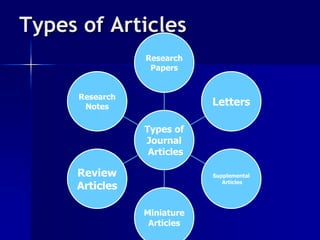
Types of Articles 
Research 
Papers 
Types of 
Journal 
Articles 
Letters 
Supplemental 
Articles 
Miniature 
Articles 
Research 
Notes 
Review 
Articles
300+ Years Ago 
1665 
First Scientific Journals Published: 
Journal des Scavans in France 
Philosophical Transactions of the 
Royal Society in London
Benefits of Writing 
• Benefit greater to author than 
reader 
• Invaluable mental discipline 
• Enhances clear thinking 
• Making a subject intelligible to 
others means you understand it 
• Improve your reading skills 
• Satisfies a creative instinct
Reasons for Not Writing 
 Difficulty knowing where to 
start 
 Not knowing how to start 
 Anxiety about writing skills 
 Lack of confidence
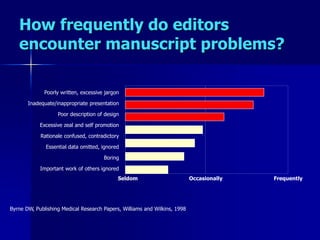
How frequently do editors 
encounter manuscript problems? 
Poorly written, excessive jargon 
Inadequate/inappropriate presentation 
Poor description of design 
Excessive zeal and self promotion 
Rationale confused, contradictory 
Essential data omitted, ignored 
Boring 
Important work of others ignored 
Seldom Occasionally Frequently 
Byrne DW, Publishing Medical Research Papers, Williams and Wilkins, 1998
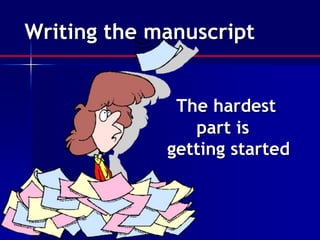
Writing the manuscript 
The hardest 
part is 
getting started
You don't have to be great 
to start, 
but you have to start 
to be great. 
Get going!
How to Improve 
 Writing is an art, you can learn 
 Read published manuscript and 
abstract carefully in major journals 
and focus on detail 
 Practice; practice; practice 
 Get help from your mentors and 
colleagues 
 Attend classes in writing skills/read 
books
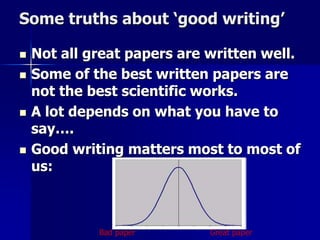
Some truths about ‘good writing’ 
 Not all great papers are written well. 
 Some of the best written papers are 
not the best scientific works. 
 A lot depends on what you have to 
say…. 
 Good writing matters most to most of 
us: 
Bad paper Great paper
What makes a good research 
paper? 
 Good science/Arts & Humanities/ 
Business & management/ Education 
 Good writing 
 Publication in good journals
Our goal is to make 
scientific writing 
readable and easy to 
understand
General rules 
 Use the present tense when referring to 
work that has already been published, but 
past tense when referring to your own 
study. 
 Use the active voice as much as possible 
 Avoid lengthy or unfocused reviews of 
previous research. 
 Cite peer-reviewed scientific literature or 
scholarly reviews. Avoid general reference 
works such as textbooks. 
 Define any specialized terms or 
abbreviations
Try to Avoid: 
• Long complicated sentences 
• Pretentious language 
• Repetition 
• Meaningless phrases 
• Irrelevant material 
• Cluttering a paragraph 
• Citing too many references
Avoid Repetition 
• Discussion in the Results section 
• Results in the Discussion section 
• Information can be in the 
Introduction OR Discussion – not 
in both! 
• Repetition of information in 
Tables and Figures in the Text
Before Starting to Write 
the Paper 
 Record your readings (results) 
 Make tables 
 Draw graphs 
 Keep file to record summaries of results 
and any observation however 
insignificant 
 Date the files 
 Revise your readings, you may need to 
repeat an experiment while you still have 
the materials. 
 Write ideas when ever they come to you
What parts of a paper are read and by whom? 
 The vast majority or readers of a journal will 
read, at most, the title and may look at the list of 
authors 
– Get as much of the paper into the title as you can and 
try to make it provoke interest in reading the summary 
 A much smaller proportion will read the 
summary 
– Get all the key messages into the summary 
 A small proportion of readers will scan the 
tables & figures 
– Make these comprehensible without having to read 
the paper 
 A tiny proportion of readers will read the whole 
paper 
– People in the field/working on same issue
06.10.2005 
Harald Romstad ØSIR 
23 
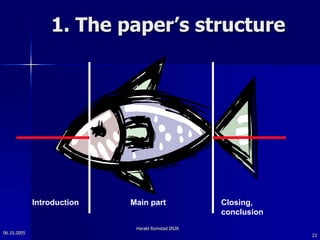
1. The paper’s structure 
Introduction Main part Closing, 
conclusion
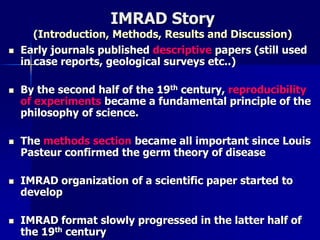
IMRAD Story 
(Introduction, Methods, Results and Discussion) 
 Early journals published descriptive papers (still used 
in case reports, geological surveys etc..) 
 By the second half of the 19th century, reproducibility 
of experiments became a fundamental principle of the 
philosophy of science. 
 The methods section became all important since Louis 
Pasteur confirmed the germ theory of disease 
 IMRAD organization of a scientific paper started to 
develop 
 IMRAD format slowly progressed in the latter half of 
the 19th century
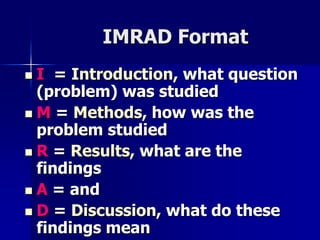
IMRAD Format 
 I = Introduction, what question 
(problem) was studied 
 M = Methods, how was the 
problem studied 
 R = Results, what are the 
findings 
 A = and 
 D = Discussion, what do these 
findings mean
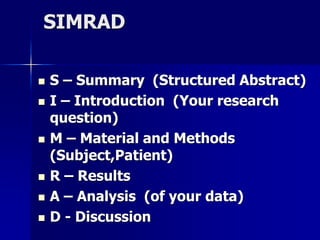
SIMRAD 
 S – Summary (Structured Abstract) 
 I – Introduction (Your research 
question) 
 M – Material and Methods 
(Subject,Patient) 
 R – Results 
 A – Analysis (of your data) 
 D - Discussion
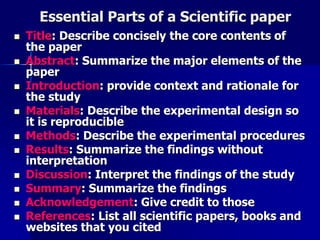
Essential Parts of a Scientific paper 
 Title: Describe concisely the core contents of 
the paper 
 Abstract: Summarize the major elements of the 
paper 
 Introduction: provide context and rationale for 
the study 
 Materials: Describe the experimental design so 
it is reproducible 
 Methods: Describe the experimental procedures 
 Results: Summarize the findings without 
interpretation 
 Discussion: Interpret the findings of the study 
 Summary: Summarize the findings 
 Acknowledgement: Give credit to those 
 References: List all scientific papers, books and 
websites that you cited
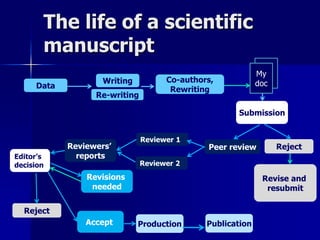
The life of a scientific 
manuscript 
My 
Data doc 
Submission 
Writing Co-authors, 
Rewriting 
Re-writing 
Accept Production Publication 
Reject 
Peer review Reject 
Revise and 
resubmit 
Reviewers’ 
reports 
Revisions 
needed 
Reviewer 1 
Reviewer 2 
Editor’s 
decision
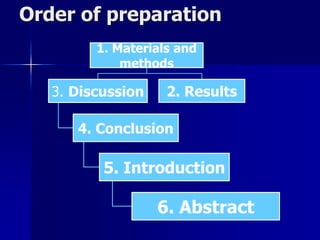
Order of preparation 
1. Materials and 
methods 
3. Discussion 
2. Results 
4. Conclusion 
5. Introduction 
6. Abstract
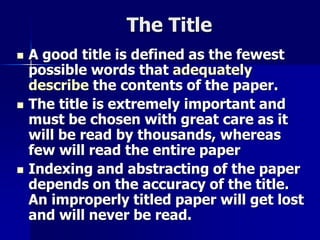
The Title 
 A good title is defined as the fewest 
possible words that adequately 
describe the contents of the paper. 
 The title is extremely important and 
must be chosen with great care as it 
will be read by thousands, whereas 
few will read the entire paper 
 Indexing and abstracting of the paper 
depends on the accuracy of the title. 
An improperly titled paper will get lost 
and will never be read.
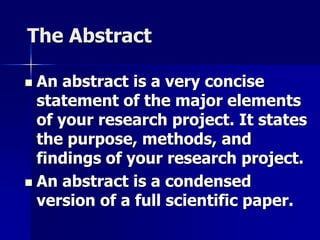
The Abstract 
 An abstract is a very concise 
statement of the major elements 
of your research project. It states 
the purpose, methods, and 
findings of your research project. 
 An abstract is a condensed 
version of a full scientific paper.
Four C's of Abstract Writing 
 Complete — it covers the major parts 
of the project/case 
 Concise — it contains no excess 
wordiness or unnecessary 
information. 
 Clear — it is readable, well organized, 
and not too jargon-laden. 
 Cohesive — it flows smoothly between 
the parts.
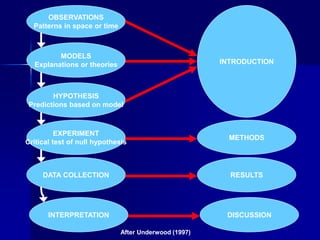
OBSERVATIONS 
Patterns in space or time 
MODELS 
Explanations or theories 
HYPOTHESIS 
Predictions based on model 
EXPERIMENT 
Critical test of null hypothesis 
DATA COLLECTION 
INTERPRETATION 
After Underwood (1997) 
INTRODUCTION 
METHODS 
RESULTS 
DISCUSSION
Suggested rules for a good 
introduction: 
 It should present the nature and 
scope of the problem 
investigated 
 Review the pertinent literature 
 State the method of investigation 
 State the principal results of the 
investigation 
 State the principal conclusion(s) 
suggested by the results
The Materials and Methods 
section 
 Provide full details so that the experiments are 
reproducible 
 If the peer reviewer has doubts that the 
experiments could be repeated, the 
manuscript will be rejected. 
 Organize the methods under subheadings, 
with related methods described together (e.g. 
subjects, experimental design, Measurement 
of…, Hormonal assays etc…). 
 Describe the experimental design in detail 
 Do not mix some of the Results in this section 
 Write in the past tense
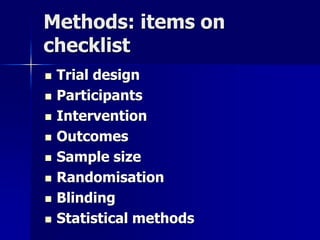
Methods: items on 
checklist 
 Trial design 
 Participants 
 Intervention 
 Outcomes 
 Sample size 
 Randomisation 
 Blinding 
 Statistical methods
How to write the Results 
 Results section is written in the past tense 
 It is the core or heart of the paper 
 It needs to be clearly and simply stated 
since it constitutes the new knowledge 
contributed to the world 
 The purpose of this section is to summarize 
and illustrate the findings in an orderly and 
logical sequence, without interpretation 
 The text should guide the reader through 
the findings, stressing the major points 
 Do not describe methods that have already 
been described in the M&M section or that 
have been inadvertently omitted
Results: items on checklist 
 Participant flow 
 Recruitment 
 Baseline data 
 Numbers analysed 
 Outcomes and estimation of 
precision 
 Ancillary analyses 
 Harms (i.e. adverse events)
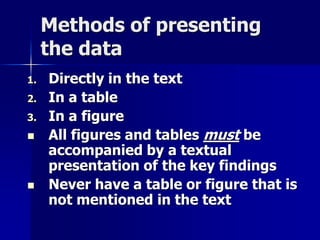
Methods of presenting 
the data 
1. Directly in the text 
2. In a table 
3. In a figure 
 All figures and tables must be 
accompanied by a textual 
presentation of the key findings 
 Never have a table or figure that is 
not mentioned in the text
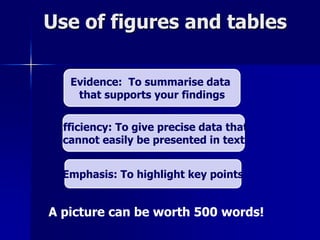
Use of figures and tables 
Evidence: To summarise data 
that supports your findings 
Efficiency: To give precise data that 
cannot easily be presented in text 
Emphasis: To highlight key points 
A picture can be worth 500 words!
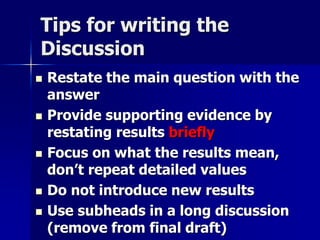
Tips for writing the 
Discussion 
 Restate the main question with the 
answer 
 Provide supporting evidence by 
restating results briefly 
 Focus on what the results mean, 
don’t repeat detailed values 
 Do not introduce new results 
 Use subheads in a long discussion 
(remove from final draft)
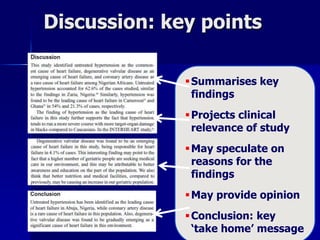
Discussion: key points 
Summarises key 
findings 
Projects clinical 
relevance of study 
May speculate on 
reasons for the 
findings 
May provide opinion 
Conclusion: key 
‘take home’ message
How to State the 
Acknowledgments 
 You should acknowledge: 
1. Any significant technical help that you have 
received from any individual in your lab or 
elsewhere 
2. The source of special equipment, cultures, 
or any other material 
3. Any outside financial assistance, such as 
grants, contracts or fellowships 
 Do not use the word “wish”, simply write “I 
thank …..” and not “I wish to thank…” 
 Show the proposed wording of the 
Acknowledgement to the person whose help 
you are acknowledging
References 
What is referencing? 
 Referencing is a standardized way of 
acknowledging the sources of information and 
ideas that you have used in your document. 
 A list of ALL the references used in the text must 
be written. 
 Reference format varies widely: 
– Harvard format (the name and year system) is 
the most widely used 
– Alphabet-Number system is a modification of 
name and year system 
– Citation order system
Publish and perish 
“The Seven Deadly Sins” 
1. Data manipulation, falsification 
2. Duplicate manuscripts 
3. Redundant publication 
4. Plagiarism 
5. Author conflicts of interest 
6. Animal use concerns 
7. Humans use concerns
Rewriting 
• Secret of good writing 
is rewriting 
• Secret of rewriting is 
re-thinking
Celebrate when your 
work is published! 
Who benefits? 
 You 
– Career; future research 
(clarified thinking) 
 Other researchers 
 Funders of the work 
 Patients
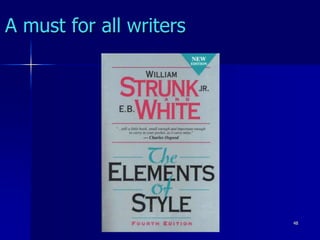
A must for all writers 
48
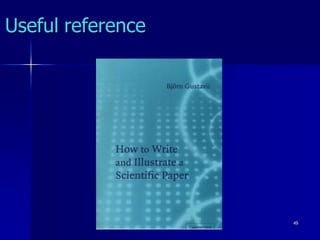
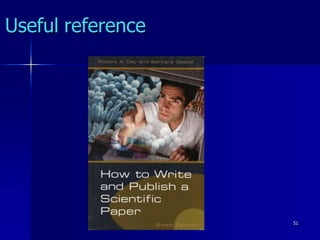
Useful reference 
49
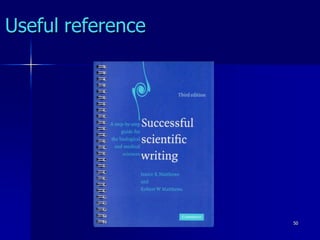
Useful reference 
50
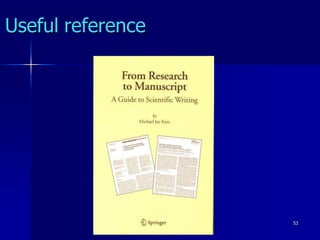
Useful reference 
51
Useful reference 
52
Useful reference 
53
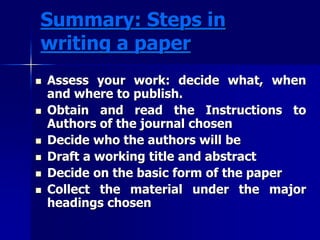
Summary: Steps in 
writing a paper 
 Assess your work: decide what, when 
and where to publish. 
 Obtain and read the Instructions to 
Authors of the journal chosen 
 Decide who the authors will be 
 Draft a working title and abstract 
 Decide on the basic form of the paper 
 Collect the material under the major 
headings chosen
Summary: Steps in 
writing a paper 
 Design tables, including their titles and 
footnotes; design or select illustrations and 
write titles and legends for them 
 Write for permission to reproduce any 
previously published tables, illustrations or 
other material that will be used 
 Write a topic outline and perhaps a sentence 
outline 
 Write, type or dictate a preliminary draft of the 
text quickly (!), to give it unity. 
 Check completeness of the references 
assembled 
 Put the manuscript or typescript away for a few 
days
Summary: Steps in 
writing a paper 
 Re-examine the structure of the paper 
 Check the illustrations and tables and 
make the final versions 
 Re-read the references you cite and 
check your own accuracy in citing them; 
check for consistency, and reduce the 
number of abbreviations and footnotes 
 (Re)type the paper (= first draft) 
 Correct the grammar and polish the style 
 Type several copies of the corrected 
paper (= second draft)
Summary: Steps in 
writing a paper 
 Ask for criticism from co-authors and friends 
 Make any necessary alterations 
 Compose a now title and abstract suitable for 
information retrieval, list the index terms and 
assemble the manuscript 
 Compile the reference list, cross-check 
references against the text, and ensure that all 
bibliographical details are correct 
 Retype (= penultimate version) and check 
typescript 
 Obtain a final critical review from a senior 
colleague 
 Make any final corrections (final version)
Summary: Steps in 
writing a paper 
 Write a covering letter to the editor, 
enclosing copies of letters giving you 
permission to reproduce any previously 
published material or to cite unpublished 
work 
 Check that all parts of the paper are 
present, and post as many copies as 
specified to the editor 
 If the editor returns the paper, revise it as 
necessary, send it elsewhere, or abandon it 
 Correct the proofs
“There is no way 
to get experience 
except through 
experience.”
Many Thanks For Your 
ATTENTION

Ridwan scientific writing1

  • 1.
    How to writea scientific paper Dr. M Ridwanur Rahman Professor, Department of Medicine, Shaheed Suhrawardy Medical College, Dhaka
  • 2.
    What is ascientific paper? A scientific paper is a written and published report describing original research results. Robert A. Day
  • 3.
    Why Writing isImportant Francis Bacon once said, “reading maketh a full man; conference a ready man; but writing an exact man”
  • 4.
    Without publication, scienceis dead. –Gerard Piel
  • 5.
    Scientific Writing "Inscience, the credit goes to the man who convinces the world, not to the man to whom the idea first occurs." --Sir William Osler
  • 6.
    Scientific Writing "Writingis an art. But when it is writing to inform it comes close to being a science as well."  --Robert Gunning,The Technique of Clear Writing
  • 7.
    Types of Articles Research Papers Types of Journal Articles Letters Supplemental Articles Miniature Articles Research Notes Review Articles
  • 8.
    300+ Years Ago 1665 First Scientific Journals Published: Journal des Scavans in France Philosophical Transactions of the Royal Society in London
  • 9.
    Benefits of Writing • Benefit greater to author than reader • Invaluable mental discipline • Enhances clear thinking • Making a subject intelligible to others means you understand it • Improve your reading skills • Satisfies a creative instinct
  • 10.
    Reasons for NotWriting  Difficulty knowing where to start  Not knowing how to start  Anxiety about writing skills  Lack of confidence
  • 11.
    How frequently doeditors encounter manuscript problems? Poorly written, excessive jargon Inadequate/inappropriate presentation Poor description of design Excessive zeal and self promotion Rationale confused, contradictory Essential data omitted, ignored Boring Important work of others ignored Seldom Occasionally Frequently Byrne DW, Publishing Medical Research Papers, Williams and Wilkins, 1998
  • 12.
    Writing the manuscript The hardest part is getting started
  • 13.
    You don't haveto be great to start, but you have to start to be great. Get going!
  • 14.
    How to Improve  Writing is an art, you can learn  Read published manuscript and abstract carefully in major journals and focus on detail  Practice; practice; practice  Get help from your mentors and colleagues  Attend classes in writing skills/read books
  • 15.
    Some truths about‘good writing’  Not all great papers are written well.  Some of the best written papers are not the best scientific works.  A lot depends on what you have to say….  Good writing matters most to most of us: Bad paper Great paper
  • 16.
    What makes agood research paper?  Good science/Arts & Humanities/ Business & management/ Education  Good writing  Publication in good journals
  • 17.
    Our goal isto make scientific writing readable and easy to understand
  • 18.
    General rules Use the present tense when referring to work that has already been published, but past tense when referring to your own study.  Use the active voice as much as possible  Avoid lengthy or unfocused reviews of previous research.  Cite peer-reviewed scientific literature or scholarly reviews. Avoid general reference works such as textbooks.  Define any specialized terms or abbreviations
  • 19.
    Try to Avoid: • Long complicated sentences • Pretentious language • Repetition • Meaningless phrases • Irrelevant material • Cluttering a paragraph • Citing too many references
  • 20.
    Avoid Repetition •Discussion in the Results section • Results in the Discussion section • Information can be in the Introduction OR Discussion – not in both! • Repetition of information in Tables and Figures in the Text
  • 21.
    Before Starting toWrite the Paper  Record your readings (results)  Make tables  Draw graphs  Keep file to record summaries of results and any observation however insignificant  Date the files  Revise your readings, you may need to repeat an experiment while you still have the materials.  Write ideas when ever they come to you
  • 22.
    What parts ofa paper are read and by whom?  The vast majority or readers of a journal will read, at most, the title and may look at the list of authors – Get as much of the paper into the title as you can and try to make it provoke interest in reading the summary  A much smaller proportion will read the summary – Get all the key messages into the summary  A small proportion of readers will scan the tables & figures – Make these comprehensible without having to read the paper  A tiny proportion of readers will read the whole paper – People in the field/working on same issue
  • 23.
    06.10.2005 Harald RomstadØSIR 23 1. The paper’s structure Introduction Main part Closing, conclusion
  • 24.
    IMRAD Story (Introduction,Methods, Results and Discussion)  Early journals published descriptive papers (still used in case reports, geological surveys etc..)  By the second half of the 19th century, reproducibility of experiments became a fundamental principle of the philosophy of science.  The methods section became all important since Louis Pasteur confirmed the germ theory of disease  IMRAD organization of a scientific paper started to develop  IMRAD format slowly progressed in the latter half of the 19th century
  • 25.
    IMRAD Format I = Introduction, what question (problem) was studied  M = Methods, how was the problem studied  R = Results, what are the findings  A = and  D = Discussion, what do these findings mean
  • 26.
    SIMRAD  S– Summary (Structured Abstract)  I – Introduction (Your research question)  M – Material and Methods (Subject,Patient)  R – Results  A – Analysis (of your data)  D - Discussion
  • 27.
    Essential Parts ofa Scientific paper  Title: Describe concisely the core contents of the paper  Abstract: Summarize the major elements of the paper  Introduction: provide context and rationale for the study  Materials: Describe the experimental design so it is reproducible  Methods: Describe the experimental procedures  Results: Summarize the findings without interpretation  Discussion: Interpret the findings of the study  Summary: Summarize the findings  Acknowledgement: Give credit to those  References: List all scientific papers, books and websites that you cited
  • 28.
    The life ofa scientific manuscript My Data doc Submission Writing Co-authors, Rewriting Re-writing Accept Production Publication Reject Peer review Reject Revise and resubmit Reviewers’ reports Revisions needed Reviewer 1 Reviewer 2 Editor’s decision
  • 29.
    Order of preparation 1. Materials and methods 3. Discussion 2. Results 4. Conclusion 5. Introduction 6. Abstract
  • 30.
    The Title A good title is defined as the fewest possible words that adequately describe the contents of the paper.  The title is extremely important and must be chosen with great care as it will be read by thousands, whereas few will read the entire paper  Indexing and abstracting of the paper depends on the accuracy of the title. An improperly titled paper will get lost and will never be read.
  • 31.
    The Abstract An abstract is a very concise statement of the major elements of your research project. It states the purpose, methods, and findings of your research project.  An abstract is a condensed version of a full scientific paper.
  • 32.
    Four C's ofAbstract Writing  Complete — it covers the major parts of the project/case  Concise — it contains no excess wordiness or unnecessary information.  Clear — it is readable, well organized, and not too jargon-laden.  Cohesive — it flows smoothly between the parts.
  • 33.
    OBSERVATIONS Patterns inspace or time MODELS Explanations or theories HYPOTHESIS Predictions based on model EXPERIMENT Critical test of null hypothesis DATA COLLECTION INTERPRETATION After Underwood (1997) INTRODUCTION METHODS RESULTS DISCUSSION
  • 34.
    Suggested rules fora good introduction:  It should present the nature and scope of the problem investigated  Review the pertinent literature  State the method of investigation  State the principal results of the investigation  State the principal conclusion(s) suggested by the results
  • 35.
    The Materials andMethods section  Provide full details so that the experiments are reproducible  If the peer reviewer has doubts that the experiments could be repeated, the manuscript will be rejected.  Organize the methods under subheadings, with related methods described together (e.g. subjects, experimental design, Measurement of…, Hormonal assays etc…).  Describe the experimental design in detail  Do not mix some of the Results in this section  Write in the past tense
  • 36.
    Methods: items on checklist  Trial design  Participants  Intervention  Outcomes  Sample size  Randomisation  Blinding  Statistical methods
  • 37.
    How to writethe Results  Results section is written in the past tense  It is the core or heart of the paper  It needs to be clearly and simply stated since it constitutes the new knowledge contributed to the world  The purpose of this section is to summarize and illustrate the findings in an orderly and logical sequence, without interpretation  The text should guide the reader through the findings, stressing the major points  Do not describe methods that have already been described in the M&M section or that have been inadvertently omitted
  • 38.
    Results: items onchecklist  Participant flow  Recruitment  Baseline data  Numbers analysed  Outcomes and estimation of precision  Ancillary analyses  Harms (i.e. adverse events)
  • 39.
    Methods of presenting the data 1. Directly in the text 2. In a table 3. In a figure  All figures and tables must be accompanied by a textual presentation of the key findings  Never have a table or figure that is not mentioned in the text
  • 40.
    Use of figuresand tables Evidence: To summarise data that supports your findings Efficiency: To give precise data that cannot easily be presented in text Emphasis: To highlight key points A picture can be worth 500 words!
  • 41.
    Tips for writingthe Discussion  Restate the main question with the answer  Provide supporting evidence by restating results briefly  Focus on what the results mean, don’t repeat detailed values  Do not introduce new results  Use subheads in a long discussion (remove from final draft)
  • 42.
    Discussion: key points Summarises key findings Projects clinical relevance of study May speculate on reasons for the findings May provide opinion Conclusion: key ‘take home’ message
  • 43.
    How to Statethe Acknowledgments  You should acknowledge: 1. Any significant technical help that you have received from any individual in your lab or elsewhere 2. The source of special equipment, cultures, or any other material 3. Any outside financial assistance, such as grants, contracts or fellowships  Do not use the word “wish”, simply write “I thank …..” and not “I wish to thank…”  Show the proposed wording of the Acknowledgement to the person whose help you are acknowledging
  • 44.
    References What isreferencing?  Referencing is a standardized way of acknowledging the sources of information and ideas that you have used in your document.  A list of ALL the references used in the text must be written.  Reference format varies widely: – Harvard format (the name and year system) is the most widely used – Alphabet-Number system is a modification of name and year system – Citation order system
  • 45.
    Publish and perish “The Seven Deadly Sins” 1. Data manipulation, falsification 2. Duplicate manuscripts 3. Redundant publication 4. Plagiarism 5. Author conflicts of interest 6. Animal use concerns 7. Humans use concerns
  • 46.
    Rewriting • Secretof good writing is rewriting • Secret of rewriting is re-thinking
  • 47.
    Celebrate when your work is published! Who benefits?  You – Career; future research (clarified thinking)  Other researchers  Funders of the work  Patients
  • 48.
    A must forall writers 48
  • 49.
  • 50.
  • 51.
  • 52.
  • 53.
  • 54.
    Summary: Steps in writing a paper  Assess your work: decide what, when and where to publish.  Obtain and read the Instructions to Authors of the journal chosen  Decide who the authors will be  Draft a working title and abstract  Decide on the basic form of the paper  Collect the material under the major headings chosen
  • 55.
    Summary: Steps in writing a paper  Design tables, including their titles and footnotes; design or select illustrations and write titles and legends for them  Write for permission to reproduce any previously published tables, illustrations or other material that will be used  Write a topic outline and perhaps a sentence outline  Write, type or dictate a preliminary draft of the text quickly (!), to give it unity.  Check completeness of the references assembled  Put the manuscript or typescript away for a few days
  • 56.
    Summary: Steps in writing a paper  Re-examine the structure of the paper  Check the illustrations and tables and make the final versions  Re-read the references you cite and check your own accuracy in citing them; check for consistency, and reduce the number of abbreviations and footnotes  (Re)type the paper (= first draft)  Correct the grammar and polish the style  Type several copies of the corrected paper (= second draft)
  • 57.
    Summary: Steps in writing a paper  Ask for criticism from co-authors and friends  Make any necessary alterations  Compose a now title and abstract suitable for information retrieval, list the index terms and assemble the manuscript  Compile the reference list, cross-check references against the text, and ensure that all bibliographical details are correct  Retype (= penultimate version) and check typescript  Obtain a final critical review from a senior colleague  Make any final corrections (final version)
  • 58.
    Summary: Steps in writing a paper  Write a covering letter to the editor, enclosing copies of letters giving you permission to reproduce any previously published material or to cite unpublished work  Check that all parts of the paper are present, and post as many copies as specified to the editor  If the editor returns the paper, revise it as necessary, send it elsewhere, or abandon it  Correct the proofs
  • 59.
    “There is noway to get experience except through experience.”
  • 61.
    Many Thanks ForYour ATTENTION

Editor's Notes

  • #42 In the Discussion you can use your data to support an argument, if relevant. You can explain poor results, and speculate on the value of good results. The discussion is where you justify your ‘take home message’. If previous authors have reported results that differ from yours, don’t assume you’re right and they’re wrong. Try and provide reasons for the discrepancies.