How to write a scientific paper Harish Kumar Arora Ph.D Research Scholar, Dept. of Pharmaceutical Sciences Guru Jambheshwar University of science & Technology, Hisar Haryana, India
What is Scientific Writing The purpose of scientific writing is to  communicate new scientific findings. It should be clear, simple & well  ordered communication to transmit  new scientific findings Scientific writing must use proper English  which gives the sense in the fewest short  words
What is a scientific paper A scientific paper is a written and published report describing original research results. It must be a publication of original research results in a journal or other source document readily available within the scientific community
A scientific paper is a written & published report describing  original research results. A scientific experiment is not complete until the results have been  published  and  understood . The Purpose of research is not well served unless the  findings or problems you solved are known to others. Significance of Scientific Writing
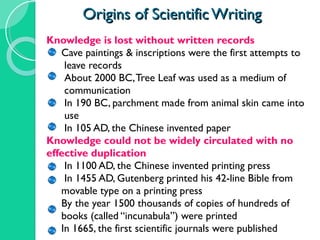
Origins of Scientific Writing Knowledge is lost without written records Cave paintings & inscriptions were the first attempts to  leave records About 2000 BC, Tree Leaf was used as a medium of  communication  In 190 BC, parchment made from animal skin came into  use In 105 AD, the Chinese invented paper Knowledge could not be widely circulated with no  effective duplication In 1100 AD, the Chinese invented printing press In 1455 AD, Gutenberg printed his 42-line Bible from  movable type on a printing press By the year 1500 thousands of copies of hundreds of  books (called “incunabula”) were printed In 1665, the first scientific journals were published
Before Starting to Write the Paper Logical analysis of subject-matter Give dates to the files and folders Give different names to files Review your results Prepare a rough draft or report Delete an unwanted material Make tables, draw graphs Review again Finalize the bibliography Write the final report and present as paper
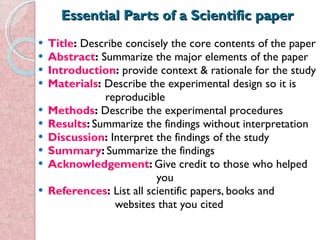
Essential Parts of a Scientific paper Title :  Describe concisely the core contents of the paper Abstract :  Summarize the major elements of the paper Introduction :  provide context & rationale for the study Materials :  Describe the experimental design so it is  reproducible Methods :  Describe the experimental procedures Results :  Summarize the findings without interpretation Discussion :  Interpret the findings of the study Summary :  Summarize the findings Acknowledgement :  Give credit to those who helped  you References :  List all scientific papers, books and  websites that you cited
IMRAD Story (Introduction, Methods, Results and Discussion) Early journals published  descriptive   papers (still used in case reports, geological surveys etc.) By the second half of the 19 th  century,  reproducibility of experiments  became a fundamental principle of the philosophy of science. The  methods section   became all important since Louis Pasteur confirmed the germ theory of disease IMRAD organization of a scientific paper started to develop  IMRAD format slowly progressed in the latter half of the 19 th  century
IMRAD Format I  =  Introduction , what question or problem  was studied M  =  Methods , how was the problem studied R  =  Results , what are the findings A  = and D  =  Discussion , what do these findings mean
Organization of a scientific paper The most common is the IMRAD If a number of methods were used to  achieve directly related results: M + R = Experimental section The results are so complex that they  need to be immediately discussed: R + D = Results and Discussion section
Some important  Language  points: Poor experimentation cannot be masked by brilliant writing; however,  poor writing can mask brilliant experimentation Avoid complex sentence structure Use simple and clear English Always keep in mind that  the paragraph  is the essential unit of thought
The Title A good title is defined as the fewest possible words  that  adequately describe  the contents of the paper. The title is extremely important and must be chosen  with great care as it will be read by thousands,  whereas few will read the entire paper Indexing and abstracting of the paper depends on the  accuracy of the title. An improperly titled paper will  get lost and will never be read.
Titles should neither be too short nor too long as to be meaningless Waste words (studies on, investigations on, a, an, the etc) should not be used. Syntax (word order) must be very carefully considered It should contain the keywords that reflect the contents of the paper. It should be meaningful and not general It should be concise, specific and informative It should capture the fundamental nature of the experiments and  findings
How to Prepare the Title Make a list of the most important keywords Think of a title that contains these words The title could state the conclusion of the paper The title  Never  contains abbreviations Think, rethink  of the title before submitting the paper Be very careful of the grammatical errors due to faulty word order Avoid the use of the word  “using”
The Abstract An abstract can be defined as a summary of the information in a document  It is of fundamental importance that the abstract be written clearly and simply, as it is the first and sometimes the only part of the manuscript read. It should provide a brief summary of each of the main sections (IMRAD) of the paper: State the principal objective and scope of the investigation Describe the methods used Summarize the results, and  State the principal conclusions   It is easier to write the abstract after completion of the paper
Criteria of the Abstract It should not exceed 250 words It should be written in one paragraph. It should be written in the past tense as it refers to work done. Long words should be followed by its abbreviation which would be used through out the abstract and paper. It should not cite any references (except in rare cases) It should never give any information or conclusion that is not stated in the paper Must be accurate with respect to figures quoted in the main text.
The Introduction It should present the nature, details and scope of the problem investigated Review the pertinent literature State the method of investigation State the principal results of the investigation State the principal conclusion suggested by the results
Materials Must identify accurately experimental animals, plants, and microorganisms used by genus, species and strain The source of subjects studied, number of individuals in each group used, their sex, age, and weight must be clearly stated If human subjects are used, the criteria for selection should be described, and consent For chemicals used, include exact technical specifications and source or method of preparation. Avoid the use of trade names of chemicals, generic or chemical names are preferred.
Methods If the method is new, all details must be provided If the method has been previously published in a  scientific journal, only the reference should be  given with some identification.
Results Results section is written in the past tense It is the core or heart of the paper It needs to be clearly and simply stated since it  constitutes the new knowledge contributed to the  world
Tables and figures Tables are appropriate for large or complicated data sets that would be difficult to explain clearly in text. Figures are appropriate for data sets that exhibit trends, patterns, or relationships that are best conveyed visually. Any table or figure must be sufficiently described by its title and caption or legend, to be understandable without reading the main text of the results section. Do not include both a table and a figure showing the same information
References Any papers not cited in the text should not be included. Reference lists allow readers to investigate the subject in  greater depth.  A reference list contains only the books, articles, and  web pages etc that are cited in the text of the document.  While  a bibliography includes all sources  consulted for background or further reading.

How to write a best Research Paper

  • 1.
    How to writea scientific paper Harish Kumar Arora Ph.D Research Scholar, Dept. of Pharmaceutical Sciences Guru Jambheshwar University of science & Technology, Hisar Haryana, India
  • 2.
    What is ScientificWriting The purpose of scientific writing is to communicate new scientific findings. It should be clear, simple & well ordered communication to transmit new scientific findings Scientific writing must use proper English which gives the sense in the fewest short words
  • 3.
    What is ascientific paper A scientific paper is a written and published report describing original research results. It must be a publication of original research results in a journal or other source document readily available within the scientific community
  • 4.
    A scientific paperis a written & published report describing original research results. A scientific experiment is not complete until the results have been published and understood . The Purpose of research is not well served unless the findings or problems you solved are known to others. Significance of Scientific Writing
  • 5.
    Origins of ScientificWriting Knowledge is lost without written records Cave paintings & inscriptions were the first attempts to leave records About 2000 BC, Tree Leaf was used as a medium of communication In 190 BC, parchment made from animal skin came into use In 105 AD, the Chinese invented paper Knowledge could not be widely circulated with no effective duplication In 1100 AD, the Chinese invented printing press In 1455 AD, Gutenberg printed his 42-line Bible from movable type on a printing press By the year 1500 thousands of copies of hundreds of books (called “incunabula”) were printed In 1665, the first scientific journals were published
  • 6.
    Before Starting toWrite the Paper Logical analysis of subject-matter Give dates to the files and folders Give different names to files Review your results Prepare a rough draft or report Delete an unwanted material Make tables, draw graphs Review again Finalize the bibliography Write the final report and present as paper
  • 7.
    Essential Parts ofa Scientific paper Title : Describe concisely the core contents of the paper Abstract : Summarize the major elements of the paper Introduction : provide context & rationale for the study Materials : Describe the experimental design so it is reproducible Methods : Describe the experimental procedures Results : Summarize the findings without interpretation Discussion : Interpret the findings of the study Summary : Summarize the findings Acknowledgement : Give credit to those who helped you References : List all scientific papers, books and websites that you cited
  • 8.
    IMRAD Story (Introduction,Methods, Results and Discussion) Early journals published descriptive papers (still used in case reports, geological surveys etc.) By the second half of the 19 th century, reproducibility of experiments became a fundamental principle of the philosophy of science. The methods section became all important since Louis Pasteur confirmed the germ theory of disease IMRAD organization of a scientific paper started to develop IMRAD format slowly progressed in the latter half of the 19 th century
  • 9.
    IMRAD Format I = Introduction , what question or problem was studied M = Methods , how was the problem studied R = Results , what are the findings A = and D = Discussion , what do these findings mean
  • 10.
    Organization of ascientific paper The most common is the IMRAD If a number of methods were used to achieve directly related results: M + R = Experimental section The results are so complex that they need to be immediately discussed: R + D = Results and Discussion section
  • 11.
    Some important Language points: Poor experimentation cannot be masked by brilliant writing; however, poor writing can mask brilliant experimentation Avoid complex sentence structure Use simple and clear English Always keep in mind that the paragraph is the essential unit of thought
  • 12.
    The Title Agood title is defined as the fewest possible words that adequately describe the contents of the paper. The title is extremely important and must be chosen with great care as it will be read by thousands, whereas few will read the entire paper Indexing and abstracting of the paper depends on the accuracy of the title. An improperly titled paper will get lost and will never be read.
  • 13.
    Titles should neitherbe too short nor too long as to be meaningless Waste words (studies on, investigations on, a, an, the etc) should not be used. Syntax (word order) must be very carefully considered It should contain the keywords that reflect the contents of the paper. It should be meaningful and not general It should be concise, specific and informative It should capture the fundamental nature of the experiments and findings
  • 14.
    How to Preparethe Title Make a list of the most important keywords Think of a title that contains these words The title could state the conclusion of the paper The title Never contains abbreviations Think, rethink of the title before submitting the paper Be very careful of the grammatical errors due to faulty word order Avoid the use of the word “using”
  • 15.
    The Abstract Anabstract can be defined as a summary of the information in a document It is of fundamental importance that the abstract be written clearly and simply, as it is the first and sometimes the only part of the manuscript read. It should provide a brief summary of each of the main sections (IMRAD) of the paper: State the principal objective and scope of the investigation Describe the methods used Summarize the results, and State the principal conclusions It is easier to write the abstract after completion of the paper
  • 16.
    Criteria of theAbstract It should not exceed 250 words It should be written in one paragraph. It should be written in the past tense as it refers to work done. Long words should be followed by its abbreviation which would be used through out the abstract and paper. It should not cite any references (except in rare cases) It should never give any information or conclusion that is not stated in the paper Must be accurate with respect to figures quoted in the main text.
  • 17.
    The Introduction Itshould present the nature, details and scope of the problem investigated Review the pertinent literature State the method of investigation State the principal results of the investigation State the principal conclusion suggested by the results
  • 18.
    Materials Must identifyaccurately experimental animals, plants, and microorganisms used by genus, species and strain The source of subjects studied, number of individuals in each group used, their sex, age, and weight must be clearly stated If human subjects are used, the criteria for selection should be described, and consent For chemicals used, include exact technical specifications and source or method of preparation. Avoid the use of trade names of chemicals, generic or chemical names are preferred.
  • 19.
    Methods If themethod is new, all details must be provided If the method has been previously published in a scientific journal, only the reference should be given with some identification.
  • 20.
    Results Results sectionis written in the past tense It is the core or heart of the paper It needs to be clearly and simply stated since it constitutes the new knowledge contributed to the world
  • 21.
    Tables and figuresTables are appropriate for large or complicated data sets that would be difficult to explain clearly in text. Figures are appropriate for data sets that exhibit trends, patterns, or relationships that are best conveyed visually. Any table or figure must be sufficiently described by its title and caption or legend, to be understandable without reading the main text of the results section. Do not include both a table and a figure showing the same information
  • 22.
    References Any papersnot cited in the text should not be included. Reference lists allow readers to investigate the subject in greater depth. A reference list contains only the books, articles, and web pages etc that are cited in the text of the document. While a bibliography includes all sources consulted for background or further reading.