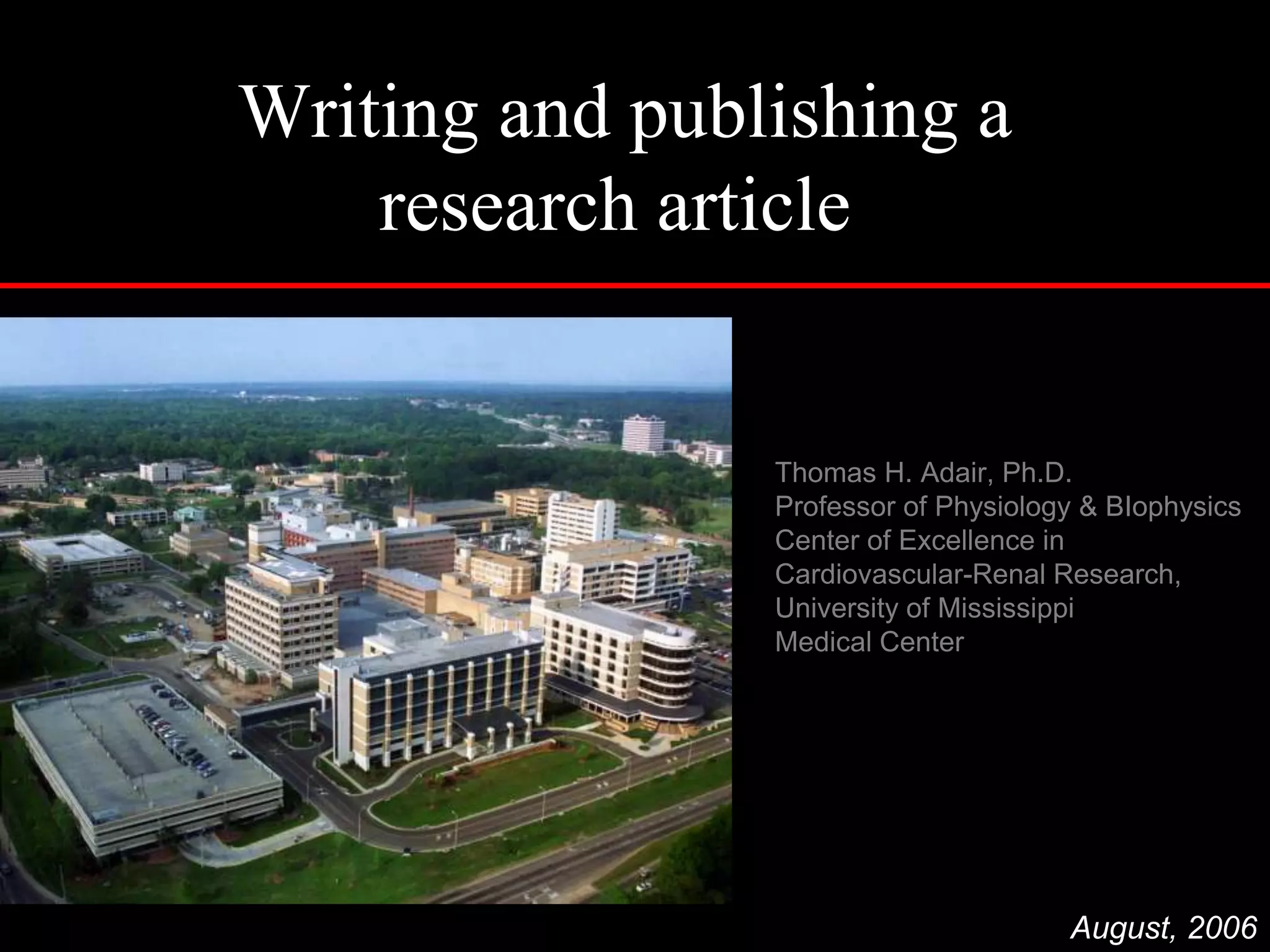
Writing and publishing a research article  Thomas H. Adair, Ph.D.Professor of Physiology & BIophysicsCenter of Excellence inCardiovascular-Renal Research,University of MississippiMedical Center August, 2006
ResourcesDay, RA. “How to write and publish a scientific paper,” 5th edition, Oryx Press, 1998.Fischer BA, Zigmond MJ. “Components of a research article.” survival@pitt.eduMarshal GS. “Writing a peer reviewed article.” http://dor.umc.edu/ARCHIVES/GMarshallPublishingarticle.pptHall, JE. “Writing research papers (and getting them published)” http://dor.umc.edu/ARCHIVES/GMarshallPublishingarticle.pptBenos, D., Reich, M. “Peer review and publication in APS journals.”http://www.the-aps.org/careers/careers1/EBSymposia/Benos2003.ppt
“There is no way to get experience except through experience.”
Why write and publish research papers?Ideally – 	to share research findings and discoveries 	with the hope of improving healthcare.Practically – 	to get funding	to get promoted	to get a job	to keep your job!
“Scientists are rated by what they finish, not by what they attempt”
Getting a paper publishedCompetition for space in journals is intense
Cost of publication is high, $360/page for APS
Rejection rates vary
 AJP = 50%
 JBC = 65%
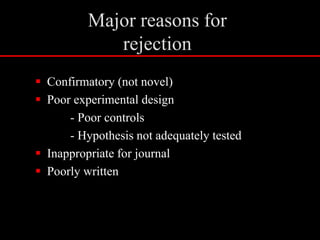
 NEJM, Science, Nature = 90%Major reasons for rejection  Confirmatory (not novel)
  Poor experimental design 	 - Poor controls	 - Hypothesis not adequately tested  Inappropriate for journal
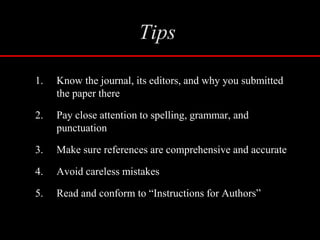
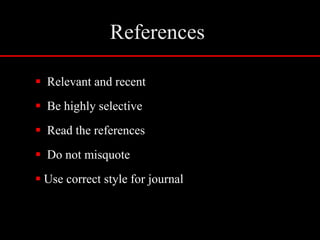
  Poorly writtenTipsKnow the journal, its editors, and why you submitted the paper therePay close attention to spelling, grammar, and punctuationMake sure references are comprehensive and accurateAvoid careless mistakesRead and conform to “Instructions for Authors”
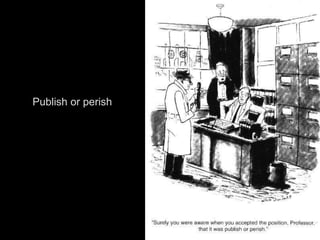
Publish or perish
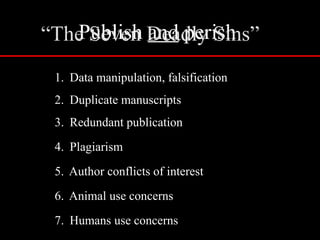
Publish and perish“The Seven Deadly Sins” Data manipulation, falsification Duplicate manuscripts Redundant publication Plagiarism Author conflicts of interest Animal use concerns Humans use concerns
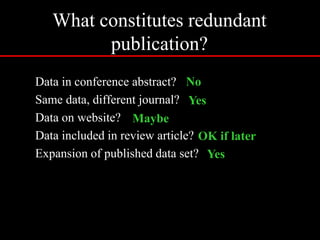
What constitutes redundant publication?Data in conference abstract?Same data, different journal?Data on website?Data included in review article?Expansion of published data set?NoYesMaybeOK if laterYes
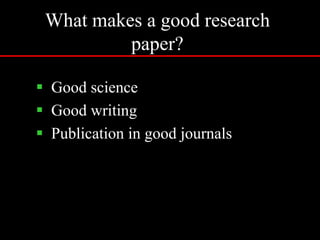
What makes a good research paper?  Good science
  Good writing
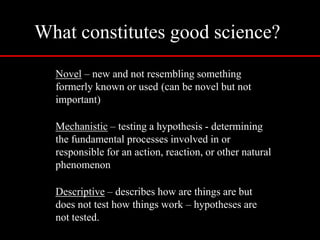
  Publication in good journalsWhat constitutes good science?Novel – new and not resembling something formerly known or used(can be novel but not important)Mechanistic – testing a hypothesis - determining the fundamental processes involved in or responsible for an action, reaction, or other natural phenomenon Descriptive – describes how are things are but does not test how things work – hypotheses are not tested.
What constitutes a good journal?Impact factor –  	average number of times published papers 	are cited up to two years after publication.Immediacy Index – 	average number of times published papers 	are cited during year of publication.
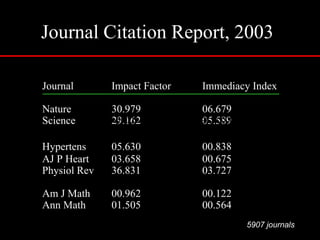
Journal Citation Report, 2003Journal		  Impact Factor	Immediacy IndexNature		  30.979 		06.679 Science	  29.162		05.589Hypertens	  05.630 		00.838AJ P Heart 	  03.658 		00.675 Physiol Rev	  36.831 		03.727Am J Math	  00.962		00.122 Ann Math 	  01.505 		00.564 AM J MATH 0002-9327 002353 00.962 00.122 AM J MATH 0002-9327 002353 00.962 00.122 5907 journals
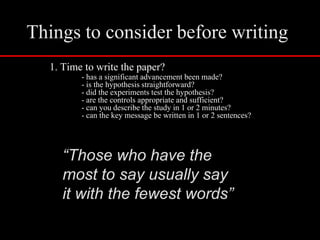
Things to consider before writing1. Time to write the paper?	- has a significant advancement been made?	- is the hypothesis straightforward?	- did the experiments test the hypothesis?	- are the controls appropriate and sufficient?	- can you describe the study in 1 or 2 minutes?	- can the key message be written in 1 or 2 sentences?“Those who have the most to say usually say it with the fewest words”
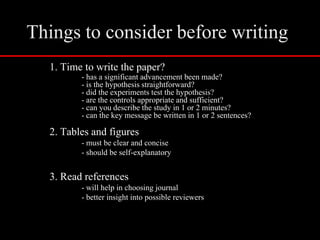
Things to consider before writing1. Time to write the paper?	- has a significant advancement been made?	- is the hypothesis straightforward?	- did the experiments test the hypothesis?	- are the controls appropriate and sufficient?	- can you describe the study in 1 or 2 minutes?	- can the key message be written in 1 or 2 sentences?2. Tables and figures 	- must be clear and concise	- should be self-explanatory3. Read references 	- will help in choosing journal	- better insight into possible reviewers
Things to consider before writing4. Choose journal	- study “instructions to authors”	- think about possible reviewers	- quality of journal “impact factor”5. Tentative title and summary6. Choose authors
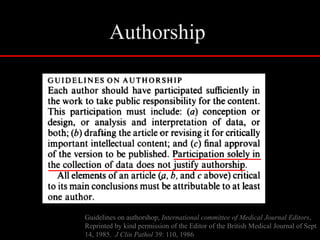
AuthorshipGuidelines on authorshop, International committee of Medical Journal Editors,Reprinted by kind permission of the Editor of the British Medical Journal of Sept14, 1985.  J Clin Pathol 39: 110, 1986
Writing the manuscriptThe hardest part is getting started.
Parts of a manuscriptTitleAbstractIntroductionMethodsResultsDiscussionAcknowledgementsReferences
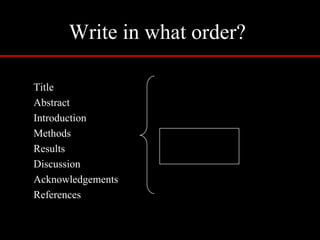
Write in what order?TitleAbstractIntroductionMethodsResultsDiscussionAcknowledgementsReferences
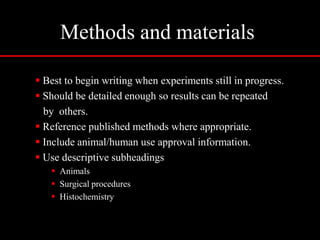
Methods and materials Best to begin writing when experiments still in progress.
 Should be detailed enough so results can be repeated    by  others. Reference published methods where appropriate.
 Include animal/human use approval information.
 Use descriptive subheadings
  Animals
  Surgical procedures
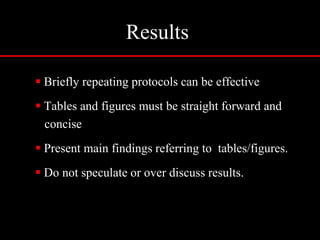
  Histochemistry Results Briefly repeating protocols can be effective
 Tables and figures must be straight forward and    concise Present main findings referring to  tables/figures.
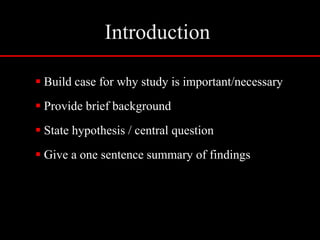
 Do not speculate or over discuss results.Introduction Build case for why study is important/necessary

Writing and publishing a research article

  • 1.
    Writing and publishinga research article  Thomas H. Adair, Ph.D.Professor of Physiology & BIophysicsCenter of Excellence inCardiovascular-Renal Research,University of MississippiMedical Center August, 2006
  • 2.
    ResourcesDay, RA. “Howto write and publish a scientific paper,” 5th edition, Oryx Press, 1998.Fischer BA, Zigmond MJ. “Components of a research article.” survival@pitt.eduMarshal GS. “Writing a peer reviewed article.” http://dor.umc.edu/ARCHIVES/GMarshallPublishingarticle.pptHall, JE. “Writing research papers (and getting them published)” http://dor.umc.edu/ARCHIVES/GMarshallPublishingarticle.pptBenos, D., Reich, M. “Peer review and publication in APS journals.”http://www.the-aps.org/careers/careers1/EBSymposia/Benos2003.ppt
  • 3.
    “There is noway to get experience except through experience.”
  • 4.
    Why write andpublish research papers?Ideally – to share research findings and discoveries with the hope of improving healthcare.Practically – to get funding to get promoted to get a job to keep your job!
  • 5.
    “Scientists are ratedby what they finish, not by what they attempt”
  • 6.
    Getting a paperpublishedCompetition for space in journals is intense
  • 7.
    Cost of publicationis high, $360/page for APS
  • 8.
  • 9.
  • 10.
  • 11.
    NEJM, Science,Nature = 90%Major reasons for rejection Confirmatory (not novel)
  • 12.
    Poorexperimental design - Poor controls - Hypothesis not adequately tested Inappropriate for journal
  • 13.
    PoorlywrittenTipsKnow the journal, its editors, and why you submitted the paper therePay close attention to spelling, grammar, and punctuationMake sure references are comprehensive and accurateAvoid careless mistakesRead and conform to “Instructions for Authors”
  • 14.
  • 15.
    Publish and perish“TheSeven Deadly Sins” Data manipulation, falsification Duplicate manuscripts Redundant publication Plagiarism Author conflicts of interest Animal use concerns Humans use concerns
  • 16.
    What constitutes redundantpublication?Data in conference abstract?Same data, different journal?Data on website?Data included in review article?Expansion of published data set?NoYesMaybeOK if laterYes
  • 17.
    What makes agood research paper? Good science
  • 18.
    Goodwriting
  • 19.
    Publicationin good journalsWhat constitutes good science?Novel – new and not resembling something formerly known or used(can be novel but not important)Mechanistic – testing a hypothesis - determining the fundamental processes involved in or responsible for an action, reaction, or other natural phenomenon Descriptive – describes how are things are but does not test how things work – hypotheses are not tested.
  • 20.
    What constitutes agood journal?Impact factor – average number of times published papers are cited up to two years after publication.Immediacy Index – average number of times published papers are cited during year of publication.

  • 21.
    Journal Citation Report,2003Journal Impact Factor Immediacy IndexNature 30.979 06.679 Science 29.162 05.589Hypertens 05.630 00.838AJ P Heart 03.658 00.675 Physiol Rev 36.831 03.727Am J Math 00.962 00.122 Ann Math 01.505 00.564 AM J MATH 0002-9327 002353 00.962 00.122 AM J MATH 0002-9327 002353 00.962 00.122 5907 journals
  • 22.
    Things to considerbefore writing1. Time to write the paper? - has a significant advancement been made? - is the hypothesis straightforward? - did the experiments test the hypothesis? - are the controls appropriate and sufficient? - can you describe the study in 1 or 2 minutes? - can the key message be written in 1 or 2 sentences?“Those who have the most to say usually say it with the fewest words”
  • 23.
    Things to considerbefore writing1. Time to write the paper? - has a significant advancement been made? - is the hypothesis straightforward? - did the experiments test the hypothesis? - are the controls appropriate and sufficient? - can you describe the study in 1 or 2 minutes? - can the key message be written in 1 or 2 sentences?2. Tables and figures - must be clear and concise - should be self-explanatory3. Read references - will help in choosing journal - better insight into possible reviewers

  • 24.
    Things to considerbefore writing4. Choose journal - study “instructions to authors” - think about possible reviewers - quality of journal “impact factor”5. Tentative title and summary6. Choose authors
  • 25.
    AuthorshipGuidelines on authorshop,International committee of Medical Journal Editors,Reprinted by kind permission of the Editor of the British Medical Journal of Sept14, 1985. J Clin Pathol 39: 110, 1986
  • 26.
    Writing the manuscriptThehardest part is getting started.
  • 27.
    Parts of amanuscriptTitleAbstractIntroductionMethodsResultsDiscussionAcknowledgementsReferences
  • 28.
    Write in whatorder?TitleAbstractIntroductionMethodsResultsDiscussionAcknowledgementsReferences
  • 29.
    Methods and materialsBest to begin writing when experiments still in progress.
  • 30.
    Should bedetailed enough so results can be repeated by others. Reference published methods where appropriate.
  • 31.
    Include animal/humanuse approval information.
  • 32.
    Use descriptivesubheadings
  • 33.
  • 34.
    Surgicalprocedures
  • 35.
    HistochemistryResults Briefly repeating protocols can be effective
  • 36.
    Tables andfigures must be straight forward and concise Present main findings referring to tables/figures.
  • 37.
    Do notspeculate or over discuss results.Introduction Build case for why study is important/necessary