5/17/2021 1
anjumk38dmc@gmail.com
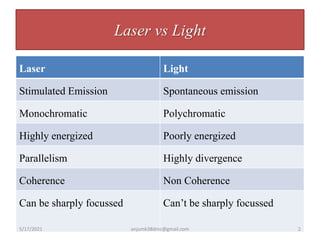
Laser vs Light
Laser Light
Stimulated Emission Spontaneous emission
Monochromatic Polychromatic
Highly energized Poorly energized
Parallelism Highly divergence
Coherence Non Coherence
Can be sharply focussed Can’t be sharply focussed
5/17/2021 2
anjumk38dmc@gmail.com
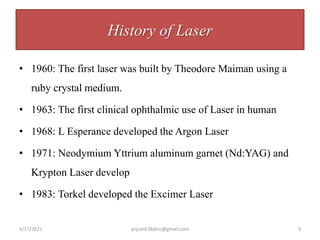
History of Laser
• 1960: The first laser was built by Theodore Maiman using a
ruby crystal medium.
• 1963: The first clinical ophthalmic use of Laser in human
• 1968: L Esperance developed the Argon Laser
• 1971: Neodymium Yttrium aluminum garnet (Nd:YAG) and
Krypton Laser develop
• 1983: Torkel developed the Excimer Laser
5/17/2021 anjumk38dmc@gmail.com 3
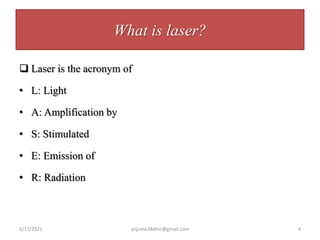
What is laser?
 Laser is the acronym of
• L: Light
• A: Amplification by
• S: Stimulated
• E: Emission of
• R: Radiation
5/17/2021 4
anjumk38dmc@gmail.com
Laser physics
• Laser as electromagnetic waves emitting radiant energy in tiny
package called quanta/photon. Each photon has a characteristic
frequency and its energy is proportional to its frequency
• Three basic ways for photons and atoms to interact.
i. Absorption
ii. Spontaneous Emission
iii. Stimulated Emission
5/17/2021 anjumk38dmc@gmail.com 5
5/17/2021 anjumk38dmc@gmail.com 6
Properties of laser
1) Laser is monochromatic
2) A particular laser has single wavelength
3) This depends on the medium used
4) It cannot be white
5) It is always coloured, i,e green, blue-green etc
6) It is coherent, i,e each wave (photon) is in the same phase as
the next.
5/17/2021 7
anjumk38dmc@gmail.com
Properties of laser
7) It is collimated, i, e rays (photon) are exactly parallel
8) Polarization: The photons vibrate in the same plane
9) It produces bright light
10) It produces intense heat & energy at short distance
11) Laser can burn, coagulate, evaporate & disrupt
12) It can be concentrated in a very small area
(Ref: Manual of Optics & Refraction PM Mukherjee Page: 2.3.4)
5/17/2021 8
anjumk38dmc@gmail.com
Properties of laser
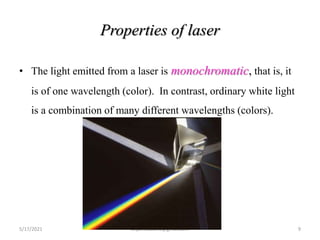
• The light emitted from a laser is monochromatic, that is, it
is of one wavelength (color). In contrast, ordinary white light
is a combination of many different wavelengths (colors).
5/17/2021 anjumk38dmc@gmail.com 9
Properties of laser
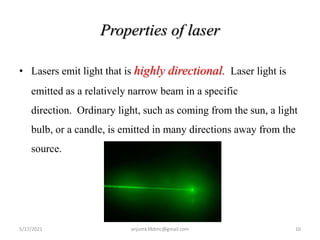
• Lasers emit light that is highly directional. Laser light is
emitted as a relatively narrow beam in a specific
direction. Ordinary light, such as coming from the sun, a light
bulb, or a candle, is emitted in many directions away from the
source.
5/17/2021 anjumk38dmc@gmail.com 10
Properties of laser
5/17/2021 anjumk38dmc@gmail.com 11
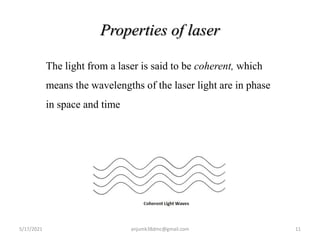
The light from a laser is said to be coherent, which
means the wavelengths of the laser light are in phase
in space and time
5/17/2021 anjumk38dmc@gmail.com 12
Different issues to know to understand laser
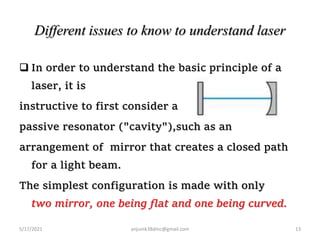
 In order to understand the basic principle of a
laser, it is
instructive to first consider a
passive resonator ("cavity"),such as an
arrangement of mirror that creates a closed path
for a light beam.
The simplest configuration is made with only
two mirror, one being flat and one being curved.
5/17/2021 13
anjumk38dmc@gmail.com
Different issues to know to understand laser
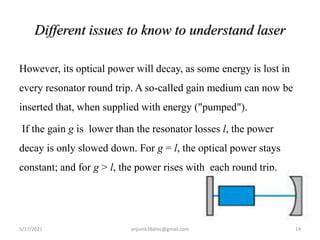
However, its optical power will decay, as some energy is lost in
every resonator round trip. A so-called gain medium can now be
inserted that, when supplied with energy ("pumped").
If the gain g is lower than the resonator losses l, the power
decay is only slowed down. For g = l, the optical power stays
constant; and for g > l, the power rises with each round trip.
5/17/2021 14
anjumk38dmc@gmail.com
Different issues to know to understand laser
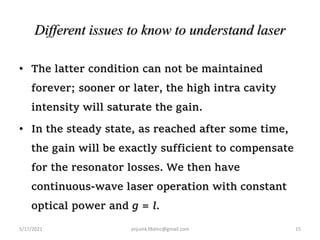
• The latter condition can not be maintained
forever; sooner or later, the high intra cavity
intensity will saturate the gain.
• In the steady state, as reached after some time,
the gain will be exactly sufficient to compensate
for the resonator losses. We then have
continuous-wave laser operation with constant
optical power and g = l.
5/17/2021 15
anjumk38dmc@gmail.com
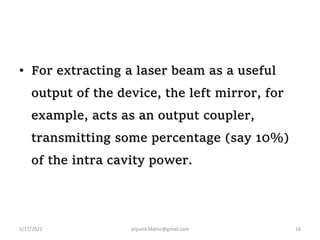
• For extracting a laser beam as a useful
output of the device, the left mirror, for
example, acts as an output coupler,
transmitting some percentage (say 10%)
of the intra cavity power.
5/17/2021 anjumk38dmc@gmail.com 16
Different issues to know to understand laser
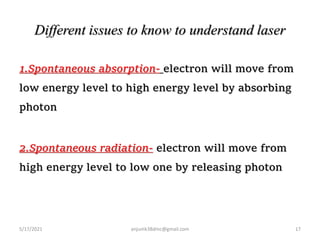
1.Spontaneous absorption- electron will move from
low energy level to high energy level by absorbing
photon
2.Spontaneous radiation- electron will move from
high energy level to low one by releasing photon
5/17/2021 17
anjumk38dmc@gmail.com
5/17/2021 anjumk38dmc@gmail.com 18
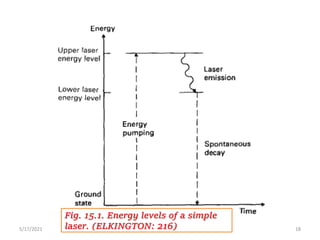
Fig. 15.1. Energy levels of a simple
laser. (ELKINGTON: 216)
5/17/2021 anjumk38dmc@gmail.com 19
Construction of Laser
5/17/2021 20
anjumk38dmc@gmail.com
5/17/2021 anjumk38dmc@gmail.com 21
Construction of Laser
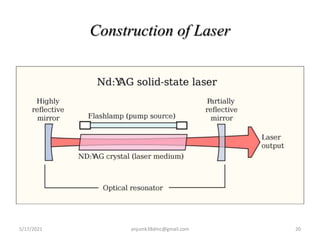
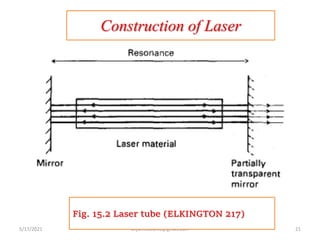
Fig. 15.2 Laser tube (ELKINGTON 217)
Three basic components of Laser
A Laser medium
• e,g solid, liquid or gas
Exciting method
• Light or electricity
Optical cavity (Laser tube)
• Around the medium acts as a resonator
5/17/2021 anjumk38dmc@gmail.com 22
Construction of Laser
• Laser consists of a cylinder that may be solid or
hollow; latter is filled with gas, liquid or a
combination.
• These substances should have ability to absorb
energy in one form and emit a new type of more
useful energy. The energy can be thermal,
mechanical, light or electrical. The process of
conversion is called lasing.
5/17/2021 23
anjumk38dmc@gmail.com
Construction of Laser
A cavity of the cylinder has two concave
mirrors at each end. One of them is fully
reflective. The mirrors are coated with thin
film of dielectric that reflects light close to
the wavelength of the laser light. The other
mirror is located on the other of the tube.
5/17/2021 24
anjumk38dmc@gmail.com
• The focal length of each mirror almost
coincides with the centre of the tube The
second mirror is partially reflective and is
considered to be leaky.
5/17/2021 anjumk38dmc@gmail.com 25
Construction of Laser
There are two slanting windows that close
each end of the tube.
The cavity or the rod is surrounded by
source of energy that raises the energy
level of the atoms within the cavity to a
high level in a very unstable state.
This is called population inversion.
5/17/2021 26
anjumk38dmc@gmail.com
The next step is spontaneous decay of the
energized atom to a lower energy level.
This phenomena is the basis behind the
release of high energy in the form of light
that is converted to suitable wavelength.
5/17/2021 anjumk38dmc@gmail.com 27
Construction of Laser
• Thus, to summarized, there are 2 steps:
1) Population inversion in active medium
2) Amplification of appropriate wavelength.
5/17/2021 28
anjumk38dmc@gmail.com
The energy stored in the laser material, i,
e, gas, liquid or solid, is released in a
narrow beam of monochromatic light.
This light is a source of high thermal
energy, which is used in ophthalmology
for various purposes.
5/17/2021 anjumk38dmc@gmail.com 29
Previously, we discuss that one mirror is
partially transparent, some of the light is
allowed to leave the tube.
5/17/2021 30
anjumk38dmc@gmail.com
• This light will be coherent (the wave fronts in
phase),
• monochromatic (one wave length) and
• collimated (all the rays parallel).
 Light is produced continuously, and such a laser
is said to be operating in continuous-wave (CW)
mode.
5/17/2021 anjumk38dmc@gmail.com 31
Laser mode
 Laser light is generally regarded as being
coherent, as a practical level not all the light
waves are preciously parallel as they resonate
between the two mirrors of the Laser tube.
 Cross-section of laser beam at different points
along its path reveals that it is very slightly
divergent, and that it is more intense at certain
points (called transverse electromagnetic modes)
5/17/2021 anjumk38dmc@gmail.com 32
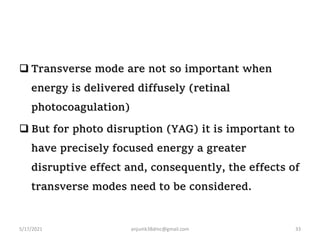
 Transverse mode are not so important when
energy is delivered diffusely (retinal
photocoagulation)
 But for photo disruption (YAG) it is important to
have precisely focused energy a greater
disruptive effect and, consequently, the effects of
transverse modes need to be considered.
5/17/2021 anjumk38dmc@gmail.com 33
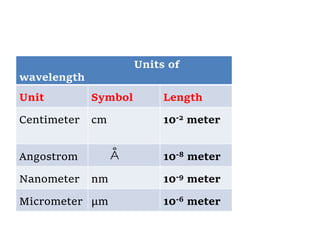
Units of
wavelength
Unit Symbol Length
Centimeter cm 10-2 meter
Angostrom 10-8 meter
Nanometer nm 10-9 meter
Micrometer μm 10-6 meter
5/17/2021 anjumk38dmc@gmail.com 35
Effects of laser energy on tissue
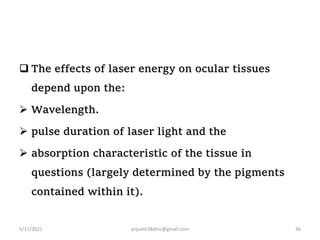
 The effects of laser energy on ocular tissues
depend upon the:
 Wavelength.
 pulse duration of laser light and the
 absorption characteristic of the tissue in
questions (largely determined by the pigments
contained within it).
5/17/2021 36
anjumk38dmc@gmail.com
Effects of laser energy on tissue
The effects can be
1) Thermal
2) Photochemical
3) Ionizing effect
5/17/2021 37
anjumk38dmc@gmail.com
Thermal effect
 Light energy is converted into heat energy if the wavelength
coincides with the absorption spectrum of the tissue pigment
on which it falls and if the pulse duration is between a few
microsecond and 10 s
 Melanin in the retina absorb most of the visible spectrum &
xanthophyll strongly absorb blue light, and hemoglobin absorb
blue, green and yellow wavelength.
5/17/2021 38
anjumk38dmc@gmail.com
Thermal effect
 In the retina, heat is transferred to the adjacent layers of the
retina to cause a 10-20 degree rise in tissue temp. The result is
photocoagulation and a localized burn.
 When visible or infrared light raises the tissue temp to 100 deg
water vaporizes and causes tissue disruption.
 Example: Carbon di oxide. Argon laser.
5/17/2021 39
anjumk38dmc@gmail.com
Photochemical effect
 When a pulse duration of 10 s or more is required to cause
damage, the mechanism is the formation of free radical ions
which are highly reactive and toxic to cells.
 Shorter wavelengths ( blue & UV) causes damage at lower
levels of irradiance and are therefore more harmful.
5/17/2021 40
anjumk38dmc@gmail.com
Ionisation
 Photon energy delivered in a nanosecond or less may be
sufficient to strip electrons from molecules to form a collection
of ions and electrons called a plasma.
 A plasma has a very high temperature and rapidly expands to
cause a mechanical shock wave sufficient to displace tissue.
 Energy released as photons may produce a flush.
 Example: Nd-YAG & Argon-fluoride excimer laser
5/17/2021 41
anjumk38dmc@gmail.com
• When the laser energy exceeds the
threshold for causing tissue damage, the
mechanism of any damage depends
largely upon the duration of exposure.
5/17/2021 anjumk38dmc@gmail.com 42
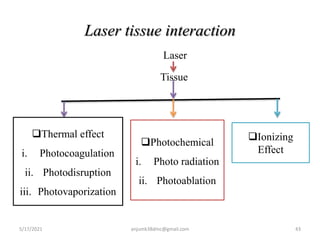
Laser tissue interaction
Laser
Tissue
5/17/2021 anjumk38dmc@gmail.com 43
Thermal effect
i. Photocoagulation
ii. Photodisruption
iii. Photovaporization
Photochemical
i. Photo radiation
ii. Photoablation
Ionizing
Effect
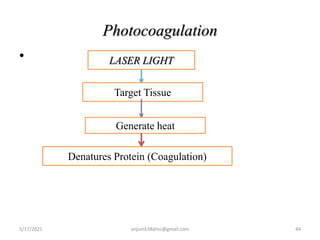
Photocoagulation
•
5/17/2021 anjumk38dmc@gmail.com 44
Target Tissue
Generate heat
Denatures Protein (Coagulation)
LASER LIGHT
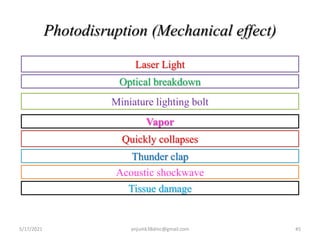
Photodisruption (Mechanical effect)
5/17/2021 anjumk38dmc@gmail.com 45
Laser Light
Miniature lighting bolt
Optical breakdown
Vapor
Tissue damage
Quickly collapses
Acoustic shockwave
Thunder clap
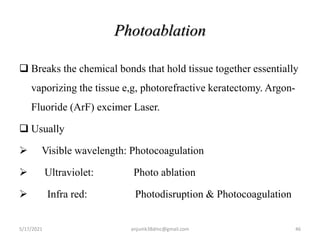
Photoablation
 Breaks the chemical bonds that hold tissue together essentially
vaporizing the tissue e,g, photorefractive keratectomy. Argon-
Fluoride (ArF) excimer Laser.
 Usually
 Visible wavelength: Photocoagulation
 Ultraviolet: Photo ablation
 Infra red: Photodisruption & Photocoagulation
5/17/2021 anjumk38dmc@gmail.com 46
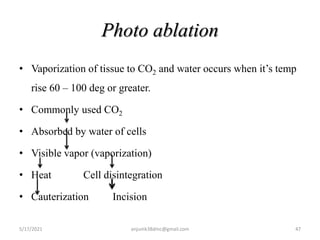
Photo ablation
• Vaporization of tissue to CO2 and water occurs when it’s temp
rise 60 – 100 deg or greater.
• Commonly used CO2
• Absorbed by water of cells
• Visible vapor (vaporization)
• Heat Cell disintegration
• Cauterization Incision
5/17/2021 anjumk38dmc@gmail.com 47
Photochemical effect
• Photo radiation
• Also called photo dynamic Therapy (PDT)
• Photochemical reaction following visible/infrared light
particularly after administration of exogenous chromophore
Commonly used photosensitizer:
• Hematoporphyrin
• Benzaporphyrin derivatives
5/17/2021 anjumk38dmc@gmail.com 48
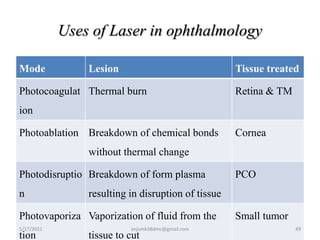
Uses of Laser in ophthalmology
Mode Lesion Tissue treated
Photocoagulat
ion
Thermal burn Retina & TM
Photoablation Breakdown of chemical bonds
without thermal change
Cornea
Photodisruptio
n
Breakdown of form plasma
resulting in disruption of tissue
PCO
Photovaporiza
tion
Vaporization of fluid from the
tissue to cut
Small tumor
5/17/2021 49
anjumk38dmc@gmail.com
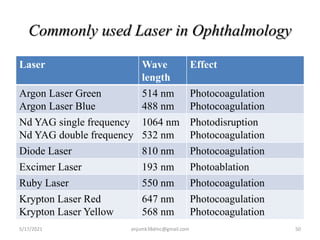
Commonly used Laser in Ophthalmology
Laser Wave
length
Effect
Argon Laser Green
Argon Laser Blue
514 nm
488 nm
Photocoagulation
Photocoagulation
Nd YAG single frequency
Nd YAG double frequency
1064 nm
532 nm
Photodisruption
Photocoagulation
Diode Laser 810 nm Photocoagulation
Excimer Laser 193 nm Photoablation
Ruby Laser 550 nm Photocoagulation
Krypton Laser Red
Krypton Laser Yellow
647 nm
568 nm
Photocoagulation
Photocoagulation
5/17/2021 50
anjumk38dmc@gmail.com
Modes of Laser Operation
• Continuous Wave Laser: It deliver their energy in a continuous
stream of photons
• Pulse Laser: Produce energy pulses of a few ten of micro to
few mili second
• Q Switches Laser: Deliver energy pulses of extremely shorter
duration (nanosecond)
• A mode locked Laser: Emits a train of short duration pulses
(picosecond)
5/17/2021 anjumk38dmc@gmail.com 51

LASER

  • 1.
  • 2.
    Laser vs Light LaserLight Stimulated Emission Spontaneous emission Monochromatic Polychromatic Highly energized Poorly energized Parallelism Highly divergence Coherence Non Coherence Can be sharply focussed Can’t be sharply focussed 5/17/2021 2 anjumk38dmc@gmail.com
  • 3.
    History of Laser •1960: The first laser was built by Theodore Maiman using a ruby crystal medium. • 1963: The first clinical ophthalmic use of Laser in human • 1968: L Esperance developed the Argon Laser • 1971: Neodymium Yttrium aluminum garnet (Nd:YAG) and Krypton Laser develop • 1983: Torkel developed the Excimer Laser 5/17/2021 anjumk38dmc@gmail.com 3
  • 4.
    What is laser? Laser is the acronym of • L: Light • A: Amplification by • S: Stimulated • E: Emission of • R: Radiation 5/17/2021 4 anjumk38dmc@gmail.com
  • 5.
    Laser physics • Laseras electromagnetic waves emitting radiant energy in tiny package called quanta/photon. Each photon has a characteristic frequency and its energy is proportional to its frequency • Three basic ways for photons and atoms to interact. i. Absorption ii. Spontaneous Emission iii. Stimulated Emission 5/17/2021 anjumk38dmc@gmail.com 5
  • 6.
  • 7.
    Properties of laser 1)Laser is monochromatic 2) A particular laser has single wavelength 3) This depends on the medium used 4) It cannot be white 5) It is always coloured, i,e green, blue-green etc 6) It is coherent, i,e each wave (photon) is in the same phase as the next. 5/17/2021 7 anjumk38dmc@gmail.com
  • 8.
    Properties of laser 7)It is collimated, i, e rays (photon) are exactly parallel 8) Polarization: The photons vibrate in the same plane 9) It produces bright light 10) It produces intense heat & energy at short distance 11) Laser can burn, coagulate, evaporate & disrupt 12) It can be concentrated in a very small area (Ref: Manual of Optics & Refraction PM Mukherjee Page: 2.3.4) 5/17/2021 8 anjumk38dmc@gmail.com
  • 9.
    Properties of laser •The light emitted from a laser is monochromatic, that is, it is of one wavelength (color). In contrast, ordinary white light is a combination of many different wavelengths (colors). 5/17/2021 anjumk38dmc@gmail.com 9
  • 10.
    Properties of laser •Lasers emit light that is highly directional. Laser light is emitted as a relatively narrow beam in a specific direction. Ordinary light, such as coming from the sun, a light bulb, or a candle, is emitted in many directions away from the source. 5/17/2021 anjumk38dmc@gmail.com 10
  • 11.
    Properties of laser 5/17/2021anjumk38dmc@gmail.com 11 The light from a laser is said to be coherent, which means the wavelengths of the laser light are in phase in space and time
  • 12.
  • 13.
    Different issues toknow to understand laser  In order to understand the basic principle of a laser, it is instructive to first consider a passive resonator ("cavity"),such as an arrangement of mirror that creates a closed path for a light beam. The simplest configuration is made with only two mirror, one being flat and one being curved. 5/17/2021 13 anjumk38dmc@gmail.com
  • 14.
    Different issues toknow to understand laser However, its optical power will decay, as some energy is lost in every resonator round trip. A so-called gain medium can now be inserted that, when supplied with energy ("pumped"). If the gain g is lower than the resonator losses l, the power decay is only slowed down. For g = l, the optical power stays constant; and for g > l, the power rises with each round trip. 5/17/2021 14 anjumk38dmc@gmail.com
  • 15.
    Different issues toknow to understand laser • The latter condition can not be maintained forever; sooner or later, the high intra cavity intensity will saturate the gain. • In the steady state, as reached after some time, the gain will be exactly sufficient to compensate for the resonator losses. We then have continuous-wave laser operation with constant optical power and g = l. 5/17/2021 15 anjumk38dmc@gmail.com
  • 16.
    • For extractinga laser beam as a useful output of the device, the left mirror, for example, acts as an output coupler, transmitting some percentage (say 10%) of the intra cavity power. 5/17/2021 anjumk38dmc@gmail.com 16
  • 17.
    Different issues toknow to understand laser 1.Spontaneous absorption- electron will move from low energy level to high energy level by absorbing photon 2.Spontaneous radiation- electron will move from high energy level to low one by releasing photon 5/17/2021 17 anjumk38dmc@gmail.com
  • 18.
    5/17/2021 anjumk38dmc@gmail.com 18 Fig.15.1. Energy levels of a simple laser. (ELKINGTON: 216)
  • 19.
  • 20.
    Construction of Laser 5/17/202120 anjumk38dmc@gmail.com
  • 21.
    5/17/2021 anjumk38dmc@gmail.com 21 Constructionof Laser Fig. 15.2 Laser tube (ELKINGTON 217)
  • 22.
    Three basic componentsof Laser A Laser medium • e,g solid, liquid or gas Exciting method • Light or electricity Optical cavity (Laser tube) • Around the medium acts as a resonator 5/17/2021 anjumk38dmc@gmail.com 22
  • 23.
    Construction of Laser •Laser consists of a cylinder that may be solid or hollow; latter is filled with gas, liquid or a combination. • These substances should have ability to absorb energy in one form and emit a new type of more useful energy. The energy can be thermal, mechanical, light or electrical. The process of conversion is called lasing. 5/17/2021 23 anjumk38dmc@gmail.com
  • 24.
    Construction of Laser Acavity of the cylinder has two concave mirrors at each end. One of them is fully reflective. The mirrors are coated with thin film of dielectric that reflects light close to the wavelength of the laser light. The other mirror is located on the other of the tube. 5/17/2021 24 anjumk38dmc@gmail.com
  • 25.
    • The focallength of each mirror almost coincides with the centre of the tube The second mirror is partially reflective and is considered to be leaky. 5/17/2021 anjumk38dmc@gmail.com 25
  • 26.
    Construction of Laser Thereare two slanting windows that close each end of the tube. The cavity or the rod is surrounded by source of energy that raises the energy level of the atoms within the cavity to a high level in a very unstable state. This is called population inversion. 5/17/2021 26 anjumk38dmc@gmail.com
  • 27.
    The next stepis spontaneous decay of the energized atom to a lower energy level. This phenomena is the basis behind the release of high energy in the form of light that is converted to suitable wavelength. 5/17/2021 anjumk38dmc@gmail.com 27
  • 28.
    Construction of Laser •Thus, to summarized, there are 2 steps: 1) Population inversion in active medium 2) Amplification of appropriate wavelength. 5/17/2021 28 anjumk38dmc@gmail.com
  • 29.
    The energy storedin the laser material, i, e, gas, liquid or solid, is released in a narrow beam of monochromatic light. This light is a source of high thermal energy, which is used in ophthalmology for various purposes. 5/17/2021 anjumk38dmc@gmail.com 29
  • 30.
    Previously, we discussthat one mirror is partially transparent, some of the light is allowed to leave the tube. 5/17/2021 30 anjumk38dmc@gmail.com
  • 31.
    • This lightwill be coherent (the wave fronts in phase), • monochromatic (one wave length) and • collimated (all the rays parallel).  Light is produced continuously, and such a laser is said to be operating in continuous-wave (CW) mode. 5/17/2021 anjumk38dmc@gmail.com 31
  • 32.
    Laser mode  Laserlight is generally regarded as being coherent, as a practical level not all the light waves are preciously parallel as they resonate between the two mirrors of the Laser tube.  Cross-section of laser beam at different points along its path reveals that it is very slightly divergent, and that it is more intense at certain points (called transverse electromagnetic modes) 5/17/2021 anjumk38dmc@gmail.com 32
  • 33.
     Transverse modeare not so important when energy is delivered diffusely (retinal photocoagulation)  But for photo disruption (YAG) it is important to have precisely focused energy a greater disruptive effect and, consequently, the effects of transverse modes need to be considered. 5/17/2021 anjumk38dmc@gmail.com 33
  • 34.
    Units of wavelength Unit SymbolLength Centimeter cm 10-2 meter Angostrom 10-8 meter Nanometer nm 10-9 meter Micrometer μm 10-6 meter
  • 35.
  • 36.
     The effectsof laser energy on ocular tissues depend upon the:  Wavelength.  pulse duration of laser light and the  absorption characteristic of the tissue in questions (largely determined by the pigments contained within it). 5/17/2021 36 anjumk38dmc@gmail.com
  • 37.
    Effects of laserenergy on tissue The effects can be 1) Thermal 2) Photochemical 3) Ionizing effect 5/17/2021 37 anjumk38dmc@gmail.com
  • 38.
    Thermal effect  Lightenergy is converted into heat energy if the wavelength coincides with the absorption spectrum of the tissue pigment on which it falls and if the pulse duration is between a few microsecond and 10 s  Melanin in the retina absorb most of the visible spectrum & xanthophyll strongly absorb blue light, and hemoglobin absorb blue, green and yellow wavelength. 5/17/2021 38 anjumk38dmc@gmail.com
  • 39.
    Thermal effect  Inthe retina, heat is transferred to the adjacent layers of the retina to cause a 10-20 degree rise in tissue temp. The result is photocoagulation and a localized burn.  When visible or infrared light raises the tissue temp to 100 deg water vaporizes and causes tissue disruption.  Example: Carbon di oxide. Argon laser. 5/17/2021 39 anjumk38dmc@gmail.com
  • 40.
    Photochemical effect  Whena pulse duration of 10 s or more is required to cause damage, the mechanism is the formation of free radical ions which are highly reactive and toxic to cells.  Shorter wavelengths ( blue & UV) causes damage at lower levels of irradiance and are therefore more harmful. 5/17/2021 40 anjumk38dmc@gmail.com
  • 41.
    Ionisation  Photon energydelivered in a nanosecond or less may be sufficient to strip electrons from molecules to form a collection of ions and electrons called a plasma.  A plasma has a very high temperature and rapidly expands to cause a mechanical shock wave sufficient to displace tissue.  Energy released as photons may produce a flush.  Example: Nd-YAG & Argon-fluoride excimer laser 5/17/2021 41 anjumk38dmc@gmail.com
  • 42.
    • When thelaser energy exceeds the threshold for causing tissue damage, the mechanism of any damage depends largely upon the duration of exposure. 5/17/2021 anjumk38dmc@gmail.com 42
  • 43.
    Laser tissue interaction Laser Tissue 5/17/2021anjumk38dmc@gmail.com 43 Thermal effect i. Photocoagulation ii. Photodisruption iii. Photovaporization Photochemical i. Photo radiation ii. Photoablation Ionizing Effect
  • 44.
    Photocoagulation • 5/17/2021 anjumk38dmc@gmail.com 44 TargetTissue Generate heat Denatures Protein (Coagulation) LASER LIGHT
  • 45.
    Photodisruption (Mechanical effect) 5/17/2021anjumk38dmc@gmail.com 45 Laser Light Miniature lighting bolt Optical breakdown Vapor Tissue damage Quickly collapses Acoustic shockwave Thunder clap
  • 46.
    Photoablation  Breaks thechemical bonds that hold tissue together essentially vaporizing the tissue e,g, photorefractive keratectomy. Argon- Fluoride (ArF) excimer Laser.  Usually  Visible wavelength: Photocoagulation  Ultraviolet: Photo ablation  Infra red: Photodisruption & Photocoagulation 5/17/2021 anjumk38dmc@gmail.com 46
  • 47.
    Photo ablation • Vaporizationof tissue to CO2 and water occurs when it’s temp rise 60 – 100 deg or greater. • Commonly used CO2 • Absorbed by water of cells • Visible vapor (vaporization) • Heat Cell disintegration • Cauterization Incision 5/17/2021 anjumk38dmc@gmail.com 47
  • 48.
    Photochemical effect • Photoradiation • Also called photo dynamic Therapy (PDT) • Photochemical reaction following visible/infrared light particularly after administration of exogenous chromophore Commonly used photosensitizer: • Hematoporphyrin • Benzaporphyrin derivatives 5/17/2021 anjumk38dmc@gmail.com 48
  • 49.
    Uses of Laserin ophthalmology Mode Lesion Tissue treated Photocoagulat ion Thermal burn Retina & TM Photoablation Breakdown of chemical bonds without thermal change Cornea Photodisruptio n Breakdown of form plasma resulting in disruption of tissue PCO Photovaporiza tion Vaporization of fluid from the tissue to cut Small tumor 5/17/2021 49 anjumk38dmc@gmail.com
  • 50.
    Commonly used Laserin Ophthalmology Laser Wave length Effect Argon Laser Green Argon Laser Blue 514 nm 488 nm Photocoagulation Photocoagulation Nd YAG single frequency Nd YAG double frequency 1064 nm 532 nm Photodisruption Photocoagulation Diode Laser 810 nm Photocoagulation Excimer Laser 193 nm Photoablation Ruby Laser 550 nm Photocoagulation Krypton Laser Red Krypton Laser Yellow 647 nm 568 nm Photocoagulation Photocoagulation 5/17/2021 50 anjumk38dmc@gmail.com
  • 51.
    Modes of LaserOperation • Continuous Wave Laser: It deliver their energy in a continuous stream of photons • Pulse Laser: Produce energy pulses of a few ten of micro to few mili second • Q Switches Laser: Deliver energy pulses of extremely shorter duration (nanosecond) • A mode locked Laser: Emits a train of short duration pulses (picosecond) 5/17/2021 anjumk38dmc@gmail.com 51