How do you feel when you
have to write an academic
paper?
Do not panic!
 In this presentation you can find
some guidelines to write an
academic paper successfully .
 Just as there are differences in the way we use language for
speech and for writing, there are also differences in the way we
write for different situations; for example, compare the following
written texts:
 Dear Mark,
My accountant friend thinks that phone company shares
are a good buy at the moment so I think I'll move some
money into them...
 Some financial advisors recommend purchasing
communication industry shares.
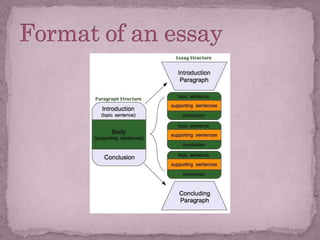
 The second way of phrasing the idea is much more
appropriate for a university assignment.
 It should have:
 1- An attention-grabbing first sentence.
 2- Informative sentences that build to
your thesis.
 3- The thesis statement.
 1- Attention-grabbing first sentence:
 Start with something interesting and sufficiently
general, but not too broad.
 A not appropriate example could be:
 “Karl Marx was a very important thinker.”
 In this case, you can substitute hundreds of names for
“Karl Marx” and it would still make sense. You want
your introduction to say something reasonably specific
about your subject.
A good example could be:
 “Karl Marx was the first important thinker to
argue that capitalism causes exploitation”.

 You could go on from there to talk about the
nature of exploitation, how he defines capitalism
and then conclude it with a thesis that
explains why he thought capitalism causes
exploitation.
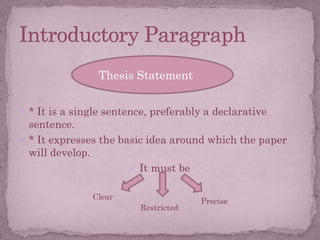
 * It is a single sentence, preferably a declarative
sentence.
 * It expresses the basic idea around which the paper
will develop.
 It must be
Thesis Statement
Clear
Restricted
Precise
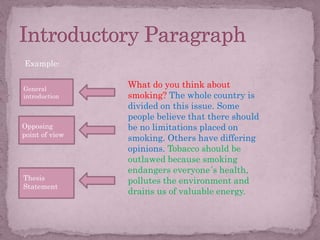
Example:
What do you think about
smoking? The whole country is
divided on this issue. Some
people believe that there should
be no limitations placed on
smoking. Others have differing
opinions. Tobacco should be
outlawed because smoking
endangers everyone´s health,
pollutes the environment and
drains us of valuable energy.
General
introduction
Opposing
point of view
Thesis
Statement
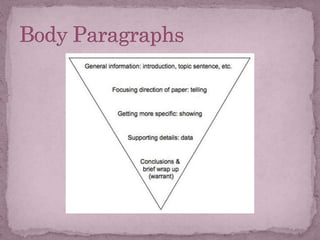
 They should include:
 * Topic sentence.
 * Elaboration of the point.
 * Examples to support your point.
 * Explanation of evidence.
 * Concluding sentence.
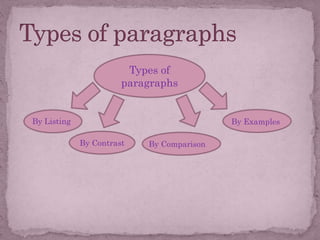
Types of
paragraphs
By Listing
By Contrast By Comparison
By Examples
 This paragraph may include:
 * Restatement of the Thesis Statement.
 * Summary of the ideas expressed in the body
paragraphs.
 * A piece of advice, a question or a call for
action.
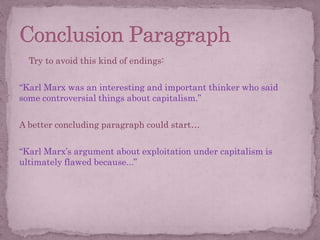
 Try to avoid this kind of endings:
“Karl Marx was an interesting and important thinker who said
some controversial things about capitalism.”
A better concluding paragraph could start…
“Karl Marx’s argument about exploitation under capitalism is
ultimately flawed because...”
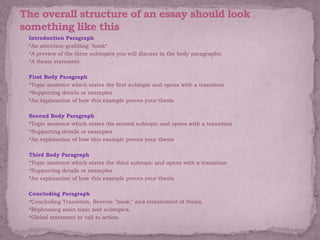
 Introduction Paragraph
 *An attention-grabbing "hook“
 *A preview of the three subtopics you will discuss in the body paragraphs.
 *A thesis statement
 First Body Paragraph
 *Topic sentence which states the first subtopic and opens with a transition
 *Supporting details or examples
 *An explanation of how this example proves your thesis
 Second Body Paragraph
 *Topic sentence which states the second subtopic and opens with a transition
 *Supporting details or examples
 *An explanation of how this example proves your thesis
 Third Body Paragraph
 *Topic sentence which states the third subtopic and opens with a transition
 *Supporting details or examples
 *An explanation of how this example proves your thesis
 Concluding Paragraph
 *Concluding Transition, Reverse "hook," and restatement of thesis.
 *Rephrasing main topic and subtopics.
 *Global statement or call to action.
 Practice! Practice! Practice!
 In the end, though, remember that good writing
not happen by accident. Although this guidelines
endeavored to explain everything that goes into
effective essay writing in as clear and concise a way
possible, it is much easier in theory than it is in
practice.
 As a result, try to practice writing sample essays on
various topics. Even if they are not masterpieces at
first, a bit of regular practice will soon change that –
and make you better prepared when it comes to the
real thing.
 Clausen, K. (2005) “General essay writing tips”. Retrieved: October, 24. From
International Student webpage. Available at:
http://www.internationalstudent.com/essay_writing/essay_tips
 Hyland, K (2000). “Good academic writing”. Retrieved: October, 24. Available at:
http://www.academiccoachingandwriting.org/S=0/academic-writing/resources/good-
academic-writing
 Imhoof, M & Hudson, H (1975) From paragraph to essay. Longman.
 Mc Carthy, M & O´Dell, F (2008). Academic vocabulary in use. Cambridge University
Press.
 Pollock, E. “Academic writing”. Retrieved: October, 24. From Uni-Learning webpage.
Available at: http://unilearning.uow.edu.au/academic/1a.html
 Sanchez Terrel, S. (2015) “30 goals conference keynote: Rosmery Ribera Ferrier”.
Retrieved :October, 23. Available at:
https://www.youtube.com/watch?v=RDBuSUXWIEU
 Strauss, V. (2012) “A guide to writing an academic paper”. Retrieved: October, 24. From
The Washington Post website. Available at:
https://www.washingtonpost.com/blogs/answer-sheet/post/a-guide-to-writing-an-
academic-paper/2012/01/18/gIQAjGCTCQ_blog.html
 Reiss, D (2005). “Guidelines for Academic papers”. Retrieved: October, 24. Available at:
http://wordsworth2.net/writing/academicpapers.htm

How to write an academic paper

  • 2.
    How do youfeel when you have to write an academic paper? Do not panic!
  • 3.
     In thispresentation you can find some guidelines to write an academic paper successfully .
  • 4.
     Just asthere are differences in the way we use language for speech and for writing, there are also differences in the way we write for different situations; for example, compare the following written texts:  Dear Mark, My accountant friend thinks that phone company shares are a good buy at the moment so I think I'll move some money into them...  Some financial advisors recommend purchasing communication industry shares.  The second way of phrasing the idea is much more appropriate for a university assignment.
  • 7.
     It shouldhave:  1- An attention-grabbing first sentence.  2- Informative sentences that build to your thesis.  3- The thesis statement.
  • 8.
     1- Attention-grabbingfirst sentence:  Start with something interesting and sufficiently general, but not too broad.  A not appropriate example could be:  “Karl Marx was a very important thinker.”  In this case, you can substitute hundreds of names for “Karl Marx” and it would still make sense. You want your introduction to say something reasonably specific about your subject.
  • 9.
    A good examplecould be:  “Karl Marx was the first important thinker to argue that capitalism causes exploitation”.   You could go on from there to talk about the nature of exploitation, how he defines capitalism and then conclude it with a thesis that explains why he thought capitalism causes exploitation.
  • 10.
     * Itis a single sentence, preferably a declarative sentence.  * It expresses the basic idea around which the paper will develop.  It must be Thesis Statement Clear Restricted Precise
  • 11.
    Example: What do youthink about smoking? The whole country is divided on this issue. Some people believe that there should be no limitations placed on smoking. Others have differing opinions. Tobacco should be outlawed because smoking endangers everyone´s health, pollutes the environment and drains us of valuable energy. General introduction Opposing point of view Thesis Statement
  • 12.
     They shouldinclude:  * Topic sentence.  * Elaboration of the point.  * Examples to support your point.  * Explanation of evidence.  * Concluding sentence.
  • 14.
    Types of paragraphs By Listing ByContrast By Comparison By Examples
  • 15.
     This paragraphmay include:  * Restatement of the Thesis Statement.  * Summary of the ideas expressed in the body paragraphs.  * A piece of advice, a question or a call for action.
  • 16.
     Try toavoid this kind of endings: “Karl Marx was an interesting and important thinker who said some controversial things about capitalism.” A better concluding paragraph could start… “Karl Marx’s argument about exploitation under capitalism is ultimately flawed because...”
  • 17.
     Introduction Paragraph *An attention-grabbing "hook“  *A preview of the three subtopics you will discuss in the body paragraphs.  *A thesis statement  First Body Paragraph  *Topic sentence which states the first subtopic and opens with a transition  *Supporting details or examples  *An explanation of how this example proves your thesis  Second Body Paragraph  *Topic sentence which states the second subtopic and opens with a transition  *Supporting details or examples  *An explanation of how this example proves your thesis  Third Body Paragraph  *Topic sentence which states the third subtopic and opens with a transition  *Supporting details or examples  *An explanation of how this example proves your thesis  Concluding Paragraph  *Concluding Transition, Reverse "hook," and restatement of thesis.  *Rephrasing main topic and subtopics.  *Global statement or call to action.
  • 18.
     Practice! Practice!Practice!  In the end, though, remember that good writing not happen by accident. Although this guidelines endeavored to explain everything that goes into effective essay writing in as clear and concise a way possible, it is much easier in theory than it is in practice.  As a result, try to practice writing sample essays on various topics. Even if they are not masterpieces at first, a bit of regular practice will soon change that – and make you better prepared when it comes to the real thing.
  • 20.
     Clausen, K.(2005) “General essay writing tips”. Retrieved: October, 24. From International Student webpage. Available at: http://www.internationalstudent.com/essay_writing/essay_tips  Hyland, K (2000). “Good academic writing”. Retrieved: October, 24. Available at: http://www.academiccoachingandwriting.org/S=0/academic-writing/resources/good- academic-writing  Imhoof, M & Hudson, H (1975) From paragraph to essay. Longman.  Mc Carthy, M & O´Dell, F (2008). Academic vocabulary in use. Cambridge University Press.  Pollock, E. “Academic writing”. Retrieved: October, 24. From Uni-Learning webpage. Available at: http://unilearning.uow.edu.au/academic/1a.html  Sanchez Terrel, S. (2015) “30 goals conference keynote: Rosmery Ribera Ferrier”. Retrieved :October, 23. Available at: https://www.youtube.com/watch?v=RDBuSUXWIEU  Strauss, V. (2012) “A guide to writing an academic paper”. Retrieved: October, 24. From The Washington Post website. Available at: https://www.washingtonpost.com/blogs/answer-sheet/post/a-guide-to-writing-an- academic-paper/2012/01/18/gIQAjGCTCQ_blog.html  Reiss, D (2005). “Guidelines for Academic papers”. Retrieved: October, 24. Available at: http://wordsworth2.net/writing/academicpapers.htm