
An Introduction to
Scientific Writing
Dr. Galib,
Assistant Professor,
IPGT & RA, GAU,
Jamnagar
Need of doing Research
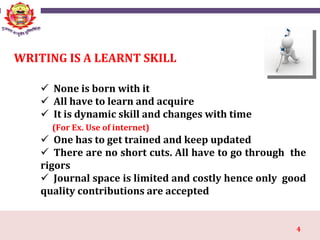
 Current times are of "Publish or Perish"
 The career graph of an individual shows growth for those who
have publications in
Good
Indexed
Standard
Peer reviewed
Well distributed
Regularly published
Scientifically acclaimed journals.
 None is born with it
 All have to learn and acquire
 It is dynamic skill and changes with time
(For Ex. Use of internet)
 One has to get trained and keep updated
 There are no short cuts. All have to go through the
rigors
 Journal space is limited and costly hence only good
quality contributions are accepted
4
WRITING IS A LEARNT SKILL
5
 .. know your subject well
Before Starting
You
6
 .. know the pattern well
 .. give the a time it requires
 .. know what the science expect
 .. try hard enough
 .. give credits where due
7
W's of writing:
1. Who: Trained, scientific communicator
2. What: New material of utility, concern to fellow beings
3. When: ASAP after the research is completed.
Do not hold it. It looses the charm of timeliness.
If you do not publish fast, others will !
Then your work will have low value.
4. Where: Hard copy journals, E-Journals
8
W's of writing:
5. Why:
Writing is transmission of research findings, ideas, opinions.
Sharing of knowledge.
Getting known for your work.
Essential requirement of certain jobs & will be picked up for jobs preferably.
Publication gives you sense of attainment and Psychological
reward.
Build your CV.
Optimal utilization of free time.
Why a structure for writing?????
For the uniformity
To avoid confusion
To reduce the verbosity / length
To clarify specifics
Poor writing results when You:
 Don’t know your subject well
 Don’t give the manuscript a time it requires
 Don’t know the readers & what they expect from you
 Don’t know the language well
 Don’t write to express your ideas, but try to impress
others
 Don’t try hard enough
 Flow of manuscript
 Sections and Order
 References for validity
[References of last 5 yrs for scientific studies]
[References from web should be current]
 Sentence Structure
 Grammar
The important issues are
Style of Presentation Research
Idea
Essentials of writing:
13
Introduction
Materials & Methods
Results
And
Discussion
.......... was introduced during 1972
by
American Naional Standards Institute
14
ABSTRACT The Mini Version of the Paper
Structure should be
 The Problem
(Background)
 Purpose of Study
 Method
 Results
 Conclusions Contents should describe
 Why the research was conducted
 How the research was conducted
 What the major results and
conclusions are
15
ABSTRACT
 Around 150- 250 words
 Well written
 Preferably be typed as single paragraph.
 Don’t cite references & Don’t use abbreviations.
 Emphasize new and important aspects of the study.
 Preferably it should be written in the past tense.
Abstract is the only part of a research paper that is displayed
many times. Hence, should give a succinct summary of entire work
and its outcomes.
16
 Important words or short phrases that
specifically describe your topic and closely related.
 Shouldn’t be long sentences.
 The terms people would enter to find.
 Terms from the Medical Subject Headings (MeSH)
list of Index Medicus.
Key Words
17
 First, write one or two sentences about your topic.
 Next, underline all the specific words that describe
your topic.
 Make a separate list of these specific words.
 Add to your list any other words that mean the same
thing (synonyms) or are related terms.
 Think of more words or phrases that describe the
larger topic, of which your topic is a part.
 Add those to the list.
Key Words
How to list "good key words"?
18
Writing Introduction
 First section of the text proper.
Purpose: to provide sufficient background
information to allow readers to understand
and evaluate the result of the present study.
19
Writing Introduction
X Be eager to reveal all in intro!
X Confuse the readers with complex sentences
X Give results and conclusions in intro!
X Write junk to fill the space.
Do NOT:
Try to impress the readers,
else you may loose the game because many readers are
very sharp and knowledgeable to catch you on wrong foot.
20
Writing a GOOD Introduction
 Review the literature
 State clearly the question (Aims & Objectives)
 Be brief and convincing.
 Should state method of the study.
 Reason of selection of the problem.
 Do not keep the reader in suspense.
 Define abbreviations (if any) in Introduction.
21
Materials & Methods
While going through this section, it becomes easy for others to understand and
repeat the same if needed.
PURPOSE:
To describe the design of the study with enough details.
MATERIALS:
Exact technical specifications and details followed.
In clinical study- criteria of selection, ‘informed consent’ statement.
METHODS:
This section answers the question: "How was the trial/study done"?
22
Materials & Methods
 Procedures adopted should be written with full details.
 If the method is new - provide all of the needed details.
 If the method is published - give literature reference.
 How is the trial/study is designed?
 Ethical aspects
 Randomization
 Blinding and Grouping
 Details of the trial drugs
 How were the data is handled
 Statistical methods
Ensure to write :
 Materials and Methods should be written in PAST tense.
23
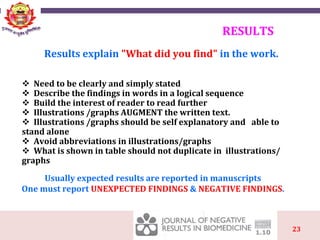
RESULTS
 Need to be clearly and simply stated
 Describe the findings in words in a logical sequence
 Build the interest of reader to read further
 Illustrations /graphs AUGMENT the written text.
 Illustrations /graphs should be self explanatory and able to
stand alone
 Avoid abbreviations in illustrations/graphs
 What is shown in table should not duplicate in illustrations/
graphs
Results explain "What did you find" in the work.
Usually expected results are reported in manuscripts
One must report UNEXPECTED FINDINGS & NEGATIVE FINDINGS.
24
TABLES
 Meant to present original and complete information.
 Used when there is a need to present numerical
values or summarize / emphasize textual material.
A table should be
• sufficiently clear
• well-labeled
• described by its legend
• must be able to stand alone and be interpretable
All Tables should be referred in the text
25
DISCUSSION
HARDEST SECTION TO WRITE.
 Many papers are rejected because of faulty discussion.
COMPONENTS:
 Highlight the specific aspects of the methods which are
responsible in obtaining the unique findings.
 Describe the results in comarision to previous works of
others with exact references.
 Never deny credits to others whose work is quoted.
 Point any exceptions or any lack of correlations and define
unsettled points.
 Discuss the theoretical implications of your work as well as
any possible practical applications.
 State your conclusion as clearly as possible.
 Do not repeat the results in discussion.
26
References
It is always better to keep writing the full references in brackets
where ever material is quoted while preparing the draft
manuscript, which can be subsequently converted to the format of
the publication.
27
References
Pubmed Style
U A, R. K. Sesame Meal Administration
Attenuates The High - Fat Diet Induced Lipid
Peroxidation And Improve Antioxidant Status
In Wistar Rat. AJPBR. 2011; 1(3): 273-280.
Web Style
U A, R. K. Sesame Meal Administration
Attenuates The High - Fat Diet Induced Lipid
Peroxidation And Improve Antioxidant Status
In Wistar Rat. ww.scopemed.org/?mno=11437
[Access: February 29, 2012].
AMA (American Medical Assoc.) Style
U A, R. K. Sesame Meal Administration
Attenuates The High - Fat Diet Induced Lipid
Peroxidation And Improve Antioxidant Status
In Wistar Rat. AJPBR. 2011; 1(3): 273-280.
Vancouver/ICMJE Style
U A, R. K. Sesame Meal Administration
Attenuates The High - Fat Diet Induced Lipid
Peroxidation And Improve Antioxidant Status
In Wistar Rat. AJPBR. (2011), [cited February
29, 2012]; 1(3): 273-280.
Harvard Style
U, A. & R., K. (2011) Sesame Meal
Administration Attenuates The High - Fat
Diet Induced Lipid Peroxidation And
Improve Antioxidant Status In Wistar Rat.
AJPBR, 1 (3), 273-280.
28
WRITING A TITLE
Title 1: Studies on Amavata
Title 2: On the addition to the method of Microscopic Reseach by a
New way of producing color contrast between an object and its
background or between difinite parts of the object itself
29
WRITING A TITLE
1Avoid too short or too long title.
2Simple, Clear and should convey the essence.
3Long titles contain ‘waste’ words.
Waste words appear right at the start of the title, e.g.-
‘Studies on’,
‘Investigations on’,
‘ Observations on’,
A, An, The.
3. Never use abbreviations, chemical formulae, jargons.
Title 1: Medhya effect of Brahmi in children
Title 2: Effect of Brahmi in Learning Disabilities of Children
30
WHO WILL BE THE AUTHOR
1Whose name first ?
2No rule.
3Alphabetical Order ??
‘Laundry list approach’ is to be avoided
Who takes the responsibility for the research results being Reported
31
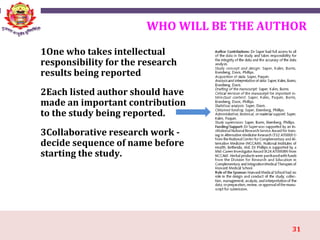
WHO WILL BE THE AUTHOR
1One who takes intellectual
responsibility for the research
results being reported
2Each listed author should have
made an important contribution
to the study being reported.
3Collaborative research work -
decide sequence of name before
starting the study.
32
WHO WILL BE THE AUTHOR
 All those who contribute significantly on the scientific
merit should get co-authorship.
 It is always good to decide the authorship order at the
protocol writing stage to save heart burn later.
 Do not gift authorship to friends, colleagues or for
getting authorship reciprocally.
33
ACKNOWLEDGEMENT
 Acknowledge any significant technical help that you
received from any individual.
 Acknowledge for outside financial assistance, such as
grants, contracts or fellowships.
 Be courteous.
 Simple assistance could be noted.
 Financial assistance is to be acknowledged.
 Name and their contribution (after concent)
35
Start Writing:
 Learn well from peers.
 Proper planning & practice prevents poor performance
 Be prepared to accept early set backs
 Have the pleasure of seeing your name in print
 Decide the journal to which you need to contribute
 Read current copy or visit web site of the journal
 Read instructions to authors
36
Start Writing:
 Start writing. All can do it
 Write the first draft in IMRAD style
 Keep reviewing and correcting it
 Discuss it with co-authors
 Ask colleagues to correct it
 Keep modifying it
 Get internal peer review done
 Incorporate suggestions
 Contribute MS as desired by the journal
 Respond to the Editor's decision
 Follow the time lines of the journal
 Please get back if you have problems.
37
For patient listening & co-operation

5 galib scientific writing

  • 1.
    An Introduction to ScientificWriting Dr. Galib, Assistant Professor, IPGT & RA, GAU, Jamnagar
  • 2.
    Need of doingResearch
  • 3.
     Current timesare of "Publish or Perish"  The career graph of an individual shows growth for those who have publications in Good Indexed Standard Peer reviewed Well distributed Regularly published Scientifically acclaimed journals.
  • 4.
     None isborn with it  All have to learn and acquire  It is dynamic skill and changes with time (For Ex. Use of internet)  One has to get trained and keep updated  There are no short cuts. All have to go through the rigors  Journal space is limited and costly hence only good quality contributions are accepted 4 WRITING IS A LEARNT SKILL
  • 5.
    5  .. knowyour subject well Before Starting You
  • 6.
    6  .. knowthe pattern well  .. give the a time it requires  .. know what the science expect  .. try hard enough  .. give credits where due
  • 7.
    7 W's of writing: 1.Who: Trained, scientific communicator 2. What: New material of utility, concern to fellow beings 3. When: ASAP after the research is completed. Do not hold it. It looses the charm of timeliness. If you do not publish fast, others will ! Then your work will have low value. 4. Where: Hard copy journals, E-Journals
  • 8.
    8 W's of writing: 5.Why: Writing is transmission of research findings, ideas, opinions. Sharing of knowledge. Getting known for your work. Essential requirement of certain jobs & will be picked up for jobs preferably. Publication gives you sense of attainment and Psychological reward. Build your CV. Optimal utilization of free time.
  • 9.
    Why a structurefor writing?????
  • 10.
    Why a structurefor writing????? For the uniformity To avoid confusion To reduce the verbosity / length To clarify specifics
  • 11.
    Poor writing resultswhen You:  Don’t know your subject well  Don’t give the manuscript a time it requires  Don’t know the readers & what they expect from you  Don’t know the language well  Don’t write to express your ideas, but try to impress others  Don’t try hard enough
  • 12.
     Flow ofmanuscript  Sections and Order  References for validity [References of last 5 yrs for scientific studies] [References from web should be current]  Sentence Structure  Grammar The important issues are Style of Presentation Research Idea Essentials of writing:
  • 13.
    13 Introduction Materials & Methods Results And Discussion ..........was introduced during 1972 by American Naional Standards Institute
  • 14.
    14 ABSTRACT The MiniVersion of the Paper Structure should be  The Problem (Background)  Purpose of Study  Method  Results  Conclusions Contents should describe  Why the research was conducted  How the research was conducted  What the major results and conclusions are
  • 15.
    15 ABSTRACT  Around 150-250 words  Well written  Preferably be typed as single paragraph.  Don’t cite references & Don’t use abbreviations.  Emphasize new and important aspects of the study.  Preferably it should be written in the past tense. Abstract is the only part of a research paper that is displayed many times. Hence, should give a succinct summary of entire work and its outcomes.
  • 16.
    16  Important wordsor short phrases that specifically describe your topic and closely related.  Shouldn’t be long sentences.  The terms people would enter to find.  Terms from the Medical Subject Headings (MeSH) list of Index Medicus. Key Words
  • 17.
    17  First, writeone or two sentences about your topic.  Next, underline all the specific words that describe your topic.  Make a separate list of these specific words.  Add to your list any other words that mean the same thing (synonyms) or are related terms.  Think of more words or phrases that describe the larger topic, of which your topic is a part.  Add those to the list. Key Words How to list "good key words"?
  • 18.
    18 Writing Introduction  Firstsection of the text proper. Purpose: to provide sufficient background information to allow readers to understand and evaluate the result of the present study.
  • 19.
    19 Writing Introduction X Beeager to reveal all in intro! X Confuse the readers with complex sentences X Give results and conclusions in intro! X Write junk to fill the space. Do NOT: Try to impress the readers, else you may loose the game because many readers are very sharp and knowledgeable to catch you on wrong foot.
  • 20.
    20 Writing a GOODIntroduction  Review the literature  State clearly the question (Aims & Objectives)  Be brief and convincing.  Should state method of the study.  Reason of selection of the problem.  Do not keep the reader in suspense.  Define abbreviations (if any) in Introduction.
  • 21.
    21 Materials & Methods Whilegoing through this section, it becomes easy for others to understand and repeat the same if needed. PURPOSE: To describe the design of the study with enough details. MATERIALS: Exact technical specifications and details followed. In clinical study- criteria of selection, ‘informed consent’ statement. METHODS: This section answers the question: "How was the trial/study done"?
  • 22.
    22 Materials & Methods Procedures adopted should be written with full details.  If the method is new - provide all of the needed details.  If the method is published - give literature reference.  How is the trial/study is designed?  Ethical aspects  Randomization  Blinding and Grouping  Details of the trial drugs  How were the data is handled  Statistical methods Ensure to write :  Materials and Methods should be written in PAST tense.
  • 23.
    23 RESULTS  Need tobe clearly and simply stated  Describe the findings in words in a logical sequence  Build the interest of reader to read further  Illustrations /graphs AUGMENT the written text.  Illustrations /graphs should be self explanatory and able to stand alone  Avoid abbreviations in illustrations/graphs  What is shown in table should not duplicate in illustrations/ graphs Results explain "What did you find" in the work. Usually expected results are reported in manuscripts One must report UNEXPECTED FINDINGS & NEGATIVE FINDINGS.
  • 24.
    24 TABLES  Meant topresent original and complete information.  Used when there is a need to present numerical values or summarize / emphasize textual material. A table should be • sufficiently clear • well-labeled • described by its legend • must be able to stand alone and be interpretable All Tables should be referred in the text
  • 25.
    25 DISCUSSION HARDEST SECTION TOWRITE.  Many papers are rejected because of faulty discussion. COMPONENTS:  Highlight the specific aspects of the methods which are responsible in obtaining the unique findings.  Describe the results in comarision to previous works of others with exact references.  Never deny credits to others whose work is quoted.  Point any exceptions or any lack of correlations and define unsettled points.  Discuss the theoretical implications of your work as well as any possible practical applications.  State your conclusion as clearly as possible.  Do not repeat the results in discussion.
  • 26.
    26 References It is alwaysbetter to keep writing the full references in brackets where ever material is quoted while preparing the draft manuscript, which can be subsequently converted to the format of the publication.
  • 27.
    27 References Pubmed Style U A,R. K. Sesame Meal Administration Attenuates The High - Fat Diet Induced Lipid Peroxidation And Improve Antioxidant Status In Wistar Rat. AJPBR. 2011; 1(3): 273-280. Web Style U A, R. K. Sesame Meal Administration Attenuates The High - Fat Diet Induced Lipid Peroxidation And Improve Antioxidant Status In Wistar Rat. ww.scopemed.org/?mno=11437 [Access: February 29, 2012]. AMA (American Medical Assoc.) Style U A, R. K. Sesame Meal Administration Attenuates The High - Fat Diet Induced Lipid Peroxidation And Improve Antioxidant Status In Wistar Rat. AJPBR. 2011; 1(3): 273-280. Vancouver/ICMJE Style U A, R. K. Sesame Meal Administration Attenuates The High - Fat Diet Induced Lipid Peroxidation And Improve Antioxidant Status In Wistar Rat. AJPBR. (2011), [cited February 29, 2012]; 1(3): 273-280. Harvard Style U, A. & R., K. (2011) Sesame Meal Administration Attenuates The High - Fat Diet Induced Lipid Peroxidation And Improve Antioxidant Status In Wistar Rat. AJPBR, 1 (3), 273-280.
  • 28.
    28 WRITING A TITLE Title1: Studies on Amavata Title 2: On the addition to the method of Microscopic Reseach by a New way of producing color contrast between an object and its background or between difinite parts of the object itself
  • 29.
    29 WRITING A TITLE 1Avoidtoo short or too long title. 2Simple, Clear and should convey the essence. 3Long titles contain ‘waste’ words. Waste words appear right at the start of the title, e.g.- ‘Studies on’, ‘Investigations on’, ‘ Observations on’, A, An, The. 3. Never use abbreviations, chemical formulae, jargons. Title 1: Medhya effect of Brahmi in children Title 2: Effect of Brahmi in Learning Disabilities of Children
  • 30.
    30 WHO WILL BETHE AUTHOR 1Whose name first ? 2No rule. 3Alphabetical Order ?? ‘Laundry list approach’ is to be avoided Who takes the responsibility for the research results being Reported
  • 31.
    31 WHO WILL BETHE AUTHOR 1One who takes intellectual responsibility for the research results being reported 2Each listed author should have made an important contribution to the study being reported. 3Collaborative research work - decide sequence of name before starting the study.
  • 32.
    32 WHO WILL BETHE AUTHOR  All those who contribute significantly on the scientific merit should get co-authorship.  It is always good to decide the authorship order at the protocol writing stage to save heart burn later.  Do not gift authorship to friends, colleagues or for getting authorship reciprocally.
  • 33.
    33 ACKNOWLEDGEMENT  Acknowledge anysignificant technical help that you received from any individual.  Acknowledge for outside financial assistance, such as grants, contracts or fellowships.  Be courteous.  Simple assistance could be noted.  Financial assistance is to be acknowledged.  Name and their contribution (after concent)
  • 35.
    35 Start Writing:  Learnwell from peers.  Proper planning & practice prevents poor performance  Be prepared to accept early set backs  Have the pleasure of seeing your name in print  Decide the journal to which you need to contribute  Read current copy or visit web site of the journal  Read instructions to authors
  • 36.
    36 Start Writing:  Startwriting. All can do it  Write the first draft in IMRAD style  Keep reviewing and correcting it  Discuss it with co-authors  Ask colleagues to correct it  Keep modifying it  Get internal peer review done  Incorporate suggestions  Contribute MS as desired by the journal  Respond to the Editor's decision  Follow the time lines of the journal  Please get back if you have problems.
  • 37.