Learning Styles and
Teaching Styles
Haniffa Beevi Bt. Abdul Jaleel
Introduction
• This study is to analyze learning and teaching style on how it
  impacts on students’ learning strategies.
• It is based on learning and teaching styles of English Poetry
  class.
• Sample – 10 students from Form One along with teacher who
  teach the subject
Data Collection
• 5 male (50%) and 5 female (50%) students has been sampled
  in this research.
• Data collected through questionnaire.
• For Learning style – Index of Learning Style questionnaire
• For Teaching style – Grasha- Riechmann questionnaire
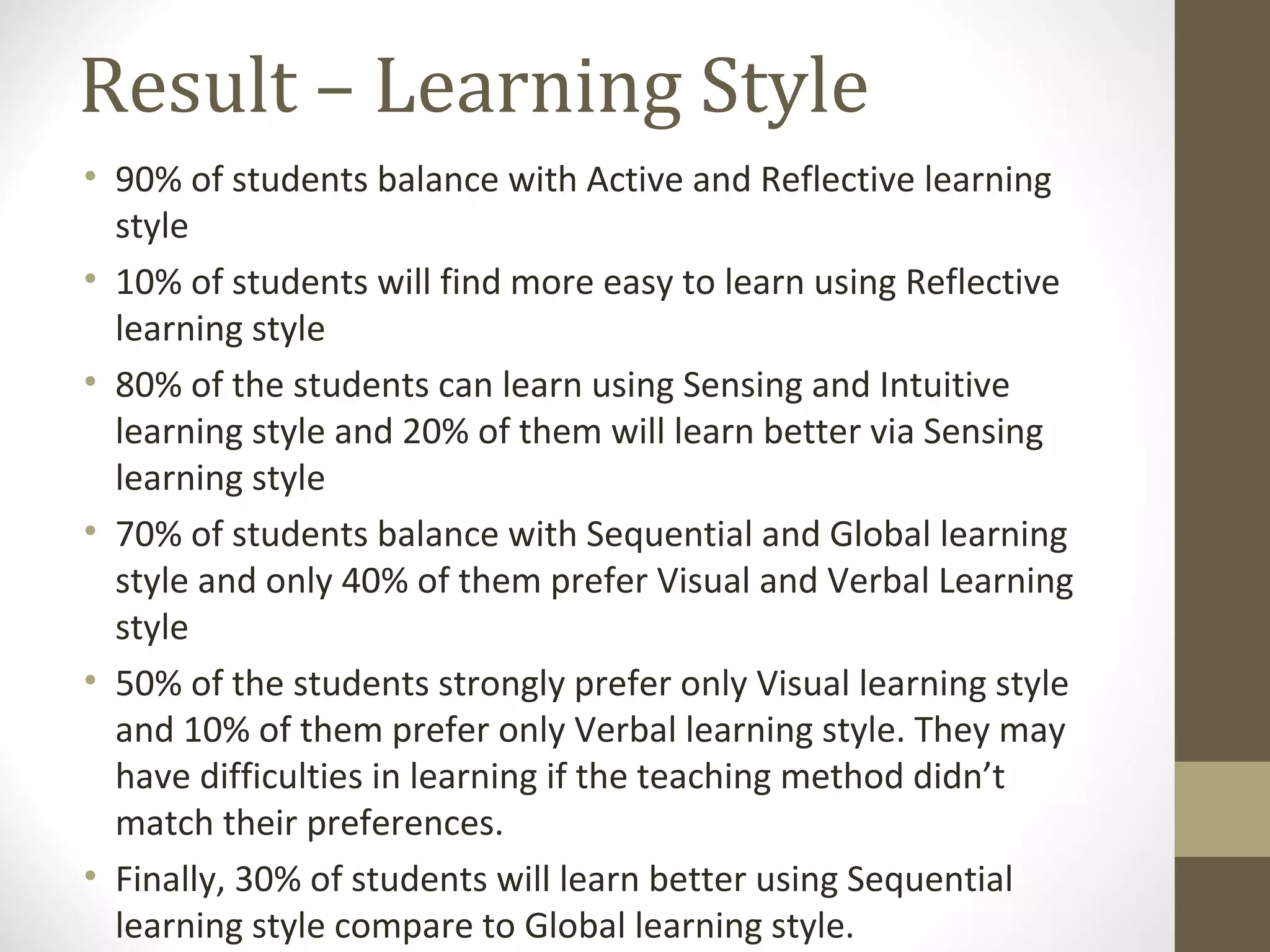
Result – Learning Style
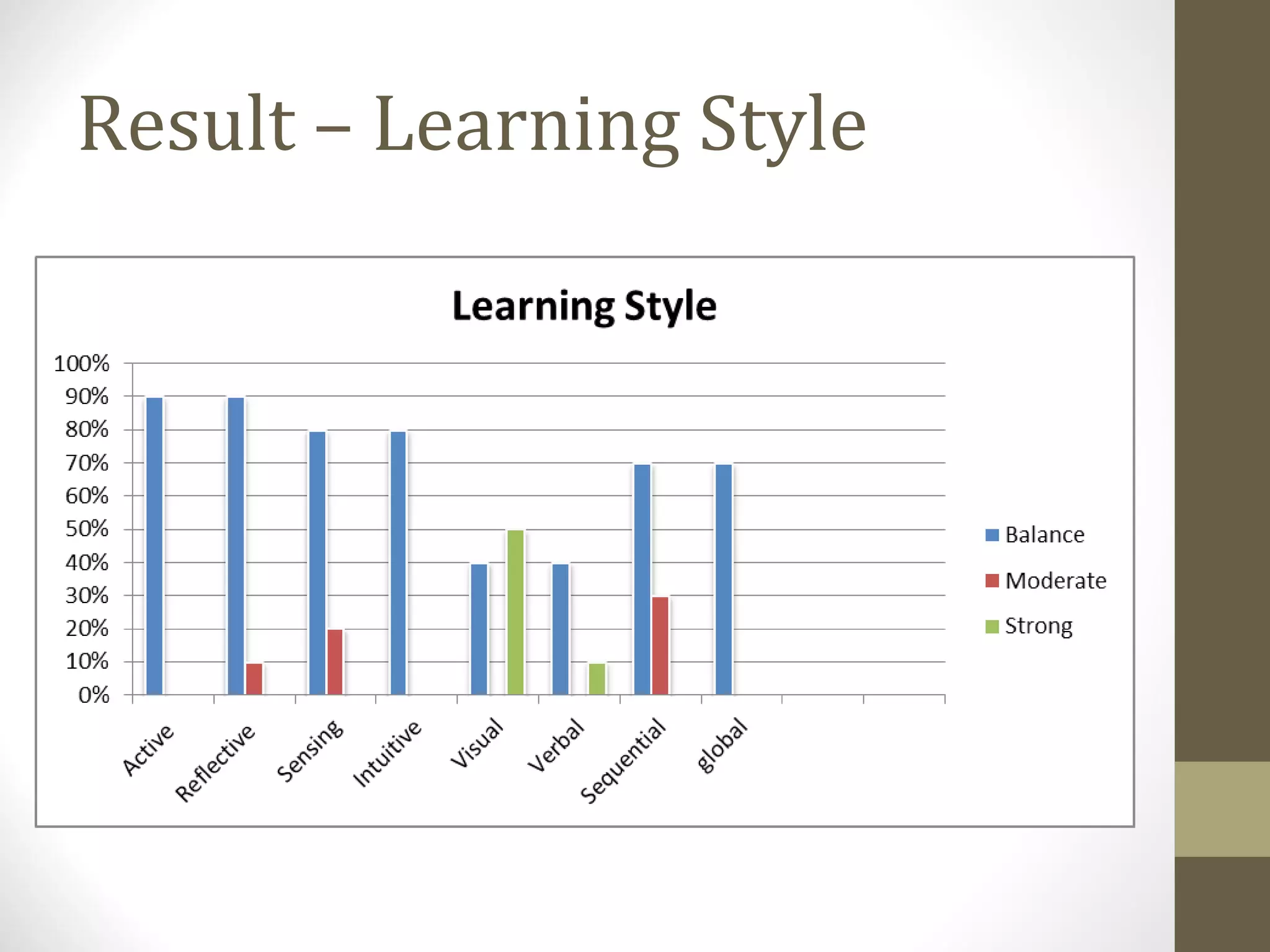
• 90% of students balance with Active and Reflective learning
  style
• 10% of students will find more easy to learn using Reflective
  learning style
• 80% of the students can learn using Sensing and Intuitive
  learning style and 20% of them will learn better via Sensing
  learning style
• 70% of students balance with Sequential and Global learning
  style and only 40% of them prefer Visual and Verbal Learning
  style
• 50% of the students strongly prefer only Visual learning style
  and 10% of them prefer only Verbal learning style. They may
  have difficulties in learning if the teaching method didn’t
  match their preferences.
• Finally, 30% of students will learn better using Sequential
  learning style compare to Global learning style.
Result – Teaching Style


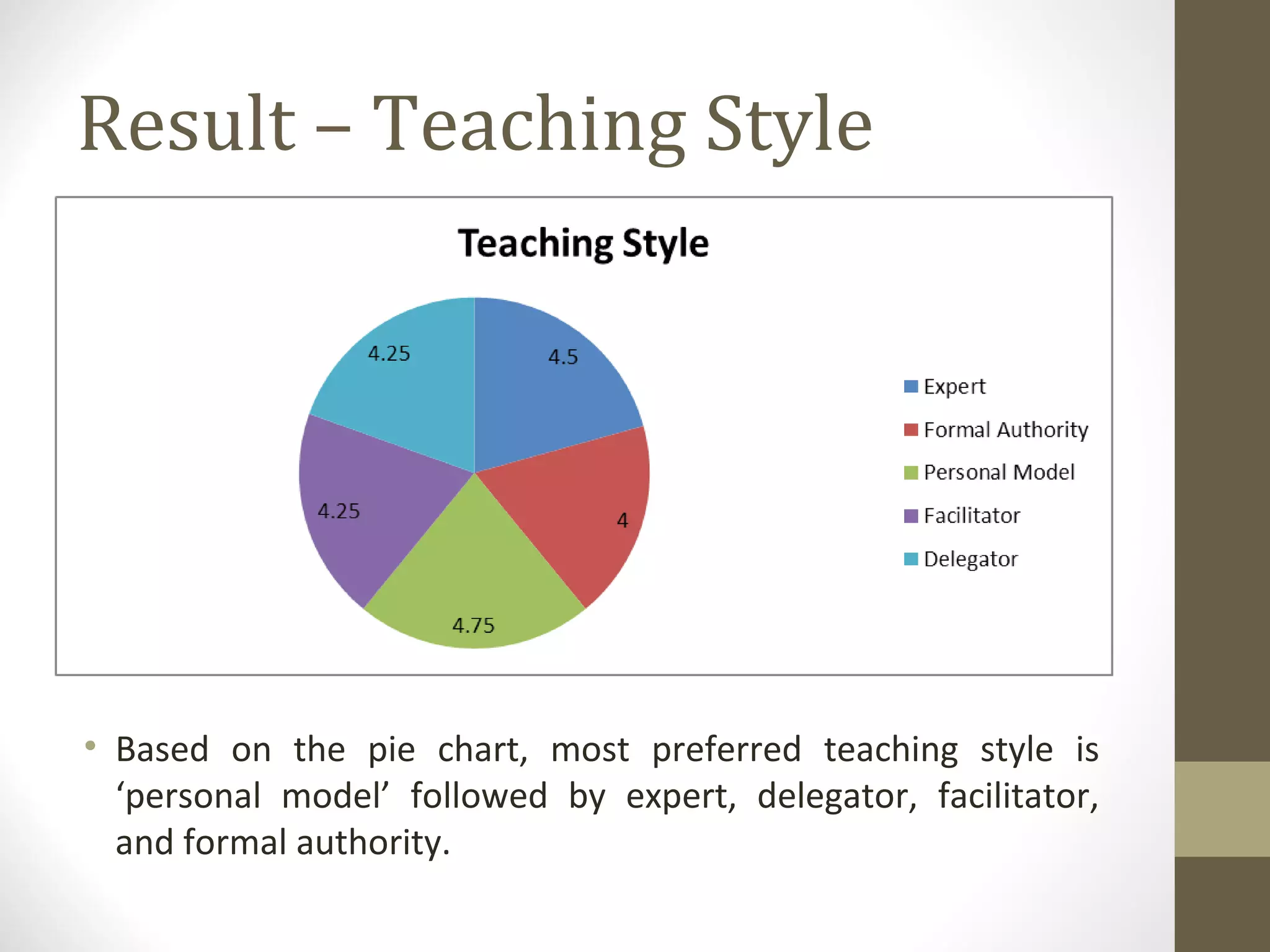
• Based on the pie chart, most preferred teaching style is
  ‘personal model’ followed by expert, delegator, facilitator,
  and formal authority.
Research Findings
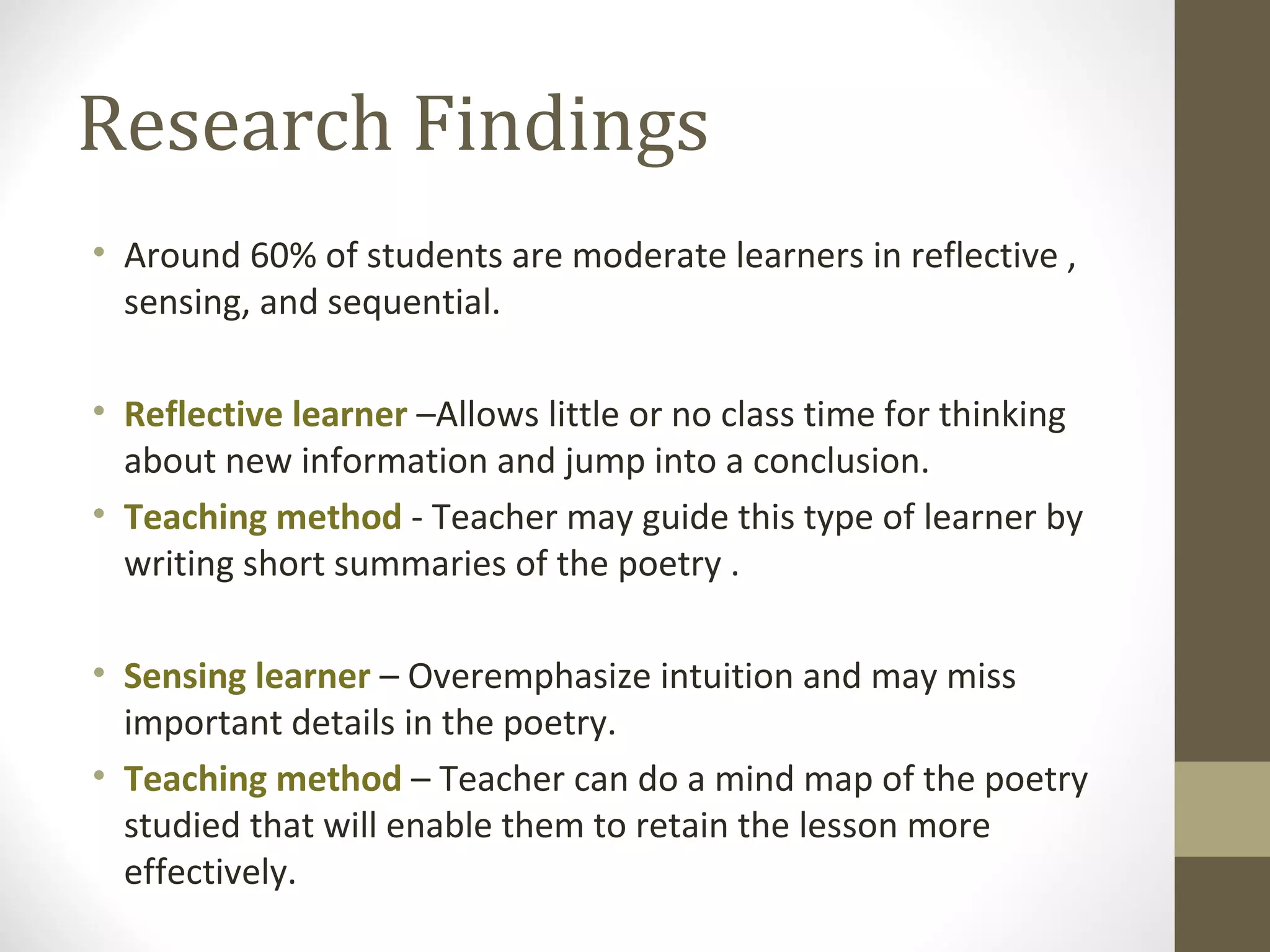
• Around 60% of students are moderate learners in reflective ,
  sensing, and sequential.

• Reflective learner –Allows little or no class time for thinking
  about new information and jump into a conclusion.
• Teaching method - Teacher may guide this type of learner by
  writing short summaries of the poetry .

• Sensing learner – Overemphasize intuition and may miss
  important details in the poetry.
• Teaching method – Teacher can do a mind map of the poetry
  studied that will enable them to retain the lesson more
  effectively.
Research Findings
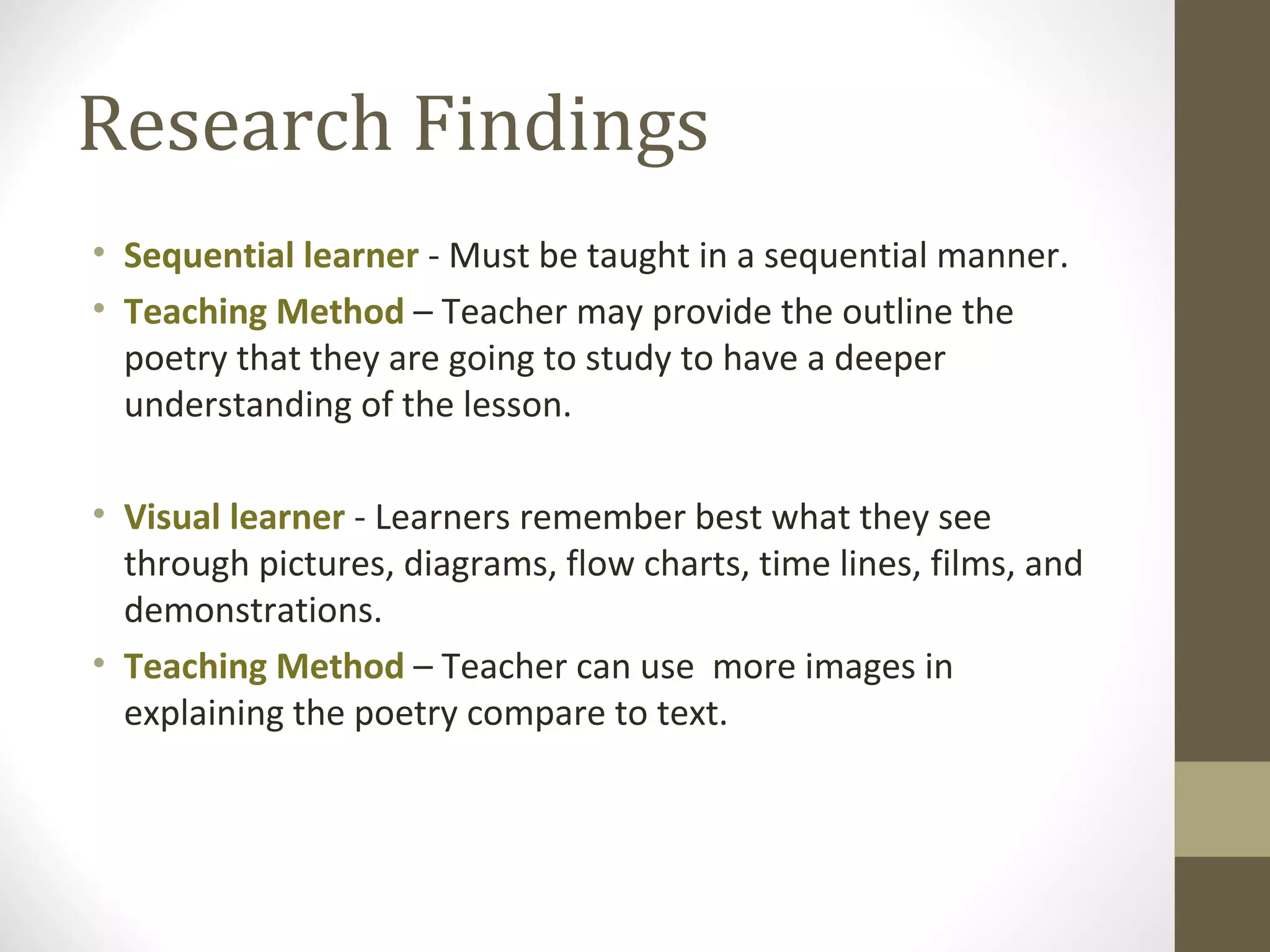
• Sequential learner - Must be taught in a sequential manner.
• Teaching Method – Teacher may provide the outline the
  poetry that they are going to study to have a deeper
  understanding of the lesson.

• Visual learner - Learners remember best what they see
  through pictures, diagrams, flow charts, time lines, films, and
  demonstrations.
• Teaching Method – Teacher can use more images in
  explaining the poetry compare to text.
Conclusion
• In conclusion, teacher plays most significant role in preparing
  the lesson which match with their students’ learning style.
• Teacher must brief the poetry in a chronological order to the
  students where this will help the sequential, global and
  sensing type of learners to understand the lesson.
• Teacher need to brainstorm the lesson in whiteboard where it
  will enhance intuitive and verbal types of learner.
• Role play for the lesson will facilitate active and reflective type
  of learners.
Teaching styles and learning styles

Teaching styles and learning styles

  • 1.
    Learning Styles and TeachingStyles Haniffa Beevi Bt. Abdul Jaleel
  • 2.
    Introduction • This studyis to analyze learning and teaching style on how it impacts on students’ learning strategies. • It is based on learning and teaching styles of English Poetry class. • Sample – 10 students from Form One along with teacher who teach the subject
  • 3.
    Data Collection • 5male (50%) and 5 female (50%) students has been sampled in this research. • Data collected through questionnaire. • For Learning style – Index of Learning Style questionnaire • For Teaching style – Grasha- Riechmann questionnaire
  • 4.
  • 5.
    Result – LearningStyle • 90% of students balance with Active and Reflective learning style • 10% of students will find more easy to learn using Reflective learning style • 80% of the students can learn using Sensing and Intuitive learning style and 20% of them will learn better via Sensing learning style • 70% of students balance with Sequential and Global learning style and only 40% of them prefer Visual and Verbal Learning style • 50% of the students strongly prefer only Visual learning style and 10% of them prefer only Verbal learning style. They may have difficulties in learning if the teaching method didn’t match their preferences. • Finally, 30% of students will learn better using Sequential learning style compare to Global learning style.
  • 6.
    Result – TeachingStyle • Based on the pie chart, most preferred teaching style is ‘personal model’ followed by expert, delegator, facilitator, and formal authority.
  • 7.
    Research Findings • Around60% of students are moderate learners in reflective , sensing, and sequential. • Reflective learner –Allows little or no class time for thinking about new information and jump into a conclusion. • Teaching method - Teacher may guide this type of learner by writing short summaries of the poetry . • Sensing learner – Overemphasize intuition and may miss important details in the poetry. • Teaching method – Teacher can do a mind map of the poetry studied that will enable them to retain the lesson more effectively.
  • 8.
    Research Findings • Sequentiallearner - Must be taught in a sequential manner. • Teaching Method – Teacher may provide the outline the poetry that they are going to study to have a deeper understanding of the lesson. • Visual learner - Learners remember best what they see through pictures, diagrams, flow charts, time lines, films, and demonstrations. • Teaching Method – Teacher can use more images in explaining the poetry compare to text.
  • 9.
    Conclusion • In conclusion,teacher plays most significant role in preparing the lesson which match with their students’ learning style. • Teacher must brief the poetry in a chronological order to the students where this will help the sequential, global and sensing type of learners to understand the lesson. • Teacher need to brainstorm the lesson in whiteboard where it will enhance intuitive and verbal types of learner. • Role play for the lesson will facilitate active and reflective type of learners.