How	
  to	
  Formulate	
  and	
  
Evaluate	
  Your	
  Research	
  
Questions	
  
Three	
  Related	
  Concepts	
  
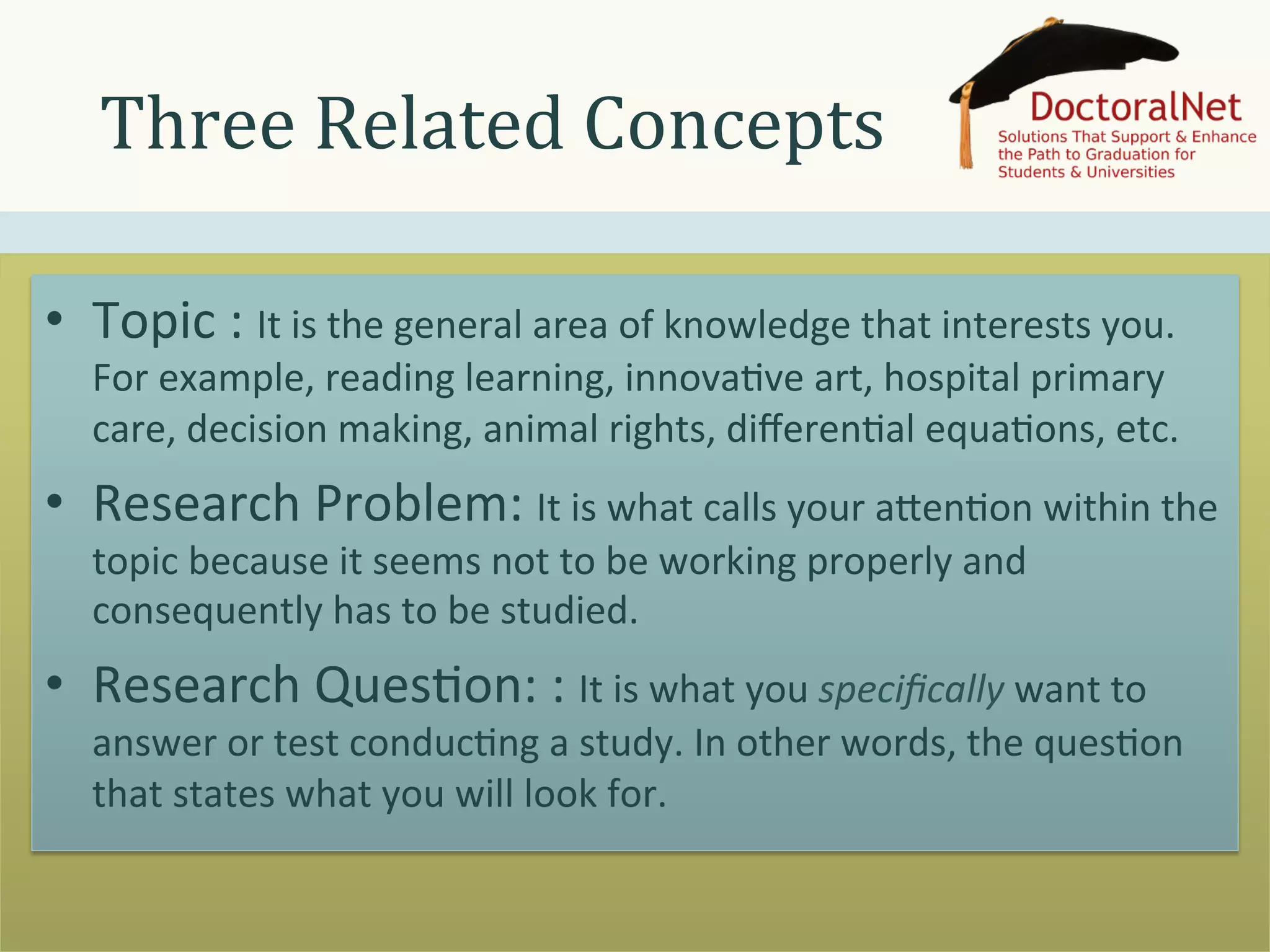
•  Topic	
  :	
  It	
  is	
  the	
  general	
  area	
  of	
  knowledge	
  that	
  interests	
  you.	
  

For	
  example,	
  reading	
  learning,	
  innova>ve	
  art,	
  hospital	
  primary	
  
care,	
  decision	
  making,	
  animal	
  rights,	
  differen>al	
  equa>ons,	
  etc.	
  

•  Research	
  Problem:	
  It	
  is	
  what	
  calls	
  your	
  aDen>on	
  within	
  the	
  
topic	
  because	
  it	
  seems	
  not	
  to	
  be	
  working	
  properly	
  and	
  
consequently	
  has	
  to	
  be	
  studied.	
  

•  Research	
  Ques>on:	
  :	
  It	
  is	
  what	
  you	
  specifically	
  want	
  to	
  

answer	
  or	
  test	
  conduc>ng	
  a	
  study.	
  In	
  other	
  words,	
  the	
  ques>on	
  
that	
  states	
  what	
  you	
  will	
  look	
  for.	
  
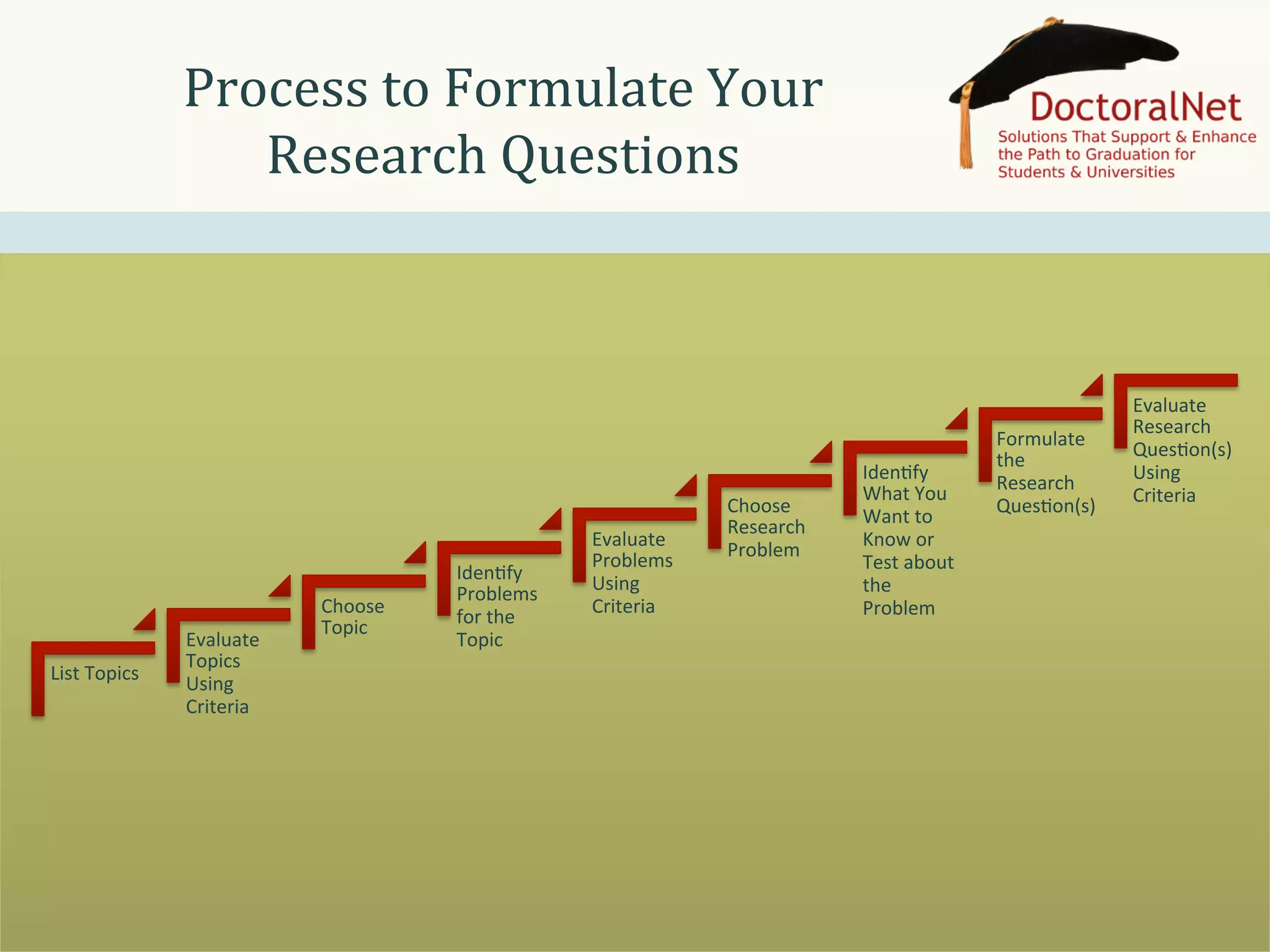
Process	
  to	
  Formulate	
  Your	
  
Research	
  Questions	
  

List	
  Topics	
  

Evaluate	
  
Topics	
  
Using	
  
Criteria	
  

Choose	
  
Topic	
  

Iden>fy	
  
Problems	
  
for	
  the	
  
Topic	
  

Evaluate	
  
Problems	
  
Using	
  
Criteria	
  

Choose	
  
Research	
  
Problem	
  

Iden>fy	
  
What	
  You	
  
Want	
  to	
  
Know	
  or	
  
Test	
  about	
  
the	
  
Problem	
  

Formulate	
  
the	
  
Research	
  
Ques>on(s)	
  

Evaluate	
  
Research	
  
Ques>on(s)	
  
Using	
  
Criteria	
  
You	
  can	
  read	
  criteria	
  for	
  evaluating	
  topics	
  and	
  problems	
  at:	
  
www.doctoralnet.com
www.slideshare.net/Silvercusa/selectingthe-research-problem-for-your-doctoraldissertation
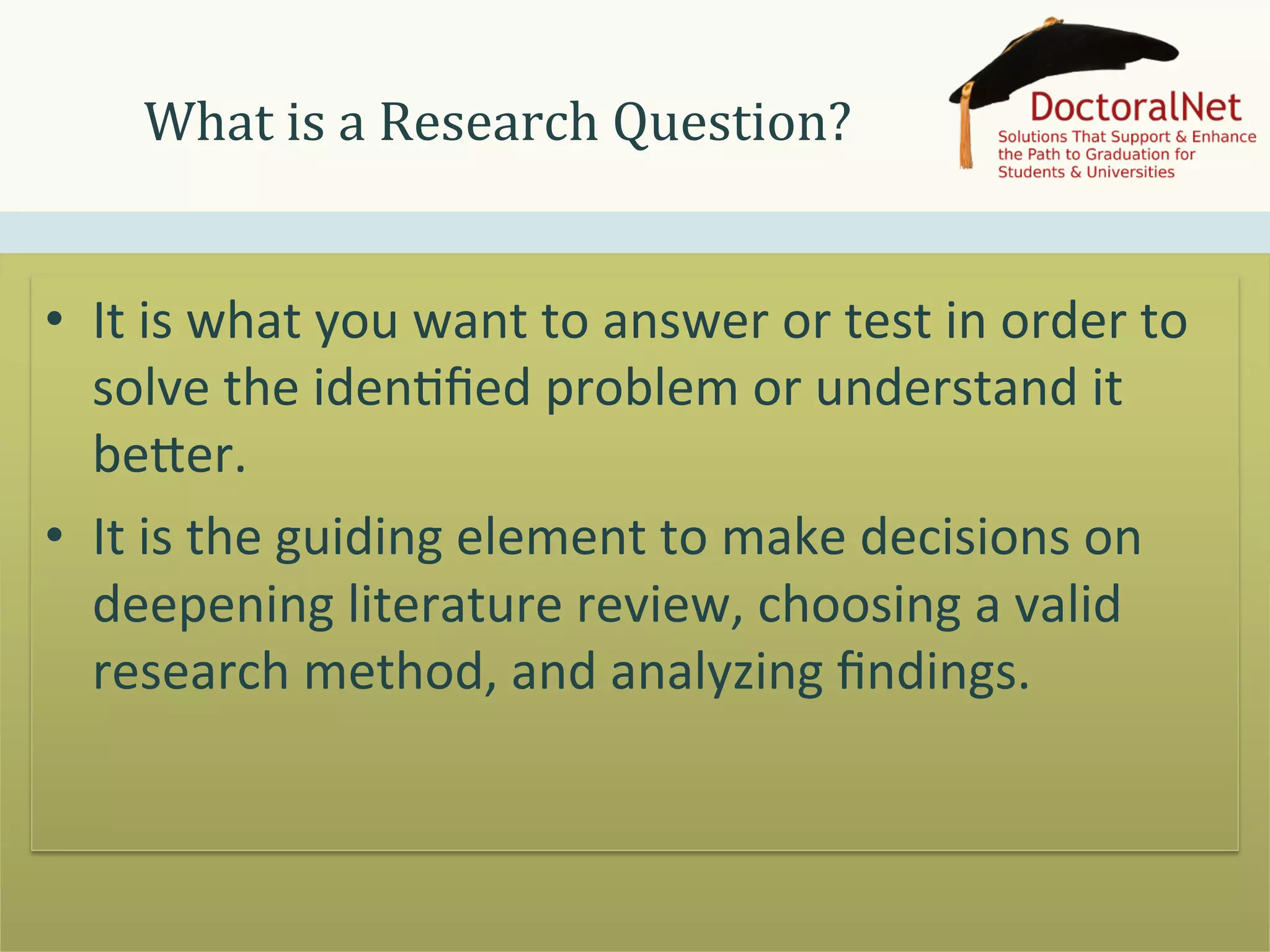
What	
  is	
  a	
  Research	
  Question?	
  
•  It	
  is	
  what	
  you	
  want	
  to	
  answer	
  or	
  test	
  in	
  order	
  to	
  
solve	
  the	
  iden>fied	
  problem	
  or	
  understand	
  it	
  
beDer.	
  	
  
•  It	
  is	
  the	
  guiding	
  element	
  to	
  make	
  decisions	
  on	
  
deepening	
  literature	
  review,	
  choosing	
  a	
  valid	
  
research	
  method,	
  and	
  analyzing	
  findings.	
  
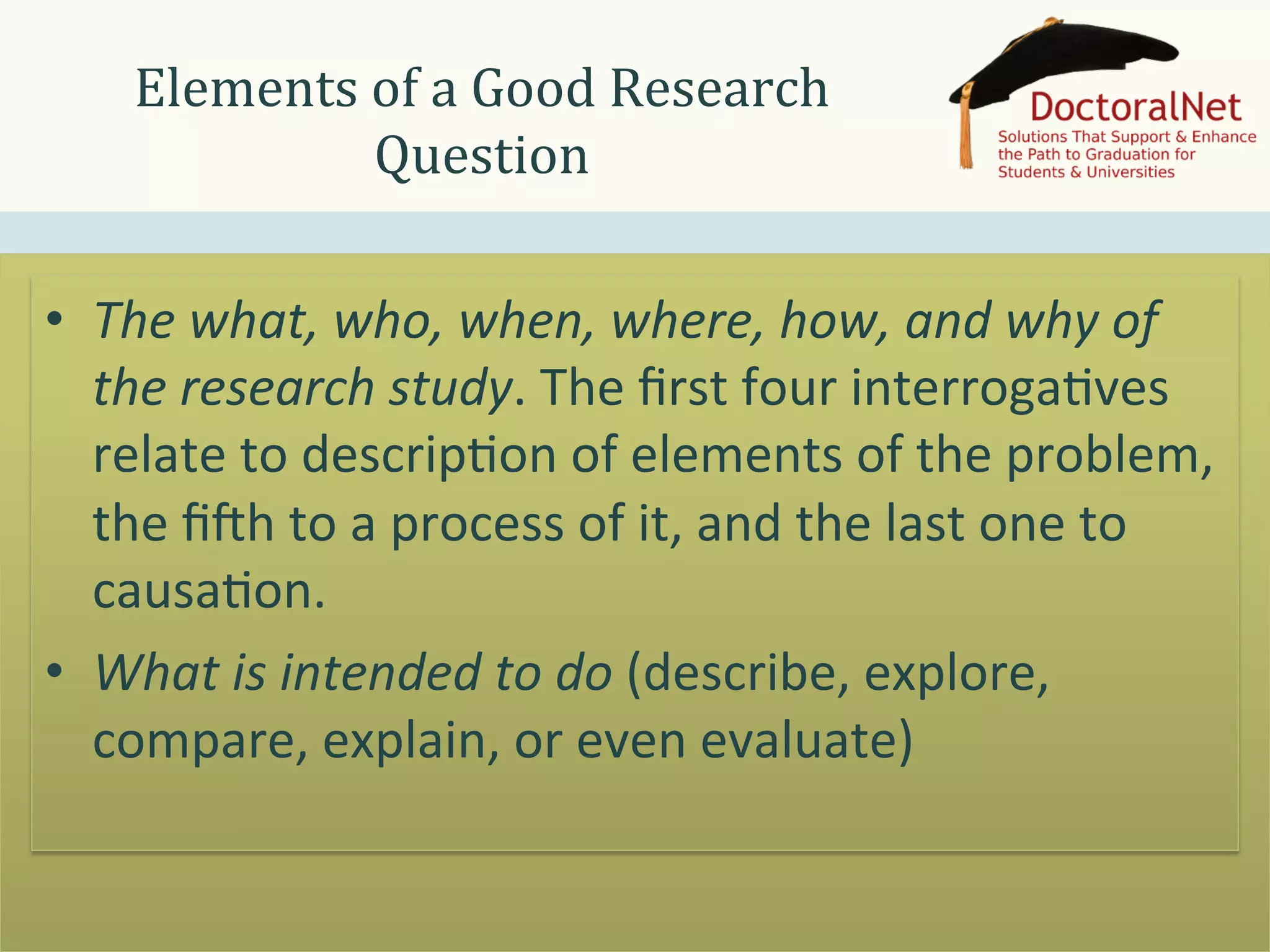
Elements	
  of	
  a	
  Good	
  Research	
  
Question	
  
•  The	
  what,	
  who,	
  when,	
  where,	
  how,	
  and	
  why	
  of	
  
the	
  research	
  study.	
  The	
  first	
  four	
  interroga>ves	
  
relate	
  to	
  descrip>on	
  of	
  elements	
  of	
  the	
  problem,	
  
the	
  fiQh	
  to	
  a	
  process	
  of	
  it,	
  and	
  the	
  last	
  one	
  to	
  
causa>on.	
  
•  What	
  is	
  intended	
  to	
  do	
  (describe,	
  explore,	
  
compare,	
  explain,	
  or	
  even	
  evaluate)	
  
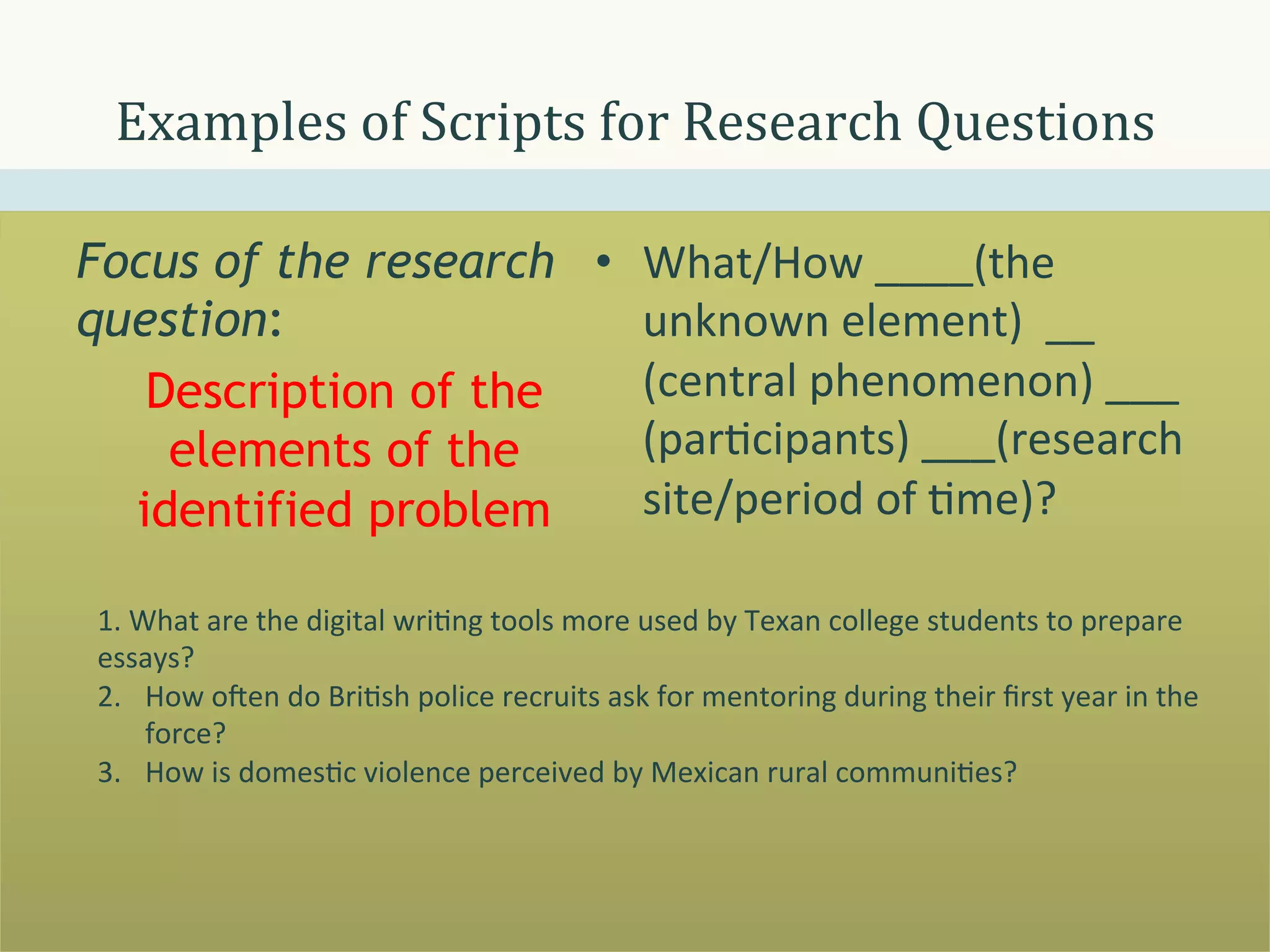
Examples	
  of	
  Scripts	
  for	
  Research	
  Questions	
  
Focus of the research •  What/How	
  ____(the	
  
question:
unknown	
  element)	
  	
  __	
  
(central	
  phenomenon)	
  ___	
  
Description of the
(par>cipants)	
  ___(research	
  
elements of the
site/period	
  of	
  >me)?	
  
identified problem
1.	
  What	
  are	
  the	
  digital	
  wri>ng	
  tools	
  more	
  used	
  by	
  Texan	
  college	
  students	
  to	
  prepare	
  
essays?	
  
2.  How	
  oQen	
  do	
  Bri>sh	
  police	
  recruits	
  ask	
  for	
  mentoring	
  during	
  their	
  first	
  year	
  in	
  the	
  
force?	
  
3.  How	
  is	
  domes>c	
  violence	
  perceived	
  by	
  Mexican	
  rural	
  communi>es?	
  
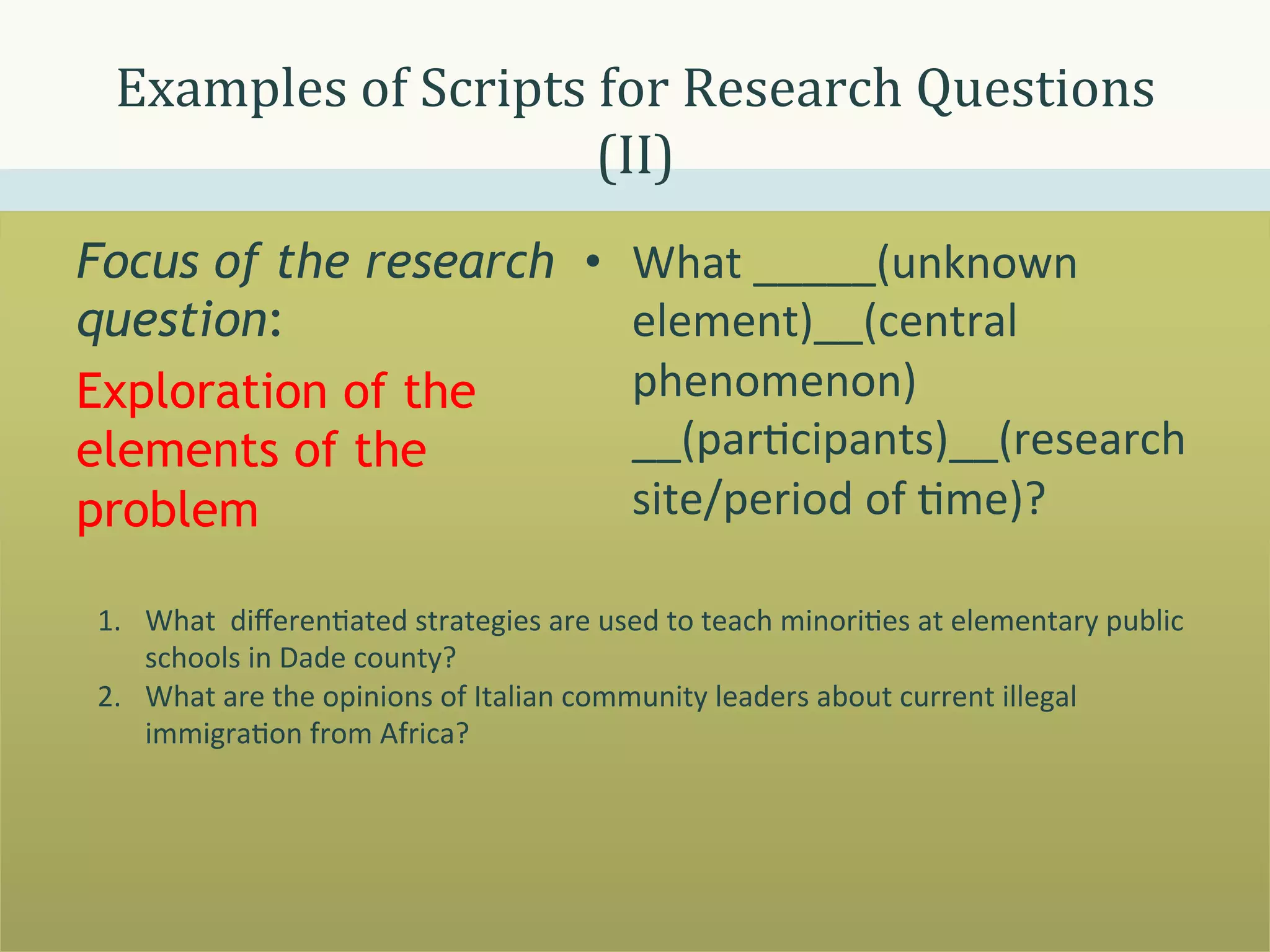
Examples	
  of	
  Scripts	
  for	
  Research	
  Questions	
  
(II)	
  
Focus of the research •  What	
  _____(unknown	
  
question:
element)__(central	
  
phenomenon)	
  
Exploration of the
__(par>cipants)__(research	
  
elements of the
site/period	
  of	
  >me)?	
  
problem
1.  What	
  	
  differen>ated	
  strategies	
  are	
  used	
  to	
  teach	
  minori>es	
  at	
  elementary	
  public	
  
schools	
  in	
  Dade	
  county?	
  	
  
2.  What	
  are	
  the	
  opinions	
  of	
  Italian	
  community	
  leaders	
  about	
  current	
  illegal	
  
immigra>on	
  from	
  Africa?	
  
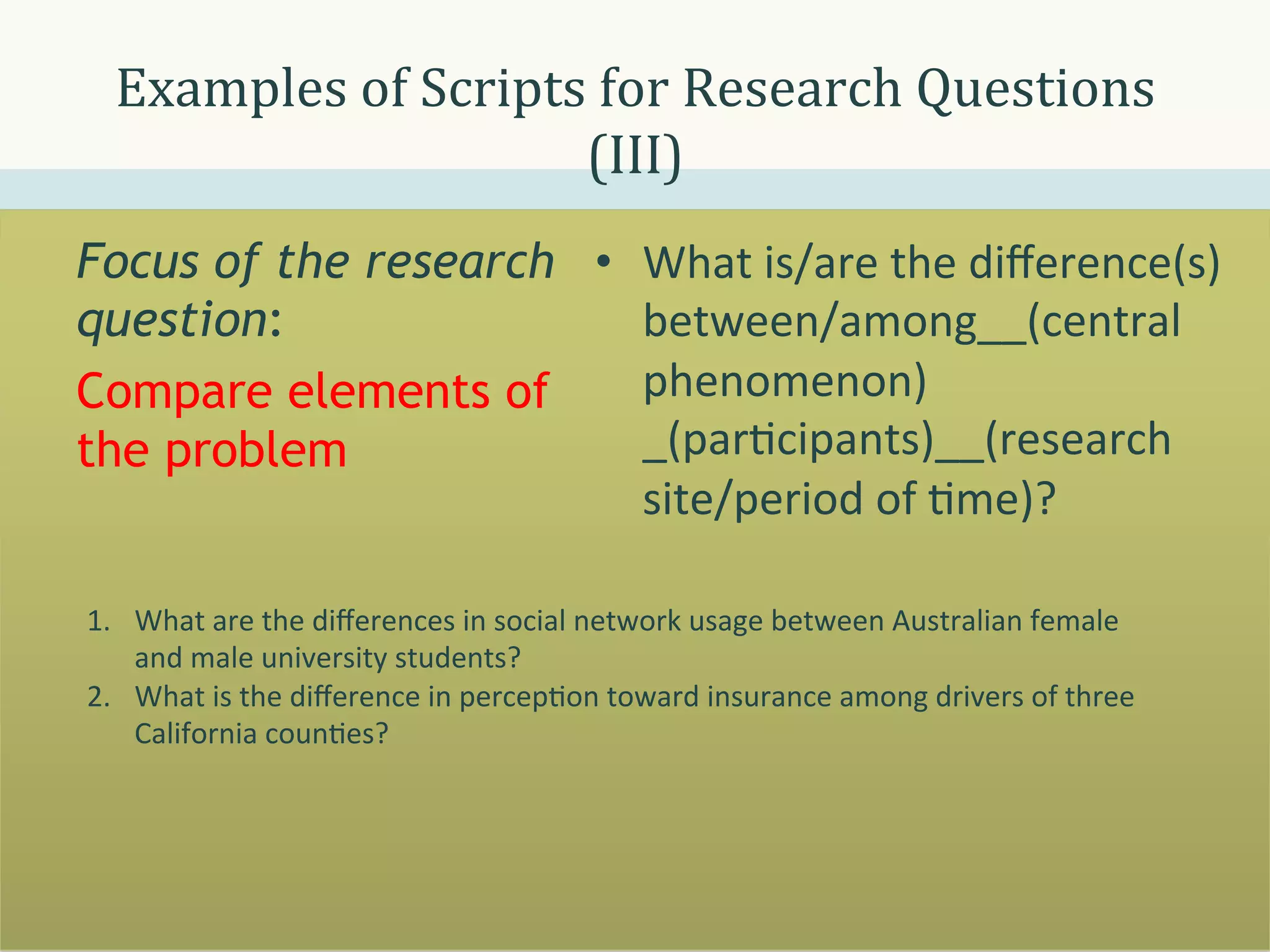
Examples	
  of	
  Scripts	
  for	
  Research	
  Questions	
  
(III)	
  
Focus of the research •  What	
  is/are	
  the	
  difference(s)	
  
question:
between/among__(central	
  
phenomenon)	
  
Compare elements of
_(par>cipants)__(research	
  
the problem
site/period	
  of	
  >me)?	
  
1.  What	
  are	
  the	
  differences	
  in	
  social	
  network	
  usage	
  between	
  Australian	
  female	
  
and	
  male	
  university	
  students?	
  
2.  What	
  is	
  the	
  difference	
  in	
  percep>on	
  toward	
  insurance	
  among	
  drivers	
  of	
  three	
  
California	
  coun>es?	
  
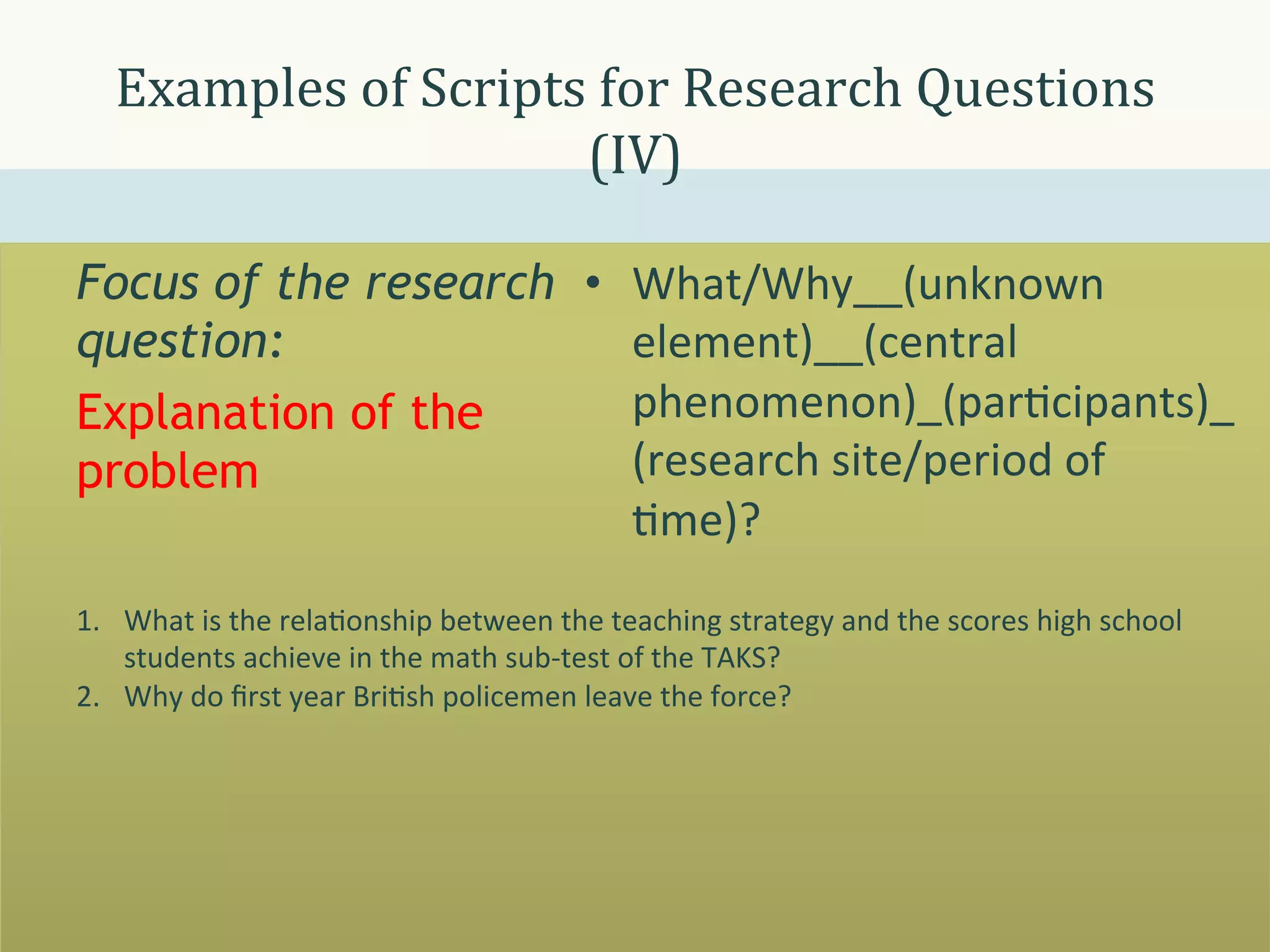
Examples	
  of	
  Scripts	
  for	
  Research	
  Questions	
  
(IV)	
  
Focus of the research •  What/Why__(unknown	
  
question:
element)__(central	
  
phenomenon)_(par>cipants)_	
  
Explanation of the
(research	
  site/period	
  of	
  
problem
>me)?	
  
1.  What	
  is	
  the	
  rela>onship	
  between	
  the	
  teaching	
  strategy	
  and	
  the	
  scores	
  high	
  school	
  
students	
  achieve	
  in	
  the	
  math	
  sub-­‐test	
  of	
  the	
  TAKS?	
  
2.  Why	
  do	
  first	
  year	
  Bri>sh	
  policemen	
  leave	
  the	
  force?	


Formulate a research question applying
	
  f	
  
one of the scripts presented
•  Specific (what needs to be

answered is clearly and
concisely stated)
•  Key elements are present
(what, who, where, when,
how, and/or why)
•  Answerable (possible to
know what would take to
answer it)
•  Interesting for you and
others
•  Feasible (in terms of time,
costs, skills, required
information, access to it, etc.)
•  Meaningful to you, others,
and the field of study
•  Timely (Is it a hot question
these days ? Is it possible to
generate new directions to
research)
•  Ethical (maintain ethical
standards in relation to
participants, data, and
researcher)

	
  Criteria	
  to	
  Evaluate	
  a	
  

Research	
  Question	
  

Adapted from:
Green, N. (2008). Formulating and
refining a research question. In
Gilbert, N. (Ed.). Researching social
life. Guildford, UK: University of
Surrey
Apply the criteria to the research
question you formulated
Now	
  you	
  know	
  :	
  
1.  What a research
question is
2.  Its role in the
research process
3.  What elements
should be in a
research question
4.  How to formulate a
research question
5.  How to evaluate its
appropriateness
Thanks	
  for	
  Reading	
  
Hope you find this conference useful and
want to meet us soon

How to Formulate and Evaluate Your Research Questions

  • 1.
    How  to  Formulate  and   Evaluate  Your  Research   Questions  
  • 2.
    Three  Related  Concepts   •  Topic  :  It  is  the  general  area  of  knowledge  that  interests  you.   For  example,  reading  learning,  innova>ve  art,  hospital  primary   care,  decision  making,  animal  rights,  differen>al  equa>ons,  etc.   •  Research  Problem:  It  is  what  calls  your  aDen>on  within  the   topic  because  it  seems  not  to  be  working  properly  and   consequently  has  to  be  studied.   •  Research  Ques>on:  :  It  is  what  you  specifically  want  to   answer  or  test  conduc>ng  a  study.  In  other  words,  the  ques>on   that  states  what  you  will  look  for.  
  • 3.
    Process  to  Formulate  Your   Research  Questions   List  Topics   Evaluate   Topics   Using   Criteria   Choose   Topic   Iden>fy   Problems   for  the   Topic   Evaluate   Problems   Using   Criteria   Choose   Research   Problem   Iden>fy   What  You   Want  to   Know  or   Test  about   the   Problem   Formulate   the   Research   Ques>on(s)   Evaluate   Research   Ques>on(s)   Using   Criteria  
  • 4.
    You  can  read  criteria  for  evaluating  topics  and  problems  at:   www.doctoralnet.com www.slideshare.net/Silvercusa/selectingthe-research-problem-for-your-doctoraldissertation
  • 5.
    What  is  a  Research  Question?   •  It  is  what  you  want  to  answer  or  test  in  order  to   solve  the  iden>fied  problem  or  understand  it   beDer.     •  It  is  the  guiding  element  to  make  decisions  on   deepening  literature  review,  choosing  a  valid   research  method,  and  analyzing  findings.  
  • 6.
    Elements  of  a  Good  Research   Question   •  The  what,  who,  when,  where,  how,  and  why  of   the  research  study.  The  first  four  interroga>ves   relate  to  descrip>on  of  elements  of  the  problem,   the  fiQh  to  a  process  of  it,  and  the  last  one  to   causa>on.   •  What  is  intended  to  do  (describe,  explore,   compare,  explain,  or  even  evaluate)  
  • 7.
    Examples  of  Scripts  for  Research  Questions   Focus of the research •  What/How  ____(the   question: unknown  element)    __   (central  phenomenon)  ___   Description of the (par>cipants)  ___(research   elements of the site/period  of  >me)?   identified problem 1.  What  are  the  digital  wri>ng  tools  more  used  by  Texan  college  students  to  prepare   essays?   2.  How  oQen  do  Bri>sh  police  recruits  ask  for  mentoring  during  their  first  year  in  the   force?   3.  How  is  domes>c  violence  perceived  by  Mexican  rural  communi>es?  
  • 8.
    Examples  of  Scripts  for  Research  Questions   (II)   Focus of the research •  What  _____(unknown   question: element)__(central   phenomenon)   Exploration of the __(par>cipants)__(research   elements of the site/period  of  >me)?   problem 1.  What    differen>ated  strategies  are  used  to  teach  minori>es  at  elementary  public   schools  in  Dade  county?     2.  What  are  the  opinions  of  Italian  community  leaders  about  current  illegal   immigra>on  from  Africa?  
  • 9.
    Examples  of  Scripts  for  Research  Questions   (III)   Focus of the research •  What  is/are  the  difference(s)   question: between/among__(central   phenomenon)   Compare elements of _(par>cipants)__(research   the problem site/period  of  >me)?   1.  What  are  the  differences  in  social  network  usage  between  Australian  female   and  male  university  students?   2.  What  is  the  difference  in  percep>on  toward  insurance  among  drivers  of  three   California  coun>es?  
  • 10.
    Examples  of  Scripts  for  Research  Questions   (IV)   Focus of the research •  What/Why__(unknown   question: element)__(central   phenomenon)_(par>cipants)_   Explanation of the (research  site/period  of   problem >me)?   1.  What  is  the  rela>onship  between  the  teaching  strategy  and  the  scores  high  school   students  achieve  in  the  math  sub-­‐test  of  the  TAKS?   2.  Why  do  first  year  Bri>sh  policemen  leave  the  force?    
  • 11.
    Formulate a researchquestion applying  f   one of the scripts presented
  • 12.
    •  Specific (whatneeds to be answered is clearly and concisely stated) •  Key elements are present (what, who, where, when, how, and/or why) •  Answerable (possible to know what would take to answer it) •  Interesting for you and others •  Feasible (in terms of time, costs, skills, required information, access to it, etc.) •  Meaningful to you, others, and the field of study •  Timely (Is it a hot question these days ? Is it possible to generate new directions to research) •  Ethical (maintain ethical standards in relation to participants, data, and researcher)  Criteria  to  Evaluate  a   Research  Question   Adapted from: Green, N. (2008). Formulating and refining a research question. In Gilbert, N. (Ed.). Researching social life. Guildford, UK: University of Surrey
  • 13.
    Apply the criteriato the research question you formulated
  • 14.
    Now  you  know  :   1.  What a research question is 2.  Its role in the research process 3.  What elements should be in a research question 4.  How to formulate a research question 5.  How to evaluate its appropriateness
  • 15.
    Thanks  for  Reading   Hope you find this conference useful and want to meet us soon