Exploiting Rapid
Change in Technology
Enhanced Learning
… for Post Graduate Education
After Data:
Weaving Together the EndGame
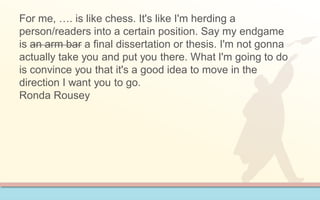
For me, …. is like chess. It's like I'm herding a
person/readers into a certain position. Say my endgame
is an arm bar a final dissertation or thesis. I'm not gonna
actually take you and put you there. What I'm going to do
is convince you that it's a good idea to move in the
direction I want you to go.
Ronda Rousey
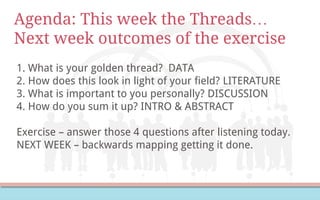
Agenda: This week the Threads…
Next week outcomes of the exercise
1. What is your golden thread? DATA
2. How does this look in light of your field? LITERATURE
3. What is important to you personally? DISCUSSION
4. How do you sum it up? INTRO & ABSTRACT
Exercise – answer those 4 questions after listening today.
NEXT WEEK – backwards mapping getting it done.
What is your golden thread?
HINT: Its in your data….
Golden Thread -
Not what you thought you were
studying….
Not what you want to say at the
end….
What your data actually confirms
as true?
What is the real outcome of your data?
Golden Thread.2
You have designed each chapter to
augment that golden thread.
Now decide whether and to what extent…
Literature
How does this look in light of your
field?
What needs to be reworked?
What is no longer necessary?
What new material has been written
that may add to your discussion?
Have you already written your lit? If
so, how much needs to be rewritten?
This is the story your literature has to sustain
Discussion: What is important to you?
Discussion
This is where your voice as a researcher and
writer should come through.
What do YOU want to say?
Do you have full substantiation of it?
What recommendations for future study does
that lead you towards?
What three points do you want your reader to retain?
Summing it up in a concise manner
Introduction
Not a synopsis of the whole text
But a lead in for the reader of the full journey
Leave us:
• understanding completely where we are
going
• but also wanting to travel the full
distance
A summation of the what and why of the research w a hint and the where it
ended.
Abstract
The purpose of this research…
Scope…
The methodology used …
Findings…
Conclusions…
Limitations …
Contributions…
http://www.doctoralnet.com/phase-3/3-5-writing-final-phd-thesis-things-to-keep-
in-mind/dissertation-thesis-polished/947-video-how-to-write-abstracts-for-
doctoral-dissertations.html
The full journey in 7-10 sentences
How an award winner did this
Abstract
This study explores how individuals understand and make meaning of their experiences while in the midst of
radical organizational change. Empirical materials for this research were obtained though written stories and
interviews of two groups of managers within the Canadian public sector who were themselves in the throes
of organizational change. The findings of this study were analyzed through a three dimensional narrative-
inquiry-space framework.
In this study, stories and metaphors were used as expressions of experience. The results of this study
support the postmodernist notion of a dialectical, co-constructed, and recursive relationship within
expressions, namely between metaphors and stories, and between expressions and experience. It was also
discovered that 7 key variables moderated the relationship between expressions and experience. These
variables are linked to 4 categories: cognitive, internal beliefs, relationships, and language.
The findings of this study suggest that the success of managing change is directly related to the ability of
leaders to attend to the problem of the interconnectedness between cybernetics and interpretive paradigms.
The scholarly need to address this problem was in direct response to the predominant tendency among
scholars and change practitioners to focus exclusively on either one of the two approaches. Accordingly, the
call to scholars and practitioners to shift from systems to stories is grounded in the need to shift from the
cognitive tyranny of either-or to the genius of the and. Narrative inquiry is well aligned to promoting the
cognitive genius of the and as a strategic tradition of inquiry.
Narrative Inquiry into the Experiences of Individuals in the Midst of
Organizational Change: A Shift from Systems to Stories by Stanley M.
Amaladas
Introduction
CHAPTER 1: INTRODUCTION TO THE STUDY.
Introduction
The Statement of the Problem
Background
Purpose of the Study
Significance of Study
Nature of the Study
Research Questions
Conceptual Framework
The Perspective of System Integration
The Perspective of Social Integration
On Demonstrating the Interconnection
Definition of Terms
Assumptions
Scope and Delimitation
Limitations
Functionary-effect
Tenure in Current Position
Willingness to Participate
Summary
Organization of Dissertation
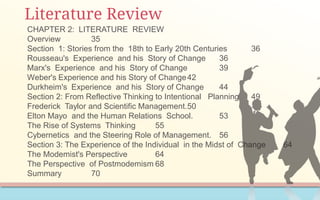
Literature Review
CHAPTER 2: LITERATURE REVIEW
Overview 35
Section 1: Stories from the 18th to Early 20th Centuries 36
Rousseau's Experience and his Story of Change 36
Marx's Experience and his Story of Change 39
Weber's Experience and his Story of Change42
Durkheim's Experience and his Story of Change 44
Section 2: From Reflective Thinking to Intentional Planning 49
Frederick Taylor and Scientific Management.50
Elton Mayo and the Human Relations School. 53
The Rise of Systems Thinking 55
Cybernetics and the Steering Role of Management. 56
Section 3: The Experience of the Individual in the Midst of Change 64
The Modemist's Perspective 64
The Perspective of Postmodemism 68
Summary 70
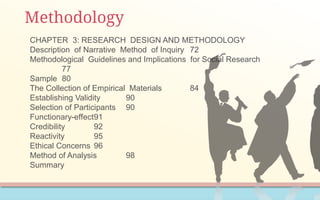
Methodology
CHAPTER 3: RESEARCH DESIGN AND METHODOLOGY
Description of Narrative Method of Inquiry 72
Methodological Guidelines and Implications for Social Research
77
Sample 80
The Collection of Empirical Materials 84
Establishing Validity 90
Selection of Participants 90
Functionary-effect91
Credibility 92
Reactivity 95
Ethical Concerns 96
Method of Analysis 98
Summary
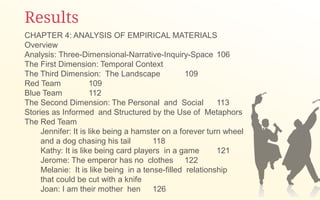
Results
CHAPTER 4: ANALYSIS OF EMPIRICAL MATERIALS
Overview
Analysis: Three-Dimensional-Narrative-Inquiry-Space 106
The First Dimension: Temporal Context
The Third Dimension: The Landscape 109
Red Team 109
Blue Team 112
The Second Dimension: The Personal and Social 113
Stories as Informed and Structured by the Use of Metaphors
The Red Team
Jennifer: It is like being a hamster on a forever turn wheel
and a dog chasing his tail 118
Kathy: It is like being card players in a game 121
Jerome: The emperor has no clothes 122
Melanie: It is like being in a tense-filled relationship
that could be cut with a knife
Joan: I am their mother hen 126
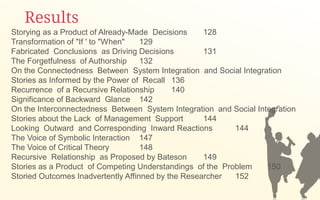
Results
Storying as a Product of Already-Made Decisions 128
Transformation of "If ' to "When" 129
Fabricated Conclusions as Driving Decisions 131
The Forgetfulness of Authorship 132
On the Connectedness Between System Integration and Social Integration
Stories as Informed by the Power of Recall 136
Recurrence of a Recursive Relationship 140
Significance of Backward Glance 142
On the Interconnectedness Between System Integration and Social Integration
Stories about the Lack of Management Support 144
Looking Outward and Corresponding Inward Reactions 144
The Voice of Symbolic Interaction 147
The Voice of Critical Theory 148
Recursive Relationship as Proposed by Bateson 149
Stories as a Product of Competing Understandings of the Problem 150
Storied Outcomes Inadvertently Affinned by the Researcher 152
Discussion
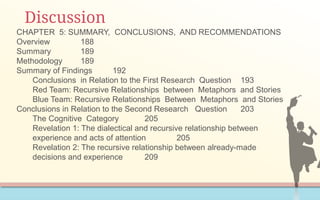
CHAPTER 5: SUMMARY, CONCLUSIONS, AND RECOMMENDATIONS
Overview 188
Summary 189
Methodology 189
Summary of Findings 192
Conclusions in Relation to the First Research Question 193
Red Team: Recursive Relationships between Metaphors and Stories
Blue Team: Recursive Relationships Between Metaphors and Stories
Conclusions in Relation to the Second Research Question 203
The Cognitive Category 205
Revelation 1: The dialectical and recursive relationship between
experience and acts of attention 205
Revelation 2: The recursive relationship between already-made
decisions and experience 209
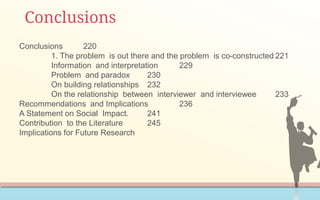
Conclusions
Conclusions 220
1. The problem is out there and the problem is co-constructed 221
Information and interpretation 229
Problem and paradox 230
On building relationships 232
On the relationship between interviewer and interviewee 233
Recommendations and Implications 236
A Statement on Social Impact. 241
Contribution to the Literature 245
Implications for Future Research
EXERCISE: Answer the questions in
this set of slides for your own study
– come back next time to work on
the timing needed to pull it off!
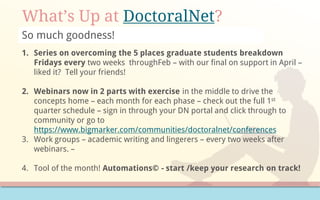
What’s Up at DoctoralNet?
So much goodness!
1. Series on overcoming the 5 places graduate students breakdown
Fridays every two weeks throughFeb – with our final on support in April –
liked it? Tell your friends!
2. Webinars now in 2 parts with exercise in the middle to drive the
concepts home – each month for each phase – check out the full 1st
quarter schedule – sign in through your DN portal and click through to
community or go to
https://www.bigmarker.com/communities/doctoralnet/conferences
3. Work groups – academic writing and lingerers – every two weeks after
webinars. –
4. Tool of the month! Automations© - start /keep your research on track!

Weaving together the end game

  • 1.
    Exploiting Rapid Change inTechnology Enhanced Learning … for Post Graduate Education After Data: Weaving Together the EndGame
  • 2.
    For me, ….is like chess. It's like I'm herding a person/readers into a certain position. Say my endgame is an arm bar a final dissertation or thesis. I'm not gonna actually take you and put you there. What I'm going to do is convince you that it's a good idea to move in the direction I want you to go. Ronda Rousey
  • 3.
    Agenda: This weekthe Threads… Next week outcomes of the exercise 1. What is your golden thread? DATA 2. How does this look in light of your field? LITERATURE 3. What is important to you personally? DISCUSSION 4. How do you sum it up? INTRO & ABSTRACT Exercise – answer those 4 questions after listening today. NEXT WEEK – backwards mapping getting it done.
  • 4.
    What is yourgolden thread? HINT: Its in your data….
  • 5.
    Golden Thread - Notwhat you thought you were studying…. Not what you want to say at the end…. What your data actually confirms as true? What is the real outcome of your data?
  • 6.
    Golden Thread.2 You havedesigned each chapter to augment that golden thread. Now decide whether and to what extent…
  • 7.
  • 8.
    How does thislook in light of your field? What needs to be reworked? What is no longer necessary? What new material has been written that may add to your discussion? Have you already written your lit? If so, how much needs to be rewritten? This is the story your literature has to sustain
  • 9.
    Discussion: What isimportant to you?
  • 10.
    Discussion This is whereyour voice as a researcher and writer should come through. What do YOU want to say? Do you have full substantiation of it? What recommendations for future study does that lead you towards? What three points do you want your reader to retain?
  • 11.
    Summing it upin a concise manner
  • 12.
    Introduction Not a synopsisof the whole text But a lead in for the reader of the full journey Leave us: • understanding completely where we are going • but also wanting to travel the full distance A summation of the what and why of the research w a hint and the where it ended.
  • 13.
    Abstract The purpose ofthis research… Scope… The methodology used … Findings… Conclusions… Limitations … Contributions… http://www.doctoralnet.com/phase-3/3-5-writing-final-phd-thesis-things-to-keep- in-mind/dissertation-thesis-polished/947-video-how-to-write-abstracts-for- doctoral-dissertations.html The full journey in 7-10 sentences
  • 14.
    How an awardwinner did this
  • 15.
    Abstract This study exploreshow individuals understand and make meaning of their experiences while in the midst of radical organizational change. Empirical materials for this research were obtained though written stories and interviews of two groups of managers within the Canadian public sector who were themselves in the throes of organizational change. The findings of this study were analyzed through a three dimensional narrative- inquiry-space framework. In this study, stories and metaphors were used as expressions of experience. The results of this study support the postmodernist notion of a dialectical, co-constructed, and recursive relationship within expressions, namely between metaphors and stories, and between expressions and experience. It was also discovered that 7 key variables moderated the relationship between expressions and experience. These variables are linked to 4 categories: cognitive, internal beliefs, relationships, and language. The findings of this study suggest that the success of managing change is directly related to the ability of leaders to attend to the problem of the interconnectedness between cybernetics and interpretive paradigms. The scholarly need to address this problem was in direct response to the predominant tendency among scholars and change practitioners to focus exclusively on either one of the two approaches. Accordingly, the call to scholars and practitioners to shift from systems to stories is grounded in the need to shift from the cognitive tyranny of either-or to the genius of the and. Narrative inquiry is well aligned to promoting the cognitive genius of the and as a strategic tradition of inquiry. Narrative Inquiry into the Experiences of Individuals in the Midst of Organizational Change: A Shift from Systems to Stories by Stanley M. Amaladas
  • 16.
    Introduction CHAPTER 1: INTRODUCTIONTO THE STUDY. Introduction The Statement of the Problem Background Purpose of the Study Significance of Study Nature of the Study Research Questions Conceptual Framework The Perspective of System Integration The Perspective of Social Integration On Demonstrating the Interconnection Definition of Terms Assumptions Scope and Delimitation Limitations Functionary-effect Tenure in Current Position Willingness to Participate Summary Organization of Dissertation
  • 17.
    Literature Review CHAPTER 2:LITERATURE REVIEW Overview 35 Section 1: Stories from the 18th to Early 20th Centuries 36 Rousseau's Experience and his Story of Change 36 Marx's Experience and his Story of Change 39 Weber's Experience and his Story of Change42 Durkheim's Experience and his Story of Change 44 Section 2: From Reflective Thinking to Intentional Planning 49 Frederick Taylor and Scientific Management.50 Elton Mayo and the Human Relations School. 53 The Rise of Systems Thinking 55 Cybernetics and the Steering Role of Management. 56 Section 3: The Experience of the Individual in the Midst of Change 64 The Modemist's Perspective 64 The Perspective of Postmodemism 68 Summary 70
  • 18.
    Methodology CHAPTER 3: RESEARCHDESIGN AND METHODOLOGY Description of Narrative Method of Inquiry 72 Methodological Guidelines and Implications for Social Research 77 Sample 80 The Collection of Empirical Materials 84 Establishing Validity 90 Selection of Participants 90 Functionary-effect91 Credibility 92 Reactivity 95 Ethical Concerns 96 Method of Analysis 98 Summary
  • 19.
    Results CHAPTER 4: ANALYSISOF EMPIRICAL MATERIALS Overview Analysis: Three-Dimensional-Narrative-Inquiry-Space 106 The First Dimension: Temporal Context The Third Dimension: The Landscape 109 Red Team 109 Blue Team 112 The Second Dimension: The Personal and Social 113 Stories as Informed and Structured by the Use of Metaphors The Red Team Jennifer: It is like being a hamster on a forever turn wheel and a dog chasing his tail 118 Kathy: It is like being card players in a game 121 Jerome: The emperor has no clothes 122 Melanie: It is like being in a tense-filled relationship that could be cut with a knife Joan: I am their mother hen 126
  • 20.
    Results Storying as aProduct of Already-Made Decisions 128 Transformation of "If ' to "When" 129 Fabricated Conclusions as Driving Decisions 131 The Forgetfulness of Authorship 132 On the Connectedness Between System Integration and Social Integration Stories as Informed by the Power of Recall 136 Recurrence of a Recursive Relationship 140 Significance of Backward Glance 142 On the Interconnectedness Between System Integration and Social Integration Stories about the Lack of Management Support 144 Looking Outward and Corresponding Inward Reactions 144 The Voice of Symbolic Interaction 147 The Voice of Critical Theory 148 Recursive Relationship as Proposed by Bateson 149 Stories as a Product of Competing Understandings of the Problem 150 Storied Outcomes Inadvertently Affinned by the Researcher 152
  • 21.
    Discussion CHAPTER 5: SUMMARY,CONCLUSIONS, AND RECOMMENDATIONS Overview 188 Summary 189 Methodology 189 Summary of Findings 192 Conclusions in Relation to the First Research Question 193 Red Team: Recursive Relationships between Metaphors and Stories Blue Team: Recursive Relationships Between Metaphors and Stories Conclusions in Relation to the Second Research Question 203 The Cognitive Category 205 Revelation 1: The dialectical and recursive relationship between experience and acts of attention 205 Revelation 2: The recursive relationship between already-made decisions and experience 209
  • 22.
    Conclusions Conclusions 220 1. Theproblem is out there and the problem is co-constructed 221 Information and interpretation 229 Problem and paradox 230 On building relationships 232 On the relationship between interviewer and interviewee 233 Recommendations and Implications 236 A Statement on Social Impact. 241 Contribution to the Literature 245 Implications for Future Research
  • 23.
    EXERCISE: Answer thequestions in this set of slides for your own study – come back next time to work on the timing needed to pull it off!
  • 24.
    What’s Up atDoctoralNet? So much goodness! 1. Series on overcoming the 5 places graduate students breakdown Fridays every two weeks throughFeb – with our final on support in April – liked it? Tell your friends! 2. Webinars now in 2 parts with exercise in the middle to drive the concepts home – each month for each phase – check out the full 1st quarter schedule – sign in through your DN portal and click through to community or go to https://www.bigmarker.com/communities/doctoralnet/conferences 3. Work groups – academic writing and lingerers – every two weeks after webinars. – 4. Tool of the month! Automations© - start /keep your research on track!