PRESENTED TO:
MA’AM AMNA
PRESENTED BY:
AMENAH GONDAL
SAMEEN FATIMA
CLASS:
BS.ED VI
EDUCATIONAL
RESEAECH
DEFINING A RESEARCH TOPIC
OBJECTIVES:
RESEARCH
“A careful consideration of study regarding a particular
concern or problem using scientific methods.”
According to the American sociologist Earl Robert Babbie,
“Research is a systematic inquiry to describe, explain,
predict, and control the observed phenomenon. Research
involves inductive and deductive methods.”
THE RESEARCH TOPIC
A research topic focuses the study to a
defined, manageable size.
 The research topic (also called the research
problem, or purpose) provides focus and
structure for the steps in the scientific
method.
 A topic statement and a hypothesis are
components of both a written research plan
and research report.
IDENTIFYING A RESEARCH TOPIC
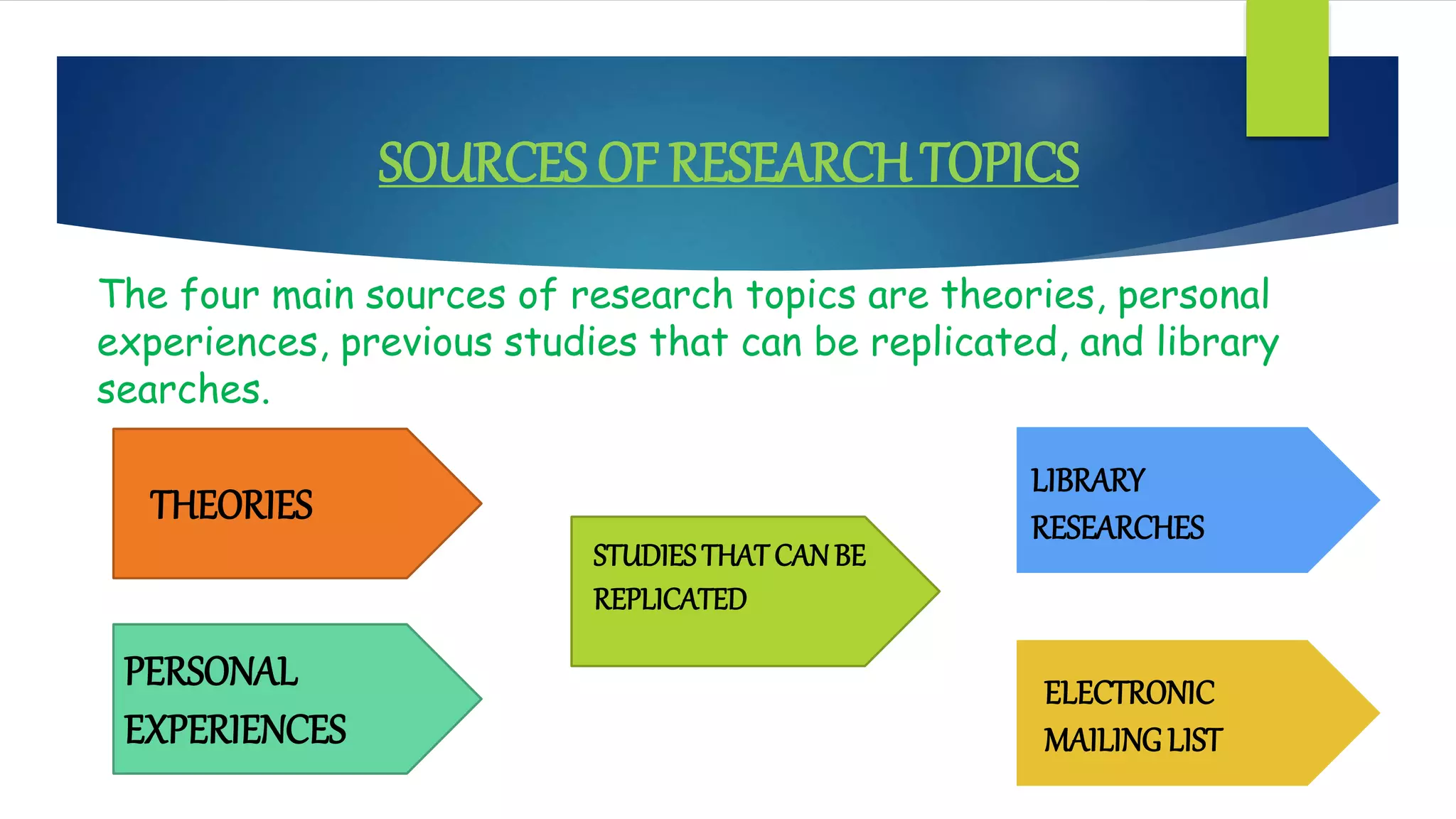
The first step in selecting a research topic is to identify
a general subject area that is related to your area of
expertise and is of particular interest to you.
Remember, you will be spending a great deal of time
reading about and working with your chosen topic. Having
one that interests you will help you maintain focus during
the months of conducting your study.
SOURCES OF RESEARCHTOPICS
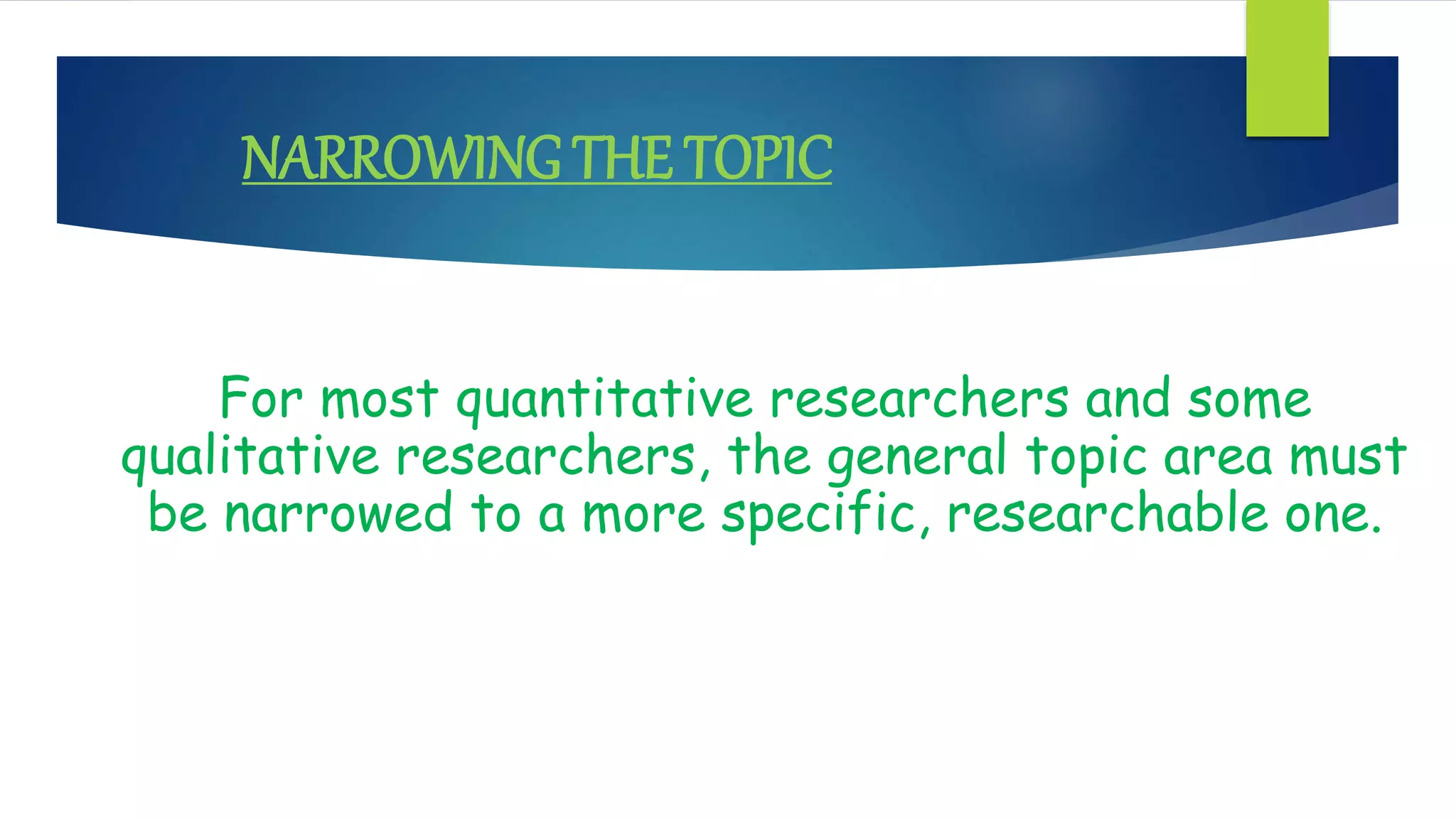
The four main sources of research topics are theories, personal
experiences, previous studies that can be replicated, and library
searches.
THEORIES
PERSONAL
EXPERIENCES
STUDIESTHATCANBE
REPLICATED
LIBRARY
RESEARCHES
ELECTRONIC
MAILINGLIST
THEORIES
“A theory is an organized body of concepts, generalizations, and
principles that can be investigated.”
Example:
Jean Piaget posited that children’s thinking develops in four stages.
Piaget described tasks and behaviors that children can and cannot do at
each stage. Whether aspects of Piaget’s theory operate as suggested is
a good basis for many possible research topics.
PERSONAL EXPERIENCES:
“A researcher’s personal experiences and concerns often lead to
useful and personally rewarding studies.”
Example:
Common questions, such as “Why does that happen?” and
“What would happen if . . . ?” can be rich topic sources.
STUDIES THAT CAN BE
REPLICATED:
“A replication is a repetition of a study using different subjects to
retest its hypothesis.”
Example:
A possible replication study may focus on how students’ use of
computers in classrooms affects their achievement, and the study may
extend original studies in the area by providing computers to children
who have not previously had access to such technology.
LIBRARY SEARCHES:
“Libraries are essential sources of information in the research
process, but the library is most useful to the researcher after a
topic has been narrowed. Then library resources can provide
information to place the topic in perspective, reveal what
researchers have already learned about the topic, and suggest
methods for carrying out a study,”
ELECTRONIC MAILING
LISTS:
Electronic mailing list services are designed by organizations to
facilitate communication (usually via the Internet) among their
members.
Example:
Examples of electronic mailing lists for educational topics include:
 American Educational Research Association List ( lists.asu.edu )
 AERA Division K Teaching and Teacher Education Forum (
lists.asu.edu )
NARROWING THE TOPIC
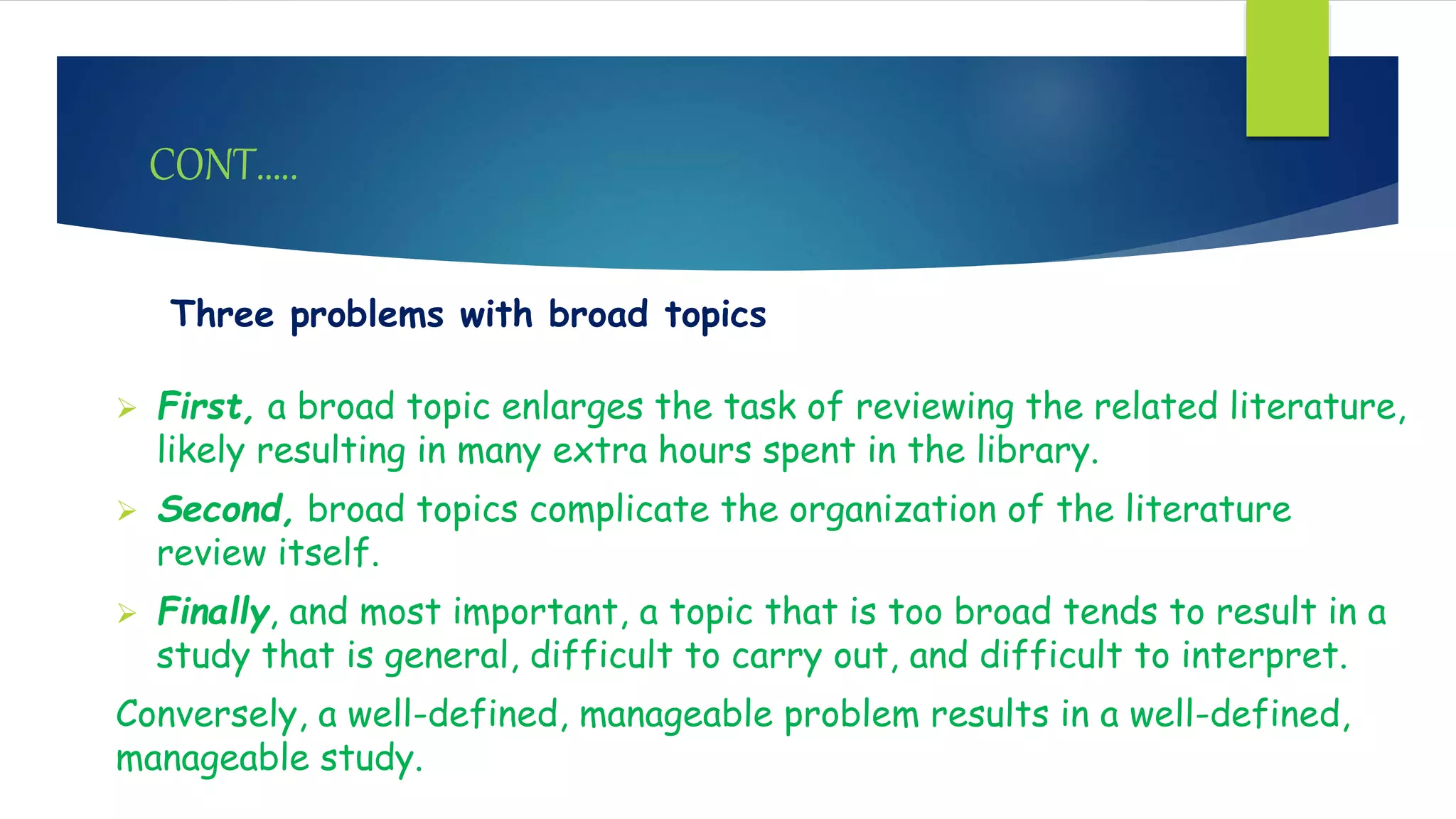
For most quantitative researchers and some
qualitative researchers, the general topic area must
be narrowed to a more specific, researchable one.
CONT…..
Three problems with broad topics
 First, a broad topic enlarges the task of reviewing the related literature,
likely resulting in many extra hours spent in the library.
 Second, broad topics complicate the organization of the literature
review itself.
 Finally, and most important, a topic that is too broad tends to result in a
study that is general, difficult to carry out, and difficult to interpret.
Conversely, a well-defined, manageable problem results in a well-defined,
manageable study.
CONT….
Suggestions for narrowing topics
 For ideas on narrowing your topic, you may begin by talking to your
faculty advisors and to specialists in your area to solicit specific
suggestions for study.
 You may also want to read sources that provide overviews of the current
status of research in your topic area and search through handbooks that
contain many chapters focused on research in a particular area.
 You can also check the Encyclopedia of Educational Research or journals
such as the Review of Educational Research, which provide reviews of
research in many areas.
CONT….
Quantitative and qualitative studies – differences in when a topic
is narrowed
 Quantitative studies tend to narrow the topic initially
 Qualitative research topics are not usually narrowed until
the researcher has more information about the participants
and their setting.
CHARACTERISTICS OF GOODTOPICS
A research topic, by definition, is an issue in need of
investigation, so it follows that a fundamental
characteristic of a good topic is that it is researchable and
of interest.
CONT…
Researchable topic:
 A researchable topic is one that can be
investigated through collecting and analyzing
data.
 A good research topic is that it has
theoretical or practical significance.
 A research topic has been conducted
ethically.
 Contribute to the educational processes
 Can be adequately researched given the
expertise, resources, and time constraints
of the researcher.
Non-researchable topics
 Address philosophical or ethical issues.
 Cannot be resolved through the
collection and analysis of data
 Address “should” questions.
 Ultimately these are matters of opinion
STATINGTHE RESEARCH TOPIC
Stating Quantitative Research
Topics
 A well-written topic
statement for a quantitative
study generally indicates the
variables of interest, the
specific relations among
those variables, and, ideally,
the characteristics of the
participants.
Stating Qualitative Research
Topics
 Qualitative research topics
usually are stated in general
language because qualitative
researchers need to become
attuned to the research
context before narrowing
their topic.
DEVELOPINGRESEARCH QUESTIONS
 Developing research questions breathes life into the research
topic statements.
 The research questions add another level of specificity to the
development of the research topic and provide the researcher
with an action plan for the development and identification of
research instruments.
FORMULATING AND STATING A HYPOTHESIS
“A hypothesis is a researcher’s prediction of the research
findings.”
Researchers do not set out to prove a hypothesis but rather collect
data that either support or do not support it.

Defining a research topic

  • 1.
    PRESENTED TO: MA’AM AMNA PRESENTEDBY: AMENAH GONDAL SAMEEN FATIMA CLASS: BS.ED VI EDUCATIONAL RESEAECH
  • 2.
  • 3.
  • 4.
    RESEARCH “A careful considerationof study regarding a particular concern or problem using scientific methods.” According to the American sociologist Earl Robert Babbie, “Research is a systematic inquiry to describe, explain, predict, and control the observed phenomenon. Research involves inductive and deductive methods.”
  • 5.
    THE RESEARCH TOPIC Aresearch topic focuses the study to a defined, manageable size.  The research topic (also called the research problem, or purpose) provides focus and structure for the steps in the scientific method.  A topic statement and a hypothesis are components of both a written research plan and research report.
  • 6.
    IDENTIFYING A RESEARCHTOPIC The first step in selecting a research topic is to identify a general subject area that is related to your area of expertise and is of particular interest to you. Remember, you will be spending a great deal of time reading about and working with your chosen topic. Having one that interests you will help you maintain focus during the months of conducting your study.
  • 7.
    SOURCES OF RESEARCHTOPICS Thefour main sources of research topics are theories, personal experiences, previous studies that can be replicated, and library searches. THEORIES PERSONAL EXPERIENCES STUDIESTHATCANBE REPLICATED LIBRARY RESEARCHES ELECTRONIC MAILINGLIST
  • 8.
    THEORIES “A theory isan organized body of concepts, generalizations, and principles that can be investigated.” Example: Jean Piaget posited that children’s thinking develops in four stages. Piaget described tasks and behaviors that children can and cannot do at each stage. Whether aspects of Piaget’s theory operate as suggested is a good basis for many possible research topics.
  • 9.
    PERSONAL EXPERIENCES: “A researcher’spersonal experiences and concerns often lead to useful and personally rewarding studies.” Example: Common questions, such as “Why does that happen?” and “What would happen if . . . ?” can be rich topic sources.
  • 10.
    STUDIES THAT CANBE REPLICATED: “A replication is a repetition of a study using different subjects to retest its hypothesis.” Example: A possible replication study may focus on how students’ use of computers in classrooms affects their achievement, and the study may extend original studies in the area by providing computers to children who have not previously had access to such technology.
  • 11.
    LIBRARY SEARCHES: “Libraries areessential sources of information in the research process, but the library is most useful to the researcher after a topic has been narrowed. Then library resources can provide information to place the topic in perspective, reveal what researchers have already learned about the topic, and suggest methods for carrying out a study,”
  • 12.
    ELECTRONIC MAILING LISTS: Electronic mailinglist services are designed by organizations to facilitate communication (usually via the Internet) among their members. Example: Examples of electronic mailing lists for educational topics include:  American Educational Research Association List ( lists.asu.edu )  AERA Division K Teaching and Teacher Education Forum ( lists.asu.edu )
  • 13.
    NARROWING THE TOPIC Formost quantitative researchers and some qualitative researchers, the general topic area must be narrowed to a more specific, researchable one.
  • 14.
    CONT….. Three problems withbroad topics  First, a broad topic enlarges the task of reviewing the related literature, likely resulting in many extra hours spent in the library.  Second, broad topics complicate the organization of the literature review itself.  Finally, and most important, a topic that is too broad tends to result in a study that is general, difficult to carry out, and difficult to interpret. Conversely, a well-defined, manageable problem results in a well-defined, manageable study.
  • 15.
    CONT…. Suggestions for narrowingtopics  For ideas on narrowing your topic, you may begin by talking to your faculty advisors and to specialists in your area to solicit specific suggestions for study.  You may also want to read sources that provide overviews of the current status of research in your topic area and search through handbooks that contain many chapters focused on research in a particular area.  You can also check the Encyclopedia of Educational Research or journals such as the Review of Educational Research, which provide reviews of research in many areas.
  • 16.
    CONT…. Quantitative and qualitativestudies – differences in when a topic is narrowed  Quantitative studies tend to narrow the topic initially  Qualitative research topics are not usually narrowed until the researcher has more information about the participants and their setting.
  • 17.
    CHARACTERISTICS OF GOODTOPICS Aresearch topic, by definition, is an issue in need of investigation, so it follows that a fundamental characteristic of a good topic is that it is researchable and of interest.
  • 18.
    CONT… Researchable topic:  Aresearchable topic is one that can be investigated through collecting and analyzing data.  A good research topic is that it has theoretical or practical significance.  A research topic has been conducted ethically.  Contribute to the educational processes  Can be adequately researched given the expertise, resources, and time constraints of the researcher. Non-researchable topics  Address philosophical or ethical issues.  Cannot be resolved through the collection and analysis of data  Address “should” questions.  Ultimately these are matters of opinion
  • 19.
    STATINGTHE RESEARCH TOPIC StatingQuantitative Research Topics  A well-written topic statement for a quantitative study generally indicates the variables of interest, the specific relations among those variables, and, ideally, the characteristics of the participants. Stating Qualitative Research Topics  Qualitative research topics usually are stated in general language because qualitative researchers need to become attuned to the research context before narrowing their topic.
  • 20.
    DEVELOPINGRESEARCH QUESTIONS  Developingresearch questions breathes life into the research topic statements.  The research questions add another level of specificity to the development of the research topic and provide the researcher with an action plan for the development and identification of research instruments.
  • 21.
    FORMULATING AND STATINGA HYPOTHESIS “A hypothesis is a researcher’s prediction of the research findings.” Researchers do not set out to prove a hypothesis but rather collect data that either support or do not support it.